
Call Us
+86 136 6007 9809
Call Us
+86 136 6007 9809

Jun. 13, 2024
Automotive Fastener Heat Treatment: Bolt Fatigue, Microstructure and OEM Quality Control
Automotive high-strength bolts must satisfy demanding mechanical requirements while operating in assemblies exposed to repeated loading,
vibration, temperature changes and environmental conditions.
For many carbon steel and alloy steel fasteners, heat treatment is an essential manufacturing operation used to achieve the required combination of strength, hardness, ductility and toughness.
However, heat treatment alone does not determine the fatigue life of a finished bolt.
A fastener may meet its specified tensile strength and hardness requirements yet remain vulnerable to fatigue cracking if the thread geometry, surface condition,
residual stresses or assembled joint design are unsuitable.
For automotive design engineers, understanding this distinction helps prevent inappropriate material or property-class substitutions.
For manufacturing engineers and production managers, it establishes the importance of consistent processing, inspection and traceability.
For OEM procurement and supplier-development teams, it clarifies which documents and test results are needed when qualifying high-strength automotive fasteners.
JUXIN FASTENERS supplies high-strength bolts, screws and drawing-based threaded components for automotive and industrial equipment applications.
This guide explains how automotive fastener heat treatment, microstructure, thread manufacturing and quality control
contribute to mechanical reliability and how OEM buyers can translate these requirements into effective RFQ specifications.
Why Heat Treatment Matters for Automotive Fasteners
High-strength steel fasteners are often required to meet specified mechanical property classes.
For applicable metric carbon steel and alloy steel bolts, screws and studs, ISO 898-1 establishes mechanical property requirements.
Heat treatment helps manufacturers obtain the material condition necessary to satisfy those requirements.
Depending on the fastener material and design, the process can influence:
Tensile strength
Proof-load performance
Hardness
Ductility
Toughness
Microstructural consistency
Surface integrity
These properties affect how a fastener responds to loading, but none should be considered independently of the complete joint.
Static Strength Is Not the Same as Fatigue Strength
Static tensile strength describes resistance to loading under defined test conditions.
Fatigue concerns damage that develops under repeated or fluctuating stresses.
A bolt can satisfy its static strength requirements and still fail under cyclic loading if the local stress conditions are sufficiently severe.
Fatigue performance depends on several interacting factors:
Thread-root geometry
Cyclic stress amplitude
Mean stress
Bolt preload
Joint stiffness
Material microstructure
Surface condition
Residual stresses
Manufacturing defects
Corrosion and operating environment
This is why automotive fastener qualification should distinguish material-property testing from application-specific fatigue validation.
How Quenching and Tempering Work
Quenching and tempering are commonly used to obtain specified mechanical properties in many high-strength steel fasteners.
The exact process depends on steel chemistry, section size, manufacturing route and the required properties.
Quenching
In a typical quench-and-temper route, the steel is heated under controlled conditions to develop the required austenitic structure and then cooled at an appropriate rate.
The cooling process can produce a hardened microstructure, including martensite where the material and conditions permit.
Important variables include:
Steel composition
Heating temperature
Holding time
Furnace atmosphere
Cooling medium
Cooling rate
Fastener geometry
Improper control can produce unacceptable property variation, distortion or cracking.
Tempering
Tempering follows hardening to adjust the microstructure and mechanical properties.
For many high-strength fasteners, the desired condition involves tempered martensite.
Tempering can reduce excessive brittleness and help achieve the specified balance of strength, ductility and toughness.
The resulting properties depend on the complete thermal cycle and material composition.
Engineering Consideration
Higher hardness is not automatically better. Excessive hardness or an unsuitable microstructure can increase susceptibility to certain failure mechanisms.
What Makes a Suitable Automotive Bolt Steel?
Steel selection should begin with the required fastener specification rather than a material name alone.
Potential materials used in appropriate fastener designs include boron steels and alloy steels.
Examples of material designations encountered in international supply chains include:
SAE 10B21
SAE 4140
JIS SCM435
These designations represent different material specifications and must not be treated as interchangeable without technical review.
The engineering evaluation should consider:
Chemical composition
Hardenability
Required section size
Manufacturing route
Heat treatment
Mechanical property class
Customer material specification
For a property class 10.9 fastener, the approved steel and processing route must together achieve the applicable mechanical requirements.
Material Selection vs. Property Class
A steel designation identifies a material specification.
A fastener property class identifies defined mechanical requirements.
They are related but not equivalent.
For example, specifying an alloy steel grade does not by itself establish that the finished fastener satisfies property class 10.9.
The finished product must conform to the applicable fastener requirements and any additional OEM specifications.
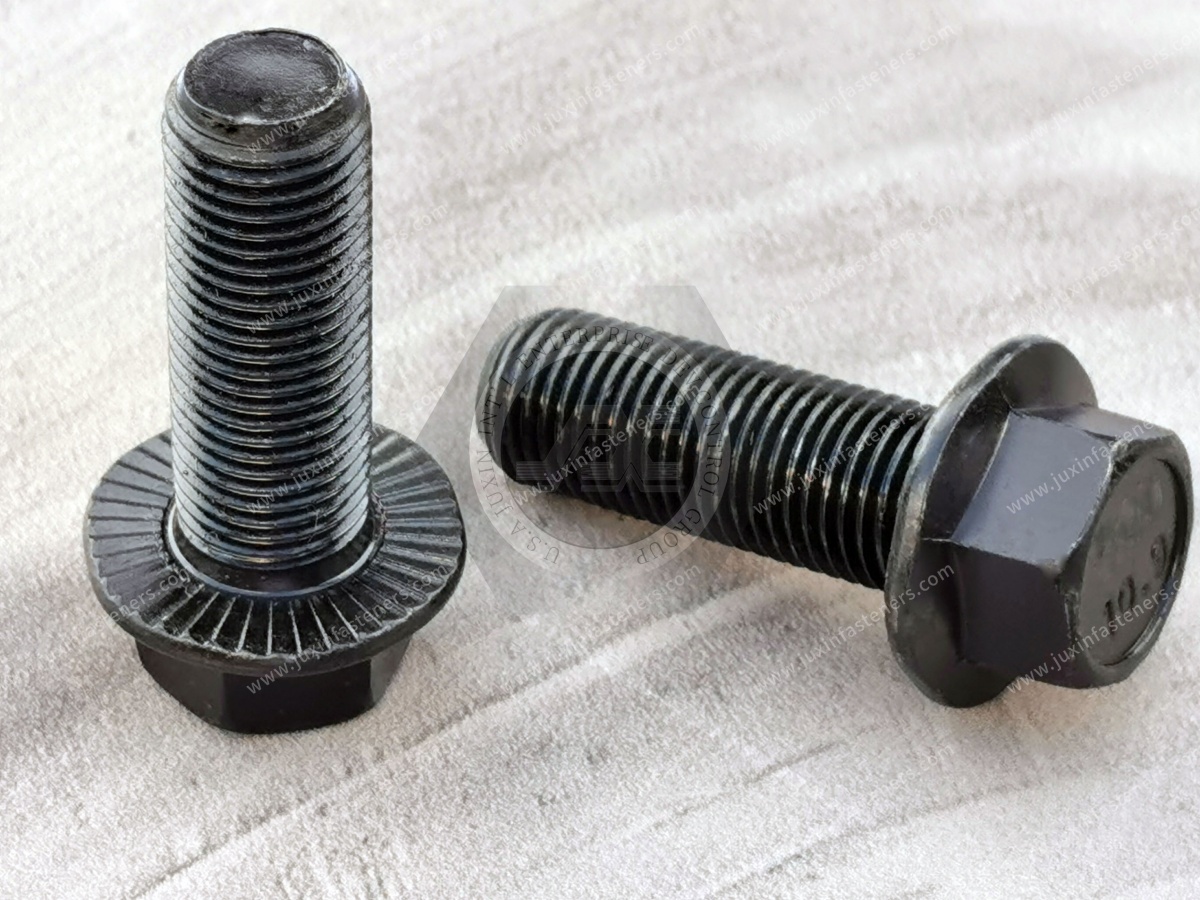
Property Class 8.8, 10.9 and 12.9: Heat Treatment Considerations
Metric steel fasteners may be specified in different mechanical property classes.
The appropriate class depends on the approved design.
| Property class | Nominal tensile-strength designation | Engineering consideration |
|---|---|---|
| 8.8 | 800 MPa | Mechanical properties must meet the applicable specification |
| 10.9 | 1,000 MPa | Higher-strength processing and verification requirements |
| 12.9 | 1,200 MPa | Careful control of material, processing and susceptibility to damage |
These values describe nominal class designations rather than the complete standard acceptance criteria.
A higher property class does not automatically provide greater fatigue durability.
Property class 12.9 should not replace 10.9 without approval of the complete joint design and relevant material and processing considerations.
Microstructure and Bolt Reliability
The internal microstructure of steel influences its mechanical behavior.
For quenched-and-tempered high-strength bolts, important considerations include:
Appropriate hardening response
Controlled tempering
Microstructural uniformity
Acceptable hardness distribution
Avoidance of detrimental processing defects
A properly controlled microstructure contributes to achieving specified properties.
However, a uniform tempered microstructure does not eliminate thread stress concentration, corrosion damage or inappropriate joint loading.
Decarburization: Why the Bolt Surface Matters
Decarburization involves the reduction of carbon content near the steel surface under certain thermal processing conditions.
It can change the local microstructure and hardness.
In threaded fasteners, surface conditions are especially important because the thread root is a potential location for high local stresses.
Excessive decarburization may adversely affect the intended mechanical performance.
Potential Effects
Reduced surface hardness
Changes in local mechanical behavior
Increased susceptibility to damage under certain loading conditions
Failure to satisfy applicable acceptance requirements
Manufacturing Controls
Relevant controls may include:
Furnace atmosphere
Heating temperature
Exposure time
Carbon potential where applicable
Material handling
Process verification
ISO 898-1 includes requirements relevant to decarburization and carburization for applicable fasteners.
The actual acceptance criteria should be taken from the relevant standard edition and customer specification.
Decarburization vs. Carburization
Decarburization reduces carbon near the surface.
Carburization increases carbon at the surface under suitable processing conditions.
Unintended carburization may also affect hardness and other properties.
Neither condition should be evaluated solely from the nominal bulk material composition.
Why Thread Roots Are Important in Fatigue
Bolt threads create geometric stress concentrations.
Under cyclic loading, local stresses near the thread root can be significantly different from nominal stresses calculated using the bolt's overall cross-section.
Potential fatigue crack initiation locations include:
Thread roots
Surface defects
Damaged threads
Abrupt geometry transitions
Areas affected by corrosion
The first highly loaded engaged threads may be particularly important depending on the joint geometry and load distribution.
Engineering Recommendation
Evaluate the actual thread geometry, loading and surface integrity rather than assuming that tensile strength alone determines fatigue life.
Thread Rolling and Fatigue Performance
Thread rolling is a forming process used to create threads by plastic deformation.
Compared with material-removal processes, thread rolling can influence surface finish, material flow and residual stress.
Under appropriate conditions, beneficial compressive residual stresses may improve fatigue behavior.
However, the result depends on:
Material condition
Rolling process
Thread geometry
Surface quality
Subsequent heat treatment
Finished fastener requirements
Thread Rolling Before or After Heat Treatment
The manufacturing sequence can influence residual stresses and process feasibility.
Rolling before heat treatment and rolling after heat treatment may produce different surface conditions.
Rolling hardened material also introduces tooling and process constraints.
Important Engineering Distinction
It is not correct to state that one sequence is universally superior for every automotive bolt.
The process must be qualified for the specific fastener and performance requirements.
Residual Stress and Fatigue
Residual stresses are stresses that remain in a component without an externally applied load.
Depending on their location and character, residual stresses can influence fatigue behavior.
Compressive residual stress at critical surfaces may be beneficial under certain loading conditions.
Tensile residual stress may be detrimental in some circumstances.
Engineering Limitation
Residual stress effects should not be assumed without an appropriate process history or validation.
Surface Discontinuities and Manufacturing Defects
Surface defects can reduce the effective reliability of a high-strength fastener.
Examples include:
Cracks
Folds
Seams
Laps
Thread damage
Heat-treatment-related defects
Applicable ISO 6157 requirements may be relevant to the evaluation of surface discontinuities for specified fastener types.
The exact applicable part and acceptance criteria must be confirmed.
Engineering Recommendation
Define surface-discontinuity acceptance requirements during supplier qualification rather than relying only on visual appearance.
Hardness Testing vs. Fatigue Testing
Hardness testing helps evaluate material response and conformity with specified mechanical requirements.
It does not directly establish fatigue life.
Similarly, tensile testing evaluates properties under defined loading conditions but cannot substitute for application-specific cyclic testing.
| Inspection or test | What it can help verify | What it does not independently prove |
|---|---|---|
| Chemical composition | Material chemistry | Finished fastener fatigue life |
| Hardness testing | Hardness conformity | Joint durability under vibration |
| Tensile testing | Defined tensile properties | Fatigue performance |
| Proof-load testing | Specified load-bearing behavior | Unlimited service life |
| Metallographic examination | Microstructure and selected surface conditions | Complete application reliability |
| Thread inspection | Dimensional thread conformity | Resistance to cyclic cracking |
| Fatigue testing | Behavior under specified cyclic test conditions | Performance under every vehicle service condition |
What Should an Automotive OEM Specify?
For an engineered high-strength bolt, the drawing and purchasing specification should establish the required product characteristics.
Potential requirements include:
Fastener dimensions
Thread designation
Mechanical property class
Material requirements
Heat-treatment-related requirements
Surface-discontinuity criteria
Surface treatment
Inspection requirements
Traceability
Application-specific validation
The required scope depends on the part's function and customer qualification system.
Hydrogen Embrittlement in High-Strength Bolts
Certain high-strength steel fasteners may be susceptible to hydrogen embrittlement.
Hydrogen may be introduced through relevant manufacturing, surface-treatment or environmental processes.
Susceptibility depends on factors such as:
Material strength
Hardness
Microstructure
Hydrogen exposure
Applied stress
Manufacturing and coating processes
This risk deserves particular attention when evaluating high-strength fasteners and certain coating routes.
Engineering Recommendation
Review the applicable material and process controls when specifying susceptible high-strength steel components.
Do not assume that heat treatment or a subsequent baking operation eliminates every hydrogen embrittlement risk.
Heat Treatment and Coating Are Different Engineering Controls
Heat treatment is used to develop material properties.
Surface treatment may provide corrosion protection and influence friction behavior.
These functions must be evaluated separately.
A coating cannot compensate for an incorrectly heat-treated bolt.
Likewise, a correctly heat-treated bolt may still require corrosion protection appropriate to the application.
Zinc Plating
Zinc plating may be specified for selected industrial and automotive fasteners.
Relevant considerations include:
Corrosion requirements
Coating thickness
Thread fit
Friction
Hydrogen embrittlement controls where applicable
Zinc-Nickel Coatings
Zinc-nickel coating systems may be selected for demanding corrosion environments.
Relevant considerations include:
Customer coating specification
Corrosion performance requirements
Coating thickness
Friction characteristics
Processing compatibility
Important Limitation
A zinc-nickel designation does not automatically establish a particular salt-spray result or friction coefficient.
Zinc-Flake Coatings
Zinc-flake systems may be considered for selected high-strength fasteners.
The complete coating system, including any topcoat, should be evaluated against the customer specification.
Black Oxide
Black oxide may be used where appearance and the specified surface condition are appropriate.
It should not automatically be treated as equivalent to a high-performance corrosion-protection system for exposed chassis components.
Automotive Chassis and Suspension Applications
Chassis fasteners may experience repeated service loads.
Potential applications include:
Suspension mounting joints
Subframe connections
Structural brackets
Steering-related mechanical assemblies
Engineering Considerations
Cyclic loading
Preload
Joint stiffness
Thread geometry
Corrosion
Material properties
Important Distinction
A bolt's heat-treatment condition must be compatible with its mechanical requirements, but fatigue durability must be assessed at the joint and application level.

EV Battery Pack and Lightweight Structural Applications
Electric vehicle structures may combine steel fasteners with aluminum components and other materials.
Applications may include selected:
Battery enclosure mounting joints
Structural brackets
Equipment supports
Mechanical mounting interfaces
Engineering Considerations
Thread strength
Joint preload
Material compatibility
Differential thermal expansion
Corrosion
Service access
Important Limitation
A high-strength heat-treated steel bolt cannot compensate for inadequate mating-thread strength in a softer structural material.
Weld Nuts and Other Automotive Threaded Components
Automotive assemblies may also incorporate weld nuts and other captive threaded components.
Their material and processing requirements depend on the intended manufacturing and joining method.
Engineering Considerations
Weldability
Thread integrity
Material compatibility
Heat-affected conditions
Dimensional requirements
Important Distinction
Heat-treatment recommendations for a property class 10.9 bolt should not automatically be applied to a weld nut or another threaded component with a different function.
Automotive Motor and Powertrain Applications
Motors, transmissions and other mechanical assemblies may require fasteners with controlled mechanical properties.
Relevant considerations include:
Dynamic loading
Temperature
Joint stiffness
Fatigue
Dimensional requirements
Assembly procedure
Fastener selection must reflect the approved equipment design.
Production Quality Control for Heat-Treated Fasteners
Manufacturing consistency requires control of the complete production route.
Depending on the product and supplier process, relevant stages may include:
Material identification
Forming or machining
Thread production
Heat treatment
Surface treatment
Final inspection
Packaging and traceability
Production managers should consider how changes in material lots, tooling, heat-treatment conditions or coating processes could affect the finished fastener.
Important Production Principle
Conformity depends on verified finished-product characteristics, not merely a statement that a heat-treatment operation was performed.
Common Heat-Treatment-Related Fastener Problems
| Observed problem | Potential contributing factor | Recommended investigation |
|---|---|---|
| Hardness below specification | Inadequate hardening or unsuitable tempering | Review material, process and test results |
| Excessive hardness | Inappropriate processing condition | Review heat-treatment parameters |
| Surface decarburization | Atmosphere or thermal exposure | Review surface examination and furnace controls |
| Quench cracking | Unsuitable hardening conditions or geometry | Review processing and defect location |
| Dimensional distortion | Thermal processing and part geometry | Review dimensional results and process sequence |
| Fatigue cracking | Cyclic loading, stress concentration or defects | Review joint design and fracture evidence |
| Delayed cracking | Possible hydrogen-related damage or other causes | Investigate material and process history |
| Batch variation | Material or process inconsistency | Review traceability and inspection records |
These are potential causes, not automatic diagnoses.
A reliable investigation may require fractography, metallography, mechanical testing and review of the actual operating conditions.
OEM Material Traceability and Inspection Documentation
Procurement teams should identify the required documentation before placing an order.
Depending on the customer specification, relevant records may include:
Material identification
Chemical composition results
Mechanical property reports
Hardness results
Dimensional inspection
Thread inspection
Surface-treatment documentation
Batch traceability
Where applicable, additional metallurgical or fatigue testing may be required.
Important Procurement Distinction
A material certificate is not automatically a fatigue-test report.
A hardness result is not automatically proof of complete heat-treatment conformity.
The required evidence must match the approved drawing and purchasing specification.
Supplier Qualification and Process Changes
Automotive OEMs and Tier-1/Tier-2 suppliers may require formal review when a manufacturer changes a critical production parameter.
Examples include changes to:
Steel specification
Material supplier
Heat-treatment route
Thread manufacturing process
Coating system
Production location
Critical tooling
The applicable change-control and approval requirements depend on the customer program.
Engineering Recommendation
Define these requirements during supplier qualification rather than waiting until a production change occurs.
Cost and Procurement Considerations
For high-strength automotive fasteners, the lowest unit price may not provide the lowest total sourcing cost.
Purchasing teams should consider:
Material availability
Manufacturing complexity
Heat-treatment requirements
Inspection scope
Coating specification
Production quantity
Lead time
Requalification cost
An alternative fastener should be evaluated against the approved engineering specification, not only its nominal diameter and property class.
Drawing-Based OEM Automotive Fastener RFQ
To evaluate a high-strength automotive fastener project, provide:
Approved 2D drawing
Application and joint function
Thread designation and pitch
Head geometry
Overall length and grip length
Mechanical property class
Material specification
Heat-treatment-related requirements
Surface-treatment specification
Inspection and documentation requirements
Sample quantity
Annual purchasing volume
Target delivery schedule
For safety-critical applications, include the relevant OEM qualification and production approval requirements.
Frequently Asked Questions
Why are automotive bolts heat treated?
Heat treatment is used to achieve specified material and mechanical properties in suitable steel fasteners.
Does heat treatment improve bolt fatigue strength?
It can influence fatigue-related material behavior, but fatigue performance also depends on thread geometry, residual stress, joint loading and surface condition.
What heat treatment is used for property class 10.9 bolts?
Quenching and tempering are commonly associated with many high-strength steel fastener manufacturing routes, subject to the applicable material and product specification.
Is a property class 12.9 bolt always more fatigue-resistant than a 10.9 bolt?
No. Higher static strength does not automatically establish better fatigue performance.
Why is decarburization important in threaded fasteners?
Excessive surface decarburization can change local hardness and mechanical behavior in critical areas.
Can thread rolling improve fatigue performance?
Under suitable conditions, thread rolling may produce beneficial surface characteristics and residual stresses, but the result depends on the manufacturing process.
Does hardness testing prove bolt fatigue life?
No. Hardness testing and fatigue testing evaluate different properties.
Can SAE 10B21 and SCM435 be directly substituted?
Not without verifying the material specification, required properties, manufacturing route and customer approval.
Does zinc-nickel coating guarantee corrosion resistance?
Performance depends on the specified coating system and test requirements. The designation alone does not establish a universal result.
What should automotive procurement teams request from a fastener supplier?
Approved drawing conformity, required material and mechanical property documentation, applicable inspection records, traceability and customer-specific qualification evidence.
JUXIN FASTENERS: High-Strength Automotive Fasteners and Drawing-Based OEM Components
JUXIN FASTENERS supplies high-strength bolts and threaded components for automotive and industrial equipment applications.
Relevant product families include:
Property class 8.8 bolts
Property class 10.9 bolts
Property class 12.9 screws
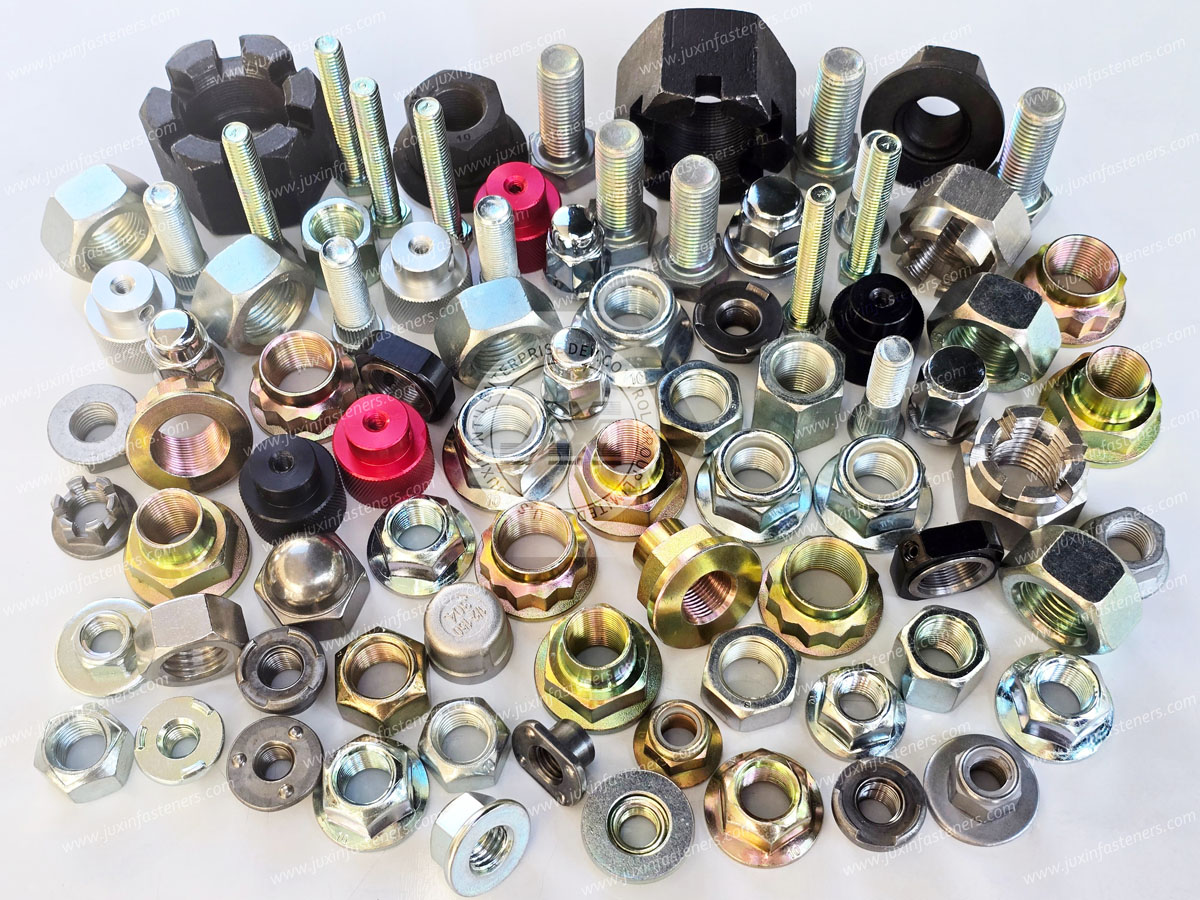
Hexagon head bolts
Hexagon flange bolts
Automotive locking nuts
Weld nuts
Custom threaded components
Drawing-based precision fasteners
Material selection, mechanical property requirements, heat-treatment-related specifications,
coating and inspection documentation are reviewed according to the customer's approved drawings and purchasing requirements.
Specific process availability and qualification scope should be confirmed for each project.
Request an Automotive High-Strength Fastener RFQ
Are you sourcing heat-treated high-strength bolts, property class 10.9 automotive fasteners or drawing-based threaded components for a new OEM program?
JUXIN FASTENERS welcomes inquiries from automotive OEMs, Tier-1 and Tier-2 suppliers, design engineers, manufacturing engineers, production managers and global procurement teams.
For efficient evaluation, provide:
Approved drawing + material + property class + thread specification + heat-treatment requirements + coating + inspection criteria + annual volume + delivery schedule
Our team can review suitable product requirements and discuss sample arrangements, manufacturing feasibility and commercial quotation details.
Company: JUXIN FASTENERS
Website: https://www.juxinfasteners.com/
Email: info@juxinfasteners.com
Send your automotive high-strength bolt drawings and OEM RFQ requirements to JUXIN FASTENERS for technical review and quotation.
Contact Us
Tel.:
+86 020 8621 0320
+86 020 3121 6067
E-mail:
Technical Support:
Navigation
SEND INQUIREY



