Call Us
+86 136 6007 9809
Call Us
+86 136 6007 9809

Nov. 09, 2023
Thin sheet metal creates a basic fastening problem: the parent material may not provide enough thickness for a durable tapped thread,
while the finished component may allow access from only one side.
A Flat Head Hex Rivet Nut solves both problems by combining:
Blind Installation + Reusable Internal Thread + Hexagonal Anti-Rotation Body + Large Front Bearing Surface
This combination makes flat head hex rivet nuts particularly useful where a conventional round-body rivet nut does
not provide the required rotational retention or where the front flange must distribute load over a larger area of the parent sheet.
JUXIN FASTENERS supplies flat head hex rivet nuts, hex blind rivet nuts, countersunk hex rivet nuts,
closed-end rivet nuts and custom threaded inserts for OEM applications in automotive and EV systems,
industrial machinery, electrical equipment, transportation, HVAC, telecommunications and fabricated sheet-metal assemblies.
The correct fastener, however, should not be selected by thread size alone.
For a reliable installed joint, engineers should evaluate:
Thread → Panel Material → Finished Thickness → Grip Range → Hex Hole → Head Geometry → Setting Parameters → Torque-Out → Axial Retention → Corrosion → Production Process
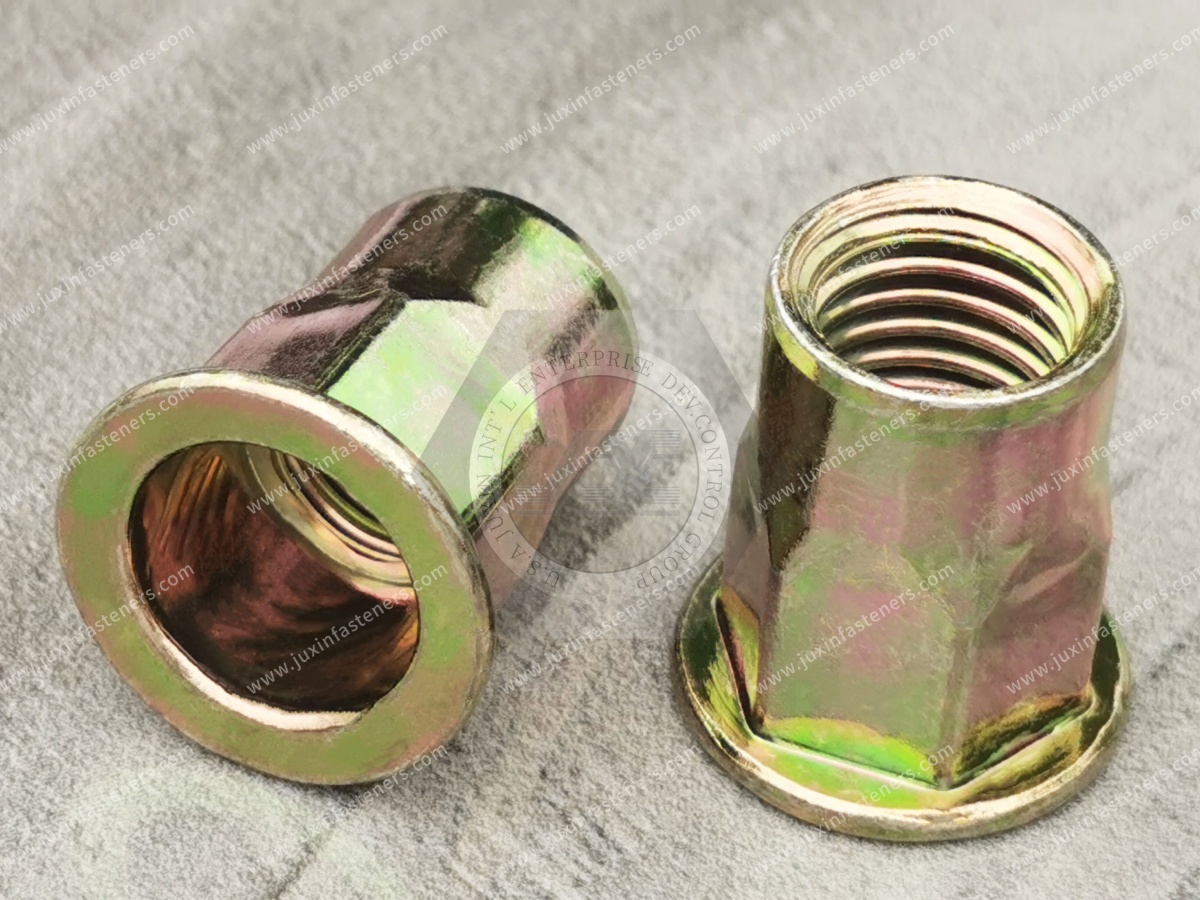
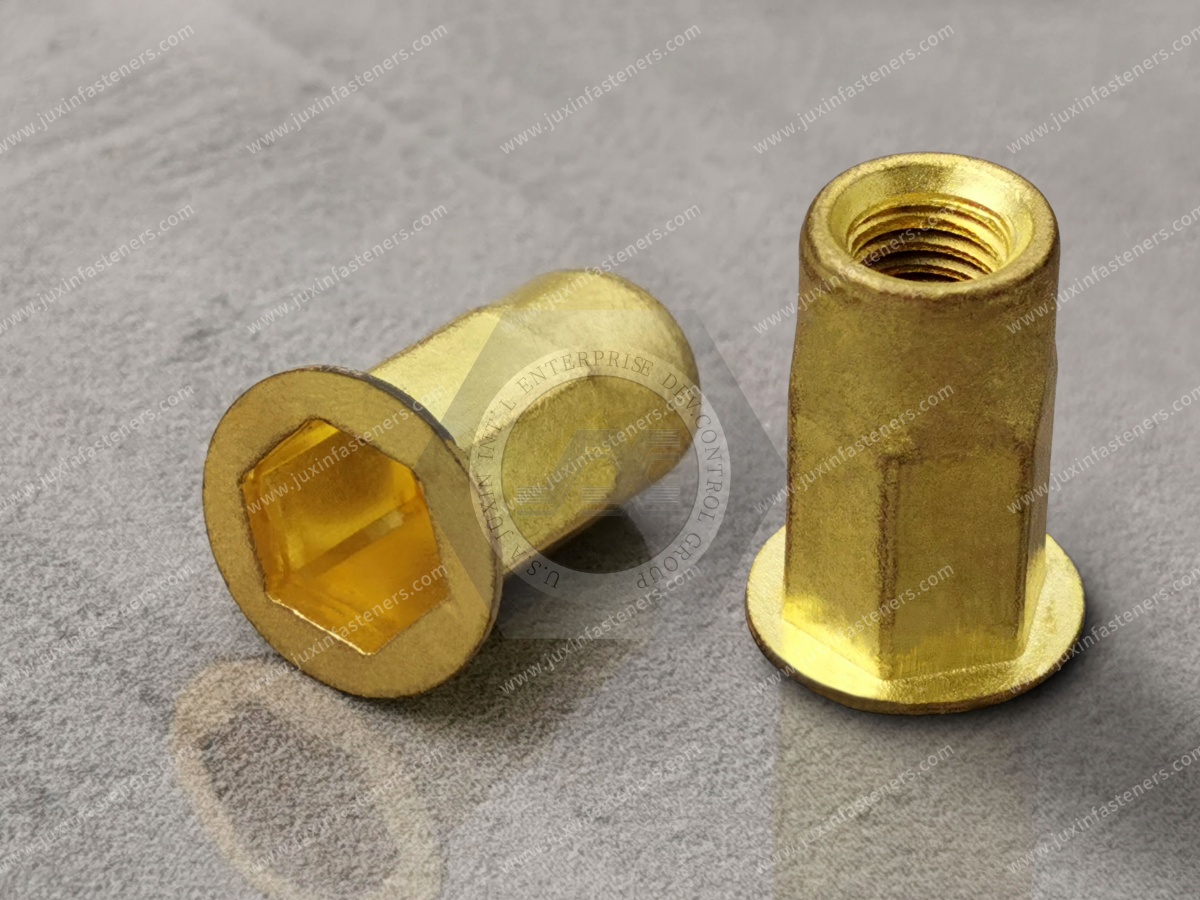
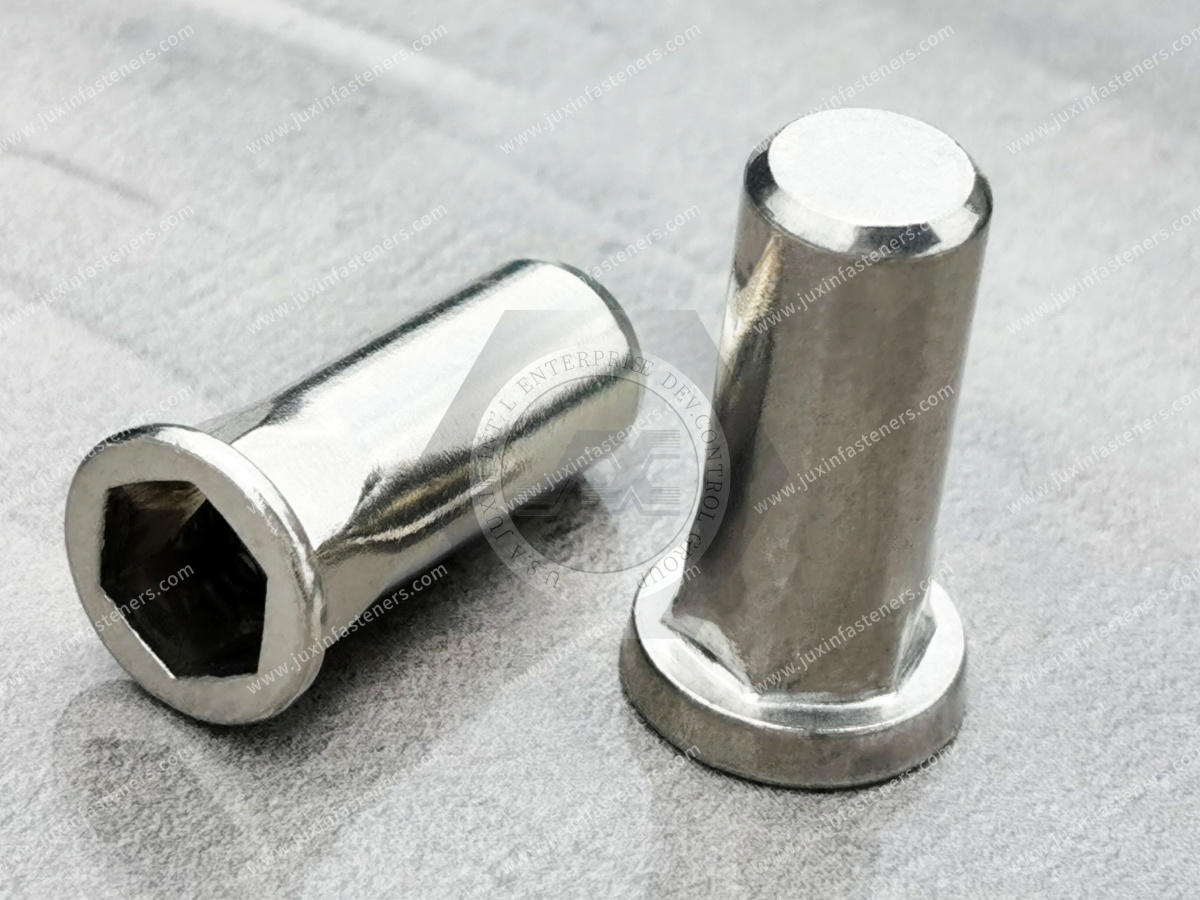
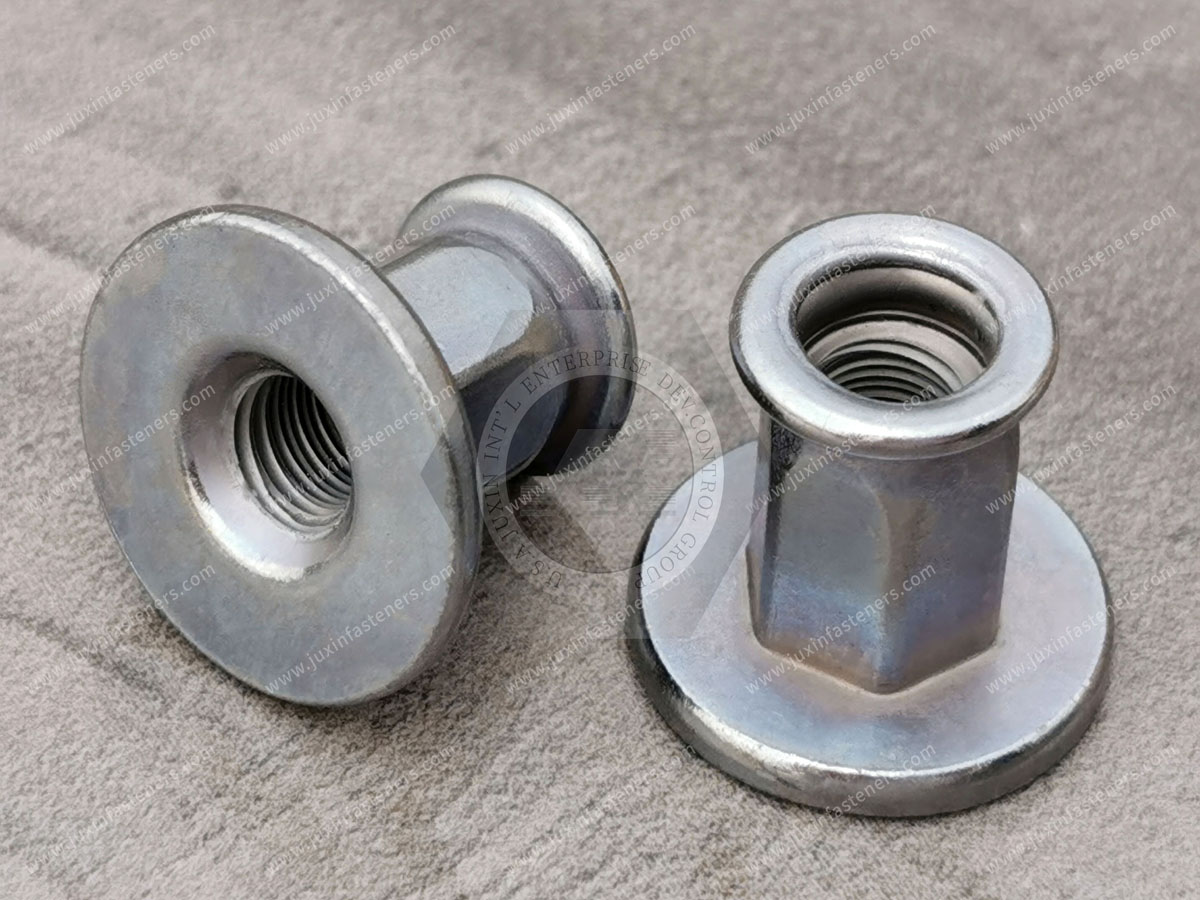
A flat head hex rivet nut, also called a flat head hexagonal blind rivet nut, hex rivnut, hex nutsert or hex-body threaded insert,
is a blind-installed internally threaded fastener with two important geometric features:
a hexagonal body that engages a matching non-round installation hole; and
a flat head or flange that remains on the accessible side of the panel.
During installation, the rivet nut is inserted into the prepared hex hole and engaged by a setting tool.
The controlled setting stroke or force deforms the designated section of the body behind the parent material.
The installed joint then relies on several interacting features:
Flat Head → Front-Side Bearing
Deformed Body → Rear-Side Retention
Hex Body + Hex Hole → Anti-Rotation
Internal Thread → Reusable Bolt Connection
This is why a flat head hex rivet nut should be considered as an installed fastening system, not merely as a threaded nut.
The principal engineering reason for selecting a hex body is positive geometric resistance to rotation.
A round rivet nut relies on the interaction between its body features, hole, parent material and installed deformation to resist spinning.
A hex rivet nut adds another mechanism:
Hex Body + Matching Hex Hole = Geometric Anti-Rotation
When torque is applied through the mating screw, the six-sided body mechanically engages the installation hole.
This can be particularly useful where the assembly experiences:
higher tightening torque;
repeated screw installation and removal;
service access;
vibration;
maintenance cycles;
risk of insert rotation in the parent material.
However, the word hex does not by itself guarantee a particular torque-out value.
Actual installed performance still depends on:
rivet nut geometry;
parent material;
panel thickness;
hex-hole dimensions;
grip range;
material combination;
setting condition;
installation-tool control.
For engineering validation, use the actual fastener and production panel.
The flat head performs a different function from the hex body.
The hex body primarily addresses rotational retention.
The flat head primarily provides a front-side bearing surface.
Compared with reduced-head or small-head configurations, a larger flat flange can provide:
greater front-side contact area;
better load distribution;
improved support on suitable thin-sheet applications;
positive front-side seating;
easier visual confirmation of flange seating.
This makes flat head hex rivet nuts useful when the design can accept head projection above the panel and a larger bearing surface is desirable.
The engineering trade-off is important:
Larger Bearing Surface ↔ Greater Front-Side Projection
If the assembly requires a nearly flush external surface, a countersunk or reduced-head hex rivet nut may be more appropriate.
These two products should not compete for the same engineering requirement.
| Design Requirement | Flat Head Hex Rivet Nut | Small Countersunk Hex Rivet Nut |
|---|---|---|
| Blind installation | Yes | Yes |
| Hex anti-rotation body | Yes | Yes |
| Large front bearing area | Major advantage | Reduced |
| Low surface projection | Not primary objective | Major advantage |
| Matching hex hole | Required for hex body | Required for hex body |
| Reusable internal thread | Yes | Yes |
| Typical design priority | Bearing support + anti-rotation | Low profile + anti-rotation |
The selection logic is therefore:
Need Anti-Rotation + Larger Front Bearing Surface?
→ Flat Head Hex Rivet Nut
Need Anti-Rotation + Low Front Projection?
→ Small Countersunk Hex Rivet Nut
This distinction prevents engineers and buyers from treating all hex rivet nuts as interchangeable.
A more useful comparison than simply calling one design “better” is to identify how each obtains rotational retention.
| Engineering Factor | Flat Head Hex Rivet Nut | Round Rivet Nut |
|---|---|---|
| Installation access | Blind / one side | Blind / one side |
| Installation hole | Hexagonal / non-round | Round |
| Anti-rotation mechanism | Positive geometric engagement plus installed deformation | Body/hole interaction and installed deformation |
| Hole production | More specialized | Simpler |
| High torque-out applications | Strong candidate | Depends strongly on body design and substrate |
| Production flexibility | Requires controlled hex hole | Round holes are generally easier to produce |
| Head options | Multiple | Multiple |
| Grip range selection | Required | Required |
A hex body can provide an important anti-rotation advantage, but it also introduces a manufacturing requirement:
the panel needs a suitable hexagonal hole.
Therefore, fastener performance and hole-production cost should be evaluated together.
One of the most common design mistakes is specifying a hex rivet nut without properly controlling the mating hole.
The hex hole influences:
fastener insertion;
rotational engagement;
alignment;
flange seating;
installation consistency;
final torque-out behavior.
If the hole is oversized, rotational clearance increases.
If the hole is undersized or distorted, the fastener may not seat correctly and its coating may be damaged during insertion.
The drawing should therefore define the installation hole based on the specific rivet nut geometry rather than using a generic nominal dimension.
For OEM production:
Rivet Nut Drawing + Hole Drawing + Panel Material + Panel Thickness
should be reviewed as one system.
The best hole-production process depends on:
panel material;
panel thickness;
production quantity;
tooling;
dimensional tolerance;
component geometry.
High-volume sheet-metal production may use punching or other controlled fabrication methods.
Prototype and lower-volume manufacturing may use different processes.
Whatever method is selected, engineers should control:
across-flat dimensions;
corner geometry;
burr condition;
distortion;
hole orientation where relevant;
coating buildup after finishing.
The objective is not simply to create a hole that “looks hexagonal.”
The objective is to produce repeatable geometry compatible with the specified rivet nut.
A flat head hex rivet nut is designed to install over a defined range of parent-material thicknesses.
This is the grip range.
Correct grip selection allows the deformable section of the rivet nut to form correctly behind the panel.
If the actual material stack is outside the intended grip range, the result can include:
incomplete deformation;
excessive deformation;
weak clamping;
panel distortion;
inconsistent seating;
poor rotational retention;
reduced axial retention.
Therefore:
M6 Thread Size Does Not Define an M6 Rivet Nut
Two M6 flat head hex rivet nuts can have different:
grip ranges;
body lengths;
head diameters;
hole requirements;
setting requirements.
Procurement teams should never approve substitution based only on thread designation.
The relevant thickness is the material condition at the actual installation location.
Engineers should consider whether the panel includes:
coatings;
stacked sheets;
local reinforcements;
formed geometry;
surface treatments;
other layers affecting the effective grip.
The production assembly should be reviewed rather than relying only on a nominal raw-sheet thickness.
Installation quality has a major influence on rivet nut performance.
Depending on the production equipment, setting may be controlled by parameters such as:
stroke;
force;
tool configuration;
mandrel engagement;
installation cycle.
Insufficient deformation may result in:
inadequate backside formation;
insufficient clamping;
reduced anti-rotation;
poor axial retention.
Excessive installation can cause:
thread damage;
body damage;
panel deformation;
flange distortion;
reduced joint consistency.
The correct production setting should be validated using the actual rivet nut and panel.
This distinction is important.
Bolt tightening torque is the torque applied when assembling the mating screw.
Torque-out resistance describes the installed rivet nut's resistance to rotating relative to the parent material under a defined test condition.
The two values are related to joint design but are not interchangeable.
An OEM drawing or validation plan should not simply state:
“High Torque.”
Instead, where performance is critical, define the relevant:
mating screw;
assembly torque;
installed fastener requirement;
test method;
acceptance criteria.
A hex rivet nut can provide strong resistance to rotation while axial retention remains a separate design consideration.
The installed fastener may experience:
rotational loading during screw tightening;
axial loading from the attached component;
vibration;
cyclic service loads;
maintenance-related loads.
Therefore:
High Anti-Rotation ≠ Unlimited Pull-Out Resistance
Where joint performance is critical, rotational and axial requirements should be evaluated separately.
The same rivet nut can behave differently when installed in:
low-carbon steel;
stainless steel;
aluminum;
high-strength sheet;
other compatible substrates.
Differences in material strength, hardness and ductility affect how the panel interacts with the fastener during installation and service.
For this reason:
Same Fastener + Different Parent Material ≠ Same Installed Joint
Prototype validation should reproduce the intended production material.
Steel is widely used where mechanical performance and production economics are important.
Depending on project requirements, surface protection may include:
zinc plating;
zinc-nickel plating;
zinc-flake coating systems;
other customer-specified finishes.
Coating selection should consider:
corrosion environment;
mating materials;
assembly requirements;
dimensional effects;
OEM specifications.
Stainless steel versions can be considered for environments requiring increased corrosion resistance.
Common options include 304-type and 316-type stainless steels depending on product design and application requirements.
Potential applications include:
outdoor equipment;
food-processing machinery;
transportation equipment;
chemical-processing equipment;
selected marine environments;
medical and laboratory equipment.
Stainless steel rivet nuts can require higher installation loads than comparable softer materials, so setting-tool capability should be verified.
Aluminum rivet nuts can support selected lightweight assemblies.
Potential applications include:
transportation equipment;
electronics;
lightweight fabricated structures;
selected aerospace-related assemblies subject to project qualification.
Material compatibility and galvanic corrosion should be considered when dissimilar metals are used.
Fastener weight alone should not determine material selection.
Flat head hex rivet nuts can provide reusable threaded attachment points in suitable automotive assemblies such as:
body brackets;
interior structures;
equipment mounts;
enclosed sections;
electrical assemblies;
selected battery-enclosure components.
The hex body can be valuable where service torque or repeated assembly creates a risk of insert rotation.
For EV battery applications, additional factors may include:
vibration;
corrosion;
sealing architecture;
electrical requirements;
thermal environment;
service strategy;
OEM validation requirements.
The rivet nut should be selected as part of the complete battery enclosure fastening system.
Rail vehicles contain numerous sheet-metal and fabricated assemblies requiring serviceable threaded attachment points.
Potential applications include:
interior panels;
lighting assemblies;
equipment cabinets;
toilet-module equipment;
electrical enclosures;
equipment brackets;
access panels.
Blind installation can be useful where the backside becomes inaccessible after fabrication.
Project-specific requirements for vibration, corrosion, traceability, maintenance and relevant rail material requirements should be reviewed separately.
Potential applications include:
machine guards;
access panels;
automation equipment;
machine covers;
control cabinets;
equipment frames.
A flat head hex rivet nut can be useful where equipment must be opened repeatedly for maintenance and rotational retention is important.
The large front flange can also provide useful bearing support on suitable panel designs.
Flat head hex rivet nuts can be used in:
electrical cabinets;
power-distribution equipment;
control systems;
telecommunications cabinets;
server equipment;
industrial electronics enclosures.
The design is particularly useful when:
the enclosure is already formed;
only one side can be accessed;
a reusable machine thread is needed;
anti-rotation is important during servicing.
For rack systems requiring positional float or easy field replacement, a cage nut may be a better architecture and should also be evaluated.
Possible applications include:
equipment covers;
access panels;
electrical compartments;
mounting brackets;
sheet-metal housings.
Engineers should compare the benefits of a hex rivet nut against the additional manufacturing cost of producing a controlled hex hole.
For low-torque applications, a round-body rivet nut may sometimes provide a more economical solution.
Flat head hex rivet nuts may be used in suitable:
equipment enclosures;
service panels;
machinery guards;
operator compartments;
electrical housings;
fabricated metal components.
For heavy structural load paths, the joint should be engineered according to the actual load and applicable structural requirements rather than assuming that a rivet nut is a substitute for a structural bolted connection.
This configuration becomes a strong candidate when several requirements occur together:
One-Side Installation Required
Reusable Internal Thread Required
High Anti-Rotation Requirement
Panel Can Accept a Hex Hole
Front Surface Can Accept a Flat Flange
Larger Bearing Surface Is Beneficial
If one of these conditions changes, another rivet nut design may be more appropriate.
More features do not automatically mean a better fastening solution.
Consider another design when:
A round-body rivet nut may simplify hole production.
Consider a countersunk or small countersunk rivet nut.
Evaluate round-body or knurled-body rivet nuts.
Evaluate a closed-end rivet nut and the complete sealing architecture.
A self-clinching nut may also deserve evaluation.
A cage nut may be more appropriate.
This prevents overengineering and helps reduce total installed cost.
| Engineering Requirement | Feature to Evaluate |
|---|---|
| One-side access | Blind rivet nut architecture |
| High anti-rotation | Hex body |
| Larger front bearing surface | Flat head / large flange |
| Low front projection | Countersunk or reduced head |
| Environmental closure | Closed-end design |
| Thick or variable material stack | Correct grip-range selection |
| Corrosive environment | Material + surface treatment |
| Frequent maintenance | Torque-out + thread durability |
| High-volume production | Hole process + installation automation |
| Lightweight assembly | Material + total joint performance |
This selection logic is more useful than choosing by product name alone.
Understanding potential failure modes improves specification quality.
Possible causes include:
incorrect hole dimensions;
poor hex-hole geometry;
insufficient setting;
wrong grip range;
unsuitable substrate;
excessive service torque.
Possible causes include:
incorrect grip range;
insufficient backside deformation;
weak or damaged parent material;
excessive axial loading;
improper installation.
Possible causes include:
excessive setting;
insufficient panel support;
unsuitable panel thickness;
incorrect fastener geometry.
Possible causes include:
excessive setting;
incorrect installation mandrel engagement;
thread contamination;
cross-threading;
incompatible mating screw.
Failure analysis should examine the fastener + hole + panel + setting process, not the fastener alone.
For critical applications, prototype testing should use:
Production Rivet Nut
Actual Parent Material
Production Hole Geometry
Actual Surface Condition
Production Installation Tool and Parameters
Specified Mating Bolt
Depending on the project, validation may include:
installation consistency;
visual seating;
thread inspection;
torque-out;
axial retention;
panel deformation;
mating screw assembly;
corrosion testing;
vibration testing;
application-specific durability.
A loose fastener dimensional inspection cannot demonstrate complete installed-joint performance.
A professional flat head hex rivet nut specification should consider:
internal thread size;
pitch or TPI;
thread tolerance;
flat-head dimensions;
hex-body dimensions;
body length;
grip range;
installation-hole dimensions;
parent material;
finished panel thickness;
rivet nut material;
surface treatment;
dimensional tolerances;
installed projection where critical;
inspection requirements;
customer-specific performance requirements.
Where an international thread or material standard applies, reference the appropriate ISO, DIN, EN, ASTM, SAE or ASME/ANSI specification as required by the project.
Do not specify the component only as:
“M6 Flat Head Hex Rivet Nut.”
That is not enough information to control the installed joint.
This is particularly important for supplier development.
Two suppliers may both quote an:
M6 Flat Head Hex Rivet Nut
while offering different:
grip ranges;
hex dimensions;
hole requirements;
head diameters;
body lengths;
materials;
coatings;
setting characteristics.
A replacement component should therefore be checked against:
Drawing + Installation Hole + Grip Range + Panel + Tooling + Required Performance
before supplier substitution is approved.
Hex rivet nuts can provide excellent anti-rotation performance, but they require a non-round installation hole.
Procurement teams should therefore compare:
Fastener Price
Hex Hole Production
Tooling
Installation Cycle
Inspection
Rework Risk
Service Requirements
A lower fastener unit price does not necessarily create the lowest assembled cost.
Likewise, a more expensive hex rivet nut can be economically justified if it solves a genuine anti-rotation problem and reduces downstream failures.
For faster technical review and quotation, provide:
drawing or existing part number;
thread size;
pitch or TPI;
thread tolerance if specified;
flat-head dimensions;
hex-body dimensions;
grip range;
parent material;
finished panel thickness;
installation-hole dimensions;
rivet nut material;
surface treatment;
mating screw specification;
assembly torque where relevant;
application environment;
installation equipment;
prototype quantity;
annual production quantity;
inspection requirements;
documentation requirements;
packaging requirements.
If the rivet nut has not yet been selected, send the assembly drawing and application requirements rather than guessing a fastener size.
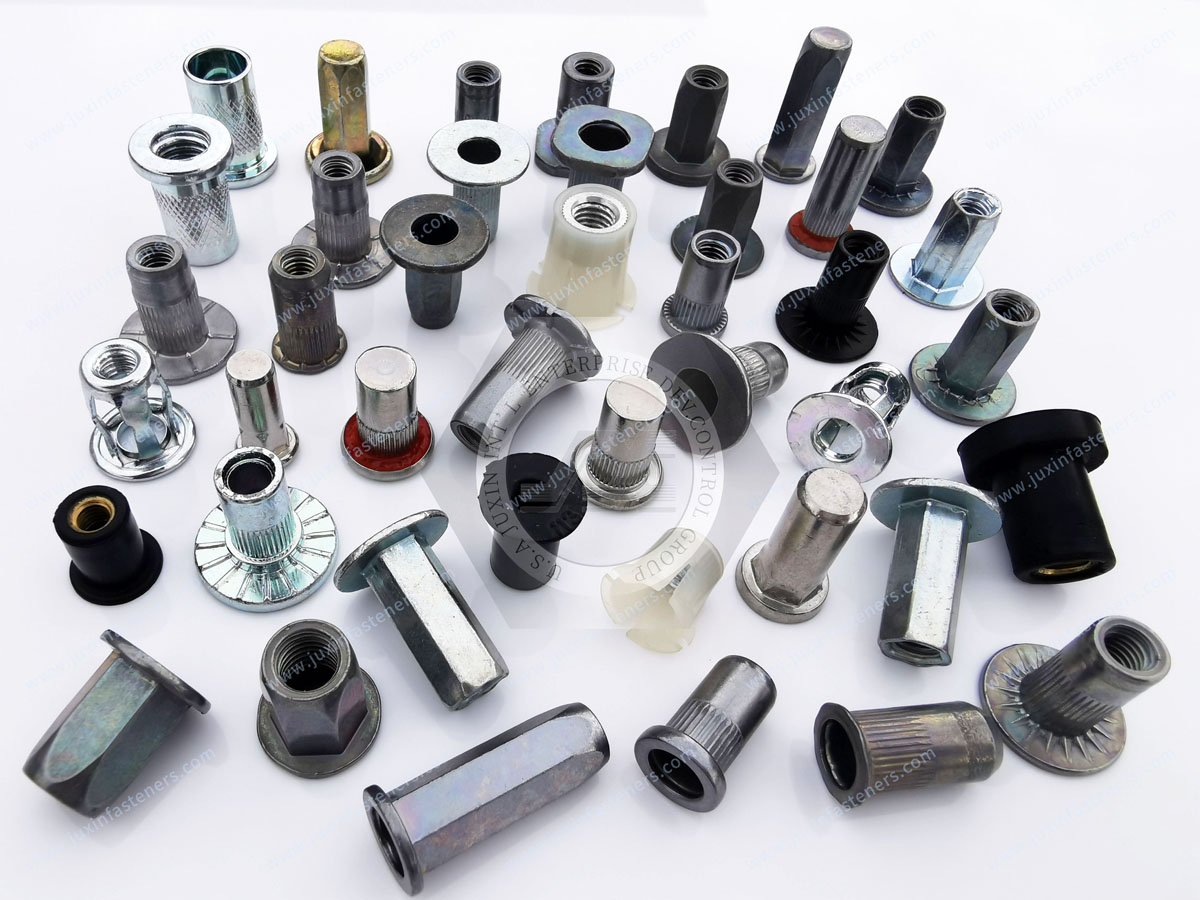
JUXIN FASTENERS supplies fastening solutions for OEM and industrial customers requiring:
flat head hex rivet nuts;
hex blind rivet nuts;
full-hex and other hex-body configurations;
countersunk hex rivet nuts;
closed-end rivet nuts;
round and knurled rivet nuts;
stainless steel rivet nuts;
steel rivet nuts;
aluminum rivet nuts;
custom threaded inserts.
Support can include:
drawing review;
dimensional customization;
material selection;
surface-treatment options;
prototype development;
production supply;
dimensional inspection;
customer-specific packaging and documentation requirements.
For custom projects, manufacturing feasibility and final specifications are reviewed against the customer's drawing and application requirements.
This page should be positioned as the Flat Head Hex Rivet Nut / Large Bearing Surface + Anti-Rotation page within the rivet nut cluster.
Link internally to:
Blind Rivet Nut Selection Guide — Article 6
for overall blind rivet nut selection.
Hex Rivet Nuts — Article 7
for the broader anti-rotation / hex-body engineering guide.
Small Countersunk Rivet Nuts — Article 8
when low front projection is more important than maximum flange bearing area.
Small Countersunk Hex Rivet Nuts — Article 9
when both low profile and strong geometric anti-rotation are required.
Closed-End Rivet Nuts — Article 10
for closed-bottom and environmental-protection requirements.
Rivet Nut vs Self-Clinching Nut — Article 11
when the engineering team has not yet decided which captive-thread technology to use.
Also connect to relevant product and industry pages for:
Blind Rivet Nuts;
Threaded Inserts;
Self-Clinching Fasteners;
Cage Nuts;
Weld Nuts;
Automotive Fasteners;
EV Battery Fasteners;
Rail Transportation Fasteners;
Electrical Enclosure Fasteners;
Industrial Machinery Fasteners.
The resulting search path becomes:
Need Thread in Thin Sheet
→ Need Blind Installation
→ Need High Anti-Rotation
→ Hex Rivet Nut
→ Need Larger Front Bearing Area
→ Flat Head Hex Rivet Nut
→ Drawing / Specification / RFQ
This creates a clear product relationship for Google, GEO systems and AI search engines while preventing this page from simply duplicating the general Hex Rivet Nut page.
If your engineering or procurement team is sourcing a flat head hex rivet nut, hex blind rivet nut,
hex rivnut or custom anti-rotation threaded insert, send JUXIN FASTENERS your drawing or application requirements.
For faster review, provide:
Thread + Panel Material + Finished Thickness + Grip Range + Hex Hole + Head Requirement + Material + Surface Treatment
+ Assembly Torque / Performance Requirement + Annual Quantity
If you are unsure whether a flat head hex, countersunk hex, round-body rivet nut or self-clinching fastener
is the appropriate architecture, provide the assembly drawing and installation conditions for review.
JUXIN FASTENERS
Website: www.juxinfasteners.com
Email: info@juxinfasteners.com
Contact Us
Tel.:
+86 020 8621 0320
+86 020 3121 6067
E-mail:
Technical Support:
Navigation
SEND INQUIREY