Call Us
+86 136 6007 9809
Call Us
+86 136 6007 9809

Nov. 09, 2023
When a threaded attachment must be added to thin sheet, tubing or an enclosed structure,
a blind rivet nut can create a reusable internal thread without requiring access to the back of the assembly.
But applications with limited front-side clearance create another design question:
How much rivet nut head can the assembly tolerate above the panel surface?
This is where small countersunk head rivet nuts and larger countersunk head rivet nuts become relevant.
Both can provide blind installation and reusable internal threads, but they should not be selected simply because one head is smaller than the other.
The engineering decision involves:
Installed Projection + Head Geometry + Panel Preparation + Bearing Area + Parent Material + Grip Range + Hole + Setting + Required Joint Performance
JUXIN FASTENERS supplies small countersunk rivet nuts, countersunk blind rivet nuts, hex rivet nuts, flat head rivet nuts,
closed-end rivet nuts and custom threaded inserts for OEM applications in automotive and EV systems, industrial machinery, electronics, electrical enclosures, transportation, HVAC and fabricated sheet-metal assemblies.
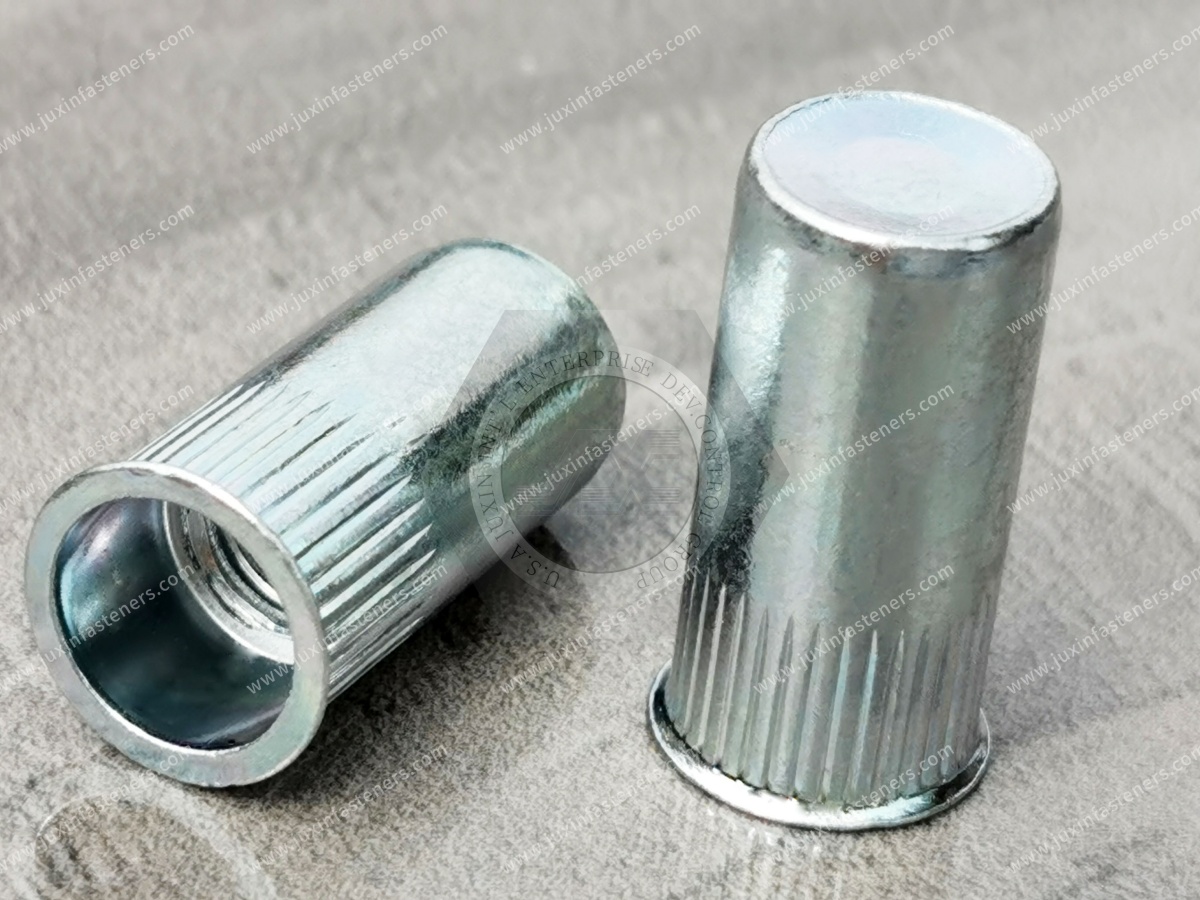
A small countersunk head rivet nut, also described as a small-head countersunk blind rivet nut,
low-profile rivet nut or countersunk threaded insert, is a blind-installed threaded fastener designed to minimize the amount of head material projecting above the accessible side of the workpiece.
During installation:
the rivet nut is inserted into a correctly prepared hole;
the setting tool engages the internal thread;
controlled setting force or stroke deforms the designated body section behind the parent material;
the installed fastener creates a captive reusable thread.
The basic installed architecture is:
Countersunk / Reduced Head → Front-Side Seating
Deformed Body → Rear-Side Mechanical Retention
Body-to-Hole Interface → Rotational Retention
Internal Thread → Reusable Screw Connection
Its main design objective is therefore not simply “small size.”
It is:
Reduced Front-Side Projection While Maintaining a Functional Blind Threaded Connection
No.
This is an important engineering distinction.
The terms countersunk, small countersunk, reduced head and low profile describe fastener geometry,
but they should not automatically be interpreted as a guarantee that the installed head will be perfectly flush with every panel.
Final projection depends on factors including:
actual head geometry;
panel preparation;
panel thickness;
installation-hole condition;
parent material;
setting condition;
dimensional tolerances.
If a component requires a specific maximum installed projection, the drawing should define that requirement dimensionally.
Do not specify only:
“Must Be Flush.”
Instead define the allowable installed condition.
The correct comparison is not simply:
Small = Light Duty
and
Large = Heavy Duty
Head size changes the front-side interface, but complete joint performance also depends on the rivet nut body, grip range, material, substrate, hole and installation process.
| Engineering Factor | Small Countersunk Head | Larger Countersunk Head |
|---|---|---|
| Front-side projection | Lower-profile objective | Generally greater head envelope |
| Front bearing area | Smaller | Larger |
| Clearance around assembly | Major advantage | Requires more available area |
| Appearance | Compact | More visible head geometry |
| Parent-sheet support | Depends on design | Larger head may provide greater front bearing area |
| Blind installation | Yes | Yes |
| Grip range | Product-specific | Product-specific |
| Axial retention | Must be validated as installed | Must be validated as installed |
| Torque resistance | Depends on body/hole/system | Depends on body/hole/system |
| Best use | Clearance-sensitive assemblies | Applications benefiting from greater head support |
A larger head should therefore not automatically be described as having a specific higher pull-out capacity without comparing the actual fasteners and installed test conditions.
Head selection creates an engineering trade-off.
A smaller head can help reduce:
interference with mating components;
visible projection;
required front-side envelope;
obstruction around adjacent hardware.
A larger head can provide:
more front-side bearing area;
greater support over the parent material;
a larger seating interface.
The correct decision depends on the panel and assembly.
This can be expressed as:
Lower Profile ← Head Selection → Greater Bearing Area
Neither end of the trade-off is automatically better.
Low-profile rivet nuts are particularly useful where the front surface interfaces with another component.
Examples include:
covers;
trim panels;
sliding components;
close-fitting brackets;
equipment housings;
electrical enclosure panels;
automotive interior components;
machinery guards;
compact electronic assemblies.
In these applications, excessive head projection may create:
interference;
assembly gaps;
cosmetic problems;
reduced clearance;
difficulty positioning another component.
The engineering requirement should therefore be based on actual available space rather than simply specifying “countersunk.”
This distinction is essential.
The head determines the front-side interface.
The body contributes to:
hole engagement;
deformation behavior;
anti-rotation;
grip-range performance.
A countersunk rivet nut can therefore be available with different body configurations depending on the product family.
Examples may include:
round body;
knurled body;
hex body.
This creates different engineering combinations.
For example:
Small Countersunk + Round Body
→ Low-profile blind thread with relatively simple round-hole preparation.
Small Countersunk + Hex Body
→ Low-profile blind thread plus positive geometric anti-rotation.
The application requirement should determine the combination.
This is particularly important within the JUXIN rivet nut content cluster.
| Requirement | Round Body | Hex Body |
|---|---|---|
| Blind installation | Yes | Yes |
| Low-profile head available | Yes | Yes |
| Hole geometry | Round | Matching hex/non-round |
| Hole manufacturing | Generally simpler | More specialized |
| Anti-rotation mechanism | Body/hole interaction after setting | Positive geometric engagement plus installed deformation |
| High torque-out requirement | Depends on design and substrate | Strong candidate |
| Production cost | Hole production may be simpler | Hex-hole process must be considered |
Therefore:
Need Low Profile Only?
→ Evaluate small countersunk round-body designs.
Need Low Profile + Strong Geometric Anti-Rotation?
→ Evaluate small countersunk hex rivet nuts.
This keeps this page separate from the dedicated Small Countersunk Hex Rivet Nut engineering page.
Every rivet nut is designed around a specific range of material thicknesses.
This is the grip range.
Correct grip range helps the deformable section form properly behind the workpiece during installation.
If the actual panel thickness is outside the intended range, potential problems include:
incomplete backside deformation;
excessive deformation;
poor clamping;
panel distortion;
inconsistent seating;
reduced rotational retention;
reduced axial retention.
Therefore:
Thread Size + Head Style Is Not Enough to Specify a Rivet Nut
An M6 small countersunk rivet nut may exist in multiple body lengths and grip ranges.
Engineers should evaluate the actual production condition at the installation point.
Depending on the assembly, this may involve:
coating;
stacked material;
local reinforcement;
formed geometry;
additional layers.
The correct fastener should be selected against the finished installation stack rather than relying only on the nominal raw-sheet specification.
The installation hole affects:
insertion;
alignment;
rotational retention;
flange seating;
setting consistency;
installed performance.
An oversized hole can reduce body-to-hole engagement.
An undersized hole can:
prevent correct insertion;
damage protective coatings;
interfere with proper seating.
Hole requirements should therefore be based on the selected rivet nut drawing or validated installation specification.
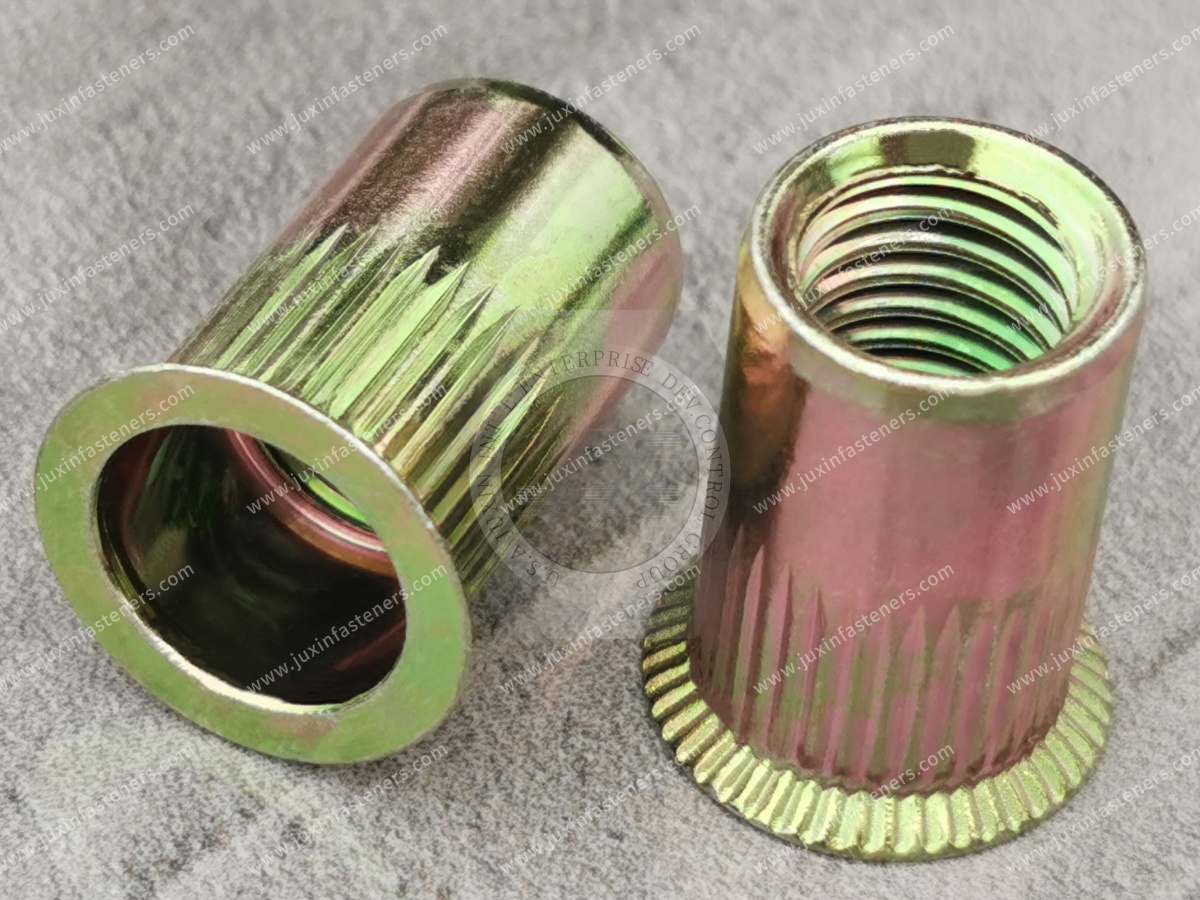
Not every product described commercially as a countersunk rivet nut uses exactly the same head geometry or panel preparation.
The required installation condition must therefore be taken from the specific product design.
Depending on the selected fastener, the panel may require particular hole or seating geometry to achieve the intended installed profile.
Engineers should not assume that a standard cylindrical hole will automatically produce a perfectly flush installed condition.
The safest specification path is:
Fastener Drawing → Required Panel Preparation → Installed Projection Requirement
Creating additional countersink geometry in a thin panel can remove or displace material around the hole.
That can influence:
local support;
sheet stiffness;
seating;
deformation during setting.
Therefore, achieving the lowest possible head projection should not be treated as the only design objective.
The joint still needs sufficient parent material around the fastener.
This is especially important in very thin sheet.
Small-head rivet nuts are installed using controlled deformation.
Depending on the equipment, the production process may control parameters such as:
stroke;
force;
tool setup;
mandrel engagement;
installation cycle.
Potential consequences include:
incomplete backside deformation;
inadequate clamping;
reduced anti-rotation;
inconsistent seating.
Potential consequences include:
panel distortion;
rivet nut body damage;
thread damage;
head or seating distortion.
Production settings should be validated with the actual fastener and panel.
A common oversimplification is:
Small Head = Weak
That conclusion cannot be made from head diameter alone.
Installed joint performance depends on the complete system:
Head Geometry + Body Geometry + Material + Grip Range + Parent Sheet + Hole + Setting + Loading Direction
Likewise:
Large Head = Strong
is also too simplistic.
A larger head may improve front-side bearing support, but torque-out and axial retention must still be evaluated for the actual fastener and substrate.
A rivet nut can experience several different service loads.
Occurs primarily when the mating screw is tightened or removed.
Relevant concerns include:
rivet nut spinning;
hole deformation;
body-to-panel engagement.
Occurs when the attached component loads the threaded insert along the fastener axis.
Relevant concerns can include:
rivet nut displacement;
parent-sheet deformation;
failure of the formed backside section.
Therefore:
Good Torque Resistance ≠ Automatically Good Axial Retention
Both should be reviewed when the application demands them.
JUXIN FASTENERS supplies countersunk rivet nut solutions in materials selected according to product design and application requirements.
Steel provides a practical combination of mechanical performance and production economics for many OEM applications.
Possible surface protection can include:
zinc plating;
zinc-nickel plating;
zinc-flake coating systems;
customer-specified finishes.
Selection should consider the required corrosion environment and dimensional effects of the coating.
304-type and 316-type stainless steels can be considered for applications requiring increased corrosion resistance.
Potential applications include:
outdoor equipment;
food-processing machinery;
transportation equipment;
selected marine environments;
medical and laboratory equipment;
chemical-processing equipment.
Installation-tool capacity should be reviewed because stainless rivet nuts may require greater setting loads.
Aluminum rivet nuts can be used in selected lightweight applications.
Potential applications include:
transportation equipment;
electronics;
aluminum structures;
weight-sensitive assemblies.
Where dissimilar metals are combined, galvanic compatibility and the actual service environment should be evaluated.
Small countersunk rivet nuts can provide low-profile reusable threaded attachment points in suitable:
interior panels;
trim assemblies;
brackets;
equipment mounts;
electrical assemblies;
selected battery-system components.
Low head projection can be useful where another component must sit close to the panel.
For EV battery assemblies, additional design considerations may include:
vibration;
sealing;
corrosion;
electrical requirements;
service access;
thermal environment;
OEM validation requirements.
The rivet nut should be evaluated as part of the complete enclosure or mounting system.
Typical applications include:
control boxes;
communication equipment;
industrial electronics;
power-distribution equipment;
server equipment;
instrumentation housings.
A low-profile head can help where clearance between panels and internal components is limited.
However, if the enclosure is produced from very thin material, the engineer should balance low projection against adequate panel support.
Compact sheet-metal assemblies in data center and telecommunications equipment may require:
reusable threads;
one-side installation;
low front projection;
repeated service access.
Possible applications include:
server chassis;
telecommunications cabinets;
equipment trays;
control enclosures;
mounting panels.
If positional float or rapid field replacement is more important, a cage nut should also be evaluated.
Small countersunk rivet nuts may be used in:
machine covers;
protective guards;
control cabinets;
automation housings;
access panels;
equipment enclosures.
The low-profile head can reduce interference with moving or closely fitted components.
Where maintenance creates significant tightening and removal torque, body geometry and anti-rotation performance become particularly important.
Potential applications include:
interior panels;
lighting equipment;
electrical cabinets;
access covers;
toilet-module equipment;
equipment enclosures;
service panels.
Blind installation can be useful when the backside of the assembly becomes inaccessible.
Project-specific requirements for vibration, corrosion, traceability, maintenance and relevant rail material requirements should be reviewed separately.
Countersunk rivet nuts may be used in:
equipment covers;
ventilation assemblies;
access panels;
electrical compartments;
fabricated sheet-metal housings.
For high-volume production, the total installed cost should include both the rivet nut and the panel-preparation process.
Rivet nuts can sometimes be used in suitable polymer or composite assemblies, but the selection logic cannot simply be copied from steel sheet.
Plastic and composite substrates may behave differently under:
installation deformation;
local compression;
torque;
creep;
temperature;
cyclic loading.
Where a reusable metal thread is required in thermoplastic material, a heat-set insert, ultrasonic insert, molded-in insert or other threaded-insert technology may be more appropriate.
The substrate and manufacturing process should determine the fastening technology.
| Design Requirement | Small Countersunk Head | Flat Head |
|---|---|---|
| Low front projection | Primary advantage | Not primary objective |
| Front bearing area | Smaller | Larger |
| Compact assembly envelope | Strong candidate | Requires more head space |
| Blind installation | Yes | Yes |
| Reusable thread | Yes | Yes |
| Surface clearance | Better candidate | More projection |
| Panel support | Must be evaluated | Larger flange can provide more front support |
Selection should be based on the actual assembly interface.
If anti-rotation is also important, the selection path becomes more specific.
Low Profile + Anti-Rotation
→ Small Countersunk Hex Rivet Nut
Large Bearing Surface + Anti-Rotation
→ Flat Head Hex Rivet Nut
This is why head style and body style should be treated as separate engineering decisions.
Possible causes include:
oversized hole;
incorrect body style;
insufficient setting;
wrong grip range;
unsuitable parent material;
excessive assembly torque.
Possible corrective actions depend on the actual cause and may include:
correcting the hole;
optimizing setting parameters;
selecting the correct grip range;
evaluating a knurled or hex body;
reviewing assembly torque.
Do not automatically solve every spin problem by changing to a larger head.
Possible causes include:
incorrect panel preparation;
burrs;
distorted hole;
incompatible head geometry;
incorrect installation;
panel deformation.
If installed projection is functionally critical, inspect the final installed dimension rather than relying only on loose-component dimensions.
Potential causes include:
excessive setting;
very thin or soft substrate;
unsuitable head/body configuration;
insufficient support during installation.
Changing to a larger head may affect load distribution, but the complete fastener and installation process should be reviewed.
A practical engineering decision path is:
1. Is only one-side installation available?
If yes, a blind rivet nut may be appropriate.
2. Is front-side clearance limited?
If yes, evaluate a countersunk or reduced-head configuration.
3. Is a specific installed projection required?
Define it dimensionally.
4. Is high anti-rotation required?
Evaluate body geometry, including hex configurations where appropriate.
5. What is the finished panel thickness?
Match it to the correct grip range.
6. What is the parent material?
Validate the fastener against the actual substrate.
7. What loads matter?
Consider rotational and axial requirements separately.
8. What is the environment?
Select material and surface protection accordingly.
9. How will the hole be produced?
Include panel preparation in the manufacturing-cost analysis.
For critical applications, test:
Production Rivet Nut
Actual Parent Material
Finished Hole / Seating Geometry
Actual Surface Condition
Production Setting Tool and Parameters
Specified Mating Screw
Depending on the project, validation can include:
installation consistency;
installed projection;
flange seating;
thread condition;
torque-out;
axial retention;
panel deformation;
corrosion;
vibration;
service-cycle testing.
This produces much more useful engineering information than evaluating the loose rivet nut alone.
Depending on the application, define:
internal thread size;
pitch or TPI;
thread tolerance;
head geometry;
head diameter;
head height;
body style;
body dimensions;
grip range;
installation-hole dimensions;
required panel preparation;
parent material;
finished panel thickness;
rivet nut material;
surface treatment;
installed projection where critical;
dimensional tolerances;
inspection requirements;
performance requirements.
Applicable ISO, DIN, EN, ASTM, SAE or ASME/ANSI requirements can be referenced where appropriate to the project.
Do not define the fastener only as:
“M6 Countersunk Rivet Nut.”
Two suppliers may both offer an:
M6 Small Countersunk Rivet Nut
but the components may differ in:
head geometry;
body diameter;
body length;
grip range;
hole requirement;
material;
coating;
installation parameters.
Changing suppliers without reviewing these characteristics can affect the production process and installed joint.
For supplier qualification, compare:
Drawing + Panel + Hole + Grip Range + Installation Process + Required Performance
A low-profile fastener can require additional panel preparation.
Procurement should therefore compare:
Fastener Price
Hole / Countersink Preparation
Tooling
Installation Cycle
Inspection
Rework
Service Requirements
The lowest-priced rivet nut is not necessarily the lowest-cost fastening solution.
For faster engineering review and quotation, provide:
drawing or existing part number;
thread size;
pitch or TPI;
required head style;
maximum installed projection if critical;
body style;
grip range;
parent material;
finished panel thickness;
hole and seating geometry;
rivet nut material;
surface treatment;
mating screw;
assembly torque where relevant;
service environment;
installation equipment;
prototype quantity;
annual quantity;
inspection requirements;
documentation requirements;
packaging requirements.
If the correct head style has not yet been determined, send the assembly drawing and available clearance.
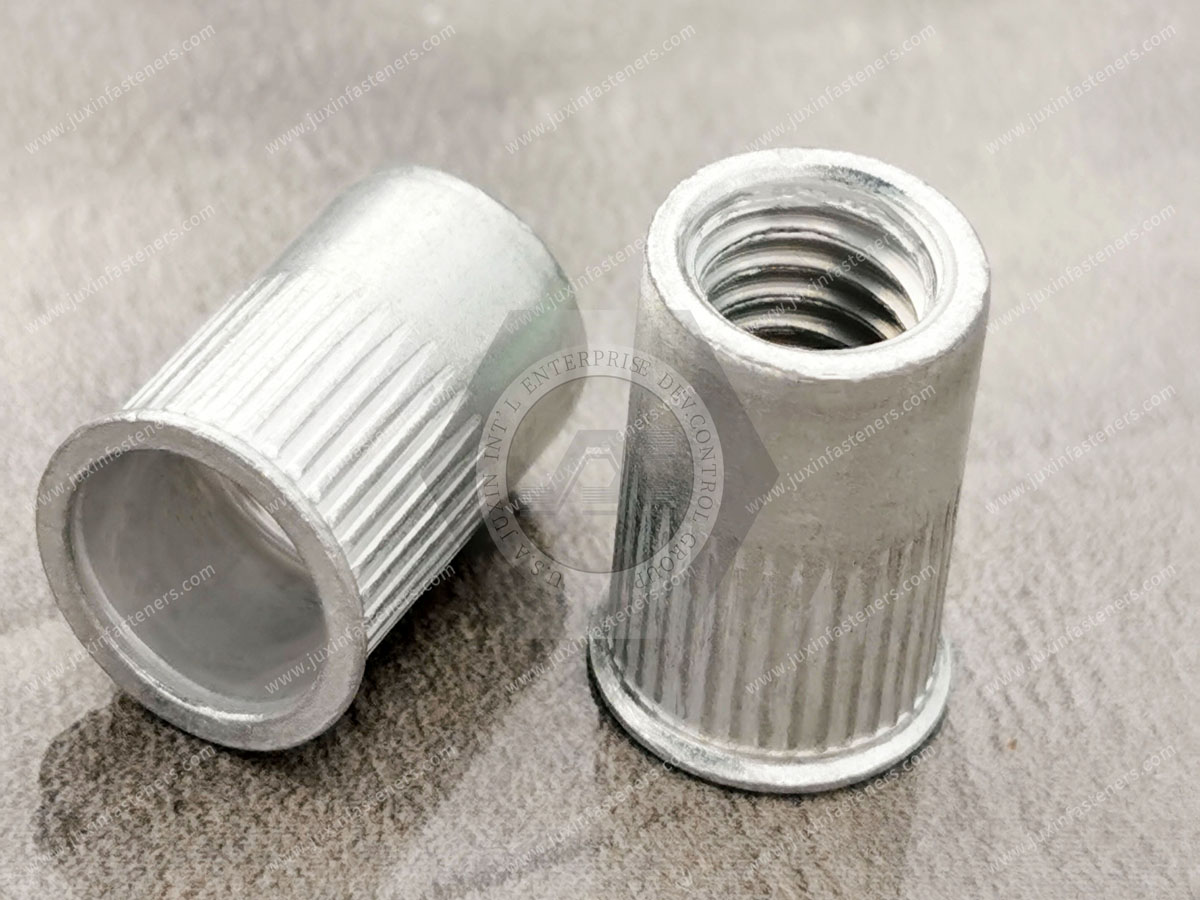
JUXIN FASTENERS supports OEM and industrial customers requiring:
small countersunk rivet nuts;
larger countersunk rivet nuts;
reduced-head rivet nuts;
countersunk hex rivet nuts;
flat head rivet nuts;
hex rivet nuts;
closed-end rivet nuts;
steel rivet nuts;
stainless steel rivet nuts;
aluminum rivet nuts;
custom blind threaded inserts.
Project support can include:
drawing review;
dimensional customization;
material selection;
surface-treatment options;
prototype development;
production supply;
dimensional inspection;
customer-specific packaging and documentation.
This page should occupy the Countersunk Head Geometry / Low-Profile Selection position within the JUXIN FASTENERS rivet nut cluster.
Link internally to:
Blind Rivet Nut Selection Guide — Article 6
for overall rivet nut selection logic.
Hex Rivet Nuts — Article 7
when anti-rotation becomes the primary requirement.
Small Countersunk Rivet Nuts — Article 8
for the dedicated low-profile product/application page.
Small Countersunk Hex Rivet Nuts — Article 9
for low profile plus positive geometric anti-rotation.
Closed-End Rivet Nuts — Article 10
where a closed threaded bottom or environmental protection is required.
Rivet Nut vs Self-Clinching Nut — Article 11
when the captive-thread technology itself has not yet been selected.
Flat Head Hex Rivet Nuts — Article 12
when anti-rotation plus a larger front bearing surface is preferred.
Also connect to relevant product and application pages for:
Blind Rivet Nuts;
Threaded Inserts;
Self-Clinching Fasteners;
Cage Nuts;
Automotive Fasteners;
EV Battery Fasteners;
Rail Transportation Fasteners;
Electrical Enclosure Fasteners;
Industrial Machinery Fasteners.
The search path becomes:
Need Blind Thread
→ Front-Side Clearance Requirement
→ Low Projection Required
→ Countersunk / Reduced Head
→ Standard Anti-Rotation Requirement or High Anti-Rotation Requirement
→ Round / Knurled Body or Hex Body
→ Grip Range + Material + Hole + Setting
→ Product / Drawing / RFQ
If your engineering or procurement team is sourcing a small countersunk rivet nut, low-profile rivnut,
countersunk blind rivet nut or custom threaded insert, send JUXIN FASTENERS your drawing or assembly requirements.
For faster review, provide:
Thread + Head Requirement + Maximum Projection + Body Style + Panel Material + Finished Thickness + Grip Range
+ Hole / Seating Geometry + Material + Finish + Required Performance + Annual Quantity
If you are comparing small countersunk, larger countersunk, flat head or hex-body rivet nuts,
send the assembly drawing so the head and body configuration can be evaluated against the actual application.
JUXIN FASTENERS
Website: www.juxinfasteners.com
Email: info@juxinfasteners.com
Contact Us
Tel.:
+86 020 8621 0320
+86 020 3121 6067
E-mail:
Technical Support:
Navigation
SEND INQUIREY