
Call Us
+86 136 6007 9809
Call Us
+86 136 6007 9809

Jul. 04, 2023
Modern vehicle manufacturing is driven by two important requirements: reducing vehicle weight while maintaining reliable assembly performance,
and increasing production efficiency without compromising fastening quality.
This is particularly important as automotive manufacturers develop fuel-efficient vehicles, hybrid platforms, electric vehicles, and increasingly complex vehicle architectures.
Metal fasteners remain essential for many structural joints, but polymer fastening components can provide important advantages in applications where the primary requirement is panel retention,
trim attachment, cable management, insulation attachment, or lightweight secondary fastening.
Automotive plastic fasteners can also reduce the risk of metal-to-metal contact and may simplify assembly where a push-in, snap-in, or one-sided installation method is preferred.
With more than 20 years of fastener manufacturing experience, JUXIN FASTENERS supplies plastic and nylon hardware for industrial OEM applications,
including plastic rivets, push clips, retaining clips, cable clamps, cable holders, nylon screws, nylon nuts, and other custom plastic fastening components.
This guide explains how engineers and automotive procurement teams can evaluate plastic snaps, rivets, clips, and retainers for vehicle interiors, exterior panels,
underbody components, electronic systems, wire harnesses, and EV-related applications.
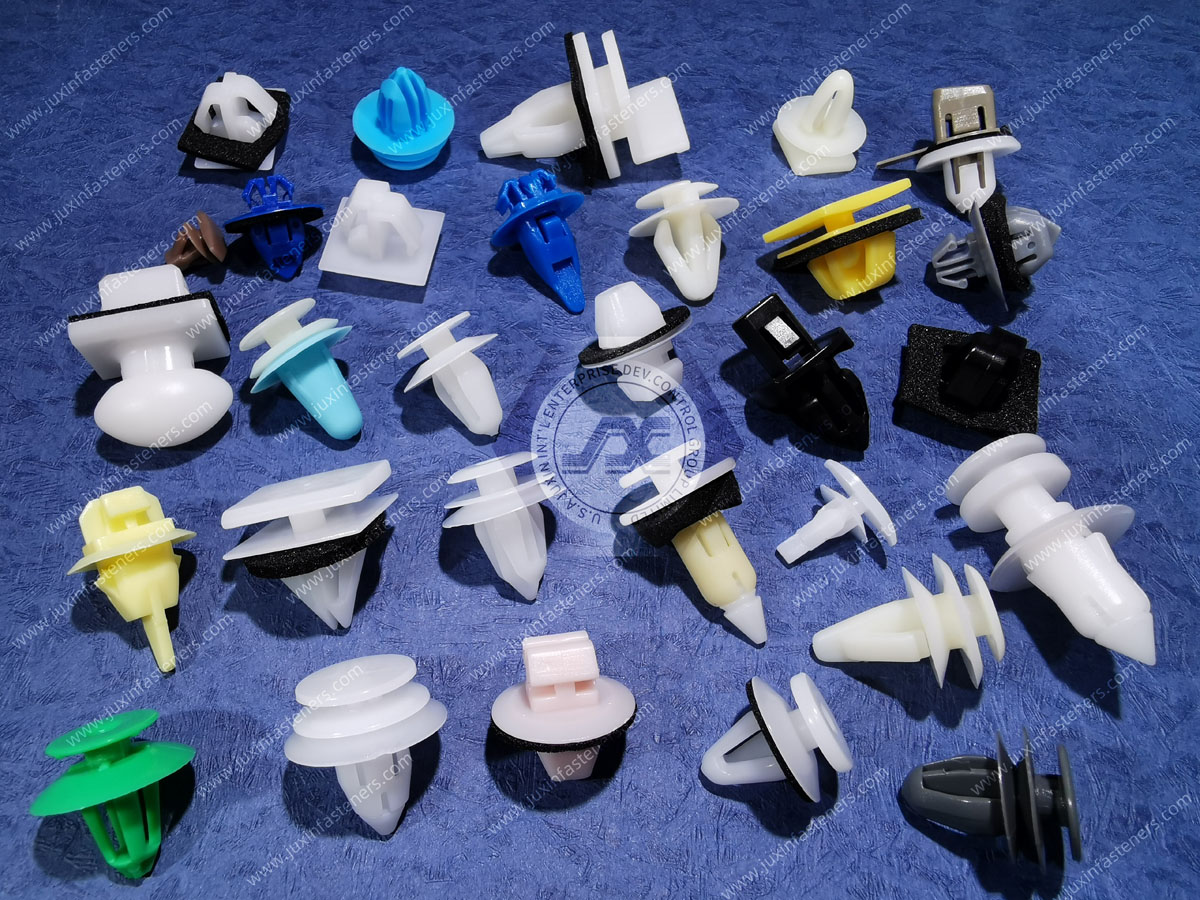
Plastic fastening components are not intended to replace every metal fastener.
Their value comes from matching the fastening method to the mechanical function.
Automotive plastic fasteners can be considered when the application requires:
Low component weight
Electrical insulation
Corrosion resistance
Rapid push-in assembly
Snap-fit attachment
Panel retention
Trim attachment
Cable and wire management
Attachment of insulation or protective materials
Reduced metal contact
Compact packaging
Easy service removal where required
Typical applications include:
Door trim
Pillar trim
Instrument panels
Headliners
Interior panels
Hood insulation
Wheel arch liners
Splash shields
Underbody panels
Aerodynamic covers
Wire harnesses
Cable routing
Electronic modules
EV electrical systems
Battery-related cable management
The correct plastic fastener depends on the parent material, panel thickness, installation force, retention requirement, temperature, chemical exposure, vibration, and service conditions.
Automotive environments expose fastening components to a wide range of mechanical and environmental conditions.
The correct polymer therefore needs to be selected according to the actual application rather than simply choosing the lowest-cost plastic.
Polyamide (PA) is widely used for industrial fastening components because it can provide a useful combination of strength, impact resistance, toughness, and chemical resistance.
Common engineering grades include:
PA6
PA66
Nylon fasteners can be considered for:
Interior trim clips
Push rivets
Cable clamps
Wire holders
Retainers
Mounting clips
Electrical isolation components
However, nylon is moisture-sensitive, and absorbed moisture can affect dimensional and mechanical behavior.
For applications with tight dimensional requirements, engineers should consider the expected environmental humidity and temperature rather than evaluating dry material properties alone.
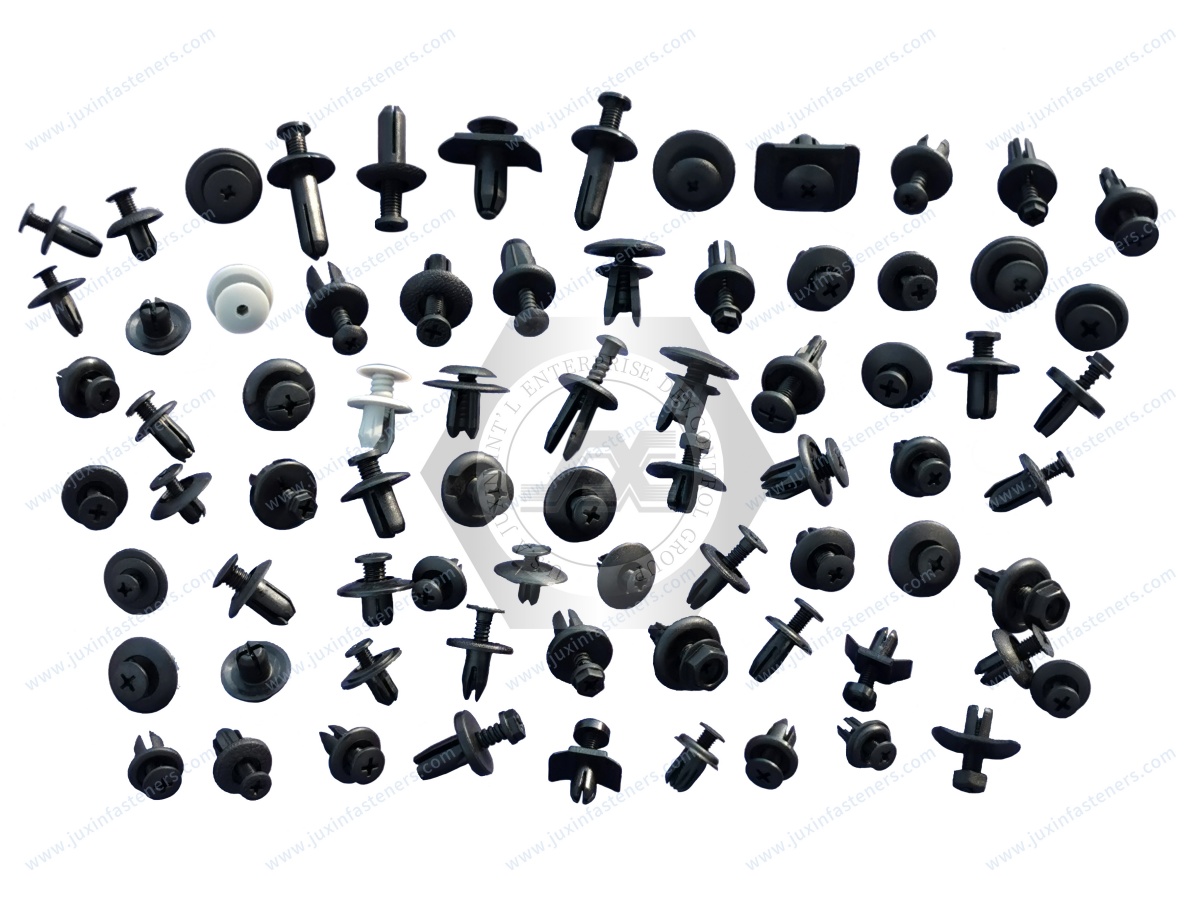
Polyoxymethylene (POM), also known as acetal, is valued for:
Low friction
Good dimensional stability
Stiffness
Wear resistance
Repeated mechanical movement
POM can be considered for clips and fastening components where controlled movement, repeated engagement, or low friction is important.
The actual suitability depends on the geometry, temperature, load, and chemical environment.
Polypropylene (PP) can provide a useful combination of low density, chemical resistance, and impact performance.
It can be considered for applications such as:
Interior panels
Underbody components
Wheel arch liners
Splash shields
Protective covers
Lightweight retaining components
The grade should be selected according to the required temperature, impact, chemical, and dimensional performance.
Polycarbonate and selected polymer blends can provide higher stiffness or impact performance for specialized applications.
However, material selection should consider:
Temperature
UV exposure
Chemical compatibility
Impact requirements
Stress cracking
Long-term aging
Required dimensional stability
The material should be validated against the actual automotive environment.
| Product Category | Typical Vehicle Application | Potential Material Options | Primary Engineering Function |
|---|---|---|---|
| Interior Trim Clips & Push Pins | Door panels, pillars, dashboards, headliners | PA, POM, PP | Panel retention and trim attachment |
| Plastic Push Rivets | Shields, covers, liners, trim | PA, PP and application-specific polymers | Rapid push-in attachment |
| Exterior Panel Clips | Moldings, covers, exterior trim | UV/temperature-suitable polymers | Retention under environmental exposure |
| Hood Insulation Clips | Hood liners and insulation materials | Application-specific nylon or polymer | Insulation retention |
| Underbody Clips & Rivets | Splash shields, wheel arch liners, belly pans | Impact- and environment-suitable polymers | Lightweight panel attachment |
| Cable Clamps & Holders | Wire harnesses and cable routing | PA, PA66 and other suitable polymers | Cable retention and routing |
| Plastic Retainers | Panels, covers and trim assemblies | PA, POM, PP | Mechanical retention |
| Nylon Screws & Nuts | Electrical and lightweight assemblies | Nylon and engineering plastics | Non-conductive fastening |
| Custom Plastic Hardware | OEM-specific assemblies | Application-specific polymer | Custom mechanical function |
The table should be treated as an engineering starting point rather than a universal material-selection chart.
Final material selection depends on the actual component design and vehicle operating environment.
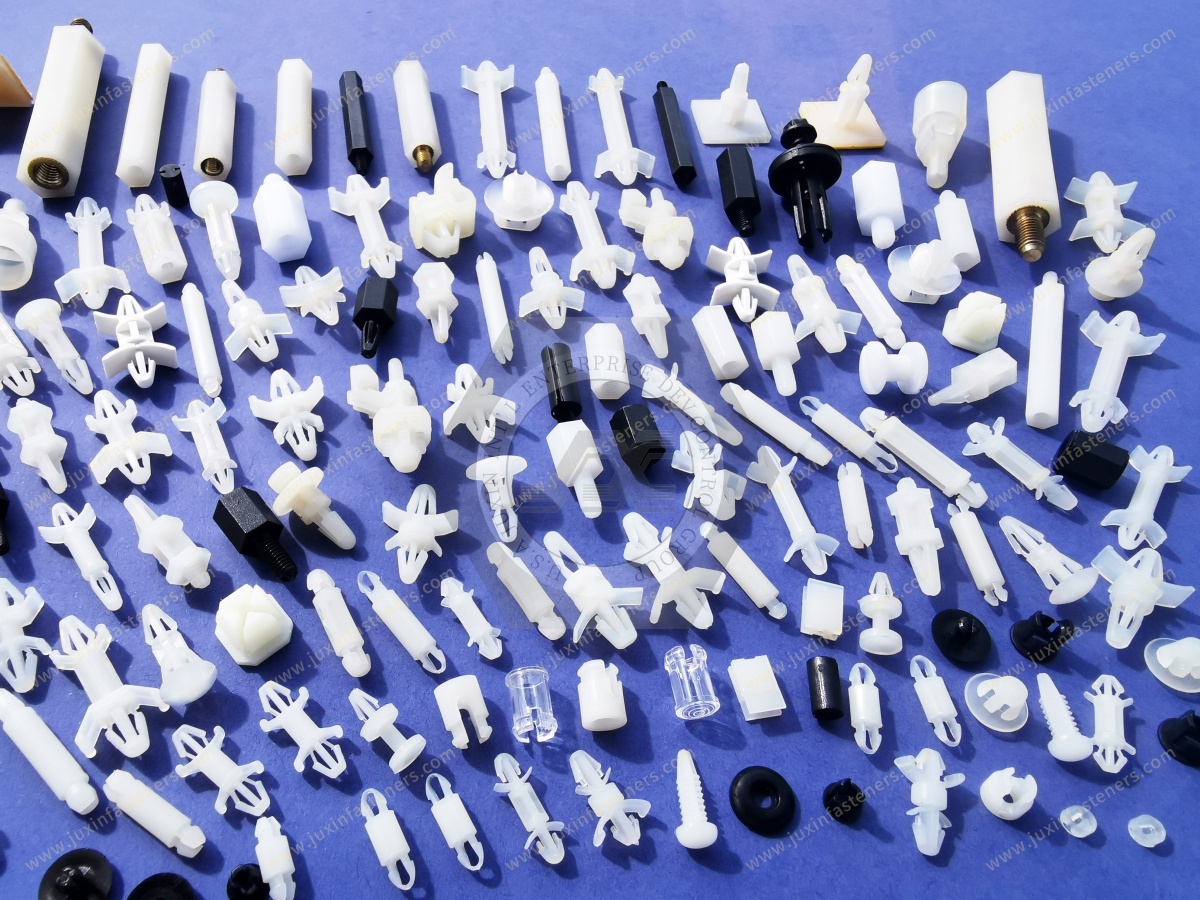
Interior trim requires fastening components that can retain panels securely while supporting efficient vehicle assembly.
Typical applications include:
Door trim
Pillar covers
Dashboard components
Headliners
Seat-related trim
Console panels
Interior decorative components
Plastic push rivets can provide a simple installation method.
The basic assembly principle is straightforward:
Align the component and panel.
Insert the rivet body through the aligned holes.
Activate the center pin or locking element.
Expand or lock the rivet to retain the panel.
The important engineering parameters include:
Hole diameter
Panel thickness
Grip range
Head diameter
Stem geometry
Insertion force
Removal force
Retention force
Material
Operating temperature
A push rivet should not be selected only by nominal hole size.
The actual panel stack-up should be evaluated because changes in trim thickness or substrate thickness can significantly affect retention.
Snap-fit joints can provide fast, tool-free or low-tool assembly.
A typical snap-fit consists of a flexible feature that deflects during insertion and then returns toward its original position after passing the mating feature.
For automotive applications, engineers should consider:
Maximum allowable deflection
Material strain
Stress concentration
Fillet geometry
Insertion force
Extraction force
Temperature
Repeated assembly cycles
Creep
Stress relaxation
A common mistake is to select a plastic based only on its tensile strength.
For a snap-fit, local strain and geometry can be more important than the nominal tensile strength listed on a material data sheet.
Sharp corners can create stress concentrations.
Insufficient beam length can increase bending strain.
Excessive interference can create high insertion force.
A well-designed snap therefore requires a balance between:
Retention force + allowable deflection + assembly force + long-term material behavior.
This is one of the most important considerations when developing custom automotive plastic clips.
Exterior automotive components face more demanding environmental conditions than many interior applications.
Depending on the vehicle location, plastic fasteners may be exposed to:
Temperature cycling
Moisture
Road water
Road salt
Dirt
Mud
Stone impact
Cleaning chemicals
UV radiation
Engine-compartment heat
Applications can include:
Hood insulation
Cowl components
Exterior moldings
Wheel arch liners
Splash shields
Underbody panels
Aerodynamic covers
For these applications, engineers should avoid assuming that an interior-grade polymer will provide equivalent performance.
The fastener material and geometry should be evaluated against the actual environmental exposure.
One of the most important differences between polymer and metal fastening systems is long-term deformation behavior.
Creep is the gradual deformation of a polymer under sustained stress.
For example, a plastic clip subjected to continuous mechanical loading may slowly deform over time.
Stress relaxation occurs when a polymer joint maintains approximately the same deformation while the internal stress decreases over time.
These two behaviors can affect:
Clamp retention
Panel movement
Rattle performance
Snap engagement
Long-term dimensional stability
Retention force
Temperature can significantly accelerate polymer deformation.
This means that a plastic clip designed for a cool interior environment may behave differently in an under-hood application.
Instead of asking:
“Is this plastic strong enough?”
the engineering question should be:
“Will this polymer and geometry maintain the required retention function throughout the expected temperature, load, and service period?”
That is a much more useful way to evaluate automotive plastic fasteners.
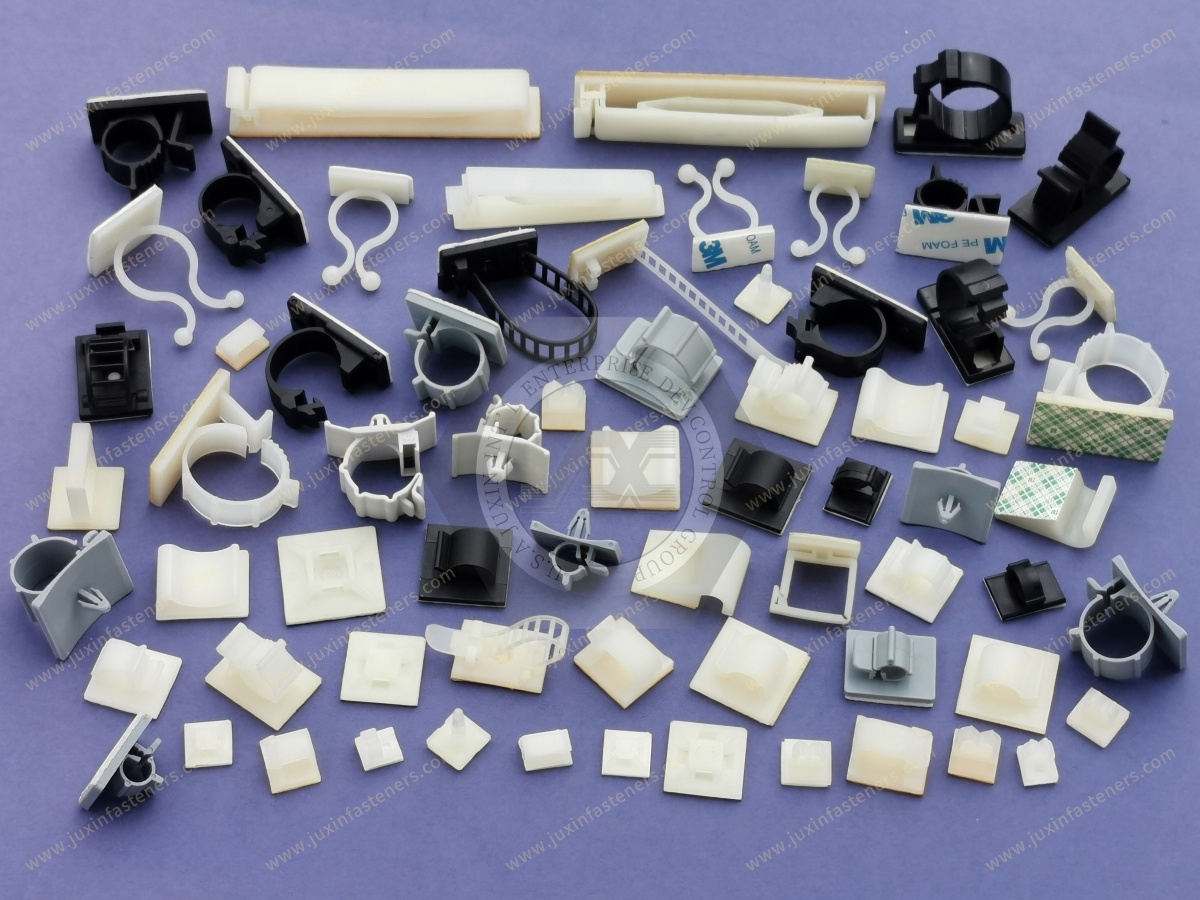
For applications requiring increased stiffness or dimensional stability, glass-fiber-reinforced nylon may be considered.
Glass reinforcement can increase stiffness and influence dimensional behavior compared with unfilled nylon.
However, reinforcement also changes:
Flow behavior during molding
Anisotropy
Shrinkage
Surface appearance
Impact behavior
Fatigue behavior
Processing requirements
Therefore, a specific glass-fiber percentage should not be treated as a universal solution.
For a custom automotive component, the appropriate polymer grade and reinforcement level should be selected according to the actual design and performance requirements.
Modern vehicles contain increasingly complex electrical systems.
EVs add additional high-voltage and low-voltage wiring, sensors, communication networks, thermal-management components, and electronic control systems.
This creates significant demand for:
Cable clamps
Wire holders
Harness clips
Cable routing brackets
Retaining clips
Plastic mounting clips
The fastening component must secure the cable while avoiding:
Excessive compression
Cable insulation damage
Abrasion
Uncontrolled movement
Excessive vibration
Interference with adjacent components
For electrical applications, polymer hardware can also provide electrical isolation where the design requires a non-conductive fastening interface.
The cable clamp should therefore be evaluated as both a fastener and a cable-management component.
Electric vehicles create additional opportunities for polymer fastening components.
Potential applications include:
Wire harness management
Low-voltage cable routing
Sensor cable retention
Electronic enclosure components
Interior trim
Underbody shields
Thermal-management system covers
Battery-related cable and harness support
For EV applications, engineers should consider:
Electrical isolation
Temperature
Vibration
Chemical exposure
Cable movement
Assembly accessibility
Long-term polymer aging
For components near high-voltage systems, the fastening material should be evaluated as part of the complete electrical and mechanical design.
A plastic fastener is not automatically suitable simply because it is electrically non-conductive.
Noise, vibration, and harshness — commonly referred to as NVH — can influence perceived vehicle quality.
A poorly retained interior panel can generate:
Rattles
Buzzing
Squeaking
Panel movement
The fastener is only one part of the NVH system.
Performance can also depend on:
Panel stiffness
Contact surfaces
Tolerance stack-up
Fastener preload
Retention force
Friction
Material pairing
Temperature
Vehicle vibration
This is why simply increasing clip retention force does not always solve an NVH problem.
Excessive retention force can increase assembly effort or make service removal difficult.
The better approach is to optimize the complete interface.
A frequently overlooked issue in automotive clip sourcing is tolerance stack-up.
Consider an assembly containing:
Trim panel
Foam layer
Bracket
Sheet metal
Plastic clip
Each component may have dimensional variation.
The final grip condition can therefore vary from one assembly to another.
If the clip grip range is too narrow, some assemblies may have insufficient retention.
If the grip range is too large, other assemblies may experience excessive movement.
For production programs, engineers should evaluate:
Nominal stack-up + component tolerances + material compression + clip tolerance.
This is often more useful than simply matching the nominal panel thickness to the nominal clip specification.
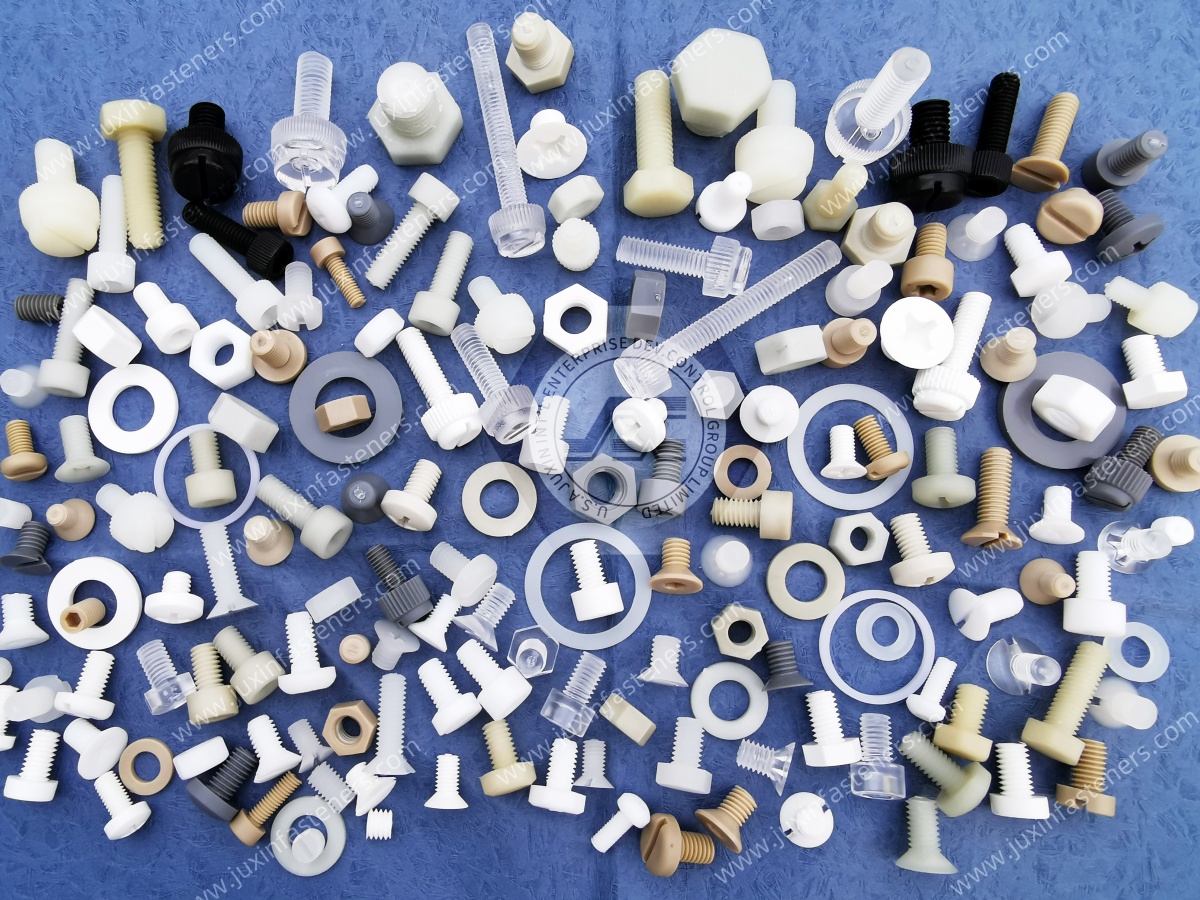
| Application | Primary Requirement | Potential Fastener Type |
|---|---|---|
| Door trim | Panel retention and low installation effort | Trim clip / push clip |
| Pillar trim | Secure retention with controlled removal | Plastic retainer |
| Headliner | Lightweight panel retention | Trim clip / plastic retainer |
| Hood insulation | Insulation attachment | Push rivet / insulation clip |
| Wheel arch liner | Environmental resistance | Plastic rivet / panel clip |
| Splash shield | Impact and environmental resistance | Heavy-duty push rivet / clip |
| Underbody panel | Lightweight retention | Plastic rivet / custom clip |
| Wire harness | Cable retention | Cable clamp / harness clip |
| EV cable routing | Electrical isolation and retention | Nylon cable clamp / holder |
| Electronic enclosure | Lightweight or non-conductive fastening | Nylon screw / nut / custom plastic hardware |
The final selection should always be validated against the actual component geometry and environmental requirements.
International standards can help define material properties and testing methods.
Relevant standards may include:
ISO 527 for tensile properties of plastics
ISO 178 for flexural properties of plastics
ASTM D638 for tensile properties of plastics
ASTM D790 for flexural properties of plastics
These standards can provide standardized material-property data, but they do not automatically define whether a particular plastic clip is suitable for a specific vehicle application.
For automotive OEM programs, customer-specific specifications and validation requirements may also apply.
The supplier should therefore manufacture and test the component according to the agreed drawing, material specification, customer specification, and applicable test requirements.
Before selecting an automotive plastic fastener, engineers should define at least the following:
What is the clip attaching to?
Steel
Aluminum
Plastic
Composite
Fabric
Foam
Multi-layer assembly
Determine the complete grip range rather than only the nominal thickness.
Specify:
Hole diameter
Hole tolerance
Hole shape
Edge distance
Panel orientation
Determine whether the fastener experiences:
Pull-out
Shear
Peel
Vibration
Repeated loading
Define:
Temperature
Humidity
Chemicals
UV exposure
Road salt
Cleaning
Vibration
Determine:
Manual insertion
Automated installation
Push-in
Press-fit
Snap-fit
Tool-assisted installation
Determine whether the component needs to be:
Permanent
Removable
Reusable
Replaceable
This information provides a much stronger basis for fastener selection than simply requesting “a plastic clip for automotive use.”
Automotive engineering and procurement teams often evaluate the same component from different perspectives.
The key questions include:
Will the clip fit the available geometry?
What is the required retention force?
What is the expected insertion force?
Can the clip withstand the environmental conditions?
Will creep or stress relaxation affect long-term retention?
Is the polymer compatible with the surrounding materials?
Can the clip survive assembly and service cycles?
Does the component interfere with cables or adjacent parts?
For custom components, engineers should provide the latest drawing or CAD model and clearly identify critical dimensions and functional requirements.
The priorities often include:
Consistent production quality
Stable material supply
Competitive total cost
Production capacity
Packaging
Lot identification
Inspection documentation
Delivery performance
Engineering communication
Long-term supply continuity
The best sourcing process connects these requirements rather than treating engineering and procurement as separate activities.
For production automotive programs, supplier qualification should go beyond unit price.
Procurement teams should evaluate:
Can the supplier manufacture the required geometry consistently?
Can the specified polymer grade be controlled and identified?
Can critical dimensions and functional features be inspected consistently?
Can the supplier maintain stable performance across production lots?
Can required inspection records, certificates, or customer-specific documentation be provided?
Can the parts be packaged to prevent deformation, contamination, damage, or mixing during transportation and assembly?
Can the supplier communicate effectively when drawing revisions, material changes, tooling changes, or production issues occur?
These factors can be more important to long-term automotive supply than the initial quoted piece price.
Plastic fasteners can contribute to cost reduction when they simplify the assembly process.
Potential advantages include:
Tool-free installation
Reduced component count
Faster panel attachment
One-sided installation
Lower part weight
Simplified cable routing
Reduced metal hardware
Easier service access
However, a lower piece price does not automatically mean a lower total cost.
OEMs should evaluate:
Fastener price + installation time + tooling + inventory + quality cost + service cost.
This total-cost approach can identify opportunities where a slightly higher unit-price clip actually reduces the overall assembly cost.
Standard clips and push rivets can solve many common fastening problems.
However, automotive manufacturers frequently encounter applications requiring a customized:
Head design
Stem geometry
Grip range
Retention feature
Snap profile
Cable-routing feature
Mounting interface
Material
Size
Packaging configuration
Custom plastic hardware can be developed around the actual vehicle assembly rather than forcing the application to fit an existing standard component.
For a custom RFQ, useful information includes:
2D drawing
3D CAD file
Material requirement
Panel thickness
Hole diameter
Grip range
Retention requirement
Insertion/removal requirements
Temperature range
Chemical exposure
Annual quantity
Prototype quantity
Packaging requirements
This information allows the supplier to evaluate both the engineering and production requirements.
JUXIN FASTENERS supplies plastic and nylon hardware for industrial OEM applications, including automotive-related fastening and component requirements.
Product categories include:
Plastic Rivets
Plastic Push Rivets
Automotive Plastic Clips
Trim Clips
Plastic Retainers
Nylon Fasteners
Nylon Screws
Nylon Nuts
Cable Clamps
Cable Holders
Wire Routing Hardware
Custom Plastic Components
These products can support applications across:
Automotive interiors
Exterior trim
Hood insulation
Wheel arch liners
Underbody panels
Splash shields
Electronic systems
Cable management
EV wiring systems
Industrial equipment
The appropriate material, geometry, dimensional requirements, and testing criteria should be established from the customer's application and engineering specification.
A well-prepared RFQ can significantly reduce engineering and quotation cycles.
Identify where the fastener will be installed.
Provide the latest 2D drawing and, where available, a 3D CAD model.
Identify the material and thickness of the component being fastened.
Specify:
Retention
Pull-out
Shear
Insertion force
Removal force
Reusability
Vibration exposure
Identify:
Temperature
Moisture
Chemicals
UV
Road salt
Cleaning
Vibration
If the material is already specified, provide the required grade.
If material selection is open, provide the application conditions so the supplier can recommend an appropriate material option.
Separate:
Prototype quantity
Validation quantity
Pilot production
Annual production volume
Specify inspection reports, material documentation, traceability, packaging, and any customer-specific requirements.
This process helps automotive buyers compare suppliers based on the complete technical and commercial requirement rather than unit price alone.
The best automotive plastic fastener is not necessarily the smallest, lightest, strongest, or cheapest component.
It is the component that provides the required function throughout the expected assembly and service conditions.
A successful design balances:
Weight + Retention + Assembly Force + Environmental Resistance + Long-Term Stability + Cost
For engineers, this means evaluating the complete joint.
For procurement teams, it means sourcing a supplier capable of maintaining the specified material, geometry, quality, and production consistency.
For automotive supply-chain managers, it means establishing a reliable production system that supports the vehicle program over its required lifecycle.
If your vehicle program requires automotive plastic clips, plastic push rivets, trim clips, plastic retainers, nylon fasteners,
cable clamps, wire harness holders, or custom plastic hardware, JUXIN FASTENERS can review your drawings and application requirements.
For an OEM RFQ, provide:
2D engineering drawing
3D CAD file where available
Required material or application conditions
Panel thickness
Hole diameter
Grip range
Retention requirements
Operating environment
Prototype and production quantities
Quality and documentation requirements
Packaging requirements
Our team can review the manufacturing requirements and provide a quotation based on the supplied specification.
Email: info@juxinfasteners.com
JUXIN FASTENERS
Automotive Plastic & Nylon Fasteners for OEM Applications
Website: juxinfasteners.com
 MORE NEWS
Sep. 25, 2026
Sep. 25, 2026
Sep. 25, 2026
Contact Us
Tel.:
+86 020 8621 0320
+86 020 3121 6067
E-mail:
Technical Support:
Navigation
SEND INQUIREY