Call Us
+86 136 6007 9809
Call Us
+86 136 6007 9809

Nov. 07, 2023
When a blind threaded joint must resist higher installation or service torque, the external geometry of the rivet nut becomes an important engineering consideration.
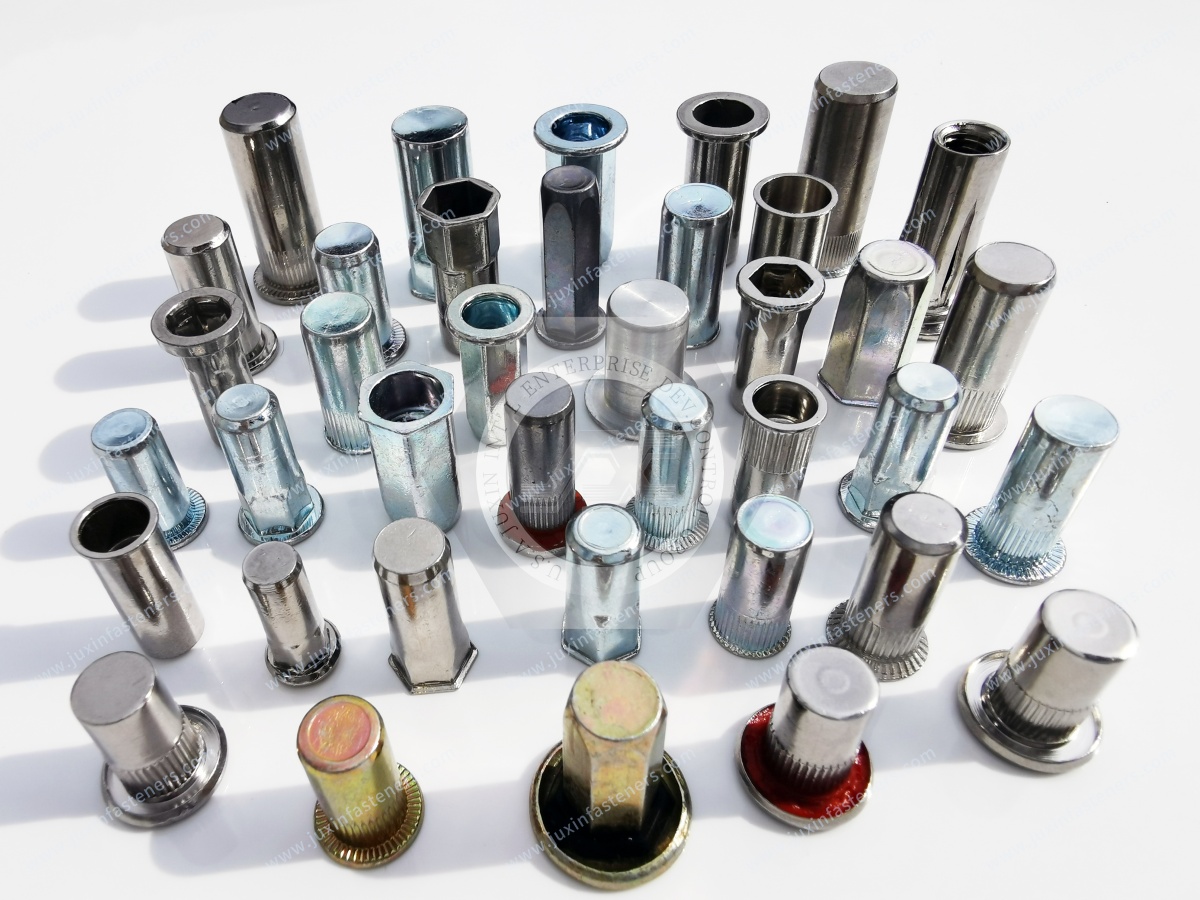
A hex rivet nut, also called a hex body rivet nut, hex blind rivet nut, hex nutsert, or hex threaded insert,
uses a hexagonal body that mechanically engages a corresponding hex-shaped installation hole.
Unlike a round-body rivet nut, which depends heavily on friction, deformation, knurling and hole conditions for rotational resistance,
a correctly installed hex-body rivet nut gains substantial anti-rotation capability from geometric engagement between the rivet nut body and the parent material.
This makes hex rivet nuts particularly relevant to OEM assemblies requiring:
strong resistance to insert rotation;
repeated bolt installation and removal;
reusable threads in thin sheet;
blind-side installation;
controlled high-torque assembly;
reliable threaded attachment in fabricated enclosures and structures.
JUXIN FASTENERS supplies full-hex rivet nuts, half-hex rivet nuts, open-end hex rivet nuts, closed-end hex rivet nuts, steel hex rivet nuts,
stainless steel hex rivet nuts, aluminum hex rivet nuts and custom blind threaded inserts for industrial OEM applications.
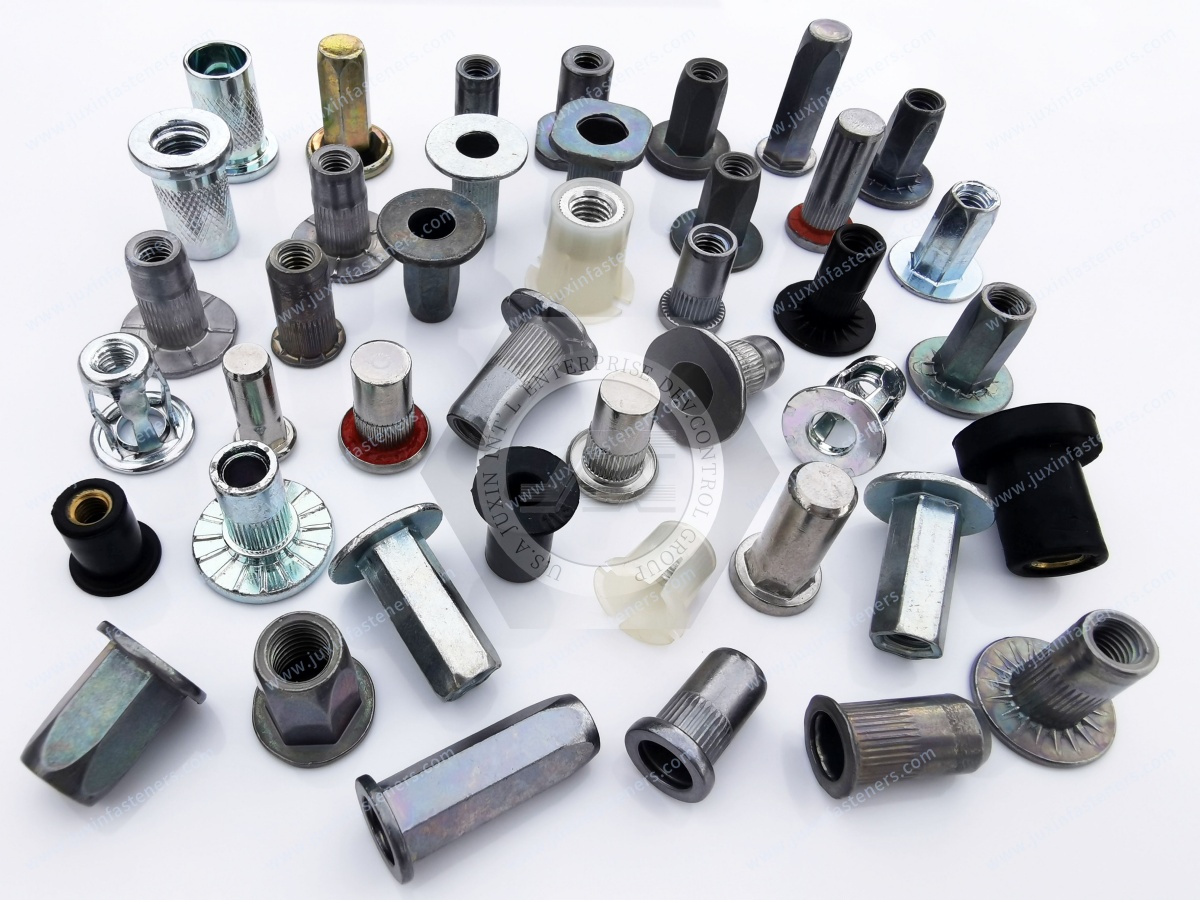
A hex rivet nut is an internally threaded blind fastener with a hexagonal external body section.
It is inserted into a matching hexagonal hole and mechanically set from one accessible side of the workpiece.
During installation, the designed deformation zone collapses behind the parent material, creating a clamping formation that retains the insert axially.
At the same time, the hexagonal body engages the matching hole and resists rotation.
The installed joint therefore uses two different retention mechanisms:
Axial Retention → Collapsed Body / Backside Formation
Rotational Retention → Hex Body / Hex Hole Engagement
Understanding this distinction is important because pull-out resistance and spin resistance are not the same performance characteristic.
A hex body can substantially improve resistance to rotation without automatically guaranteeing higher axial pull-out strength in every substrate.
A round rivet nut installed in a round hole can rotate if the frictional and mechanical engagement between the insert and parent material is overcome.
Knurling can improve this interaction, but the fundamental interface remains predominantly circular.
A hex-body rivet nut works differently.
Its external flats and corners engage a corresponding non-round hole. For the insert to rotate, the surrounding parent material must resist deformation around this geometry.
The functional relationship is:
Hex Body Geometry + Controlled Hex Hole + Correct Setting = Mechanical Anti-Rotation
This is why hex rivet nuts are often considered when conventional round-body designs experience spinning during bolt tightening or servicing.
But the geometry only works correctly when the installation hole, material thickness and setting process are properly controlled.
The two products solve similar blind-threading problems but use different approaches to rotational retention.
| Engineering Factor | Hex Rivet Nut | Round Rivet Nut |
|---|---|---|
| Installation hole | Hex / non-round | Round |
| Hole manufacturing | More complex | Simpler |
| Anti-rotation mechanism | Geometric engagement | Friction, deformation and body features |
| Hole preparation cost | Usually higher | Usually lower |
| Resistance to spinning | Often advantageous | Depends strongly on design and installation |
| Retrofit drilling | Less convenient | Easier |
| High-volume punched sheet | Highly suitable when tooling exists | Highly suitable |
| Serviceable high-torque joint | Often advantageous | Application-dependent |
The engineering decision should not be:
Hex is always better than round.
Instead:
Required Torque Resistance → Parent Material → Hole-Manufacturing Capability → Production Volume → Rivet Nut Geometry
A round or knurled rivet nut can be the more economical solution when its rotational resistance is sufficient.
A hex body becomes valuable when the application justifies the additional hole-manufacturing requirement.
Knurled rivet nuts are another common solution for improving resistance to rotation.
The important difference is the mechanism.
A knurled round-body rivet nut uses external serrations to increase mechanical interaction with the parent material.
A hex rivet nut uses positive geometric engagement with a matching hole.
Therefore:
Knurled Body → Enhanced Surface Engagement
Hex Body → Shape-Based Mechanical Engagement
The correct choice depends on:
required rotational resistance;
parent-material strength;
available hole-making process;
panel thickness;
installation equipment;
production cost.
If the manufacturing line can only economically produce round holes, a suitable knurled design may be preferable.
If high rotational resistance is critical and hex holes can be produced consistently, a hex-body design may provide a more robust solution.
Hex rivet nuts are not all geometrically identical.
Two common design concepts are full-hex and half-hex bodies.
A full-hex design uses an extended hexagonal body section.
Potential advantages include:
strong geometric engagement;
high resistance to rotation;
positive location within the prepared hole.
They are often considered for demanding applications where rotational stability is a major design requirement.
A half-hex design combines a hexagonal anti-rotation section with another body section designed for deformation during setting.
Potential advantages can include:
effective anti-rotation;
application-specific setting behavior;
compatibility with certain panel and tooling requirements.
However, full hex should not automatically be interpreted as stronger than half hex.
Performance depends on the complete design, including:
dimensions;
material;
grip range;
deformation zone;
parent material;
installation condition.
Supplier drawings and application testing should govern selection.
The presence of a hex body does not remove the need to select the correct grip range.
Grip range defines the parent-material thickness range for which the rivet nut is designed to set correctly.
A single M6 hex rivet nut family may include several body lengths for different sheet thicknesses.
Selecting the wrong grip range can cause:
incomplete backside formation;
excessive deformation;
poor clamping;
reduced rotational resistance;
parent-material damage;
inconsistent installation.
Therefore:
M6 Hex Rivet Nut ≠ Complete Specification
The engineer must also define the appropriate grip range.
For broader grip-range selection principles, link this page to the JUXIN FASTENERS Blind Rivet Nut Selection Guide.
With a hex rivet nut, the installation hole is not merely clearance for insertion.
It is part of the anti-rotation system.
The relationship between the body and hole must allow:
reliable insertion;
controlled positional fit;
sufficient engagement of the flats and corners;
accommodation of manufacturing tolerances and coatings.
If the hole is excessively large, rotational play can increase and anti-rotation performance may decrease.
If the hole is too small or distorted, installation may become difficult and the parent material or rivet nut can be damaged.
This means the finished production hole must be controlled, not merely the nominal CAD dimension.
Thread size does not determine external body geometry.
Two suppliers can offer M6 hex rivet nuts with different:
body dimensions;
across-flats dimensions;
head dimensions;
overall lengths;
grip ranges.
Therefore, replacing one supplier's hex rivet nut with another based only on internal thread designation can create an assembly problem.
For supplier qualification, compare the complete product drawing.
The appropriate hole-making method depends on:
parent material;
sheet thickness;
production volume;
dimensional tolerance;
fabrication sequence.
Possible production processes can include:
punching;
stamping;
laser cutting;
other suitable fabrication methods.
For high-volume sheet-metal production, a punched hex hole may provide an efficient solution once appropriate tooling is established.
For prototypes or lower-volume fabricated equipment, laser cutting may provide flexibility.
The correct process should be determined by the OEM manufacturing system rather than the rivet nut supplier alone.
A nominally correct hex hole can still produce poor results if its edges are heavily burred or distorted.
Potential problems include:
incomplete head seating;
difficult insertion;
tilted installation;
damage to coating;
inconsistent setting;
reduced geometric engagement.
Hole quality should therefore be included in the production-control plan where rivet nut performance is critical.
Open-end hex rivet nuts are suitable for many general industrial applications.
They allow the mating fastener to extend through the threaded section where the assembly geometry permits.
Typical applications include:
machinery panels;
equipment frames;
electrical cabinets;
automotive assemblies;
fabricated enclosures.
The open-end design should be selected according to available backside clearance and bolt engagement requirements.
A closed-end hex rivet nut combines anti-rotation geometry with a closed metal bottom.
This can be useful when the design needs to reduce direct passage through the bottom of the threaded insert.
Applications may include:
electrical enclosures;
outdoor equipment;
vehicle assemblies;
equipment exposed to contamination.
However:
Closed-End ≠ Automatically Waterproof
The closed body prevents direct passage through the bottom of the rivet nut, but moisture or fluid can still migrate around the interface between the flange and parent panel.
Where sealing is required, the complete installed interface must be evaluated.
Some hex rivet nut configurations can incorporate sealing features beneath the flange.
These may help control ingress around the installation interface.
The sealing performance depends on factors such as:
seal material;
panel surface;
hole condition;
installation setting;
flange design;
temperature;
fluid or chemical exposure.
A sealing feature should therefore be specified according to the actual environmental requirement.
Do not assume that the words sealed, closed-end, and waterproof are interchangeable.
Steel is widely used for hex rivet nuts because it offers a useful combination of:
mechanical strength;
formability;
production efficiency;
cost effectiveness.
Possible industrial surface treatments include:
zinc plating;
zinc-nickel plating;
zinc-flake coating systems;
other project-specific coatings.
Steel hex rivet nuts are commonly considered for:
automotive assemblies;
machinery;
industrial enclosures;
fabricated equipment;
commercial vehicles.
The coating should be specified according to the required corrosion performance rather than appearance alone.
Stainless steel hex rivet nuts may be appropriate where increased corrosion resistance is required.
Depending on product availability and application requirements, materials can include 304-type or 316-type stainless steel.
Potential applications include:
outdoor equipment;
food-processing machinery;
chemical equipment;
marine-related equipment;
transportation systems.
However, stainless steel creates an important production consideration:
Higher Material Strength / Work Hardening → Potentially Higher Setting Demand
Before substituting stainless steel for a steel or aluminum rivet nut, confirm that the installation equipment can reliably set the selected component.
Corrosion improvement is not useful if the production tool cannot produce a controlled installation.
Aluminum hex rivet nuts can be considered for applications prioritizing:
low mass;
relatively low setting force;
compatibility with selected lightweight structures.
Potential applications include:
transportation equipment;
electronics;
aluminum fabricated assemblies;
lightweight machinery.
However, aluminum should not automatically be selected simply because the panel is aluminum.
Required service load, thread performance, tightening torque and environmental conditions must also be considered.
A hex rivet nut's resistance to rotation does not depend only on the insert.
The surrounding material must also resist deformation.
A hex rivet nut installed into high-strength sheet can behave differently from the same component installed into:
thin aluminum;
soft steel;
plastic;
composite panel.
This produces a critical engineering relationship:
Hex Geometry + Parent Material Strength + Material Thickness + Installation Quality → Rotational Performance
For critical applications, testing should therefore use representative production material.
Hex geometry may help provide anti-rotation in selected plastics or composites, but these materials introduce different failure mechanisms from metal sheet.
Possible concerns include:
cracking at hex corners;
creep;
local crushing;
pull-through;
edge breakout.
The sharper geometric features of a hex hole can also create local stress concentrations in some brittle materials.
Therefore, a hex rivet nut designed successfully for sheet steel should not automatically be transferred to a composite or polymer structure.
Substrate-specific validation is required.
A hex body provides strong geometric resistance to rotation, but spinning can still occur.
Possible causes include:
oversized hex hole;
rounded or poorly formed hole corners;
incorrect body size;
insufficient setting;
incorrect grip range;
weak parent material;
excessive service torque;
damaged installation hole.
Troubleshooting should follow:
Inspect Hole Geometry → Confirm Rivet Nut Body → Verify Grip Range → Check Setting → Evaluate Parent Material → Review Bolt Torque
Simply replacing the insert with a harder material may not correct the root cause.
This is an important distinction for both engineering and procurement.
A hex rivet nut can provide excellent rotational resistance, but the joint still has mechanical limits.
Excessive tightening torque can result in:
internal thread damage;
bolt failure;
panel deformation;
rivet nut rotation;
damage to the collapsed backside formation.
Therefore:
High Anti-Rotation Capability ≠ Unlimited Bolt Tightening Torque
Final assembly torque should be established for the complete joint.
A hex rivet nut is often selected primarily because of its anti-rotation capability.
But engineers must separately consider axial retention.
Torque-Out / Spin Resistance evaluates resistance to rotation.
Pull-Out Resistance evaluates resistance to axial extraction.
A design change that improves one does not necessarily improve the other proportionally.
For example, hex geometry may significantly improve rotation resistance while axial retention still depends strongly on:
backside formation;
flange design;
material thickness;
substrate strength;
setting quality.
Both performance requirements should be defined where relevant.
The setting process creates the backside deformation that retains the rivet nut.
Under-setting can produce:
weak backside formation;
reduced clamping;
low pull-out performance;
possible rotation.
Over-setting can produce:
thread distortion;
panel deformation;
damaged insert body;
inconsistent production results.
The objective is:
Repeatable Controlled Setting
not maximum installation force.
When changing rivet nut material, supplier, grip range or body geometry, installation settings should be reviewed.
Hex rivet nuts are particularly relevant to automotive manufacturing where blind threaded attachments are required in thin or enclosed structures.
Potential applications include:
body structures;
equipment brackets;
interior assemblies;
electrical equipment;
battery enclosure components;
serviceable panels.
EV platforms can contain combinations of:
thin steel;
aluminum;
extrusions;
enclosed structural sections;
battery and power-electronics assemblies.
Where repeated servicing or higher assembly torque is expected, hex-body anti-rotation can become an important design advantage.
The actual OEM drawing and validation requirements must govern final selection.
Hex rivet nuts can provide durable reusable threads in:
machine guards;
sheet-metal covers;
automation enclosures;
equipment frames;
service panels;
fabricated machinery.
In frequently maintained machinery, anti-rotation is particularly important because repeated bolt removal and installation can progressively challenge a poorly retained insert.
The fastening system should therefore be designed for both initial assembly and expected service life.
Electrical equipment manufacturers may use hex rivet nuts for:
control cabinets;
electrical panels;
power-distribution equipment;
switchgear enclosures;
industrial control systems.
The hex body can provide stable threaded mounting where repeated access is required.
Outdoor installations may additionally require evaluation of:
corrosion resistance;
closed-end geometry;
sealing;
coating compatibility;
grounding strategy.
Hex rivet nuts may be suitable for selected:
network enclosures;
telecommunications cabinets;
equipment frames;
power-distribution systems;
server infrastructure.
However, cage nuts and other captive fastening systems may offer better field serviceability in certain rack designs.
The design decision should consider:
Torque Requirement + Serviceability + Hole Manufacturing + Replaceability
rather than using one fastening technology across every enclosure.
Transportation equipment may use hex rivet nuts in suitable:
interior structures;
equipment cabinets;
lighting systems;
service panels;
electrical assemblies;
fabricated brackets.
Rail projects can introduce additional requirements for:
vibration;
corrosion;
documentation;
traceability;
maintenance;
associated fire and smoke requirements where sealing or polymer components are involved.
The applicable railway project specification should govern the final fastening system.
Heavy equipment frequently combines fabricated sheet, enclosures and serviceable components.
Potential applications include:
machine panels;
protective guards;
equipment housings;
electrical boxes;
maintenance covers.
Hex rivet nuts can be particularly useful where service bolts are repeatedly installed and removed and rotation of the threaded insert would create difficult field repairs.
A useful decision path is:
Is Blind-Side Threaded Installation Required?
If no → evaluate conventional nut, weld nut, tapped hole or another fastening system.
If yes →
Is a Round or Knurled Rivet Nut Sufficient for the Required Torque?
If yes → the simpler round-hole system may be more economical.
If no →
Can the Manufacturing Process Produce a Controlled Hex Hole?
If yes → evaluate a hex-body rivet nut.
Then define:
Thread → Grip Range → Body Geometry → Hole Geometry → Material → Head Style → Environment → Installation → Service Load
This avoids selecting a more complex fastener before confirming that the application needs it.
Depending on the application, the specification should define:
internal thread size;
thread tolerance;
full-hex or half-hex body;
body dimensions;
across-flats dimension;
overall length;
head diameter;
head thickness;
grip range;
installation-hole dimensions;
open-end or closed-end configuration;
material;
surface treatment;
dimensional tolerances;
burr requirements;
applicable international standard or customer specification;
inspection requirements.
Where anti-rotation is critical, the installation-hole geometry should be controlled on the assembly drawing as well as the rivet nut drawing.
For efficient supplier evaluation, procurement teams should provide as applicable:
drawing or existing part specification;
thread size and pitch/TPI;
full-hex or half-hex configuration;
open or closed end;
head style;
grip range;
panel material;
panel thickness;
hex-hole dimensions;
rivet nut material;
surface treatment;
corrosion requirement;
service torque requirement where applicable;
application environment;
installation equipment;
prototype quantity;
production quantity;
annual demand;
inspection requirements;
documentation requirements;
packaging requirements.
An RFQ stating only:
“M6 Hex Rivet Nut — 20,000 pcs”
does not fully define the component.
M6 products can differ in grip range, body geometry, head style, material, coating and required installation hole.
Where the reason for selecting a hex rivet nut is anti-rotation performance, supplier qualification should focus on the installed system, not only loose-component dimensions.
Depending on project requirements, validation may include:
dimensional inspection;
thread inspection;
installation fit;
backside formation;
torque-out / spin resistance;
pull-out resistance;
final bolt assembly;
corrosion requirements.
Tests should use representative production material whenever practical.
A torque value generated in a thick laboratory steel plate should not automatically be assumed to represent a thin aluminum production panel.
A strong validation setup should reproduce:
Production Panel Material + Actual Thickness + Finished Hex Hole + Coating + Rivet Nut + Setting Tool + Installation Parameters + Mating Bolt
This matters because changing any one of these can change joint behavior.
For example:
Same Hex Rivet Nut + Softer Panel = Different Rotational Performance
or:
Same Thread Size + Different Supplier Body Geometry = Different Hole Fit
This installed-system approach provides more useful engineering information than evaluating the rivet nut in isolation.
Standard hex rivet nuts should be evaluated first when they satisfy the assembly requirements.
Custom manufacturing may become appropriate where the OEM requires:
non-standard grip range;
special body dimensions;
special head geometry;
custom closed-end depth;
sealing feature;
special thread;
unusual material;
special coating;
restricted installation envelope.
Custom development should begin with the functional problem.
The objective should not be to make a proprietary fastener unnecessarily, but to solve an assembly requirement that standard products cannot satisfy.
This page should occupy the specific entity:
Hex Rivet Nut → Anti-Rotation / High-Torque Blind Thread
It should link upward to:
Blind Rivet Nut Selection Guide — Article 6
for engineers who still need to choose among the major rivet nut families.
It should link sideways to:
Round Body Rivet Nuts;
Knurled Rivet Nuts;
Closed-End Rivet Nuts;
Stainless Steel Rivet Nuts;
Aluminum Rivet Nuts;
Large-Flange Rivet Nuts.
It should also connect to alternative fastening technologies:
Weld Nuts for welded captive threads;
Cage Nuts where replaceability and panel serviceability matter;
Threaded Inserts for plastics and engineered substrates;
Industrial Nut Selection Guide — Article 5 for broader nut-system selection.
The intended search architecture becomes:
Blind Thread Requirement → Rivet Nut → Anti-Rotation Requirement → Hex Rivet Nut → Material / Grip / Hole → Product → RFQ
This keeps Article 7 from competing directly with the broader Article 6.
JUXIN FASTENERS supports industrial customers sourcing:
full-hex rivet nuts;
half-hex rivet nuts;
open-end hex rivet nuts;
closed-end hex rivet nuts;
steel hex rivet nuts;
stainless steel hex rivet nuts;
aluminum hex rivet nuts;
sealing configurations;
custom blind threaded inserts.
Project review can include:
drawing review;
thread requirements;
grip-range review;
hex-body geometry;
installation-hole requirements;
parent-material information;
material and coating requirements;
sample requirements;
manufacturing feasibility;
inspection requirements;
production quantities;
packaging requirements;
repeat OEM supply.
If your project requires a hex rivet nut, full-hex rivet nut, half-hex rivet nut, heavy-duty anti-rotation rivnut, closed-end hex rivet nut,
stainless steel hex rivet nut or custom blind threaded insert, send JUXIN FASTENERS your drawing or application requirements for review.
For faster technical evaluation, provide:
Thread Size + Grip Range + Panel Material + Panel Thickness + Hex Hole Dimensions + Full/Half Hex + Head Style + Material + Surface Treatment + Required Quantity
If the existing assembly has a rivet nut spinning problem, also provide information about the current installation hole, parent material, material thickness, rivet nut body style,
installation method and final bolt tightening requirement. This allows the project to be reviewed as an installed fastening system rather than simply replacing one rivet nut with another.
JUXIN FASTENERS
Website: www.juxinfasteners.com
Email: info@juxinfasteners.com
Contact Us
Tel.:
+86 020 8621 0320
+86 020 3121 6067
E-mail:
Technical Support:
Navigation
SEND INQUIREY