
Call Us
+86 136 6007 9809
Call Us
+86 136 6007 9809

Jul. 29, 2022
When standard blind rivet nuts and studs cannot fully meet the requirements of a production assembly, custom blind rivet nuts and studs provide a purpose-designed fastening solution.
Juxin Fasteners develops and manufactures custom blind rivet nuts, blind rivet studs, sealed rivet nuts, closed-end rivet nuts, anti-rotation rivet nuts, double-flange inserts, and application-specific threaded inserts for automotive, industrial, electronics, plastics, medical, and fluid-related applications.
Our OEM fastening solutions can be customized according to the functional requirements of the assembly, including:
Head shape
Head diameter
Body geometry
Thread specification
Component length
Material
Surface treatment
Seal integration
Anti-rotation features
Pull-out resistance
Installation requirements
The objective is not simply to manufacture a different fastener size. It is to develop a threaded fastening component that integrates with the customer's complete assembly and production process.
| Seal Ring Function: Ensures leak tightness with pressurized or non-pressurized liquids. Characteristics: 1. Seal placed in a groove under the head 2. Possibility of resistance to different environments (temperature and product) 3. Resistance level in compliance with standard ISO 20653, IPX7 |  |
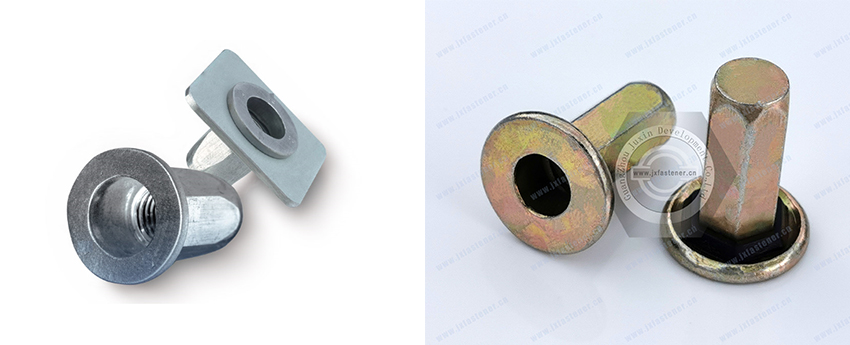
Blind rivet nuts and studs are threaded fastening components designed to be installed from one accessible side of a component.
Unlike conventional nuts that require access to the rear side of the workpiece, a blind rivet nut creates a threaded connection within the parent component through controlled deformation of the fastener body.
A blind rivet stud provides a fixed external threaded stud after installation.
This fastening principle is particularly useful for:
Thin sheet metal
Closed profiles
Automotive components
Plastic molded parts
Electrical and electronic housings
Enclosures
Brackets
Composite or lightweight components
Assemblies with restricted rear access
For OEM applications, the geometry of the fastener can be modified to address specific requirements for sealing, anti-rotation, load distribution, corrosion resistance, installation, and dimensional control.
With knurls on the body and under the extra-large head, this fastening improves mechanical properties in soft workpieces. Guarantees the best match of blind rivet nuts to plastic workpieces. Zinc-nickel surface treatment provides optimum corrosion resistance. | 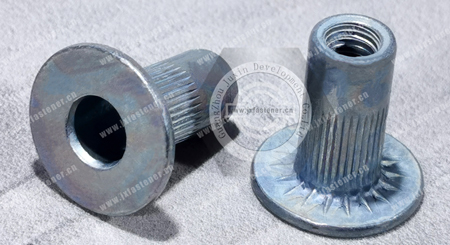 |
| The hexagonal body, thread For fastening motor vehicle safety belts, increased resistance to turning, very high mechanical loading capacity, and a zinc-nickel surface treatment provide optimum corrosion resistance. | 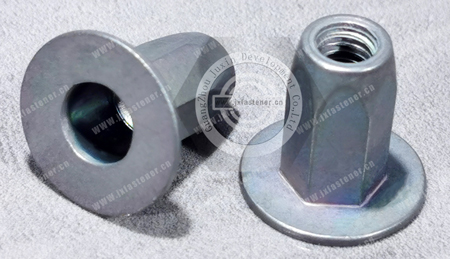 |
Automotive assemblies frequently combine steel, aluminum, plastics, molded components, coated surfaces, and complex enclosed structures.
These components may require threaded fastening points without adding welding operations or increasing the thickness of the parent material.
Juxin Fasteners develops automotive blind rivet nuts and studs for application-specific requirements such as:
Body components
Interior assemblies
Seat components
Safety-related fastening applications
Trim components
Brackets
Plastic molded components
Automotive enclosures
Electrical assemblies
Fluid-related components
For automotive applications, the rivet nut or stud can be designed around the required thread, installation geometry, anti-rotation performance, corrosion protection, sealing requirements, and available assembly space.
Where required, zinc-nickel surface treatment can be considered for enhanced corrosion protection.
Benefits: ● Huge flange diameters possible ● Deformation area for length adjustment of the insert; close length tolerances < L ± 0.05 mm ● Torque resistance by hexagonal design or knurls ● Pull out resistance by providing significant undercuts ● No metal-cutting operation ● Also feasible as a compression limiter | 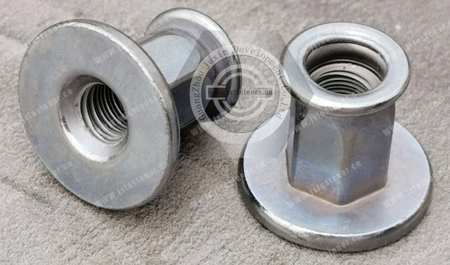 |
Some applications require a threaded fastening point while also controlling the passage of water, gas, liquids, dust, or other environmental contaminants.
Juxin Fasteners provides closed-end blind rivet nuts with integrated sealing features for applications requiring sealed threaded connections.
The seal can be positioned in a groove beneath the fastener head.
Depending on the application, sealing requirements can be evaluated against the specified environmental conditions, including temperature and exposure to the relevant medium.
For applications where a specified ingress protection level is required, the complete assembly should be validated against the applicable customer and system requirements.
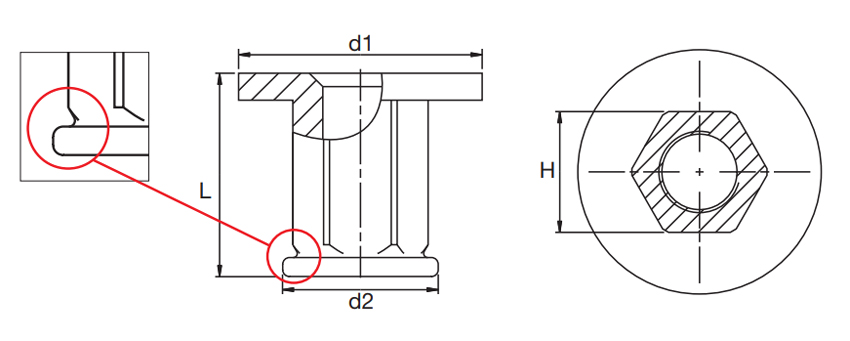
An embedded or molded captive seal can provide a controlled sealing interface between the fastener head and the parent component.
Compared with a conventional loose O-ring arrangement, an integrated seal can simplify component handling and assembly.
Potential advantages include:
Captive sealing element
Controlled seal positioning
Improved assembly consistency
Reduced risk of loose seal components
Integration with the fastener head
Suitability for application-specific sealing requirements
This design can be considered for automotive components such as car boot hinges and other assemblies requiring a sealed threaded fastening point.
A closed-end blind rivet nut provides a threaded fastening point while incorporating a closed rear end.
Closed-end designs can be evaluated where the application requires separation between the threaded cavity and the opposite side of the component.
Typical application considerations include:
Moisture exposure
Fluid exposure
Dust protection
Enclosed assemblies
Automotive components
Electrical equipment
Sealed housings
The complete joint design should always be evaluated when a gas- or water-tight connection is required.
One of the most important design considerations for a blind rivet nut is resistance to rotation during screw installation and service.
Juxin Fasteners can provide hexagonal body designs, knurled bodies, ribs, and under-head features to increase mechanical engagement with the parent material.
These features are particularly useful for:
Soft materials
Plastic components
Sheet metal
Molded parts
Automotive components
Industrial equipment
A hexagonal body provides mechanical engagement with the surrounding hole and can improve resistance to rotation.
Knurled or ribbed body configurations can provide additional mechanical engagement, particularly in softer workpieces.
Ribs beneath an enlarged head can improve mechanical interlocking between the fastener and the parent material.
The correct geometry should be selected according to the parent material, hole design, installation process, required torque resistance, and expected service loads.
Plastic components can present different fastening challenges compared with steel or aluminum sheet metal.
Directly forming threads in a molded plastic component may not provide the required durability for repeated assembly and disassembly.
Custom blind rivet nuts and molded inserts can provide a dedicated threaded connection while improving mechanical engagement with the plastic substrate.
Juxin Fasteners can develop fasteners featuring:
Knurled bodies
Ribs beneath the head
Large flange diameters
Undercut geometries
Customized lengths
Application-specific head configurations
These designs can improve the mechanical connection between the threaded insert and plastic workpiece.
For plastic components, the insert geometry should be selected according to the plastic material, mold design, hole configuration, installation process, required torque, and expected axial loading.
A standard fastener head may not always provide the required bearing area for a soft or lightweight substrate.
For these applications, large flange blind rivet nuts can increase the bearing area beneath the head.
Potential advantages include:
Increased load distribution
Reduced localized stress
Improved engagement with soft materials
Greater design flexibility
Compatibility with customized component geometries
Large flange configurations can be particularly useful in plastic and lightweight components.
The appropriate flange diameter should be determined according to the parent material, component geometry, available space, and required mechanical performance.
Juxin Fasteners can provide double-flange and application-specific insert designs for applications requiring enhanced mechanical engagement and controlled dimensional performance.
Double-flange configurations can provide:
Improved anti-rotation performance
Enhanced clamping
Increased load distribution
Controlled insertion
Repeatable positioning in high-volume production
Steel versions can be produced through cold forming, with the component geometry adapted to the required application.
For specified designs, component length can be controlled according to the required mold or assembly dimensions.
Where applicable, production tolerances can be developed according to the customer's drawing and technical specification.
Some application-specific inserts use a deformation area that allows the installed length or engagement geometry to accommodate the dimensions of the surrounding component or mold.
This approach can provide greater flexibility when the insert is integrated into molded or formed components.
Potential benefits include:
Application-specific length adjustment
Improved adaptation to component geometry
Controlled installation
Reduced need for additional machining
Integration with molded components
This can be especially useful for plastic molded components and complex OEM assemblies.
One advantage of blind rivet nut installation is that it creates a threaded fastening point without requiring a conventional metal-cutting threading operation in the parent component.
This can simplify the manufacturing process where the parent component is:
Thin sheet metal
Plastic
Lightweight material
Enclosed
Difficult to machine after forming
The fastening method can therefore be incorporated into an assembly process where conventional tapping or rear-side nut installation would be difficult.
Electronics and electrical assemblies often require compact threaded fastening points in housings, panels, brackets, and molded components.
Custom rivet nuts and threaded inserts can be developed for:
Electronic housings
Electrical enclosures
Control equipment
Communication equipment
Cable management components
Mounting brackets
Plastic housings
Instrumentation equipment
Engineering considerations may include:
Available installation space
Thread size
Component material
Wall thickness
Torque requirements
Anti-rotation requirements
Corrosion environment
Assembly method
Application-specific blind rivet nuts can provide repeatable threaded mounting points while reducing the need for conventional rear-side nuts or additional machining.
Industrial equipment manufacturers often require fastening components that integrate with specific housings, frames, brackets, covers, and production processes.
Juxin Fasteners develops custom blind rivet nuts and studs for:
Industrial machinery
Automation equipment
Electrical cabinets
HVAC equipment
Sheet metal assemblies
Equipment housings
Control panels
Industrial enclosures
Mounting brackets
Custom geometry can help address requirements that cannot be efficiently solved with a standard catalog fastener.
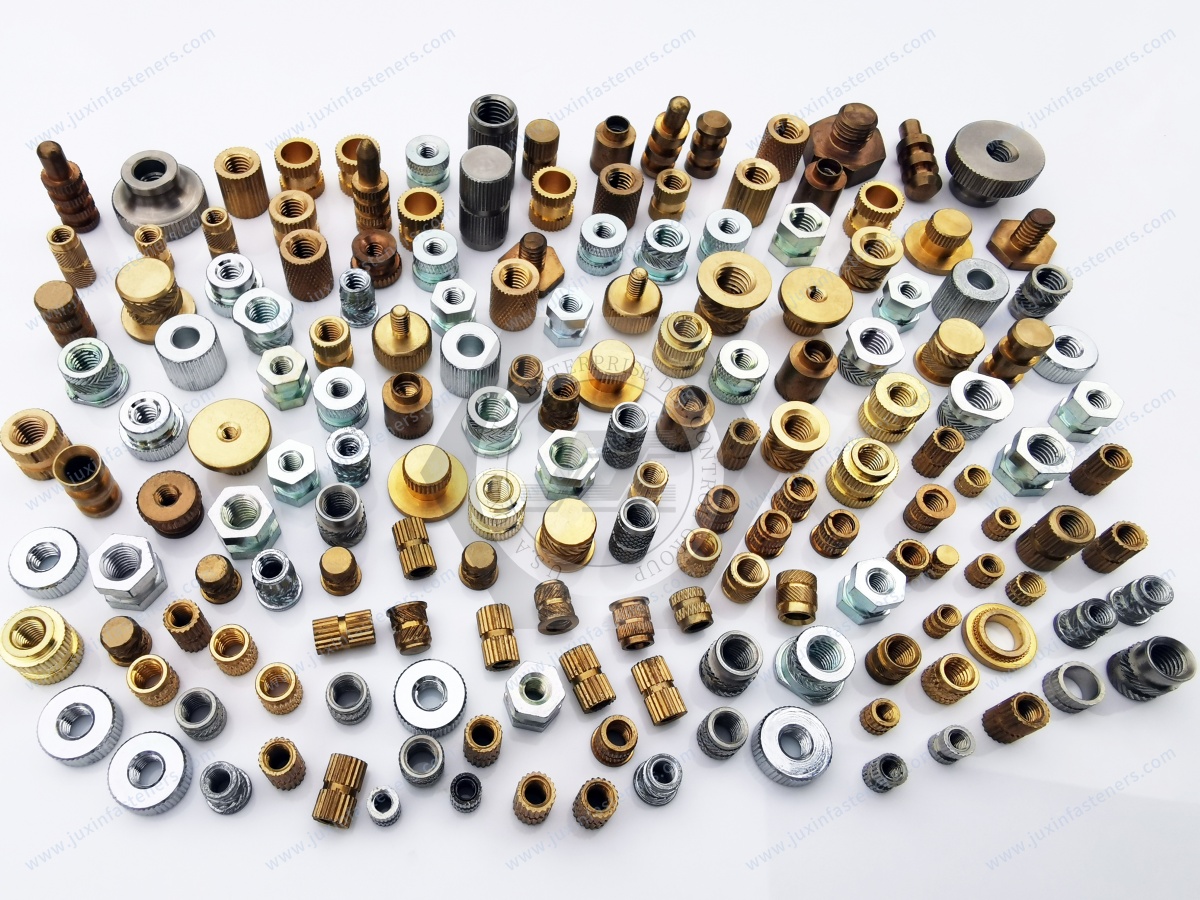
Medical equipment and related precision assemblies may require compact threaded fastening points in molded plastics, sheet metal, and specialized housings.
Custom threaded inserts can be considered for:
Equipment housings
Instrument assemblies
Medical device components
Plastic molded parts
Mounting systems
For medical applications, material, dimensional, cleanliness, validation, and regulatory requirements should be defined by the customer's application and applicable standards.
Fluid-related equipment may require threaded fastening points together with environmental sealing.
Custom blind rivet nuts and studs can therefore be developed with features such as:
Closed ends
Integrated seals
Large bearing heads
Application-specific geometries
Corrosion-resistant surface treatments
Applications may include equipment housings and components where the fastening point is exposed to moisture, fluids, or other environmental conditions.
The complete assembly should be tested against the required pressure, temperature, media compatibility, and sealing performance.
For applications exposed to demanding environmental conditions, surface treatment is an important part of fastener selection.
Zinc-nickel surface treatment can be specified for suitable steel blind rivet nuts and studs where enhanced corrosion protection is required.
This can be considered for applications such as:
Automotive components
Outdoor industrial equipment
Electrical enclosures
Machinery
Transportation equipment
The appropriate coating and corrosion protection system should be selected according to the application environment and customer specification.
Juxin Fasteners can evaluate a wide range of design variables for OEM projects.
Possible configurations include:
Standard heads
Large flange heads
Application-specific head diameters
Head configurations designed for molded components
Possible configurations include:
Round body
Hexagonal body
Knurled body
Ribbed body
Undercut body
Application-specific deformation zones
Metric and other thread requirements can be evaluated according to the customer's drawing and application.
For certain application-specific designs, M4 to M12 configurations can be developed according to project requirements.
Custom component lengths can be developed according to the assembly or mold dimensions.
For specific designs, component length and tolerance should be confirmed against the customer's technical drawing.
Options may include integrated sealing elements or closed-end configurations depending on the application.
Surface treatments can be selected according to:
Corrosion requirements
Parent material
Environmental exposure
Automotive requirements
Customer specifications

Before specifying a custom blind rivet nut or stud, procurement and engineering teams should provide as much application information as possible.
Specify whether the fastener will be installed into:
Steel
Stainless steel
Aluminum
Plastic
Molded polymer
Composite or other material
The actual component thickness or mold geometry should be provided.
Define:
Thread size
Thread pitch
Internal or external thread
Required thread length
Confirm whether installation is possible from:
One side
Both sides
An enclosed section
A molded component
Specify the expected installation torque and service loading where available.
The expected axial load should be considered when selecting the insert geometry and undercut design.
Where high installation torque or service torque is expected, specify the required resistance to rotation.
Provide information about:
Temperature
Moisture
Water
Chemicals
Salt exposure
Pressure
Vibration
If the assembly must resist water, gas, or fluid penetration, define the required sealing performance and applicable validation standard.
Production volume helps determine the most appropriate manufacturing process, tooling strategy, inspection method, and packaging solution.
Juxin Fasteners approaches custom fasteners as an engineering and manufacturing project, rather than simply a modified catalog product.
Our team can review:
Customer drawings
2D and 3D files
Material requirements
Thread specifications
Component dimensions
Installation method
Tooling requirements
Surface treatment
Sealing requirements
Annual volume
Packaging specifications
The manufacturing approach can then be developed around the required application and production conditions.
For automotive and industrial customers, repeatability is essential.
Custom blind rivet nuts and studs may require controlled dimensional characteristics such as:
Overall length
Head diameter
Head thickness
Thread dimensions
Body diameter
Deformation area
Flange dimensions
Seal position
Anti-rotation features
For specific projects, dimensional tolerances are established according to the approved engineering drawing and customer specification.
This approach allows the fastener to be integrated into high-volume production with consistent assembly performance.
Juxin Fasteners operates according to ISO 9001 quality management requirements and can establish inspection controls according to customer specifications.
Depending on the application, quality control can include:
Dimensional inspection
Thread inspection
Visual inspection
Material verification
Surface treatment inspection
Seal inspection
Installation testing
Torque testing
Pull-out testing
Batch traceability
For automotive and other demanding OEM applications, inspection requirements can be defined during the product development stage.
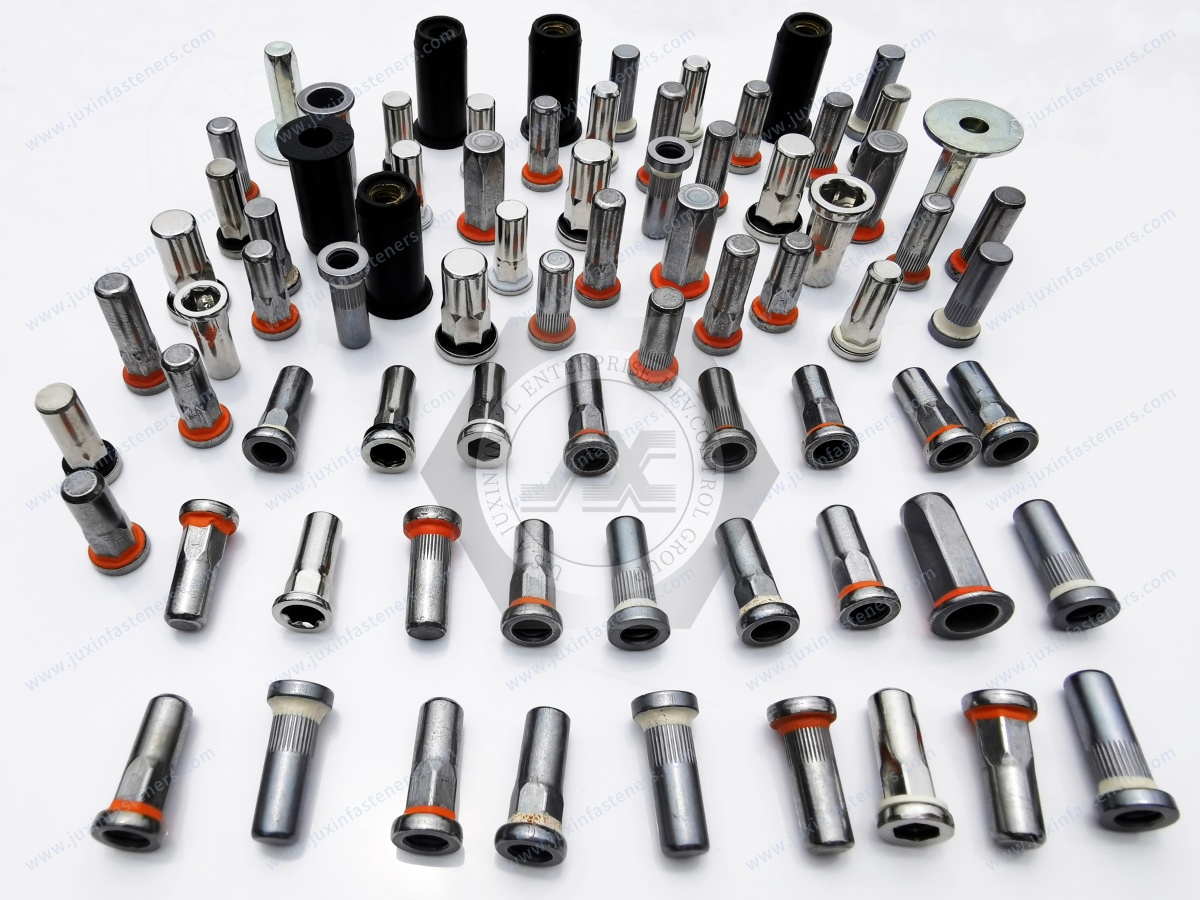
We design the fastening component around the customer's actual assembly rather than forcing the application to fit a standard product.
Head diameter, body configuration, flange design, length, deformation area, knurling, ribs, and other features can be evaluated according to the application.
Closed-end and integrated sealing configurations can be developed for applications requiring environmental protection.
Hexagonal bodies, knurling, ribs, and undercut features can improve mechanical engagement and resistance to rotation.
Our custom fastening solutions support automotive, industrial, electronics, plastics, medical technology, fluid-related, and other manufacturing applications.
Juxin Fasteners supports the complete process from engineering review and sample development through production, inspection, packaging, and international supply.
Our application-specific threaded fastening solutions can be considered for:
Body components
Interior systems
Seat components
Safety-related assemblies
Trim
Brackets
Plastic components
Battery-related enclosures
Electrical components
Cable management
Brackets
Service panels
Lightweight assemblies
Equipment housings
Machine guards
Access panels
Mounting brackets
Automation equipment
Electrical cabinets
Electronic housings
Control panels
Communication equipment
Instrumentation
Molded components
Plastic housings
Structural plastic assemblies
Automotive plastic parts
Equipment housings
Instrument assemblies
Precision molded components
Fluid equipment
Sealed housings
Components requiring environmental sealing
HVAC
Rail transit
Sheet metal fabrication
Renewable energy equipment
Specialty equipment
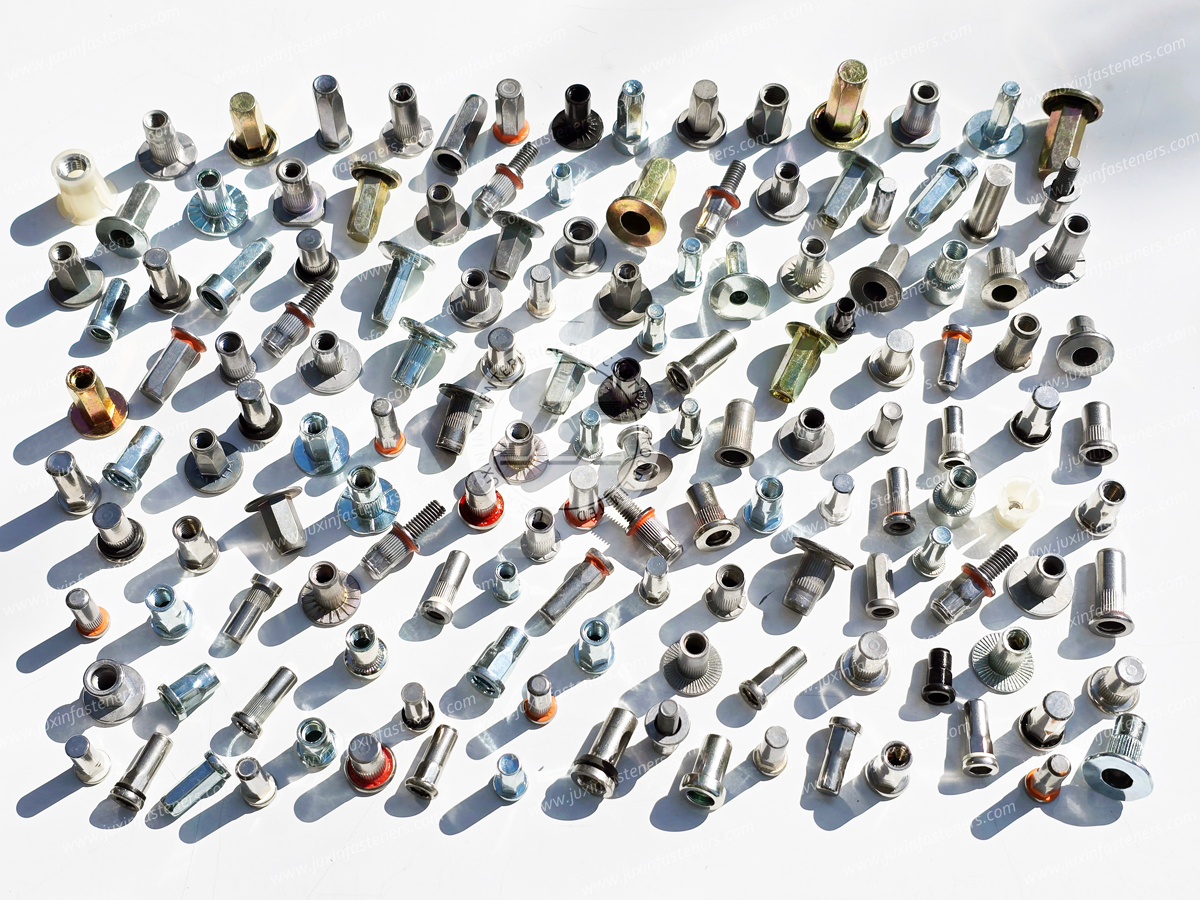
If your application requires a threaded connection that cannot be solved efficiently with a standard fastener, Juxin Fasteners can review the application and develop a custom blind rivet nut, blind rivet stud, sealed rivet nut, anti-rotation insert, or application-specific threaded insert.
Send us your:
Engineering drawing
2D or 3D file
Thread specification
Parent material
Material thickness
Required dimensions
Installation method
Torque or load requirements
Sealing requirements
Surface treatment
Annual quantity
Our engineering team can evaluate the application and recommend an appropriate fastening design.
Juxin Fasteners
OEM Custom Fastening Solutions
Email: info@juxinfasteners.com
 MORE NEWS
Sep. 25, 2026
Sep. 25, 2026
Sep. 25, 2026
Contact Us
Tel.:
+86 020 8621 0320
+86 020 3121 6067
E-mail:
Technical Support:
Navigation
SEND INQUIREY