
Call Us
+86 136 6007 9809
Call Us
+86 136 6007 9809

Jan. 15, 2024
How to Select Blind Rivet Nuts and Materials for EV Battery Housing Applications
Blind rivet nuts are widely used fastening solutions in industries where access is available from only one side of the workpiece. They provide reliable threaded connections in thin sheets, hollow sections, and lightweight structures.
With the rapid growth of the electric vehicle (EV) industry, blind rivet nuts are increasingly used in electric vehicle battery housings, battery modules, and structural enclosures, where high strength, corrosion resistance, and sealing performance are critical.
This guide explains how to select the right blind rivet nut type, material, and sealing technology for demanding applications such as new energy vehicle battery systems.
The "pull method" comprises Spin on, 1. Insert, 2—upset, 3. and Spinoff, 4. cycles.
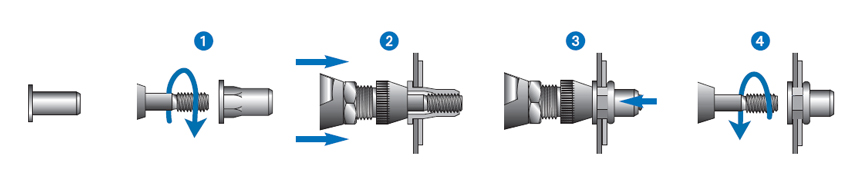
Selection criteria for blind rivet nut Selecting the body.
Hexagonal body A hexagonal body in a hexagonal hole ensures the blind rivet nut has the best resistance to over-torque turning. | 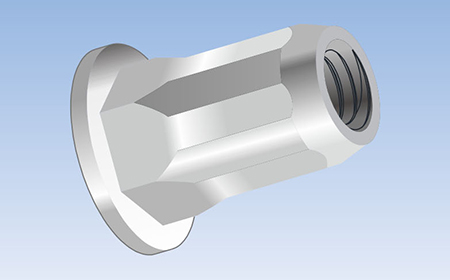 |
Round body, knurled or plain For use where a hexagonal hole is not possible. The knurled version is preferred to the smooth, particularly for plastic or soft materials (aluminum, PA, SMC, etc.). | 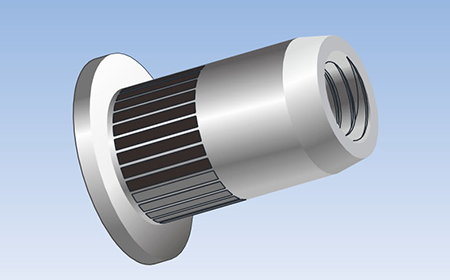 |
Open-end This is the most common option due to its compact form and the free choice of screw length. | 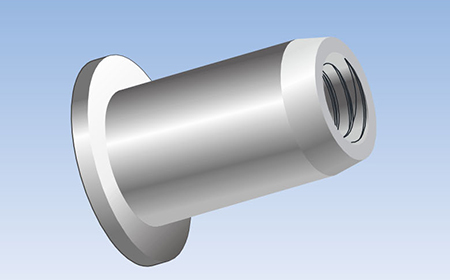 |
Closed-end For all uses where no liquid is to be allowed to pass between the screw and the blind rivet nut. To form a pressure-tight seal between the blind rivet nut and the workpiece, we manufacture blind rivet nuts with a seal on the bodyside (see example on page 112). | 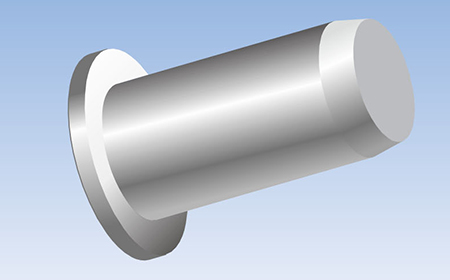 |
Hexagonal body, flat head "Advantages: 1. Very high turning resistance 2. Suitable for soft components (aluminum, plastic,...) 3. High crimping force 4. screw length can be varied (open end) 5. Splash-proof closed-ended)" | 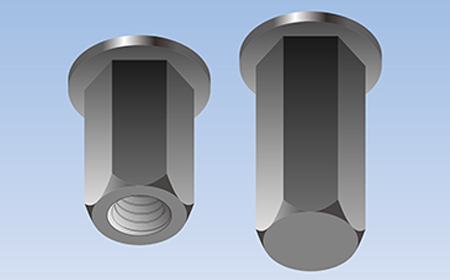 |
1. Selecting Blind Rivet Nuts Based on Workpiece Thickness
The first step when choosing a blind rivet nut is to determine the parent material thickness.
Each blind rivet nut has a specified grip range, which defines the minimum and maximum material thickness that can be properly fastened.
Selection guidelines:
Measure the thickness of the base material accurately.
Ensure the thickness falls within the recommended grip range.
If two rivet nuts fall within the acceptable tolerance range, choose the shorter grip range model, especially when working with complex components or confined installation spaces.
For soft materials or plastic components, such as engineering plastics used in electrical housings, a larger upset area on the blind side is recommended. This increases the contact surface and significantly improves the joint's mechanical strength and load distribution.
Common parent materials include:
Aluminum sheet
Thin steel sheet
Composite materials
Engineering plastics
2. Selecting the Right Rivet Nut Material
Blind rivet nuts are typically manufactured in the following materials:
Carbon Steel
High strength
Cost-effective
Ideal for structural assemblies
Aluminum
Lightweight
Good corrosion resistance
Suitable for lightweight components
Stainless Steel
Excellent corrosion resistance
High durability in harsh environments
Widely used in food processing, marine equipment, and automotive components
The correct material should be selected based on:
Required mechanical strength
Environmental exposure
Corrosion resistance
Compatibility with the parent material
For demanding environments such as electric-vehicle battery enclosures, stainless steel rivet nuts are often preferred for their excellent corrosion resistance and long-term reliability.
Brass and specialized alloys can also be supplied for applications requiring enhanced electrical conductivity or corrosion resistance.
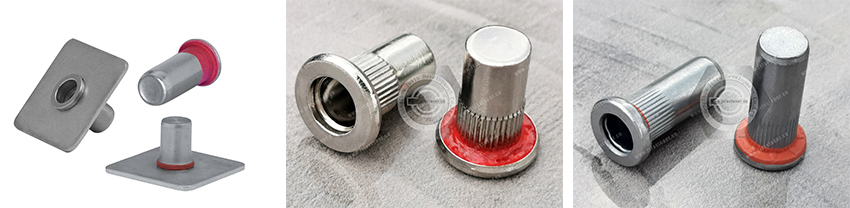
Waterproof, Coating and heating 150°C
"Advantages:
1. Integrated sealing function
2. Pre-applied seal
3. Stable tensile strength in the mating screw."
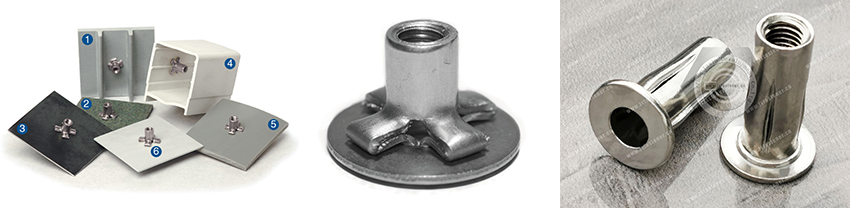
3. Slotted Blind Rivet Nuts for Maximum Pull-Out Resistance
For applications requiring high pull-out strength, slotted shank blind rivet nuts provide an effective solution.
These rivet nuts are specifically designed for installation in:
Plastic components
Hollow sections
Thin sheet metals
Lightweight structural assemblies
During installation, the slotted shank expands into four “petals” on the blind side of the workpiece. This creates a significantly larger bearing surface and improves load distribution.
Key Advantages
Large clamping area for higher pull-out resistance
Reinforced bearing surface that strengthens thin materials
Minimal radial stress during installation, reducing the risk of cracking in weak materials
Suitable for soft materials and thin sheet applications
Available thread sizes typically include:
M4 – M12
Standard materials include carbon steel, with aluminum and stainless steel available upon request.
4. Sealed Blind Rivet Nuts for EV Battery Systems
In electric vehicles, the battery pack is the core component of the entire power system. Ensuring reliable sealing and structural integrity of the battery housing is critical for vehicle safety.
Blind rivet nuts equipped with Seal Ring Technology are increasingly used in EV battery pack assemblies.
These rivet nuts feature a pre-installed sealing ring, enabling fast, reliable installation even in automated assembly processes such as blow-feed systems.
Key Benefits
Integrated sealing ring for reliable sealing performance
Suitable for high-volume automated production
Metal-to-metal fastening ensures long-term structural stability
Protection against dust, moisture, and fluid intrusion
The sealed fastening points meet stringent automotive industry sealing standards, including requirements consistent with IP67 protection levels.
5. Rivet Nut Applications in New Energy Vehicle Battery Housings
Blind rivet nuts play a critical role in the assembly of electric vehicle battery systems, particularly in:
Battery pack housings
Battery module frames
Cooling plate assemblies
Battery cover plates
Structural mounting brackets
In these applications, rivet nuts provide:
Reliable threaded connections in thin aluminum battery housings
Strong fastening without damaging lightweight materials
Sealed fastening points to prevent electrolyte or moisture ingress
Battery packs must pass strict leakage and sealing tests to ensure safety during vehicle operation. Proper sealing is essential to prevent contamination, moisture ingress, or electrolyte leakage that could affect battery performance.
Fasteners used in these assemblies must therefore meet high automotive-quality standards and provide IP67-level sealing performance.
6. Reliable Fastening Solutions for the EV Industry
As electric vehicle production continues to grow globally, manufacturers require fastening solutions that combine:
High structural strength
Corrosion resistance
Reliable sealing performance
Compatibility with lightweight materials
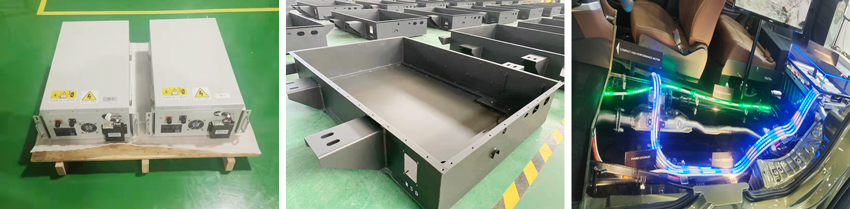
Blind rivet nuts with sealing technology provide an ideal solution for EV battery housing assemblies, ensuring both structural reliability and environmental protection.
With extensive experience in industrial fastening solutions, Juxin Fasteners provides a wide range of blind and sealed rivet nuts, as well as customized fastening solutions, designed to meet the strict requirements of the automotive and new energy industries.
 MORE NEWS
Contact Us
Tel.:
+86 020 8621 0320
+86 020 3121 6067
E-mail:
Technical Support:
Navigation
SEND INQUIREY