
Call Us
+86 136 6007 9809
Call Us
+86 136 6007 9809

Feb. 27, 2023
When joining structural hollow profiles, closed sheet metal channels, or multi-material assemblies, double-sided access is rarely feasible.
Traditional solid rivets require backing anvils, while spot welding introduces thermal distortion and surface damage.
Threaded nuts may also create additional assembly steps and can be unsuitable where access to the rear side of the panel is limited.
Industrial blind rivets solve this access problem by allowing a permanent mechanical joint to be installed from one side of the assembly.
A blind rivet consists of a tubular rivet body and a central mandrel.
During installation, the rivet body is inserted through a pre-drilled or punched hole and a pulling tool applies axial force to the mandrel.
The mandrel deforms the blind side of the rivet body, creating a mechanical interlock behind the workpiece.
Once the predetermined installation condition is reached, the mandrel breaks at its designed break point.
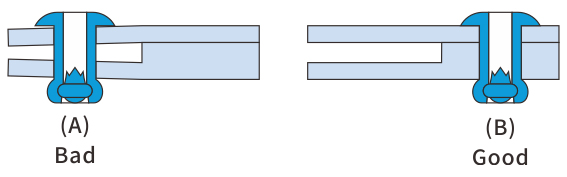
This makes blind rivets particularly valuable for sheet metal, structural profiles, automotive components, EV assemblies, electronics,
HVAC equipment, telecom cabinets, and other applications where only one side of the joint is accessible.
For engineers, correct blind rivet selection depends on joint geometry, grip range, shear and tensile requirements, hole diameter, edge distance, material compatibility, and installation conditions.
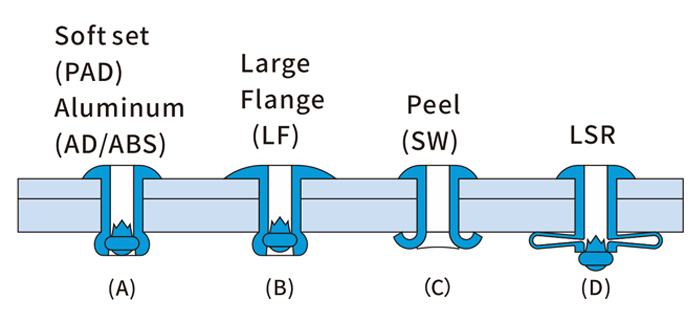
For procurement teams, selection also involves multi-grip inventory consolidation, supplier cross-reference, quality documentation, batch traceability, production capacity, and total cost of assembly.
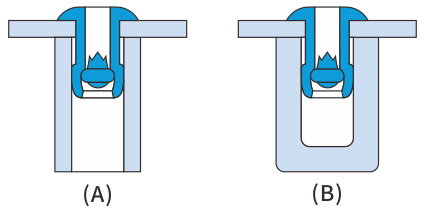
To prevent joint shear fatigue, sheet tear-out, premature mandrel failure, or galvanic degradation, structural and design engineers should evaluate the complete joint geometry before selecting an industrial blind rivet.
The three fundamental design parameters are:
Edge distance
Rivet pitch
Grip range
These parameters directly influence the ability of the blind rivet to develop a stable mechanical interlock and transfer the applied load into the parent material.
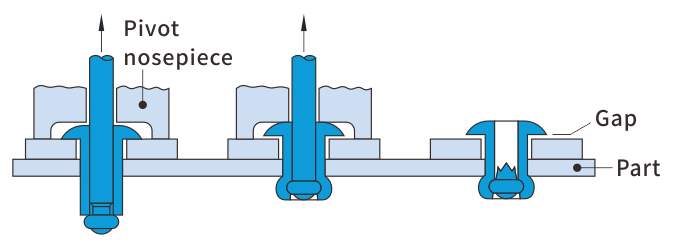
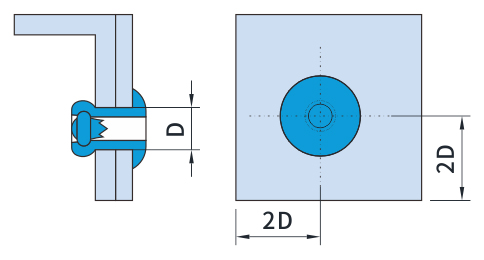
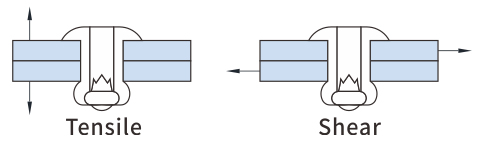
Installing blind rivets too close to the edge of a component can increase the risk of parent-material shear rupture or local deformation.
Conversely, placing rivets too close together can cause overlapping stress fields and reduce the effective load distribution of the joint.
Minimum Edge Distance (Emin):
Maintain a distance of at least twice the nominal rivet body diameter (D) from the hole center to the workpiece edge:
Emin ≥ 2 × D
Recommended Pitch Spacing (P):
Spacing between adjacent rivet centers should equal approximately three times the body diameter to distribute tensile loads more uniformly:
P ≈ 3 × D
These values provide a practical starting point for DFM design.
Final dimensions should be verified against the specific blind rivet manufacturer's recommendations, parent material, sheet thickness, and joint loading conditions.
Grip range is the certified total material thickness over which a specific blind rivet length can properly form the blind-side head and establish the required clamping condition.
The calculated grip includes all materials being joined:
Calculated Grip = T1 + T2 + Tsealant/interlayer + Gassembly gap
Where:
T1 = thickness of workpiece 1
T2 = thickness of workpiece 2
Tsealant/interlayer = thickness of any coating, gasket, adhesive, or intermediate material
Gassembly gap = any permitted assembly gap
Selecting the correct grip range is essential.
Information Gain — Engineering Risk Warning:
Under-gripping can result in incomplete blind-side head formation and reduced tensile capacity.
Over-gripping can cause the rivet shank to buckle outside the hole, leading to loose joints, lateral movement, and reduced shear strength.
For this reason, engineers should calculate the actual joint stack-up rather than selecting a blind rivet based only on nominal sheet thickness.
       [ Single-Sided Pulling Tool Nosepiece ]
                       |
                       v
     +-----------------------------------+
     |        DOMED RIVET HEAD           |
   ==+==============+=====+==============+==  <-- Workpiece Panel 1 (T1)
     |              |     |              |
     |              |     |              |    <-- Workpiece Panel 2 (T2)
   ==+==============+=====+==============+==  <-- Total Grip = T1 + T2
     |  (DISPLACED  |     |  EXPANDED    |
     |   BLIND-SIDE |     |   RIVET      |
     |   BULB)      |     |   BODY)      |
     +--------------+-----+--------------+
                    |
                    +-- [ Retained Mandrel Head ]
The illustration shows how the blind-side portion of the rivet expands behind the joined materials during installation.
This mechanical deformation creates the clamping action that allows a blind rivet to form a permanent joint without requiring access to the rear side of the assembly.
When dissimilar metals are joined in the presence of an electrolyte such as moisture, coastal salt spray, or industrial air, galvanic corrosion can accelerate degradation of the less noble anodic material.
Material selection is therefore an important part of blind rivet engineering.
The rivet body, mandrel, and parent sheet should be evaluated as a complete material system.
| Parent Material / Substrate | Primary Corrosion Risk | Recommended Rivet Material Combination | Preferred Head Style | Key Application Benchmark |
|---|---|---|---|---|
| Aluminum Alloys (5000/6000 Series) | Low to Moderate | Aluminum Body / Steel Mandrel or All-Aluminum (Soft-Set) | Large Flange / Dome Head | EV battery trays, trailer side walls |
| Mild Carbon Steel (Zinc Plated) | Surface Rust | Zinc-Plated Steel Body / Steel Mandrel | Dome / Countersunk 120° | HVAC ducting, switchgear cabinets |
| 304 / 316 Stainless Steel Sheet | High Severe Galvanic | 316 Stainless Body / Stainless Mandrel | Dome / Large Flange | Chemical tanks, outdoor telecom racks |
| Marine & Salt-Spray Environments | Extreme Pitting | Monel (Nickel-Copper) Body / Steel Mandrel | Closed-End Dome | Marine hardware, offshore platforms |
| Frangible Plastics & Composites | Surface Cracking / Crazing | Soft-Set Aluminum / Peel / LSR Rivets | Large Flange Head | Automotive interior trims, composite panels |
Always evaluate the material compatibility between the rivet and parent sheet.
If carbon steel blind rivets are installed into aluminum sheets in a wet or salt-contaminated environment, the aluminum panel can act as the sacrificial anode and corrosion may accelerate around the fastener hole.
For outdoor, marine, EV, and chemically exposed assemblies, material selection should therefore consider:
Parent material
Rivet body material
Mandrel material
Surface treatment
Environmental exposure
Electrical isolation requirements
Presence of moisture or electrolytes
For critical applications, corrosion testing or application-specific validation should be performed before production release.
Not all blind rivets are designed for the same mechanical or environmental requirements.
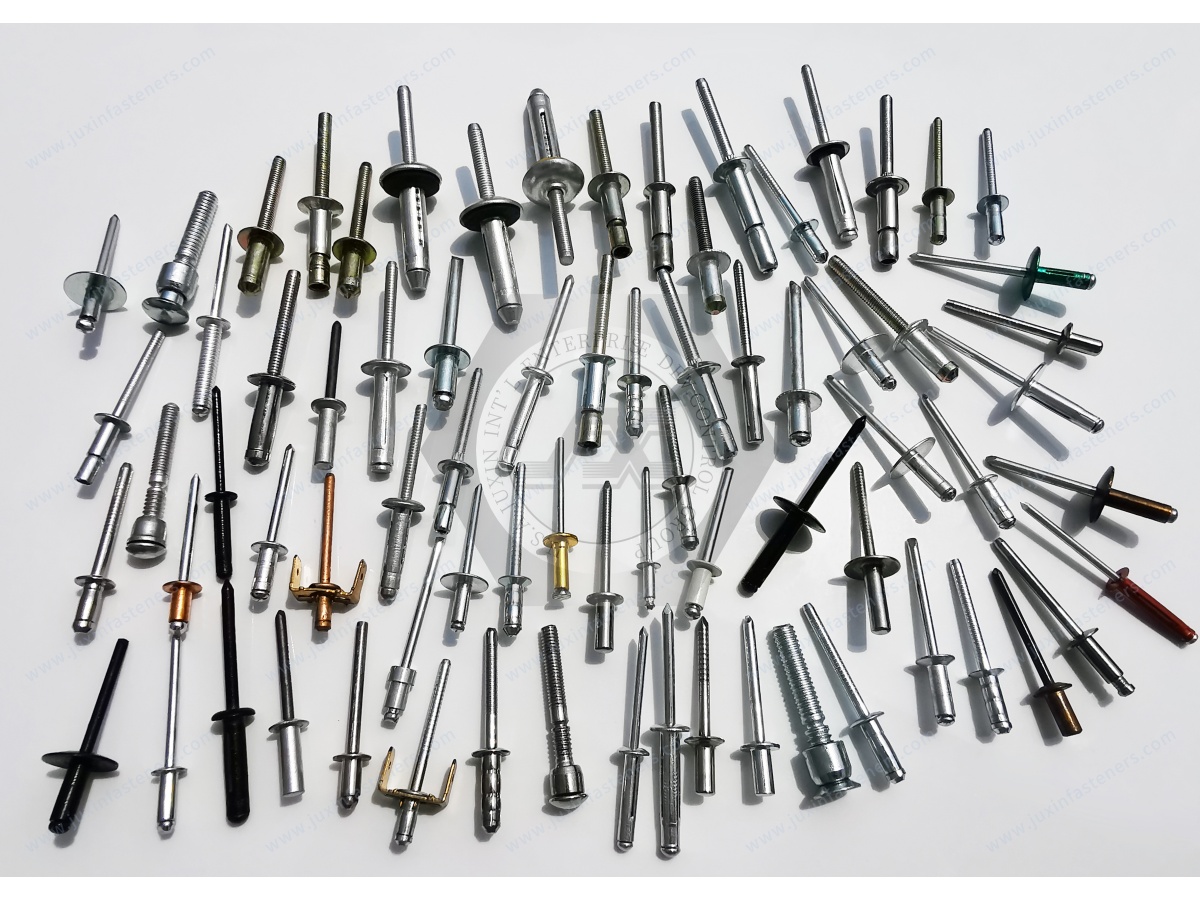
Open-end blind rivets, closed-end blind rivets, micro blind rivets, pull-thru rivets, soft-set rivets, and multi-grip structural blind rivets each solve different engineering problems.
| Rivet Type Series | Structural Feature | Mechanical Capability | Leakage & Seal Rating | Primary Target Application |
|---|---|---|---|---|
| Open-End Standard | Pre-assembled tubular body on headed mandrel | General-purpose clamping; wide diameter/length options | Non-sealed (Permeable) | General sheet metal, commercial signages, HVAC ducts |
| Closed-End (Sealed) | Cup-shaped closed body; 100% mandrel retention | 23% higher tensile strength than open-end equivalent | Watertight & Vapor-Tight up to 100 psi | EV battery enclosures, white goods, outdoor LED screens |
| Micro Blind Rivets | 2.0 mm ultra-miniature aluminum body | Low installation pressure; prevents PCB or thin panel cracking | Non-sealed | Printed circuit boards, compact consumer electronics |
| Pull-Thru (PT) Series | Countersunk double-flush design; mandrel pulls completely through | Blind-side protrusion < 0.4 mm; zero loose stem risk | Non-sealed | Automotive sunroof tracks, cabinet drawers, server slides |
| Soft-Set Alloys | Special low-tensile break aluminum mandrel | Low clamping force; prevents cracking in brittle resins | Non-sealed | Acrylic panels, ABS housings, automotive plastics |
| Multi-Grip / Structural | Wide grip-range body with high-strength ring groove | High shear strength; consolidates multiple stock part numbers | Weatherproof option | Heavy truck frames, rail transport, structural steel |
The correct rivet architecture should be selected according to the required grip range, joint strength, installation access, environmental exposure, cosmetic requirements, and parent material.
Open-end blind rivets are one of the most widely used blind fastening solutions for general industrial assembly.
Their tubular body and mandrel design provides a simple and economical way to join sheet metal from one side.
Typical applications include:
General sheet metal fabrication
HVAC ducting
Electrical cabinets
Signage
Enclosures
Brackets
Light industrial assemblies
Open-end blind rivets are particularly suitable where complete sealing is not a primary requirement.
For applications involving water, vapor, dust, or fluid containment, engineers should consider a closed-end or sealed blind rivet design instead.
Closed-end blind rivets feature a cup-shaped rivet body that encloses the mandrel area.
The closed construction provides additional protection against fluid and vapor passage through the fastener itself.
According to the supplied technical specification, the closed-end design provides:
100% mandrel retention
23% higher tensile strength than the equivalent open-end configuration
Watertight and vapor-tight performance up to 100 psi
These characteristics make closed-end blind rivets particularly attractive for:
EV battery enclosures
Outdoor electrical equipment
White goods
Outdoor LED screens
HVAC equipment
Sealed sheet metal housings
Where an enclosure requires a specific IP rating, the rivet should be considered as one part of the complete sealing system.
The final enclosure rating depends on panel joints, gaskets, cable entries, fastener interfaces, and assembly quality.
Micro blind rivets are designed for applications where conventional blind rivets may be too large or require excessive installation force.
The supplied Micro series uses a 2.0 mm ultra-miniature aluminum rivet body.
Key benefits include:
Compact installation footprint
Low installation pressure
Suitability for thin panels
Reduced risk of cracking delicate components
Application suitability for compact electronic assemblies
Potential applications include:
Printed circuit boards
Compact consumer electronics
Electronic housings
Small brackets
Miniature sheet metal components
For electronics manufacturing, the choice of rivet should also consider blind-side clearance and the potential presence of the retained or broken mandrel.
Pull-Thru (PT) blind rivets are designed for applications where blind-side protrusion and loose mandrel concerns are particularly important.
The countersunk double-flush architecture allows the rivet to sit flush with the assembly surfaces.
The supplied PT series provides:
Blind-side protrusion below 0.4 mm
Complete mandrel pull-through
Zero loose stem risk
Countersunk double-flush installation
Potential applications include:
Automotive sunroof tracks
Cabinet drawers
Server slides
Precision sheet metal assemblies
Applications with restricted internal clearance
This design can be particularly useful where a conventional retained mandrel could interfere with moving components or internal assemblies.
Brittle plastics, acrylic panels, ABS housings, and composite materials can be damaged by excessive installation force.
Soft-set blind rivets use a special low-tensile break aluminum mandrel to reduce the clamping force generated during installation.
Potential applications include:
Acrylic panels
ABS housings
Automotive interior trim
Composite panels
Lightweight assemblies
The objective is to establish a secure mechanical joint while reducing the risk of cracking, crazing, or local deformation of the parent material.
For plastic and composite assemblies, engineers should validate installation force, flange size, hole diameter, and joint compression before production.
Multi-grip blind rivets are designed to accommodate a wider range of material thicknesses.
This can provide an important procurement advantage because a single rivet specification may cover several joint thickness conditions that would otherwise require multiple standard rivet lengths.
Structural blind rivets use enhanced mechanical features such as high-strength ring grooves to improve load transfer and mandrel retention.
Typical applications include:
Heavy truck frames
Rail transport
Structural steel
Aluminum extrusions
Industrial machinery
Automotive structures
For procurement teams, multi-grip blind rivets can also help consolidate inventory and reduce the number of stock part numbers.
Engineering Challenge
EV battery packs, battery enclosures, and chassis modules require fastening systems that can withstand vibration while helping protect sensitive internal components from environmental exposure.
Battery enclosure applications may also require fluid-tight sealing and controlled joint performance.
JUXIN FASTENERS Solution
Closed-End Stainless Steel Rivets provide 100% mandrel retention, a 100 psi hydrostatic pressure seal, and 23% greater tensile strength than standard open rivets according to the supplied product specification.
These characteristics make them suitable for EV battery enclosure applications where sealing and mechanical performance are important.
For other automotive assemblies, structural and multi-grip blind rivets can be selected according to sheet thickness, grip range, and joint loading.
Engineering Challenge
High-density PCB mounting and server slide rails can provide virtually no blind-side clearance.
In these environments, broken mandrel debris or excessive rivet protrusion may interfere with sensitive electronic or moving components.
JUXIN FASTENERS Solution
Micro 2.0 mm Aluminum Rivets and Pull-Thru (PT) Countersunk Rivets provide compact fastening options.
The PT configuration provides blind-side protrusion below 0.4 mm and complete mandrel pull-through according to the supplied technical specification.
The mandrel remains intact during cycle times as fast as 2 seconds, eliminating loose stem debris.
Engineering Challenge
Structural aluminum extrusions may contain internal web channels where conventional riveting equipment cannot easily reach or properly clamp against unsupported internal walls.
JUXIN FASTENERS Solution
Extended Nosepiece Systems paired with Large Flange Multi-Grip Rivets can bridge wide internal gaps and distribute under-head clamping pressure over twice the surface area.
This helps reduce localized deformation and improves load distribution in aluminum extrusion applications.
Potential applications include:
Aluminum profiles
Structural channels
Industrial frames
Transportation structures
Equipment housings
Selecting an industrial blind rivet requires both engineering and procurement considerations.
The engineer is primarily concerned with joint performance and manufacturability.
The procurement manager is concerned with standardization, inventory, supplier reliability, documentation, cost, and production continuity.
Zero Thermal Stress
Unlike spot welding, blind riveting forms a mechanical joint without creating a heat-affected zone (HAZ).
This eliminates welding-related heat input, paint burning, and potential panel distortion.
Hole Tolerances
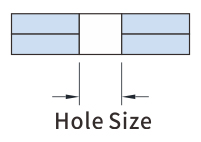
Drill or punch mounting holes according to the recommended hole diameter for the selected blind rivet.
Holes should be properly formed and free from excessive burrs because poor hole conditions can affect installation and premature mandrel breakoff.
Dynamic Shock Capacity
Structural ring-groove rivets provide positive mechanical stem locking and can provide increased resistance to loosening under cyclic mechanical shear.
For highly loaded structural applications, engineers should validate the joint using the required shear and tensile test conditions.
A simplified joint-load evaluation should consider the applied load and the number of effective rivets.
For a uniformly distributed load:
Load per rivet ≈ Total Applied Load / Number of Effective Rivets
The actual allowable joint load depends on:
Rivet shear strength
Rivet tensile strength
Parent sheet strength
Hole diameter
Edge distance
Rivet pitch
Grip range
Bearing stress
Joint configuration
For structural applications, the weakest component of the complete joint should be evaluated rather than relying solely on the rated strength of the blind rivet.
Standardizing on multi-grip blind rivets allows one fastener to cover a wider thickness range.
According to the supplied commercial specification, a multi-grip blind rivet can cover the thickness range of up to three standard rivets, potentially cutting warehouse inventory SKUs by up to 60%.
This can provide procurement advantages including:
Fewer part numbers
Reduced inventory complexity
Lower stocking requirements
Simplified purchasing
Easier production scheduling
Reduced risk of selecting the wrong rivet length
The actual inventory reduction depends on the customer's existing part-number structure and approved grip ranges.
JUXIN FASTENERS blind rivets can be cross-referenced against international dimensional standards including DIN 7337 and IFI-114 where applicable.
This allows procurement teams to evaluate replacement or dual-source options against legacy blind rivet specifications.
Before approving a replacement, engineering should verify:
Rivet diameter
Rivet length
Grip range
Head diameter
Head style
Material
Mandrel material
Break load
Shear strength
Tensile strength
Hole diameter
Surface treatment
For critical applications, drawing and sample validation should be completed before production substitution.
JUXIN FASTENERS operates under an ISO 9001 quality system.
Depending on project requirements, documentation can include:
PPAP Level 3 documentation
Material heat-lot traceability
Shear and tensile test reports
Salt-spray test certifications
Dimensional inspection reports
Material certificates
Surface treatment documentation
Documentation requirements can be defined according to the customer's industry, product specification, and quality system.
When requesting an RFQ from a blind rivet manufacturer or supplier, providing complete technical information can significantly improve quotation accuracy.
The RFQ should ideally include:
Rivet type
Rivet diameter
Rivet length
Head style
Grip range
Rivet body material
Mandrel material
Surface treatment
Number of layers
Individual material thickness
Total grip thickness
Hole diameter
Edge distance
Rivet pitch
Required shear load
Required tensile load
Indoor or outdoor use
Humidity
Salt spray
Chemical exposure
Temperature
Corrosion requirements
Sealing requirements
Inspection standard
PPAP requirements
Material certification
Batch traceability
Salt spray testing
Dimensional inspection
Packaging requirements
This information enables the blind rivet supplier to recommend the correct body architecture, material, grip range, and surface treatment instead of quoting solely from nominal diameter and length.
For OEM applications, choosing a blind rivet manufacturer involves more than comparing unit prices.
A qualified industrial blind rivet supplier should be able to support:
Standard blind rivets
Closed-end blind rivets
Structural blind rivets
Multi-grip blind rivets
Micro blind rivets
Pull-thru rivets
Aluminum blind rivets
Stainless steel blind rivets
Custom configurations
Engineering samples
CAD data
Quality documentation
Batch traceability
International OEM supply
Procurement teams should also evaluate the supplier's ability to maintain consistent dimensional quality, material control, production capacity, and lead-time stability.
JUXIN FASTENERS supports OEM and industrial customers with blind rivets and other industrial fastening solutions for sheet metal, automotive,
EV, electronics, telecom, HVAC, transportation, and machinery applications.
The correct fastening method depends on the structure and assembly process.
| Requirement | Blind Rivets | Solid Rivets | Weld Nuts / Welding | Threaded Fasteners |
|---|---|---|---|---|
| One-Side Access | Excellent | Limited | Depends on process | Depends on configuration |
| Heat Input | None | None | Yes | None |
| Installation | Pulling tool | Bucking / anvil access | Welding equipment | Nut or threaded insert |
| Loose Hardware | No | No | No | Possible |
| Sealed Options | Available | Limited | Depends on design | Depends on assembly |
| Thin Sheet Applications | Excellent | Suitable with access | Suitable with process control | Depends on thread system |
| Multi-Grip Options | Available | Limited | Not typical | Depends on design |
| Automation Potential | High | High | High | High |
Blind rivets are particularly advantageous when the joint can only be accessed from one side and a permanent mechanical connection is required.
Before selecting an industrial blind rivet, engineers and procurement teams should confirm:
Aluminum
Carbon steel
Stainless steel
Plastic
Composite
Mixed-material assembly
Number of layers
Total grip
Hole diameter
Edge distance
Rivet pitch
Blind-side clearance
Shear load
Tensile load
Clamp requirement
Vibration resistance
Dynamic loading
Structural requirements
Water exposure
Salt spray
Humidity
Chemical exposure
Temperature
Corrosion resistance
Sealing requirement
Open-end
Closed-end
Micro
Pull-Thru
Soft-Set
Multi-Grip
Structural
Annual volume
Packaging
Part-number consolidation
Lead time
Quality documentation
PPAP
Batch traceability
OEM customization
This checklist helps prevent one of the most common blind rivet sourcing errors: selecting a rivet that fits the hole but does not provide the correct grip range,
mechanical performance, environmental compatibility, or installation characteristics.
JUXIN FASTENERS provides industrial blind rivets and related fastening solutions for OEM engineering and procurement teams.
Our blind rivet solutions can support applications requiring:
One-side installation
Thin sheet metal assembly
Structural fastening
Sealed joints
Multi-grip capability
Low-clearance installation
Corrosion resistance
Plastic and composite assembly
Automotive and EV fastening
Electronics and telecom assembly
For procurement teams, JUXIN FASTENERS can support standard product sourcing, dimensional cross-reference, custom requirements, prototype samples, quality documentation, and production supply.
For engineering teams, technical evaluation can focus on rivet architecture, material compatibility, grip range, hole geometry, installation conditions, and required joint performance.
Whether you require 3D CAD models for digital assembly validation, test samples for shear and tensile testing, or a high-volume production RFQ,
JUXIN FASTENERS supports global OEM engineering and purchasing teams.
Submit 2D/3D CAD models and joint requirements directly to our technical team.
Accepted technical file formats include:
STEP
IGES
Where available, include:
Joint drawings
Material specifications
Sheet thickness
Grip range
Hole diameter
Required load
Environmental conditions
Existing part number
Email: info@juxinfasteners.com
JUXIN FASTENERS supports customized blind rivet requirements including:
Specialized head geometries
Custom mandrel break loads
Non-standard grip lengths
Custom rivet body configurations
Special material combinations
High-corrosion surface finishes
Zinc-Nickel finishes
Anodizing
Passivation
Other application-specific requirements
Rapid prototype turnaround can be supported according to product configuration, tooling requirements, material, and finishing process.
The correct blind rivet is not selected by diameter and length alone.
A reliable industrial blind rivet joint requires the complete system to be considered:
Parent Material + Hole Geometry + Grip Range + Rivet Architecture + Installation Process + Joint Loading + Environmental Exposure
For engineers, this approach helps prevent sheet tear-out, poor blind-side formation, premature mandrel failure, and incompatible material combinations.
For procurement teams, it provides a framework for evaluating supplier equivalency, multi-grip consolidation, quality documentation, traceability, inventory reduction, and total assembly cost.
JUXIN FASTENERS supplies industrial blind rivets, structural blind rivets, closed-end blind rivets, multi-grip blind rivets, micro blind rivets, pull-thru rivets,
and other sheet metal fastening solutions for global OEM and industrial applications.
For product selection, engineering evaluation, samples, CAD files, cross-reference requests, or OEM sourcing:
JUXIN FASTENERS — Industrial Blind Rivets and OEM Sheet Metal Fastening Solutions for Global Engineering and Procurement Teams.
 MORE NEWS
Sep. 25, 2026
Sep. 25, 2026
Sep. 25, 2026
Contact Us
Tel.:
+86 020 8621 0320
+86 020 3121 6067
E-mail:
Technical Support:
Navigation
SEND INQUIREY