
Call Us
+86 136 6007 9809
Call Us
+86 136 6007 9809

Mar. 21, 2023
Determining the precise exposed thread length of a bolted joint is not merely a cosmetic choice—it directly impacts joint integrity, fatigue life, torque retention under cyclic dynamic loads,
and global compliance across critical industrial assemblies. Engineering teams and procurement specialists often evaluate:
“How many exposed bolt threads are required beyond the nut face to guarantee structural integrity while preventing dynamic self-loosening?”
This technical guide provides a unified synthesis of international standards (ASME B31.3, DIN 78, GB50205, B/ZQ 4247-2006, GB50235), mathematical shear load engagement mechanics,
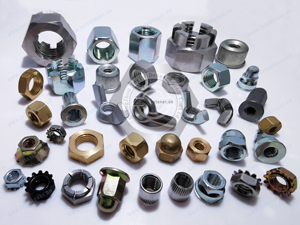
and commercial selection criteria for high-vibration lock nuts and structural weld nuts manufactured by JUXIN FASTENERS.
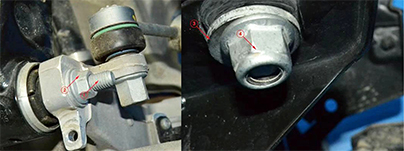 | 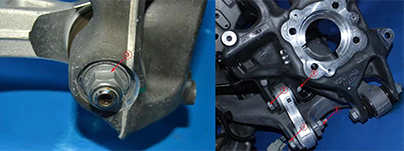 |
Different international engineering standards specify distinct criteria for bolt thread protrusion based on structural risk, dynamic environment, and thermal expansion factors.
| Standard / Standard Body | Target Application Area | Minimum Exposed Threads | Maximum Exposed Threads / Protrusion Limit | Primary Engineering Justification |
|---|---|---|---|---|
| DIN 78 | General Mechanical Engineering & Structural Steel | 2 Threads (Standard Nut) | 3 Threads (Lock Nut); 5 Threads or 0.5 × Bolt Diameter maximum clearance guideline | Guarantees full lead thread engagement and runout clear of chamfer radius. |
| ASME B31.3 | Process Piping & High-Pressure Vessels | 1 Pitch Recessed (Minimum effective engagement = full nut height) | Flush to 3 Pitch Protrusion | Prioritizes complete thread-engagement area within heavy hex nuts under thermal stress. |
| GB50205 | Steel Structure Construction Acceptance | 2 Threads | 4 Threads | Prevents thread stripping during high-clamp preloading. |
| GB50235 | Industrial Metallic Piping Installation | 0 Threads (Flush installation permissible) | 3 Threads | Minimizes space envelope in tight piping manifolds. |
| B/ZQ 4247-2006 | Heavy Machinery & Metallurgy Design | 2 Threads | 4 Threads | Standardizes protrusion length across automated assembly lines. |
| JUXIN FASTENERS Recommended | High-Vibration & Heavy Industrial Assemblies | 2 Threads (Standard) | 3 Threads (Vibration Lock); 5 Threads (Maximum clearance limit) | Maximizes prevailing-torque lock features and prevents first-thread bending shear. |
 |  |  |
In a standard bolt-nut connection, thread load distribution is non-linear. The first 3 engaged threads carry approximately 65% to 75% of the total axial load:
Thread 1 (closest to bearing face): ~34% of load
Thread 2: ~23% of load
Thread 3: ~15% of load
Nut Bearing Face
|
+---> [Thread 1: ~34% Load] <--- Highest shear concentration
+---> [Thread 2: ~23% Load]
+---> [Thread 3: ~15% Load]
+---> [Thread 4+: Decreasing load share]
|
Exposed Threads (2–3 Pitch Protrusion)
Leaving 2 to 3 exposed threads beyond the top nut face ensures that the complete chamfer and runout of the bolt shank are located outside the main tensile load path.
If a bolt terminates flush inside the nut body, the lead chamfer reduces effective thread contact on Thread 1 and Thread 2, leading to local plastic deformation, thread stripping, or localized fatigue failure under fatigue cycling.
 |  |  |
Under transverse dynamic vibration, the relative transverse displacement (Δs) between mating threads causes localized slip.
When transverse slip occurs, the frictional holding torque (Tf) drops toward zero according to the Junker transverse vibration model:
T_total = Fv × (P / 2π + μt × d2 / (2 × cos α) + μb × rb)
Where:
Fv = Axial preload force
P = Thread pitch
d2 = Pitch diameter
α = Flank angle (30° for ISO metric)
μt, μb = Friction coefficients of thread and nut bearing face
rb = Mean bearing radius of the nut face
When vibration reduces the friction component (μt), exposed threads equipped with prevailing-torque features (e.g., nylon rings or distorted metal collars) provide critical residual locking torque.
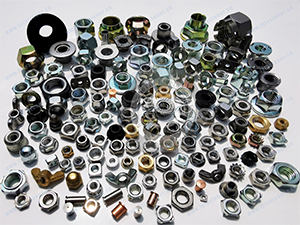
For heavy equipment, automotive chassis, agricultural machinery, and energy infrastructure, standard hex nuts with standard exposure are insufficient to mitigate rotational self-loosening.
JUXIN FASTENERS manufactures engineered locking solutions certified to global standards.
JUXIN FASTENERS SELECTION MATRIX
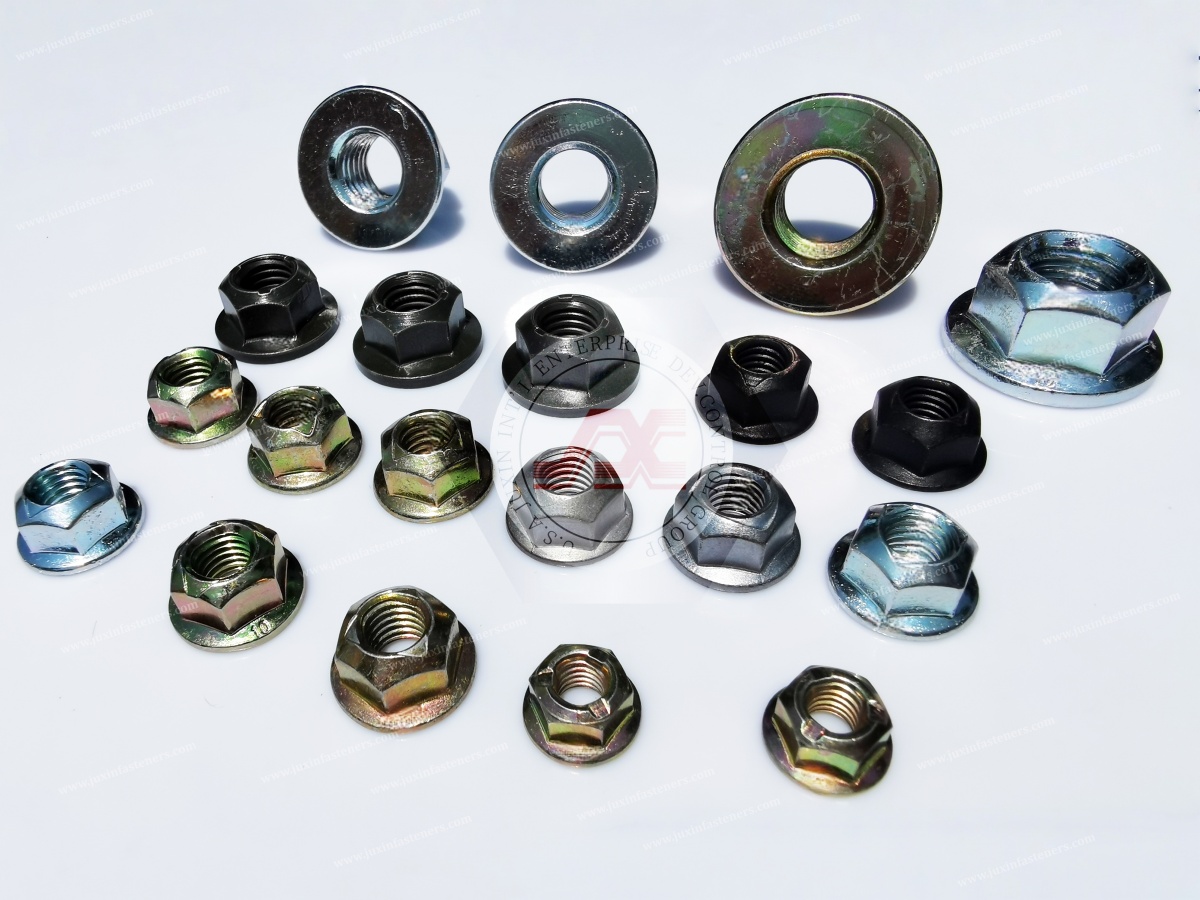
NYLON INSERT LOCK NUTS
Temperature: -50°C to +100°C
Friction-based polymer ring
Non-damaging to mating bolt
DIN 980V ALL-METAL LOCK NUTS
Temperature: -70°C to +300°C
Deformed prevailing-torque metal collar
High tensile structural joints (Grade 8/10)
Operating Temperature Range: -50°C to +100°C
Working Principle: As the bolt passes through the unthreaded polyamide insert, the non-metallic ring deforms elastically,
exerting radial compressive force against the bolt threads to establish permanent friction-locking torque.
Key Advantages:
Reusable up to 5 assembly cycles without loss of prevailing torque.
Non-damaging to surface coatings or plated bolt threads.
Excellent sealing capability against liquid/gas ingress along the thread spiral.
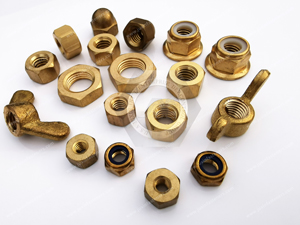
Material & Grade Availability: Carbon Steel (Class 6, 8, 10), Stainless Steel (A2-70, A4-80), Brass, Aluminum Alloy, Titanium Alloy.
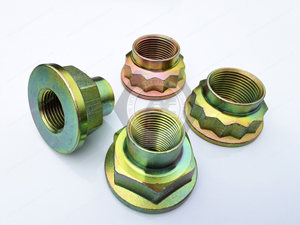
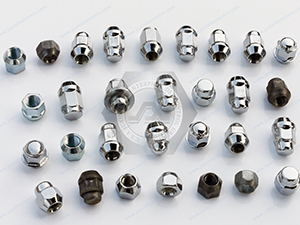
For elevated temperature environments or extreme dynamic fatigue where organic inserts fail, DIN 980V all-metal lock nuts deliver standard-compliant prevailing torque.
DIN 980V Technical Profile:
Thread Range: M4 to M39 (Coarse and Fine Thread Pitches)
Thread Tolerance: 6H (Unplated) / 6g/6H (Galvanized)
Property Classes: Grade 8, Grade 10, Grade 12
Stainless Options: A2-70, A2-80, A4-70, A4-80
Plating/Finishes: Eco-friendly Blue-White Zinc Passivation (Cr-Free), Zinc-Nickel Alloy (1000+ hrs Salt Spray), Copper Flake
Mechanism: Designed with top-collar elliptical deformation (Form V).
The metal deformation creates a thread wedge effect, maintaining clamp load even after complete loss of bolt pre-tension under extreme impulse loading.
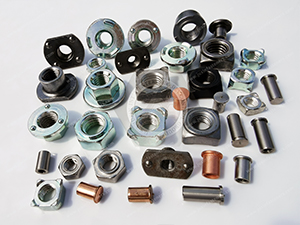
Weld nuts provide permanent threaded anchor points in thin-sheet metal structures, heavy chassis panels, and enclosed structural tubing.
Achieving structural joint strength requires strict adherence to welding thermodynamics and electrode geometry.
Tungsten Electrode (80°–85°)
\ Filler Wire (≤10°)
\ ===>
+-------+
| Weld | <--- Chamfer Protection Zone
| Nut |
==========+=======+==========
Parent Metal Sheet
Electrode Geometry: Maintain an angle of 80° to 85° between the tungsten electrode (GTAW/TIG) and the nut face to form a uniform weld pool without overheating the internal thread wall.
Filler Rod Angle: Keep filler wire insertion angle ≤10° to minimize spatter accumulation on internal locking threads.
Current & Timing Requirements: Standard non-flanged weld nuts require higher initial current and extended dwell times to compensate for mass heat sink differences between the nut body and thin sheet metal.
Chamfer Protection: Adjust current ramps to avoid melting the lead-in chamfer. Damaging the chamfer distorts thread entry, causing bolt galling during high-speed automated installation.
This matrix assists Strategic Sourcing Managers, Procurement Specialists, and Design Engineers in selecting components based on total cost of ownership (TCO), application environment, and installation parameters.
| Selection Metric | Nylon Insert Lock Nuts (DIN 985) | All-Metal Lock Nuts (DIN 980V) | Weld Nuts (DIN 928 / DIN 929) |
|---|---|---|---|
| Primary Intent | General Vibration Anti-Loosening | High-Temp / Heavy Fatigue Locking | Blind Assembly / Fixed Thread Anchors |
| Thermal Limit | -50°C to +100°C | -70°C to +300°C | Limited only by parent metal/finish |
| Reusability | Medium (3–5 cycles) | High (Structural Single/Double Use) | Permanent (Welded Joint) |
| Assembly Speed | Fast (Automated Nut Runners) | Medium (High prevailing torque) | Fast (Post-welding bolt insertion) |
| Target Roles | Procurement / Design Engineer | Structural / Aerospace / Heavy Truck | Chassis / Sheet Metal Assembly |
| MOQ & Lead Time | Bulk Stock / 15–20 Days | Made-to-Order / 20–25 Days | Custom Projection / 15 Days |
JUXIN FASTENERS operates precision cold-heading and CNC machining facilities producing standard and custom fasteners compliant with ISO,
DIN, ASME, and GB specifications. Our technical engineering team provides application verification, torque-tension testing, and customized plating solutions for tier-1 industrial and automotive supply chains.
For technical drawings, CAD files, price quotes, or sample requests, contact our engineering sales department:
Official Website: https://www.juxinfasteners.com
Technical Sales Email: info@juxinfasteners.com
Product Line Capabilities: High-Strength Bolts, DIN 980V All-Metal Lock Nuts, Nylon Insert Lock Nuts, Weld Nuts, Thread-Forming Screws, Custom Automotive Fasteners.
 MORE NEWS
Sep. 25, 2026
Sep. 25, 2026
Sep. 25, 2026
Contact Us
Tel.:
+86 020 8621 0320
+86 020 3121 6067
E-mail:
Technical Support:
Navigation
SEND INQUIREY