
Call Us
+86 136 6007 9809
Call Us
+86 136 6007 9809

Mar. 21, 2023
In critical industrial assemblies—ranging from heavy machinery chassis and automotive powertrains to high-speed rail and renewable energy
structures—fastener joint loosening caused by dynamic shock and transverse vibration presents severe operational risks.
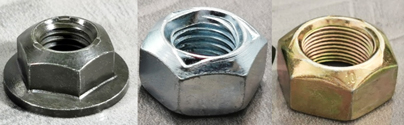 |  |
While standard hex nuts such as DIN 934 / ISO 4032 hex nuts require secondary locking mechanisms such as spring washers or cotter pins,
DIN 980 all-metal prevailing torque lock nuts deliver self-contained, high-reliability locking performance without auxiliary components.
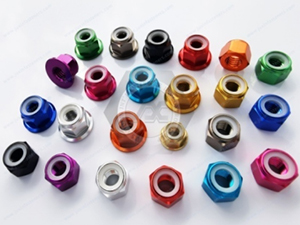
Unlike nylon insert lock nuts such as DIN 985 Nylon Insert Lock Nuts, which experience material degradation when exposed to temperatures above 120°C or aggressive chemical solvents,
DIN 980 all-metal nuts retain consistent prevailing torque across extreme thermal cycles (-50°C to +450°C depending on material grade and surface treatment).
For applications where vibration resistance, high-temperature performance, repeated assembly, and long-term thread retention are critical,
selecting the correct all-metal prevailing torque nut architecture is therefore an important part of joint design.
The primary advantage of a DIN 980 lock nut is that the locking function is integrated directly into the metallic nut rather than relying on a separate nylon insert, spring washer, cotter pin, or other auxiliary locking component.
This makes DIN 980 all-metal lock nuts particularly suitable for industrial environments where temperature, vibration, chemical exposure, or assembly conditions can limit the performance of polymer-based locking systems.
 | 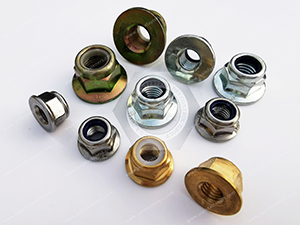 | 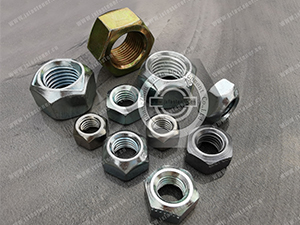 | 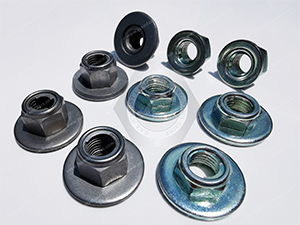 |
While standard industry literature broadly categorizes DIN 980 nuts, JUXIN FASTENERS' metallurgical testing isolates key structural differences that impact engineering selection.
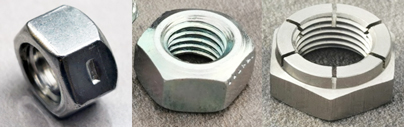
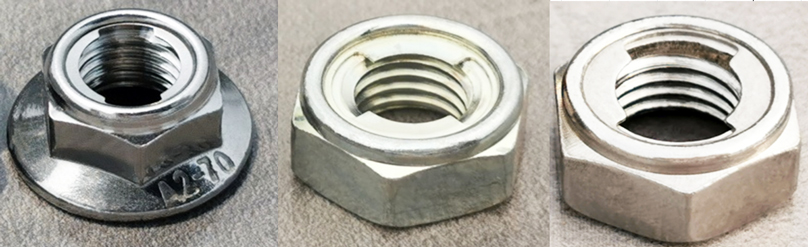
DIN 980-V employs controlled 3-point, ovalized, or side-extruded top-thread crimping.
The thread profile is elastically expanded during bolt engagement, generating continuous radial friction interference.
Engineering application:
Best suited for high-strength steel bolts with Property Classes 8.8, 10.9, and 12.9 under heavy clamp loads.
DIN 980-M integrates a heat-treated, spring-tempered stainless steel locking element positioned at the crown.
The metallic tab wedges into mating bolt threads without deforming the main nut threads.
Engineering application:
Ideal for stainless steel assemblies using A2-70 and A4-80 fasteners, particularly where reducing thread galling during rapid power-tool installation is important.
The primary anti-loosening metric for prevailing torque nuts is governed by ISO 2320.
Prevailing torque (Tp) is the resistance torque required to rotate the nut down the bolt thread before clamp load seating occurs.
The total tightening torque can be expressed as:
T_total = Tp + (K × Fv × d)
Where:
Tp = Prevailing torque (ISO 2320 maximum limit)
K = Torque coefficient (friction factor)
Fv = Target bolt clamp force (N)
d = Nominal thread diameter (m)
This relationship is important for engineers because the total tightening torque of an all-metal lock nut is not simply the torque required to generate bolt preload.
The prevailing torque component must also be considered when defining assembly torque specifications.
JUXIN FASTENERS precision-engineers thread lead angles and crimp depth to maintain optimal prevailing torque across five installation/removal cycles, satisfying strict automotive OEM standards.
Carbon Steel — Class 8, 10, 12
Meets ISO 898-2 proof stress requirements of approximately 800 MPa to 1150 MPa.
Stainless Steel — A2-70, A4-80
Evaluated on full-load holding stress per ISO 3506-2.
Carbon Steel — Class 8, 10, 12
-50°C to +300°C: Standard Zinc / Geomet
Up to +450°C: Uncoated applications
Stainless Steel — A2-70, A4-80
-196°C to +400°C
Suitable for cryogenic and elevated thermal applications
Carbon Steel — Class 8, 10, 12
Guaranteed 1st installation maximum torque
5th removal minimum torque
Stainless Steel — A2-70, A4-80
Requires dry-film micro-wax coating for 5-cycle reuse
Carbon Steel — Class 8, 10, 12
Cr3+ Zinc Plated
Zinc-Nickel
Geomet 321/500
Black Oxide
Zinc-Nickel options can provide 1000h+ NSS red-rust resistance depending on the specified system and test conditions.
Stainless Steel — A2-70, A4-80
Passivated Stainless Steel
Electropolished
Gold-Plated Spring Band Coating
JUXIN FASTENERS provides customized DIN 980 all-metal locking solutions tailored to specific operating environments across key industrial sectors.
Recommended Fastener:
DIN 980-V Class 10 Zinc-Nickel / Geomet Flanged Locks
Engineering & Supply Chain Requirement:
High-frequency harmonic vibration resistance (Junker tested).
The fasteners are fully compatible with high-speed automated feeder bowls with zero thread jamming.
For automotive OEM assembly, this combination addresses the need for vibration-resistant lock nuts, controlled friction, corrosion protection, and automated installation.
Recommended Fastener:
DIN 980-V Class 12 Phosphated / Heavy-Duty All-Metal
Engineering & Supply Chain Requirement:
Extreme proof load capability for hydraulic cylinder mounts and chassis linkage.
Compliant with ISO 898-1 heavy-duty standards.
These heavy-duty all-metal lock nuts are designed for assemblies exposed to substantial mechanical loads, vibration, shock, and repeated operating cycles.
Recommended Fastener:
DIN 980-M Stainless Steel A4-80 / Hot-Dip Galvanized
Engineering & Supply Chain Requirement:
C4/C5 atmospheric corrosion resistance.
The joint must maintain sustained clamp force under continuous outdoor wind fatigue and environmental exposure.
For renewable energy applications, corrosion resistance and long-term prevailing torque retention are critical sourcing considerations.
Recommended Fastener:
DIN 980-V Class 8 Bright Zinc + Top-Lube Coated
Engineering & Supply Chain Requirement:
Low scatter coefficient with a friction factor of 0.10 - 0.15 for high-speed automated nut runners without galling.
This is particularly important for automated assembly environments where torque consistency, feed reliability, and repeatable installation behavior directly affect production efficiency.
Austenitic stainless steel nuts such as A2/A4 are prone to pressure welding, commonly referred to as galling, under high-speed pneumatic drivers.
JUXIN FASTENERS resolves this by applying a proprietary micro-encapsulated dry lubrication or gold-plated spring band coating to DIN 980-M stainless lock nuts.
This maintains a predictable friction coefficient of approximately µ = 0.12, ensuring smooth assembly without requiring manual anti-seize paste on the factory floor.
This approach is particularly valuable for OEM production lines where manual anti-seize application can increase labor, introduce contamination, and create friction-coefficient variation between assemblies.
For procurement specialists, sourcing managers, and supply chain developers, balancing unit cost with zero-defect quality delivery is paramount.
Sourcing directly from JUXIN FASTENERS provides complete transparency from raw material wire drawing to final surface finishing.
Quality Assurance Documentation
Full material traceability with:
EN 10204 3.1 Chemical & Mechanical Mill Test Certificates
ISO 898-1 proof load test reports
Complete PPAP Level 3 packages
PFMEA
Control Plan
Dimensional Inspection
Gage R&R
Optical Sorting Technology
100% automated eddy-current and optical sorting machines are used to guarantee defect rates below 50 PPM (Parts Per Million) for automated factory feed systems.
This capability is particularly relevant to automotive and industrial customers requiring stable automated assembly performance and controlled production quality.
Custom Manufacturing & Packaging
JUXIN FASTENERS supports customized:
Fine thread M10x1.25
Fine thread M12x1.5
Custom collar heights
Specialized surface coatings
Zinc-Nickel with 1000h+ red rust resistance
Bulk B2B carton packaging
Pallet packaging
These options allow procurement teams to align fastener specifications with existing OEM drawings, assembly processes, corrosion requirements, and logistics systems.
The correct DIN 980 specification should be selected according to both engineering performance and commercial supply-chain requirements.
| Evaluation Area | Engineering Requirement | Procurement Requirement | JUXIN FASTENERS Consideration |
|---|---|---|---|
| Locking Mechanism | Prevailing torque retention | Consistent batch performance | DIN 980-V / DIN 980-M |
| Vibration Resistance | High transverse-load resistance | Reduced field maintenance | All-metal prevailing torque design |
| Temperature | Material and coating limits | Long-term operating stability | Carbon steel / stainless steel options |
| Corrosion | Environment-specific protection | Reduced replacement cost | Zinc, Zinc-Nickel, Geomet, stainless |
| Automated Assembly | Stable friction coefficient | Jam-free feeding | Optical sorting and feeder compatibility |
| Quality Documentation | Material and dimensional verification | PPAP / traceability | PPAP Level 3 and material certificates |
| Total Cost of Ownership | Reliable joint performance | Reduced maintenance and downtime | Factory-direct OEM sourcing |
For engineers evaluating DIN 980 vs. DIN 985, the primary distinction is the locking mechanism.
| Feature | DIN 980 All-Metal Lock Nut | DIN 985 Nylon Insert Lock Nut |
|---|---|---|
| Locking Mechanism | Metallic prevailing torque | Nylon insert interference |
| High-Temperature Suitability | High, depending on material/coating | Limited by nylon temperature resistance |
| Chemical Exposure | Metallic system | Nylon compatibility must be evaluated |
| Vibration Resistance | High | High when correctly specified |
| Auxiliary Washer Required | No | No |
| Repeated Installation | Designed around prevailing torque requirements | Nylon wear must be considered |
| Automotive / Heavy Machinery | Strong candidate | Application dependent |
| High-Temperature Assembly | Preferred | Generally unsuitable above nylon limits |
The all-metal construction makes DIN 980 particularly attractive when high temperature, chemical exposure, vibration,
or long-term prevailing torque retention is more important than the lower-cost construction of nylon insert nuts.
JUXIN FASTENERS manufactures a comprehensive range of engineered locking and structural nuts to serve different industrial assembly requirements.
https://juxinfasteners.com/products/all-metal-flange-lock-nuts/
Designed for applications requiring integrated flange bearing surfaces and prevailing torque locking.
https://juxinfasteners.com/products/hexagon-nuts-tapered-elastic-washers/
Suitable where elastic locking elements are required as part of the nut assembly.
https://juxinfasteners.com/products/round-weld-nuts/
Used where permanent threaded attachment is required directly on sheet metal structures.
https://juxinfasteners.com/products/knurled-set-nuts/
Designed for applications requiring specialized mechanical retention and installation configurations.
https://juxinfasteners.com/products/12-spline-flange-nuts/
Suitable for applications requiring specialized flange geometry and controlled installation.
https://juxinfasteners.com/products/plate-welding-nuts/
Designed for sheet-metal assemblies requiring integrated welded threads.
https://juxinfasteners.com/products/thin-castle-nuts/
Used for applications requiring reduced nut height and specific mechanical retention arrangements.
Need technical evaluation, 3D CAD models, or custom quotations for DIN 980 all-metal prevailing torque lock nuts?
Our engineering and supply chain teams are ready to support your project requirements with factory-direct competitive pricing and sample dispatch.
Whether the application requires:
DIN 980-V or DIN 980-M
Carbon steel or stainless steel
Class 8, 10, or 12
A2-70 or A4-80
Zinc plating
Zinc-Nickel
Geomet
Black Oxide
Passivation
Custom fine threads
Custom collar heights
Automated assembly compatibility
PPAP Level 3 documentation
JUXIN FASTENERS can support engineering evaluation and volume OEM sourcing from prototype through production.
For technical evaluation, CAD models, samples, cross-referencing, or factory-direct RFQ requirements, provide your application details to the JUXIN FASTENERS engineering and supply-chain team.
Direct Inquiry Email:
info@juxinfasteners.com
Recommended RFQ Information:
2D Technical Drawings
3D STEP Files
Required Thread Specification
Base Material Grade
Required Strength Class
Surface Treatment Specifications
Operating Temperature
Corrosion Environment
Target Torque / Preload
Annual Production Volume
PPAP / Quality Documentation Requirements
Packaging Requirements
Automated Assembly Requirements
Official Corporate Website:
https://juxinfasteners.com/
Quality Certifications:
ISO 9001:2015 & IATF 16949 Certified Manufacturing
DIN 980 all-metal prevailing torque lock nuts provide an integrated mechanical locking solution for industrial assemblies where vibration resistance, temperature capability, corrosion protection, and long-term torque retention are critical.
The correct selection depends on more than simply choosing a locking nut.
Engineers should evaluate:
Locking architecture — DIN 980-V thread deformation versus DIN 980-M embedded stainless steel locking segment.
Fastener material and strength class — Carbon steel Class 8/10/12 or stainless steel A2-70/A4-80 according to the application.
Operating temperature — Particularly where nylon insert lock nuts may exceed their practical temperature limits.
Prevailing torque requirements — Use ISO 2320 principles to evaluate installation and removal torque.
Corrosion environment — Select zinc, Zinc-Nickel, Geomet, Black Oxide, passivated stainless steel, or other specified finishes according to environmental exposure.
Automated assembly requirements — Control friction coefficient, dimensional consistency, optical sorting, and feeder compatibility.
Supply-chain quality requirements — Verify PPAP Level 3 documentation, material traceability, proof-load testing, and batch-level inspection.
For OEM manufacturers, purchasing teams, and engineering departments, selecting the right DIN 980 lock nut supplier can reduce assembly risk while improving joint reliability and long-term supply stability.
JUXIN FASTENERS — Engineered Industrial Fastening Solutions for Global OEM Manufacturing
Direct Technical Contact:
info@juxinfasteners.com
Website:
https://juxinfasteners.com/
 MORE NEWS
Sep. 25, 2026
Sep. 25, 2026
Sep. 25, 2026
Contact Us
Tel.:
+86 020 8621 0320
+86 020 3121 6067
E-mail:
Technical Support:
Navigation
SEND INQUIREY