
Call Us
+86 136 6007 9809
Call Us
+86 136 6007 9809

Mar. 21, 2023
Selecting the correct nut architecture requires balancing mechanical loads, environmental exposure, assembly method, weight constraints, accessibility,
corrosion resistance, and long-term service requirements.
Standard hex nuts are not always the most suitable solution when an assembly requires protection of exposed threads, tool-less adjustment, improved load distribution, reduced weight, or specialized material performance.
This technical guide provides a comparative engineering and procurement framework for three distinct specialty fastener classes:
Cap Nuts (Acorn Nuts): Used to cover exposed bolt threads, improve user safety, provide environmental protection, and create a finished external appearance.
DIN 1587 is a widely recognized dimensional reference for high-form hexagon domed cap nuts.
Wing Nuts (Butterfly Nuts): Designed for applications requiring frequent manual installation and removal without conventional hand tools.
Titanium 12-Point Flange Nuts: Designed for weight-sensitive applications where titanium's strength-to-weight characteristics, corrosion resistance,
and non-magnetic properties can provide engineering advantages.
The correct selection should not be based on appearance alone. Engineers should evaluate thread size, nut geometry, material, installation torque,
prevailing-torque requirements, temperature, corrosion exposure, assembly frequency, available installation space, and the mechanical requirements of the complete bolted joint.
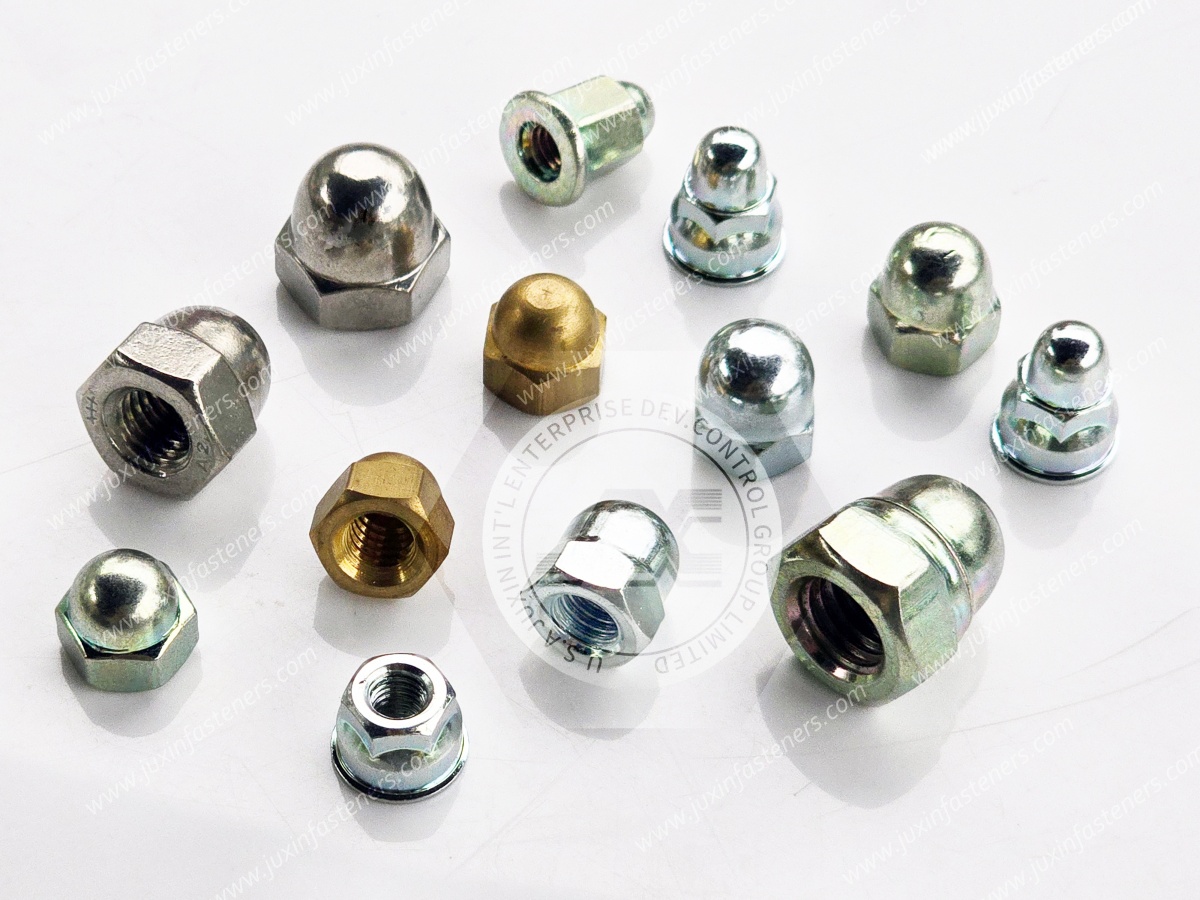
Cap nuts, also known as acorn nuts or dome nuts, cover the exposed end of a threaded fastener. Their primary engineering value is not simply decorative.
The closed-end geometry can protect the exposed bolt end from accidental contact, reduce the accumulation of contaminants around the thread end,
and provide a controlled external profile for assemblies where exposed threads are undesirable.
DIN 1587 is a widely used European reference for high-form hexagon domed cap nuts.
When specifying DIN 1587 cap nuts, procurement teams should still verify the exact material, property class, thread tolerance, surface treatment,
dimensions and customer drawing requirements because these details can vary by product specification and manufacturer.
For custom welded cap-nut designs, engineers should distinguish between a standard DIN 1587 cap nut and a fabricated or welded cap-nut assembly because the manufacturing construction,
installation method and application requirements are different.
CAP NUT APPLICATION STRUCTURE
DIN 1587 High-Form Hexagon Domed Cap Nut
+--------------------------------+
| Stamped / Formed Cap |
| || |
| Hexagon Nut Body |
+--------------------------------+
Custom Welded Cap Nut
+--------------------------------+
| Integrated Cap |
| || |
| Welded Nut Structure |
+--------------------------------+
Typical Engineering Functions:
DIN 1587 Cap Nut:
Exposed-thread protection
Improved external appearance
Protection against accidental contact with bolt ends
General machinery, equipment, furniture, electrical and enclosure applications
Welded Cap Nut:
Fixed threaded attachment point
Applications requiring a permanently positioned nut
Sheet-metal and fabricated assemblies
Applications where the nut must remain attached to the parent structure before final assembly
| Engineering Parameter | DIN 1587 Cap Nut | Welded Cap-Nut Assembly |
|---|---|---|
| Manufacturing Architecture | High-form hexagon domed cap-nut construction | Nut/cap structure permanently attached by welding or other specified joining process |
| Primary Function | Covers and protects exposed bolt threads while providing a finished external profile | Provides a fixed threaded fastening point with a protective cap |
| Installation | Installed similarly to a conventional nut | Nut is positioned and attached to the parent component before final bolt installation |
| Thread Protection | Dome covers the exposed bolt end | Closed cap protects the bolt end after assembly |
| Mechanical Consideration | Joint strength is determined by the nut, bolt, thread engagement and parent assembly | Joint performance also depends on weld quality, parent material and weld geometry |
| Environmental Protection | Provides physical coverage of the exposed thread end; should not automatically be considered a pressure or hermetic seal | Provides physical thread-end protection; sealing performance depends on the specific design and joining process |
| Typical Applications | Electrical enclosures, machinery, furniture, decorative equipment, light industrial assemblies | Sheet-metal structures, automotive and equipment components where a fixed threaded point is required |
Before specifying a cap nut, engineering teams should verify:
Thread size and pitch
Nut height and available installation envelope
Bolt length and exposed-thread length
Required mechanical property class
Base material compatibility
Corrosion environment
Surface treatment
Temperature exposure
Whether the cap must provide physical protection only or an actual environmental seal
Whether the nut must remain permanently attached to the parent component
Required installation torque and joint preload
A cap nut should not be selected simply because its external dome fits over the bolt.
The bolt length must be coordinated with the nut height and internal cap geometry so that the bolt does not bottom out against the closed end before the nut reaches the intended seating condition.
For a DIN 1587 cap nut, the available internal cap clearance should therefore be checked against the bolt protrusion and the nut's dimensional specification before production release.
Surface treatment should be selected according to the substrate material, operating environment, required corrosion performance, dimensional requirements, and applicable coating specification.
Common options include:
Electro-Galvanized Zinc Plating:
Suitable for many indoor and general industrial applications
Provides sacrificial corrosion protection
Coating thickness and performance should be specified according to the applicable fastener coating standard and customer requirement
Nickel or Chrome Plating:
Can provide a decorative and durable surface
May be selected where appearance, surface hardness, or corrosion resistance is important
Application suitability depends on substrate and required performance
Zinc-Aluminum Flake Coatings:
Non-electrolytic coating systems can be considered where high corrosion resistance and controlled hydrogen-embrittlement risk are important
Particularly relevant to higher-strength steel fasteners where conventional electroplating requires additional process controls
Actual corrosion performance depends on coating system, substrate, thickness, topcoat, test method and customer specification
For outdoor or chemically aggressive applications, engineers should specify the required corrosion category and test method rather than treating a coating name or salt-spray-hour figure as a universal service-life guarantee.
JUXIN FASTENERS can evaluate material and surface-treatment requirements according to application conditions, mechanical requirements and customer specifications.
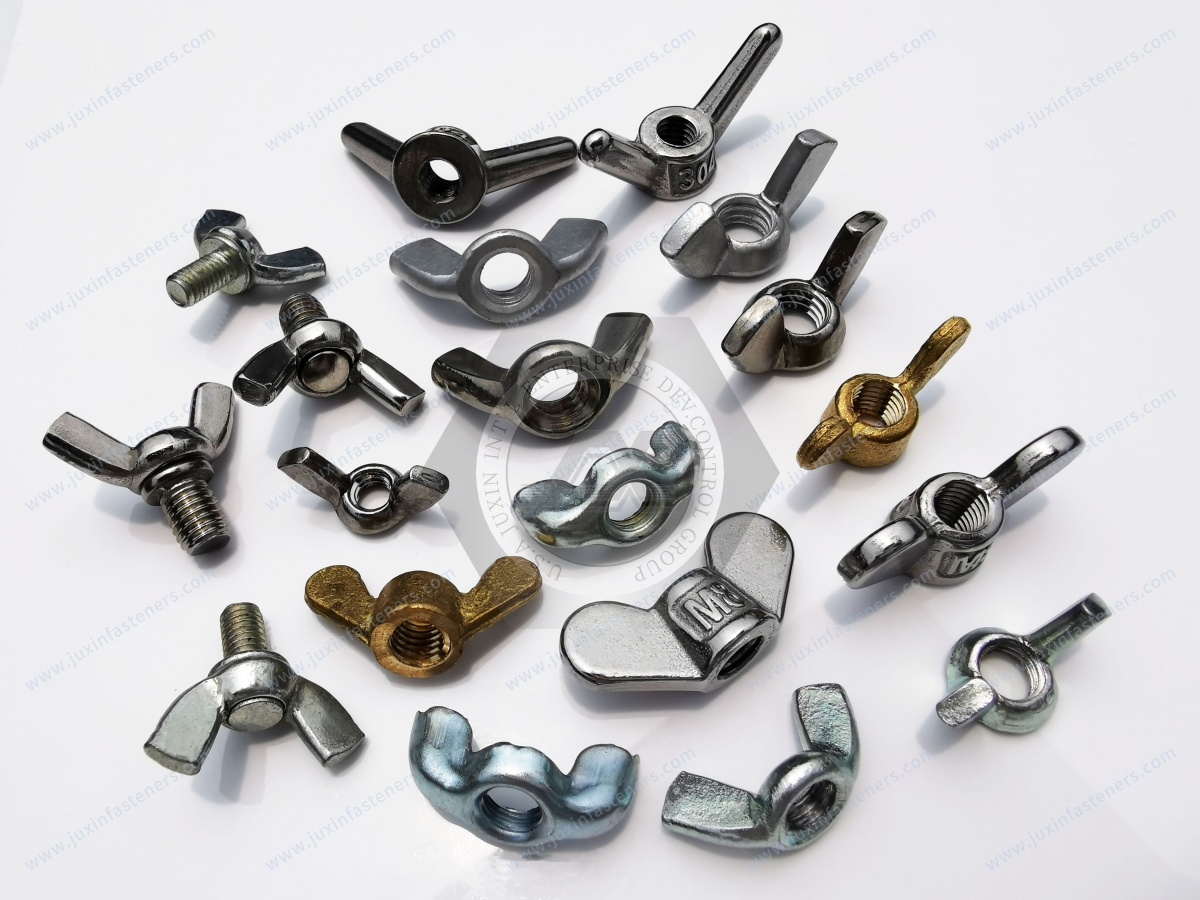
Wing nuts feature two opposing wings that allow the operator to install and remove the nut manually without a conventional wrench or socket.
They are particularly useful when an assembly requires frequent access, adjustment, inspection, cleaning, filter replacement, panel removal or other maintenance operations.
The main engineering advantage of a wing nut is therefore not maximum tightening torque. It is accessibility and repeatable manual serviceability.
WING NUT FORCE VECTORS
                     [Wing]       [Wing]
                       \            /
                        \  Manual  /
                         \ Torque /
                      +-------------+
                      |  Threaded   |
                      |    Body     |
                      +-------------+
                            ||
                      Axial Clamp Force
The approximate torque generated by a manual force can be expressed as:
T_manual ≈ F_manual × r_effective
Where:
T_manual = applied tightening torque
F_manual = effective manual force applied to the wing
r_effective = effective distance from the rotational axis to the point of force application
For a simplified symmetric wing geometry, the effective lever arm can be related to the wing span:
T_manual ≈ F_pinch × (W_span / 2)
Where:
F_pinch = effective manual pinch force
W_span = total wing span
Actual achievable torque varies significantly with operator strength, wing geometry, surface condition, accessibility, thread size, lubrication, and ergonomic requirements.
For this reason, wing nuts should not normally be specified as substitutes for torque-controlled structural fasteners.
Where the joint requires a defined preload, engineers should establish the required clamp load and verify whether manual installation can reliably achieve it.
For safety-critical or high-preload applications, a conventional wrench-installed nut or another controlled locking system may be more appropriate.
Thread pitch should also be evaluated carefully. A finer pitch changes the relationship between applied torque and axial displacement,
but it does not automatically guarantee a higher or more reliable preload because friction, thread geometry, material and installation conditions remain significant variables.
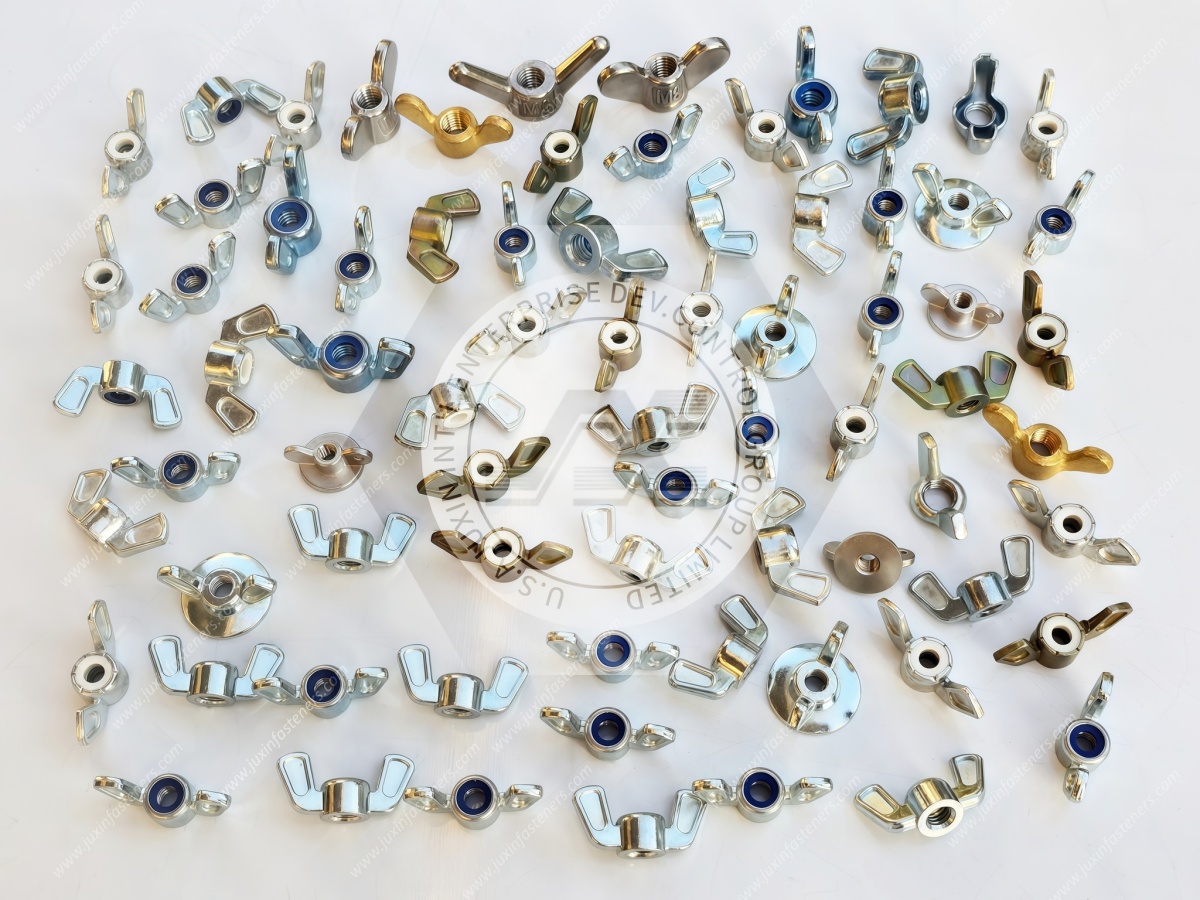
JUXIN FASTENERS WING NUT MATERIAL OPTIONS
| Material | Primary Advantage | Potential Target Applications |
|---|---|---|
| Stainless Steel | Corrosion resistance and durability | Marine equipment, chemical-processing equipment, outdoor machinery |
| Engineering Plastic such as PA66 | Electrical insulation and low density | Electrical enclosures, instrumentation, selected equipment assemblies |
| Brass | Corrosion resistance, electrical conductivity and machinability | Electrical equipment and instrumentation |
| Zinc Alloy / Die-Cast Materials | Economical production and convenient manual handling | General equipment and consumer/industrial hardware where applicable |
Material selection should always be based on the actual mechanical, thermal, chemical and electrical requirements of the assembly.
Medical Devices and Diagnostics:
Where non-metallic or electrically insulating hardware is required, engineering polymers such as polyamide can provide an alternative to conductive metallic components.
However, any claim regarding MRI compatibility must be evaluated against the complete assembly and the specific material grade rather than assuming that every plastic wing nut is automatically MRI-safe.
Electrical Utilities and Equipment:
Insulating polymer components can be useful where electrical isolation is required. However, a plastic wing nut should never be treated as personal protective equipment or as a substitute for an engineered electrical safety system.
Maintenance Access:
Wing nuts are particularly useful for removable covers, inspection panels, filters, guards and equipment housings where frequent manual removal is expected.
Marine and Chemical Environments:
Stainless steel or other corrosion-resistant materials may be appropriate where repeated manual operation is combined with moisture, salt spray or chemical exposure.
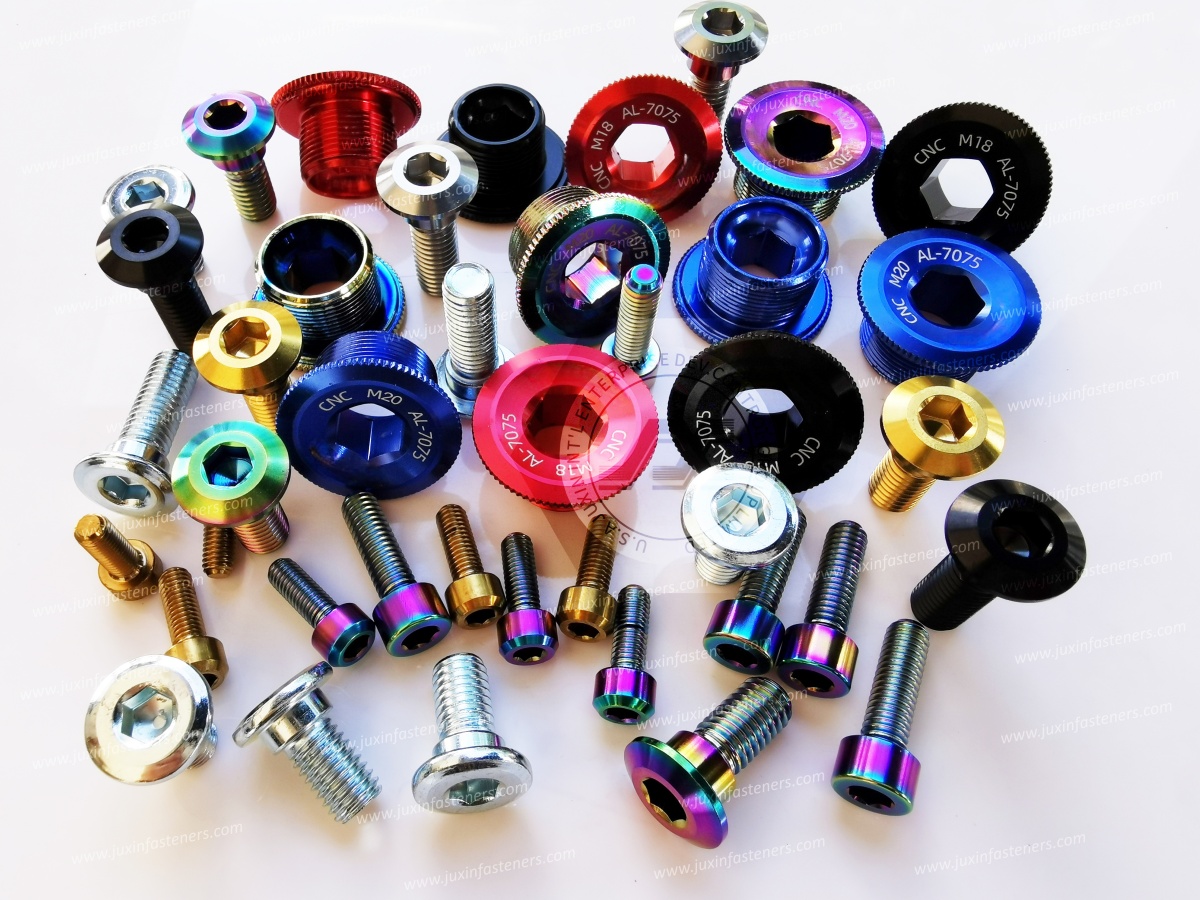
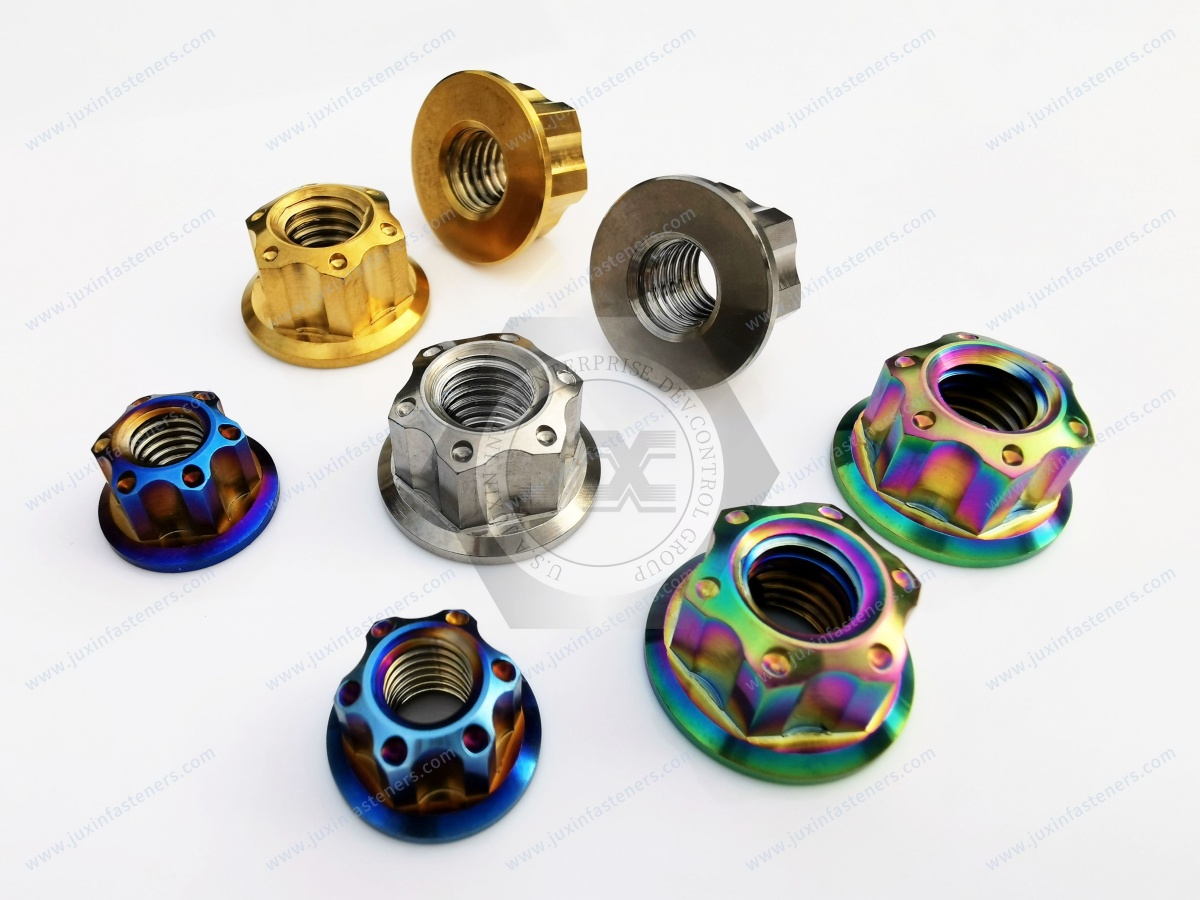
For aerospace, motorsport, performance automotive, robotics, medical equipment and other weight-sensitive applications, titanium fasteners can offer a significant reduction in density compared with conventional steel.
A titanium flange nut combines the material advantages of titanium with an integrated flange that distributes bearing load over a larger surface area than a conventional non-flanged nut.
The 12-point wrenching profile provides multiple wrenching positions and can be useful where access is restricted.
12-POINT FLANGE NUT ARCHITECTURE
                   12-Point Wrenching Profile
                       (Double Hex Drive)

                     /-------------\
                    /    12-Point   \
                   |     Drive      |
                   |---------------|
                    \               /
                     \             /
                  +-------------------+
                  | Integral Flange   |
                  +-------------------+
                   Load Distribution Face
Titanium alloys are substantially less dense than conventional carbon steel.
Ti-6Al-4V, commonly known as Grade 5 titanium, has a density of approximately 4.43 g/cm³ compared with approximately 7.85 g/cm³ for typical carbon steel.
This difference can provide a substantial weight reduction where fastener mass is important.
However, engineers should not compare fasteners solely by ultimate tensile strength. The complete design should consider:
Density
Yield strength
Ultimate tensile strength
Elastic modulus
Fatigue behavior
Thread shear strength
Bearing strength
Temperature
Corrosion environment
Galvanic compatibility
Installation torque
Lubrication
Galling resistance
Required preload
| Material Property | Typical Carbon Steel Grade 10.9 | Ti-6Al-4V Titanium | Engineering Significance |
|---|---|---|---|
| Density | ~7.85 g/cm³ | ~4.43 g/cm³ | Titanium provides a substantial weight reduction |
| Ultimate Tensile Strength | ≥1,040 MPa under applicable property-class requirements | Commonly around 900+ MPa depending on specification and condition | Must be evaluated according to the applicable material standard |
| Yield Strength | ≥940 MPa under applicable Grade 10.9 requirements | Commonly around 800+ MPa depending on specification and condition | Actual value depends on material condition and specification |
| Thermal Conductivity | Higher than titanium alloys | ~6–7 W/(m·K) for Ti-6Al-4V | Low thermal conductivity affects heat transfer during processing and frictional heating |
| Magnetic Behavior | Carbon steel is generally ferromagnetic | Titanium is non-ferromagnetic | Useful in selected magnetic-sensitive applications |
| Density Advantage | Baseline | Approximately 44% lower density than typical carbon steel | Important for weight-sensitive assemblies |
Material properties shown above are representative engineering values. Final design values should always be taken from the applicable material and fastener specification, heat-treatment condition and supplier certification.
One of the most important engineering considerations when specifying titanium fasteners is thread galling.
Titanium has a strong tendency to gall under unfavorable combinations of contact pressure, sliding, surface condition, installation speed and insufficient lubrication.
During tightening, local surface damage can initiate adhesive wear and material transfer between mating threads.
This can cause:
Sudden increase in installation torque
Unstable torque-tension behavior
Thread damage
Seizure during installation
Difficulty removing the fastener
Permanent damage to the bolt and nut
This is particularly important when titanium nuts are paired with titanium bolts because the mating surfaces can have a high susceptibility to adhesive wear.
Therefore, titanium fastener selection should include a thread-interface strategy, not simply a material selection.
Surface Engineering and Coatings
Depending on the application, titanium fasteners may use controlled surface treatments or conversion coatings to modify surface hardness, friction behavior and wear resistance.
Possible approaches include anodizing or other controlled surface-treatment technologies.
The suitability of each treatment depends on the titanium grade, mating material, dimensional tolerance and required electrical or corrosion performance.
Solid Film Lubricants
Dry-film lubricants such as molybdenum disulfide (MoS₂) may be considered where controlled friction and galling resistance are required.
The objective is not simply to reduce friction as much as possible. The engineering objective is to establish a repeatable friction coefficient so that the specified installation torque produces a predictable preload.
Torque-tension behavior can be represented conceptually as:
T ≈ K × F × d
Where:
T = installation torque
K = effective nut factor representing friction and geometry
F = desired preload
d = nominal fastener diameter
Because K can change significantly with coating, lubrication, surface finish, thread condition and assembly speed, the torque value used for production should be validated using the actual fastener/coating/lubricant combination.
Controlled Installation Speed
High-speed automated installation can increase the risk of galling in susceptible titanium thread combinations.
Where titanium fasteners are used in production, engineers should evaluate:
Installation speed
Lubricant or coating
Thread tolerance
Surface finish
Nut and bolt material combination
Repeated assembly requirements
Target preload
Actual torque-tension behavior
12-Point Wrenching Geometry
The 12-point profile provides more wrenching positions than a conventional six-point hex profile.
This can be advantageous in confined installation spaces where rotational access is limited.
However, the number of wrenching points does not itself increase the tensile strength of the nut.
The actual torque capacity depends on the wrenching geometry, material strength, dimensional design, tool fit and applicable specification.
Titanium is highly corrosion resistant, but engineers should still consider galvanic compatibility when titanium fasteners are assembled with dissimilar metals.
Potential considerations include:
Aluminum structures
Magnesium components
Carbon-fiber-reinforced polymer structures
Stainless steel
Carbon steel
Marine environments
Salt exposure
In electrically conductive and wet environments, galvanic interaction can become an important part of the joint design.
Therefore, titanium selection should be evaluated together with:
Mating material
Isolation strategy
Coating
Lubrication
Environmental exposure
Required service life
The three nut architectures discussed in this guide solve different engineering problems.
The correct selection should therefore start with the assembly requirement, not the product name.
APPLICATION EVALUATION FLOWCHART
REQUIREMENT: Is frequent manual assembly and disassembly required without conventional tools?
YES:
Select WING NUTS.
Then evaluate:
Required manual torque
Thread size
Material
Corrosion exposure
Electrical insulation requirements
Frequency of removal and reinstallation
REQUIREMENT: Does the assembly require protection of the exposed bolt end?
YES:
Select CAP NUTS.
For a standard European specification, consider DIN 1587 cap nuts.
Then evaluate:
Bolt protrusion
Cap internal clearance
Thread engagement
Environmental exposure
Surface treatment
Standard vs. custom construction
REQUIREMENT: Is weight reduction a major design objective?
YES:
Consider TITANIUM FLANGE NUTS.
Then evaluate:
Titanium grade
Required mechanical properties
Mating bolt material
Galling risk
Lubrication/coating
Installation torque
Galvanic compatibility
REQUIREMENT: Is increased bearing area required?
YES:
Consider a FLANGE NUT.
The flange can distribute bearing load over a larger area and may reduce local bearing stress on the mating component, depending on the joint geometry and material.
REQUIREMENT: Is high vibration resistance the primary requirement?
DO NOT select a specialty nut solely because of its external shape.
Instead, evaluate:
Required preload
Prevailing torque
Joint slip
Vibration environment
Locking mechanism
Temperature
Reusability
Applicable fastener standard
A cap nut or wing nut is not automatically a vibration-locking nut. If anti-loosening performance is required, an appropriate prevailing-torque or mechanical locking solution should be specified separately.
For procurement teams, a clear RFQ specification should contain enough information for suppliers to quote and manufacture the correct component without making assumptions.
Recommended specification information includes:
Product Type:
DIN 1587 Cap Nut
Wing Nut
Titanium Flange Nut
Welded Cap Nut
Other specialty nut configuration
Thread:
Metric or inch
Nominal diameter
Coarse or fine pitch
Internal thread tolerance
Material:
Carbon steel
Stainless steel
Titanium alloy
Brass
Engineering plastic
Other specified alloy
Mechanical Requirements:
Property class
Tensile requirements
Yield requirements where applicable
Torque/preload requirement
Prevailing-torque requirement if applicable
Surface Treatment:
Zinc plating
Zinc-aluminum flake coating
Nickel plating
Chrome plating
Passivation
Titanium surface treatment
Customer-specific coating
Dimensional Requirements:
Overall height
Flange diameter
Wing span
Wrenching profile
Cap diameter
Internal clearance
Drawing-controlled dimensions
Quality Requirements:
Dimensional inspection
Thread gauge inspection
Material certification
Coating certification
Inspection report
Traceability requirements
Packaging requirements
Application Information:
Operating temperature
Corrosion environment
Assembly method
Installation speed
Required service life
Frequency of removal
Mating bolt material
To explore adjacent structural components and technical sizing guides, visit the relevant JUXIN FASTENERS technical and product resources.
Bolt Exposed Thread Requirements & High-Vibration Lock Nuts:
https://www.juxinfasteners.com/technical-guide/bolt-exposed-thread-length-anti-loosening-fasteners/
This guide explains exposed thread length, thread engagement, prevailing-torque lock nuts and vibration-resistant fastening considerations.
High-Strength Industrial Hex Bolts & Custom Studs:
https://www.juxinfasteners.com/products/high-strength-hex-bolts/
Technical information for high-strength bolts and custom threaded fastening components used in industrial applications.
Automotive & Chassis Fastener Solutions:
https://www.juxinfasteners.com/solutions/automotive-fasteners/
Solutions covering automotive fasteners, weld nuts, thread-forming screws and other chassis fastening components.
Self-Clinching Fasteners for Sheet Metal:
https://www.juxinfasteners.com/products/self-clinching-fasteners/
Useful where permanent threaded attachment points are required in thin sheet metal without conventional welding.
Weld Fasteners:
https://www.juxinfasteners.com/products/weld-fasteners/
Relevant for fixed threaded attachment points in fabricated sheet-metal and automotive structures.
JUXIN FASTENERS supports the development and supply of standard and custom fastening components for industrial applications.
Our manufacturing capabilities include cold heading, CNC machining, stamping and other production processes depending on the product design, material and required geometry.
For specialty nuts such as DIN 1587 cap nuts, wing nuts and titanium flange nuts, engineering review should focus on more than the catalog name.
We can evaluate the drawing, material, thread specification, surface treatment, installation method and application environment to determine an appropriate manufacturing and sourcing solution.
For technical drawings, 3D CAD models, material requirements, prototype samples, inspection requirements or commercial quotations, contact the JUXIN FASTENERS engineering and sales team.
Official Website:
https://www.juxinfasteners.com
Engineering & Sales Contact:
info@juxinfasteners.com
Core Product Capabilities:
DIN 1587 Cap Nuts, Wing Nuts, Titanium Flange Nuts, DIN 980V All-Metal Lock Nuts, Nylon Insert Lock Nuts, Weld Nuts, High-Strength Bolts, Custom Cold-Formed Fasteners and CNC Machined Fastener Components.
 MORE NEWS
Sep. 25, 2026
Sep. 25, 2026
Sep. 25, 2026
Contact Us
Tel.:
+86 020 8621 0320
+86 020 3121 6067
E-mail:
Technical Support:
Navigation
SEND INQUIREY