
Call Us
+86 136 6007 9809
Call Us
+86 136 6007 9809

Nov. 16, 2024
In modern mechanical assemblies, the relationship between bolt friction coefficient and tightening torque plays a critical role in ensuring fastening reliability, safety, and long-term performance.
For industries such as automotive manufacturing, electric vehicles (EV), industrial equipment, rail transportation, renewable energy, and precision machinery, controlling the friction coefficient of bolts and fasteners is essential to achieving consistent clamp force and preventing joint failure.
The friction coefficient directly affects the conversion efficiency between applied torque and generated axial preload force. Even small variations in friction can significantly change the final tightening torque, clamp load, and assembly quality.
As an experienced OEM custom fastener manufacturer, Juxin Fasteners provides precision-engineered fastening solutions with controlled surface treatments, dimensional accuracy, and strict quality inspection to meet demanding industrial requirements.
The bolt friction coefficient represents the resistance between contacting surfaces during tightening or loosening.
In a threaded connection, friction mainly occurs in two areas:
Thread friction coefficient (μG)
The friction between the male and female threads.
Bearing surface friction coefficient (μK)
The friction between the fastener bearing surface and the connected component.
Together, these friction values determine how much of the applied tightening torque is converted into useful axial clamp force.
Approximately:
A large portion of tightening torque is consumed by friction.
Only a small portion contributes directly to bolt preload.
Therefore, controlling friction variation is one of the most important factors in achieving stable fastening performance.
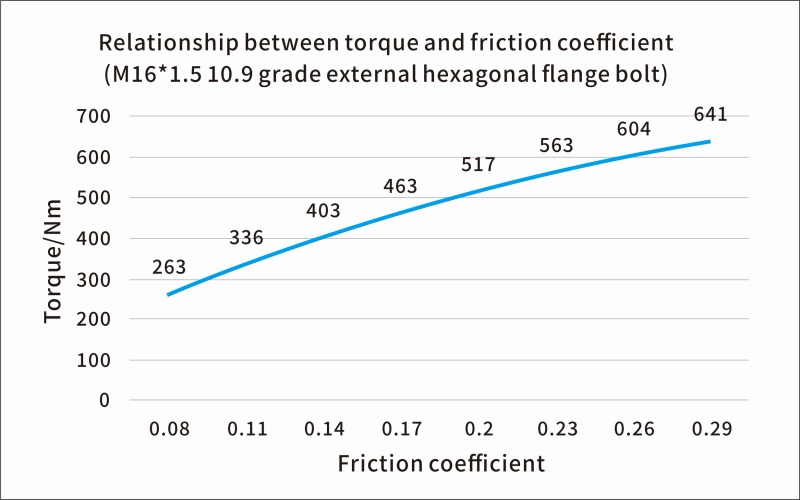
The relationship between friction coefficient and torque is complex but generally positive:
Higher friction coefficient → Higher required tightening torque
Lower friction coefficient → Lower required tightening torque
When friction increases:
More rotational force is required to overcome resistance.
Higher tightening torque is needed.
Torque-to-clamp-force efficiency decreases.
When friction decreases:
Less torque is required.
More applied torque is converted into axial preload.
Assembly efficiency improves.
However, excessively low friction may reduce loosening resistance, while excessively high friction may create unstable tightening conditions.
Therefore, the objective is not simply to minimize friction, but to achieve a stable and controlled friction coefficient range.
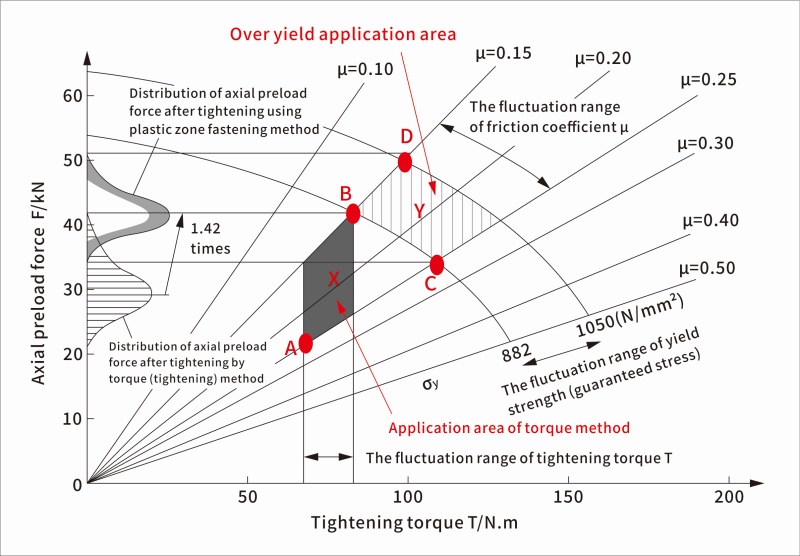
The torque control method uses a fixed target tightening torque.
For example:
A production line may specify:
M10 Bolt → 50 Nm tightening torque
Although the torque value remains constant, changes in friction coefficient can cause significant variations in final clamp force.
A higher friction coefficient may result in:
Lower axial preload
Reduced joint reliability
A lower friction coefficient may result in:
Higher axial preload
Risk of over-stressing the fastener
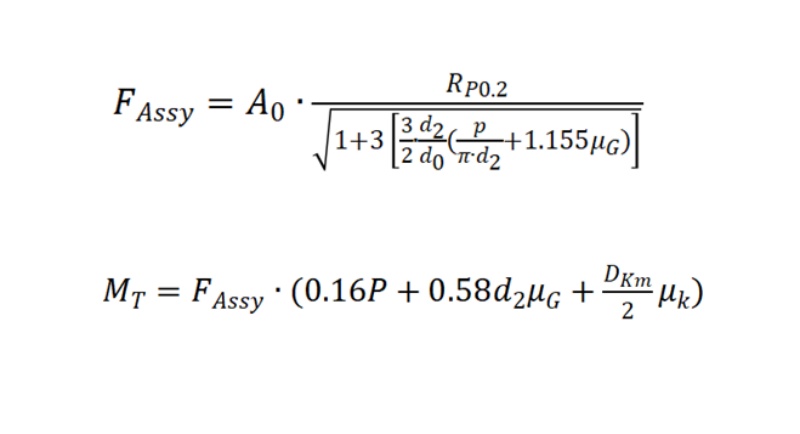
The torque-angle method is widely used in automotive and high-performance applications.
This method controls:
Initial tightening torque
Rotation angle after yield point
Because final torque changes according to friction conditions, friction stability becomes extremely important.
Applications include:
Engine components
Automotive chassis systems
EV battery structures
Safety-critical assemblies
Stable friction performance helps manufacturers reduce assembly variation and improve production consistency.
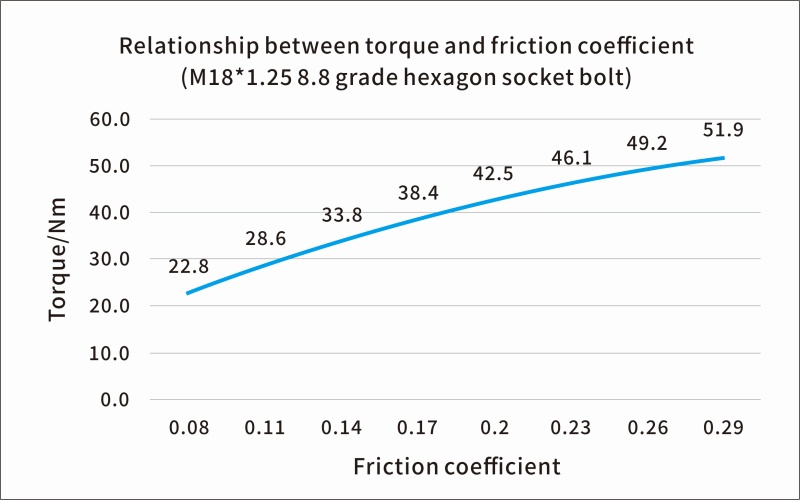
The primary purpose of a fastener is to generate sufficient clamp force to maintain joint integrity.
The relationship between torque and clamp force depends on:
Bolt diameter
Thread pitch
Fastener grade
Material strength
Surface coating
Lubrication condition
Friction coefficient
For example:
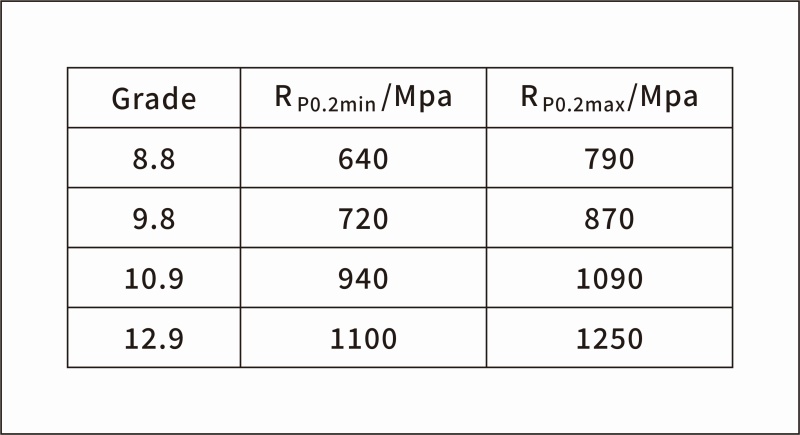
A high-strength Grade 10.9 bolt and a lower-grade fastener may require different torque values even under the same friction conditions.
Professional fastener manufacturers must control these factors through:
Precision manufacturing
Thread accuracy
Surface treatment control
Torque testing
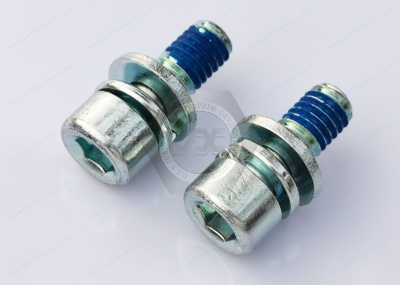
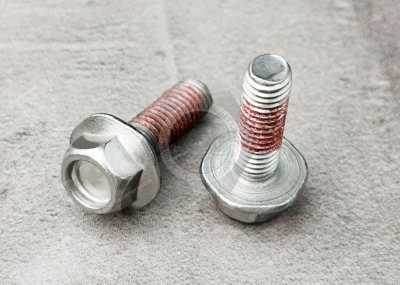
Friction coefficient variation can directly influence fastener failure behavior.
Advantages:
Better resistance against loosening
Higher locking performance
Potential risks:
Higher tightening torque
Increased shear stress
Reduced safety margin before fracture
Advantages:
Better torque efficiency
Higher preload conversion
Potential risks:
Reduced loosening resistance
Potential joint movement under vibration
For critical applications, engineers must balance friction performance with mechanical requirements.
Surface treatment is one of the most important methods for controlling fastener friction performance.
Different coatings create different friction characteristics.
Common industrial surface treatments include:
Electro-zinc plating provides:
Corrosion protection
Stable surface performance
Cost-effective protection
Common applications:
Industrial equipment
Electrical enclosures
General machinery
Zinc-Nickel coating provides:
Higher corrosion resistance
Stable friction characteristics
Automotive-grade performance
Applications:
Automotive components
EV systems
Outdoor equipment
Chromium-free zinc-aluminum coatings provide:
Excellent corrosion resistance
Environmental compliance
Long service life
Applications:
Automotive chassis
Wind power equipment
Rail transportation
PTFE coating reduces friction and improves:
Lubricity
Assembly efficiency
Anti-seizing performance
Applications:
Aerospace equipment
Chemical systems
High-temperature environments
Several manufacturing factors influence fastener friction performance.
Different materials have different hardness and surface characteristics.
Common materials include:
Carbon steel
Alloy steel
Stainless steel
Aluminum
Material selection directly affects friction behavior and mechanical performance.
Thread precision affects:
Contact area
Friction stability
Assembly consistency
High-precision thread processing reduces friction variation.
Surface roughness influences contact friction.
Factors include:
Thread surface finish
Bearing surface quality
Cold heading process parameters
Higher manufacturing accuracy helps achieve stable friction values.
Lubrication layers can effectively control friction.
Common solutions include:
Dry lubricant coatings
Anti-seize coatings
Pre-applied locking adhesive
Microencapsulated adhesive coatings

Automotive manufacturers require precise torque performance for:
Engine systems
Chassis assemblies
Body structures
Safety components
Juxin supplies:
Hex flange bolts
Weld nuts
Weld studs
Self-clinching fasteners
Custom automotive fasteners
Electric vehicle manufacturing requires highly controlled fastening systems.
Applications include:
Battery pack assembly
Electrical modules
Lightweight structures
Controlled friction performance ensures:
Stable clamp force
Reliable electrical connections
Long-term durability
Industrial machinery requires fasteners capable of handling:
Heavy loads
Continuous vibration
Mechanical stress
Juxin provides custom fastening solutions for:
Automation equipment
Machinery manufacturing
Industrial assemblies
For thin sheet metal structures, reliable fastening is essential.
Products include:
Self-clinching nuts
Threaded inserts
Rivet nuts
Precision screws
These solutions provide strong threaded connections while maintaining assembly consistency.
Rail, solar, and wind power equipment require corrosion-resistant fasteners with stable torque performance.
Applications include:
Rail structures
Solar mounting systems
Wind turbines
Juxin Fasteners specializes in OEM custom fasteners and industrial fastening solutions for global customers.
Our manufacturing capabilities include:
✔ Custom fasteners according to customer drawings
✔ Automotive-grade fastening components
✔ Precision thread processing
✔ Controlled surface treatment
✔ Zinc, Zinc-Nickel, Zinc-Aluminum coatings
✔ Torque and performance verification
✔ Strict quality inspection
Our products are widely used in:
Automotive
EV manufacturing
Industrial equipment
Electronics
Energy
Rail transportation
The bolt friction coefficient is a key parameter affecting tightening torque, clamp force, and fastening reliability.
By controlling material selection, manufacturing precision, thread quality, and surface treatment technology, manufacturers can achieve consistent assembly performance and improve product reliability.
Juxin Fasteners works with engineers, purchasing teams, and OEM manufacturers worldwide to provide reliable custom fastening solutions.
Contact Juxin Fasteners for OEM Fastener Solutions
Email: info@juxinfasteners.com
Website:
https://www.juxinfasteners.com/
 MORE NEWS
Sep. 27, 2026
Sep. 27, 2026
Sep. 27, 2026
Contact Us
Tel.:
+86 020 8621 0320
+86 020 3121 6067
E-mail:
Technical Support:
Navigation
SEND INQUIREY