Call Us
+86 136 6007 9809
Call Us
+86 136 6007 9809

Nov. 14, 2023
When an OEM assembly requires a permanent internal thread in thin sheet material but the rear side of the workpiece is inaccessible,
a closed end rivet nut can solve two engineering problems at the same time: blind installation and isolation of the threaded opening from the opposite side of the assembly.
Also known as a closed end blind rivet nut, sealed rivet nut, closed end nutsert, sealed threaded insert or closed-bottom rivet nut,
this fastener incorporates a closed barrel rather than the open body used in a conventional through-hole rivet nut.
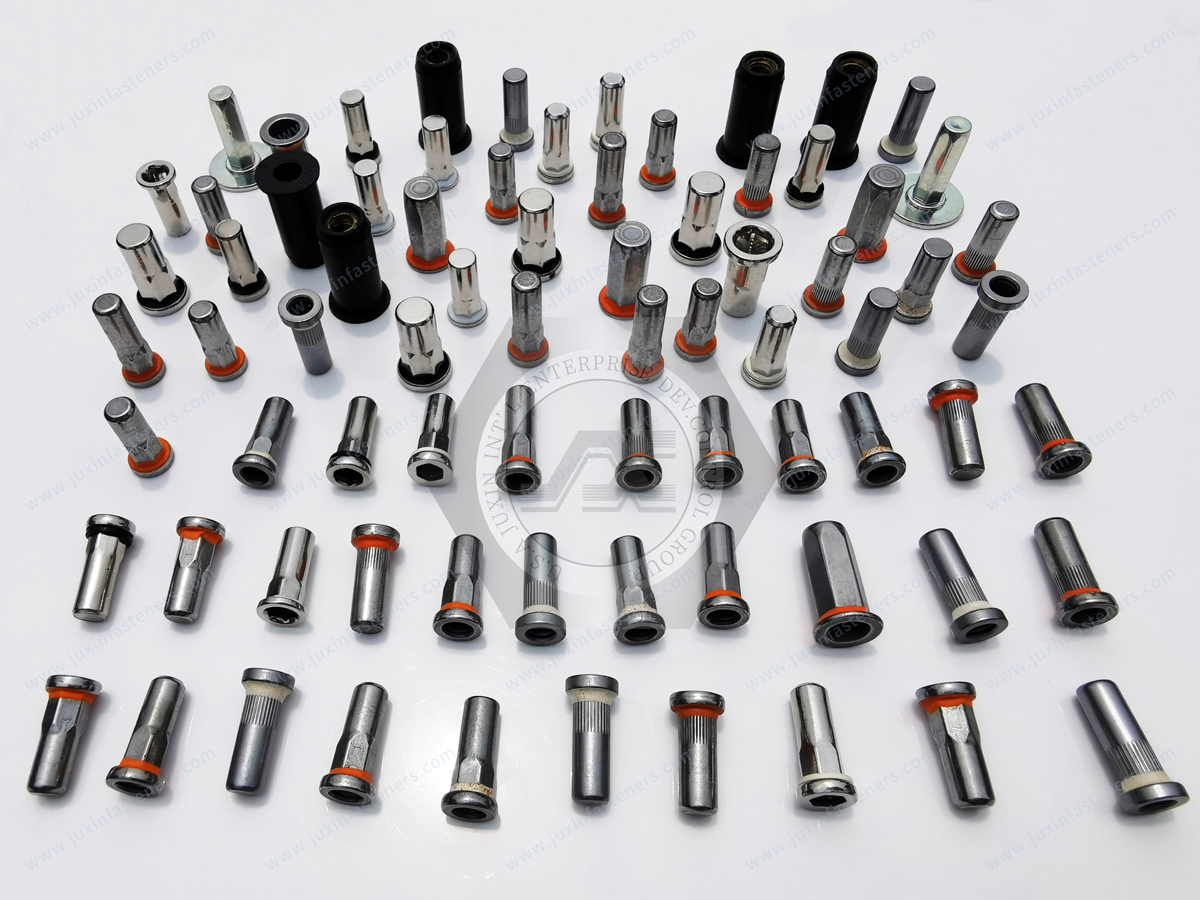
JUXIN FASTENERS supplies closed end rivet nuts, open end blind rivet nuts, hex rivet nuts, countersunk rivet nuts,
knurled rivet nuts and custom threaded inserts for OEM manufacturers and industrial supply chains.
Available configurations can include carbon steel, stainless steel and aluminum, with different head styles,
body geometries, thread sizes, grip ranges and surface finishes according to the assembly requirement.
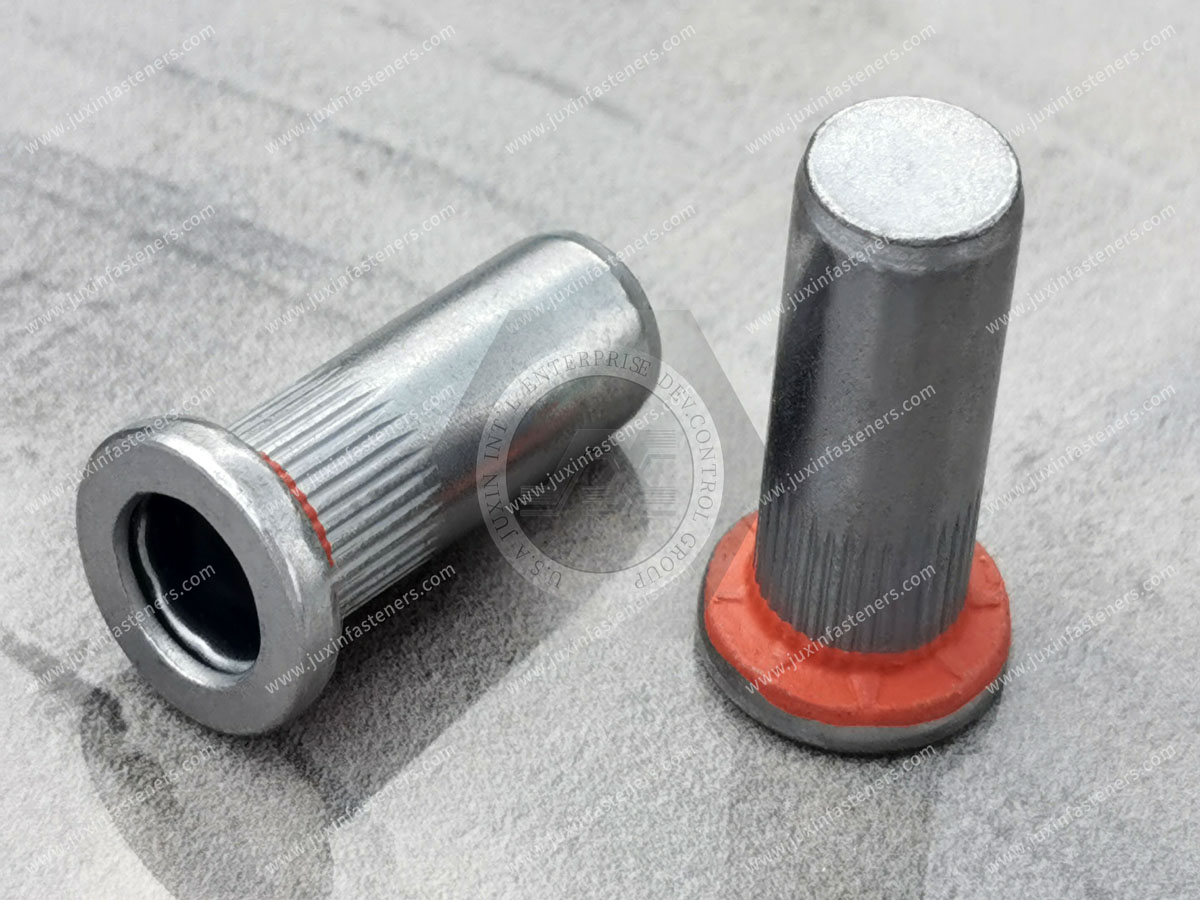
A closed end rivet nut is an internally threaded blind fastener with a sealed bottom.
It is installed from one side of the workpiece using a rivet nut setting tool. During installation, the deformable section of the rivet nut collapses behind the parent material,
forming a mechanical clamp while leaving a reusable internal thread on the accessible side.
Its closed bottom differentiates it from an open end rivet nut.
In an open end design, the threaded passage continues through the insert.
In a closed end design, the bottom of the insert terminates in an enclosed barrel.
This makes closed end rivet nuts particularly useful where engineers want to reduce the possibility of:
water passing through the threaded opening;
oil or process fluid entering through the insert;
dust entering through the internal thread;
contamination moving from one side of the panel to the other;
the mating screw projecting beyond the insert.
However, the closed barrel is only one part of the sealing system.
This distinction is important when specifying a waterproof rivet nut or sealed rivet nut.
A closed end rivet nut blocks the direct passage through the bottom of the threaded insert.
But a complete installed joint may still have another possible leakage path:
between the rivet nut flange/body and the parent sheet.
Therefore:
Closed Bottom ≠ Automatically Waterproof Assembly
and
Closed Bottom ≠ Automatically Gas-Tight or Pressure-Tight Joint
If an enclosure requires a specified IP rating, leak rate, pressure resistance or fluid-tight performance, engineers should evaluate the complete installation.
Depending on the requirement, the assembly may need:
a sealing washer;
bonded sealing element;
under-head seal;
O-ring;
sealant;
specialized sealing rivet nut;
controlled installation hole;
validated setting parameters;
finished-assembly leak testing.
This distinction is especially important for automotive battery enclosures, electrical cabinets, outdoor electronics and fluid-sensitive equipment.
The basic selection difference is not simply “sealed versus unsealed.”
| Engineering Factor | Closed End Rivet Nut | Open End Rivet Nut |
|---|---|---|
| Bottom | Closed | Open |
| Direct path through thread | Blocked at bottom | Open |
| Screw projection through insert | Restricted | Possible |
| Blind installation | Yes | Yes |
| Thin-sheet threaded connection | Yes | Yes |
| Environmental isolation | Better starting point | Limited through-thread isolation |
| Overall waterproof rating | Requires assembly validation | Requires additional sealing strategy |
| Available body length | Usually greater | Often more compact |
| Internal screw depth | Limited | More flexible |
| Typical cost | Usually higher | Usually lower |
For a dry indoor machine cover, an open end rivet nut may be completely adequate.
For an outdoor enclosure where moisture entering through the threaded opening is undesirable, a closed end design may provide a significant engineering advantage.
A closed end blind rivet nut becomes particularly useful when one or more of the following conditions exist:
Typical examples include:
closed sections;
hollow profiles;
box structures;
vehicle body assemblies;
fabricated enclosures;
completed sheet metal structures.
Examples include:
electrical cabinets;
battery enclosures;
outdoor equipment;
electronic housings;
contamination-sensitive assemblies.
Because the barrel is closed, the mating screw cannot extend indefinitely through the insert.
This can protect components located behind the mounting surface.
Closed end rivet nuts create a threaded mounting point without a weld nut.
This can be useful when engineers want to avoid:
localized heating;
welding distortion;
welding spatter;
damage to finished surfaces;
additional post-weld finishing.
One practical difference between open and closed end rivet nuts is frequently overlooked during design.
With an open end rivet nut, an excessively long screw may simply project beyond the insert if space permits.
With a closed end rivet nut, available internal screw depth is finite.
If the mating screw is too long, it can bottom against the closed end before the joint reaches the intended clamp load.
This can produce a misleading assembly condition:
the screw feels tight, but the components may not actually be clamped correctly.
For this reason, engineers should verify:
usable thread depth;
mating screw length;
washer thickness;
bracket thickness;
required thread engagement;
assembly tolerance stack.
This is particularly important when one closed end rivet nut is used across several different bracket configurations.
Installation typically follows five stages.
The hole must correspond to the specified rivet nut body geometry and dimensional requirement.
Hole size is critical.
An oversized hole can reduce:
anti-rotation performance;
installation consistency;
torque resistance;
sealing-interface control.
An undersized hole may prevent correct insertion or damage the coating.
The rivet nut is threaded onto the mandrel of the installation tool.
The fastener is inserted into the prepared hole until the flange contacts the parent material.
The installation tool applies controlled axial force or stroke.
The deformable section collapses behind the sheet, creating a mechanical clamp around the parent material.
After setting, the mandrel is removed and the installed insert should be checked for:
correct seating;
flange contact;
correct deformation;
thread condition;
rotation;
installation damage.
Where sealing performance is critical, functional leak testing may also be required.
One of the most important values when selecting any blind rivet nut is the grip range.
Grip range defines the parent-material thickness range over which a specific rivet nut is designed to set correctly.
Selecting only:
M6 Closed End Rivet Nut
is not enough.
Two M6 closed end rivet nuts may have different:
body lengths;
grip ranges;
flange diameters;
hole requirements;
installed deformation characteristics.
If the material is thinner than the intended grip range, the insert may not form correctly.
If the material is too thick, there may be insufficient deformation length to establish the required mechanical lock.
For OEM purchasing, always specify:
Thread Size + Parent Material Thickness / Grip Range
rather than thread size alone.
Closed end rivet nuts can be manufactured with different external body geometries.
Suitable for many general-purpose applications where installation simplicity is important.
Knurling increases mechanical interaction with the parent material and may improve anti-rotation performance depending on the sheet material and installation condition.
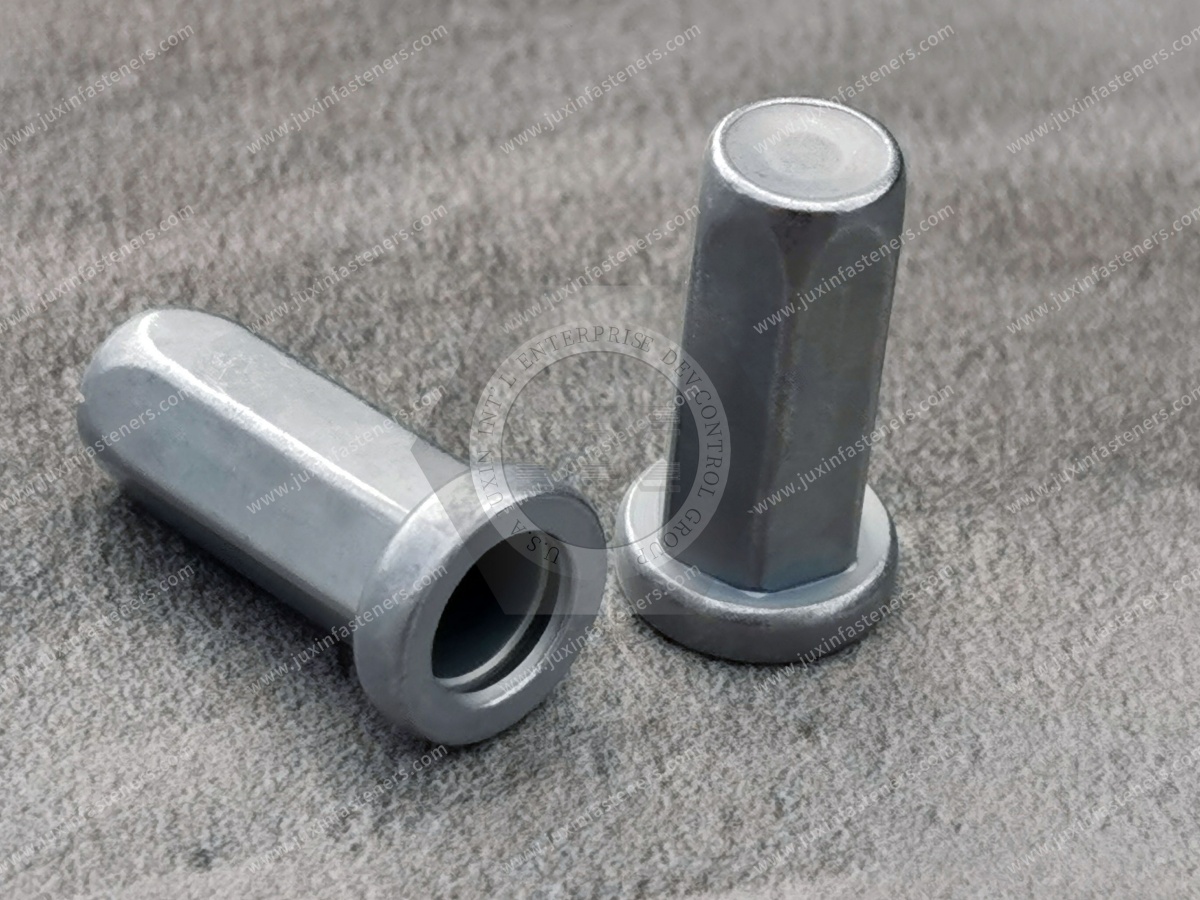
A hexagonal body engages with a corresponding hexagonal installation hole.
This provides positive geometric resistance to rotation and is useful where higher installation or service torque is expected.
For demanding OEM assemblies, anti-rotation performance should be considered together with:
hole geometry;
sheet material;
sheet hardness;
grip range;
installation force;
flange design.
Different flange styles solve different assembly problems.
Provides a larger bearing surface against the parent material.
Useful for:
thin sheet;
softer materials;
assemblies requiring greater load distribution.
Provides lower surface projection where assembly clearance is limited.
Used where a lower-profile or flush installation is required.
A countersunk configuration requires the parent material and hole preparation to support the required countersink geometry.
Head style should not be selected only for appearance. It influences bearing area, installation condition and load transfer.
Carbon steel provides a practical combination of:
mechanical strength;
manufacturability;
availability;
cost efficiency.
Typical applications include:
industrial machinery;
automotive assemblies;
electrical equipment;
agricultural equipment;
fabricated sheet metal structures.
Possible protective finishes include:
zinc plating;
zinc-nickel coating;
black zinc where specified;
mechanical zinc coatings;
customer-specified coating systems.
Coating selection should be based on the actual corrosion requirement rather than appearance alone.
For automotive, EV and outdoor equipment, zinc-nickel coatings may be considered where higher corrosion resistance than conventional zinc plating is required.
However, procurement specifications should define the required performance, such as:
coating system;
coating thickness where applicable;
corrosion-test requirement;
passivation;
topcoat;
friction requirement;
environmental compliance.
Writing only “zinc-nickel plated” may not provide enough information for a controlled OEM supply specification.
Stainless steel closed end rivet nuts can be considered for assemblies exposed to moisture, chemicals or outdoor environments.
Common material families include:
304 / A2-type stainless steel;
316 / A4-type stainless steel.
Potential applications include:
food-processing equipment;
outdoor machinery;
marine-related equipment;
selected medical equipment;
chemical-processing equipment;
corrosion-sensitive enclosures.
A4/316-type stainless steel may be preferred where chloride exposure is more severe.
However, stainless steel selection should still consider:
mating fastener material;
galling;
installation force;
parent material;
galvanic interaction;
actual corrosion environment.
Aluminum closed end rivet nuts provide a lightweight threaded insert solution.
Potential applications include:
transportation equipment;
electronic enclosures;
lightweight structures;
selected aerospace interior assemblies.
Advantages can include:
low mass;
corrosion resistance;
easier setting compared with some higher-strength materials.
However, aluminum inserts generally should not be selected where maximum thread strength, pull-out resistance or torque resistance is the dominant requirement without validating the joint.
Another important selection factor is the combination of:
Rivet Nut Material + Parent Material + Mating Screw + Environment
For example, installing a stainless steel rivet nut into an aluminum panel in a wet or salt-containing environment can create galvanic-corrosion considerations.
The correct solution may require:
material compatibility review;
protective coating;
isolation layer;
sealant;
controlled drainage;
application-specific corrosion testing.
Selecting the “most corrosion-resistant rivet nut” does not automatically create the most corrosion-resistant assembly.
Automotive applications may include:
body structures;
brackets;
underbody equipment;
electrical modules;
interior structures;
HVAC assemblies;
enclosures.
Important selection factors include:
vibration;
torque resistance;
corrosion protection;
installation cycle time;
sheet thickness;
serviceability.
Where water intrusion is a concern, the closed end can help eliminate the direct path through the threaded barrel, but the flange-to-panel interface still needs to be considered.
EV battery systems create a particularly useful application case.
Potential mounting points include:
battery enclosure brackets;
service covers;
cable-management components;
electrical hardware;
accessory brackets;
enclosure-mounted equipment.
The engineering requirement may involve:
blind installation;
controlled screw depth;
corrosion resistance;
vibration resistance;
environmental sealing.
However, a closed end rivet nut should not automatically be described as a complete battery-pack sealing solution.
Where enclosure sealing is safety- or performance-critical, the complete interface should be validated according to the battery enclosure design and project requirements.
Closed end threaded inserts are useful in:
control cabinets;
switchgear;
telecom cabinets;
outdoor electronic housings;
automation enclosures;
power-distribution equipment.
They provide a reusable threaded mounting point without leaving an open threaded passage through the insert.
For IP-rated enclosures, however, the complete installation should be tested according to the applicable enclosure requirement.
Do not assume an IP rating from the fastener name alone.
Closed end rivet nuts can also support sheet metal assemblies used in:
server cabinets;
power-distribution equipment;
cooling equipment;
UPS systems;
battery energy storage cabinets;
data-center infrastructure.
In these applications, engineers may value:
clean blind installation;
repeatable service threads;
controlled screw projection;
corrosion protection;
reliable mounting of electrical and cooling-related hardware.
Where liquid cooling systems are present, the rivet nut should not be treated as a pressure-fluid fitting unless the complete joint has been specifically designed and validated for that purpose.
Applications can include:
battery energy storage systems;
solar electrical enclosures;
inverter cabinets;
outdoor control equipment;
wind-energy electrical assemblies.
These systems may combine:
outdoor moisture;
temperature cycling;
corrosion;
vibration;
maintenance access.
Closed end rivet nuts can therefore be useful where a reusable blind thread and improved environmental isolation are required.
Closed end rivet nuts may be used in:
passenger interior assemblies;
lighting systems;
equipment cabinets;
HVAC equipment;
access panels;
electrical enclosures;
exterior equipment where appropriately specified.
Rail projects may introduce additional requirements involving:
vibration;
fire behavior of adjacent materials;
corrosion;
traceability;
project-specific standards;
installation validation.
The fastener should therefore be selected as part of the complete assembly requirement.
Typical applications include:
machine guards;
access panels;
equipment housings;
robotic equipment;
control systems;
production machinery.
The reusable internal thread allows equipment panels and components to be removed for service while maintaining a permanent threaded insert in the base structure.
Stainless steel closed end rivet nuts may be considered for selected food-processing machinery where corrosion resistance and cleanability are important.
However, fastener selection for hygienic equipment should consider:
equipment zone;
cleaning chemistry;
crevice formation;
surface finish;
washdown;
hygienic-design requirements.
A closed end rivet nut should not automatically be described as hygienic simply because it is manufactured from stainless steel.
Potential applications include:
equipment housings;
laboratory instruments;
diagnostic equipment;
carts;
non-implantable equipment structures.
Selection should depend on the actual regulatory and cleanliness requirements of the equipment.
General industrial rivet nuts should not be represented as suitable for every medical application without application-specific validation.
Two important mechanical characteristics for rivet nut joints are:
The resistance of the installed rivet nut to being pulled axially from the parent material.
The resistance of the installed insert to rotating in the installation hole when torque is applied to the mating screw.
These values are not properties of the rivet nut alone.
They can change significantly with:
sheet material;
sheet thickness;
hole diameter;
body geometry;
flange design;
installation stroke or force;
rivet nut material.
Therefore, catalogue values from one installation condition should not automatically be assumed for another parent material.
A common production problem is assuming that greater setting force always produces a stronger rivet nut joint.
Over-setting can cause:
thread distortion;
flange deformation;
parent-sheet damage;
reduced service life;
damaged coatings;
inconsistent clamp formation.
Under-setting can cause:
rotation;
insufficient rear bulge;
poor seating;
low mechanical retention.
The objective is not maximum setting force.
The objective is:
Correct and repeatable setting for the specific rivet nut and grip condition.
For environmentally sensitive assemblies, dimensional control becomes especially important.
Potential leakage can be influenced by:
hole diameter;
hole roundness;
burrs;
scratches;
coating damage;
flange seating;
sheet flatness;
seal condition;
installation force.
This means that specifying a sealed rivet nut without controlling the installation process may not deliver repeatable sealing performance.
| Requirement | Recommended Direction |
|---|---|
| General blind threaded connection | Open or closed end depending on environment |
| Block passage through thread | Closed end |
| Screw must not project behind insert | Closed end |
| Water-sensitive enclosure | Closed end + evaluate flange sealing |
| IP-rated enclosure | Sealed system + validation/testing |
| High anti-rotation requirement | Hex / half-hex body |
| General sheet metal | Round or knurled body |
| Corrosive environment | Stainless steel or suitable coated steel |
| Lightweight structure | Aluminum where mechanical requirements permit |
| Higher corrosion requirement | Evaluate stainless steel or enhanced coating |
| High vibration | Evaluate body geometry, setting and locking strategy |
| Pressure/gas-tight requirement | Application-specific sealing design and testing |
For faster engineering review and more accurate quotation, purchasing teams should provide:
thread size and pitch;
head style;
body style;
open or closed end requirement;
parent material;
parent material thickness;
required grip range;
installation hole size if already defined;
rivet nut material;
surface finish;
corrosion requirement;
pull-out requirement if specified;
torque / spin-out requirement if specified;
sealing requirement;
IP or leak requirement if applicable;
mating screw length;
drawing;
annual quantity.
This information is considerably more useful than an RFQ that simply states:
“M6 waterproof rivet nut.”
M6 stainless waterproof rivet nut, 10,000 pcs.
This does not define enough information for a controlled engineering selection.
M6 × 1.0 closed end blind rivet nut for 1.5 mm stainless steel enclosure, flat head, round knurled body, stainless steel,
outdoor application, mating screw length 12 mm. Enclosure requires environmental sealing; please review flange sealing options. Annual volume 100,000 pcs. Drawing attached.
The second RFQ allows engineering, sourcing and manufacturing teams to evaluate the same assembly conditions.
Depending on customer requirements, production inspection may include:
thread size and pitch;
body diameter;
head diameter;
overall length;
grip-related dimensions;
closed-end integrity.
Thread inspection can be performed using appropriate thread gauges according to the specified thread system.
Sample setting can verify:
correct deformation;
installation behavior;
seating;
thread condition after setting.
Where required:
pull-out testing;
spin-out / torque testing;
thread performance testing.
Depending on the finish:
appearance;
coating thickness;
corrosion testing;
coating adhesion or project-specific requirements.
Where the customer specifies a defined sealing requirement, the installed assembly—not merely the loose rivet nut—may need application-specific leak testing.
Closed end rivet nuts are often supplied according to:
manufacturer specifications;
customer drawings;
OEM engineering specifications;
ISO metric thread requirements;
ASME/ANSI inch-thread requirements where applicable;
ASTM material or coating requirements where specified;
DIN or EN requirements applicable to related dimensions, materials or testing.
Because blind rivet nuts are highly dependent on installation geometry and parent-material conditions,
the customer drawing and validated installation specification are often as important as the general fastener standard.
JUXIN FASTENERS supports OEM and drawing-based closed end rivet nut projects involving:
metric threads;
inch threads;
special body lengths;
different grip ranges;
flat / large flange heads;
reduced heads;
countersunk heads;
round bodies;
knurled bodies;
half-hex bodies;
full-hex bodies;
carbon steel;
stainless steel;
aluminum;
specified coatings;
packaging and traceability requirements.
For customized parts, provide the drawing together with the parent-material and installation information whenever possible.
This article should form part of the main Blind Rivet Nut / Threaded Insert Content Cluster.
Recommended internal links:
Blind Rivet Nuts – Selection Guide
→ Main rivet nut hub covering body styles, materials and engineering selection.
Open End vs Closed End Rivet Nuts
→ Comparison page for engineers deciding between the two barrel designs.
Hex Rivet Nuts
→ High anti-rotation threaded inserts for sheet metal.
Flat Head Hex Rivet Nuts
→ Large bearing surface combined with positive anti-rotation geometry.
Countersunk Rivet Nuts
→ Low-profile and flush-installation applications.
Small Countersunk Head Rivet Nuts
→ Compact sheet metal fastening applications.
Stainless Steel Rivet Nuts
→ Corrosion-resistant threaded inserts for demanding environments.
Automotive Fastening Solutions
→ Application cluster for body, interior, EV and equipment assemblies.
Railway Fastening Solutions
→ Interior and equipment mounting applications for rail vehicles.
Custom Fasteners According to Drawing
→ Commercial conversion page for non-standard OEM requirements.
The intended conversion path is:
Closed End Rivet Nut Search
→ Understand Sealing Function
→ Define Parent Material & Grip Range
→ Choose Body / Head Geometry
→ Select Material & Coating
→ Define Sealing Requirement
→ Upload Drawing / Technical Specification
→ Engineering Review
→ Sample / Quotation
→ OEM Production
If you are sourcing closed end rivet nuts, sealed blind rivet nuts, waterproof rivet nut assemblies, stainless steel closed end rivet nuts,
hex closed end rivet nuts or custom threaded inserts, send JUXIN FASTENERS your application information.
For faster evaluation, provide:
Thread Size + Parent Material + Sheet Thickness + Grip Range + Head Style + Body Style + Material + Coating + Sealing Requirement + Mating Screw Length + Drawing + Quantity
If your project requires a defined waterproof, IP, air-leak or fluid-leak performance,
please include that requirement so the complete fastening interface can be evaluated rather than assuming the closed-end barrel alone provides the required seal.
JUXIN FASTENERS supports procurement teams, supplier-development managers, design engineers and manufacturing engineers with standard and drawing-based industrial fastening solutions.
JUXIN FASTENERS
Website: www.juxinfasteners.com
Email: info@juxinfasteners.com
Contact Us
Tel.:
+86 020 8621 0320
+86 020 3121 6067
E-mail:
Technical Support:
Navigation
SEND INQUIREY