
Call Us
+86 136 6007 9809
Call Us
+86 136 6007 9809

Aug. 14, 2026
Concrete Anchoring Solutions: Wedge Anchors vs. Concrete Screws for Industrial Applications
Engineering Selection Guide for Mechanical Expansion Anchors, Heavy-Duty Concrete Screws and OEM Fastening Systems
Concrete anchoring is a critical part of securing equipment, steel brackets, building services and industrial installations to concrete structures.
A concrete anchor must do more than fit into a drilled hole.
It must transfer the specified loads into the supporting material while meeting the application's installation, durability and service requirements.
Different concrete fastening systems use different load-transfer mechanisms.
Wedge anchors rely on mechanical expansion. Concrete screws develop engagement through specially designed threads interacting with a predrilled substrate.
Neither method is universally superior.
The correct solution depends on:
Concrete strength and condition
Cracked or uncracked concrete
Applied tension and shear
Static, dynamic or seismic loading
Effective embedment depth
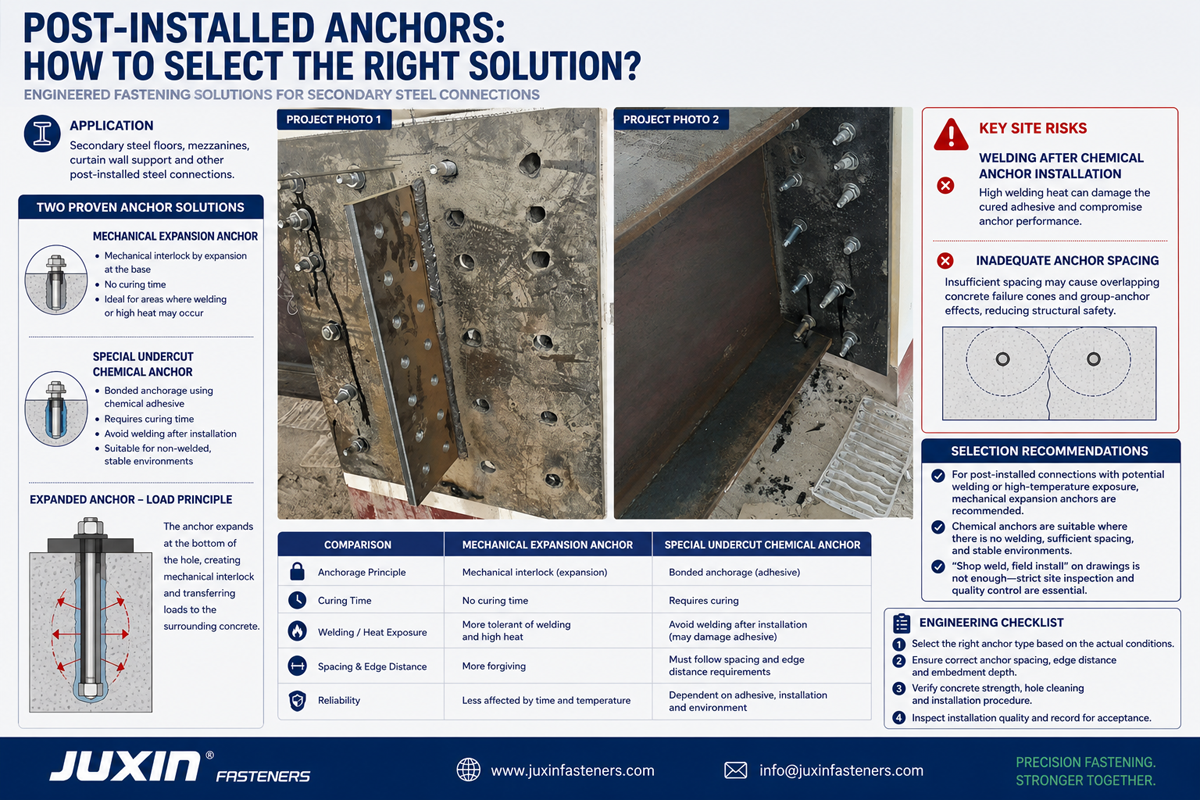
Anchor spacing and edge distance
Supporting-member thickness
Fixture and base plate geometry
Installation method
Corrosion exposure
Inspection requirements
Applicable product qualifications
OEM production and procurement requirements
Juxin Fasteners supplies industrial fastening components and supports inquiries for wedge anchors, concrete screws,
heavy-duty threaded fasteners and customized OEM fastening hardware, subject to product specifications and technical feasibility.
This guide explains the engineering differences between common concrete anchoring technologies and provides practical guidance
for design engineers, structural engineers, manufacturing teams, production managers and industrial purchasing specialists.
What Are Concrete Anchors?
Concrete anchors are fastening systems designed to connect an attached component to a concrete substrate.
The attached component may be:
A steel base plate
An equipment support
A structural bracket
A pipe support
An electrical enclosure
A cable tray support
A handrail base
A machinery frame
An industrial mounting assembly
The anchor transfers forces from the attached component into the concrete.
The complete load path is:
Attached equipment → fixture or base plate → anchor → concrete substrate.
The performance of this connection depends on every part of the system.
Concrete Anchors vs. Ordinary Steel Bolts
A conventional bolt connects mechanical components through a nut or internally threaded part.
A concrete anchor is designed to develop resistance in concrete through an approved anchoring mechanism.
A high-strength bolt is not automatically a qualified concrete anchor.
Likewise, a concrete screw should not be treated as a substitute for a structural steel bolt unless the connection has been specifically designed and approved for that purpose.
Common Types of Concrete Anchoring Systems
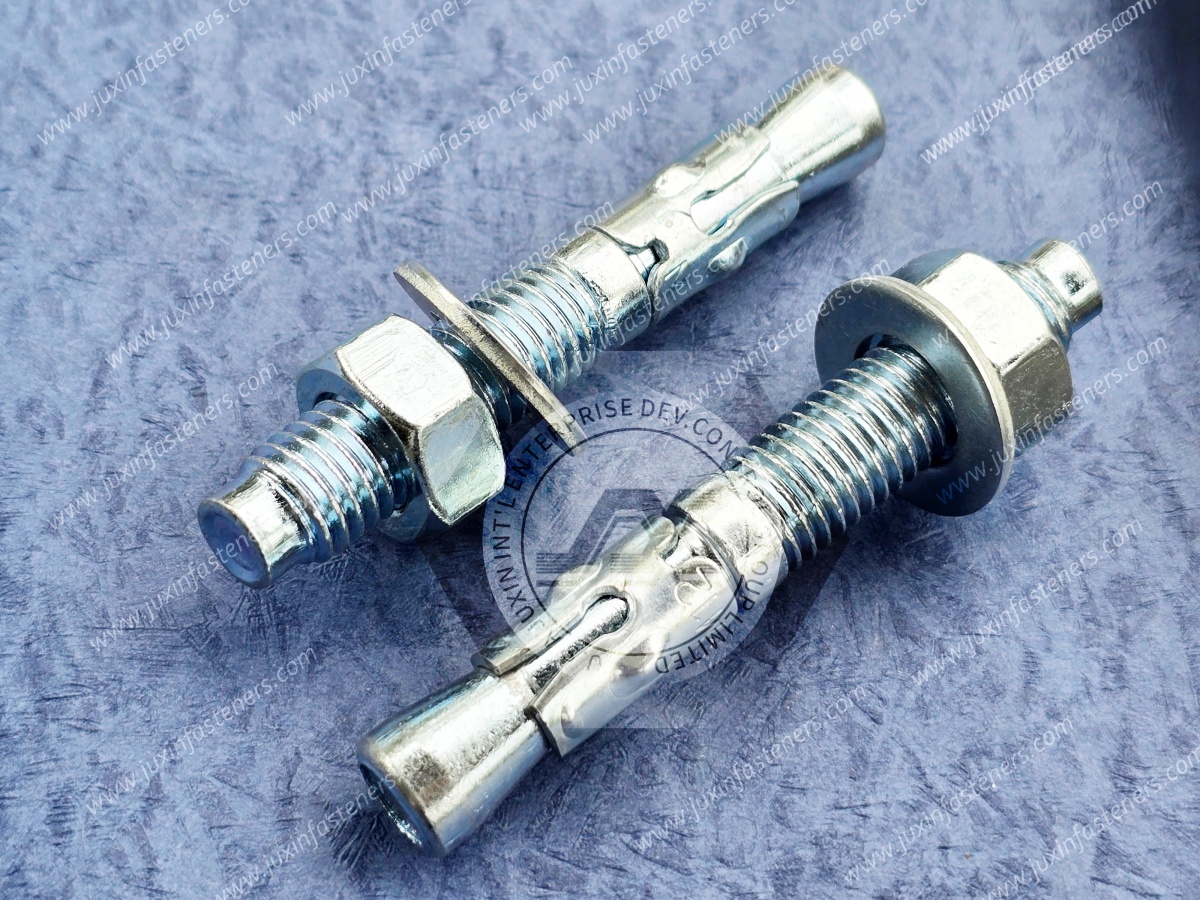
Wedge Anchors
Post-installed mechanical expansion anchors that use a wedge or expansion clip to engage with concrete.
Concrete Screw Anchors
Post-installed anchors that use specially designed threads to form mechanical engagement with concrete.
Sleeve Anchors
Expansion anchors using a sleeve mechanism. Their approved applications vary by product.
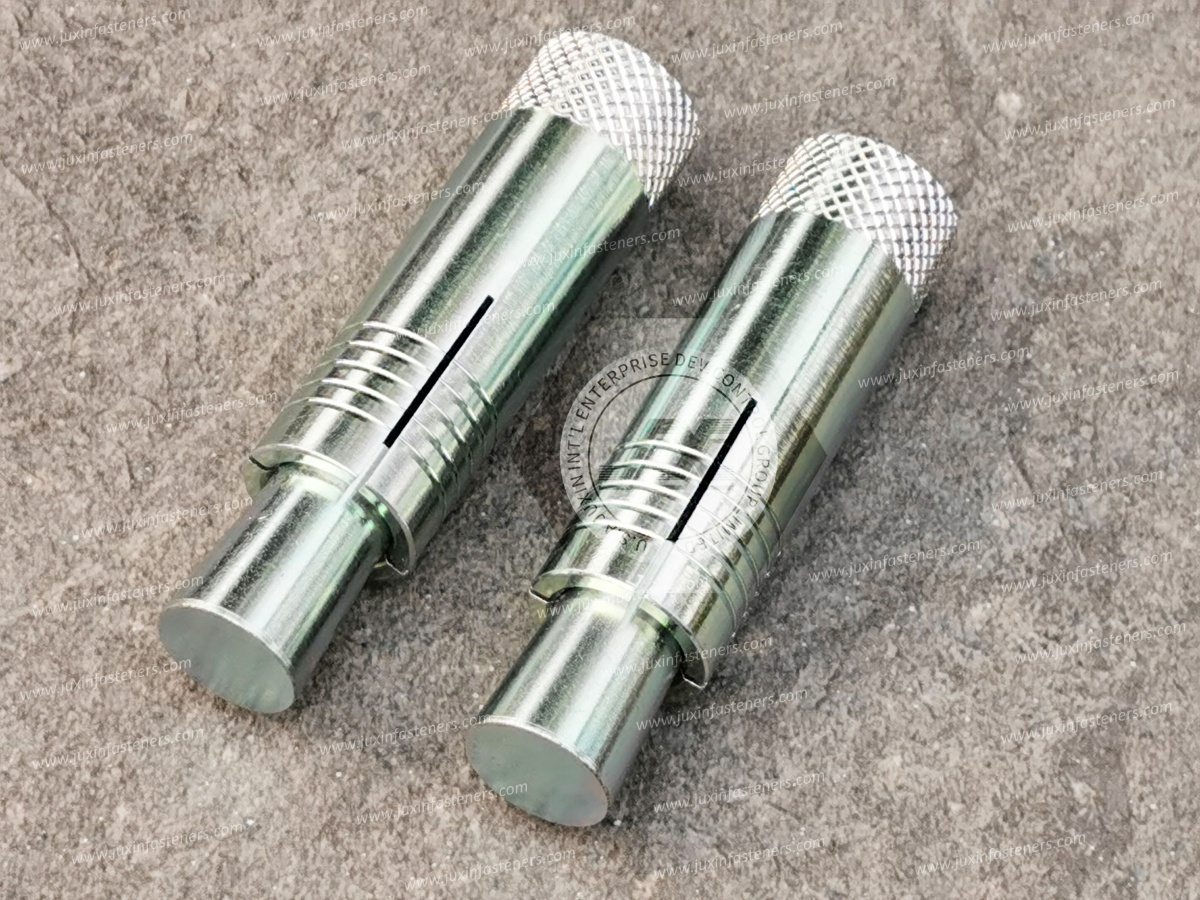
Undercut Anchors
Anchors designed to engage a mechanically formed undercut in the base material.
Bonded Anchors
Systems that use an approved adhesive or resin together with a compatible rod or reinforcing element.
Cast-In Anchors
Anchors positioned before concrete placement.
This article focuses on wedge anchors and concrete screws because they represent two widely used but mechanically different post-installed fastening approaches.
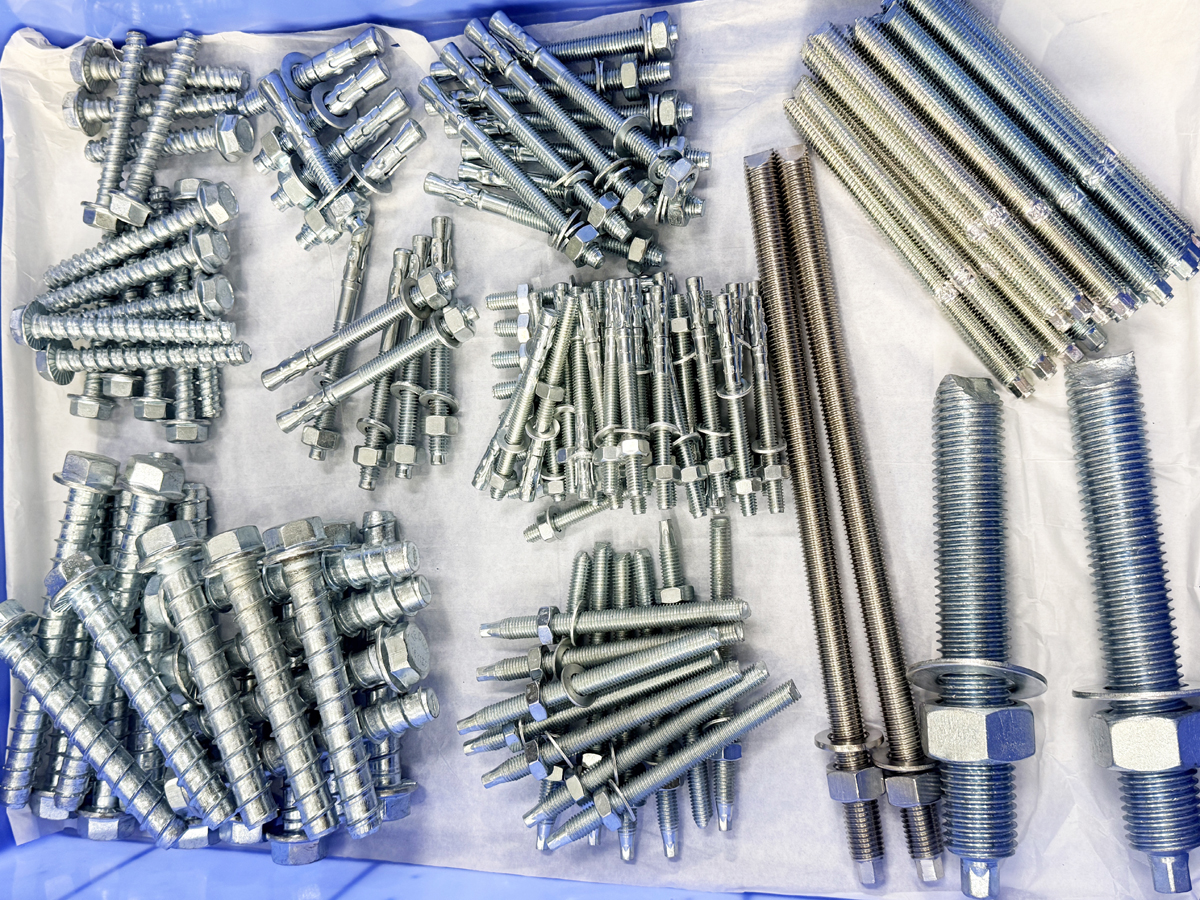
Wedge Anchors for Concrete: How They Work
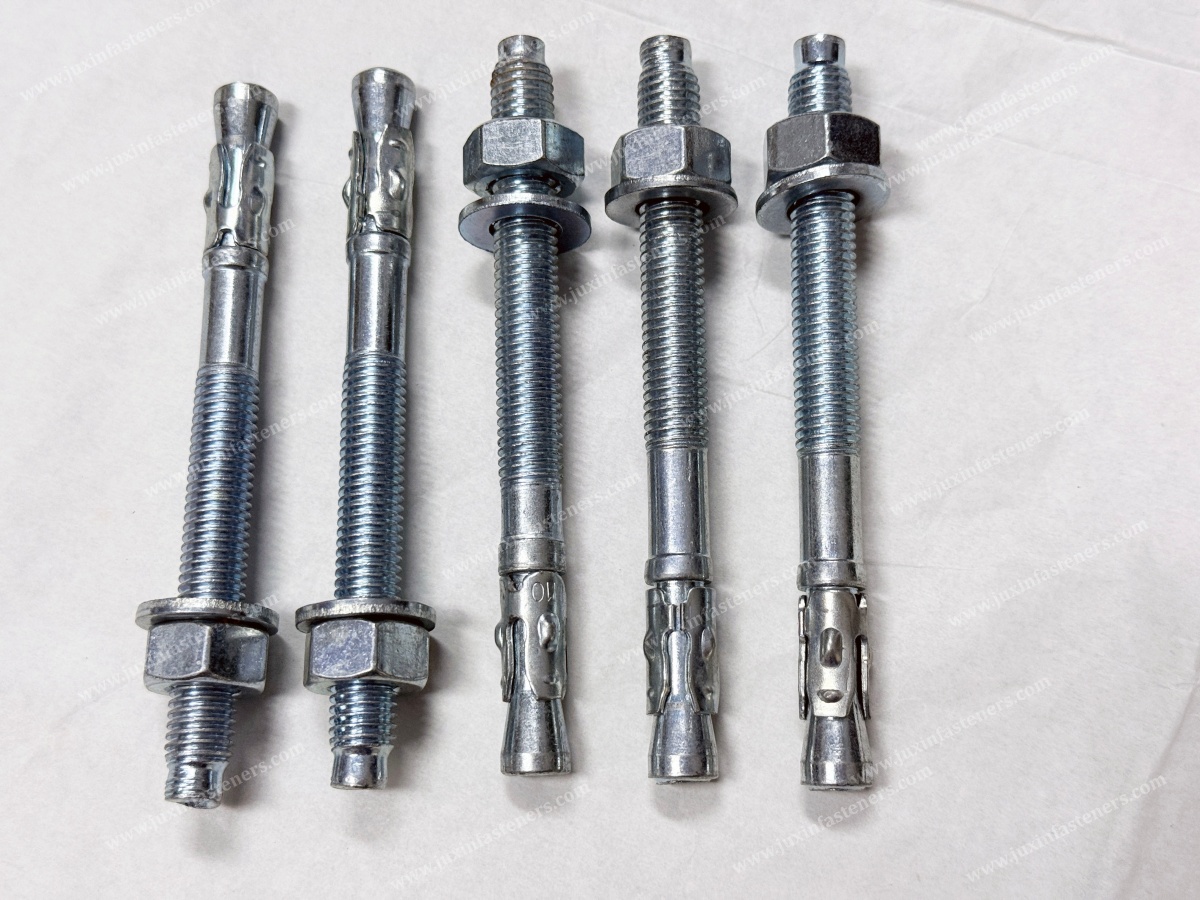
A wedge anchor is a mechanical expansion anchor commonly used to secure steel components and equipment to suitable concrete.
A typical stud-type wedge anchor includes:
A threaded steel stud
An expansion cone or tapered section
An expansion clip
A compatible nut
A washer
During installation, tightening the nut activates the expansion mechanism.
The expansion clip engages against the drilled-hole wall, allowing the anchor to transfer load into the concrete.
The precise mechanism and installation requirements depend on the product design.
Typical Wedge Anchor Applications
Potential applications include:
Industrial machinery bases
Steel support brackets
Equipment frames
Electrical equipment
Handrail bases
Guarding systems
Infrastructure equipment
Selected structural attachments
The actual suitability depends on the specific anchor qualification, supporting material and design loads.
Wedge Anchor Selection Factors
Engineers should check:
Approved concrete strength range
Cracked-concrete qualification where required
Anchor diameter and length
Effective embedment
Fixture thickness
Minimum spacing
Minimum edge distance
Minimum concrete thickness
Installation torque
Corrosion protection
Product evaluation documentation
Important Limitation
A wedge anchor described as suitable for concrete is not automatically suitable for hollow block, brick, weak masonry or deteriorated concrete.
The approved base material must be verified.
Wedge Anchor Installation Considerations
A typical installation workflow may involve:
Verifying the approved substrate
Checking the anchor location
Drilling to the specified diameter and depth
Preparing and cleaning the hole as instructed
Inserting the anchor
Positioning the fixture
Tightening according to the approved procedure
Inspecting the completed installation
The exact sequence depends on the selected product.
Why Drill Diameter Matters
A drilled hole that is too large may prevent the expansion mechanism from developing the intended engagement.
A hole that is too small may prevent proper installation or damage the anchor.
Why Installation Torque Matters
For torque-controlled expansion anchors, tightening is part of the setting mechanism.
Too little torque may result in improper setting.
Excessive torque may damage the anchor or concrete.
There is no universal installation torque for all wedge anchors of the same nominal diameter.
Why Concrete Edge Distance Matters
Expansion forces may contribute to splitting where anchors are installed too close to concrete edges or where the supporting member is too thin.
The minimum permitted dimensions must be taken from the actual anchor documentation.
Wedge Anchors for Concrete Floors, Walls and Equipment Bases
Wedge anchors may be used in suitable concrete floors, walls and other concrete members.
However, the direction of loading and installation orientation can affect the applicable requirements.
For example:
Floor-Mounted Equipment
The design may involve vertical loads, shear and overturning moments.
Wall-Mounted Brackets
The connection may experience tension and shear, depending on bracket geometry.
Overhead Attachments
Overhead installations may have additional approval, inspection and safety requirements.
Engineering Insight
An anchor that performs adequately in one installation orientation should not automatically be assumed suitable for every other orientation.
Wedge Anchor Materials and Surface Treatments
Zinc-Plated Carbon Steel
Zinc-plated carbon steel may provide an economical option for appropriate indoor environments.
Its suitability depends on the coating specification and exposure conditions.
Galvanized Steel
Galvanized steel may provide enhanced corrosion protection in certain environments.
The specific coating process, thickness and compatibility with the anchor design must be verified.
18-8 / 304 Stainless Steel
Austenitic stainless steel may be considered where improved atmospheric corrosion resistance is required.
The exact anchor material and mechanical properties must be confirmed.
316 Stainless Steel
316 stainless steel may offer improved resistance to certain chloride-containing environments compared with 304 stainless steel.
However, it is not immune to pitting, crevice corrosion or all marine exposures.
Material Selection Rule
A stainless steel anchor should not automatically replace a carbon steel anchor based solely on corrosion resistance.
The complete product's mechanical performance and approval must also be considered.
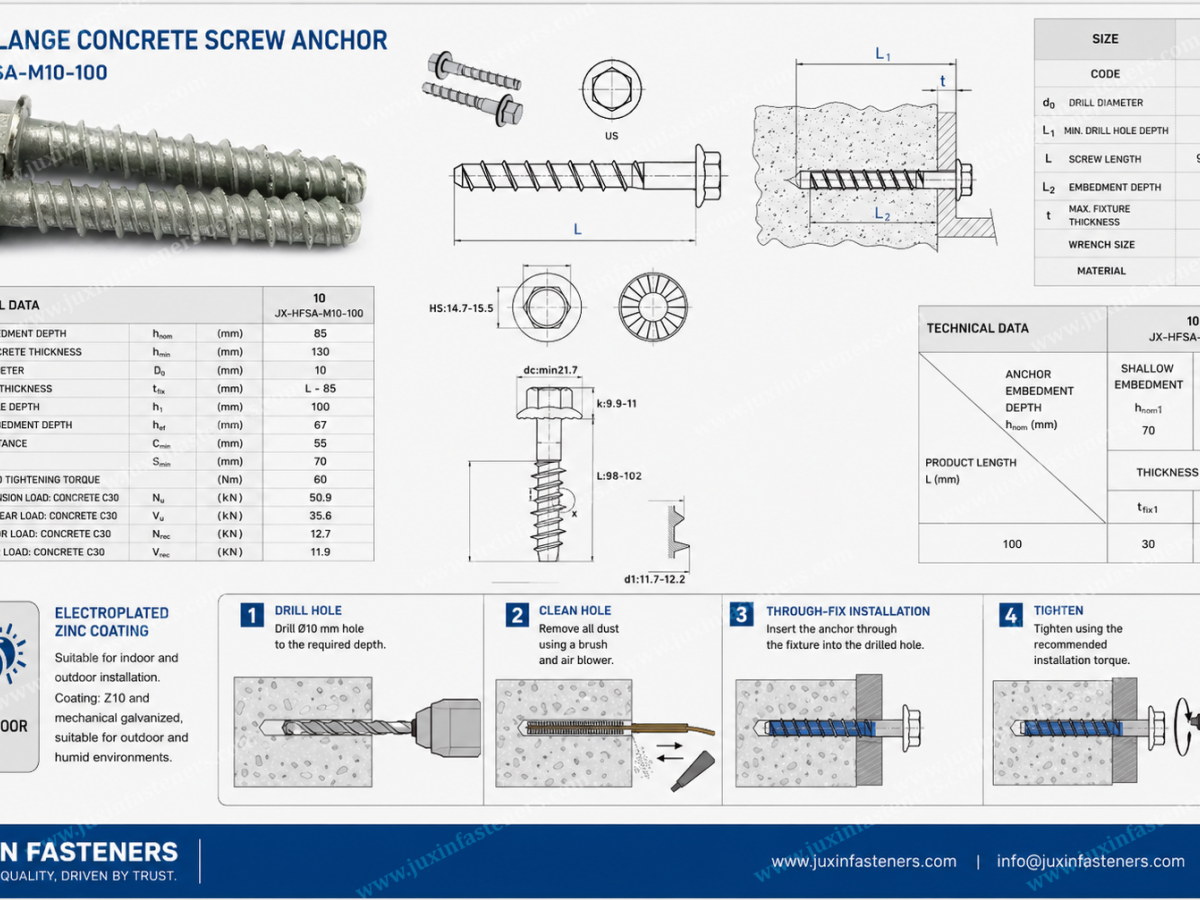
Concrete Screws: Heavy-Duty Concrete Tapping Fasteners
Concrete screws, also known as concrete screw anchors or concrete tapping screws, use a different anchoring mechanism from wedge anchors.
A concrete screw is installed into a correctly prepared pilot hole.
Its specially designed thread engages with the concrete and transfers load through mechanical interlock.
Depending on the design, the thread may cut or form engagement with the substrate.
Common Concrete Screw Configurations
Concrete screw anchors may be supplied with:
Hex heads
Flange heads
Countersunk heads
Internal-drive heads
Other product-specific configurations
The selected head geometry should match the fixture and installation tooling.
Heavy-Duty Hex Head Concrete Screws
Hex head concrete screws can provide convenient access for suitable powered or manual installation tools.
They may be used for:
Steel brackets
Equipment supports
Electrical installations
Cable management
HVAC supports
Industrial mounting hardware
The specific load rating and approved application depend on the individual product.
Concrete Screw vs. Ordinary Self-Tapping Screw
A conventional self-tapping screw designed for sheet metal or plastic is not equivalent to a concrete screw anchor.
Concrete screws require specialized thread geometry and suitable material properties for the intended substrate.
Concrete Screw Installation
A typical process involves:
Confirming the approved base material
Drilling the specified pilot hole
Preparing the hole as required
Driving the screw using the specified tooling
Confirming the required installation condition
Inspecting the completed connection
Engineering Caution
An incorrectly sized pilot hole can cause excessive installation torque, thread damage, poor engagement or premature failure.
The correct hole diameter is product-specific.
Self-Cutting Concrete Bolts
The term self-cutting concrete bolt is sometimes used for heavy-duty concrete screw anchors whose threads create engagement within a predrilled hole.
These products may simplify certain installation workflows.
However, the name alone does not establish:
Structural approval
Cracked-concrete suitability
Seismic qualification
Reusability
Load capacity
All such claims must be supported by the exact product's technical documentation.
Concrete Screw Removal and Reinstallation
Some concrete screw anchors can be removed after installation.
However, removability does not automatically mean that the anchor can be reused in the same hole.
Reinstallation or reuse must follow the specific product's approval and manufacturer's instructions.
Where Concrete Screws Are Used
Mechanical and Electrical Services
Potential applications include:
Cable trays
Pipe supports
Electrical junction boxes
Conduit supports
HVAC brackets
Duct supports
Equipment Installation
Potential applications include:
Light equipment supports
Steel mounting brackets
Machinery accessories
Maintenance fixtures
Building Maintenance
Concrete screws may be useful for certain retrofit and renovation projects where direct attachment to existing concrete is required.
Railings and Handrails
Concrete screws may be considered only where the product is qualified for the relevant loads and applicable safety requirements.
Facade and Curtain Wall Attachments
Facade attachments may be safety-critical.
They require project-specific structural design, suitable anchor qualification and compliance with applicable building requirements.
A generic concrete screw should not be recommended for a facade system without that verification.
Wedge Anchors vs. Concrete Screws: Engineering Comparison
| Feature | Wedge Anchors | Concrete Screws |
|---|---|---|
| Primary anchoring mechanism | Mechanical expansion | Thread engagement with concrete |
| Typical installation | Drill, insert and activate expansion | Drill pilot hole and drive screw |
| Expansion during setting | Typically significant to the mechanism | Different mechanism; does not rely on a conventional expansion clip |
| Required hole dimensions | Product-specific | Product-specific |
| Installation torque | May control expansion setting | Depends on product and driving requirements |
| Fixture removal | Nut and fixture may be removable while anchor remains | Screw may be removable, subject to product conditions |
| Reuse | Not assumed | Not assumed |
| Cracked-concrete suitability | Only where qualified | Only where qualified |
| Seismic suitability | Only where qualified | Only where qualified |
| Structural applications | Possible with suitable approval and design | Possible with suitable approval and design |
| Corrosion options | Depend on product | Depend on product |
| Design capacity | Product- and application-specific | Product- and application-specific |
Which Anchor Is Stronger?
Neither wedge anchors nor concrete screws can be declared universally stronger.
A meaningful comparison must use:
The same supporting material
Comparable design conditions
Relevant anchor sizes
Applicable loading directions
Required embedment
Edge distance and spacing
Product-specific qualification data
Which Anchor Is Faster to Install?
Concrete screws may simplify installation in some applications because they do not use a separate nut-setting expansion mechanism.
However, installation time also depends on drilling, cleaning, access, tooling and inspection.
A properly designed wedge anchor system may be more practical in other situations.
Which Anchor Is Better Near Concrete Edges?
The answer depends on the approved minimum edge distance and resistance of the specific products.
It is not technically correct to assume that every concrete screw is suitable for closer edge distances than every wedge anchor.
Engineering Selection Principle
Compare the approved anchoring systems, not merely their generic product categories.
Cracked vs. Uncracked Concrete
Concrete cracking is a major consideration in post-installed anchoring.
Cracks can change the way anchors transfer loads into concrete.
Some products are qualified for cracked concrete.
Others may be intended only for uncracked concrete.
Why Cracked Concrete Matters
A crack passing through an anchor location can influence anchoring resistance.
The design must account for the expected concrete condition.
Can an Anchor for Uncracked Concrete Be Used in Cracked Concrete?
Not automatically.
The product must be suitable for the specified application and have the relevant technical qualification.
Seismic Applications
Seismic loading may require additional anchor qualification and design checks.
A product described as heavy-duty is not necessarily seismic-qualified.
Concrete Anchor Load Capacity: More Than Steel Strength
Concrete anchor design must consider several possible failure mechanisms.
Steel Failure
The steel anchor may yield or fracture under excessive loading.
Concrete Cone Breakout
A portion of the concrete may fracture around the anchor under tensile loading.
Pullout Failure
The anchor may lose its engagement with the concrete.
Concrete Splitting
Concrete may crack or split due to installation effects or applied loads.
Concrete Edge Breakout
Concrete near an edge may fail under shear.
Concrete Pryout
Certain shear-loading conditions may produce concrete pryout failure.
Anchor Group Effects
Closely spaced anchors may have interacting failure zones.
Fixture Failure
The connected steel plate or bracket may deform or fail.
Engineering Information Gain: The Weakest Element Controls
Increasing the steel strength of an anchor does not necessarily increase the design capacity of the connection.
If concrete breakout, edge failure or base plate deformation governs, stronger steel alone may provide little benefit.
The complete connection must be evaluated.
Tension, Shear and Combined Loading
Tension
Acts approximately along the anchor axis.
Shear
Acts approximately across the anchor.
Combined Tension and Shear
Many real equipment connections experience both.
Overturning
Equipment mounted above a base plate may create overturning moments that increase tension in selected anchors.
Unequal Load Distribution
In an anchor group, loads may not be distributed equally.
The design should consider base plate stiffness, anchor locations and load eccentricity.
Anchor Embedment Depth
Effective embedment depth is a critical design parameter.
It influences the transfer of load into the concrete.
However, a greater embedment depth does not automatically guarantee a higher approved design capacity.
The effect depends on the specific anchor system and applicable failure modes.
Anchor Edge Distance and Spacing
The distance from an anchor to a concrete edge can affect its resistance.
Anchor spacing can affect group behavior.
The required values must come from the product's technical documentation and applicable design provisions.
Base Plate and Fixture Thickness
The connected fixture influences the load path.
Engineers should consider:
Plate thickness
Plate stiffness
Hole diameter
Hole spacing
Washer bearing
Grout layers
Stand-off distance
Installation tolerances
Why Stand-Off Installation Needs Special Review
Where an anchor supports a fixture above the concrete surface, the exposed portion may experience additional bending.
This is different from a base plate bearing directly against concrete.
The design must consider the actual fixture geometry.
Suitable Substrates for Concrete Anchors
Normal-Weight Concrete
A common base material for qualified concrete anchoring systems.
Lightweight Concrete
Some anchors may be qualified for specific lightweight concrete conditions.
Precast Concrete
Precast elements may be suitable if thickness, strength, reinforcement and installation conditions meet the requirements.
Concrete-Filled Steel Deck
Certain anchoring systems may be qualified for specified concrete-filled steel deck configurations.
Solid Masonry
Some fasteners are designed or qualified for specific masonry materials.
However, concrete anchor approval does not automatically extend to brick or masonry.
Hollow Masonry
Hollow blocks may require specialized fastening systems.
Deteriorated Concrete
Damaged or weak concrete requires engineering evaluation before an anchor system is selected.
Engineering Rule
Do not assume that one anchor is suitable for concrete, brick, hollow block and all masonry substrates merely because its commercial description mentions multiple materials.
International Standards for Concrete Anchoring
EN 1992-4: Design of Fastenings for Use in Concrete
EN 1992-4 provides European design rules for fastenings used in concrete.
Relevant design considerations include:
Tensile resistance
Shear resistance
Combined loading
Anchor spacing
Edge distance
Concrete failure modes
Anchor groups
Product-specific assessed characteristics must be used in the design.
European Technical Assessment (ETA)
An ETA may provide assessed performance information for a particular anchor product.
It may define:
Intended use
Approved base material
Installation conditions
Anchor dimensions
Resistance characteristics
Environmental limitations
An ETA applies to the specific assessed product and its stated scope.
ACI 318 Chapter 17
ACI 318 Chapter 17 provides design provisions for anchoring to concrete in applicable North American structural projects.
The governing edition depends on the adopted code and project requirements.
ACI CODE-355.2-24
ACI CODE-355.2-24 establishes qualification requirements for post-installed mechanical anchors in concrete.
Its scope includes relevant mechanical anchoring technologies and qualification conditions.
ICC-ES Evaluation Reports
An ICC-ES evaluation report may provide evidence that a specific anchor product has been evaluated for stated applications and code requirements.
The report should be checked for:
Product identification
Applicable code editions
Approved base materials
Anchor dimensions
Installation conditions
Design information
Limitations of use
Standards Are Not Interchangeable
Thread standards, material standards, coating standards, anchor qualification standards and structural design standards serve different purposes.
Conformity with one does not automatically establish conformity with the others.
Corrosion Protection for Concrete Anchors
The environment influences long-term anchoring reliability.
Potential exposures include:
Indoor humidity
Condensation
Rain
Deicing salts
Coastal atmospheres
Industrial pollutants
Chemical exposure
Temperature cycling
Zinc-Plated Steel
May be suitable for selected indoor or less aggressive environments.
Galvanized Steel
May provide improved corrosion protection in certain applications, depending on coating specification and exposure.
304 Stainless Steel
May provide improved atmospheric corrosion resistance in suitable environments.
316 Stainless Steel
May offer improved resistance to certain chloride-containing environments compared with 304 stainless steel.
Important Limitation
316 stainless steel is not universally resistant to seawater, chloride crevice corrosion or every aggressive chemical environment.
Galvanic Corrosion
Dissimilar metals in contact with an electrolyte may create galvanic corrosion risks.
The complete anchor assembly and attached fixture should be evaluated.
Coating Compatibility
A coating may affect:
Thread dimensions
Installation friction
Setting torque
Corrosion protection
Component compatibility
Coating substitutions in a qualified anchor system require technical review.
Hydrogen Embrittlement
Certain high-strength steel fasteners may be susceptible to hydrogen embrittlement.
Material properties, coating processes and service conditions should be evaluated where relevant.
Salt Spray Testing
ASTM B117 and ISO 9227 describe laboratory salt spray testing methods.
Such testing can support coating evaluation under specified conditions.
However, salt spray hours should not be directly converted into guaranteed real-world service life.
Installation Quality: The Link Between Engineering and Production
A properly designed anchor may still fail to perform as intended if installed incorrectly.
Installation quality should be treated as part of the engineering specification.
Verify the Substrate
Confirm the approved concrete or masonry condition.
Check Hole Location
Verify edge distance, spacing and installation tolerance.
Drill the Correct Hole
Use the required diameter and depth.
Prepare the Hole
Follow the specified cleaning and preparation instructions.
Install the Anchor
Use the approved installation method and tooling.
Control Tightening
Where required, use the specified installation torque or setting procedure.
Inspect the Installation
Apply the project-specific acceptance criteria.
Record Critical Installations
Maintain installation records where required.
Common Installation Failure Matrix
| Problem | Potential cause | Engineering response |
|---|---|---|
| Anchor slips or pulls out | Wrong substrate or inadequate installation | Verify product approval and procedure |
| Concrete cracks during setting | Edge distance, spacing or excessive expansion effects | Review anchor layout and installation |
| Screw cannot reach required position | Incorrect pilot hole or substrate condition | Verify drilling and product instructions |
| Excessive installation torque | Incorrect hole size, tooling or product mismatch | Review installation process |
| Base plate bends | Inadequate fixture stiffness | Review plate design |
| Anchor steel fractures | Excessive stress or unsuitable material | Review design loads and product properties |
| Corrosion appears | Inadequate material or coating | Review environmental requirements |
| Reinstallation fails | Unapproved reuse or damaged hole | Follow product-specific reuse rules |
| Inspection is inconsistent | Unclear acceptance criteria | Define controlled installation records |
Industrial Applications for Wedge Anchors and Concrete Screws
Industrial Machinery and Production Equipment
Applications may include:
Machine bases
Equipment frames
Guarding systems
Production-line supports
Auxiliary machinery
Engineering considerations include dynamic loading, vibration, alignment and foundation stiffness.
Electrical Equipment and Power Distribution
Applications may include:
Control cabinets
Power distribution equipment
UPS installations
Electrical mounting frames
Cable management supports
The appropriate anchor must be selected according to equipment weight, installation geometry and project requirements.
HVAC and Mechanical Building Services
Applications may include:
Pipe supports
Duct supports
Mechanical equipment brackets
HVAC mounting frames
Cable trays
Overhead and safety-related installations require appropriate product qualification and design.
AI Data Centers and Cooling Infrastructure
Selected data center installations may require anchoring for:
Cooling equipment
Auxiliary mechanical systems
UPS equipment
Electrical support structures
Facility equipment
Not every rack or enclosure requires concrete anchoring.
Anchor selection should follow the actual equipment and facility design.
Rail Transit and Infrastructure
Potential applications include:
Station equipment
Cable management systems
Auxiliary mounting structures
Maintenance equipment
Selected rail infrastructure components
Safety-critical and vibration-sensitive applications require project-specific approval.
Construction and Steel Support Structures
Wedge anchors and concrete screws may be considered for selected steel-to-concrete attachments.
However, structural applications require engineering design and suitable product qualification.
Automotive Manufacturing Facilities
Potential applications include:
Production machinery
Assembly fixtures
Equipment guards
Automation supports
Maintenance equipment
Production managers may prioritize repeatable installation, access and downtime reduction.
Renewable Energy and Energy Storage Facilities
Potential applications include selected equipment bases and support structures.
Exposure conditions, loads and relevant project standards must be evaluated.
Industry Selection Matrix
| Application | Main concern | Engineering selection priority |
|---|---|---|
| Machinery base | Dynamic loads and alignment | Qualified anchor system and foundation design |
| Electrical cabinet | Stability and access | Load path, fixture geometry and installation |
| Cable tray support | Suspended loads | Approved anchor and overhead installation requirements |
| HVAC bracket | Service loading | Suitable substrate and installation method |
| Safety railing | Human safety | Structural design and qualified anchors |
| Rail equipment | Vibration and durability | Project approval and environmental performance |
| Outdoor enclosure | Corrosion | Compatible material and anchor qualification |
| Data center equipment | Installation consistency | Equipment design and mounting requirements |
| Industrial retrofit | Existing concrete condition | Substrate verification and approved installation |
OEM Custom Fasteners and Equipment Mounting Hardware
Not every equipment installation uses a standard off-the-shelf threaded component.
OEM customers may require:
Special threaded studs
Custom mounting bolts
Machined spacers
Custom nuts
Special washers
Threaded standoffs
Drawing-specific mounting components
Juxin Fasteners supports drawing-based inquiries for these industrial fastening components.
Important Qualification Boundary
A custom bolt or machined threaded component is not automatically a qualified concrete anchor.
If the component is intended to function as a structural concrete anchor, the required product qualification and performance evidence must be established.
Drawing-Based Manufacturing Requirements
A complete drawing may identify:
Material
Dimensions
Thread system
Tolerances
Surface treatment
Mechanical requirements
Inspection criteria
Packaging
Metric and Inch Thread Systems
Metric, UNC, UNF, BSW and BSF thread systems must not be treated as directly interchangeable.
For concrete anchoring systems, the thread configuration must also match the actual approved product assembly.
Manufacturing and Production Planning
Depending on the component, production may involve:
Forming
CNC machining
Thread processing
Heat treatment where specified
Surface finishing
Inspection
Packaging
The actual manufacturing route depends on the product design and technical requirements.
Production Manager Considerations
For repeated equipment installations, production and assembly teams should evaluate:
Installation time
Tool access
Hole location tolerance
Part identification
Packaging by installation set
Fastener consistency
Inspection requirements
Rework risk
Engineering Information Gain: Installation Cost Is Part of Fastener Selection
Two anchor products with similar unit prices may have different total installed costs.
Differences may arise from:
Drilling time
Hole cleaning
Setting operations
Tool changes
Installation access
Inspection time
Rework
Replacement procedures
A purchasing decision based only on unit price may overlook these factors.
Quality Control for Industrial Anchor Fasteners
Depending on product and customer requirements, inspection may include:
Dimensional accuracy
Thread inspection
Material verification
Mechanical property testing
Surface treatment inspection
Visual inspection
Packaging verification
Lot identification
Concrete Anchor Qualification vs. Factory Inspection
Dimensional inspection and material testing help verify manufacturing conformity.
However, they do not replace anchor system qualification.
Where structural anchoring performance is required, the actual product must have suitable engineering and evaluation evidence.
Supplier Development and Procurement Qualification
Procurement teams should verify:
Product Identity
Is the product a wedge anchor, concrete screw, conventional threaded bolt or other component?
Application Approval
Is the anchor suitable for the required substrate and loading?
Technical Documentation
Are the required technical data, ETA or evaluation reports available?
Material and Coating
Do they match the specification?
Quality Control
Are the required inspection and traceability arrangements established?
Commercial Conditions
Can the supplier support:
Samples
MOQ
Initial order quantity
Annual forecast
Required lead time
Packaging
Delivery requirements
Change Control
Any change to the anchor design, material, coating or approved assembly must be evaluated against the project requirements.
Why Choose Juxin Fasteners for Industrial Fastening Projects?
Juxin Fasteners has more than 20 years of experience supplying industrial fastening components to global customers.
Our product portfolio includes:
Wedge anchors and concrete screw inquiries
Heavy-duty threaded fasteners
Custom mounting bolts
Industrial nuts
CNC machined components
Sheet-metal fastening hardware
OEM custom fastening components
We support technical review based on customer drawings, specifications, materials, finishes and quantities.
Specific product availability, manufacturing feasibility, testing and approval documentation must be confirmed for each project.
Frequently Asked Questions
What is the difference between a wedge anchor and a concrete screw?
A wedge anchor uses a mechanical expansion mechanism. A concrete screw uses specially designed threads to engage with a prepared concrete hole.
Which is stronger: wedge anchors or concrete screws?
Neither category is universally stronger. Capacity depends on the exact product, concrete condition, embedment, edge distance, spacing and loading.
Can wedge anchors be used in cracked concrete?
Only where the specific wedge anchor is qualified for the relevant cracked-concrete conditions.
Can concrete screws be used in cracked concrete?
Some concrete screw anchors are qualified for cracked concrete. Others are not.
Are concrete screws reusable?
Removability does not automatically establish reusability. Follow the specific product's approved instructions.
What is the required hole diameter for a wedge anchor?
Use the drilled-hole diameter specified by the actual anchor manufacturer.
What is the required pilot hole for a concrete screw?
Use the product-specific pilot hole diameter and installation requirements.
Can wedge anchors be installed near concrete edges?
Only where the applicable minimum edge distance and design resistance requirements are satisfied.
Can concrete screws replace wedge anchors?
A substitution requires review of product approval, structural design, installation requirements and applicable project conditions.
What is EN 1992-4?
It provides European design rules for fastenings used in concrete.
What is ACI CODE-355.2-24?
It provides qualification requirements for post-installed mechanical anchors used in concrete.
What is an ICC-ES evaluation report?
It documents an evaluation of a specific product for stated code and application conditions.
Is 316 stainless steel suitable for marine concrete anchors?
It may be suitable for certain environments, but corrosion conditions and product qualification must be evaluated.
Can ordinary high-strength bolts be used as concrete anchors?
Not automatically. Concrete anchoring requires a suitable anchoring mechanism and the necessary design or qualification evidence.
Does Juxin Fasteners support OEM concrete fastening projects?
Juxin Fasteners accepts drawing-based inquiries for industrial anchoring-related products and customized fastening components,
subject to technical feasibility and applicable requirements.
OEM Concrete Anchor RFQ Checklist
Application
Industry and equipment type
Fixture drawing
Supporting structure
Installation location
Intended service life
Substrate
Concrete type
Concrete strength
Cracked or uncracked condition
Member thickness
Reinforcement constraints
Edge distance
Anchor spacing
Loading
Tensile load
Shear load
Combined loading
Dynamic loading
Seismic requirements where applicable
Safety-related requirements
Anchor Specification
Wedge anchor or concrete screw
Exact product designation
Anchor diameter
Length
Effective embedment
Head type
Thread designation
Material
Coating
Required approval
Installation
Hole diameter
Hole depth
Hole cleaning
Setting procedure
Installation torque where specified
Tooling access
Inspection requirements
Quality
Drawing tolerances
Material documentation
Mechanical testing requirements
Coating inspection
Lot traceability
Product evaluation documentation where applicable
Commercial Requirements
Sample quantity
Initial order quantity
Annual forecast
MOQ expectations
Lead time
Packaging
Delivery destination
Request a Concrete Anchor or OEM Fastener Quotation
Juxin Fasteners welcomes inquiries from industrial equipment manufacturers, construction product suppliers, electrical and mechanical contractors,
infrastructure equipment manufacturers, design engineers, structural engineers, manufacturing engineers, production managers and global purchasing teams.
Whether your project requires wedge anchors, heavy-duty concrete screws, special mounting bolts or customized industrial fastening components,
begin with the application requirements and product specification.
For structural or safety-related concrete anchoring applications, please include the required product approval, engineering specification and installation conditions.
Send your technical drawings, material requirements, quantities and delivery expectations for review.
Company: Juxin Fasteners
Website: https://www.juxinfasteners.com/
Email: info@juxinfasteners.com
Reliable concrete anchoring begins with the correct load path, qualified anchor system, compatible substrate and controlled installation.
 MORE NEWS
Oct. 13, 2026
Contact Us
Tel.:
+86 020 8621 0320
+86 020 3121 6067
E-mail:
Technical Support:
Navigation
SEND INQUIREY