
Call Us
+86 136 6007 9809
Call Us
+86 136 6007 9809

Aug. 14, 2026
Wedge Anchors for Concrete: Heavy-Duty Expansion Anchor Selection, Installation and OEM Supply
Engineering Guide to Concrete Wedge Anchors, Torque-Controlled Expansion, Structural Design and Industrial Fastener Procurement
Wedge anchors are post-installed mechanical expansion fasteners used to secure equipment, steel brackets, base plates and other components to suitable concrete substrates.
Their reliability depends on more than steel strength or nominal anchor diameter.
A properly specified wedge anchor must transfer the intended tension and shear loads into the concrete while meeting the requirements for effective embedment,
concrete condition, edge distance, spacing, corrosion protection and installation.
For structural and safety-related applications, the specific anchor product must also have the necessary technical qualification and design data.
Juxin Fasteners supplies industrial fastening components and supports sourcing inquiries for wedge anchors, concrete expansion anchors and customized mounting hardware for OEM,
construction equipment, infrastructure and industrial applications.
This guide explains how to select, specify, install and procure concrete wedge anchors,
with particular attention to the engineering decisions that influence long-term connection reliability and production consistency.
What Is a Wedge Anchor?
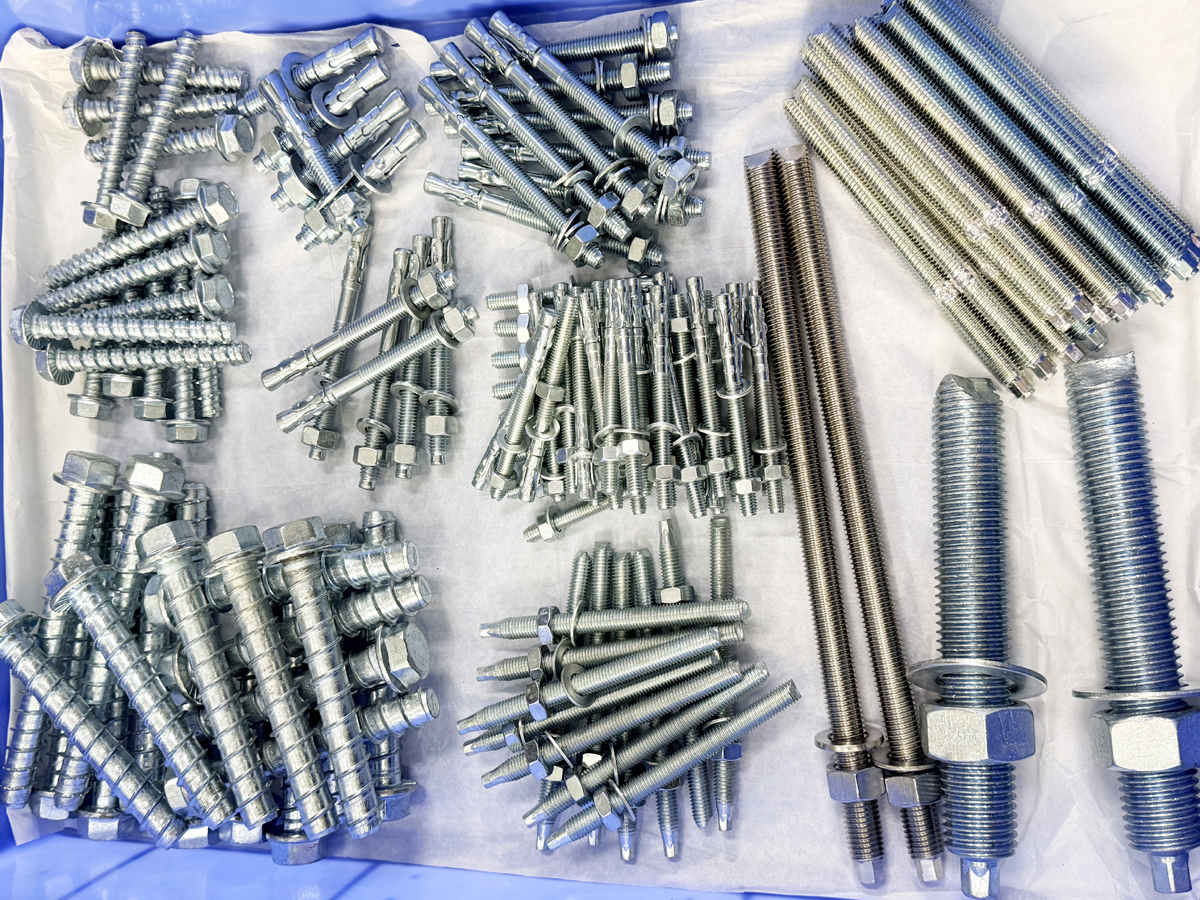
A wedge anchor is a mechanical expansion anchor designed to develop anchoring resistance in a suitable drilled concrete hole.
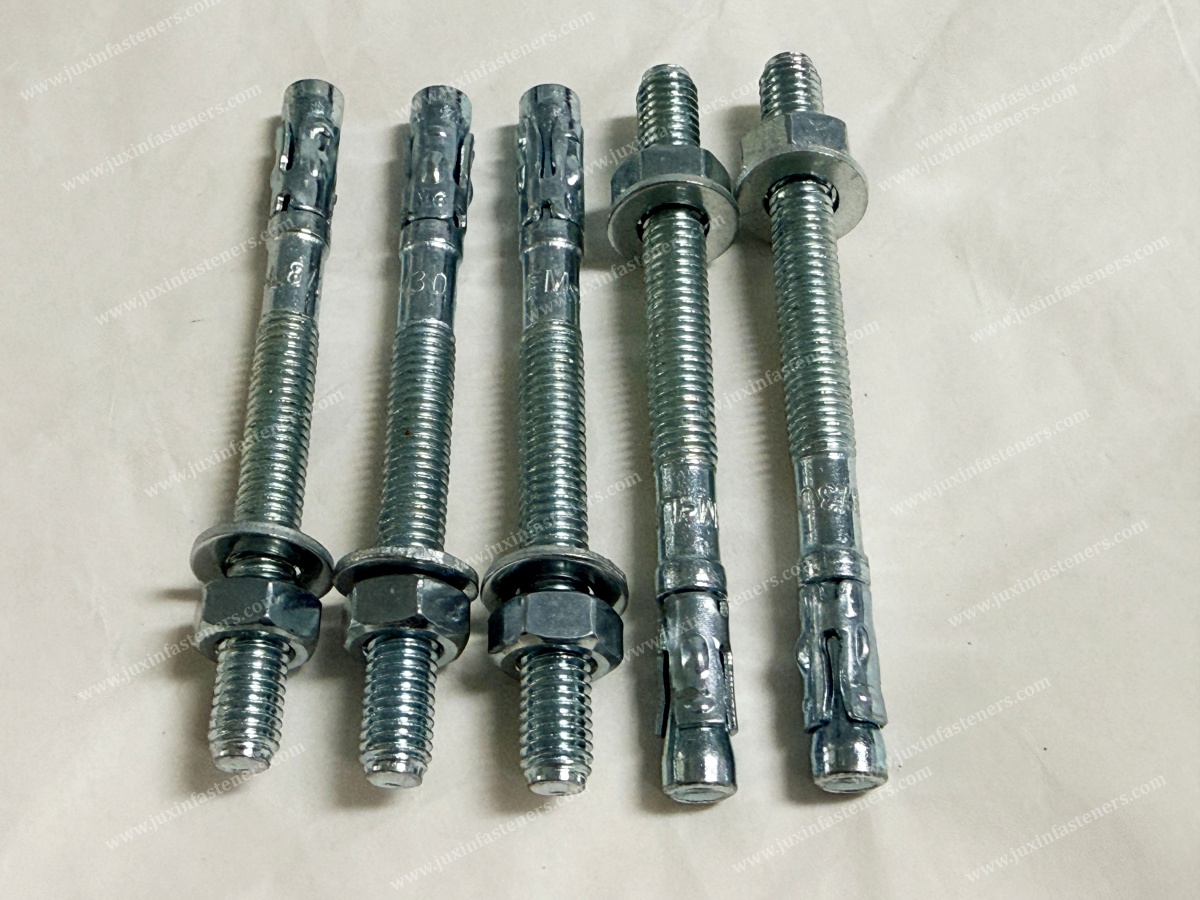
A typical stud-type wedge anchor includes:
A threaded anchor body or stud
A tapered expansion section
An expansion clip or sleeve
A compatible hex nut
A washer
When the nut is tightened, the anchor body moves relative to the expansion element.
The expansion mechanism engages against the concrete hole wall, enabling load transfer into the surrounding substrate.
Wedge anchors are commonly described as:
Concrete wedge anchors
Wedge anchor bolts
Mechanical expansion anchors
Torque-controlled expansion anchors
Stud-type concrete anchors
Through-bolt anchors
Terminology varies by market and product configuration. The actual product design and qualification should always be checked.
Why Wedge Anchors Are Used in Industrial Applications
Wedge anchors can provide a practical fastening method where an installed component must be attached to concrete.
Potential applications include:
Industrial equipment bases
Steel mounting brackets
Electrical equipment supports
Machinery frames
Guarding systems
Handrail bases
Mechanical service supports
Infrastructure equipment
The anchor's suitability depends on the complete connection design.
A heavy-duty product description does not establish an allowable load, seismic qualification or approval for every concrete condition.
How Concrete Wedge Anchors Work
Wedge anchors develop resistance through mechanical expansion within a drilled hole.
For a typical torque-controlled stud anchor, installation involves inserting the anchor into the prepared hole and tightening the nut.
The tapered section interacts with the expansion clip, generating radial pressure and mechanical engagement with the concrete.
The load-transfer mechanism depends on the geometry of the anchor and its interaction with the surrounding concrete.
Tension Load Transfer
Tension acts approximately along the anchor axis and tends to pull the anchor away from the concrete.
The anchor system must resist this force through its approved mechanical engagement.
Shear Load Transfer
Shear acts approximately perpendicular to the anchor axis.
Shear resistance depends on the anchor, fixture geometry, concrete condition and relevant failure mechanisms.
Combined Tension and Shear
Real installations frequently experience both loading directions.
The applicable interaction requirements must be checked using the relevant design standard and product data.
Why Concrete Strength Matters
Concrete strength influences the resistance of the supporting material.
However, concrete strength alone does not determine anchor capacity.
Cracking condition, edge distance, spacing, embedment and load direction can also control the design.
Wedge Anchor Installation: Correct Procedure and Common Risks
The installation process should follow the exact manufacturer's instructions for the selected anchor.
A typical procedure includes:
Verify the specified concrete substrate.
Confirm anchor position and minimum distances.
Drill the specified hole diameter and depth.
Prepare or clean the hole as required.
Insert the anchor through the fixture or according to the specified sequence.
Set the required embedment.
Tighten the nut to the prescribed installation torque.
Inspect the completed installation.
Drill Hole Diameter
The drilled-hole diameter must match the approved anchor installation specification.
An oversized hole can reduce engagement and compromise setting.
An undersized hole may prevent proper installation or damage the anchor.
Drill Hole Depth
The drilled depth must accommodate the specified anchor installation and effective embedment.
The required depth is not necessarily identical to the nominal anchor length.
Hole Cleaning
Dust and debris may affect installation.
Cleaning requirements depend on the anchor design, drilling method and approved installation instructions.
Anchor Insertion
The anchor should be inserted without damaging the threaded section or expansion mechanism.
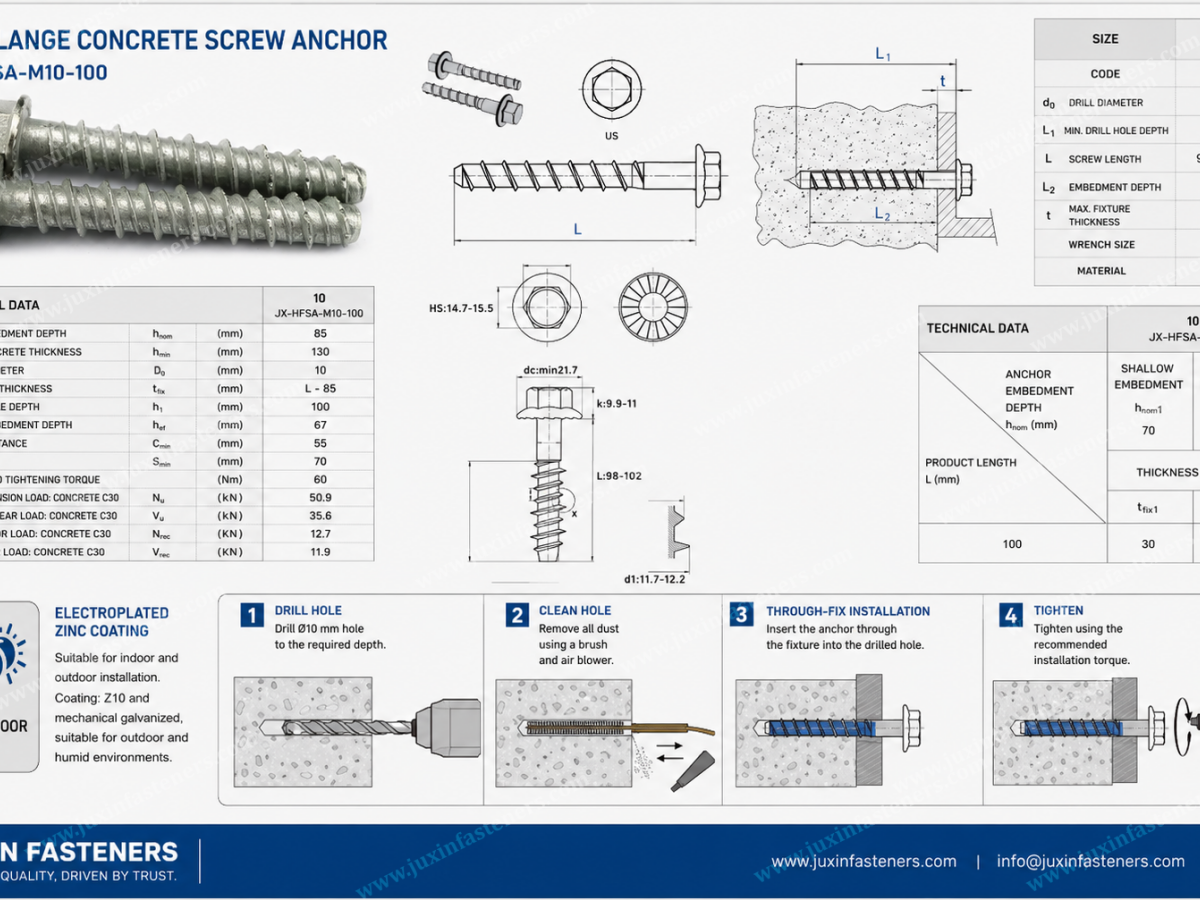
Installation Torque
For torque-controlled expansion anchors, tightening is part of the anchor-setting process.
The specified torque is product-specific.
Insufficient tightening may result in improper setting.
Excessive tightening may damage the anchor or surrounding concrete.
Engineering Caution
There is no universal installation torque that applies to all wedge anchors of the same diameter.
Never substitute a generic torque chart for the actual anchor manufacturer's instructions.
Inspection
Critical installations may require verification of anchor location, embedment, tightening procedure and other project-specific acceptance criteria.
Wedge Anchor Dimensions: Diameter, Length and Embedment
Selecting the correct anchor requires understanding several different dimensions.
Nominal Anchor Diameter
The nominal diameter identifies the anchor size.
It is an important ordering parameter but does not independently determine design resistance.
Anchor Length
The overall length must accommodate the required installation configuration.
Effective Embedment Depth
Effective embedment is a critical design parameter related to load transfer into the concrete.
It should not be confused with overall anchor length or drilled-hole depth.
Fixture Thickness
The component being secured may be a steel plate, bracket or equipment base.
Fixture thickness affects the required anchor length and available threaded projection.
Thread Projection
Sufficient thread must remain available for the nut and any required installation condition.
Washer and Nut Compatibility
The nut and washer must match the specified anchor assembly.
Practical Anchor Length Selection
The required anchor length is influenced by:
Fixture thickness
Required embedment
Washer and nut geometry
Thread projection
Installation tolerance
Product-specific setting requirements
A simplified dimensional estimate may help preliminary planning, but the final length must follow the actual manufacturer's dimensional data.
Metric Wedge Anchors
Metric products use metric dimensions and thread designations.
Common market searches include M6, M8, M10, M12 and M16 wedge anchors, although the actual supply range must be confirmed.
Imperial Wedge Anchors
North American products may use inch-based dimensions and UNC thread designations.
Typical market searches include 3/8-inch, 1/2-inch, 5/8-inch and 3/4-inch wedge anchors.
Metric and Imperial Are Not Directly Interchangeable
A metric anchor and an inch-series anchor may have approximately similar nominal dimensions but different thread profiles,
pitches, nuts, washers and approved installation requirements.
Metric, UNC, UNF, BSW and BSF thread systems must not be treated as directly interchangeable.
Engineering Insight
An anchor's nominal thread diameter, drilled-hole diameter and effective embedment are separate technical parameters.
They should be recorded independently in engineering drawings and procurement specifications.
Cracked vs. Uncracked Concrete: A Critical Selection Requirement
Concrete members may experience cracking during their service life.
Cracks can affect the way mechanical anchors transfer load into the substrate.
Uncracked Concrete
Some wedge anchors are qualified only for uncracked concrete conditions.
Cracked Concrete
Other wedge anchors are specifically qualified for cracked concrete.
These products must be evaluated according to the relevant qualification requirements.
Can All Wedge Anchors Be Used in Cracked Concrete?
No.
Cracked-concrete suitability must be established for the specific anchor product and applicable dimensions.
Seismic Applications
Seismic applications may require additional product qualification and engineering checks.
A wedge anchor described as heavy-duty is not automatically qualified for seismic loading.
Why Product Qualification Matters
An anchor's suitability can depend on:
Product model
Anchor diameter
Embedment configuration
Concrete strength
Concrete cracking condition
Load direction
Seismic requirements
Installation method
Different sizes within the same commercial product family may have different qualification scopes.
Wedge Anchor Load Capacity: Steel Strength Is Not the Whole Story
A wedge anchor connection can fail through different mechanisms.
Steel Failure in Tension
The anchor steel may yield or fracture under excessive tensile loading.
Steel Failure in Shear
The steel section may fail under excessive transverse loading.
Concrete Cone Breakout
A cone-shaped portion of the concrete may fracture under tension.
Pullout Failure
The anchor may lose its mechanical engagement with the concrete.
Concrete Splitting
Concrete may split because of installation effects, geometry or applied loads.
Concrete Edge Breakout
Concrete near an edge may fail under shear.
Concrete Pryout
Certain loading conditions may lead to pryout failure.
Anchor Group Effects
Closely spaced anchors may interact through overlapping concrete failure zones.
Fixture Failure
The attached plate or bracket may deform before the anchor reaches its nominal resistance.
Engineering Information Gain: The Weakest Element Governs
Increasing the steel strength of a wedge anchor does not automatically increase the resistance of the complete connection.
If concrete breakout, splitting, edge failure or base plate deformation governs, a stronger anchor body may not solve the problem.
The design must evaluate the full load path.
Tension and Shear Design for Equipment Bases
Industrial equipment anchoring can involve several load effects.
Equipment Weight
Dead load may act vertically through the equipment support.
Horizontal Forces
Operating forces, impact or external loads may introduce shear.
Overturning Moment
Tall equipment or eccentric loading can create tension in selected anchors.
Vibration
Dynamic loading may influence connection behavior and installation requirements.
Anchor Group Load Distribution
Multiple anchors do not necessarily share load equally.
Base plate stiffness and equipment geometry influence the load path.
Stand-Off Installation
Where the attached component is elevated above the concrete surface, the exposed anchor section may experience bending.
Such installations require additional engineering consideration.
Concrete Edge Distance and Anchor Spacing
Wedge anchors generate expansion effects in concrete.
Insufficient edge distance or spacing can reduce the resistance of the fastening system.
Edge Distance
The distance between an anchor and the nearest concrete edge.
Anchor Spacing
The distance between adjacent anchors.
Concrete Member Thickness
The thickness of the concrete supporting member.
Why These Dimensions Matter
Small edge distances or close anchor spacing may increase the risk of concrete splitting or breakout.
Important Distinction
The minimum permitted installation dimensions and the dimensions needed to achieve a particular design resistance are not necessarily the same.
The applicable design must use the actual product's approved data.
Anchor Groups and Base Plate Geometry
For equipment bases and steel brackets, the anchor layout should be evaluated together with:
Base plate dimensions
Plate thickness
Hole diameter
Hole spacing
Edge distance
Washer bearing
Load eccentricity
Concrete member thickness
A strong anchor cannot compensate for an inadequately designed base plate.
Concrete Wedge Anchor Materials and Corrosion Resistance
Material selection affects durability and compatibility with the installation environment.
Carbon Steel Wedge Anchors
Carbon steel is commonly used for industrial and construction anchoring products.
The actual mechanical properties depend on the specified material and manufacturing process.
Zinc-Plated Wedge Anchors
Zinc plating may provide economical corrosion protection for suitable indoor applications.
It should not automatically be treated as sufficient for aggressive outdoor environments.
Galvanized Wedge Anchors
Galvanized products may offer enhanced corrosion protection depending on the coating specification and service conditions.
Coating thickness and process compatibility must be evaluated.
304 Stainless Steel Wedge Anchors
304 stainless steel may provide improved atmospheric corrosion resistance compared with unprotected carbon steel.
It can be considered for selected humid or outdoor environments.
316 Stainless Steel Wedge Anchors
316 stainless steel may offer improved resistance to certain chloride-containing environments.
However, it is not immune to pitting or crevice corrosion.
Corrosion Protection Selection
| Environment | Potential material consideration | Engineering caution |
|---|---|---|
| Dry indoor installation | Zinc-plated carbon steel | Confirm exposure and project requirements |
| Humid industrial environment | Suitable protective coating or stainless steel | Check condensation and chemicals |
| Outdoor equipment | Galvanized or stainless steel options | Confirm coating and service life |
| Coastal atmosphere | Suitable stainless steel or qualified corrosion-resistant system | Evaluate chloride exposure |
| Aggressive industrial environment | Application-specific material system | Check chemical compatibility |
These are general material-selection considerations, not universal product approvals.
Hydrogen Embrittlement Risk
Certain high-strength steel fasteners can be susceptible to hydrogen embrittlement.
Where relevant, material strength, surface treatment and processing requirements should be reviewed.
Coating and Anchor Qualification
Changing the coating of a qualified wedge anchor may affect:
Friction
Installation torque
Dimensional fit
Expansion behavior
Corrosion performance
A coating substitution should not be treated as a purely cosmetic change.
Galvanic Corrosion
Where dissimilar metals are exposed to moisture or electrolytes, galvanic corrosion may become relevant.
The anchor, nut, washer and attached fixture should be considered as an assembly.
International Standards for Wedge Anchors
EN 1992-4: Design of Fastenings for Use in Concrete
EN 1992-4 provides European design provisions for fastening systems transferring loads into concrete.
It addresses relevant resistance and failure mechanisms for suitable fastening systems.
European Technical Assessment (ETA)
An ETA may document assessed characteristics and intended use for a specific wedge anchor product.
It can include:
Product identification
Intended base material
Approved anchor sizes
Characteristic resistance data
Installation conditions
Minimum dimensions
Environmental limitations
An ETA applies to the assessed product, not to every wedge anchor supplied by the same industry.
EAD 330232 Series
European Assessment Documents in the EAD 330232 series address mechanical fasteners for use in concrete.
The applicable edition should be determined according to the product assessment.
ACI 318 Chapter 17
ACI 318 Chapter 17 provides design requirements for anchoring to concrete in applicable North American projects.
The governing code edition depends on the project and jurisdiction.
ACI CODE-355.2-24
ACI CODE-355.2-24 addresses qualification of post-installed mechanical anchors in concrete.
It provides criteria relevant to static and seismic loading and cracked or uncracked concrete conditions.
ICC-ES Evaluation Reports
An ICC-ES evaluation report may establish that a specific product has been evaluated for stated code conditions.
Engineers and buyers should verify:
Report holder
Exact product name
Covered diameters
Base material
Installation requirements
Applicable code editions
Restrictions
Product Qualification Is Not the Same as Material Certification
A material certificate or dimensional inspection report does not establish concrete anchor qualification.
Structural anchor applications require suitable product-level performance evidence.
Standards and Product Documentation Must Match
A project should not rely on technical values copied from another manufacturer's wedge anchor, even when the nominal diameter and appearance are similar.
Wedge Anchor Applications in Industrial Equipment
Machinery and Production Lines
Wedge anchors may be considered for securing:
Equipment bases
Machinery frames
Guarding systems
Auxiliary production equipment
Maintenance platforms
Engineering considerations include equipment loads, foundation geometry, vibration and installation access.
Structural Steel Brackets and Base Plates
Wedge anchors can be used in selected steel-to-concrete connections.
Structural design and qualified product data are required where the connection is safety-related.
Electrical Cabinets and Power Distribution Equipment
Potential applications include:
Control cabinets
Electrical equipment bases
Power distribution enclosures
Industrial electrical mounting frames
Auxiliary electrical supports
The fastening design should account for equipment stability, load path and access.
HVAC and Mechanical Equipment
Applications may include:
Mechanical equipment bases
HVAC mounting frames
Pipe support structures
Service equipment brackets
Overhead and safety-related installations require appropriate qualification.
Rail and Transportation Infrastructure
Potential applications include:
Station equipment
Auxiliary support structures
Cable management
Equipment enclosures
Maintenance installations
Projects involving vibration, seismic loading or public safety require application-specific engineering approval.
Renewable Energy and Energy Storage Facilities
Potential applications include selected equipment bases and auxiliary mounting structures.
Outdoor corrosion exposure and structural loading should be considered.
AI Data Center Infrastructure
Selected data center facilities may require concrete anchoring for:
Cooling equipment
UPS equipment
Mechanical service installations
Electrical support structures
Facility equipment bases
The anchor should be specified according to the actual equipment and building design.
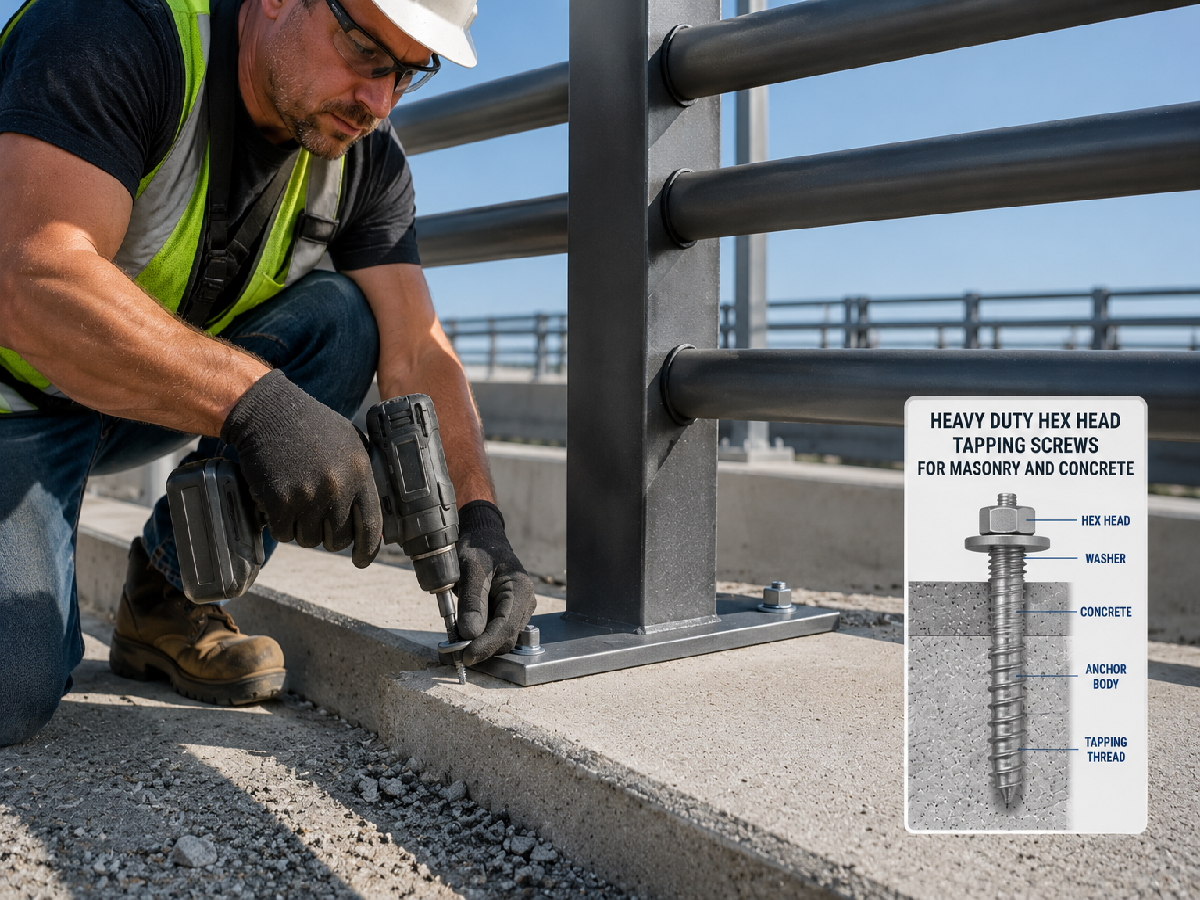
Safety Railings and Guardrails
Wedge anchors may be used in qualified railing and guardrail systems.
These applications can be safety-critical and require appropriate structural design.
Industrial Application Selection Matrix
| Application | Main engineering concern | Selection priority |
|---|---|---|
| Machinery base | Dynamic loading and alignment | Load path and foundation design |
| Steel bracket | Tension and shear | Approved anchor resistance |
| Electrical cabinet | Stability and installation access | Fixture geometry and substrate |
| HVAC support | Service loads | Anchor qualification and installation |
| Safety railing | Human safety | Structural design and approval |
| Rail equipment | Vibration and durability | Project requirements and corrosion |
| Outdoor enclosure | Corrosion | Material and coating selection |
| Data center equipment | Installation consistency | Equipment-specific mounting requirements |
| Industrial retrofit | Existing concrete condition | Substrate verification |
Engineering Information Gain: From Equipment Drawing to Wedge Anchor Specification
An equipment manufacturer may initially specify only a mounting-hole pattern and a required fastener diameter.
That information is usually insufficient for selecting a qualified concrete anchor.
A more complete engineering workflow should identify:
Equipment Geometry
Base plate dimensions
Fixture thickness
Hole positions
Installation access
Equipment center of gravity
Loading
Dead load
Operating loads
Shear
Tension
Overturning
Dynamic effects
Concrete Conditions
Concrete strength
Cracking condition
Member thickness
Reinforcement constraints
Edge distance
Anchor spacing
Anchor Product
Exact anchor type
Product model
Nominal diameter
Length
Effective embedment
Approved installation conditions
Environment
Indoor or outdoor exposure
Moisture
Chemicals
Chlorides
Required service life
Quality and Documentation
Installation instructions
Inspection requirements
Required product approval
Traceability
Packaging
Engineering Outcome
The result should be a complete anchor specification that purchasing and production teams can use consistently.
This reduces ambiguity between design, sourcing and installation.
Manufacturing Engineering and Production Manager Considerations
In industrial equipment programs, anchor selection affects installation efficiency.
Tooling Compatibility
Check drilling and tightening equipment.
Installation Access
Ensure adequate space for the required tools.
Hole Pattern Consistency
Maintain fixture-hole and anchor-location tolerances.
Part Identification
Use clear product identification to avoid mixing anchor types.
Installation Instructions
Standardize the approved installation procedure.
Inspection
Define the acceptance criteria for critical installations.
Packaging
Consider installation-set packaging for repeated equipment assemblies.
Rework
Evaluate the consequences of incorrect hole drilling or anchor setting.
Total Installed Cost
A low unit price does not always result in a low installed cost.
Total cost can include:
Anchor purchase price
Drilling time
Hole preparation
Setting time
Inspection
Rework
Replacement
Equipment downtime
Practical Procurement Insight
When comparing suppliers, consider the full installed fastening system rather than only the price per anchor.
OEM Wedge Anchor Supply and Custom Fastening Components
Juxin Fasteners supports industrial fastening inquiries based on customer specifications and project requirements.
Potential sourcing needs include:
Standard wedge anchors
Concrete expansion anchors
Heavy-duty threaded fasteners
Special mounting bolts
Custom washers
CNC machined spacers
Drawing-based fastening components
OEM packaging
Custom Components vs. Qualified Concrete Anchors
A custom-machined threaded stud or modified expansion component is not automatically a qualified concrete anchor.
Any modification affecting a structural anchor's design or performance requires appropriate engineering review and qualification.
Drawing-Based Requirements
Customers may specify:
Material
Dimensions
Thread designation
Tolerances
Surface treatment
Mechanical requirements
Inspection criteria
Packaging
Manufacturing Process Considerations
Depending on the product, manufacturing may involve:
Forming
Machining
Thread processing
Heat treatment
Surface treatment
Inspection
Packaging
The actual manufacturing route depends on the selected product and customer specification.
Quality Control for Concrete Wedge Anchors
Manufacturing quality should address the characteristics relevant to the anchor assembly.
Dimensional Inspection
Verify the required product dimensions.
Thread Inspection
Check thread designation and dimensional conformity.
Material Verification
Confirm the specified material.
Expansion Component Inspection
Check the geometry and condition of the expansion mechanism where applicable.
Surface Treatment Inspection
Verify the specified finish.
Assembly Inspection
Confirm nut, washer and anchor compatibility.
Packaging Inspection
Verify product identification and packaging requirements.
Lot Traceability
Provide traceability arrangements where required and agreed.
Qualification Documentation
For structural applications, verify that the exact anchor has the required product assessment documentation.
Why Expansion Clip Consistency Matters
The expansion clip is not merely an accessory.
Its geometry and interaction with the tapered section influence anchor setting and engagement.
For repeated production, uncontrolled variation in the expansion component can affect installation behavior.
This is one reason why a wedge anchor should be evaluated as a complete product assembly.
Supplier Development and Bulk Purchasing Requirements
Procurement teams sourcing wedge anchors should evaluate more than the quoted unit price.
Product Specification
Confirm the exact anchor type, diameter, length, material and finish.
Technical Qualification
Confirm whether ETA, ICC-ES or other project-specific documentation is required.
Manufacturing Consistency
Review the inspection and quality requirements.
MOQ
Confirm minimum order quantities for the requested specification.
Lead Time
Evaluate sampling, production and delivery timing.
Packaging
Confirm bulk cartons, installation sets or customer-specific packaging.
Repeat Supply
Consider consistency across future orders.
Change Control
Require technical review of material, coating, geometry or component substitutions.
Supplier Comparison Checklist
| Procurement criterion | Why it matters |
|---|---|
| Exact anchor designation | Prevents substitution errors |
| Product qualification | Establishes approved application scope |
| Material specification | Supports mechanical and corrosion requirements |
| Dimensional consistency | Supports installation repeatability |
| Expansion mechanism consistency | Influences setting behavior |
| Coating specification | Supports durability and compatibility |
| Packaging identification | Reduces product mixing |
| MOQ and lead time | Supports production planning |
| Quality documentation | Supports supplier approval |
| Change control | Protects the approved product configuration |
Frequently Asked Questions About Wedge Anchors
What are wedge anchors used for?
Wedge anchors are used to secure suitable fixtures and equipment to concrete through a mechanical expansion mechanism.
Are wedge anchors suitable for cracked concrete?
Only where the exact product and applicable size are qualified for cracked concrete.
Can wedge anchors be used in hollow block?
Not automatically. A concrete wedge anchor should not be assumed suitable for hollow masonry unless the product documentation specifically covers that substrate.
How do I determine wedge anchor load capacity?
Use the exact product's approved technical data and the applicable concrete anchoring design method.
What is the difference between anchor length and effective embedment?
Anchor length is the overall product dimension. Effective embedment is a design parameter associated with load transfer into the concrete.
What drill bit size is required for a wedge anchor?
Use the drill diameter specified by the actual anchor manufacturer.
How much torque should be applied to a wedge anchor?
Use the specified installation torque for the exact product and installation condition.
Can wedge anchors be installed near concrete edges?
Only where the approved minimum edge distance and design resistance requirements are satisfied.
Can wedge anchors be removed?
The fixture and nut may be removable, but the installed expansion anchor typically remains embedded. Removal options depend on the product and installation.
Can wedge anchors be reused?
Reuse should not be assumed. Follow the manufacturer's instructions and applicable approval conditions.
Are stainless steel wedge anchors stronger than carbon steel wedge anchors?
Not necessarily. Strength depends on the exact product and material properties.
Is 316 stainless steel suitable for outdoor wedge anchors?
It may be appropriate for certain environments, but actual corrosion exposure and product qualification must be considered.
Are metric and imperial wedge anchors interchangeable?
No. Thread systems, dimensions, nuts, washers and approved installation requirements may differ.
Can a custom wedge anchor be used in a structural connection?
Only where the required engineering evaluation and product qualification have been established.
Does Juxin Fasteners support bulk wedge anchor sourcing?
Juxin Fasteners accepts project-based and bulk inquiries for industrial anchoring components, subject to product availability and technical requirements.
OEM Wedge Anchor RFQ Checklist
To request a technically accurate quotation, provide the following information where available.
Product
Wedge anchor type
Diameter
Length
Thread designation
Material
Surface treatment
Nut and washer requirements
Engineering Application
Equipment or fixture type
Base plate drawing
Fixture thickness
Anchor layout
Concrete strength
Cracked or uncracked condition
Concrete thickness
Edge distance
Anchor spacing
Loading
Tension
Shear
Combined loading
Dynamic loading
Seismic requirements where applicable
Installation
Drilled-hole diameter
Hole depth
Effective embedment
Installation torque
Installation access
Inspection requirements
Quality and Approval
Required ETA or ICC-ES documentation
Material documentation
Dimensional tolerances
Coating requirements
Lot traceability
Customer inspection requirements
Commercial
Sample quantity
Initial order quantity
Annual forecast
MOQ expectations
Required lead time
Packaging
Delivery destination
Request a Wedge Anchor Quotation from Juxin Fasteners
Juxin Fasteners supports global OEM manufacturers, industrial equipment suppliers, distributors,
engineering companies and purchasing teams seeking concrete wedge anchors and industrial fastening components.
Whether your project requires standard concrete expansion anchors, corrosion-resistant wedge anchors,
bulk purchasing or customized mounting hardware, the correct starting point is a complete technical specification.
For structural or safety-related applications, please include the required product qualification and design documentation.
Send us your drawing, dimensions, material requirements, surface treatment, application conditions and expected order quantities.
Company: Juxin Fasteners
Website: https://www.juxinfasteners.com/
Email: info@juxinfasteners.com
Small Component. Critical Connection.
 MORE NEWS


Oct. 13, 2026
Contact Us
Tel.:
+86 020 8621 0320
+86 020 3121 6067
E-mail:
Technical Support:
Navigation
SEND INQUIREY