
Call Us
+86 136 6007 9809
Call Us
+86 136 6007 9809

Sep. 18, 2023
A copper washer can look like one of the simplest components in an industrial assembly.
A circular piece of copper.
One hole.
A small thickness.
Yet when that washer is responsible for sealing a threaded plug, banjo connection, hydraulic fitting or another fluid interface, its function is no longer simply:
Bolt → Washer → Load Distribution
It becomes:
Connection → Copper Sealing Washer → Controlled Compression → Surface Conformity → Static Seal
That distinction changes how engineers should select the washer and how procurement teams should source it.
A copper sealing washer is not automatically interchangeable with any copper flat washer of approximately the same diameter.
For a sealing application, engineers may need to consider:
connection geometry;
inside diameter;
outside diameter;
thickness;
copper grade;
material condition;
hardness or temper where specified;
sealing-surface condition;
compression;
tightening procedure;
fluid compatibility;
operating temperature;
operating pressure;
reuse policy;
applicable standard or customer drawing.
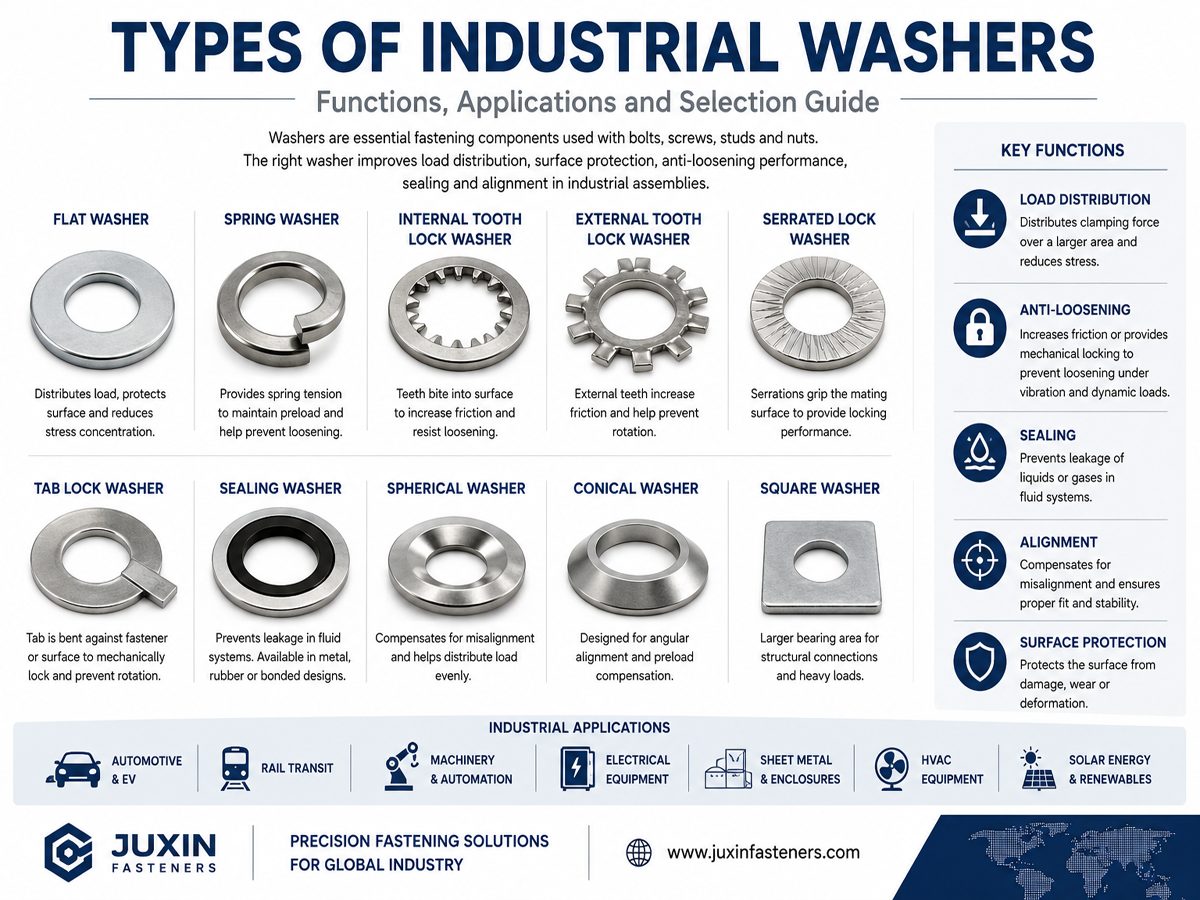
JUXIN FASTENERS supplies copper washers, copper sealing washers, copper crush washers, sealing rings and custom stamped washer components for industrial OEM and replacement applications.
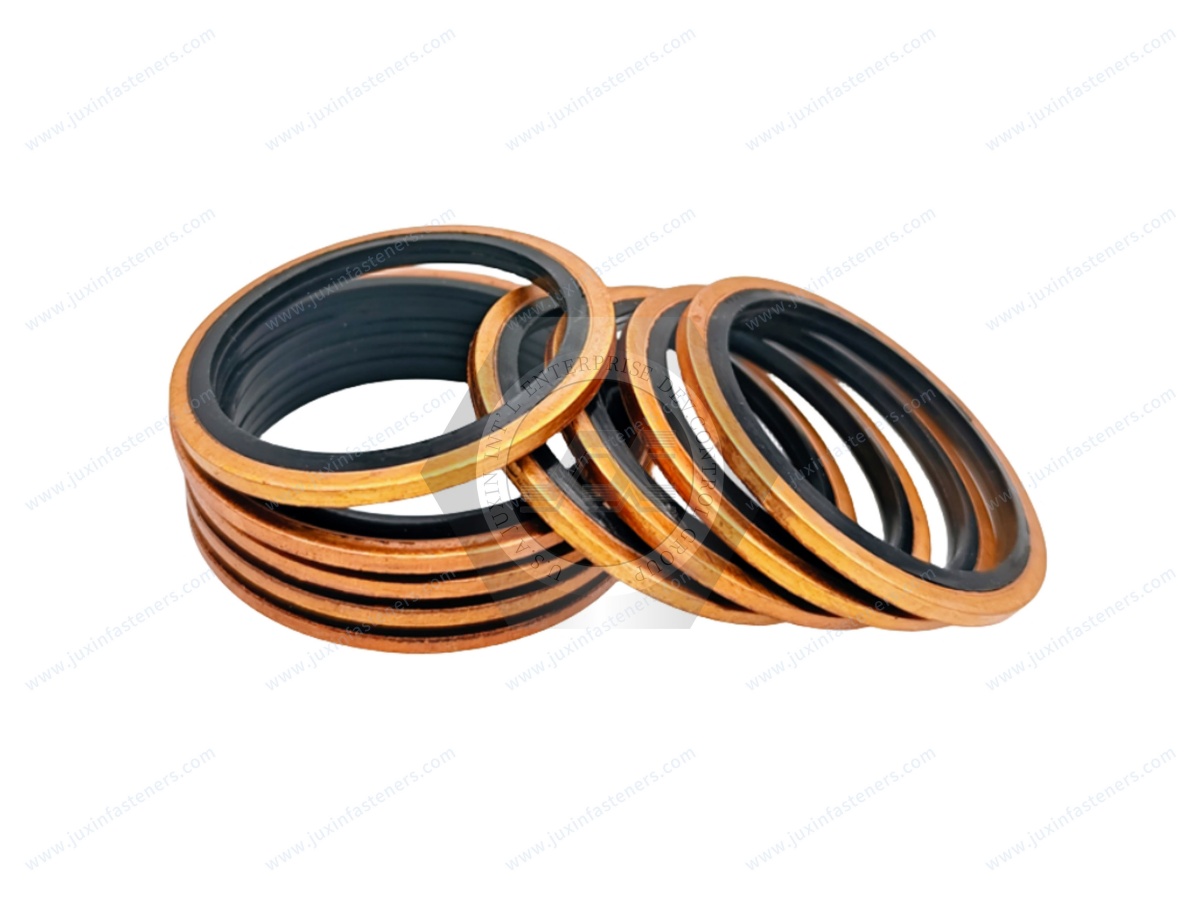
A copper sealing washer is a metallic sealing element installed between two mating surfaces.
Unlike an ordinary flat washer used mainly to increase bearing area, a copper sealing washer can be selected so that controlled deformation helps conform to the mating surfaces.
This can help close small surface pathways through which fluid could otherwise leak.
The basic sealing concept is:
Mating Surface → Copper Washer → Mating Surface
Under controlled clamp load:
Compression → Local Plastic Deformation → Surface Conformity → Static Sealing Interface
This is why copper sealing washers are also frequently searched as:
copper crush washers;
copper sealing rings;
copper gasket washers;
annealed copper washers;
soft copper washers;
copper gaskets.
Terminology varies by industry and connection design.
These two products may look similar but should not automatically be treated as identical.
Its primary purpose may include:
bearing-area distribution;
electrical contact;
spacing;
surface protection;
general fastening.
Its primary purpose is to participate in a controlled sealing interface.
The selection logic therefore changes.
Copper Flat Washer → Bearing / Electrical / Spacing Function
Copper Sealing Washer → Static Sealing Function
A supplier should know which function the customer actually requires before recommending a material condition or manufacturing route.
Copper combines useful properties for selected static sealing applications.
Depending on grade and material condition, copper can provide:
formability;
ductility;
thermal conductivity;
electrical conductivity;
corrosion resistance in suitable environments;
ability to conform locally under compression.
For sealing, one of the most important properties is not simply strength.
It is the ability of the selected copper condition to deform appropriately at the interface.
This creates an important engineering principle:
Harder Is Not Automatically Better for a Copper Sealing Washer
Two copper washers can have the same:
ID;
OD;
thickness;
and still behave differently during tightening if their material conditions differ.
A softer or annealed copper condition can deform differently from harder-worked copper.
Therefore:
Same Dimensions ≠ Same Sealing Behavior
For a sealing washer, procurement should not focus only on dimensional size.
Material grade and condition may be equally important.
The term annealed copper washer is commonly used where a relatively soft copper condition is desired for sealing.
Annealing changes the material condition and can increase ductility compared with work-hardened copper.
In a suitable sealing design, this can help the washer conform to the mating surfaces during installation.
However:
Annealed Copper ≠ Automatic Leak-Free Seal
Successful sealing still depends on the complete interface.
A copper washer does not seal simply because it is made from copper.
The seal depends on the interaction of:
Washer Material + Material Condition + Washer Geometry + Mating Surfaces + Clamp Load + Connection Design
If any part of that system is unsuitable, leakage may still occur.
The washer seals against mating surfaces.
Those surfaces can therefore be just as important as the washer.
Potential problems include:
scratches;
dents;
corrosion;
burrs;
contamination;
embedded particles;
damaged seating faces;
excessive surface irregularity.
Installing a new washer against a damaged seat may not correct the underlying problem.
When a copper sealing washer leaks, replacing the washer is only one possible corrective action.
A useful troubleshooting sequence is:
Step 1 — Confirm the Correct Washer
Check:
ID;
OD;
thickness;
material;
condition.
Step 2 — Inspect the Sealing Faces
Look for:
scoring;
corrosion;
dents;
burrs;
contamination.
Step 3 — Check Washer Positioning
The washer should seat correctly without unintended interference.
Step 4 — Check the Connection
Inspect:
threads;
bolt or plug;
fitting;
mating seat.
Step 5 — Review Tightening Procedure
Insufficient or excessive tightening can both create problems.
Step 6 — Confirm Fluid and Temperature Compatibility
The complete connection must be appropriate for the service environment.
This prevents a common maintenance mistake:
Leak → Install More Torque → Damage Connection
The term copper crush washer describes the way the washer can deform during installation.
It does not mean the washer should be compressed without control.
The engineering objective is controlled deformation sufficient for the intended sealing interface.
Too little deformation may provide inadequate conformity.
Too much compression may cause:
excessive thinning;
extrusion;
permanent distortion;
damage to mating components;
altered connection geometry.
Therefore:
Controlled Compression ≠ Maximum Compression
No universal compression percentage should be applied to every copper sealing washer.
Required deformation depends on:
washer geometry;
material condition;
connection design;
mating surfaces;
required seal;
tightening specification.
Follow the approved drawing or assembly procedure.
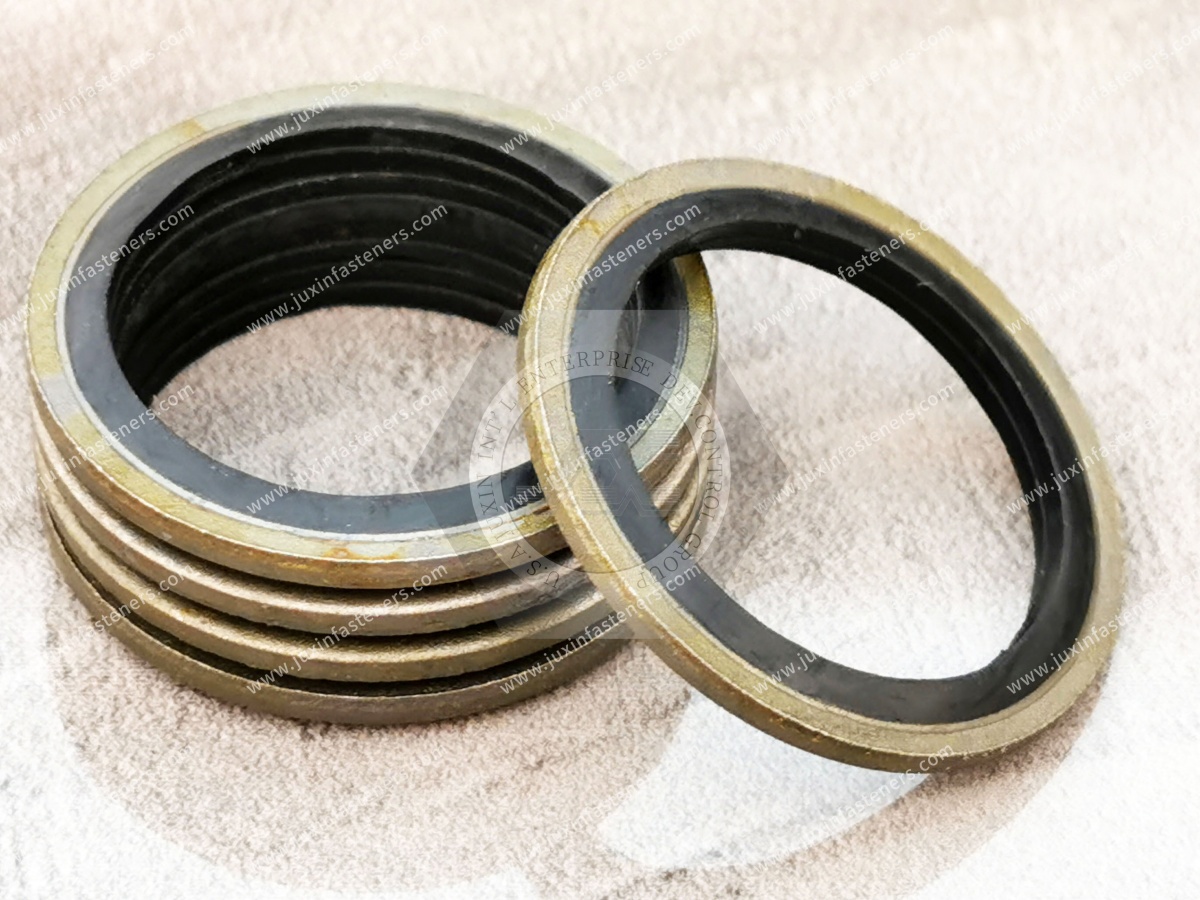
No.
Torque belongs to the complete threaded connection.
It depends on factors such as:
thread size;
thread pitch;
fastener material;
lubrication;
surface finish;
target clamp load;
fitting design;
washer condition;
customer specification.
Therefore:
Copper Washer Size ≠ Universal Tightening Torque
DIN 7603 is an important standard encountered in searches for industrial sealing rings.
DIN 7603:2001-05 is a current standard covering sealing rings.
For European machinery, automotive-related equipment, hydraulic connections and MRO applications, buyers may encounter drawings or BOMs specifying:
DIN 7603
The standard designation should be treated as a controlled product requirement rather than as a generic synonym for every copper washer.
A copper washer manufactured to customer dimensions should not automatically be described as DIN 7603.
The correct sourcing distinction is:
DIN 7603 Sealing Ring
versus:
Custom Copper Sealing Washer
Both can be valid products, but they are not automatically the same specification.
Older equipment may reference earlier editions of DIN 7603.
When sourcing replacement parts:
identify the original standard edition where possible;
check the current standard;
compare dimensions and technical requirements;
review material requirements;
confirm the application;
obtain engineering approval if a change is required.
Do not silently replace a legacy part based only on nominal diameter.
One of the largest problems in the old-style purchasing description is:
“Copper Washer”
Copper is not one single material specification.
Industrial buyers may encounter various copper designations depending on:
international material system;
customer drawing;
industry;
product function.
For OEM sourcing, the customer should provide the required material designation where controlled.
If no material is specified, the supplier should first determine the functional requirement rather than inventing a grade.
A description such as:
High-Purity Copper Washer
does not fully define:
copper grade;
temper;
mechanical condition;
dimensional requirement;
sealing performance.
For technical procurement, a recognized material designation or approved drawing is preferable.
ASTM material specifications may apply to copper sheet, strip or other raw-material forms used to manufacture washers.
However:
Raw-Material Standard ≠ Finished-Washer Performance Standard
For example, specifying a copper sheet material standard does not by itself define:
washer dimensions;
burr limits;
flatness;
sealing capability;
final condition;
application suitability.
The finished component requirements still need to be controlled.
Copper hardness can influence how the washer deforms.
However, there is no responsible reason to publish one universal hardness range for all copper sealing washers.
Required hardness or material condition depends on:
copper grade;
manufacturing route;
annealing;
connection design;
customer specification.
Therefore, JUXIN FASTENERS does not treat a generic hardness value as applicable to every copper sealing washer.
Thickness can affect:
available deformation;
installed geometry;
clamp relationship;
sealing behavior.
A thicker washer is not automatically better.
A thinner washer is not automatically better.
The correct thickness belongs to the connection design.
The ID must fit the:
bolt;
plug;
fitting;
banjo bolt;
threaded connection
while providing the intended sealing interface.
Too much radial clearance can change the available sealing area.
Too little clearance can prevent proper assembly.
The OD determines the outer boundary of the sealing ring.
It must be compatible with:
available seating face;
fitting geometry;
nearby features;
required sealing width.
A larger OD does not automatically improve sealing.
A commercial RFQ that states only:
M10 Copper Washer
may be insufficient.
Two washers intended for an M10 connection can have different:
IDs;
ODs;
thicknesses;
material conditions.
For replacement sourcing, provide actual dimensions or a controlled drawing.
Tolerance requirements depend on:
washer dimensions;
stamping process;
sealing function;
customer drawing;
inspection requirement.
There is no universal ±0.1 mm ID/OD and ±0.05 mm thickness rule for every copper washer.
If the sealing system requires tighter control, specify it on the drawing.
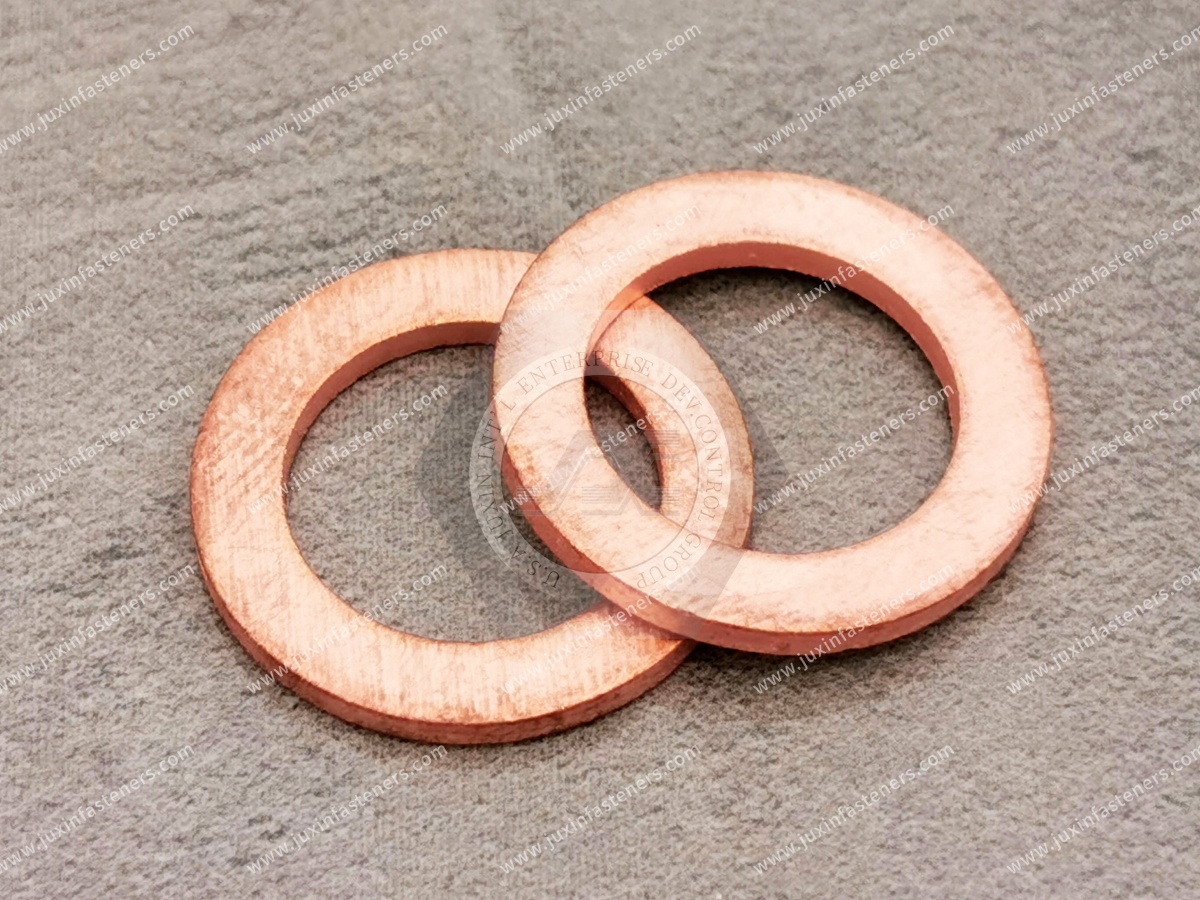
Many copper sealing washers can be produced from copper sheet or strip through stamping.
A typical manufacturing route may include:
Material → Blanking / Piercing → Deburring → Cleaning → Annealing Where Required → Inspection → Packaging
The exact sequence depends on:
material;
dimensions;
volume;
final condition;
customer specification.
Stamping can create a burr on a cut edge.
For precision sealing applications, burr condition may affect:
seating;
handling;
assembly;
surface contact.
Where important, the customer drawing should specify acceptable edge and burr requirements.
A sealing washer that is significantly distorted before assembly may not seat as intended.
Flatness can therefore be an important inspection consideration for selected designs.
The required limit should follow the drawing or validated application.
Copper sealing washers used in fluid systems should be protected from contamination.
Potential contaminants include:
metal chips;
abrasive particles;
oil not compatible with the system;
packaging debris.
Cleanliness requirements should match the actual application.
This is one of the highest-value engineering questions around copper sealing washers.
A copper crush washer can undergo permanent plastic deformation during the first installation.
After removal:
thickness may have changed;
contact impressions may remain;
work hardening may have occurred;
surface damage may exist.
For a sealing-critical connection, reuse should not automatically be assumed.
During initial installation, the washer conforms to the specific mating surfaces.
After disassembly, reinstalling it can create a different contact condition.
Therefore:
Previously Compressed Washer ≠ New Washer Condition
Where the OEM or equipment manufacturer specifies replacement after disassembly, follow that requirement.
Copper can be annealed metallurgically.
That does not mean field re-annealing is automatically an approved maintenance procedure.
Uncontrolled reheating can introduce uncertainty regarding:
final material condition;
oxidation;
contamination;
dimensional distortion;
process repeatability.
For controlled industrial, automotive or safety-related assemblies, follow the approved maintenance procedure.
If the specification requires a new sealing washer, use a new washer.
Both copper and aluminum sealing washers are used in industrial fluid connections.
The correct choice depends on:
fitting design;
mating materials;
pressure;
temperature;
fluid;
corrosion environment;
OEM specification.
Do not substitute copper for aluminum—or aluminum for copper—based only on dimensions.
A bonded sealing washer typically combines:
Metal Washer + Elastomeric Sealing Element
This differs fundamentally from a solid copper sealing washer.
A bonded seal can provide a different sealing mechanism.
Selection depends on:
fluid;
temperature;
pressure;
connection design;
elastomer compatibility.
An O-ring is an elastomeric seal installed within a designed gland or interface.
A copper washer is a metallic sealing element.
They are not interchangeable without redesigning the sealing system.
A standard steel flat washer primarily provides a bearing function.
Copper sealing washers are selected for a different purpose.
Therefore:
Steel Flat Washer ≠ Copper Sealing Washer Replacement
This distinction is critical.
Copper sealing washers are generally used as static sealing elements between surfaces that remain clamped together.
They should not automatically be described as dynamic seals for:
rotating shafts;
reciprocating rods;
moving pistons;
bearing interfaces.
Dynamic sealing normally requires a dedicated seal architecture.
Copper sealing washers can be used in selected hydraulic connections, depending on fitting design.
Potential interfaces include:
threaded plugs;
adapters;
fittings;
banjo connections;
ports.
But:
Copper Washer ≠ Universal Hydraulic Seal
Pressure capability belongs to the complete connection.
Banjo connections are a common commercial search application for copper crush washers.
The assembly can include:
Bolt Head → Copper Washer → Banjo Fitting → Copper Washer → Mating Port
The washers participate in sealing the interfaces.
Correct selection depends on:
banjo bolt geometry;
fitting geometry;
washer ID;
washer OD;
thickness;
material condition;
tightening specification.
Do not substitute a generic copper washer without checking the assembly.
Drain plugs are another common application.
Potential equipment includes:
engines;
gearboxes;
transmissions;
industrial machinery;
pumps;
reservoirs.
A copper washer can provide a static seal between the plug and seating face where the connection is designed for this sealing method.
Replacement should follow the equipment specification.
Copper sealing washers may be used in selected oil-system connections.
The designer should evaluate:
oil compatibility;
temperature;
pressure;
connection geometry;
sealing surfaces.
The copper material alone does not determine system capability.
Copper washers can appear in selected fuel-system connection designs.
However, fuel-system sealing is safety-sensitive.
Do not substitute washer:
material;
dimensions;
thickness;
condition
without the appropriate specification and approval.
Copper crush washers are widely associated with certain hydraulic brake connection designs, particularly banjo-type connections.
These are safety-critical applications.
The correct washer must follow:
vehicle or equipment specification;
fitting design;
material requirement;
dimensions;
approved service procedure.
JUXIN FASTENERS does not recommend selecting a safety-critical brake sealing washer only from nominal bolt size.
Potential copper sealing washer applications include:
fluid connections;
thermal-management equipment;
pumps;
compressors;
gearboxes;
service plugs;
selected brake or hydraulic interfaces where specified.
EV thermal-management systems can use various sealing architectures.
Copper should not automatically be assumed suitable for every coolant connection.
Fluid compatibility and connection design must be confirmed.
Potential applications include:
hydraulic power units;
lubrication systems;
pumps;
compressors;
gearboxes;
threaded service ports.
The washer should be specified as part of the complete fluid connection.
Copper is widely associated with HVAC and refrigeration systems, but this does not mean every refrigeration connection should use a copper sealing washer.
Potential washer applications must follow the specific:
fitting design;
refrigerant;
lubricant;
pressure;
temperature;
applicable equipment specification.
Do not use a generic copper washer to replace a designed refrigeration seal.
Potential applications can include selected:
lubrication systems;
hydraulic equipment;
auxiliary machinery;
threaded service connections.
Temperature and pressure requirements should be confirmed from the actual equipment specification.
Copper offers useful corrosion behavior in many environments, but:
Copper ≠ Universally Corrosion-Proof in Marine Service
The complete galvanic system must be considered.
Copper in contact with dissimilar metals in an electrolyte can create galvanic-corrosion concerns.
Copper washers can also be selected for electrical interfaces because of copper's conductivity.
But this is a different design function from fluid sealing.
For an electrical washer, engineers may prioritize:
electrical conductivity;
contact resistance;
surface condition;
clamping stability.
For a sealing washer, the priority may instead be:
controlled deformation;
sealing geometry;
surface conformity.
Do not assume one copper washer design is optimized for both.
Potential copper washer applications may exist in:
liquid-cooling equipment;
pumps;
power systems;
electrical connections;
auxiliary mechanical equipment.
However, liquid-cooling systems use carefully engineered sealing architectures.
A copper washer should only be used where the connection is designed and validated for a metallic sealing ring.
Copper sealing gaskets exist in aerospace standards.
For example, SAE aerospace standards define specific copper gaskets for particular fitting systems.
This does not mean a generic industrial copper washer is automatically an aerospace component.
Aerospace sourcing can require:
exact drawing;
material specification;
dimensions;
traceability;
inspection;
approved supplier requirements.
Therefore:
Copper Material ≠ Aerospace Qualification
JUXIN FASTENERS can evaluate drawing-based copper washer requirements for:
maintenance equipment;
ground-support equipment;
tooling;
non-flight-critical assemblies;
subject to the customer's actual specification.
Flight-critical hardware should follow the applicable aerospace qualification and approved sourcing system.
| Engineering Requirement | Selection Consideration |
|---|---|
| Static threaded plug | Evaluate copper sealing washer |
| Banjo connection | Match fitting and bolt geometry |
| Drain plug | Follow equipment specification |
| Hydraulic port | Confirm connection design and pressure |
| Large surface damage | Repair/replace seat rather than relying on washer |
| Need dynamic shaft sealing | Use dedicated dynamic seal |
| Need electrical conductivity | Evaluate electrical interface separately |
| Need elastomeric seal | Evaluate bonded seal or O-ring |
| DIN 7603 drawing | Source to controlled DIN requirement |
| Custom dimensions | Use customer drawing |
| Safety-critical system | Follow OEM-approved specification |
| Used crush washer | Do not assume reuse is acceptable |
| Observed Problem | Possible Cause |
|---|---|
| Leak immediately after assembly | Wrong dimensions, damaged seat, insufficient compression, contamination |
| Leak after washer replacement | Mating surface damaged or incorrect washer |
| Washer heavily distorted | Excessive compression or incorrect geometry |
| Washer extruded outward | Geometry or clamp condition requires review |
| Repeated leakage after retightening | Underlying interface problem may remain |
| Corrosion around joint | Environment or galvanic compatibility requires review |
| New supplier part leaks | Material condition, dimensions or surface condition may differ |
| Replacement looks correct but fails | Visual similarity does not prove functional equivalence |
“M12 copper washer” may not define the required sealing component.
Two copper washers of identical dimensions can deform differently.
A sealing washer often depends on controlled conformity.
The intended function matters.
The leak may originate from the mating surface.
Previous compression can alter the washer.
Excessive torque can damage the connection.
Fluid and environment compatibility must be reviewed.
DIN 7603 is a controlled sealing-ring standard.
Aerospace parts require the applicable controlled specification and qualification.
Engineers and maintenance teams may search:
copper sealing washer;
copper crush washer;
annealed copper washer;
soft copper washer;
copper gasket washer;
DIN 7603 copper washer;
copper washer for hydraulic fitting;
copper washer for banjo bolt;
copper washer for drain plug;
copper crush washer leaking;
can copper washers be reused;
annealed vs hard copper washer;
copper washer sealing pressure;
copper washer thickness;
copper washer material.
These searches often indicate an active design, leakage or replacement problem.
Procurement teams may search:
copper washer manufacturer;
copper sealing washer supplier;
copper crush washer supplier;
DIN 7603 supplier;
annealed copper washer supplier;
custom copper washer manufacturer;
copper gasket manufacturer;
OEM copper sealing washer;
metric copper washer supplier;
inch copper washer supplier;
custom stamped copper washer.
These queries have stronger commercial intent.
For technical and commercial evaluation by JUXIN FASTENERS, provide where applicable:
drawing;
sample;
customer part number;
applicable standard;
DIN 7603 requirement where applicable;
nominal connection size;
inside diameter;
outside diameter;
thickness;
dimensional tolerances;
flatness requirement;
edge/burr requirement;
copper grade;
material condition or temper;
hardness requirement where controlled;
annealed condition where required;
mating component material;
fitting type;
sealing-surface geometry;
fluid;
operating pressure;
operating temperature;
tightening specification where controlled;
cleanliness requirement;
inspection requirement;
material documentation requirement;
packaging requirement;
sample quantity;
prototype quantity;
production quantity;
estimated annual demand;
customer-specific requirements.
A copper sealing washer is a metallic ring used between mating surfaces where controlled compression and local deformation help create a static sealing interface.
Not necessarily. A flat copper washer may be intended primarily for bearing, spacing or electrical purposes, while a sealing washer is selected for a sealing interface.
Suitable copper grades and conditions can provide useful ductility and surface conformity under controlled compression.
It is a common term for a copper sealing washer designed to undergo controlled deformation during installation.
The required material condition depends on the design. Annealed or relatively soft copper is commonly used for selected sealing applications, but the approved specification should control the requirement.
DIN 7603 is a current German standard for sealing rings.
No. Custom copper washers and other standard washers should not be labeled DIN 7603 unless they conform to the applicable requirements.
Reuse should not be assumed. A crush washer may undergo permanent deformation during initial installation. Follow the equipment or OEM maintenance specification.
Copper can be annealed metallurgically, but uncontrolled field re-annealing should not be treated as an approved maintenance procedure unless the equipment specification allows it.
Pressure capability belongs to the complete connection—not the washer alone. Evaluate the fitting, threads, sealing faces, washer geometry, material and installation procedure.
They are generally used for static sealing interfaces. Rotating or reciprocating interfaces normally require dedicated dynamic seals.
Yes, in hydraulic connections specifically designed for metallic sealing washers. They are not universal hydraulic seals.
Copper crush washers are commonly used in selected banjo connection designs. Match the washer to the bolt, fitting, seating surface and OEM specification.
Certain hydraulic brake connections use copper sealing washers. Because braking is safety-critical, use the specified dimensions, material and approved service procedure.
Copper washers may also be used in electrical interfaces, but electrical contact and fluid sealing are different engineering functions.
Custom copper washer requirements can be evaluated from drawings, samples, ID, OD, thickness, material, material condition, tolerances and production quantity.
A buyer may initially send:
“Please quote M12 copper washers, 50,000 pcs.”
Before production sourcing, the useful questions become:
Is This a Flat Washer or a Sealing Washer?
What Is the Actual ID?
What Is the OD?
What Is the Thickness?
What Copper Grade Is Required?
What Material Condition Is Required?
Does It Need to Be Annealed?
What Is Being Sealed?
What Fluid Is Used?
What Are the Operating Pressure and Temperature?
What Are the Mating-Surface Materials?
Is DIN 7603 Required?
Is There a Customer Drawing?
Is This a New Design or a Replacement Part?
The sourcing path becomes:
Application → Static Seal → Connection Geometry → ID / OD / Thickness → Copper Grade → Material Condition → Surface Interface → Fluid / Environment → Sample → Validation → Production RFQ
That is the difference between purchasing a piece of copper with a hole in it and sourcing a controlled industrial sealing component.
JUXIN FASTENERS supports OEM and custom sourcing of:
copper sealing washers;
copper crush washers;
annealed copper washers;
copper sealing rings;
DIN 7603 sealing rings where specified;
custom stamped copper washers;
flat washers;
sealing washers;
industrial fastening components.
Potential application sectors include:
automotive and EV equipment;
hydraulic equipment;
industrial machinery;
pumps and compressors;
thermal-management equipment;
HVAC equipment;
power-generation equipment;
marine equipment;
electrical equipment;
AI data center and HPC infrastructure;
maintenance and replacement programs.
For broader washer selection, see Industrial Washers: Types, Functions & Selection Guide.
For screw, bolt and washer interface engineering, see Washers and Bolts: Fastening Systems Selection Guide.
For flat-washer bearing-area selection, refer to the JUXIN FASTENERS Flat Washer Selection Guide: Size, Bearing Area, ISO Standards & Industrial Applications.
For screw-to-washer compatibility, refer to the JUXIN FASTENERS Screws & Flat Washers: Size, Hardness, Bearing Area & Joint Selection Guide.
For OEM copper sealing washer RFQs, send your drawing or sample, ID, OD, thickness, copper specification, material condition, application,
fluid, operating conditions, quantity and estimated annual demand to:
For a copper sealing washer, the most useful sourcing question is not simply:
“What bolt size does it fit?”
It is:
“What material condition, geometry and interface does this static seal require?”
 MORE NEWS
Sep. 27, 2026
Sep. 27, 2026
Sep. 27, 2026
Contact Us
Tel.:
+86 020 8621 0320
+86 020 3121 6067
E-mail:
Technical Support:
Navigation
SEND INQUIREY