
Call Us
+86 136 6007 9809
Call Us
+86 136 6007 9809

Sep. 17, 2023
A drawing or BOM may contain a short fastener callout such as:
DIN 6796 – M10
For procurement, that looks simple.
Find an M10 DIN 6796 conical spring washer, request a price and place the order.
For an industrial OEM program, however, the thread-size callout may be only the beginning of the sourcing task.
Engineers and purchasing teams may still need to confirm:
applicable DIN 6796 edition;
nominal size;
mating bolt property class;
joint function;
spring-steel technical requirements;
material and surface finish;
corrosion environment;
dimensional requirements;
customer-specific requirements;
inspection requirements;
sample approval;
production quantity.
DIN 6796 is not simply a generic name for every conical or Belleville-style washer.
DIN 6796:2009-08 specifically covers conical spring washers for bolted connections.
For engineers, the key question is:
“Is DIN 6796 the correct spring element for this bolted joint?”
For procurement teams, the next question is:
“What information must accompany DIN 6796 and the nominal size before the part can be sourced reliably?”
A more controlled commercial path is:
Drawing / BOM → DIN 6796 Identification → Nominal Size → Bolt Property Class → Joint Function →
Material / Technical Requirements → Finish → Environment → Sample → Validation → Production RFQ
JUXIN FASTENERS supports OEM sourcing of DIN 6796 conical spring washers, spring washers, flat washers,
disc springs, screw-and-washer assemblies and related industrial fastening components for machinery, automotive and EV equipment,
power systems, electrical equipment, industrial automation, HVAC, energy equipment and other engineered assemblies.
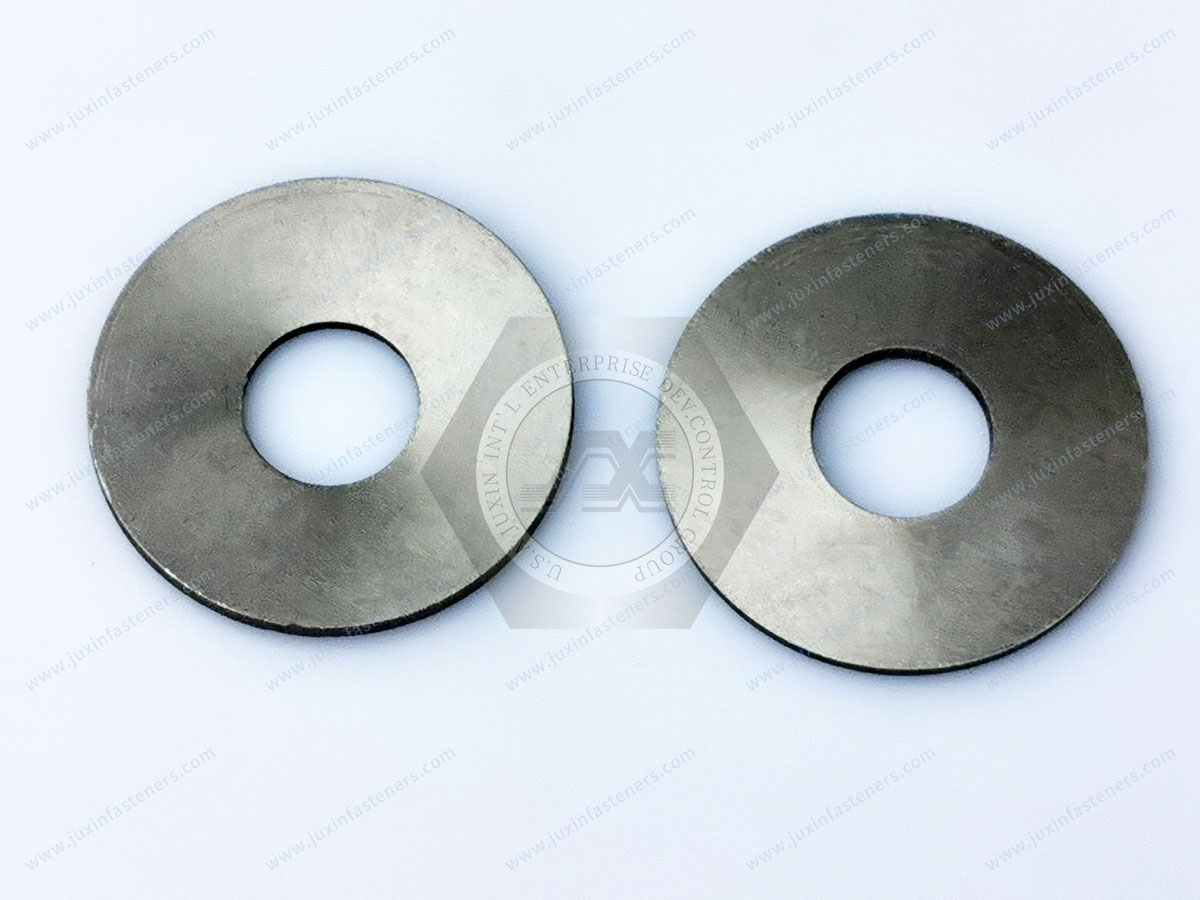
DIN 6796 specifies conical spring washers for bolted connections.
The washer has a conical profile rather than the flat geometry of a conventional plain washer.
When compressed within the bolted joint, the conical geometry provides elastic deflection.
This additional elasticity can be useful where a bolted connection needs to accommodate limited settlement or embedment while maintaining an appropriate clamping-force relationship.
The correct engineering description is therefore:
Conical Spring Element for a Bolted Connection
rather than:
Universal Lock Washer
That distinction matters when selecting and sourcing the part.
Yes.
DIN 6796:2009-08 is currently listed as a current DIN standard.
It replaced DIN 6796:1987-10.
For new drawings, purchase specifications and supplier qualification, the controlled standard edition should be confirmed rather than relying on an old catalog or legacy drawing without review.
DIN's current introductory information for DIN 6796 identifies these conical spring washers as spring elements for bolted connections using bolts in property classes:
8.8 to 10.9
according to ISO 898-1.
This is an important procurement detail.
A supplier should not automatically extend DIN 6796 compatibility to every higher bolt property class simply because the washer physically fits the bolt.
A common online description states that DIN 6796 washers are suitable for:
8.8, 10.9 and 12.9 bolts
That should not be repeated as a generic DIN 6796 claim.
The current DIN 6796 scope information identifies the intended range as:
8.8–10.9
For a 12.9 bolted joint, engineers should evaluate the actual joint, washer specification and approved customer requirements rather than assuming DIN 6796 compatibility.
This creates a useful sourcing rule:
Physical Fit ≠ Standard Compatibility
DIN's current standard information also explains that with bolt property classes below 8.8, the spring washer can embed in a way that significantly reduces its securing effect.
Therefore, the nominal thread size alone is not enough.
The mating fastener property class matters.
A professional RFQ should identify:
DIN 6796 + Nominal Size + Mating Bolt Property Class
where applicable.
ISO 898-1 defines mechanical properties for carbon and alloy steel bolts, screws and studs within its scope.
DIN 6796 references the relevant bolt property-class framework.
This does not mean that ISO 898-1 is a washer standard.
Instead:
ISO 898-1 → Bolt / Screw / Stud Mechanical Properties
DIN 6796 → Conical Spring Washer for Bolted Connections
The standards perform different roles within the fastening system.
DIN 267-26 provides technical specifications for conical spring washers for bolted connections.
For sourcing and engineering review, DIN 6796 and DIN 267-26 should therefore not be treated as unrelated documents.
A useful procurement model is:
DIN 6796 → Product Geometry / Product Standard
DIN 267-26 → Technical Specifications
The applicable drawing and customer requirements remain controlling.
A flat washer primarily provides a bearing interface.
A DIN 6796 washer provides elastic behavior through conical deflection.
Therefore:
Flat Washer → Bearing Area / Interface
DIN 6796 → Elastic Spring Element in Bolted Joint
These components should not be considered interchangeable merely because both are installed under a bolt head or nut.
A split spring washer has a helical split-ring geometry.
DIN 6796 uses a continuous conical geometry.
Their:
shape;
stiffness;
deflection;
contact behavior;
application logic
are different.
Therefore:
DIN 6796 ≠ Split Lock Washer
This distinction is especially important for RFQs.
A DIN 6796 washer and a Belleville disc spring both use conical geometry.
However, they should not automatically be treated as the same engineering product.
DIN 6796 is specifically intended for bolted connections.
A true disc spring is commonly selected as a mechanical spring based on:
force;
deflection;
spring geometry;
working height;
stack arrangement.
For current European disc-spring engineering, EN 16983 and EN 16984 are relevant standards.
Therefore:
DIN 6796 → Bolted-Joint Conical Spring Washer
EN 16983 / EN 16984 → Disc-Spring Engineering System
If a customer requests a “Belleville washer,” the supplier should determine which product family is actually required.
One of the most important corrections to older product descriptions is the claim:
“DIN 6796 prevents bolt loosening caused by vibration.”
That statement is too broad.
Bolted joints can lose preload through mechanisms such as:
settlement;
embedment;
creep;
thermal dimensional change.
They can also experience:
rotational self-loosening under transverse movement.
These are not the same failure mechanism.
A DIN 6796 washer can add elasticity to the joint and can help compensate for limited settlement.
That does not mean it automatically prevents rotational self-loosening under every vibration condition.
This distinction is critical for both engineers and buyers.
Clamp force can decrease even when the nut or screw has not visibly rotated.
Potential causes include:
embedment;
surface settlement;
creep;
gasket compression;
thermal dimensional changes.
Relative transverse movement can create conditions in which a threaded fastener rotates and loses preload.
The correct countermeasure depends on the actual failure mechanism.
Therefore:
Preload Compensation ≠ Thread Locking
A bolted joint behaves as a mechanical spring system.
The bolt stretches.
The clamped components compress.
A conical spring washer introduces another elastic element into the system.
This can increase available elastic travel.
Conceptually:
Bolt + Clamped Parts
becomes:
Bolt + Clamped Parts + Conical Spring Element
The resulting joint behavior depends on the stiffness relationships among all of these components.
When mating surfaces settle after tightening, the clamped thickness can decrease slightly.
In a very stiff joint, a small dimensional change may cause a meaningful loss of clamp force.
An appropriately selected conical spring washer can provide additional elastic deflection.
This can help compensate for limited settlement.
However:
DIN 6796 ≠ Unlimited Settlement Compensation
The washer has finite deflection and force characteristics.
Creep is particularly important in assemblies involving:
polymers;
gaskets;
soft materials;
elevated temperatures.
A DIN 6796 washer may help accommodate some dimensional change.
But it cannot automatically eliminate long-term creep.
The engineer should evaluate:
expected displacement;
washer working range;
required minimum clamp load;
temperature;
material behavior.
Different joint materials expand by different amounts as temperature changes.
Potential combinations include:
steel bolt + aluminum housing;
steel fastener + polymer component;
stainless fastener + mixed-material stack.
A conical spring element may help accommodate limited dimensional variation.
But:
DIN 6796 Washer ≠ Unlimited Thermal Compensation
The complete thermal stack should be evaluated.
A buyer may search for:
DIN 6796 M6
DIN 6796 M8
DIN 6796 M10
DIN 6796 M12
DIN 6796 M16
This is useful for initial identification.
But production sourcing may require more information.
Depending on the application, the RFQ may need to define:
standard;
nominal size;
dimensions;
material;
finish;
bolt property class;
environment;
customer drawing.
Even when a standard is specified, procurement should confirm that the supplier is quoting the intended part.
Important dimensions can include:
inside diameter;
outside diameter;
thickness;
free height.
For replacement sourcing, a drawing or sample can help prevent confusion with visually similar conical washers.
DIN 6796-type conical spring washers are spring elements.
The relevant material and technical requirements should follow:
applicable standard;
drawing;
customer specification;
service environment.
Avoid reducing the specification to a vague statement such as:
“High-Strength Steel Washer”
For controlled OEM procurement, the applicable material requirement should be identified.
Spring steel is commonly associated with DIN 6796 conical spring washers because the component requires elastic behavior.
However:
Spring Steel ≠ Complete Material Specification
Material condition, heat treatment and technical requirements must support the required spring performance.
Buyers may also search for:
DIN 6796 stainless steel washer
or:
A2 DIN 6796 washer
or:
A4 DIN 6796 washer
Do not assume that a commercially available stainless conical washer automatically conforms to every requirement of DIN 6796.
If stainless material is requested, confirm:
whether exact DIN 6796 conformity is required;
whether the customer needs DIN 6796 geometry only;
whether an alternative conical spring washer is acceptable;
material grade;
required spring performance;
corrosion environment.
This distinction is especially important in replacement sourcing.
If an original drawing specifies one material and the proposed supplier offers another, the change should be reviewed.
Potential changes in material can affect:
spring force;
elastic modulus;
relaxation;
fatigue behavior;
corrosion resistance;
temperature capability.
Therefore:
Same Dimensions + Different Material ≠ Automatic Equivalent
Heat treatment is used to achieve appropriate mechanical properties in spring-steel components.
However:
Heat Treatment ≠ Corrosion Protection
The two requirements should be treated separately.
Surface finish can influence:
corrosion resistance;
friction;
appearance;
compatibility with the mating fastener.
The correct finish depends on the application and customer specification.
Do not assume every DIN 6796 washer must use the same coating.
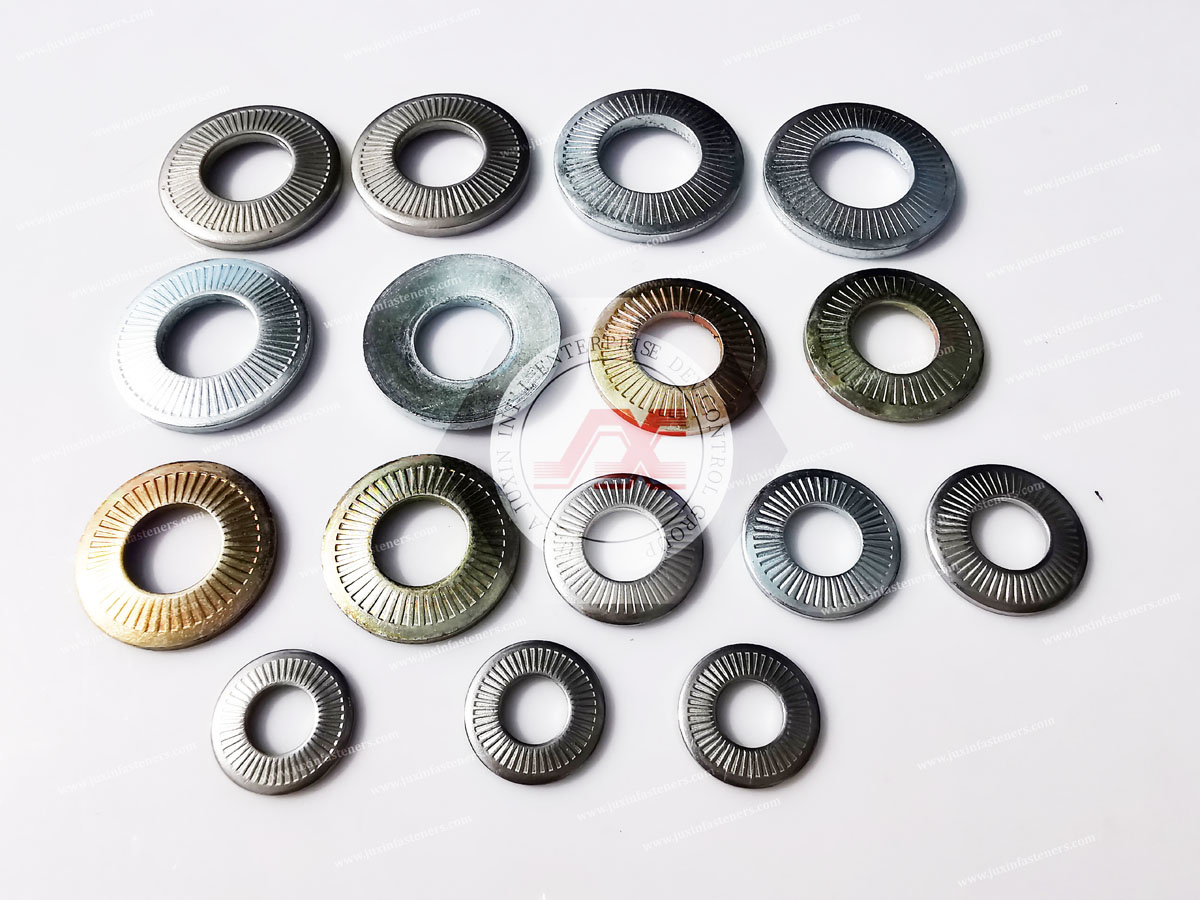
Non-electrolytic zinc-flake systems may be considered for selected high-strength spring-steel fasteners where corrosion protection is required.
The actual coating system should be defined by:
customer specification;
required corrosion performance;
friction requirements;
environmental conditions.
A brand name should not replace the engineering coating specification unless the customer explicitly requires that system.
Hydrogen embrittlement can be a concern for high-hardness or high-strength steel components exposed to certain manufacturing and coating processes.
Risk depends on:
material;
hardness;
cleaning process;
electroplating process;
applied stress;
subsequent processing.
Therefore, the correct engineering statement is not:
“DIN 6796 washers can never be electroplated.”
Instead:
Hydrogen-embrittlement risk should be evaluated for the selected material, hardness and coating process.
Hydrogen-embrittlement control should follow the applicable:
material specification;
coating specification;
process requirements;
customer requirements.
Do not create a universal baking temperature or duration for all DIN 6796 washers.
Mechanical coating processes may be considered for selected spring-steel fasteners where appropriate.
However, it is too broad to claim:
“Mechanical galvanizing always provides better adhesion.”
Coating performance depends on the actual system and process.
The finish should be selected from validated requirements rather than a universal ranking.
Corrosion performance depends on more than washer material.
Relevant variables can include:
coating type;
coating thickness;
pretreatment;
service environment;
temperature;
chemicals;
contact with dissimilar metals;
handling;
installation damage.
Do not infer field service life directly from a coating name.
If a customer specifies salt-spray testing, ASTM B117 may be used as a test method where applicable.
However:
Salt-Spray Hours ≠ Direct Field Service Life
Do not convert laboratory test duration into an unsupported real-world service-life claim.
DIN 6796 washers may be installed under a bolt head or nut depending on the joint design.
The controlled drawing or assembly specification should determine the actual position.
Do not create a universal installation orientation without reference to the joint.
The washer's conical geometry creates its spring behavior.
But generic instructions such as:
“Always install the convex side toward the load.”
should not be used as a universal rule without reference to the applicable drawing or assembly specification.
Follow:
standard requirements;
engineering drawing;
assembly instructions.
A conical spring washer works through elastic deflection.
Completely flattening the washer should not be treated as a universal installation target.
The intended working condition depends on the joint design.
Excessive compression can alter spring behavior.
The washer standard does not provide one universal tightening torque for every joint.
Torque depends on factors including:
thread size;
bolt property class;
target preload;
friction;
coating;
lubrication;
nut or tapped-hole condition;
bearing interface.
Therefore:
DIN 6796 Size ≠ Universal Torque Value
The joint specification should control tightening.
Changing the washer coating or surface condition can alter the bearing friction beneath a rotating fastener.
This can change the relationship between:
Applied Torque → Achieved Preload
For preload-sensitive assemblies, washer finish should therefore be considered part of the tightening system.
Maintenance and MRO teams may encounter old equipment containing a conical washer that appears to be DIN 6796.
A professional replacement process can follow:
Step 1 — Check the Original Drawing or BOM
Identify the original standard and size.
Step 2 — Confirm the Standard Edition
Determine whether the drawing references an older DIN 6796 edition.
Step 3 — Measure the Existing Washer
Check:
ID;
OD;
thickness;
free height.
Step 4 — Identify the Mating Fastener
Confirm:
nominal thread size;
property class;
material;
finish.
Step 5 — Identify the Joint Function
Determine whether the washer is intended for:
settlement compensation;
elastic reserve;
another controlled function.
Step 6 — Review Material and Finish
Do not silently change either.
Step 7 — Compare Proposed Replacement
Verify dimensional and functional compatibility.
Step 8 — Validate Before Production
For critical equipment, approve the replacement through the customer's engineering process.
A visually similar conical washer may not have the same:
dimensions;
thickness;
material;
hardness;
spring force;
technical requirements.
Therefore:
Looks Similar ≠ Functional Equivalent
This is especially important when sourcing from a physical sample.
If the original drawing is unavailable, procurement may provide a physical sample.
Useful information includes:
ID;
OD;
thickness;
free height;
material information if known;
finish;
mating bolt size;
application;
original equipment age;
estimated annual quantity.
A sample can support identification, but the original engineering requirement remains preferable.
Not every application requires an exact standard DIN 6796 part.
A customer may instead need:
different OD;
different ID;
different thickness;
different spring behavior;
different material;
special coating.
In that case, the component should be treated as a:
Custom Conical Spring Washer
rather than inaccurately labeling it DIN 6796.
If dimensions or technical requirements differ from the standard, a more accurate drawing description may be:
Conical Spring Washer — Based on DIN 6796 Geometry
or another customer-approved designation.
The final wording should follow the customer's drawing-control system.
High-volume OEM assembly creates another sourcing decision.
A traditional assembly may require:
1 Screw + 1 Loose DIN 6796-Type Washer
This requires operators or automated equipment to handle two components.
A captive screw-and-washer assembly combines them into one assembly.
Potential benefits can include:
reduced loose-part handling;
reduced risk of washer omission;
simplified kitting;
improved repetitive assembly;
easier line-side component management.
DIN 6900-5:2025-12 covers screw-and-washer assemblies with coarse thread and captive conical spring washers.
The current standard applies to assemblies using flat-bearing-head screws in:
M2.5 to M12
with bolt property classes:
8.8 and 10.9
This creates a useful OEM sourcing branch.
A buyer currently purchasing:
Screw + Loose Conical Spring Washer
may be able to evaluate:
Captive Screw-and-Washer Assembly
where the application and production process justify it.
Potential indicators include:
high annual volume;
repetitive manual assembly;
automated assembly;
frequent washer omission;
complicated kitting;
line-side part-count reduction targets.
The engineering drawing and production process must still approve the change.
| Procurement Requirement | Loose DIN 6796 Washer | Captive Assembly |
|---|---|---|
| Washer sourced separately | Yes | No |
| Flexible screw selection | High | More controlled |
| Loose-part handling | Required | Reduced |
| Washer omission risk | Higher | Reduced |
| Existing legacy BOM | Often suitable | Requires change review |
| High-volume repetitive assembly | Suitable | May offer process advantages |
| Automated feeding | Application-dependent | Can be advantageous |
| Standard reference | DIN 6796 | DIN 6900-5 where applicable |
DIN 6796-type conical spring washers may be evaluated in selected bolted joints where controlled elastic behavior is required.
Potential equipment areas include:
mechanical brackets;
drive-system equipment;
auxiliary machinery;
thermal-management equipment;
production machinery.
Do not automatically claim suitability for safety-critical:
suspension;
steering;
braking;
battery structural joints
without application-specific approval.
Potential applications include:
machine tools;
production equipment;
material-handling systems;
clamping assemblies;
heavy mechanical equipment.
The joint should be evaluated according to its actual loading and preload requirements.
Potential applications can include:
generators;
mechanical power equipment;
mounting systems;
auxiliary machinery.
Temperature, corrosion and preload requirements should be defined for the actual equipment.
Wind-energy equipment contains numerous bolted connections.
DIN 6796-type washers may be relevant to selected mechanical assemblies.
However, generic DIN 6796 washers should not automatically be specified for critical wind-turbine structural joints without the required engineering approval.
Potential applications include:
mechanical mounting systems;
switchgear mechanisms;
equipment brackets;
enclosures;
power equipment.
A DIN 6796 washer does not automatically provide:
electrical bonding;
grounding;
EMI shielding.
Those functions require separate electrical evaluation.

Potential applications may exist inside:
cooling equipment;
pumps;
power equipment;
UPS systems;
mechanical support equipment.
The correct selection path remains:
Bolted Joint Requirement → Elastic Requirement → DIN 6796 Evaluation
not:
AI Equipment → DIN 6796 Automatically
Potential applications can include:
fans;
blowers;
pumps;
actuators;
equipment frames;
mechanical modules.
DIN 6796 washers do not inherently create:
airtight joints;
watertight joints;
refrigerant seals.
Sealing must be engineered separately.
Railway equipment may contain applications where conical spring washers are evaluated.
However, railway fastening can involve industry-specific requirements for self-loosening resistance, fatigue and validation.
A generic DIN 6796 washer should not automatically be described as railway-approved.
DIN 6796 washers may be used in selected machinery and equipment.
Do not automatically extend that statement to structural steel bolting.
Structural bolting systems can have separate standards and joint requirements.
A generic DIN 6796 industrial washer should not automatically be described as an aerospace fastener.
Potential non-flight-critical or ground-support requirements can be evaluated from:
drawing;
material;
specification;
traceability;
inspection;
customer approval.
Flight-critical applications require the applicable aerospace qualification system.
Potential applications may exist in:
diagnostic equipment housings;
laboratory machinery;
equipment carts;
internal mechanical assemblies.
Do not automatically claim:
medical-grade material;
ISO 13485 production;
biocompatibility;
sterile compatibility.
Those requirements must be separately specified and verified.
| RFQ Situation | Recommended Action |
|---|---|
| Drawing says DIN 6796 + size | Confirm edition, bolt class, material/finish and quantity |
| Bolt class is 8.8 | Within stated DIN 6796 bolt-class range |
| Bolt class is 10.9 | Within stated DIN 6796 bolt-class range |
| Bolt class is below 8.8 | Review suitability before sourcing |
| Bolt class is 12.9 | Do not assume DIN 6796 compatibility |
| Customer requests stainless | Confirm whether exact standard conformity or geometry-equivalent part is required |
| Customer needs anti-loosening under transverse vibration | Evaluate locking requirement separately |
| Customer needs settlement compensation | DIN 6796 may be relevant |
| Customer needs high-force spring system | Evaluate Belleville disc spring |
| Customer needs large spring travel | Evaluate another spring architecture |
| Old equipment / MRO | Confirm legacy drawing, dimensions and material |
| High-volume screw + loose washer | Evaluate captive assembly |
| Customer needs sealing | Use dedicated sealing system |
| Customer needs grounding | Validate electrical interface separately |
DIN 6796 M10 may not contain every commercial requirement.
The current DIN information identifies 8.8–10.9.
Settlement compensation and rotational locking are different engineering tasks.
Similar conical geometry does not make the standards interchangeable.
Technical requirements should be reviewed with the applicable product specification.
The controlled material and technical requirements may need more detail.
Confirm conformity before using the standard designation.
Finish can affect corrosion and friction.
Torque belongs to the complete bolted-joint design.
High-volume applications may benefit from a captive screw-and-washer solution.
Engineers may search:
DIN 6796 washer;
DIN 6796 conical spring washer;
DIN 6796 dimensions;
DIN 6796 bolt class;
DIN 6796 8.8;
DIN 6796 10.9;
DIN 6796 12.9;
DIN 6796 vs Belleville washer;
DIN 6796 preload;
DIN 6796 settlement;
DIN 267-26;
DIN 6796 replacement;
DIN 6796 installation.
These searches often indicate an active drawing, specification or troubleshooting task.
Purchasing and supplier-development teams may search:
DIN 6796 supplier;
DIN 6796 manufacturer;
DIN 6796 washer manufacturer;
DIN 6796 spring washer supplier;
DIN 6796 M8 supplier;
DIN 6796 M10 supplier;
DIN 6796 M12 supplier;
stainless DIN 6796 washer;
zinc flake DIN 6796 washer;
custom conical spring washer;
OEM DIN 6796 supplier;
DIN 6796 replacement supplier.
These searches indicate strong commercial intent.
For technical and commercial evaluation by JUXIN FASTENERS, provide where applicable:
drawing;
BOM;
customer part number;
DIN 6796 edition;
nominal thread size;
washer ID;
washer OD;
thickness;
free height;
mating bolt or screw;
bolt property class;
nut specification where relevant;
joint material;
clamped thickness;
joint function;
target preload where controlled;
settlement requirement;
temperature range;
corrosion environment;
washer material;
material specification;
hardness requirement where controlled;
heat-treatment requirement where controlled;
surface finish;
coating specification;
friction requirement where controlled;
hydrogen-embrittlement requirements where applicable;
inspection requirement;
dimensional report requirement;
spring-force requirement where controlled;
sample requirement;
prototype quantity;
production quantity;
estimated annual demand;
packaging requirement;
labeling requirement;
customer-specific requirements.
DIN 6796 is a current German standard for conical spring washers used in bolted connections.
Yes. DIN 6796:2009-08 is currently listed as a current standard.
Current DIN information identifies property classes 8.8 through 10.9 according to ISO 898-1.
Do not assume that from the standard designation. DIN's current scope information identifies 8.8–10.9. A 12.9 application should be separately engineered and specified.
DIN's current information warns that the washer can embed, significantly reducing its securing effect.
It should not be treated as a universal anti-loosening device. It can add elasticity and help compensate for limited settlement, while rotational self-loosening requires separate evaluation.
No. The geometries are related, but DIN 6796 is specifically for conical spring washers in bolted connections. Engineered disc springs use a different design and standards framework.
DIN 267-26 provides technical specifications for conical spring washers used in bolted connections.
Stainless conical washers are commercially available, but exact DIN 6796 conformity should not be assumed from shape alone. Confirm the material and specification with the supplier.
The coating process must be evaluated against material, hardness, hydrogen-embrittlement risk, corrosion requirements and customer specifications. No single coating rule applies to every application.
The washer standard alone does not establish one universal tightening torque. Torque depends on the complete bolted joint.
Reuse should not be assumed automatically. Evaluate deformation, corrosion, surface damage, spring condition and the requirements of the application.
Not automatically. A flat washer does not provide the same elastic spring function.
Not automatically. The geometry and joint behavior are different.
Not automatically. Confirm whether the requirement is a bolted-joint washer or an engineered spring element.
Yes. A sample can support dimensional and sourcing evaluation, but the original drawing, BOM and application information are preferable where available.
Custom conical spring washer requirements can be evaluated from drawings, samples, dimensions, material, finish, spring requirements and production quantities.
A buyer may send:
“Please quote DIN 6796 M10, 100,000 pcs.”
That gives the supplier:
standard;
nominal size;
quantity.
For controlled OEM sourcing, the next questions may be:
What Bolt Property Class Is Used?
Is the Drawing Based on DIN 6796:2009-08 or a Legacy Edition?
What Material Is Required?
What Surface Finish Is Required?
What Corrosion Environment Applies?
Is Settlement Compensation the Intended Function?
Is Rotational Locking Required Separately?
Does the Customer Require Dimensional or Spring-Force Inspection?
Would a Captive Screw-and-Washer Assembly Improve Production Efficiency?
The sourcing path becomes:
BOM → DIN 6796 → Size → Bolt Class → Joint Function → Material → Finish → Environment → Inspection → Sample → Approval → Production RFQ
That is the difference between purchasing a washer that looks correct and sourcing a controlled fastening component for an industrial OEM program.
JUXIN FASTENERS supports OEM sourcing of:
DIN 6796 conical spring washers;
custom conical spring washers;
flat washers;
hardened washers;
wave washers;
disc springs;
spring washers;
screw-and-washer assemblies;
high-strength bolts and nuts;
custom industrial fasteners.
Potential application sectors include:
industrial machinery;
automotive and EV equipment;
electrical equipment;
power distribution;
power generation;
wind energy;
HVAC equipment;
automation;
telecommunications;
AI data center and HPC equipment;
rail-related equipment;
heavy machinery;
laboratory and diagnostic equipment.
For the engineering behavior of DIN 6796 washers in bolted joints, refer to the JUXIN FASTENERS DIN 6796 Conical Spring Washers: Bolt Preload, Settlement & Selection Guide.
For the decision between a DIN 6796 washer and a true Belleville spring, refer to the JUXIN FASTENERS Conical Spring Washers vs Belleville Disc Springs: Selection, Standards & Applications.
For detailed disc-spring force, deflection and stacking engineering, refer to the JUXIN FASTENERS Disc Springs & Belleville Washers: Load, Deflection, Stacking & Selection Guide.
For broader washer selection, see Industrial Washers: Types, Functions & Selection Guide.
For screw-and-washer system selection, see Washers and Bolts: Fastening Systems Selection Guide.
For high-strength bolted-joint requirements, see High-Strength Bolts and Nuts.
For captive washer assembly engineering, refer to the JUXIN FASTENERS SEMS Screws & Captive Washer Assemblies: Types, Standards, Design & OEM Sourcing Guide.
For OEM DIN 6796 washer RFQs, send your drawing or sample, standard edition, nominal size, mating bolt property class, material, finish, application, quantity and estimated annual demand to:
A professional DIN 6796 sourcing inquiry should not stop at:
“DIN 6796 M10.”
The more useful procurement question is:
“What DIN 6796 washer specification is required for this bolt class, joint function, environment and production program?”
 MORE NEWS
Sep. 27, 2026
Sep. 27, 2026
Sep. 27, 2026
Contact Us
Tel.:
+86 020 8621 0320
+86 020 3121 6067
E-mail:
Technical Support:
Navigation
SEND INQUIREY