
Call Us
+86 136 6007 9809
Call Us
+86 136 6007 9809

Oct. 10, 2023
DIN 2093 disc springs, commonly known as Belleville disc springs or Belleville washers, are conical spring elements engineered to generate relatively high axial force within a compact installation space.
Unlike an ordinary flat washer, a disc spring is designed to deflect elastically under axial load.
That controlled deflection allows the component to store mechanical energy and provide a defined spring response.
DIN 2093 disc springs can be used individually or arranged into series, parallel or combination stacks to create different relationships between force and deflection.
This makes them particularly valuable in applications requiring:
high spring force in limited axial space;
controlled preload;
compensation for limited joint settlement;
thermal movement compensation;
tolerance compensation;
valve and actuator spring force;
mechanical energy storage;
overload protection;
controlled movement.
For engineers, selecting a disc spring is therefore fundamentally different from selecting an ordinary washer.
The important questions are not simply diameter and thickness.
They include:
What force is required? At what deflection? How much working travel is needed? What fatigue life is expected?
Will a single spring or a stack be required? What temperature and corrosion environment will the spring experience?
JUXIN FASTENERS supplies DIN 2093 disc springs, Belleville washers and other spring and fastening components for drawing-based industrial OEM applications.
For specifications, drawings, load requirements and RFQs, contact info@juxinfasteners.com.
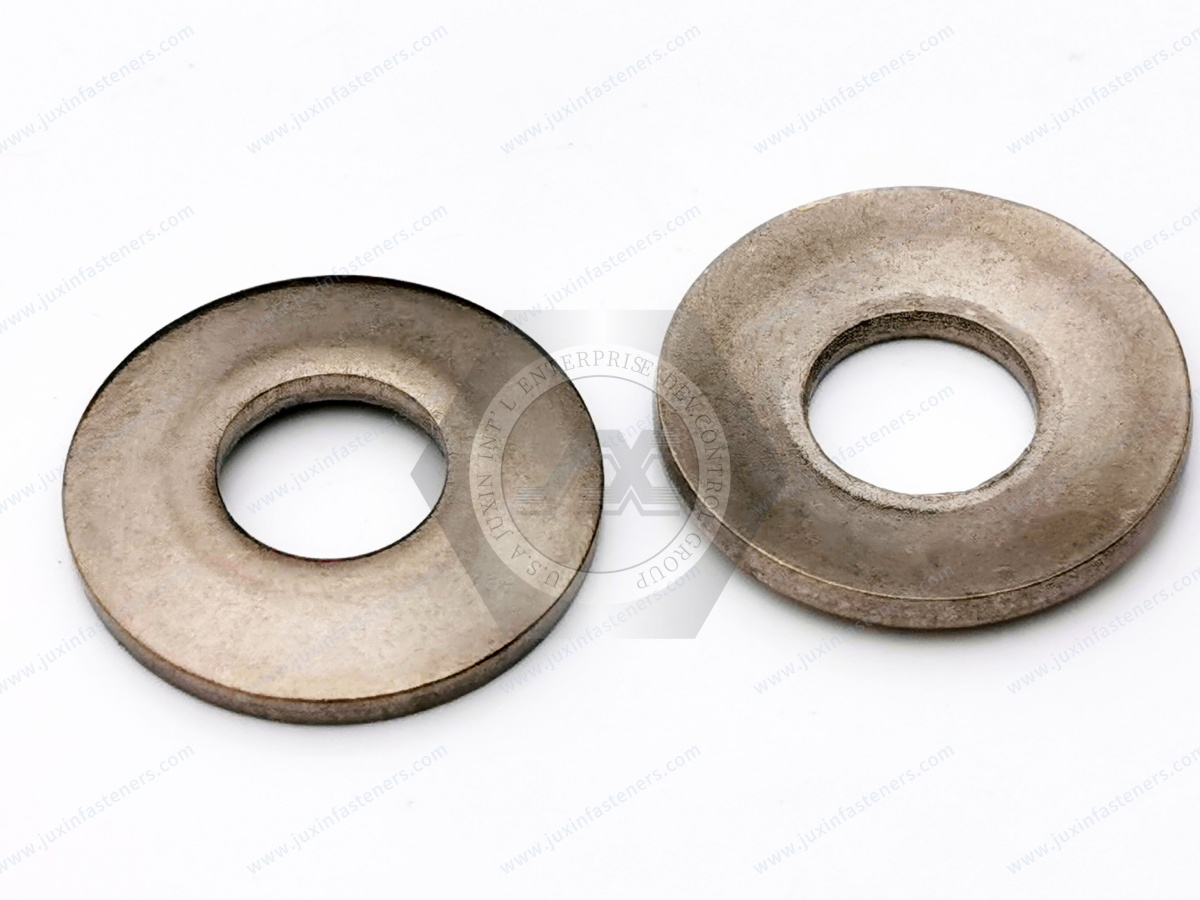
A DIN 2093 disc spring is an annular conical spring that deflects in the axial direction when loaded.
The component is typically characterized by dimensions including:
outside diameter;
inside diameter;
thickness;
free height;
cone height.
These dimensions interact with material properties to determine the spring's load-deflection behavior.
The product may be searched under terms including:
DIN 2093 disc spring
DIN 2093 disc spring washer
Belleville washer
Belleville disc spring
conical spring washer
disc spring stack
high-load spring washer
preload disc spring
For engineering procurement, the DIN designation and required functional performance should be used rather than relying only on the generic term "Belleville washer."
"Disc spring" and "Belleville washer" are often used interchangeably.
However, the term disc spring better communicates the engineering function.
A precision DIN 2093 component should be treated as a spring with a defined force-deflection characteristic rather than as a conventional washer whose primary purpose is simply load distribution.
This distinction becomes important in engineered assemblies.
A disc spring begins with a conical geometry.
As axial force is applied, the cone progressively flattens.
This deformation stores elastic energy.
When the applied displacement or load decreases, the spring attempts to recover toward its original shape.
The relationship between applied force and spring deflection creates the characteristic load-deflection curve.
This relationship is influenced by:
outside diameter;
inside diameter;
material thickness;
cone height;
elastic modulus;
material properties;
friction;
manufacturing tolerances.
This is why two disc springs with similar outside diameters can have dramatically different spring characteristics.
One of the strongest engineering advantages of disc springs is their ability to generate high axial forces with relatively small movement.
This makes them useful where a conventional coil spring would require too much installation length.
Typical examples include:
bolted joints;
valves;
actuators;
clutches;
brakes;
bearing systems;
machine tools;
high-pressure equipment;
thermal compensation assemblies.
The value of a disc spring is therefore strongly related to its force-to-space ratio.
The fundamental specification for a disc spring is the relationship between:
Force (F) and Deflection (s).
As the disc spring is compressed, the required force changes.
Unlike an ideal linear coil spring, the force-deflection curve of a disc spring can be nonlinear.
Its exact behavior depends heavily on geometry.
For engineering selection, it is often more useful to specify:
required force at a defined working deflection
than to specify only the physical dimensions.
Two suppliers may offer disc springs with apparently similar:
outside diameter;
inside diameter;
thickness.
But dimensional similarity alone does not guarantee identical spring performance.
Differences in:
material;
heat treatment;
hardness;
free height;
manufacturing tolerance;
surface condition
can change the actual force produced at a given deflection.
For engineered applications, procurement should therefore treat functional spring performance as a sourcing characteristic, not merely dimensions and price.
Several dimensions are particularly important.
Influences the overall spring geometry and installation envelope.
Determines clearance around a guide rod, bolt or shaft.
Strongly influences spring force and stiffness.
Defines the unloaded axial height.
Influences available deflection and the shape of the load-deflection response.
A dimensional change that appears small on a drawing can produce a meaningful change in spring force.
One of the most useful properties of disc springs is the ability to combine multiple springs into stacks.
Three common arrangements are:
series;
parallel;
combination.
Each configuration changes the overall spring behavior.
In a series stack, adjacent disc springs face opposite directions.
Conceptually, when identical springs are arranged in series:
available total deflection increases;
the force required at corresponding individual spring deflection remains approximately similar.
This is useful when a single spring provides the desired force but not enough travel.
Series stacking therefore allows engineers to increase working movement without simply making one spring dramatically larger.
In a parallel stack, disc springs are nested in the same direction.
For identical springs:
load capacity increases;
deflection remains approximately similar to that of one spring.
This configuration is useful when the required force is greater than a single spring can provide.
However, friction between nested springs becomes an important consideration.
Series and parallel groups can be combined.
For example, several springs can be nested in parallel to create a high-force group, and multiple groups can then be arranged in series to increase total travel.
This gives engineers substantial flexibility in designing a spring system around a restricted installation envelope.
The stack should be evaluated as a complete spring assembly rather than simply counting washers.
For identical idealized springs:
Series → more travel
Parallel → more force
Series + parallel → tailor both
This simple rule is useful for initial design thinking.
Actual performance must still account for friction, tolerances, guidance and the applicable disc-spring design data.
Theoretical stack calculations are useful, but actual stacks can behave differently because of:
friction between springs;
friction against guide surfaces;
manufacturing tolerance;
misalignment;
surface treatment;
lubrication;
spring-to-spring variation.
This becomes increasingly important as the number of springs in the stack increases.
For demanding applications, functional stack testing may therefore be necessary.
When disc springs slide against adjacent springs or guide surfaces, friction consumes energy.
This means the force measured during loading can differ from the force measured during unloading.
The difference is known as hysteresis.
Hysteresis can be useful in some applications because it dissipates energy.
In other applications, it reduces the precision of the spring response.
Engineers should therefore distinguish between:
energy dissipation and accurate spring-force control.
They are not always the same objective.
Disc springs are sometimes described broadly as vibration-damping washers.
That description can be misleading.
A disc spring primarily provides controlled axial spring force.
Friction in a stack can dissipate some energy, but DIN 2093 disc springs should not automatically be treated as dedicated vibration isolators.
If vibration isolation is the engineering objective, system stiffness, excitation frequency, damping and resonance should be analyzed separately.
Disc springs can be incorporated into bolted assemblies where limited joint-thickness changes are expected.
Potential causes include:
settlement;
embedding;
gasket compression;
thermal expansion;
thermal contraction;
material relaxation.
A conventional highly stiff bolted assembly can lose significant preload after a small dimensional change.
Adding an appropriately designed spring element increases compliance.
This can reduce the sensitivity of clamp force to limited displacement changes.
This distinction is critical.
Disc springs can help manage preload changes.
They do not automatically prevent rotational self-loosening caused by severe transverse joint movement.
If the primary failure mechanism is fastener rotation, engineers may need to evaluate:
wedge-lock washers;
prevailing-torque lock nuts;
positive mechanical locking;
another validated anti-rotation method.
Preload compensation and rotational locking are different engineering functions.
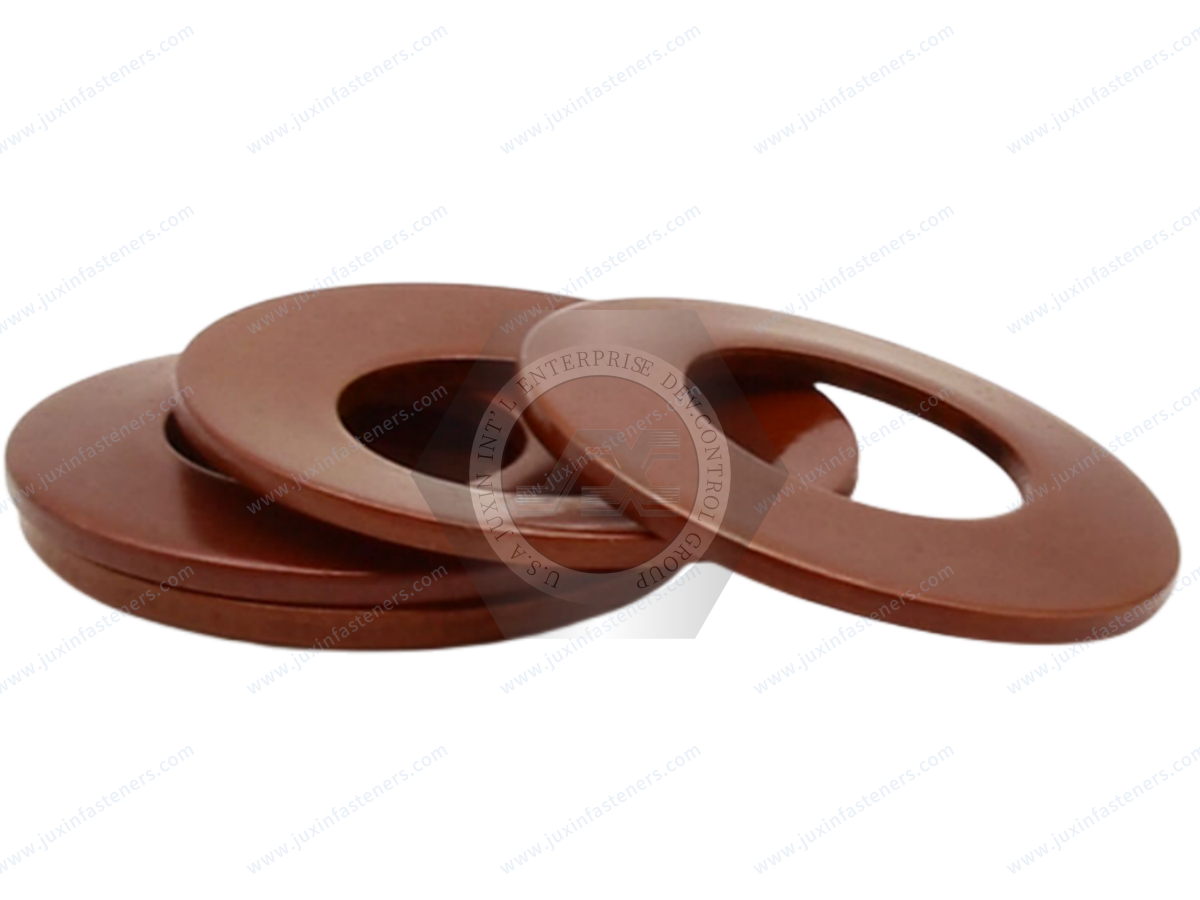
Both products provide elastic behavior, but their engineering capability differs.
May be appropriate for:
compact spring action;
limited elastic compensation;
relatively simple bolted assemblies.
May be appropriate for:
higher spring loads;
engineered load-deflection requirements;
controlled spring travel;
series or parallel stacking;
more demanding preload-management systems.
Where spring force is a design parameter rather than a secondary feature, DIN 2093 is generally the more engineered spring solution.
Both disc springs and coil springs store mechanical energy, but their geometry creates different packaging characteristics.
Can offer:
high axial force;
short installation height;
flexible stacking;
compact radial spring systems.
Can offer:
larger travel;
different linearity characteristics;
simpler long-stroke designs.
The correct choice depends on the required:
force;
stroke;
installation envelope;
fatigue life;
dynamic behavior.
Disc springs are not universally superior to coil springs; they solve a different packaging and force problem.
Products such as:
wave washers;
wave springs;
diaphragm springs;
slotted disc springs
can have different geometries and functions.
They should not automatically be categorized as DIN 2093 disc springs.
For OEM sourcing, the product standard and drawing should clearly identify the required spring type.
Disc springs require materials capable of sustaining high elastic stress while maintaining dimensional and fatigue performance.
Depending on the applicable DIN specification and customer requirement, materials may include suitable spring steels and corrosion-resistant spring materials.
The international engineering specification should define material through the applicable standard, mechanical requirements or approved drawing rather than relying on local material designations.
Important characteristics include:
high elastic limit;
strength;
toughness;
fatigue resistance;
heat-treatment response;
temperature capability;
corrosion resistance.
The mechanical behavior of a disc spring depends strongly on controlled material condition.
Heat treatment can influence:
hardness;
elastic behavior;
fatigue life;
dimensional stability.
An incorrectly processed disc spring can meet nominal dimensions while failing to provide the required spring force or fatigue performance.
Supplier qualification should therefore evaluate material and heat-treatment control together with dimensional inspection.
Higher hardness does not automatically mean a better disc spring.
Excessive hardness can reduce toughness or increase sensitivity to cracking.
Insufficient hardness can reduce spring performance or allow permanent deformation.
The required material condition should follow the applicable product specification.
If a disc spring is loaded beyond its intended operating condition, it may not fully recover its original free height.
This permanent deformation is commonly described as set.
Excessive set can change:
preload;
working height;
spring force;
stack behavior.
This is why a disc spring should not simply be compressed as far as physically possible without considering the intended working range.
Operating a disc spring near complete flattening can create high stresses.
For cyclic applications, repeatedly operating at extreme deflection can reduce fatigue life.
The optimal working range depends on:
geometry;
load;
required travel;
number of cycles;
applicable design requirements.
A spring should therefore be selected around its working point, not only its maximum theoretical capacity.
A disc spring used as a static preload element has different design priorities from one undergoing millions of compression cycles.
May prioritize:
load capacity;
compactness;
preload stability.
Must also consider:
stress range;
fatigue;
surface condition;
alignment;
guidance;
cycle frequency.
Procurement should communicate expected cycle requirements when fatigue performance matters.
Disc spring fatigue is strongly influenced by the stress range between minimum and maximum operating positions.
A spring repeatedly cycled through a large portion of its travel can experience a very different fatigue life from one operating over a narrow range.
Therefore, a dynamic RFQ should ideally include:
minimum working load;
maximum working load;
minimum working height;
maximum working height;
expected cycles.
This is much more useful than simply requesting "long-life DIN 2093 washers."
Disc spring stacks often require guidance to maintain alignment.
Depending on the assembly, guidance can be provided by:
an internal guide rod;
an external guide sleeve.
The guide helps prevent:
lateral displacement;
stack buckling;
misalignment.
However, guidance must allow the springs to move without excessive interference.
A guide that is too tight can create:
excessive friction;
binding;
coating damage;
inconsistent load response.
A guide that is too loose may allow:
misalignment;
lateral movement;
unstable stacking.
The appropriate clearance should follow the disc spring design, applicable standard and operating conditions.
Disc springs can slide against guide surfaces during compression.
Poor guide-surface condition can increase:
friction;
wear;
scoring;
hysteresis.
For repeatedly cycled stacks, guide quality can therefore influence long-term performance.
Lubrication may be used in some disc spring stacks to manage friction and wear.
However, lubrication can change:
friction;
hysteresis;
loading behavior.
The lubrication condition should therefore be considered part of the spring-system design where functional force characteristics are important.
Carbon spring steel disc springs may require protective surface treatments.
Potential systems can include:
phosphate-based finishes;
zinc-based systems where appropriate;
zinc-flake coatings;
other engineered protective treatments.
Coating selection should consider:
corrosion exposure;
fatigue;
hydrogen embrittlement risk;
coating thickness;
friction;
operating temperature.
High-strength spring steels can be susceptible to hydrogen embrittlement under certain electroplating and chemical processing conditions.
This is particularly important for highly stressed spring components.
Surface-treatment selection should therefore consider the complete material and process system.
For demanding applications, coating-process controls can be more important than simply specifying a decorative finish.
Where corrosion resistance is critical, suitable stainless or other corrosion-resistant spring materials may be evaluated.
Potential environments include:
chemical processing;
foodservice equipment;
outdoor systems;
cooling equipment;
marine-related environments.
However, changing material can alter:
elastic modulus;
spring force;
temperature capability;
fatigue performance.
A material substitution should therefore be reviewed as an engineering change.
Temperature can influence:
elastic modulus;
strength;
relaxation;
corrosion;
coating behavior.
For elevated-temperature valves, turbines or process equipment, material selection must consider the expected operating temperature and duration.
A standard spring material suitable at room temperature may not maintain the same performance at elevated temperature.
Disc springs can be useful where components expand and contract differently with temperature.
Examples include assemblies combining:
steel fasteners;
aluminum structures;
copper conductors;
polymer or gasket materials.
An appropriately designed spring system can accommodate some dimensional change while maintaining force.
This is especially relevant in equipment experiencing repeated thermal cycling.
Disc springs are widely relevant to valve and pressure-control mechanisms because high force may be required in a compact space.
Potential functions include:
valve preload;
sealing force;
actuator return force;
pressure-response mechanisms;
compensation for thermal movement.
For these applications, the spring should be selected from the required force and travel rather than simply by nominal diameter.
Some sealing systems experience:
gasket relaxation;
thermal cycling;
differential thermal expansion.
A disc spring stack can sometimes be used to increase joint compliance and help stabilize clamping force.
However, the spring does not create the seal by itself.
Sealing performance depends on the complete system, including:
gasket;
flange stiffness;
bolt preload;
temperature;
pressure;
surface condition.
AI data-center and HPC liquid-cooling infrastructure includes:
pumps;
valves;
cooling distribution units;
manifolds;
heat exchangers;
high-power thermal systems.
Disc springs may be relevant in suitable valve, pump, actuator and preload-control mechanisms.
Thermal cycling can also make spring compensation useful in selected bolted or sealing assemblies.
For liquid-cooling equipment, material compatibility, corrosion resistance and long-term force stability should be considered together.
Power electronics can experience substantial temperature cycling.
Applications may include:
inverter systems;
power modules;
converters;
UPS equipment;
high-current assemblies.
Where controlled mechanical pressure must be maintained despite thermal dimensional changes, disc spring systems can provide useful compliance.
Electrical applications must also evaluate electrical insulation, conductivity and contact requirements separately.
EV systems contain:
battery structures;
cooling equipment;
pumps;
valves;
electrical power systems;
high-current connections.
Disc springs may be relevant where controlled preload or thermal compensation is required.
For automotive production, the complete component and assembly must follow applicable OEM qualification and validation requirements.
High-current electrical systems sometimes require controlled contact pressure.
Disc springs can potentially provide mechanical compliance as temperature changes.
However, electrical contact design must also consider:
contact resistance;
temperature rise;
conductor creep;
oxidation;
plating;
electrical safety.
A DIN 2093 spring alone does not establish a qualified electrical connection.
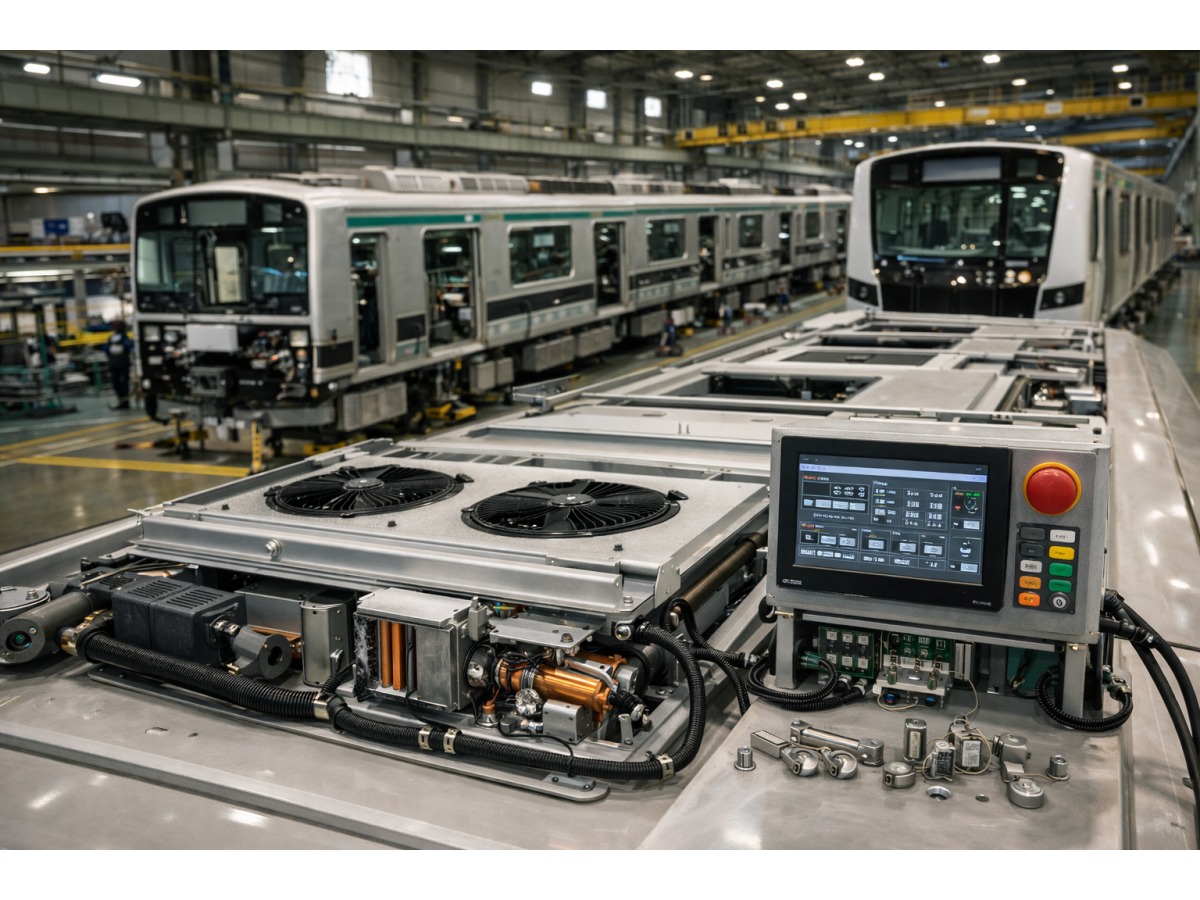
Disc springs can be used in:
presses;
machine tools;
clamping systems;
couplings;
braking systems;
overload mechanisms;
bearing assemblies;
hydraulic equipment.
Their high-force compact geometry can reduce required spring-system length.
Bearings can require controlled axial preload to manage:
stiffness;
clearance;
noise;
positioning accuracy.
Disc springs can provide compliant preload in suitable bearing arrangements.
However, the required force must match the bearing design.
Excessive preload can increase:
friction;
heat;
wear;
bearing failure risk.
Bearing preload should therefore be calculated as part of the complete system.
Machine-tool spindles and precision mechanisms can require preload compensation as temperature changes.
Disc springs can provide compliance while maintaining axial force.
For precision equipment, stack friction and hysteresis may become important because they can affect force repeatability.
Disc-spring principles are used in many clutch and brake systems.
However, specialized diaphragm springs, slotted springs and application-specific spring geometries should not automatically be treated as standard DIN 2093 disc springs.
For replacement or OEM sourcing, the exact drawing and product specification should govern.
Rail and transportation systems can contain:
braking mechanisms;
couplings;
actuators;
suspension-related mechanisms;
equipment assemblies.
Disc springs may provide compact high-force spring functions in approved designs.
Rail applications require the relevant customer and system qualification.
Wind turbines and renewable-energy equipment can use disc springs in:
braking systems;
pitch mechanisms;
bolted systems;
actuators;
high-load mechanical assemblies.
Long service intervals make fatigue and corrosion performance particularly important.
Semiconductor equipment can require compact precision spring systems in:
clamping mechanisms;
actuators;
precision positioning equipment;
tool assemblies.
Where force repeatability is important, friction and stack hysteresis should be considered.
Disc springs can be used in aerospace mechanisms, but aerospace projects require controlled:
materials;
manufacturing processes;
traceability;
inspection;
qualification.
A commercial DIN 2093 disc spring should not automatically be represented as aerospace-qualified.
The applicable customer and industry specification should govern.
A well-designed stack can still fail if assembly conditions are ignored.
Potential problems include:
over-compression;
fatigue cracking;
permanent set;
corrosion;
guide wear;
excessive friction;
misalignment;
stack inversion;
coating damage;
incorrect spring orientation.
Understanding these failure modes helps engineering and procurement teams define better specifications.
Disc springs are intended primarily for axial loading.
Angular or lateral misalignment can create uneven contact and local stress.
A poorly guided stack can therefore experience:
asymmetric wear;
inconsistent force;
premature fatigue.
Assembly alignment should be considered during system design.
This is one of the most important procurement lessons.
Once multiple disc springs are arranged into a functional stack, the system has:
a defined orientation;
a defined installed height;
a defined load-deflection curve;
friction interfaces;
guidance requirements.
If springs are assembled in the wrong orientation, the force and travel can change dramatically.
Production drawings and work instructions should therefore define the stack arrangement clearly.
For complex stacks, OEM documentation should define:
quantity;
orientation;
number of parallel springs per group;
number of series groups;
installed height;
preload or assembly force where relevant.
This reduces assembly errors and improves supplier communication.
DIN 2093 standard disc springs can provide advantages including:
established dimensional families;
easier sourcing;
predictable engineering data;
simplified replacement.
Custom disc springs may be required where:
installation envelope is unique;
force-deflection requirement cannot be met by standard sizes;
special material is required;
special surface treatment is required.
Before creating a custom spring, engineers should determine whether a standard spring stack can meet the requirement.
A standard stack may reduce tooling, qualification and lifecycle sourcing risk.
A practical disc spring selection process begins with the application rather than the catalog.
Determine the required minimum and maximum spring force.
Confirm:
outside diameter limit;
inside diameter requirement;
available axial height.
Determine the working deflection range.
Is the spring:
static;
occasionally cycled;
highly cyclic?
Consider:
temperature;
corrosion;
chemicals;
humidity.
Use:
series for additional travel;
parallel for additional force;
combination for both.
Define guide rod or sleeve requirements.
For demanding applications, confirm actual force at the required working positions.
Procurement should avoid sourcing DIN 2093 disc springs only by:
outside diameter;
inside diameter;
thickness;
lowest price.
A technically meaningful comparison should also consider:
material;
heat treatment;
hardness;
free height;
force at specified deflection;
fatigue requirement;
surface treatment;
dimensional tolerance;
traceability.
A spring that is dimensionally interchangeable but functionally different can change the performance of the complete machine.
Depending on the application and specification, inspection may include:
outside diameter;
inside diameter;
thickness;
free height;
flatness or geometric condition;
material;
hardness;
surface treatment;
surface defects.
Functional testing may include force measurement at specified deflection or installed height.
For engineered spring systems, this functional data can be more meaningful than appearance alone.
A practical method of evaluating a disc spring is to compress it to a specified height and measure the resulting force.
This directly connects the component to its intended mechanical function.
For production programs, defined force-at-height requirements can help identify variation caused by:
material;
heat treatment;
thickness;
free height;
forming.
This creates a more useful quality characteristic than relying only on nominal dimensions.
For an accurate quotation and technical review, provide:
DIN 2093 designation where applicable
outside diameter
inside diameter
thickness
free height
required working force
required working deflection or installed height
minimum and maximum load where applicable
stack arrangement
quantity per stack
guide method
material
surface treatment
operating temperature
corrosion environment
expected number of cycles
annual demand
order quantity
inspection requirements
functional testing requirements
material certification requirements
packaging
target delivery schedule
For custom disc springs, provide a 2D drawing and required load-deflection curve or working points whenever available.
JUXIN FASTENERS supports OEM and industrial supply-chain customers requiring spring, locking and preload-management components.
Our product scope includes:
DIN 2093 disc springs
Belleville washers
disc spring stacks
DIN 137A saddle spring washers
DIN 9250 safety washers
DIN 25201 wedge-lock washers
DIN 7967 self-locking counter nuts
all-metal lock nuts
nylon-insert lock nuts
high-strength bolts and nuts
custom stamped components
CNC-machined components
This broader product capability allows engineering teams to evaluate the actual mechanical problem before choosing a component.
If the requirement is high force with limited travel, a disc spring may be appropriate.
If the requirement is more spring travel, a series stack may help.
If the requirement is higher force, a parallel stack may help.
If the problem is rotational bolt loosening, a different locking technology may be required.
If the problem is limited joint settlement, spring compliance may help stabilize preload.
This engineering-based approach creates a clearer path from application requirement to product specification.
It is a conical annular spring designed to produce axial spring force as it is compressed.
The terms are commonly used interchangeably, although "disc spring" better describes its engineered spring function.
Series stacking increases total available deflection while maintaining approximately similar force behavior for identical idealized springs.
Parallel stacking increases load capacity while maintaining approximately similar deflection for identical idealized springs.
Yes. Combination stacks can be designed to achieve both higher force and greater travel.
They can help manage preload changes, but they do not automatically prevent rotational self-loosening caused by severe transverse movement.
Their primary function is spring force. Friction in stacks can dissipate energy, but they should not automatically be treated as dedicated vibration-isolation devices.
Because disc springs are functional spring components. Two dimensionally similar springs can produce different forces because of material, heat treatment and manufacturing variation.
A disc spring should operate within its intended design range. Repeated extreme compression can increase stress and reduce fatigue life.
It is the difference between loading and unloading behavior caused largely by friction between springs and guide surfaces.
Not automatically. Changing material can alter spring force, temperature capability, fatigue behavior and corrosion resistance.
Guidance helps maintain alignment and prevents lateral displacement or unstable stacking during compression.
Provide dimensions, material, finish, required force, working deflection or installed height, stack configuration, operating environment, cycle requirement, quantity and inspection requirements.
DIN 2093 disc springs should not be selected as ordinary washers.
They are engineered spring components.
The better engineering question is not:
"Which Belleville washer fits this bolt?"
It is:
"What force must be maintained, through what displacement, within what installation space, over how many cycles and under what environmental conditions?"
Once those requirements are known, engineers can determine whether the application needs:
one disc spring;
a series stack;
a parallel stack;
a combination stack;
or another spring technology.
For design and reliability engineers, this approach connects geometry directly to load-deflection performance.
For procurement and supplier-development teams, it changes the RFQ from a dimensional commodity purchase into a measurable functional specification.
JUXIN FASTENERS supplies DIN 2093 disc springs, Belleville washers, disc spring stacks and related preload-management and locking components for industrial machinery,
valves, EV thermal systems, AI data-center liquid cooling, power electronics, renewable energy, automation, rail and other industrial OEM applications.
For quotation, specification review or application support, send your drawing, required load, working deflection, material, finish and expected quantity to:
Previous: Disc Spring Washers (Belleville Washers)
Next: DIN 137A Washers
 MORE NEWS
Sep. 27, 2026
Sep. 27, 2026
Sep. 27, 2026
Contact Us
Tel.:
+86 020 8621 0320
+86 020 3121 6067
E-mail:
Technical Support:
Navigation
SEND INQUIREY