
Call Us
+86 136 6007 9809
Call Us
+86 136 6007 9809

Sep. 29, 2023
Open retaining rings are compact mechanical retention components used to control axial movement of parts mounted on shafts, pins, axles and other cylindrical features.
Depending on their geometry and installation method, these components may also be described as open snap rings, open circlips, open-end retaining rings, shaft retaining clips or open-profile retaining rings.
Their basic purpose is straightforward: create a mechanical stop that prevents a mounted component from moving beyond its intended axial position.
Typical retained components include:
bearings
gears
rollers
bushings
pulleys
linkages
small mechanical assemblies
electromechanical components
However, the term "open retaining ring" covers several geometries and should not be treated as one universal standardized product.
For engineers and procurement teams, the correct selection depends on the ring geometry, groove design, shaft material, axial load, rotational speed, assembly direction, installation access and service environment.
JUXIN FASTENERS supplies standard and drawing-based open retaining rings, circlips, snap rings, E-clips and custom stamped retaining components for industrial OEM applications.
For drawing review, material selection, custom dimensions and RFQs, contact info@juxinfasteners.com.
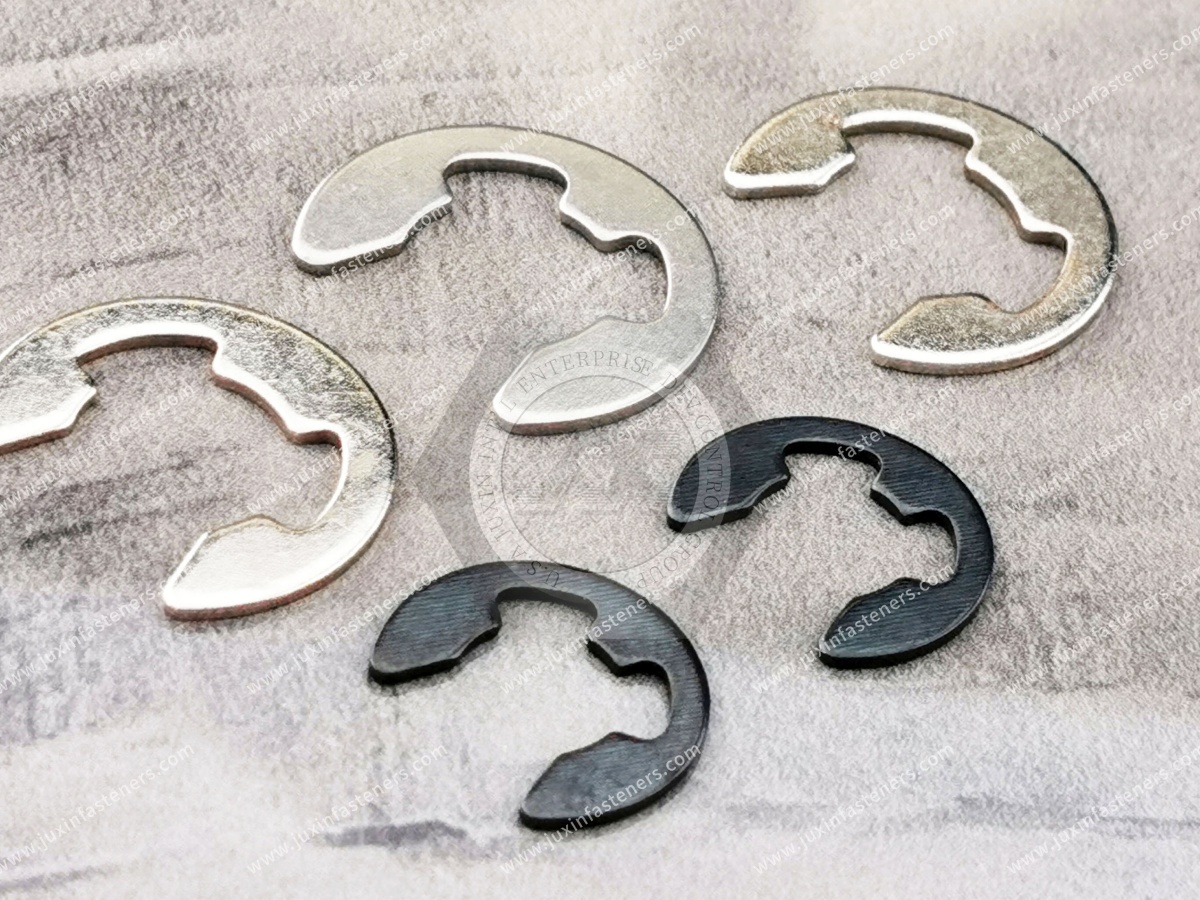
An open retaining ring is a non-continuous ring-shaped mechanical component designed to engage a shaft, pin, bore or groove and provide axial retention.
The opening allows the ring to elastically deform during installation.
Depending on the design, installation may involve:
radial insertion;
expansion over a shaft;
compression into a bore;
installation into a specially designed groove.
This is why "open retaining ring" should be treated as a product family description, not as a complete engineering specification.
An OEM drawing or recognized standard should identify the exact configuration.
The primary function is axial retention.
The ring prevents another component from moving beyond a defined axial position.
For example, it may:
retain a bearing on a shaft;
locate a roller on a pin;
prevent a gear from moving axially;
retain a linkage component;
position a bushing;
secure a small rotating component.
The ring itself does not inherently reduce vibration, reduce noise or prevent bearing wear.
Those results depend on the complete mechanical system.
A correctly designed retention system can support reliable equipment operation,
but an open retaining ring should not be described as a vibration damper or friction-reduction device unless the specific assembly has been engineered for that function.
A conventional external circlip such as a DIN 471-type retaining ring is installed into a groove around a shaft.
It typically has lug features that allow the ring to be expanded using appropriate circlip pliers.
Some open retaining-ring designs use a different profile and installation method.
Depending on geometry, they may provide:
reduced radial envelope;
easier installation;
radial assembly;
simplified automated insertion;
compatibility with compact mechanisms.
Therefore, engineers should not select a retaining component merely because both products appear to be "open rings."
The groove and installation method must match the actual ring design.
DIN 6799 E-clips are one specific type of open-profile shaft-retention component.
Their E-shaped geometry allows radial installation into an appropriate shaft groove.
This makes DIN 6799 particularly useful when:
shaft-end access is restricted;
rapid assembly is required;
compact packaging is important;
automated installation is planned.
An open retaining ring with another profile may have different installation behavior and load capability.
For this reason, DIN 6799 E-clips should be specified by their standard rather than grouped indiscriminately with every open snap-ring design.
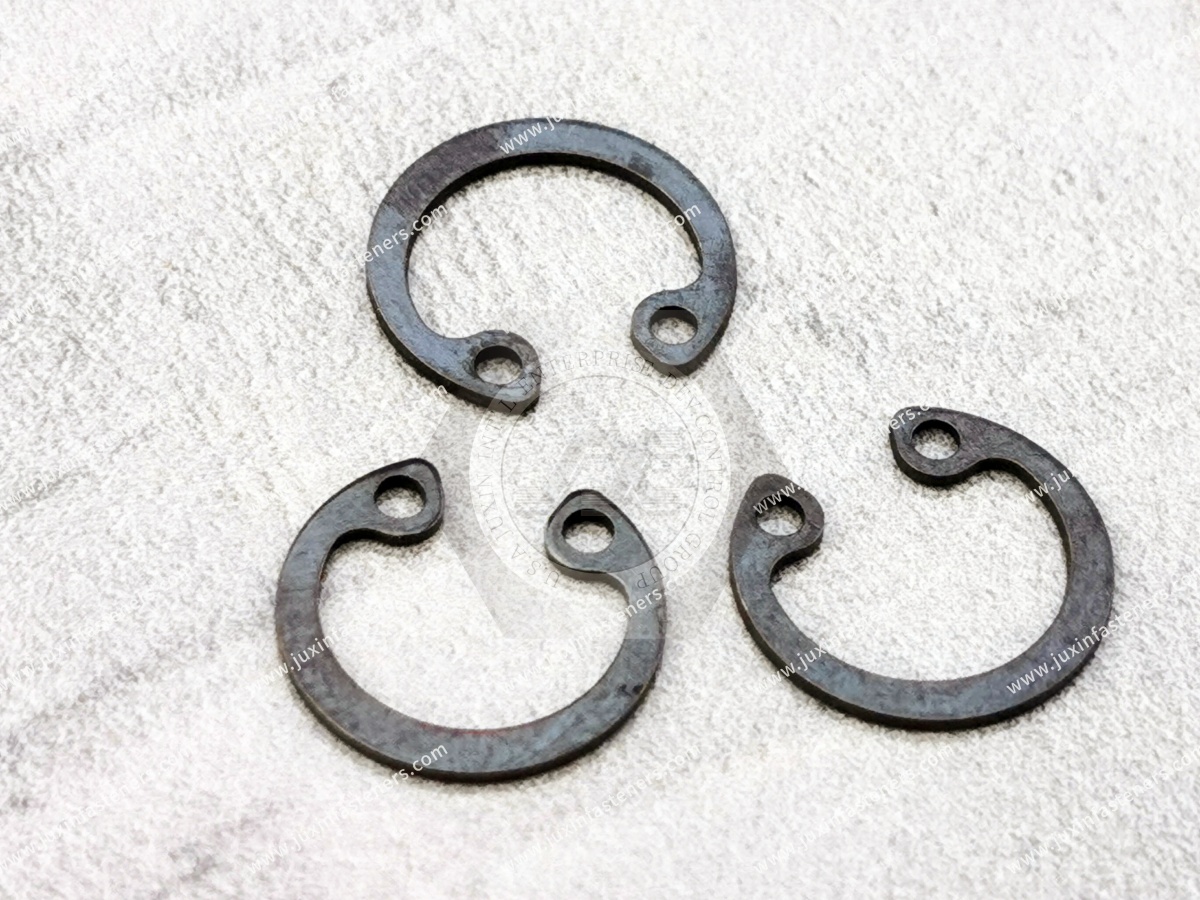
Internal retaining rings are designed for grooves inside bores or housings.
DIN 472 is commonly associated with internal circlips for bores.
The basic distinction is:
external retaining components retain parts on shafts;
internal retaining components retain parts inside bores.
This sounds simple, but confusion between shaft and bore retention remains a common RFQ problem.
A professional specification should clearly state whether the component is intended for a shaft or housing.
Commercial suppliers sometimes use descriptions such as C-type, D-type or E-type retaining ring.
These descriptions can help communicate general shape, but they should not be used as universal engineering load classifications.
For example, it is not technically reliable to assume:
C-type automatically means light load;
D-type automatically means heavy load;
E-type automatically means medium load.
Load capability depends on much more than the letter used to describe the ring shape.
Relevant factors include:
material
hardness
heat treatment
ring thickness
radial engagement
groove dimensions
shaft material
component contact geometry
dynamic loading
rotational speed
For OEM procurement, the drawing or recognized standard should therefore define the component.
Two retaining rings can have a similar visual profile while providing very different mechanical performance.
A small change in:
thickness;
radial width;
opening geometry;
contact area;
heat treatment;
groove engagement
can significantly alter retention behavior.
This is why an image-based quotation without dimensions can be risky.
For custom retaining rings, a 2D drawing or physical sample should be used to confirm the required geometry.
A retaining ring does not work independently.
When axial load is applied, the force follows a load path similar to:
retained component → retaining ring → groove wall → shaft
The weakest element in this path can determine the actual retention capability.
Possible failure modes include:
ring deformation
ring disengagement
groove-wall deformation
groove shear
shaft yielding
excessive component edge deformation
A high-strength retaining ring installed into a weak groove can still produce a weak assembly.
This principle should guide both engineering selection and supplier qualification.
Groove diameter influences how deeply the retaining ring engages the shaft.
Insufficient engagement can increase the risk of ring displacement.
Excessive groove depth can also change support conditions and installed geometry.
For standard components, groove dimensions should follow the applicable standard.
For custom open retaining rings, groove geometry should be treated as part of the product-development process.
Groove width affects both installation and axial movement.
If the groove is too narrow, the ring may not fully seat.
If it is excessively wide, the assembly may develop unnecessary axial movement.
This is particularly important where the ring controls the position of:
bearings
rollers
gears
precision linkages
sensor mechanisms
For these assemblies, engineers should evaluate the complete tolerance stack.
A common design focus is the thickness of the retaining ring.
However, if the groove itself is positioned incorrectly along the shaft, the retained component can still have excessive end play.
Axial position depends on the combined tolerances of:
shaft shoulder
component width
spacers
groove location
groove width
ring thickness
For precision mechanisms, groove-location tolerance should therefore be included in the dimensional analysis.
Open retaining rings are often manufactured from spring steel, but the shaft may be made from a much softer material.
Examples include:
aluminum
mild steel
polymer
brass
lightweight alloys
Under high axial load, the groove wall may deform before the retaining ring reaches its own mechanical limit.
This means that increasing ring hardness does not necessarily increase assembly load capacity.
The groove material must also be evaluated.
Cutting a groove into a shaft reduces the local cross-sectional area.
The groove can also create a stress concentration.
This matters when the shaft is exposed to:
bending
torsion
fatigue
impact
For highly stressed shafts, engineers should evaluate whether the groove itself creates an unacceptable reduction in shaft fatigue strength.
In some designs, eliminating the groove and using another retention method may provide a better overall solution.
External open retaining rings installed on rotating shafts experience centrifugal force.
As rotational speed increases, the ring tends to expand outward.
This can reduce effective groove engagement.
Rotational speed therefore becomes an important selection factor in:
electric motors
pumps
spindles
fans
high-speed rollers
rotating automation equipment
A ring suitable for a stationary pivot pin should not automatically be approved for a high-speed rotor.
Some assemblies experience load predominantly from one direction.
Others experience reversing axial forces.
Repeated load reversal can create different stresses in the ring and groove than a constant static load.
Engineers should identify whether the load is:
static
cyclic
reversing
impact
vibration-induced
This information can influence both ring selection and validation.
A retaining ring can prevent axial displacement, but it does not inherently absorb vibration.
If an assembly suffers from excessive vibration, the root cause may involve:
imbalance
bearing clearance
shaft alignment
insufficient preload
structural resonance
gear mesh
motor excitation
Installing a retaining ring can secure a component axially but does not solve these underlying vibration problems.
This distinction is important for troubleshooting mechanical systems.
The retaining ring should not normally function as a continuously loaded sliding bearing surface.
If a rotating component rubs directly against the ring during operation, engineers should evaluate whether the assembly requires:
a thrust washer;
spacer;
thrust bearing;
controlled axial clearance.
Continuous rubbing can create wear, debris and heat.
The retaining ring should primarily perform its retention function.
Material selection should balance elasticity, strength, fatigue resistance, corrosion resistance and cost.
Carbon spring steel is commonly used for retaining rings because it can provide:
high elastic recovery;
mechanical strength;
hardness;
fatigue resistance;
economical high-volume production.
Heat treatment should be controlled to achieve the required spring characteristics.
Stainless steel open retaining rings can be used where corrosion resistance is important.
Potential applications include:
outdoor equipment;
foodservice machinery;
cooling equipment;
humid environments;
selected marine-related equipment;
corrosion-sensitive mechanisms.
The exact stainless steel grade should be chosen according to environmental and mechanical requirements.
For global sourcing, a local material name does not provide enough information to ensure functional equivalence.
OEM specifications should instead define, where appropriate:
material standard
mechanical properties
hardness
heat-treatment condition
corrosion requirement
surface treatment
This reduces ambiguity when qualifying suppliers across different regions.
Carbon steel open retaining rings can be supplied with surface treatments according to customer requirements.
Potential options include:
phosphate finishes;
zinc-based coatings;
zinc-flake coatings;
other engineered finishes.
The selected finish should consider:
corrosion exposure;
dimensional tolerance;
coating flexibility;
installation wear;
environmental compliance.
Open retaining rings deform elastically during installation.
The surface coating must tolerate that movement.
A coating that cracks, flakes or separates during installation can compromise corrosion protection and create debris inside the mechanism.
This means coating selection should consider the installation deformation of the ring, not simply the salt-spray specification.
Retaining-ring grooves often have relatively tight dimensional tolerances.
Coating thickness can influence:
ring thickness
insertion force
groove fit
axial clearance
seating
For precision assemblies, the drawing should clarify the relationship between final coated dimensions and functional tolerances.
Installation depends on the actual retaining-ring design.
Possible methods include:
circlip pliers
radial push tools
dedicated insertion tools
automated assembly equipment
The correct installation tool should match the ring geometry.
Using inappropriate tools can:
permanently deform the ring;
scratch the surface;
reduce groove engagement;
damage the shaft;
create incomplete seating.
Spring steel components have an elastic range.
If an external retaining ring is expanded beyond its intended installation limit, it may not return to its original geometry.
This can reduce:
groove engagement
radial holding force
axial retention capability
Installation tooling should therefore control deformation rather than simply forcing the ring into position.
A retaining ring can appear installed while only partially engaging the groove.
Potential causes include:
incorrect groove width
burrs
contamination
wrong ring size
excessive coating
misaligned tooling
For production assemblies, seating verification can be more important than visual presence alone.
High-volume OEM manufacturing may use automated feeding and installation systems for retaining rings.
Automation requires consistent:
ring geometry
flatness
surface condition
packaging
groove dimensions
installation force
Depending on the component design, rings may be supplied for:
bowl feeding
magazine feeding
rail feeding
robotic insertion
Manufacturing engineers should consider automation requirements during component selection rather than after the assembly line has been designed.
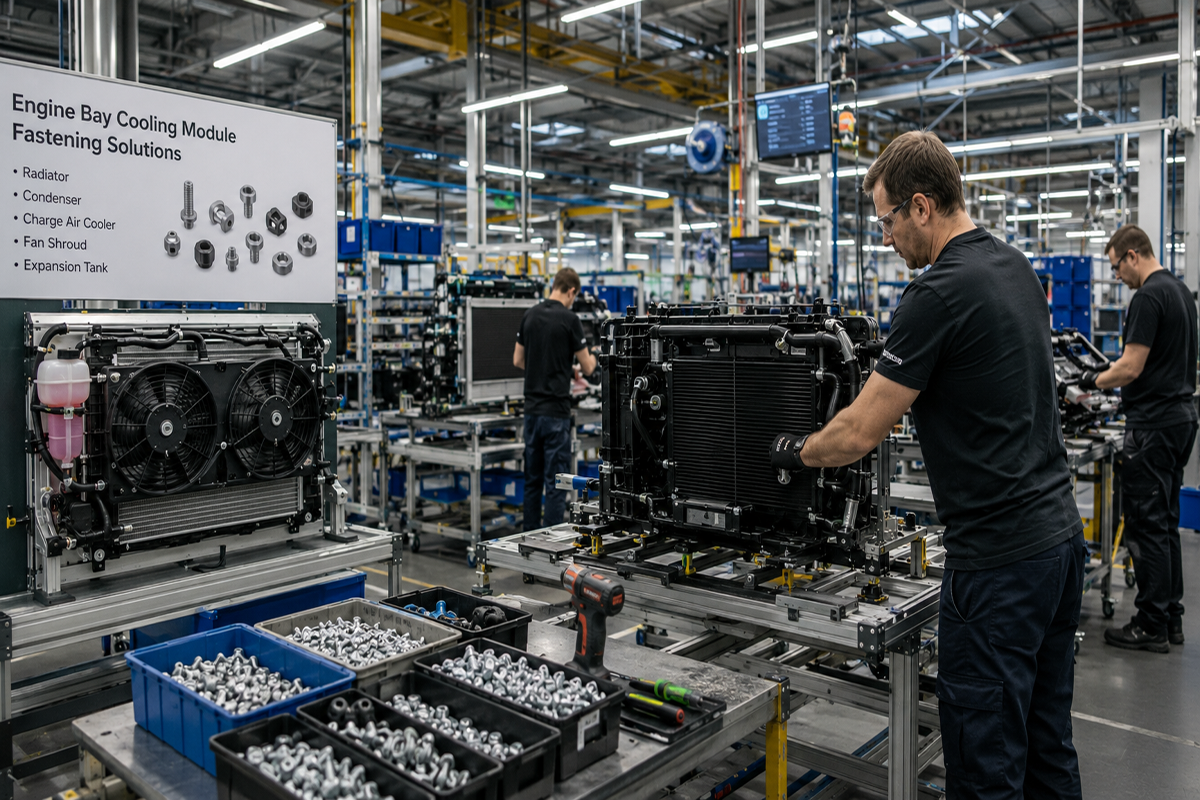
Open retaining rings can be used in appropriate automotive and EV mechanical systems such as:
actuator mechanisms
electric motors
pumps
thermal-management equipment
gear assemblies
linkage systems
auxiliary mechanical assemblies
For high-speed EV motor applications, rotational speed and groove engagement require particular attention.
Safety-critical vehicle applications require OEM-approved specifications and validation.
Motor assemblies can combine high rotational speed, bearing positioning and compact packaging.
Open retaining rings may be used for appropriate shaft-retention functions, but engineers should evaluate:
centrifugal expansion
axial load
bearing arrangement
groove fatigue
installation process
thermal conditions
High-speed e-drive applications should not be treated as equivalent to conventional low-speed motor assemblies.
Common applications include:
gearboxes
pumps
conveyors
rollers
machine tools
drive systems
automation equipment
Open retaining rings can reduce component count and simplify assembly where groove-based axial retention is appropriate.
Compact robotic and automation mechanisms frequently require efficient shaft and pin retention.
Potential applications include:
pivot pins
rollers
actuators
guide mechanisms
miniature gear systems
Radially installed open rings can be particularly useful when axial assembly access is limited.
Pumps and valves may contain shafts, bearings and internal mechanisms requiring axial retention.
Material selection should account for the actual fluid and environmental exposure.
The retaining ring should not be treated as a sealing component.
AI data-center infrastructure contains mechanical equipment including:
pumps
cooling distribution units
fans
valves
actuators
motors
Open retaining rings may be used inside these mechanical subassemblies for shaft, pin and bearing retention.
For liquid-cooling equipment, corrosion compatibility and long service intervals should be considered.
HVAC equipment contains many rotating and actuated components.
Applications may include:
fan shafts
blowers
dampers
actuators
pumps
compressors
For rotating equipment, shaft speed and groove retention should be evaluated.
Compact mechanisms in commercial kitchen and foodservice equipment can use open retaining rings for:
motors
hinges
rollers
actuators
small drive systems
Where corrosion or washdown exposure is present, stainless steel material may be preferred according to the application.
Retaining rings can be used in linkages, shafts and mechanical mechanisms in agricultural and construction equipment.
However, harsh service conditions can introduce:
shock
dirt
corrosion
impact
reversing loads
Heavy-duty applications should be evaluated individually rather than assuming every open ring is appropriate.
Retaining rings can be used in aerospace and medical mechanisms, but these industries require controlled specifications, traceability and qualification.
A standard commercial open retaining ring should not automatically be described as aerospace- or medical-qualified.
The approved customer specification should govern such applications.
A standard product such as DIN 471, DIN 472 or DIN 6799 is generally preferable when:
standard geometry fits the assembly;
required load is within the validated capability;
installation access is compatible;
standard groove dimensions are acceptable;
commercial availability is important.
Standardization can simplify sourcing, replacement and quality control.
A custom design may be justified when:
standard ring geometry interferes with surrounding components;
radial space is limited;
installation direction is unusual;
groove dimensions are already fixed;
a specific contact geometry is required;
automated assembly requires a special profile;
material or coating requirements are unusual.
For these projects, the retaining ring becomes a drawing-based stamped component rather than a catalog item.
A custom ring can solve packaging or assembly problems, but it also introduces:
tooling cost
supplier dependency
qualification requirements
drawing control
potentially higher MOQ
If a standard DIN solution satisfies the engineering requirement, standardization may provide better lifecycle sourcing.
Procurement and engineering should therefore make the standard-versus-custom decision together.
A practical selection process should answer the following questions.
Identify the component and required axial position.
Determine whether the retention occurs externally on a shaft or internally in a housing.
Define:
static load
cyclic load
reversing load
impact load
For external rings on rotating shafts, evaluate centrifugal effects.
Confirm:
groove diameter
groove width
groove location
edge geometry
Confirm that the groove can carry the required load.
Consider:
axial access
radial access
manual assembly
automated assembly
maintenance removal
Evaluate:
corrosion
temperature
chemicals
moisture
outdoor exposure
This approach turns retaining-ring selection into an engineering decision rather than a catalog lookup.
A sourcing team should not issue an RFQ simply stating "C-type open ring" or "open snap ring."
A professional RFQ should include:
applicable DIN or other standard if relevant
customer drawing
shaft or bore application
nominal diameter
groove dimensions
ring dimensions
material
heat treatment
hardness where specified
surface treatment
corrosion requirement
operating conditions
annual demand
order quantity
inspection requirements
documentation
packaging
delivery schedule
For custom components, a 2D drawing is strongly recommended.
Depending on the component and application, inspection can include:
ring thickness
radial dimensions
opening geometry
flatness
material
hardness
heat treatment
coating
burr condition
surface defects
Functional inspection can also include:
installation fit
groove seating
controlled deformation
retention checks
For OEM programs, the inspection plan should reflect the characteristics that actually influence assembly performance.
For quotation and technical review, provide:
product standard or customer drawing
external or internal application
shaft or bore diameter
groove diameter
groove width
groove location
ring thickness
ring profile
material
hardness requirement
heat treatment
surface treatment
corrosion requirement
axial load if known
rotational speed if applicable
shaft or housing material
installation method
annual volume
order quantity
quality documentation
packaging requirements
target delivery schedule
If the existing component is non-standard and no drawing is available, a physical sample may also support dimensional review.
JUXIN FASTENERS supports OEM, Tier-1 and industrial supply-chain customers requiring standard and custom mechanical fastening components.
Our portfolio includes:
open retaining rings
DIN 471 external retaining rings
DIN 472 internal retaining rings
DIN 6799 E-clips
circlips
snap rings
spring washers
disc spring washers
locking washers
lock nuts
high-strength bolts and nuts
self-clinching fasteners
blind rivet nuts
weld fasteners
threaded inserts
custom stamped fasteners
CNC-machined components
This allows engineering and sourcing teams to evaluate the retaining component within the broader fastening and assembly architecture.
An open retaining ring is a non-continuous mechanical ring used to retain components axially on shafts or inside bores, depending on the design.
Some circlips are open retaining rings, but the terminology covers different geometries. The applicable standard or drawing should define the actual product.
An E-clip is a specific open-profile retaining component, commonly standardized under DIN 6799, that is installed radially into a shaft groove.
No. Shape terminology alone does not define load capacity. Material, thickness, groove engagement, shaft material and loading conditions must also be considered.
Not inherently. Their main function is axial retention. Vibration problems should be analyzed separately.
Not inherently. A thrust washer or bearing may be needed where sliding or rotating contact occurs.
Potentially, but centrifugal expansion and groove engagement must be evaluated.
Yes. The groove reduces local cross-section and creates a stress concentration, which can be important in highly stressed shafts.
Not automatically. The material must meet both mechanical and environmental requirements.
Custom designs may be useful where standard ring geometry cannot meet packaging, assembly, material or functional requirements.
Provide the standard or drawing, shaft/bore and groove dimensions, material, finish, load conditions, speed where relevant, quantity, quality requirements and delivery schedule.
The most important question when selecting an open retaining ring is not simply:
"Which shape fits the shaft?"
The better engineering questions are:
How will the load transfer through the ring and groove? How will the component be assembled? What happens at operating speed?
Can the groove carry the load? And would a standard or custom retaining system provide the lowest overall assembly risk?
For design engineers, this approach improves mechanical reliability.
For manufacturing engineers, it improves installation consistency and automation readiness.
For procurement and supplier-development teams, it creates a measurable specification that can be compared across suppliers.
JUXIN FASTENERS supplies open retaining rings, circlips, snap rings, DIN 6799 E-clips, DIN 471 external retaining rings,
DIN 472 internal retaining rings and custom stamped retaining components for industrial OEM applications.
For quotation, drawing review, custom component development or application support, send your specification, drawing and expected quantity to:
 MORE NEWS
Sep. 27, 2026
Sep. 27, 2026
Sep. 27, 2026
Contact Us
Tel.:
+86 020 8621 0320
+86 020 3121 6067
E-mail:
Technical Support:
Navigation
SEND INQUIREY