
Call Us
+86 136 6007 9809
Call Us
+86 136 6007 9809

Sep. 28, 2023
DIN 25201 stainless steel wedge-lock washers are paired mechanical locking washers designed to resist rotational loosening in bolted joints exposed to severe vibration, transverse movement, shock and cyclic loading.
Unlike conventional spring washers or toothed safety washers that depend primarily on spring action or increased friction at the bearing surface,
wedge-locking washers use a geometric locking principle between two mating cam surfaces.
This distinction makes DIN 25201 wedge-lock washers particularly relevant when engineers are investigating bolted joints where transverse vibration can cause conventional locking methods to lose effectiveness.
For procurement teams, however, sourcing a wedge-lock washer should involve more than requesting a nominal thread size.
Washer geometry, material, surface hardness, bolt property class, bearing surface, preload, corrosion exposure and validation requirements can all influence the final joint.
JUXIN FASTENERS supplies stainless steel wedge-locking washer pairs and other vibration-resistant fastening components for industrial OEM and engineered equipment applications.
For drawing review, application requirements and RFQs, contact info@juxinfasteners.com.
A DIN 25201 wedge-lock washer system consists of two washers used together as a matched pair.
The outer faces typically incorporate radial serrations intended to engage the bolt head or nut and the mating surface.
The inner faces incorporate opposing wedge-shaped cams.
When correctly installed:
the serrated outer faces interact with the fastener and joint surfaces;
the cam faces remain positioned against each other;
attempted loosening rotation forces movement across the cams;
the geometry increases the axial distance between the fastener bearing surfaces;
this movement works against the existing bolt preload.
This is the basis of the wedge-locking principle.
The component may be searched under several names:
DIN 25201 wedge-lock washers
DIN 25201 locking washers
stainless steel wedge-lock washers
wedge locking washer pairs
vibration-resistant washers
self-locking washers
anti-loosening washers
cam lock washers
For technical sourcing, the standard or approved drawing should always take priority over generic commercial terminology.
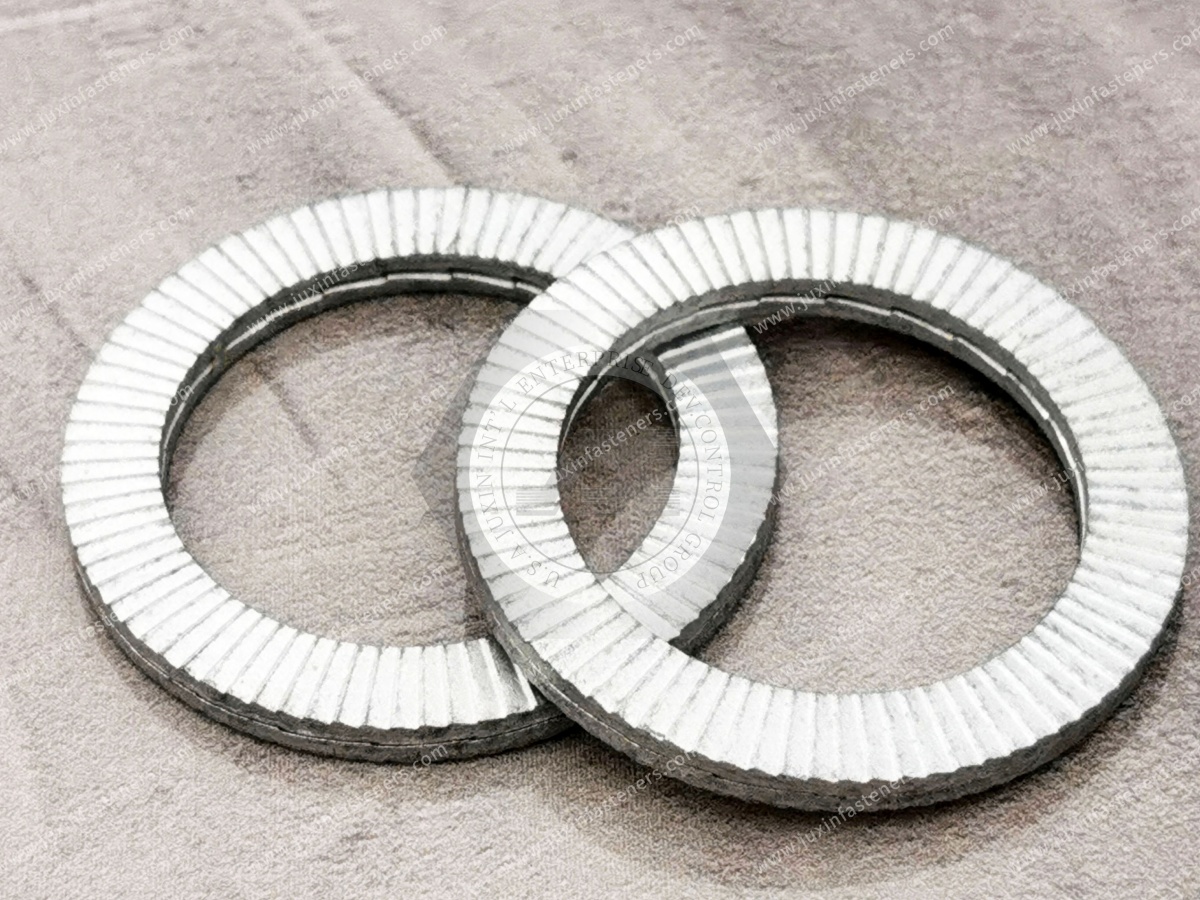
A wedge-locking system depends on the interaction between two cam surfaces.
The pair is therefore the functional locking system.
The outward-facing serrated surfaces are intended to interact with the bolt head or nut on one side and the joint surface on the other. The inward-facing cams interact with each other.
This is fundamentally different from installing two ordinary washers together.
Correct washer orientation is therefore essential.
Separating the pair and installing the washers incorrectly can prevent the wedge-locking mechanism from functioning as intended.
For production assembly, washer pairs may be supplied in a configuration intended to simplify handling and preserve correct orientation. Packaging and assembly method should be confirmed during sourcing.
The most important technical concept behind wedge-locking washers is the relationship between the cam angle and the thread helix angle.
In a properly designed wedge-locking system, the cam geometry is selected so that the wedge effect resists the rotational path associated with thread loosening.
As the nut or bolt attempts to rotate loose, movement between the cam faces tends to increase the axial separation of the washer pair.
Increasing that distance requires additional movement against the clamp force already present in the joint.
This creates a geometric resistance to loosening.
The important engineering insight is that the system is designed so that attempted loosening must work against the bolt preload rather than relying solely on friction at the threads.
This is why wedge-locking washers should not be described simply as "double toothed washers."
Their locking principle is fundamentally different.
Many traditional anti-loosening solutions depend significantly on friction.
Examples include certain:
spring washers
toothed washers
prevailing-torque nuts
thread-locking compounds
Wedge-locking washers use another mechanism.
Their external serrations help prevent relative rotation at the outer interfaces, while the internal cam geometry creates the wedge-locking effect.
This distinction becomes important in high-vibration applications because friction conditions can change due to:
lubrication
coating
temperature
surface wear
repeated installation
contamination
surface finish
A wedge-locking system is therefore best understood as a preload-dependent geometric locking system, rather than simply a high-friction washer.
Not all vibration affects a bolted joint in the same way.
A bolted connection can experience:
axial vibration
transverse vibration
rotational excitation
impact
thermal cycling
combined dynamic loading
Transverse movement across the joint interface can be especially important because it may produce relative movement between clamped components and promote self-loosening.
If the transverse load becomes sufficient to overcome friction within the joint, microscopic slip can occur.
Repeated slip cycles can progressively rotate a nut or bolt and reduce preload.
This is one reason engineers evaluating high-vibration joints should consider the actual loading direction rather than simply asking whether an assembly "vibrates."
A wedge-lock washer does not eliminate the need for correct bolt preload.
The joint still relies on adequate clamping force.
Insufficient preload can allow excessive movement between the joined components, increasing the risk of:
joint slip
fretting
fatigue loading
bolt bending
loss of alignment
progressive joint damage
Correct tightening remains essential.
The specified installation method should consider:
bolt material and property class
thread condition
lubrication
washer material
bearing surface
friction conditions
tightening equipment
required clamp load
The presence of a wedge-lock washer should never be interpreted as permission to ignore torque or tension control.
Wedge-lock washers are designed primarily to address rotational loosening.
But not every reduction in bolt preload is caused by fastener rotation.
Clamp load can also decrease because of:
embedding
joint settlement
gasket creep
polymer stress relaxation
local yielding
thermal expansion mismatch
thread deformation
A wedge-lock washer cannot automatically compensate for all of these mechanisms.
For example, if a bolted connection passes through a polymer component that creeps under sustained compression,
the bolt may lose preload even if the wedge-locking washer prevents rotational loosening.
The correct solution may require:
a compression limiter
metallic insert
sleeve
larger bearing surface
different joint geometry
This distinction is critical when troubleshooting field failures.
Stainless steel wedge-lock washers can be selected where corrosion resistance is required in addition to vibration-resistant locking.
Depending on the approved specification, stainless steel material may be appropriate for applications involving:
outdoor exposure
humidity
foodservice equipment
certain chemical environments
marine-related equipment
cooling systems
stainless steel machinery
corrosion-sensitive industrial assemblies
The exact stainless steel grade should be confirmed from the applicable drawing, product specification and service environment.
Austenitic stainless steel selections may include A4/316-type materials for applications requiring greater resistance to certain corrosive environments.
Material selection should consider the complete assembly rather than the washer in isolation.
A common procurement assumption is that stainless steel always represents the premium solution.
That is not necessarily true.
In some high-load applications, hardened carbon or alloy steel wedge-locking washers with an engineered coating may be more appropriate.
The decision should consider:
required washer hardness
bolt property class
bearing surface hardness
corrosion environment
operating temperature
coating requirements
galvanic compatibility
customer specification
Stainless steel should be selected because it meets the joint requirements, not simply because it appears more corrosion resistant on a product datasheet.
A stainless steel wedge-lock washer may be installed against carbon steel, coated steel or aluminum.
This creates a multi-material joint.
In wet or conductive environments, galvanic relationships between dissimilar metals can influence long-term corrosion behavior.
Engineers should consider:
material combination
exposed surface area
electrolyte exposure
chloride concentration
drainage
coating damage
isolation requirements
expected service life
This is especially relevant in EV battery structures, outdoor energy systems, marine equipment and aluminum assemblies.
The outer serrations of a wedge-lock washer need a suitable interface with the fastener bearing surface and joint material.
Performance can therefore depend on mating-surface hardness.
Potential surfaces include:
hardened steel
structural steel
stainless steel
cast iron
aluminum
zinc-coated steel
painted surfaces
polymers
composites
A washer that performs well against hardened steel may interact differently with soft aluminum or a thick painted coating.
Excessive embedding can affect preload and surface condition.
Insufficient engagement can affect locking behavior.
The washer should therefore be evaluated as part of the complete joint stack-up.
One important joint-design issue is the relationship between the washer outside diameter and the supporting surface.
If the assembly contains:
oversized holes
slotted holes
soft materials
limited bearing area
a standard outside-diameter wedge-lock washer may not provide the required support.
A larger outside-diameter version or an engineered supporting interface may be required.
This is an important RFQ detail because nominal thread size alone does not describe the bearing geometry of the joint.
Engineers should provide hole dimensions and mating-surface information when the application uses slots or oversized clearance holes.
Wedge-locking washers may interact aggressively with surface coatings because the outer serrations are designed to engage the adjacent surfaces.
This can affect:
paint
powder coating
zinc coatings
decorative finishes
corrosion-protection layers
If the serrations penetrate or damage a coating, local corrosion protection may be reduced.
For outdoor equipment, the engineer should therefore evaluate both locking performance and corrosion consequences.
The strongest mechanical interface is not automatically the best environmental solution.
Direct use against polymers requires careful evaluation.
Plastic materials can experience:
creep
stress relaxation
local crushing
surface damage
thermal expansion
preload loss
A wedge-locking washer may prevent fastener rotation while the polymer underneath continues to relax.
For plastic assemblies, a more reliable design may incorporate:
threaded inserts
compression limiters
metal sleeves
load-spreading washers
reinforced bosses
JUXIN FASTENERS also supplies threaded inserts and custom fastening components for plastic assemblies where preload retention must be managed through the complete joint design.
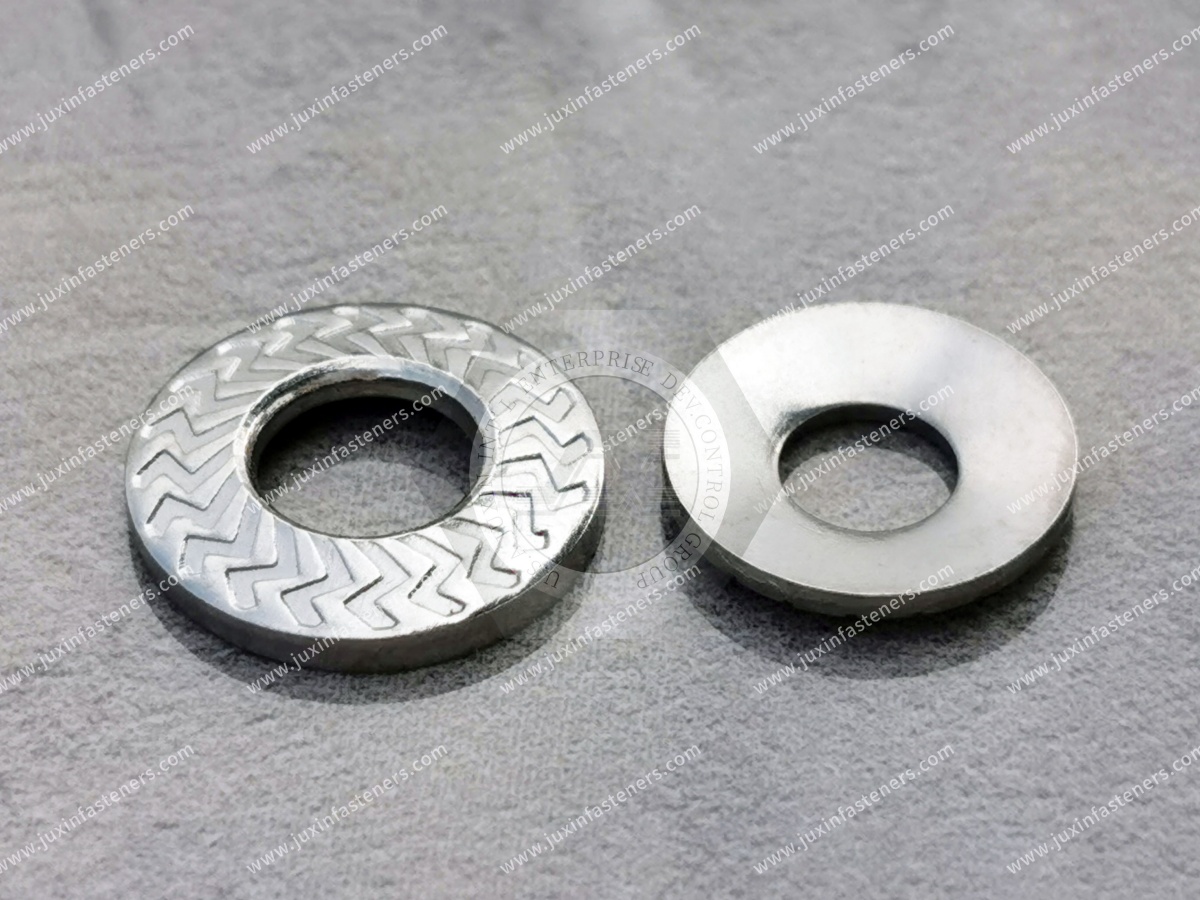
Correct installation is essential to wedge-locking performance.
Match the washer pair to the approved bolt or stud diameter and drawing.
The cam faces must remain together.
The serrated faces should point outward toward the fastener bearing surface and the joint surface.
Ensure the washer has adequate support and that the mating surface is compatible with the serrations.
Use the required tightening procedure for the actual bolt, nut, washer, lubrication and joint configuration.
For controlled OEM production, inspection requirements may include washer orientation, presence detection, torque monitoring or other assembly controls.
Installation should always follow the approved engineering specification for the joint.
A common sourcing mistake is replacing a conventional washer with a wedge-lock washer while keeping every other assembly parameter unchanged.
Changing the bearing interface can change friction.
That can change the relationship between applied torque and achieved preload.
For critical joints, engineers should therefore validate tightening conditions using the actual:
bolt
nut
washer pair
lubrication
coating
mating surface
The correct torque should come from the validated joint specification rather than a generic torque table.
Whether a wedge-lock washer pair can be reused depends on the product specification, surface condition and application requirements.
Before reuse, relevant factors may include:
serration condition
cam condition
corrosion
deformation
contamination
mating-surface damage
For safety-critical or validated OEM joints, reuse should not be assumed unless permitted by the approved engineering procedure.
For demanding applications, anti-loosening performance should be validated rather than assumed from product appearance.
Transverse vibration testing is commonly used to evaluate how a bolted joint retains preload under repeated lateral displacement.
Junker-type testing is particularly relevant because it subjects the joint to transverse movement while monitoring clamp-load behavior.
Depending on the applicable product and customer specification, testing may reference established vibration-test methods such as DIN 65151-type transverse vibration testing or other approved procedures.
The important procurement principle is simple:
Do not define anti-loosening performance only by saying "high vibration." Define the validation method and acceptance criteria where joint criticality requires it.
DIN 25201 wedge-locking washers and DIN 9250 safety washers should not be treated as interchangeable products.
Uses paired cam surfaces to create a geometric wedge-locking effect.
Particularly relevant where transverse vibration and rotational self-loosening are key engineering concerns.
Uses a different locking geometry and interface mechanism.
It can be appropriate for many industrial anti-loosening applications but should not be described as having the same operating principle as a wedge-locking pair.
Engineers should select according to the actual joint requirements rather than treating every anti-loosening washer as equivalent.
Traditional spring lock washers rely significantly on spring action and interface friction.
Wedge-locking washers use paired cam geometry.
For demanding transverse-vibration environments, engineers may therefore evaluate wedge locking where conventional spring-washer performance is insufficient.
However, the decision should still be based on the actual joint, validation requirements and approved specification.
Prevailing-torque nuts and wedge-lock washers address loosening differently.
A prevailing-torque lock nut creates rotational resistance within the threaded assembly.
A wedge-lock washer creates a locking mechanism at the bearing interfaces.
Selection may depend on:
access
maintenance
temperature
available nut type
bolt length
reuse requirements
corrosion environment
joint geometry
In some assemblies, one technology may provide a simpler and more economical solution than the other.
Industrial equipment can expose bolted connections to continuous vibration, cyclic loads and repeated start-stop operation.
Potential applications include:
pumps
motors
gearboxes
machine frames
robotic equipment
production machinery
material-handling systems
industrial automation
Wedge-locking washers can be evaluated where conventional bolted joints have demonstrated rotational loosening or where the design requires enhanced vibration resistance.
Vehicle systems operate under road vibration, shock and thermal cycling.
Potential non-safety-critical and engineering-approved applications may include:
equipment brackets
auxiliary structures
battery supporting equipment
thermal-management assemblies
manufacturing fixtures
production equipment
Safety-critical vehicle systems require OEM-approved components, validation and assembly procedures.
A generic DIN designation alone should not be interpreted as approval for braking, steering, suspension or other safety-critical functions.
High-density computing infrastructure increasingly contains mechanical systems such as:
pumps
cooling distribution units
liquid-cooling manifolds
heat exchangers
equipment frames
power cabinets
HVAC systems
These assemblies can experience pump-induced vibration, fan vibration, transportation loads and thermal cycling.
DIN 25201 stainless steel wedge-lock washers may be considered for selected mechanical joints where corrosion resistance and vibration-resistant locking are both required.
Battery energy storage systems combine structural frames, electrical cabinets, HVAC equipment, cooling systems and outdoor enclosures.
Bolted joints may experience:
transportation vibration
outdoor temperature changes
humidity
long service intervals
equipment maintenance
Wedge-locking washers can form part of the fastening strategy where rotational loosening is an identified risk.
Rail equipment is a natural high-vibration environment, but railway applications also have stringent approval and validation requirements.
DIN 25201-type wedge-locking systems may be considered for suitable mechanical connections according to the applicable customer, system and railway requirements.
Component selection should be based on the approved drawing and validation plan rather than on a generic claim of railway suitability.
Renewable-energy equipment can experience vibration, wind loading, thermal cycling and long outdoor service periods.
Potential mechanical applications include:
tracking equipment
inverter structures
equipment housings
auxiliary frames
maintenance-access assemblies
Material and corrosion protection should be selected according to the actual exposure environment.
Fans, compressors, pumps and cooling systems can transmit repeated vibration into surrounding mechanical structures.
Potential applications include:
pump mounting
compressor assemblies
equipment frames
fan systems
cooling skids
liquid-cooling equipment
For these systems, the locking strategy should be considered together with alignment, vibration isolation and joint preload.
Stainless steel wedge-lock washers may be considered for certain marine-related assemblies because corrosion resistance is often important.
However, "stainless steel" alone does not guarantee suitability for continuous saltwater or chloride exposure.
The stainless steel grade, crevice conditions, galvanic couples and actual service environment should be reviewed before approval.
Wedge-locking principles can be relevant to vibration-resistant aerospace engineering, but aerospace hardware is governed by highly controlled material, traceability, qualification and approval requirements.
DIN 25201 commercial washers should therefore not be presented as automatically suitable for aircraft or spacecraft.
Aerospace use requires the applicable approved specification and customer qualification.
This distinction protects both engineering integrity and supply-chain compliance.
Wedge locking is powerful, but it is not automatically the best choice for every joint.
Other solutions may be more appropriate when:
the bearing surface is too soft;
the surface coating must remain undamaged;
the joint contains significant polymer creep;
space is limited;
prevailing torque is preferred;
permanent locking is required;
cost and assembly simplicity dominate the requirement.
Alternatives can include:
all-metal lock nuts
nylon-insert lock nuts
thread-locking adhesive
safety wire or positive mechanical retention
self-clinching fasteners
weld nuts
threaded inserts
custom joint redesign
The best anti-loosening solution is the one that addresses the actual failure mechanism.
Before specifying DIN 25201 stainless steel wedge-lock washers, engineers should confirm:
thread size
bolt property class
required preload
loading direction
vibration severity
joint stiffness
mating-surface material
surface hardness
hole geometry
operating temperature
corrosion exposure
installation method
maintenance requirements
validation method
This avoids treating washer selection as an isolated catalog decision.
For procurement teams, the words "DIN 25201 stainless steel washer" are not sufficient to define a complete sourcing requirement.
A supplier RFQ should clarify:
applicable standard
customer drawing if applicable
nominal size
dimensions
stainless steel grade
hardness or mechanical requirements where applicable
washer pair configuration
surface requirements
corrosion requirements
inspection criteria
material certification
traceability
packaging
annual demand
delivery requirements
For vibration-critical programs, the buyer should also confirm whether functional validation or test reports are required.
Depending on the customer specification, inspection may include:
inside diameter
outside diameter
washer thickness
cam geometry
serration geometry
material verification
hardness
surface condition
pair orientation
dimensional conformity
For engineered OEM programs, inspection scope should follow drawing characteristics and application risk.
To support an accurate quotation and technical review, provide:
DIN 25201 designation or drawing
bolt/thread size
required dimensions
stainless steel grade
bolt property class
mating-surface material
hole diameter or slot dimensions
operating temperature
vibration conditions
corrosion environment
required quantity
annual usage
validation requirements
inspection/documentation requirements
packaging requirements
delivery schedule
For application-specific assemblies, a 2D drawing, 3D model or joint stack-up can help accelerate engineering review.
JUXIN FASTENERS supports industrial OEM and supply-chain customers requiring standard and custom fastening components for engineered assemblies.
Our broader product portfolio allows engineering and procurement teams to evaluate wedge-lock washers alongside related fastening technologies, including:
DIN 9250 stainless steel safety washers
DIN 9250 carbon steel safety washers
spring washers
disc spring washers
all-metal lock nuts
nylon-insert lock nuts
high-strength bolts and nuts
self-clinching fasteners
blind rivet nuts
weld nuts
threaded inserts for plastics
custom cold-formed components
CNC-machined fastening parts
This allows customers to select the locking technology according to the actual joint rather than forcing every vibration problem into one fastener category.
It uses a matched pair of washers with opposing cam surfaces.
Attempted loosening produces movement across the cams, creating a geometric resistance that works against the preload in the bolted joint.
The two cam faces must interact to create the wedge-locking mechanism. A single washer cannot provide the same paired-cam function.
The cam faces are positioned against each other, while the serrated outer faces contact the fastener bearing surface and the joint surface.
No. They are different locking washer systems with different geometries and operating principles.
No. A wedge-locking pair relies on cam geometry rather than conventional spring-washer action.
No. Adequate preload remains fundamental to bolted-joint performance.
They may be suitable in some assemblies, but the softer aluminum bearing surface, serration interaction and galvanic corrosion conditions require evaluation.
Potentially, but the outer serrations may damage or penetrate the coating. Both locking performance and corrosion protection should be considered.
No. They primarily address rotational loosening. Joint settlement, gasket creep, polymer relaxation and thermal effects can still reduce preload.
For critical applications, transverse vibration testing such as a Junker-type test or another customer-approved validation method can be specified with defined acceptance criteria.
Provide the standard or drawing, thread size, material, bolt property class, mating surface, vibration environment, corrosion requirements, quantities, quality documentation and delivery requirements.
DIN 25201 wedge-lock washers provide a fundamentally different anti-loosening mechanism from conventional spring washers and toothed safety washers.
Their value comes from the relationship between paired cam geometry, bolt preload and controlled interaction with the surrounding joint surfaces.
For design engineers, this means evaluating vibration direction, preload, mating materials, bearing geometry and environmental exposure.
For procurement and supplier-development teams, it means sourcing the washer as an engineered component with defined material, dimensional,
quality and validation requirements rather than purchasing solely by thread size.
JUXIN FASTENERS supplies DIN 25201 stainless steel wedge-lock washers, DIN 9250 safety washers, lock nuts, spring washers,
high-strength fasteners and custom vibration-resistant fastening components for industrial OEM applications.
For quotation, drawing review or fastening application support, send your specification, drawing and expected quantity to:
 MORE NEWS
Sep. 27, 2026
Sep. 27, 2026
Sep. 27, 2026
Contact Us
Tel.:
+86 020 8621 0320
+86 020 3121 6067
E-mail:
Technical Support:
Navigation
SEND INQUIREY