
Call Us
+86 136 6007 9809
Call Us
+86 136 6007 9809

Sep. 14, 2023
DIN 6798 J internal serrated lock washers remain widely recognized in industrial fastener drawings, maintenance documentation, spare-parts lists and supplier catalogs.
They are also commonly searched as:
DIN 6798 J washers;
DIN 6798J lock washers;
internal serrated lock washers;
Form J serrated washers;
internal tooth lock washers;
internal star washers.
However, engineers and procurement teams working with DIN 6798 J should understand an important point:
DIN 6798 is a withdrawn legacy standard.
This does not mean DIN 6798 J products have disappeared from the industrial supply chain.
They continue to be manufactured, stocked and sourced for:
existing machinery;
legacy OEM drawings;
MRO replacement;
spare parts;
customer-controlled specifications;
validated assemblies.
The correct engineering question is therefore not simply:
“Can I still buy DIN 6798 J washers?”
It is:
“What does the legacy DIN 6798 J specification require, and should the existing design be reproduced, reviewed or replaced?”
A practical engineering and procurement path is:
Legacy Drawing → DIN 6798 J Identification → Form J Geometry → Dimensions → Material → Finish → Application Review → Replacement Decision → Sample / Validation → RFQ
JUXIN FASTENERS supports OEM and MRO sourcing of DIN 6798 J-type internal serrated lock washers, internal tooth washers,
external tooth washers, flat washers, spring washers, locking fasteners and custom fastening components for industrial machinery,
electrical equipment, automotive equipment, telecommunications, HVAC, automation and other engineered assemblies.
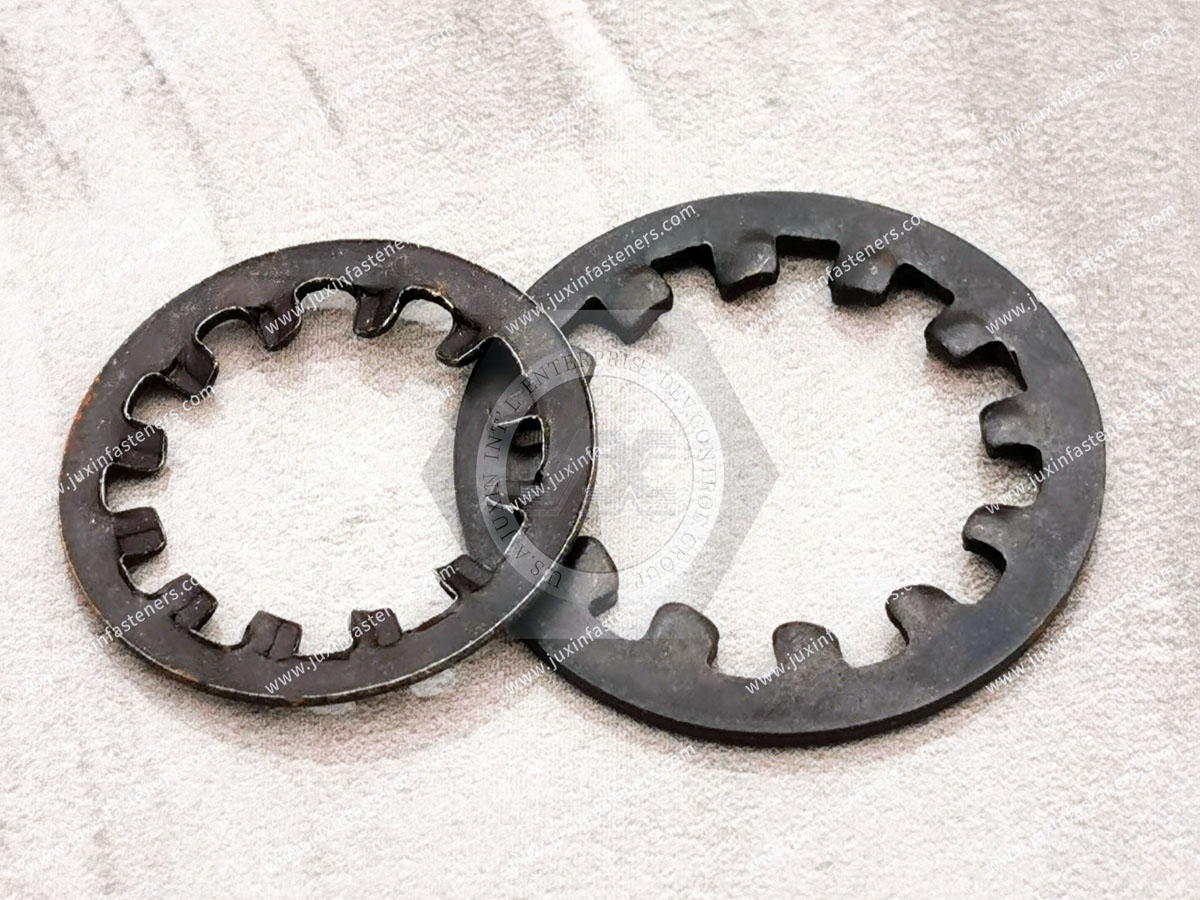
DIN 6798 historically defined serrated lock washers in several configurations.
Form J identifies the internal-serration configuration.
The washer has multiple formed serrations positioned around the internal circumference.
The teeth are integral features of the washer.
This creates the characteristic DIN 6798 J geometry:
Circular Washer Body + Internal Formed Serrations
There is no separate locking pin or separately assembled tooth component.
For procurement and drawing interpretation, the most important identification point is:
DIN 6798 J → Internal Serrations
This distinguishes Form J from other DIN 6798 geometries.
When an old drawing states:
DIN 6798 J
the buyer should not automatically substitute:
external tooth washer;
split spring washer;
plain washer;
disc spring;
wedge-lock washer.
These products have different geometries and locking mechanisms.
DIN 6798 is no longer a current DIN standard.
This matters because a professional technical page should distinguish between:
Legacy Standard Identification
and:
Current Design Standard
A withdrawn standard can remain commercially important for many years because industrial equipment and OEM drawings can remain in service much longer than the standard itself.
Therefore:
Withdrawn Standard ≠ Obsolete Installed Equipment
and:
Withdrawn Standard ≠ Product No Longer Available
Industrial equipment often remains operational for decades.
Maintenance teams may encounter drawings or bills of materials containing:
DIN 6798 J M6
or:
DIN 6798 J M10
even though the original standard has been withdrawn.
The purchasing requirement therefore becomes:
Find a compatible replacement without changing the validated assembly unintentionally.
This creates strong search intent around:
DIN 6798 J dimensions;
DIN 6798 J supplier;
DIN 6798 J equivalent;
DIN 6798 J replacement;
DIN 6798 J stainless steel;
DIN 6798 J zinc plated;
DIN 6798 J M6;
DIN 6798 J M8;
DIN 6798 J M10.
A common mistake is:
“DIN 6798 is withdrawn, so replace it with another lock washer.”
That is not automatically correct.
A replacement component may differ in:
inside diameter;
outside diameter;
thickness;
overall height;
number of serrations;
tooth geometry;
material;
hardness;
surface finish;
locking behavior.
If the washer is part of an existing validated assembly, substitution should be controlled.
A typical DIN 6798 J washer is identified by dimensions such as:
inside diameter;
outside diameter;
material thickness;
overall formed height;
number of teeth or serrations.
The exact dimensions depend on nominal size.
These dimensions determine how the washer interfaces with:
the fastener shank;
bolt or screw head;
nut bearing face;
mating component.
Therefore:
Nominal Thread Size Alone Is Not a Complete Replacement Specification
Commercial DIN 6798 J product data commonly follows the legacy dimensional pattern below.
| Nominal Thread | Approx. Inside Diameter | Approx. Outside Diameter | Nominal Thickness |
|---|---|---|---|
| M2 | 2.2 mm | 4.5 mm | 0.3 mm |
| M2.5 | 2.7 mm | 5.5 mm | 0.4 mm |
| M3 | 3.2 mm | 6.0 mm | 0.4 mm |
| M4 | 4.3 mm | 8.0 mm | 0.5 mm |
| M5 | 5.3 mm | 10.0 mm | 0.6 mm |
| M6 | 6.4 mm | 11.0 mm | 0.7 mm |
| M8 | 8.4 mm | 15.0 mm | 0.8 mm |
| M10 | 10.5 mm | 18.0 mm | 0.9 mm |
| M12 | 13.0 mm | 20.5 mm | 1.0 mm |
| M14 | 15.0 mm | 24.0 mm | 1.0 mm |
| M16 | 17.0 mm | 26.0 mm | 1.2 mm |
| M20 | 21.0 mm | 33.0 mm | 1.4 mm |
| M24 | 25.0 mm | 38.0 mm | 1.5 mm |
| M27 | 28.0 mm | 44.0 mm | 1.6 mm |
| M30 | 31.0 mm | 48.0 mm | 1.6 mm |
These dimensions are useful for engineering identification and RFQ preparation.
For production procurement, the required drawing, approved legacy specification or customer-controlled dimensional requirement should govern the order.
The washer bore must provide the intended relationship with the fastener shank or thread.
An incorrect inside diameter can cause:
assembly interference;
excessive clearance;
poor centering;
incorrect serration location.
For replacement sourcing, measure the actual component if the drawing is incomplete.
Outside diameter affects:
available bearing footprint;
radial packaging space;
relationship between the serrations and fastener bearing face;
clearance from adjacent features.
A visually similar washer with a larger or smaller OD may not behave the same way.
Washer thickness affects:
formed stiffness;
tooth behavior;
stack height;
interface geometry.
Substituting a thicker washer because it appears “stronger” is not automatically appropriate.
Likewise, a thinner washer can deform differently.
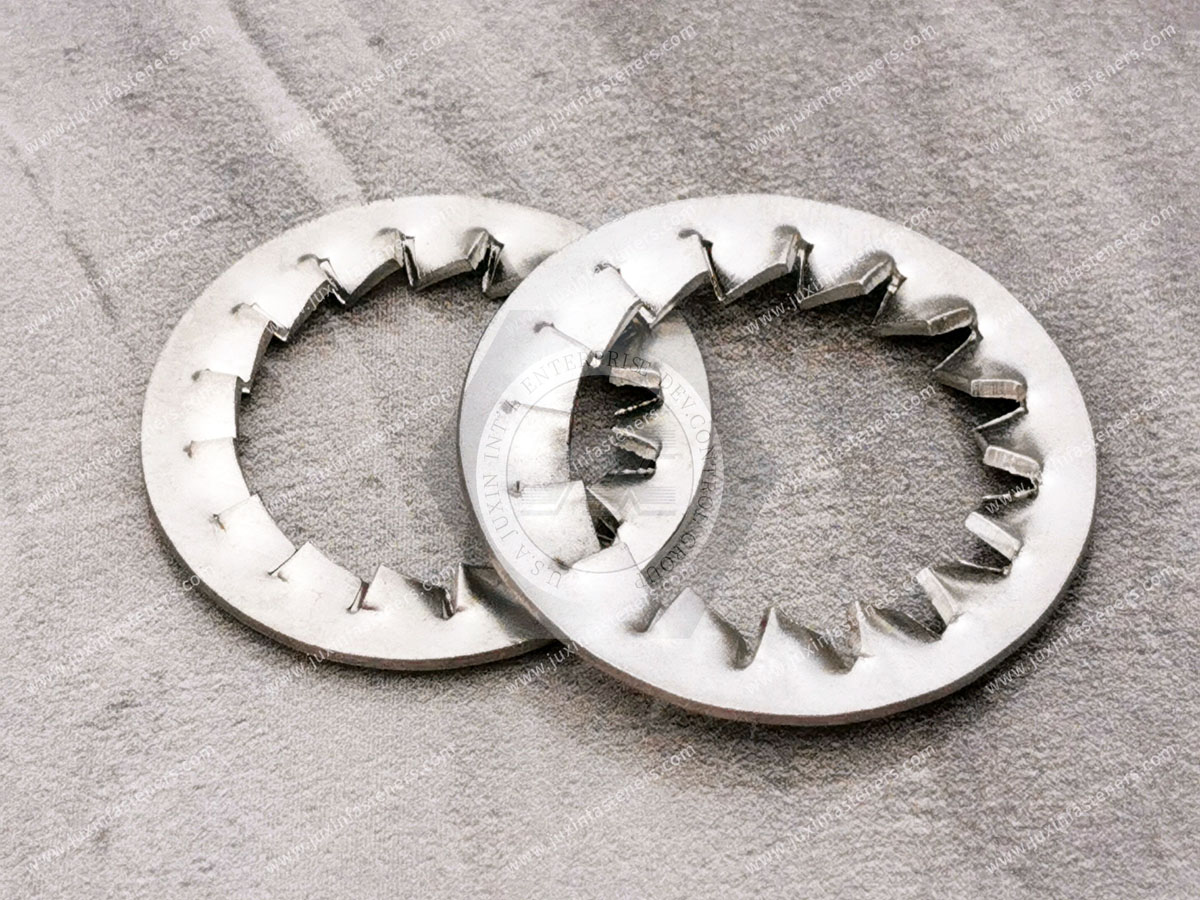
DIN 6798 J serrations are not simply flat cuts in a flat washer.
The formed tooth geometry creates an overall height greater than the base material thickness.
This geometry contributes to how the serrations contact the mating surfaces during tightening.
For close-clearance assemblies, overall height can also affect packaging.
The internal serrations are formed out of the washer plane.
When the fastener is tightened, the serrated features interact with the adjacent bearing surfaces.
Depending on the:
washer material;
washer hardness;
fastener material;
mating material;
coating;
clamp load,
the serrations can create localized contact and resistance to relative rotation.
This is different from the behavior of a plain washer.
A plain washer primarily modifies the bearing interface by providing a relatively broad, continuous contact surface.
A DIN 6798 J washer intentionally uses serrated contact.
Therefore:
DIN 6798 J ≠ ISO 7089 Plain Washer
The two products should not be substituted simply because they fit the same nominal screw size.
A split spring washer uses a helical split-ring geometry.
DIN 6798 J uses multiple internal serrations.
These are different locking concepts.
Therefore:
DIN 6798 J ≠ Split Spring Lock Washer
A bearing tab lock washer uses an inner tab that engages a shaft groove and an outer tab that engages a slotted bearing lock nut.
DIN 6798 J does not use that mechanism.
Therefore:
DIN 6798 J ≠ MB Bearing Lock Washer
This distinction is particularly important in MRO sourcing, where the generic term lock washer can refer to several completely different products.
A wedge-locking washer system uses paired washers and engineered wedge geometry.
DIN 6798 J is a single serrated washer.
The two systems should not be treated as performance equivalents without engineering validation.
DIN 6798 J washers are designed to create a serrated locking interface.
However, no responsible engineering specification should reduce bolted-joint performance to:
“DIN 6798 J = vibration-proof.”
Actual self-loosening behavior depends on the complete joint, including:
preload;
transverse displacement;
joint stiffness;
friction;
fastener geometry;
surface condition;
external loading.
For severe vibration or critical joints, the locking method should be evaluated against the actual service condition.
These are different functions.
A serrated washer can provide resistance to relative rotation at the bearing interface.
It does not automatically compensate for preload loss caused by:
embedment;
creep;
gasket compression;
coating relaxation;
thermal expansion differences.
Therefore:
Rotational Resistance ≠ Preload Compensation
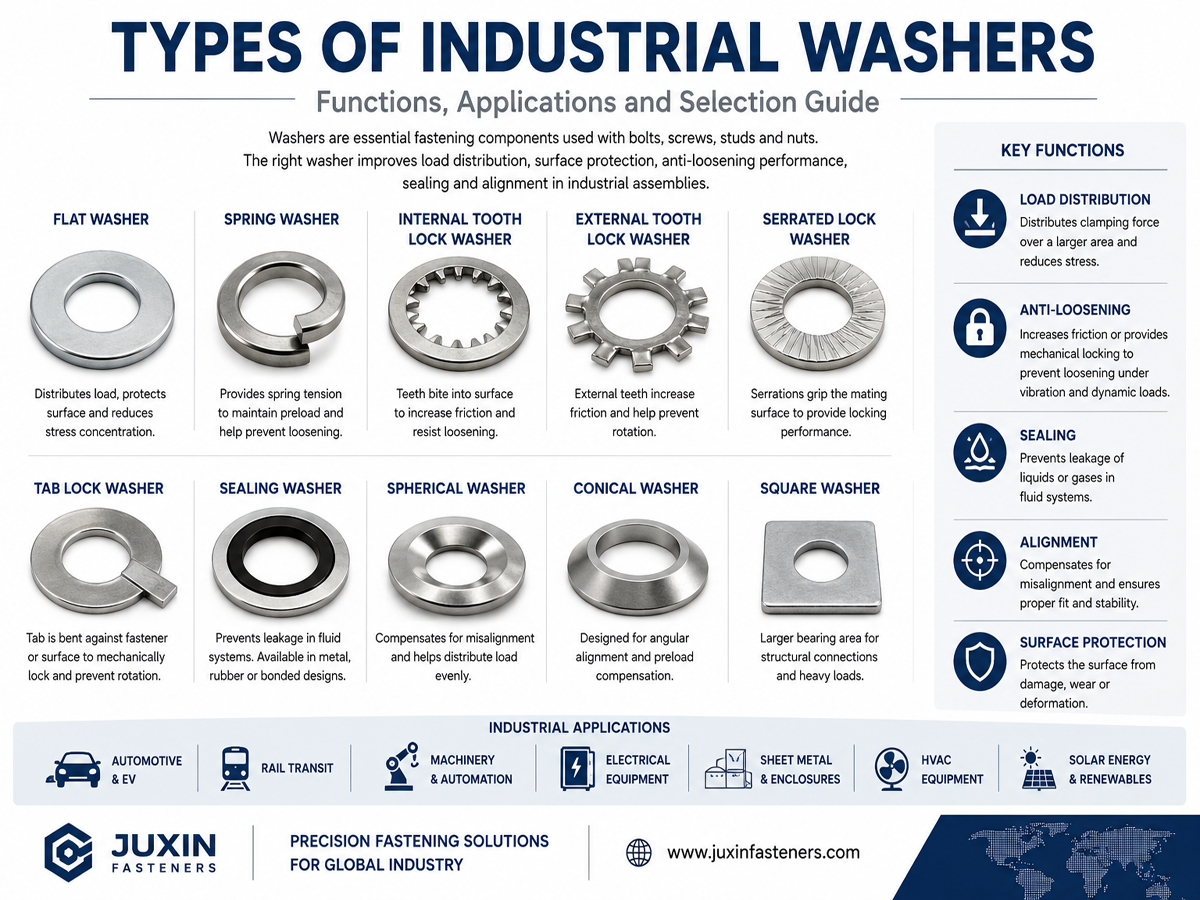
DIN 6798 J belongs to the broader family of internal serrated or internal tooth lock washers.
But not every internal tooth washer should automatically be called DIN 6798 J.
A custom or other-standard internal tooth washer may use different:
dimensions;
tooth geometry;
hardness;
material;
finish.
The DIN designation should only be used when the part is intended to correspond to the applicable DIN 6798 J geometry or customer specification.
For the broader engineering comparison of internal tooth washers, see the JUXIN FASTENERS internal tooth lock washer engineering guide.
Legacy DIN 6798 terminology distinguishes different tooth configurations.
Internal serrations.
External serrations.
This means a buyer searching:
DIN 6798 J
should not receive:
DIN 6798 A
as an uncontrolled substitute.
The locking interfaces differ.
DIN 6798 also historically included a configuration associated with countersunk applications.
Again:
J ≠ A ≠ V
The form letter is part of the product specification.
Omitting it from an RFQ can result in the wrong washer.
Spring steel is widely used for DIN 6798 J-type serrated lock washers.
The material provides the characteristics needed for the formed serration geometry.
However, procurement should not simply state:
“High-strength alloy steel.”
That description is unnecessarily broad and can be technically misleading.
A controlled RFQ should specify the required material or approved product specification.
Stainless steel versions are also commercially available.
They can be useful where corrosion resistance is important.
Potential stainless grades depend on supplier capability and customer requirements.
However:
Stainless Steel ≠ Corrosion-Proof
The environment, chloride exposure, mating materials and required mechanical behavior should be considered.
Zinc-plated spring-steel versions remain common in industrial supply.
A coating can provide corrosion protection appropriate to selected environments.
But:
Zinc Plated ≠ Suitable for Every Corrosive Environment
The required corrosion performance should be specified separately.
This is an important procurement point for hardened or spring-steel components receiving electroplated coatings.
Depending on:
material condition;
hardness;
manufacturing process;
cleaning;
plating process;
applied stress,
hydrogen embrittlement risk may need to be evaluated.
This is especially relevant when electroplated zinc coatings are specified for higher-hardness steel components.
ISO 4042 provides important guidance for electroplated coating systems on fasteners and related hydrogen-embrittlement considerations within its scope.
Do not assume that every zinc-plated DIN 6798 J washer has identical process risk.
Potential surface conditions can include, depending on material and project:
plain/oiled;
black finish;
zinc-based coating;
customer-specified coating;
stainless steel without carbon-steel plating.
The finish can affect:
corrosion resistance;
friction;
tooth interaction;
appearance;
electrical contact.
Therefore, finish should be included in the RFQ.
Serrated washers are sometimes used where localized tooth contact can assist an electrical bonding interface.
The teeth may penetrate selected surface films or coatings.
However:
DIN 6798 J ≠ Automatically Certified Grounding Washer
Electrical performance depends on the complete assembly.
Where bonding is required, engineers should evaluate:
substrate material;
coating;
contact resistance;
clamp force;
corrosion;
environmental exposure;
applicable electrical requirements.
In one application, tooth penetration through a coating may help create metallic contact.
In another application, the same tooth penetration may damage a corrosion-protection system.
Therefore:
Same Washer + Different Engineering Requirement = Different Result
This is why the mating surface should be specified during product selection.
Painted or powder-coated surfaces require careful evaluation.
The serrations may:
mark the coating;
penetrate the coating;
expose the substrate.
That can affect:
appearance;
corrosion resistance;
electrical continuity.
Do not assume the result is desirable.
Aluminum is generally softer than many hardened or spring-steel washer materials.
Serrations can create localized indentation.
Engineers should consider:
aluminum alloy;
component thickness;
clamp load;
coating;
corrosion;
galvanic interaction.
The washer should not be selected only because it creates a strong tooth impression.
A metal serrated washer may create undesirable local stress in an engineering-plastic component.
Possible concerns include:
indentation;
cracking;
reduced bearing area;
creep.
A different bearing or locking strategy may be more appropriate.
Before installation, confirm:
DIN 6798 J / Form J / Internal Serrations
Do not confuse it with:
Form A;
Form V;
plain washer;
split spring washer;
bearing tab washer.
This simple identification step prevents many assembly errors.
Check:
nominal thread size;
washer inside diameter;
washer outside diameter;
washer thickness;
fastener bearing face;
available radial clearance.
A nominal M8 designation alone does not prove that every M8 internal tooth washer is identical.
Determine whether the washer will contact:
bare steel;
plated steel;
stainless steel;
aluminum;
painted surface;
powder coating;
another material.
The serrations interact directly with these surfaces.
Avoid creating a universal installation-direction rule unless it is supported by the actual washer geometry, drawing or manufacturer specification.
The important requirement is that the serrated washer is installed in the intended bearing interface and functions according to the approved assembly design.
Use the tightening requirement specified for the fastener assembly.
Avoid generic statements such as:
“Tighten moderately.”
Industrial fastening requires a controlled tightening process appropriate to the joint.
Adding or changing a serrated washer can alter the bearing interface and therefore potentially affect the torque-preload relationship.
For critical joints, validate the complete assembly.
DIN 6798 J washer size alone does not determine a universal tightening torque.
Torque depends on factors including:
bolt size;
bolt property class;
thread;
friction;
lubrication;
coating;
joint design.
Therefore:
Washer Standard ≠ Universal Bolt Torque
The serrations can deform and create impressions in the mating surfaces during tightening.
Do not automatically assume unlimited reuse.
For controlled assemblies, follow:
OEM maintenance instructions;
customer specification;
validated maintenance procedure.
Where reliable locking is important, replacing the washer during service can provide a more controlled interface.
When an engineer encounters DIN 6798 J on an old drawing, there are two different tasks.
If the assembly is validated and remains in service, the objective may be:
Source a dimensionally and functionally compatible replacement.
If the engineer is developing a new product, the objective may be:
Review whether a legacy DIN 6798 J locking method is still appropriate for the actual joint requirement.
These should not be treated as the same decision.
If a customer RFQ states:
DIN 6798 J M10
the supplier should not silently quote another lock-washer type as if it were identical.
If an alternative is proposed, clearly identify:
dimensional differences;
material differences;
standard differences;
finish differences;
functional differences.
The customer can then evaluate the substitution.
A practical replacement process is:
Step 1: Identify the original DIN 6798 J callout.
Step 2: Determine the nominal size.
Step 3: Verify ID, OD and thickness.
Step 4: Identify material.
Step 5: Identify hardness where controlled.
Step 6: Identify surface finish.
Step 7: Review the mating surface.
Step 8: Confirm the required locking function.
Step 9: Compare the proposed replacement.
Step 10: Validate before changing a controlled assembly.
This is much safer than replacing by nominal size alone.
Sometimes the original drawing is unavailable.
In that case, provide the supplier with:
clear photographs;
nominal fastener size;
measured ID;
measured OD;
measured thickness;
tooth configuration;
material if known;
finish;
mating fastener;
equipment application.
A physical sample can also help with dimensional verification.
Legacy DIN 6798 J callouts may appear in existing European-origin machinery, vehicle-related equipment and industrial assemblies.
However, the existence of a DIN washer does not automatically mean the part is qualified for a safety-critical automotive joint.
Customer-specific requirements must control such applications.
This is one of the strongest application areas for legacy DIN 6798 J sourcing.
Potential uses include:
equipment covers;
brackets;
drive-system accessories;
machine assemblies;
control equipment.
MRO demand can remain long after the original machine design was released.
Potential uses include:
control cabinets;
switchgear-related equipment;
chassis;
electrical housings;
mounting hardware.
Where electrical bonding is intended, the electrical interface must be separately validated.
Legacy and current industrial hardware can use internal serrated washers in:
racks;
cabinets;
enclosures;
equipment mounting assemblies.
The actual requirement should be identified from the drawing.
Potential applications include:
equipment housings;
control assemblies;
brackets;
service hardware.
For severe vibration around rotating machinery, do not assume a DIN 6798 J washer alone provides sufficient locking performance.
Internal serrated washers can appear in:
machine frames;
control hardware;
sensors;
actuator assemblies;
equipment panels.
Compact Form J geometry can be useful where the external washer profile should remain relatively contained beneath the fastener.
For marine or other corrosive service, material and finish selection become particularly important.
A legacy zinc-plated spring-steel washer may not automatically be suitable for a new corrosive application.
Consider:
stainless grade where appropriate;
mating materials;
galvanic effects;
coating system;
actual corrosion exposure.
Do not interpret a generic DIN 6798 J product as automatically aerospace-qualified.
For aerospace, flight-critical or other high-reliability systems, use only hardware and locking methods permitted by the applicable engineering specification.
JUXIN FASTENERS can evaluate drawing-controlled industrial or non-flight-critical requirements where they match actual manufacturing capability.
DIN 6798 J-type washers can be relevant to selected:
electrical cabinets;
power-conversion equipment;
cooling equipment;
auxiliary machinery;
control hardware.
But the application name does not determine suitability.
The actual mechanical and electrical interface does.
| Situation | Recommended Engineering Direction |
|---|---|
| Existing drawing explicitly calls DIN 6798 J | Verify and source compatible Form J washer |
| Existing validated machine requires spare parts | Maintain controlled replacement specification |
| Drawing gives only nominal size | Verify ID, OD, thickness, material and finish |
| Supplier proposes different tooth washer | Compare geometry and function before approval |
| New product design | Review whether legacy locking method remains appropriate |
| Severe transverse vibration | Evaluate locking performance and alternatives |
| Electrical bonding requirement | Validate electrical interface separately |
| Painted surface | Evaluate coating penetration |
| Soft aluminum | Evaluate localized tooth indentation |
| Plastic parent material | Consider alternative bearing/locking solution |
| Corrosive environment | Review material and coating rather than copying legacy finish |
It is a withdrawn legacy standard.
DIN 6798 J products remain widely supplied commercially.
Dimensions, material and finish also matter.
Internal and external serrations are different configurations.
Other standards and custom geometries exist.
Finish is a separate sourcing requirement.
Joint performance depends on the complete assembly.
Higher-hardness electroplated steel components can require process consideration.
Electrical contact requires separate validation.
A visually similar washer may not be functionally equivalent.
Engineers may search:
DIN 6798 J;
DIN 6798 J dimensions;
DIN 6798 J withdrawn;
DIN 6798 J replacement;
DIN 6798 J equivalent;
DIN 6798 J internal serrated washer;
DIN 6798 J vs DIN 6798 A;
DIN 6798 J material;
DIN 6798 J M6 dimensions;
DIN 6798 J M8 dimensions;
DIN 6798 J M10 dimensions.
These searches often indicate that the user is interpreting an existing drawing or replacing an existing component.
Purchasing teams may search:
DIN 6798 J supplier;
DIN 6798 J manufacturer;
DIN 6798J washer manufacturer;
DIN 6798 J spring steel washer;
DIN 6798 J stainless washer;
DIN 6798 J zinc plated;
DIN 6798 J M6 supplier;
DIN 6798 J M8 supplier;
DIN 6798 J M10 supplier;
legacy DIN washer supplier.
These searches are close to RFQ intent.
For technical and commercial evaluation by JUXIN FASTENERS, provide where applicable:
original drawing;
physical sample;
customer part number;
DIN 6798 J callout;
nominal thread size;
washer inside diameter;
washer outside diameter;
washer thickness;
overall formed height where controlled;
serration configuration;
number of serrations where controlled;
material;
hardness where specified;
spring-steel requirement where applicable;
stainless-steel grade where applicable;
surface finish;
zinc-plating requirement where applicable;
coating specification;
trivalent chromium requirement where applicable;
RoHS/REACH requirement where applicable;
corrosion requirement;
mating fastener;
fastener property class where relevant;
fastener bearing-face diameter;
mating material;
mating-surface finish;
electrical bonding requirement where applicable;
vibration environment;
tightening requirement;
sample quantity;
replacement quantity;
production quantity;
estimated annual demand;
inspection requirement;
packaging requirement;
labeling requirement;
customer-specific requirements.
DIN 6798 J identifies the internal-serration Form J configuration from the legacy DIN 6798 serrated lock-washer standard.
DIN 6798 has been withdrawn.
However, DIN 6798 J remains widely used as a commercial and legacy drawing designation.
Yes, DIN 6798 J-type internal serrated lock washers remain commercially available from industrial fastener suppliers.
Form J identifies internal serrations.
DIN 6798 J uses internal serrations, while Form A uses external serrations.
No.
It is a serrated lock washer, not a conventional split spring washer.
DIN 6798 J is one specific legacy standardized internal-serration geometry.
Not every internal tooth washer is necessarily DIN 6798 J.
Spring-steel versions are common, and stainless-steel versions are also commercially available.
The required material should be specified in the RFQ.
No.
Surface finish is a separate requirement.
Serrated washers can be part of selected electrical bonding interfaces, but DIN 6798 J alone does not guarantee electrical grounding performance.
Do not substitute automatically.
Compare dimensions, material, hardness, finish, mating surfaces and locking function before approving a replacement.
Do not automatically assume unlimited reuse.
Serrations and mating surfaces can deform during tightening.
Follow the equipment or customer maintenance requirement.
A maintenance buyer may begin with:
“Need DIN 6798 J M8.”
A professional sourcing process should continue:
Is This an Existing Validated Assembly?
Then:
What Are the Original ID, OD and Thickness?
Spring Steel or Stainless?
What Hardness Is Required?
What Finish?
What Surface Does the Washer Contact?
Is Mechanical Locking the Only Function?
Is Electrical Contact Also Required?
The complete commercial path becomes:
Legacy DIN Callout → Part Identification → Dimensional Verification → Material → Finish → Interface Review → Replacement Approval → Sample / Validation → Production RFQ
That is the difference between simply selling a washer and supporting an industrial supply chain.
JUXIN FASTENERS supports OEM and MRO sourcing of DIN 6798 J-type internal serrated lock washers, internal tooth washers, external tooth washers,
flat washers, spring washers, bolts, screws, nuts, locking fasteners and custom fastening components for industrial machinery, electrical equipment, automotive equipment,
telecommunications, HVAC, automation, power systems and other engineered assemblies.
For broader internal-tooth washer engineering and selection, refer to the JUXIN FASTENERS Internal Tooth Lock Washers: Design, Selection, Installation & Anti-Rotation Guide.
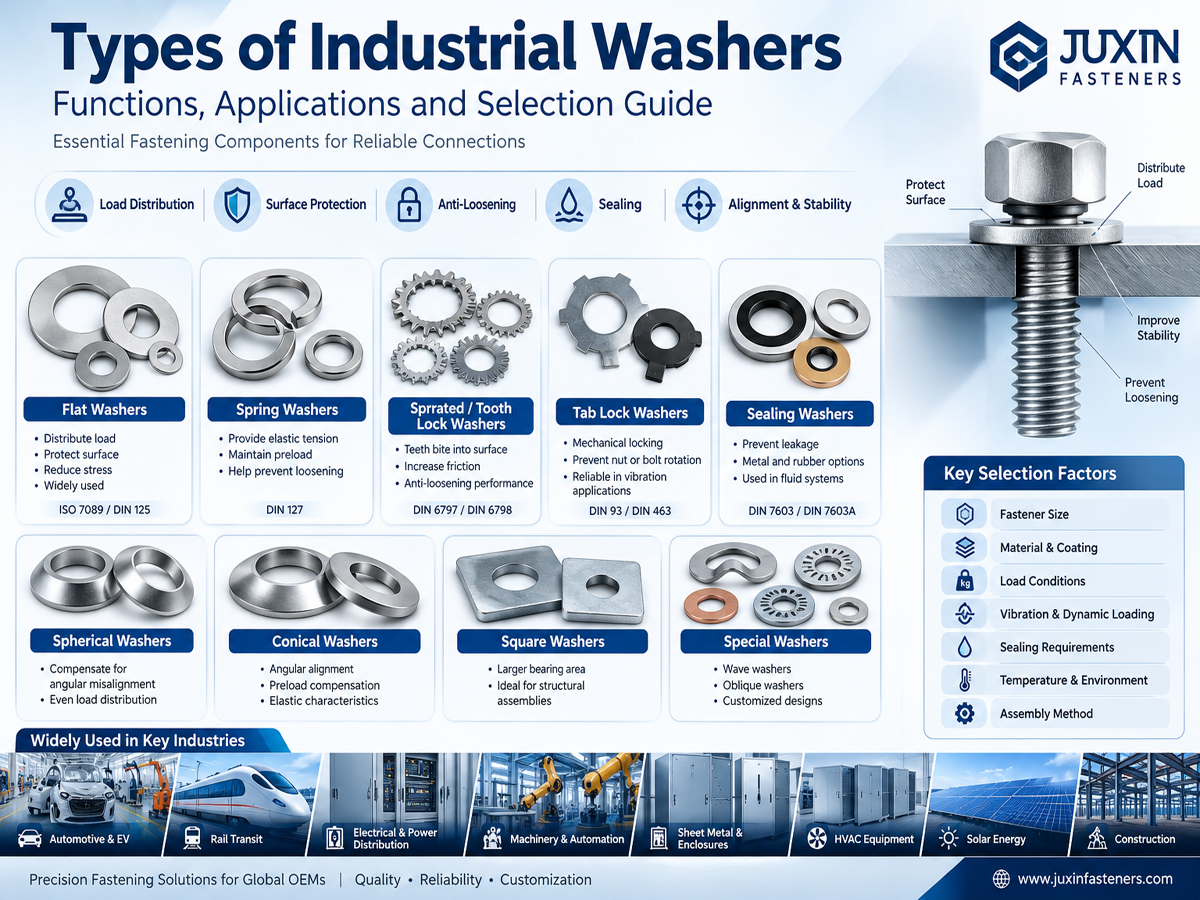
For broader washer-family selection, see Industrial Washers: Types, Functions & Selection Guide.
For washer-and-bolt system engineering, see Washers and Bolts: Fastening Systems Selection Guide.
For high-strength threaded fasteners, see High-Strength Bolts & Nuts: Engineering Selection Guide.
For DIN 6798 J replacement, OEM or MRO RFQs, send your original drawing or sample, nominal size, ID, OD, thickness, material, hardness, finish, mating fastener, application, quantity and estimated annual demand to:
A withdrawn standard does not make an installed component disappear.
The engineering task is to understand what the legacy specification controlled, what the existing assembly requires, and whether the replacement is genuinely equivalent before it enters production or service.
 MORE NEWS
Sep. 25, 2026
Sep. 25, 2026
Sep. 25, 2026
Contact Us
Tel.:
+86 020 8621 0320
+86 020 3121 6067
E-mail:
Technical Support:
Navigation
SEND INQUIREY