
Call Us
+86 136 6007 9809
Call Us
+86 136 6007 9809

Oct. 11, 2023
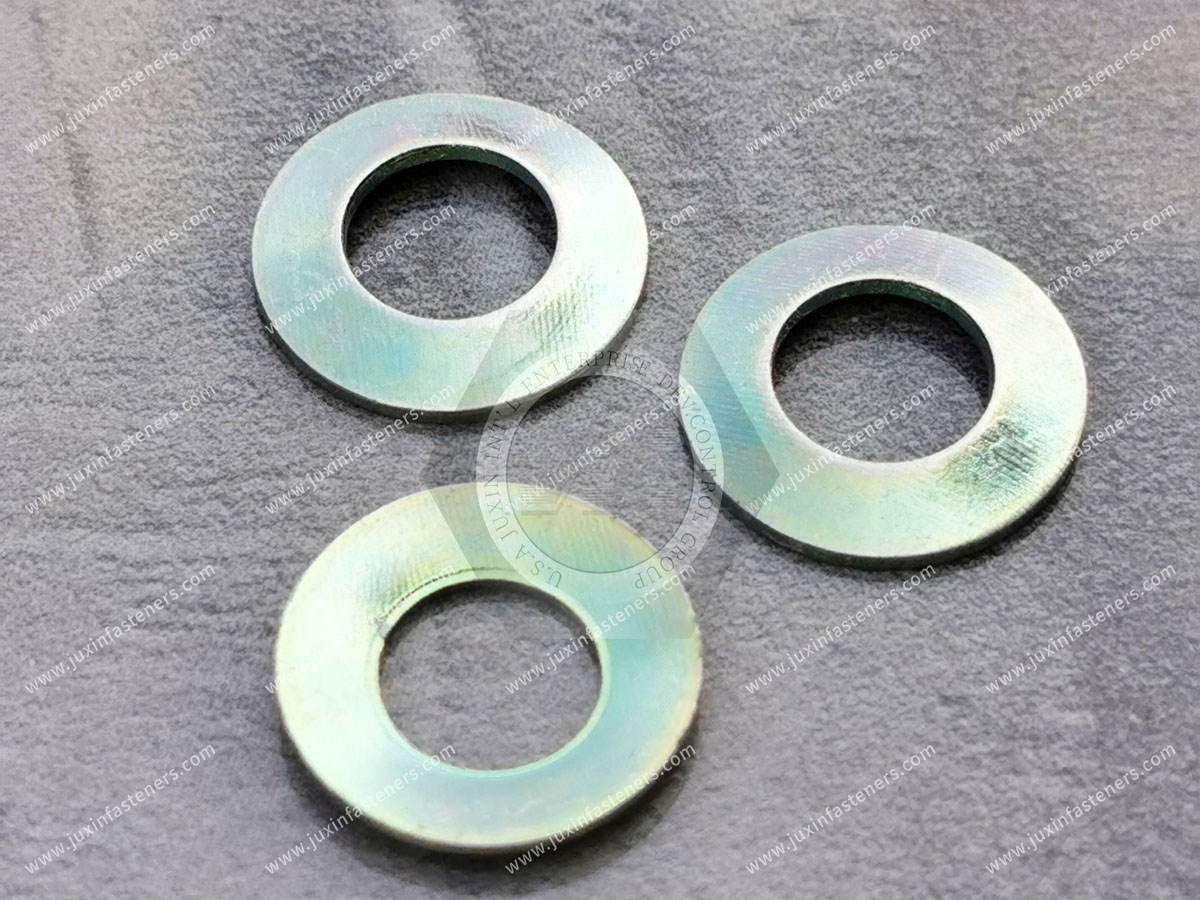
Disc springs and DIN 6796 conical spring washers can look remarkably similar.
Both are annular metal components with a conical profile. Both deflect under axial compression. Both can store elastic energy. Both may appear in assemblies where preload and movement matter.
That visual similarity creates a common sourcing problem:
A disc spring and a DIN 6796 conical spring washer are not automatically interchangeable.
Their intended engineering functions are different.
A true disc spring, also widely called a Belleville spring or Belleville washer, is primarily engineered as a mechanical spring element. Its force–deflection behavior,
working travel, stress, fatigue, relaxation and possible stacking arrangements are central to the design.
A DIN 6796 conical spring washer is specifically intended for use in bolted connections.
This creates the fundamental selection logic:
Need a designed axial spring element? → Evaluate a Disc Spring
Need a conical spring washer specifically for a bolted connection? → Evaluate DIN 6796
For mechanical engineers, design engineers and procurement teams, understanding this distinction is more useful than comparing the two products only by outside diameter, inside diameter and thickness.
The simplest engineering distinction is:
| Design Question | Disc Spring / Belleville Spring | DIN 6796 Conical Spring Washer |
|---|---|---|
| Primary role | Mechanical spring element | Elastic washer for bolted connections |
| Main engineering focus | Force, deflection, stress, fatigue, relaxation | Bolted-joint application and elastic washer behavior |
| Typical standards framework | EN 16983 / EN 16984 | DIN 6796 |
| Stacking | Common engineering option | Not automatically treated as a disc-spring stack |
| Typical design question | “What force is required at what deflection?” | “Is this washer appropriate for this bolted joint?” |
| Replacement basis | Geometry + spring performance + duty | Standard/drawing + bolt/joint interface |
| Automatically prevents loosening? | No | No |
This last point is especially important.
Elastic preload support and resistance to rotational self-loosening are not the same engineering function.
A disc spring is a conical annular spring designed to produce a defined relationship between axial load and deflection.
Common names include:
disc spring;
Belleville spring;
Belleville washer;
disc spring washer;
conical disc spring.
Important engineering parameters include:
outside diameter;
inside diameter;
thickness;
free height;
cone height;
force at specified deflection;
working deflection range;
material;
static or dynamic duty;
fatigue requirement;
relaxation;
operating temperature;
and stack arrangement.
Disc springs may be used individually or combined in series, parallel or mixed arrangements.
Their principal value is their ability to generate substantial axial force within a compact installation height.
DIN 6796 defines conical spring washers for bolted connections.
Unlike a general-purpose mechanical disc spring, the DIN 6796 washer should be understood in the context of the threaded joint in which it operates.
It is installed beneath an appropriate bolt head or nut and elastically deflects as the joint is tightened.
The washer adds elastic behavior to the clamped system.
This can be useful where the designer is concerned about preload changes caused by limited amounts of:
settlement;
embedding;
dimensional movement;
thermal effects;
gasket or interface behavior;
or other joint displacement.
However, the exact benefit depends on the complete bolted joint.
DIN 6796:2009-08 remains the current DIN standard for conical spring washers for bolted connections.
This is important because older industrial drawings may reference previous editions.
For a new project, procurement teams should verify:
the required standard edition;
nominal size;
material or technical delivery requirement;
finish;
mating bolt/nut;
and any customer-specific drawing requirements.
If an existing approved drawing specifies a particular historical edition, suppliers should not silently substitute another requirement.
DIN 2093 is still frequently encountered in legacy drawings and online product descriptions for disc springs.
However, DIN 2093 has been withdrawn.
The current European disc-spring framework uses:
EN 16983 / DIN EN 16983 — Disc springs: Quality specifications and dimensions
and
EN 16984 / DIN EN 16984 — Disc springs: Calculation
Therefore, a modern engineering page should not describe DIN 2093 as the current controlling disc-spring standard.
Legacy DIN 2093 requirements may still matter for existing equipment, spare parts or customer drawings, but they should be treated as legacy specifications.
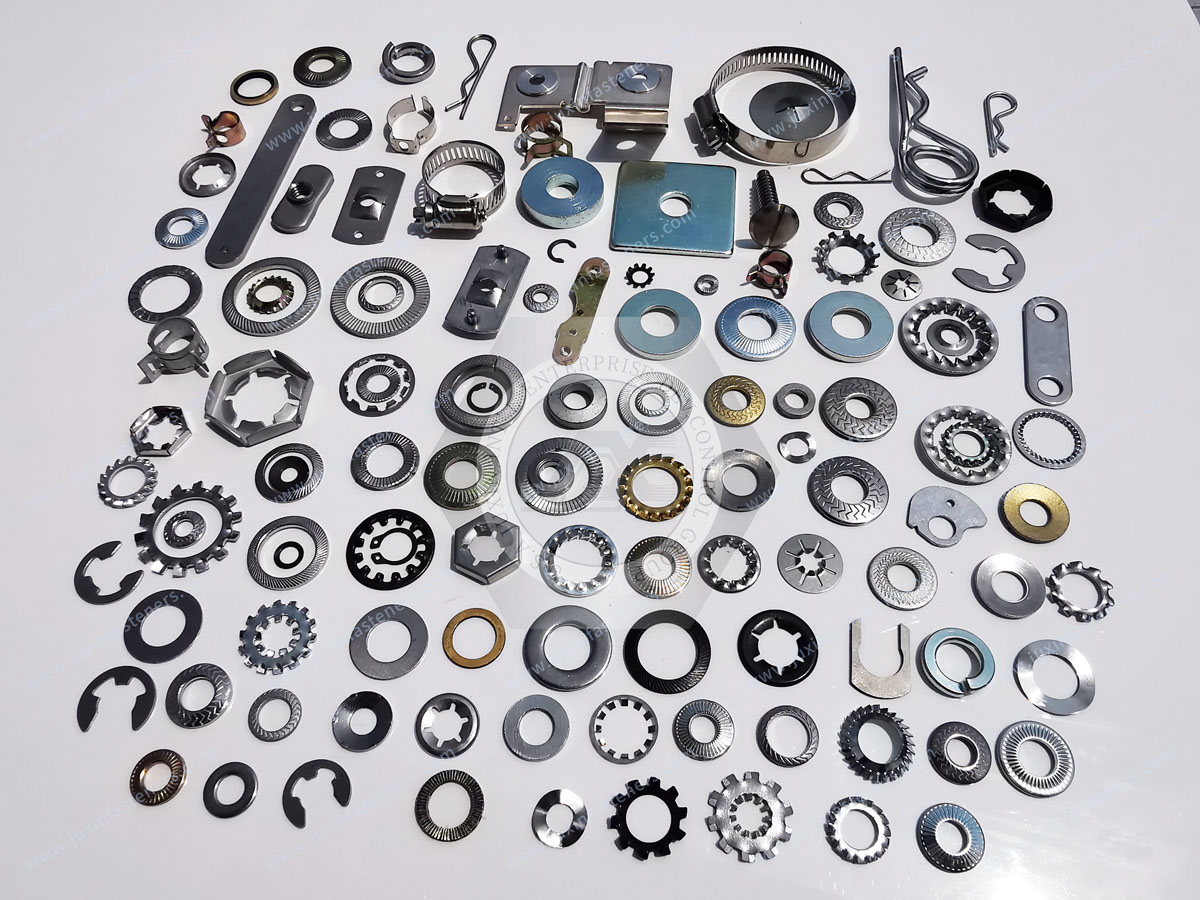
The confusion usually comes from terminology.
Industrial buyers may use phrases such as:
disc washer;
disc spring washer;
Belleville washer;
conical washer;
conical spring washer;
spring disc;
bolt spring washer.
Some of these terms are used inconsistently between markets, suppliers and legacy drawings.
This creates a procurement risk.
A request such as:
“Need M16 Belleville washer”
does not necessarily provide enough information to identify the required component.
The supplier still needs to know:
Is this a mechanical spring?
Is it a DIN 6796 washer?
Is there an existing drawing?
Is there a standard callout?
What function does it perform?
What is the mating bolt?
Is force–deflection performance specified?
Product name alone should not control the engineering decision.
The easiest way to separate the products is to look at the complete system.
A disc spring design can be represented as:
External Load → Disc Spring → Controlled Deflection → Restoring Force
The engineer is primarily concerned with spring behavior.
A DIN 6796 application can be represented as:
Bolt / Nut → Conical Spring Washer → Clamped Parts → Joint Preload System
The washer is one element within a larger bolted connection.
The engineer should therefore evaluate the complete joint rather than treating the washer as an independent anti-loosening device.
This is one of the most important distinctions in washer selection.
A bolted connection can lose clamp load without the nut or bolt visibly rotating.
Possible causes include:
embedding;
settling;
gasket compression;
creep;
thermal movement;
contact-surface changes;
or deformation of clamped components.
This is preload loss.
Rotational self-loosening is different.
It involves relative rotation of the threaded fastener under conditions that may include transverse movement, vibration or dynamic loading.
Therefore:
Preload Loss ≠ Rotational Loosening
and
Preload Compensation ≠ Automatic Thread Locking
A conical spring washer may increase the elastic reserve of an appropriate joint, but this should not automatically be described as “preventing vibration loosening.”
Imagine two bolted assemblies experiencing the same small dimensional loss at the joint interface.
A very stiff system may experience a relatively large reduction in clamp load from that displacement.
A system with additional elastic travel may respond differently.
This is one reason engineers sometimes introduce elastic elements into bolted joints.
The relevant question is not simply:
“How strong is the washer?”
It is:
“How does the washer change the load–displacement behavior of the complete bolted joint?”
That is a much more useful engineering question.
It can contribute elastic compliance to an appropriately designed bolted connection.
But the result depends on:
bolt stiffness;
clamped-part stiffness;
washer geometry;
washer deflection;
initial preload;
joint settlement;
temperature;
friction;
bearing surfaces;
and external loading.
Therefore, no universal preload-retention percentage should be quoted without the applicable design basis.
The old practice of stating that every DIN 6796 washer produces a fixed percentage of bolt preload is too simplistic for a general engineering article.
Not automatically.
A DIN 6796 conical spring washer should not be treated as equivalent to every other locking technology.
Resistance to vibration-induced loosening depends on the complete joint.
Potential strategies for threaded-joint security may include, depending on the application:
suitable preload;
joint design;
prevailing-torque fasteners;
mechanical locking features;
adhesive locking;
wedge-locking systems;
locking nuts;
or other engineered approaches.
The appropriate method depends on the failure mechanism.
If the actual problem is rotational self-loosening under transverse vibration, the engineer should evaluate a solution specifically intended for that problem.
For a true disc spring, the load–deflection relationship is a primary design characteristic.
Geometry influences:
spring force;
available deflection;
stress;
stiffness;
and spring behavior.
Important dimensions include:
outside diameter;
inside diameter;
thickness;
free height;
and cone height.
Material properties and manufacturing tolerances also influence performance.
A disc spring should therefore not be replaced using nominal diameter alone.
One of the clearest differences between disc springs and DIN 6796 bolted-joint washers is the importance of engineered stacking.
Disc springs arranged in series can provide increased total deflection.
Conceptually:
More Series Discs → More Available Travel
Actual performance is influenced by friction, tolerance and guidance.
Nested discs arranged in parallel can provide increased force.
Conceptually:
More Parallel Discs → Greater Combined Force
Again, friction between contacting discs affects real behavior.
Series and parallel groups can be combined to obtain a required balance of:
force;
deflection;
installed length;
and stiffness.
This makes disc springs suitable for engineered spring systems beyond ordinary bolted-joint washer applications.
A common engineering mistake is seeing two conical products and assuming they can be stacked using the same design logic.
DIN 6796 washers are intended for bolted connections.
Disc springs are engineered as spring elements under the applicable disc-spring framework.
If an application requires a calculated spring stack, use the appropriate disc-spring design approach rather than assuming multiple DIN 6796 washers create an equivalent spring system.
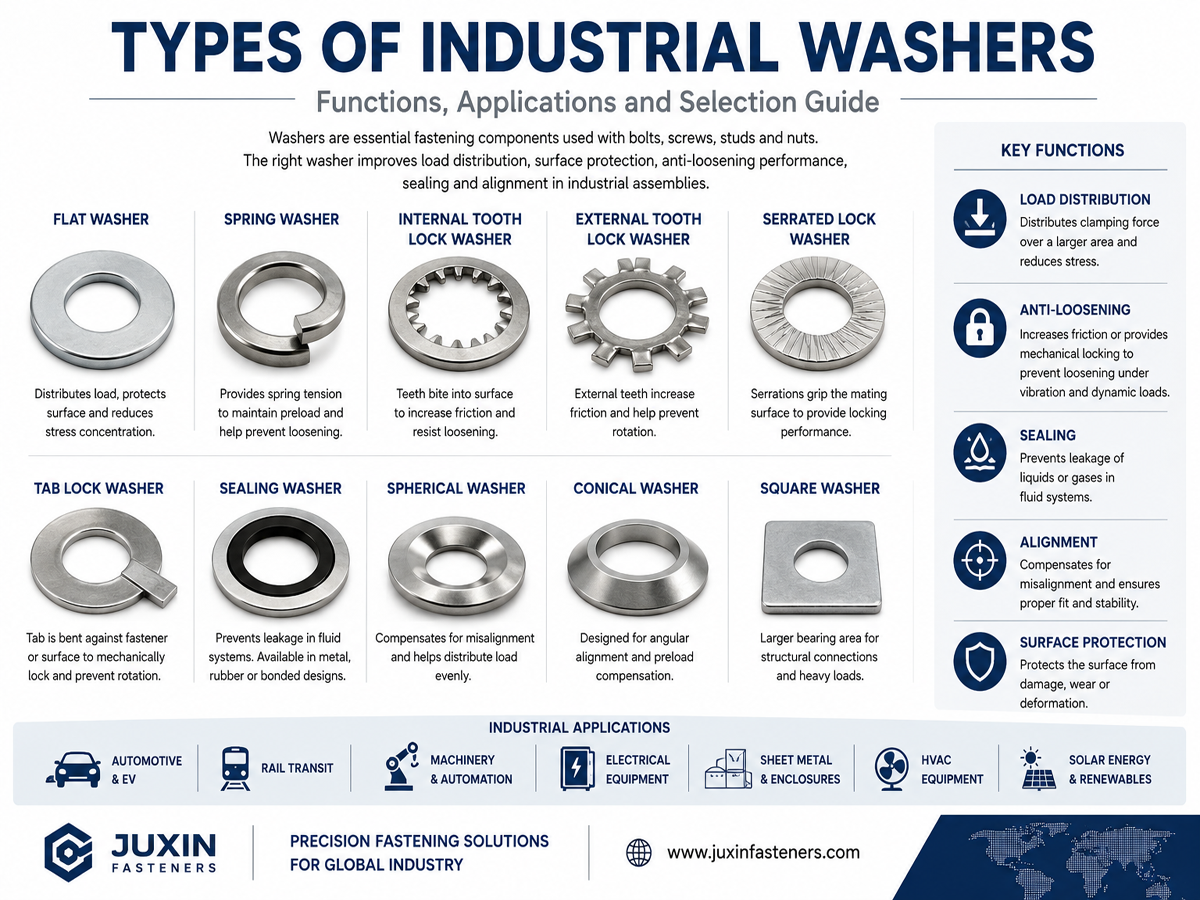
A conventional flat washer primarily provides functions such as:
bearing-area distribution;
seating;
surface protection;
or separation between components.
A DIN 6796 washer adds elastic deflection.
Therefore:
Flat Washer → Primarily Bearing / Seating Function
DIN 6796 Washer → Elastic Washer Function in a Bolted Connection
Whether both are required, or whether one should be omitted, depends on the specific joint design and applicable specification.
Do not apply a universal rule to every bolted assembly.
These products use different geometries and should not be treated as interchangeable simply because both may be called “spring washers.”
A split lock washer and a DIN 6796 conical spring washer have different:
shapes;
contact conditions;
deformation behavior;
standards;
and intended application logic.
Selection should begin with the joint problem, not the generic phrase “lock washer.”
A wedge-locking washer system uses a fundamentally different mechanical principle from a conical spring washer.
Its locking behavior should not be confused with the elastic behavior of DIN 6796.
This distinction is especially useful when the design problem is severe transverse vibration.
The engineering sequence should be:
Identify Failure Mode → Select Locking / Elasticity Strategy → Validate Complete Joint
not:
Vibration Exists → Add Any Spring Washer
The old article associated DIN 6796 washers broadly with bolt property classes 8.8 through 12.9.
Bolt strength is relevant, but bolt property class alone does not determine washer suitability.
The engineer should also consider:
bolt diameter;
bolt preload;
nut or tapped-hole interface;
bearing surface;
clamped materials;
joint stiffness;
surface coating;
friction;
service temperature;
dynamic loading;
and joint settlement.
A high-strength bolt does not automatically require a DIN 6796 washer.
Likewise, adding a conical washer does not automatically improve every high-strength joint.
A conical spring washer deflects as the bolted connection is tightened.
Its installed condition should be consistent with the applicable design and standard requirements.
However, engineers should avoid simplistic rules such as:
“Always tighten until completely flat.”
The correct installed condition depends on the specific washer and joint design.
Over-compression or inappropriate use can reduce the intended elastic behavior.
For critical applications, installation requirements should come from the approved drawing, joint calculation or relevant specification.
Adding an elastic washer does not remove the influence of friction from torque-controlled tightening.
Torque-to-preload behavior is affected by:
thread friction;
under-head or under-nut friction;
washer surface;
coating;
lubrication;
material;
and installation process.
Therefore:
Same Tightening Torque ≠ Automatically Same Bolt Preload
when washer, coating or lubrication conditions change.
This becomes especially important in second-source qualification.
DIN 6796 conical spring washers are commonly associated with spring-steel construction under the applicable standard and technical delivery requirements.
For non-standard or application-specific elastic washers, material selection should be based on:
required mechanical behavior;
temperature;
corrosion;
fatigue;
environment;
coating;
and customer drawing.
Disc springs may use a broader range of materials depending on the application, including appropriate spring steels, stainless grades and high-performance alloys.
Do not assume that a material suitable for a disc spring is automatically suitable for a DIN 6796 replacement.
Depending on product, material and customer requirements, possible finish strategies may include suitable:
trivalent zinc systems;
zinc-nickel;
phosphate/oil;
non-electrolytic coating systems;
or stainless-steel passivation for appropriate stainless components.
Hexavalent chromium should not be specified.
Finish selection should consider:
corrosion environment;
friction;
fatigue sensitivity;
hydrogen-embrittlement risk where applicable;
bearing surfaces;
dimensional effect;
temperature;
and restricted-substance requirements.
Color alone is not a coating specification.
The old article divided conical washers into generic products rated from -200°C to 300°C or even 600°C.
Those ranges should not be applied universally.
Temperature capability depends on:
material;
heat treatment;
stress;
relaxation;
oxidation;
coating;
corrosion;
and required mechanical behavior.
If an application operates at elevated or cryogenic temperature, the RFQ should specify the actual service temperature and performance requirement.
A supplier can then evaluate whether a standard DIN 6796 product, a disc spring or a custom spring component is appropriate.
Fatigue performance depends on:
stress level;
stress range;
material;
heat treatment;
geometry;
surface condition;
cyclic displacement;
corrosion;
temperature;
and required number of cycles.
A static bolted-joint washer and a dynamically cycled disc spring therefore require different engineering evaluations.
For cyclic applications, define the duty.
Do not rely on a generic “long service life” claim.
A useful selection process begins with the mechanical function.
The assembly requires a mechanical spring with a defined relationship among:
force;
deflection;
travel;
stress;
fatigue;
relaxation;
and available space.
Examples may include:
bearing preload;
valve mechanisms;
actuators;
overload systems;
clamping mechanisms;
brake or clutch mechanisms;
and engineered spring stacks.
The engineering problem exists specifically within a bolted connection and an elastic conical washer is required under the applicable joint design.
Potential objectives may include adding elastic compliance or helping accommodate limited preload changes associated with joint displacement.
The primary problem is rotational self-loosening under transverse vibration or another defined locking failure mode.
This distinction prevents a common sourcing mistake:
Using a preload-compensation product to solve a locking problem without first identifying the failure mechanism.
Industrial machinery contains both true spring systems and bolted joints.
DIN 6796 washers may be considered in appropriate:
machinery frames;
equipment modules;
mechanical assemblies;
machine tools;
drive equipment;
and bolted subassemblies.
Disc springs may instead be used in:
clamping mechanisms;
tool holders;
bearings;
overload protection;
actuators;
and preload systems.
The two products may therefore exist in the same machine while performing completely different functions.
Automotive and EV equipment contains:
bolted mechanical assemblies;
power electronics;
charging equipment;
production machinery;
tooling;
actuators;
bearing systems;
and other mechanical systems.
DIN 6796 conical spring washers may be considered where the specific bolted-joint design calls for them.
Disc springs may be used where a controlled mechanical spring function is required.
Generic components should not automatically be represented as automotive-qualified or safety-critical vehicle hardware without the required program validation.
Power equipment can experience:
thermal cycling;
heavy mechanical loads;
equipment vibration;
long service periods;
and preload-sensitive connections.
Potential applications may occur in:
power-generation equipment;
electrical machinery;
switchgear mechanisms;
industrial power systems;
energy-storage equipment;
and serviceable mechanical assemblies.
Where thermal movement affects joint preload, engineers should evaluate the complete stiffness and temperature behavior rather than assuming a conical washer alone solves the problem.
Most ordinary enclosure screws do not require DIN 6796 washers.
However, selected internal mechanical or power-equipment connections may require additional elastic compliance.
Potential applications may include suitable:
power modules;
mechanical support structures;
heavy electrical equipment;
switch mechanisms;
and equipment mounting assemblies.
Electrical grounding or bonding should be treated separately.
A DIN 6796 washer does not automatically establish a validated electrical contact path.
DIN 6796 washers and disc springs should not be marketed as generic “AI server washers.”
The credible applications are in mechanical and power infrastructure where the function genuinely requires them.
Potential equipment can include:
UPS systems;
PDU equipment;
power-conversion systems;
cooling equipment;
CDU systems;
pumps;
valves;
actuators;
and selected mechanical support equipment.
The product should be connected to the actual mechanical requirement:
Bolted-Joint Elasticity → DIN 6796
or
Mechanical Spring Function → Disc Spring
rather than merely adding an AI data-center keyword.
Liquid-cooling infrastructure contains:
pumps;
valves;
heat-exchange equipment;
mechanical frames;
power equipment;
and serviceable bolted assemblies.
Disc springs may appear in valve, actuator, preload or mechanical control functions.
DIN 6796 washers may be considered for suitable bolted connections where their elastic behavior is required.
Neither product should automatically be described as a pressure-sealing component.
Semiconductor equipment contains precision machinery, automation, valves, actuators and mechanical structures.
Disc springs may be used for controlled force or preload.
Conical spring washers may be considered in suitable bolted assemblies.
Vacuum compatibility, cleanroom compatibility and contamination requirements must be separately specified and validated.
Automation equipment may use disc springs in:
grippers;
fixtures;
overload mechanisms;
actuator systems;
clamping mechanisms;
and tooling.
DIN 6796 washers may be used in appropriate bolted assemblies within machinery or control equipment.
For moving robotic systems, dynamic loads and vibration require application-specific joint evaluation.
Construction and off-highway equipment can expose bolted assemblies to:
shock;
vibration;
contamination;
thermal cycling;
and heavy mechanical loading.
DIN 6796 washers may be considered where the bolted-joint design specifically benefits from an elastic conical washer.
The product should not automatically be represented as a structural connection solution without engineering validation.
Rail equipment contains bolted mechanical, electrical and equipment assemblies operating under vibration and long service cycles.
Both disc springs and conical spring washers may have suitable applications.
However, rail-specific vibration, fatigue, fire and safety requirements remain separate qualification issues.
Generic industrial washers should not automatically be represented as rail-qualified.
HVAC equipment includes:
compressors;
pumps;
valves;
actuators;
fans;
drives;
and mechanical equipment.
Disc springs may provide controlled spring force in suitable mechanisms.
DIN 6796 washers may be considered for appropriate bolted connections.
Neither should automatically be described as sealing, waterproofing or vibration-certification hardware.
Commercial food-service equipment contains much more than enclosure panels.
Mechanical systems can include:
refrigeration equipment;
compressors;
pumps;
dispensing mechanisms;
hinges;
latches;
valves;
heating equipment;
adjustment systems;
and serviceable machinery.
A disc spring may provide compact mechanical preload in an actuator, valve or clamping mechanism.
A DIN 6796 conical spring washer may be considered in a suitable bolted equipment connection where elastic joint behavior is required.
However, neither product should automatically be described as:
food-contact compliant;
hygienic-design certified;
washdown-rated;
or resistant to every cleaning chemical.
Material and finish must be selected for the actual equipment location and environment.
Suitable applications may occur in:
diagnostic machinery;
laboratory equipment;
mechanical actuators;
equipment frames;
clamping systems;
and serviceable mechanisms.
The product itself does not establish medical-device certification, biocompatibility, sterilization compatibility or cleanroom qualification.
Disc springs and conical spring washers may be considered for suitable:
tooling;
ground-support equipment;
test equipment;
electronics enclosures;
and non-flight-critical equipment
where program requirements permit.
Generic industrial products should not be represented as flight-qualified or aerospace-certified without appropriate evidence.
Similar shape does not mean identical spring performance.
DIN 2093 is a legacy reference. Current European disc-spring requirements should be reviewed under EN 16983 / EN 16984 as applicable.
Elastic joint behavior and rotational locking are different functions.
The complete joint and product specification matter.
Bolt property class alone does not define the correct washer strategy.
Changes in coating, lubrication, washer interface and friction can change torque–preload behavior.
The required spring force and deflection may be completely different.
Temperature capability must be tied to material and required mechanical behavior.
A second-source program should begin by identifying which product is actually being sourced.
outside diameter;
inside diameter;
thickness;
free height;
force at specified deflection;
working range;
material;
heat-treatment requirement where specified;
surface finish;
fatigue requirement;
relaxation requirement;
temperature;
stack arrangement;
and guidance.
standard designation and edition;
nominal size;
geometry;
mating bolt or nut;
bolted-joint application;
material/technical delivery requirement;
finish;
bearing interface;
environmental condition;
and customer-specific drawing requirements.
Same outside diameter does not establish functional equivalence.
JUXIN FASTENERS distinguishes among different sourcing objectives.
Critical dimensions and interfaces match the approved requirement.
Some non-critical geometry may differ while the required installation and function remain acceptable after customer validation.
Material, finish, dimensions or another feature is intentionally changed.
A new washer or spring component is developed around the actual mechanical requirement.
For spring products, functional equivalence should include mechanical behavior—not appearance alone.
When the original drawing is unavailable, an existing physical sample can support development.
A practical workflow is:
Physical Sample → Dimensional Review → Functional Review → Critical Feature Identification → Material / Finish Information Review → Drawing Confirmation → Manufacturing Feasibility → Prototype / Sample Development → Customer Validation → Production
A physical sample can help establish:
dimensions;
shape;
visible finish;
mounting relationship;
and application clues.
But the sample alone may not reveal:
exact alloy chemistry;
heat treatment;
original spring-force requirement;
fatigue requirement;
relaxation requirement;
original coating chemistry;
or intended bolt preload.
Therefore, the customer should provide application information wherever possible.
This comparison page serves two different B2B search journeys.
Engineers may search:
disc spring vs Belleville washer;
disc spring vs conical spring washer;
DIN 6796 vs disc spring;
DIN 6796 anti loosening;
conical spring washer preload;
spring washer preload loss;
Belleville washer bolt preload;
disc spring load deflection.
Their primary question is:
Which mechanical principle solves the problem?
Procurement and supplier-development teams may search:
DIN 6796 washer manufacturer;
DIN 6796 washer supplier;
conical spring washer manufacturer;
Belleville washer supplier;
disc spring second source;
custom conical spring washers;
spring washer from drawing;
spring washer from sample.
Their primary question is:
Can another supplier manufacture and qualify the required part without changing its function?
A useful B2B page should answer both.
For a technically useful quotation, provide:
DIN 6796 designation where applicable
Standard edition if controlled
Nominal size
Customer part number
Existing drawing
Physical sample where available
Bolt diameter
Thread system
Bolt property class where relevant
Nut or tapped-hole information
Joint materials
Bearing surface
Intended preload where known
Tightening method
Existing washer arrangement
Static or dynamic equipment
Vibration environment
Thermal cycling
Joint settlement concern
Required service life
Safety or qualification requirements where applicable
Material requirement
Coating
Corrosion requirement
Restricted-substance requirement
Lubrication condition where controlled
Operating temperature
Sample quantity
Pilot quantity
Production quantity
Estimated annual usage
Packaging
Traceability requirements where specified
Target schedule
Long-term supply requirement
If the requirement is actually a mechanical disc spring rather than DIN 6796, also provide:
outside diameter;
inside diameter;
thickness;
free height;
required force;
force measurement position;
working deflection;
minimum and maximum load;
static or dynamic duty;
cycle requirement;
relaxation requirement where applicable;
stack arrangement;
guidance;
temperature;
and available installation space.
This difference in RFQ information is itself a useful way to identify whether the correct product family has been selected.
For conical spring washers and disc springs, procurement teams should evaluate more than unit price.
Relevant capabilities may include:
drawing review;
standards interpretation;
material control;
manufacturing feasibility;
heat-treatment control where applicable;
dimensional inspection;
spring-performance requirements where specified;
surface-finish control;
sample development;
high-volume production capability;
packaging;
change communication;
and long-term supply support.
For suitable high-volume programs, automatic optical sorting may be used for compatible externally measurable characteristics depending on product geometry and inspection requirements.
Optical sorting does not replace spring-force, fatigue or complete bolted-joint validation.
JUXIN FASTENERS supports OEM and custom industrial fastener projects for equipment manufacturers, engineering teams, procurement organizations and global supply chains.
Disc spring and conical spring washer projects can be reviewed from:
customer 2D drawings;
3D information where applicable;
physical samples;
standard designations;
dimensions;
required materials;
surface finishes;
application information;
and production quantities.
For replacement or second-source projects, the first objective is to determine whether the existing component is:
a standardized conical spring washer;
a true disc spring;
a custom elastic washer;
or another spring/locking component.
That identification reduces the risk of quoting a visually similar but functionally incorrect replacement.
Prototype or sample evaluation can then be used before volume production so the customer can verify fit, installation and functional requirements in the actual assembly.
A practical decision path is:
What does the component actually need to do?
→ Is it a mechanical spring or part of a bolted joint?
→ Is a standard designation shown on the drawing?
→ If DIN 2093 appears, is it a legacy disc-spring requirement requiring review against the current project specification?
→ If DIN 6796 appears, is the application a bolted connection?
→ Is the problem preload loss, rotational loosening, or both?
→ Does the assembly require defined force–deflection behavior?
→ Does the component operate individually or in a spring stack?
→ What bolt, nut and clamped materials are involved?
→ What operating temperature and corrosion environment apply?
→ What material and finish are required?
→ Is the project an exact replacement, functional equivalent or redesign?
→ How will the sample be validated?
→ What production quantity and long-term supply requirements apply?
This changes the purchasing question from:
“Can you quote this Belleville washer?”
to:
“Is this component a disc spring or a DIN 6796 conical spring washer, and what mechanical function must the replacement preserve?”
That is a much safer sourcing question for engineers, procurement managers and supplier-development teams.
For DIN 6796 conical spring washers, disc springs, Belleville washers, custom spring washers, drawing-based parts,
physical-sample development or second-source projects, send your available drawing, sample, application information, material, finish and quantity to:
JUXIN FASTENERS can review the available information and evaluate an appropriate sample-development and manufacturing path for your application.
 MORE NEWS
Sep. 27, 2026
Sep. 27, 2026
Sep. 27, 2026
Contact Us
Tel.:
+86 020 8621 0320
+86 020 3121 6067
E-mail:
Technical Support:
Navigation
SEND INQUIREY