
Call Us
+86 136 6007 9809
Call Us
+86 136 6007 9809

Jun. 22, 2024
Double-Ended Studs: DIN 938 vs DIN 939, Thread Engagement and OEM Industrial Applications
Double-ended studs are threaded fastening components used in machinery,
equipment housings and other industrial assemblies where one end of a fastener engages a tapped component and the opposite end provides an external thread for securing a mating part.
They are particularly useful when a joint must be assembled, disassembled or serviced repeatedly.
Unlike a conventional bolt, a double-ended stud can remain installed in the base component while the nut is removed during maintenance.
This arrangement may help reduce repeated wear on expensive tapped holes, provided the stud remains correctly installed and the joint is properly designed.
However, the reliability of a double-ended stud connection depends on more than tensile strength.
Engineers must evaluate thread engagement, base material strength, preload, joint stiffness, fatigue loading, corrosion exposure and the installation method.
JUXIN FASTENERS supplies industrial threaded fasteners and drawing-based custom CNC-machined components, including double-ended studs for OEM machinery and equipment applications.
This guide explains the differences between DIN 938 and DIN 939, how to select suitable thread engagement and what engineering and procurement teams should verify before approving a stud for production.
What Is a Double-Ended Stud?
A double-ended stud is a fastener with external threads at both ends.
Many designs include an unthreaded section between the threaded ends.
One end is commonly installed into a tapped hole in a machine housing or other component.
The opposite end receives a nut or another mating threaded component.
The geometry depends on the application and applicable specification.
Typical design features include:
Screw-in threaded end
Nut-end external thread
Specified overall length
Defined thread engagement length
Optional unthreaded shank
Chamfered or otherwise prepared thread ends
Some custom designs use different thread diameters or thread forms at opposite ends.
Such designs require explicit engineering drawings.
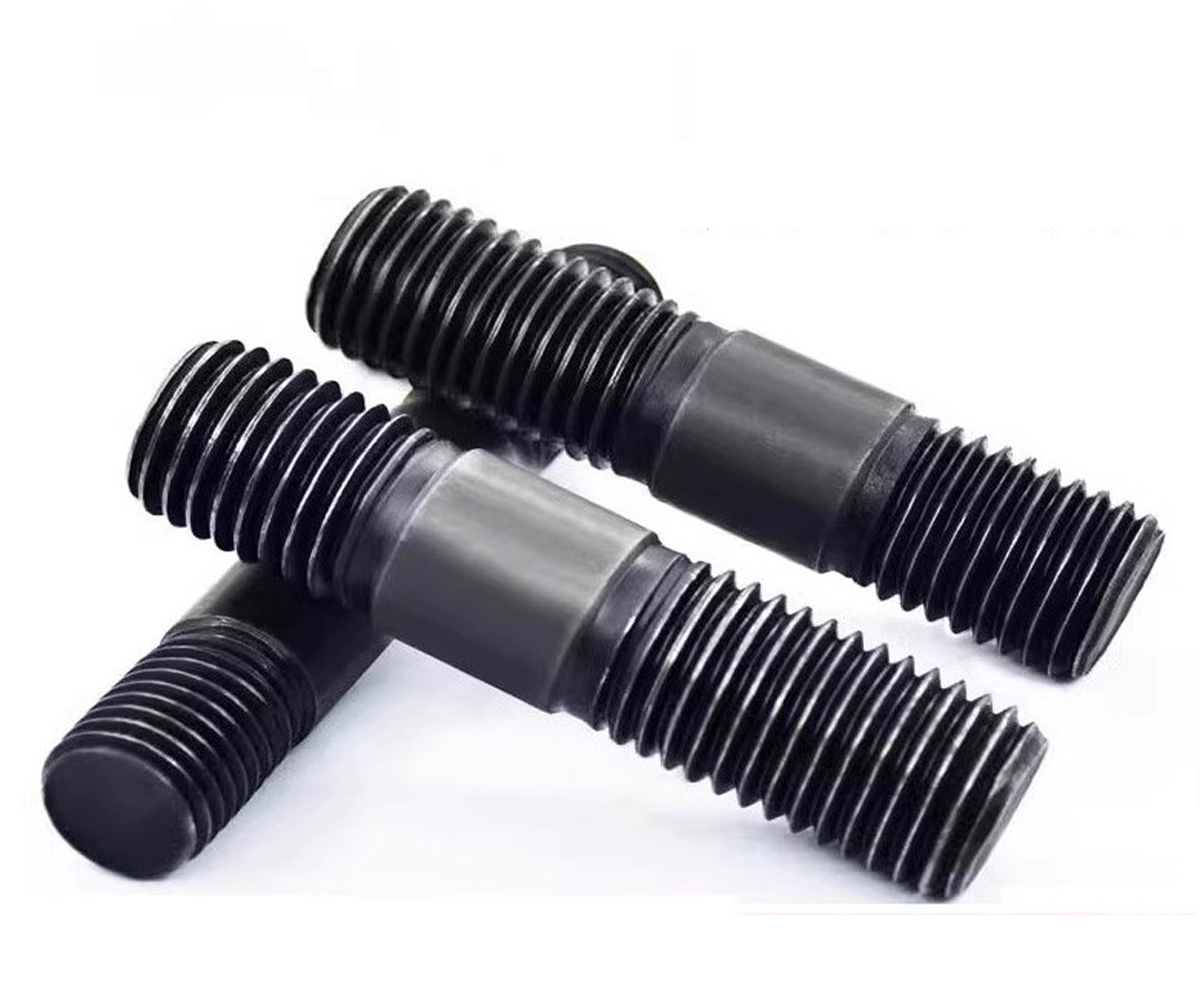
Double-Ended Stud vs. Stud Bolt vs. Threaded Adapter
These terms may overlap in industrial purchasing, but they do not always describe identical products.
Double-Ended Stud
Typically has two defined threaded ends, often with an unthreaded center section.
It is commonly used with one end installed into a tapped component.
Fully Threaded Stud Bolt
May have continuous external threading along most or all of its length.
Such products are often used in flanged joints with nuts at both ends.
Their material and dimensional requirements may differ from those of DIN 938 or DIN 939 machine studs.
Male-to-Male Threaded Adapter
Connects two female-threaded components.
It may use different thread sizes or forms at each end.
A threaded adapter should not automatically be treated as a structural stud.
For OEM purchasing, the actual drawing and thread designations should control the specification rather than the general product name.
DIN 938 vs. DIN 939: What Is the Difference?
DIN 938 and DIN 939 are established dimensional references for double-ended studs with different nominal screw-in end lengths.
The primary distinction is the length of the threaded end intended to engage the tapped component.
DIN 938 Double-Ended Studs
DIN 938 specifies a screw-in end with a nominal length approximately equal to one times the nominal thread diameter.
This is commonly described as a 1d screw-in end.
For example, an M10 stud with a nominal 1d screw-in end has a nominal engagement-end length of approximately 10 mm, subject to the applicable drawing and dimensional definitions.
DIN 938 studs may be considered where the tapped base material and joint design permit the specified engagement.
DIN 939 Double-Ended Studs
DIN 939 specifies a longer screw-in end, nominally approximately 1.25 times the thread diameter.
This is commonly described as a 1.25d screw-in end.
For an M10 stud, the nominal screw-in end length is approximately 12.5 mm, subject to the applicable standard dimensions.
A longer engagement end may be useful where the tapped component requires additional thread engagement.
Does DIN 939 Automatically Provide Higher Clamping Force?
No.
A longer screw-in end does not automatically increase the allowable preload or the stud's tensile strength.
The permissible preload depends on the stud material, thread size, engaged base material, thread geometry, joint design and installation conditions.
Longer engagement may improve resistance to internal thread stripping in some applications, but it cannot compensate for every weakness in the joint.
DIN 938 vs. DIN 939 Selection Table
| Engineering factor | DIN 938 | DIN 939 |
|---|---|---|
| Typical screw-in end | Approximately 1d | Approximately 1.25d |
| Primary distinction | Shorter engagement end | Longer engagement end |
| Base material consideration | Requires adequate tapped-thread strength | May provide additional engagement where needed |
| Tensile strength | Depends on specified material and property class | Depends on specified material and property class |
| Preload capability | Must be calculated for the complete joint | Must be calculated for the complete joint |
| Replacement suitability | Not automatically interchangeable | Not automatically interchangeable |
A substitution between DIN 938 and DIN 939 requires review of the tapped-hole depth, effective engagement, overall stud geometry and assembly clearance.
Why Thread Engagement Is Critical
Thread engagement is one of the most important design parameters in a double-ended stud connection.
The screw-in end transfers load into the internally threaded base component.
If engagement is insufficient, the internal threads may strip before the stud reaches its intended tensile capacity.
If the tapped hole is too shallow, the stud may bottom out before achieving the intended installation condition.
Steel Tapped Components
Steel housings may provide relatively high internal-thread strength, depending on the actual material and condition.
The required engagement must still be verified.
Cast Iron Housings
Cast iron is common in machinery housings, gearboxes and pumps.
Its thread strength depends on the grade and microstructure.
Thread engagement should be selected for the actual casting material rather than assumed from the nominal stud diameter alone.
Aluminum Housings
Aluminum threaded components may require longer engagement or an engineered threaded insert, depending on the alloy, temper, loads and maintenance requirements.
A longer stud alone is not always the best solution.
Where the internal thread is vulnerable to stripping or repeated service wear, a suitable threaded insert may be considered.
Blind Tapped Holes
Blind holes require particular attention to:
Usable thread depth
Drill-point clearance
Thread runout
Stud-end geometry
Bottoming risk
Installation method
The nominal threaded length is not necessarily equal to the effective load-bearing engagement.
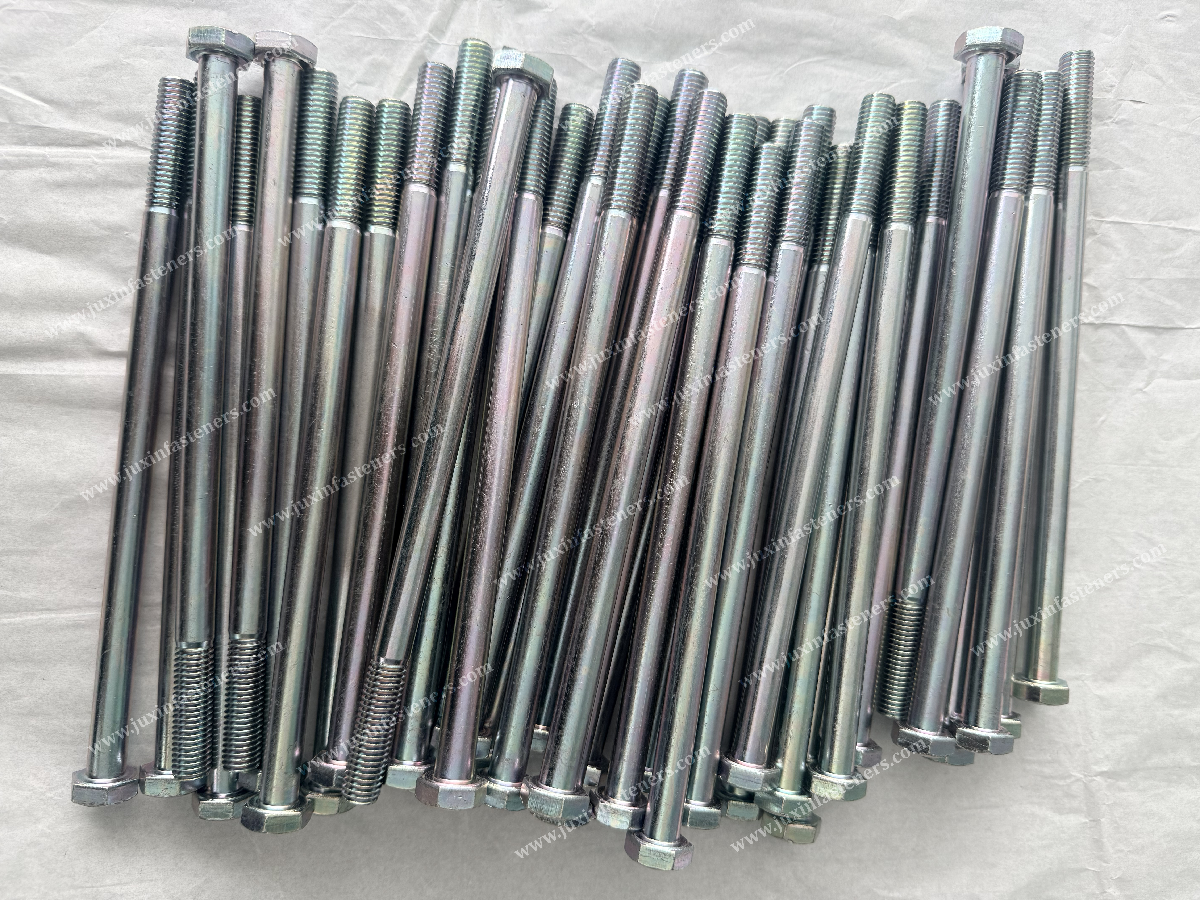
Practical Thread Engagement Decision Matrix
| Joint condition | Main engineering concern | Recommended review |
|---|---|---|
| Steel tapped housing | Stud strength vs. internal-thread strength | Effective engagement and preload |
| Cast iron housing | Internal-thread stripping | Material grade and engagement |
| Aluminum housing | Lower thread strength and service wear | Engagement or threaded insert |
| Blind tapped hole | Stud bottoming | Hole depth and thread runout |
| Repeated maintenance | Wear of base-component threads | Stud retention and service procedure |
| High cyclic loading | Fatigue at thread roots | Preload and joint stiffness |
| Elevated temperature | Preload relaxation | Material properties and thermal effects |
| Corrosive environment | Corrosion and seizure | Material/coating compatibility |
Thread Standards: Metric, UNC, UNF and Other Systems
Double-ended studs may be manufactured with different thread systems according to the drawing.
Metric Threads
Metric thread specifications are commonly based on ISO thread geometry and tolerances.
ISO 261, ISO 965 and related applicable standards may be relevant to the specified thread.
UNC and UNF Threads
Unified inch threads are commonly specified using ASME B1.1.
UNC and UNF have different pitches and application considerations.
BSW and BSF Threads
British Standard Whitworth and British Standard Fine threads use different thread forms from ISO metric and Unified threads.
Important Compatibility Rule
Metric, UNC, UNF, BSW and BSF threads must not be treated as interchangeable.
Even where nominal diameters appear similar, thread pitch, profile and tolerance requirements may differ.
For custom double-ended studs, each end should be identified separately on the drawing.
Double-Ended Stud Materials
Material selection should reflect the actual loading, operating temperature, corrosion exposure and applicable customer requirements.
Carbon Steel
Carbon steel may be suitable for general machinery applications where the specified mechanical properties can be achieved.
Alloy Steel
Alloy steel may be selected for higher-strength applications, subject to the required heat treatment and mechanical properties.
Stainless Steel
Stainless steel may be appropriate where corrosion resistance is important.
However, stainless steel is not automatically stronger than alloy steel, and not every stainless grade is suitable for elevated temperatures or chloride-rich environments.
Other Materials
Special materials may be considered for drawing-based projects where engineering requirements justify them.
Availability and manufacturing feasibility must be confirmed during quotation.
Mechanical Property Specifications
The applicable material and mechanical property standard depends on the actual stud design and intended service.
ISO 898-1 may be relevant to specified carbon steel or alloy steel externally threaded fasteners within its scope.
ISO 3506-1 may be relevant to specified stainless steel fasteners within its scope.
Neither standard should be assumed to cover every custom stud or specialized service condition.
For pressure-containing, high-temperature or safety-critical applications, the applicable equipment specification may impose additional requirements.
Heat Treatment and Mechanical Performance
Heat treatment may be used to achieve specified mechanical properties in suitable materials.
Quenching and tempering are common for certain high-strength alloy steel fasteners.
However, heat treatment must be selected according to the material and required properties.
Case hardening or induction hardening should not be assumed appropriate for a stud whose design requires controlled through-section tensile properties.
Surface Finishes and Corrosion Protection
The appropriate finish depends on the operating environment, thread fit, assembly method and customer requirements.
Possible specifications may include:
Zinc plating
Zinc-nickel plating
Zinc-flake coating
Black oxide
Phosphate and oil
Plain or uncoated finish
Other coatings may be evaluated where technically justified and commercially available.
Coating Thickness and Thread Fit
A coating changes the effective thread dimensions.
For coated studs, the engineer must verify the specified thread tolerance and coating requirements.
ISO 4042 may be relevant to electroplated fasteners within its scope.
ISO 10683 may be relevant to non-electrolytically applied zinc-flake coatings within its scope.
Hydrogen Embrittlement Risk
High-strength steel fasteners may require special attention to hydrogen embrittlement risks associated with certain manufacturing or coating processes.
Coating selection should account for the fastener strength and the relevant specification.
Corrosion Resistance vs. Assembly Friction
Corrosion resistance and tightening behavior are different properties.
A coating that provides corrosion protection does not automatically provide a stable or suitable torque-preload relationship.
Where clamp load is important, the specified coating and lubrication condition should be included in joint validation.
How Double-Ended Studs Are Installed
A common installation sequence involves:
Verify the stud dimensions, thread designation and material.
Inspect the tapped hole for conformity and damage.
Confirm the required engagement depth.
Install the screw-in end using the approved method.
Position the mating component.
Install the nut and washer arrangement specified by the joint design.
Apply the approved tightening procedure.
Verify any required final assembly characteristics.
Avoid Stud Bottoming
In blind holes, the stud should not be unintentionally forced against the bottom of the hole.
Bottoming may create misleading torque readings or damage the component.
Stud Installation Methods
Depending on the design, studs may be installed using suitable stud-driving tools, a double-nut method or other approved procedures.
The installation method must avoid damage to the threads and ensure the intended engagement.
Preload and Tightening Torque
The tightening torque applied to a nut is not identical to the clamp load generated in the joint.
Friction at the threads and bearing surfaces significantly influences the torque-preload relationship.
For critical joints, the tightening procedure must be established using the actual materials, coatings, lubrication and joint geometry.
Why Double-Ended Studs Can Be Useful for Maintenance
In machinery that requires periodic disassembly, a stud can remain installed in the base component while the nut is removed.
This may reduce repeated disturbance of the tapped hole.
The benefit is particularly relevant where the base component is expensive or difficult to repair.
Examples include:
Gearbox housings
Pump casings
Compressor housings
Industrial engine assemblies
Machine equipment covers
However, the stud must remain properly installed, and the maintenance procedure must be compatible with the joint design.
Do Double-Ended Studs Provide Better Alignment?
They can assist assembly by providing projecting threaded locations before a component is secured.
This may be useful when positioning heavy or awkward components.
However, ordinary threaded studs should not automatically be treated as precision locating dowels.
If accurate component positioning is critical, dedicated locating features may be necessary.
Do Studs Distribute Load More Evenly Than Bolts?
Not inherently.
Load distribution depends on joint stiffness, fastener arrangement, preload, bearing surfaces and the connected components.
A stud may offer assembly advantages, but superior load distribution must be demonstrated for the actual joint.
Vibration, Fatigue and Anti-Loosening
Double-ended studs can experience cyclic loading, vibration and thermal changes.
A properly designed joint relies on appropriate preload and sufficient joint integrity.
Fatigue Considerations
Fatigue performance depends on:
Thread-root geometry
Material properties
Surface condition
Preload
Joint stiffness
Cyclic loading
Bending or misalignment
A larger unthreaded shank does not automatically guarantee improved fatigue performance.
Vibration Loosening
A stud does not inherently prevent the nut from loosening.
Where appropriate, the joint may require a specified locking method.
Options may include compatible prevailing-torque nuts, approved locking compounds or other engineered retention systems.
The locking method must be selected for the temperature, materials, service requirements and assembly procedure.
Thermal Expansion and Preload Loss
Temperature changes can affect the relative expansion of the stud and connected components.
In elevated-temperature service, preload relaxation and material property changes may also become important.
The joint must be assessed for its operating temperature range.
Common Double-Ended Stud Failures
Internal Thread Stripping
Potential causes include insufficient engagement, weak base material, damaged threads or excessive preload.
Stud Tensile Failure
Potential causes include excessive axial load, incorrect material specification or an unsuitable tightening procedure.
Fatigue Cracking
Potential causes include cyclic loading, insufficient preload, bending or stress concentration.
Nut Loosening
Potential causes include vibration, joint settlement, inadequate preload or an unsuitable locking strategy.
Thread Galling
Galling may occur in certain material combinations, including some stainless steel threaded assemblies.
Material selection, surface condition and appropriate lubrication may need to be considered.
Corrosion and Seizure
Corrosion can make disassembly difficult and may reduce effective load-bearing capacity.
The environment and maintenance interval should influence the material and coating specification.
Industrial Applications
Automotive and Industrial Vehicles
Double-ended studs may be used in suitable engine, transmission, exhaust and equipment mounting applications.
Material and mechanical requirements must be based on the actual joint.
Safety-critical automotive applications require the applicable customer approval and validation.
Heavy Equipment and Mining Machinery
Applications may include:
Gearbox housings
Pump assemblies
Compressor housings
Hydraulic equipment
Industrial machinery covers
Equipment mounting connections
The selection should reflect vibration, contamination, maintenance frequency and mechanical loading.
Pumps, Compressors and Industrial Engines
Studs may be useful where repeated disassembly is expected.
The screw-in end should be selected for the housing material and tapped-hole design.
Industrial Machinery Manufacturing
Potential applications include:
CNC equipment
Packaging machinery
Industrial automation equipment
Injection molding machinery
Processing equipment
Stud connections may simplify assembly and servicing where the design supports them.

Power Equipment and Renewable Energy
Custom double-ended studs may be considered for suitable equipment housings, electrical machinery and industrial support assemblies.
Use in safety-critical energy infrastructure requires project-specific qualification.
Oil and Gas Equipment
Specialized studs are used in many oil and gas assemblies.
However, pressure-containing flange bolting and high-temperature service may require dedicated material standards, traceability and qualification.
Ordinary DIN 938 or DIN 939 studs should not automatically be substituted for pressure-rated bolting.
Structural Steel Applications
Structural steel connections require the fastener systems and standards specified by the structural design.
A general machinery stud should not automatically be represented as suitable for bridges, towers or other regulated structural connections.
Marine and Outdoor Equipment
Material and coating selection must consider salt exposure, galvanic corrosion, crevice conditions and maintenance.
Stainless steel is not universally corrosion-proof in marine environments.
Manufacturing and Production Considerations
For production managers and manufacturing engineers, a double-ended stud should be evaluated as part of the complete assembly process.
Important considerations include:
Thread quality and consistency
Stud installation access
Tapped-hole quality
Engagement depth
Tightening sequence
Nut and washer compatibility
Assembly tooling
Inspection requirements
Maintenance access
Rework procedures
Total Installed Cost
The cost of a stud connection includes more than the unit price of the stud.
It may also include:
Tapped-hole preparation
Stud installation
Assembly labor
Tightening verification
Inspection
Maintenance
Replacement of damaged components
The most economical choice depends on the complete production and service requirements.
OEM Procurement and Supplier Qualification
For procurement and supplier development teams, double-ended studs should be sourced against a clear specification.
A generic description such as “M12 double-ended stud” is usually insufficient for a reliable quotation.
Important Purchasing Requirements
Applicable standard or approved drawing
Thread designation at each end
Screw-in end length
Nut-end thread length
Overall length
Unthreaded shank dimensions
Material grade
Mechanical property requirements
Heat treatment
Surface finish
Inspection requirements
Packaging
Annual volume
Delivery schedule
Alternative Supplier Qualification
Two studs with the same nominal diameter may differ in thread engagement, tolerances, shank geometry and mechanical properties.
An alternative supplier should be evaluated against the complete approved drawing.
Custom Double-Ended Stud Manufacturing
JUXIN FASTENERS supports drawing-based inquiries for standard and custom threaded fastening components.
Custom requirements may include:
Special overall lengths
Different screw-in and nut-end lengths
Nonstandard shank geometry
Different thread sizes at opposite ends
Metric or specified inch threads
Material and heat-treatment requirements
Special surface finishes
Drawing-defined tolerances
Manufacturing feasibility, tooling, MOQ and lead time depend on the specific drawing and order requirements.
Frequently Asked Questions
What is the main difference between DIN 938 and DIN 939?
DIN 938 has a nominal screw-in end length of approximately 1d, while DIN 939 has a nominal screw-in end length of approximately 1.25d.
Is DIN 939 stronger than DIN 938?
Not automatically. Strength depends on the material, thread size and joint design. Longer engagement may help where internal-thread strength is limiting.
Can double-ended studs reduce wear in tapped holes?
They may reduce repeated disturbance of the tapped base threads when the stud remains installed during maintenance.
Are double-ended studs better than bolts?
Neither is universally better. Selection depends on assembly, maintenance, joint loading and manufacturing requirements.
Can double-ended studs prevent vibration loosening?
No. The complete threaded joint must be designed for vibration resistance.
Can one end use a metric thread and the other an inch thread?
A custom adapter or stud can be designed with different thread systems if explicitly specified and engineered. The threads are not interchangeable.
Are stainless steel studs always suitable for marine use?
No. The stainless grade and exposure conditions must be evaluated.
Can JUXIN FASTENERS supply custom double-ended studs?
Drawing-based custom threaded stud inquiries can be reviewed for material, dimensions, manufacturing feasibility and quotation.
What should be included in a double-ended stud RFQ?
Provide the drawing, thread specifications, engagement lengths, overall dimensions, material, mechanical requirements, surface finish, quantities and delivery schedule.
JUXIN FASTENERS: Double-Ended Studs and Custom Threaded Components
JUXIN FASTENERS supplies industrial fasteners and drawing-based custom components for international OEM customers.
Relevant products include:
Double-ended threaded studs
DIN 938-type studs
DIN 939-type studs
Custom threaded studs
CNC-machined threaded components
High-strength bolts and screws
Threaded inserts for suitable repair or design applications
Selected industrial locking nuts
Product specifications, materials, coatings, manufacturing feasibility and quality documentation are reviewed according to customer requirements.
Request a Double-Ended Stud RFQ
Are you developing a machinery assembly, replacing an existing threaded stud or qualifying a new supplier for OEM production?
JUXIN FASTENERS welcomes inquiries from mechanical engineers, design engineers, manufacturing engineers, production managers, purchasing managers and supplier development teams.
Please provide:
2D drawing + applicable standard + thread designation at both ends + screw-in end length + nut-end length + overall length + material grade
+ mechanical property requirements + coating + annual volume + target delivery date
Our team can review product options, drawing requirements, sample arrangements, MOQ, lead time and quotation details.
Company: JUXIN FASTENERS
Website: https://www.juxinfasteners.com/
Email: info@juxinfasteners.com
Send your double-ended stud drawings and RFQ to JUXIN FASTENERS for technical evaluation and quotation.
Contact Us
Tel.:
+86 020 8621 0320
+86 020 3121 6067
E-mail:
Technical Support:
Navigation
SEND INQUIREY



