
Call Us
+86 136 6007 9809
Call Us
+86 136 6007 9809

Jun. 22, 2024
Self-Clinching Threaded Studs: Flush-Head Installation, Sheet Metal Design and OEM Solutions
Self-clinching threaded studs provide permanent external threaded mounting points in suitable sheet metal panels without requiring a conventional welding process.
They are widely considered for industrial equipment where compact construction, repeatable assembly and controlled panel installation are important.
Unlike a loose bolt, a self-clinching stud remains mechanically retained in the panel after installation.
The projecting threaded section can then be used to secure brackets, electrical components, covers or other mating parts.
However, successful self-clinching installation depends on the interaction between the stud geometry and the surrounding sheet material.
The panel must be compatible with the stud's retention design, and the mounting hole, installation tooling and applied force must be controlled.
JUXIN FASTENERS supplies self-clinching threaded studs, self-clinching nuts, standoffs and drawing-based custom fastening components for sheet metal OEM applications.
This guide explains how flush-head self-clinching studs work, how to select suitable installation conditions and what engineering and procurement teams should verify before approving a product for production.
What Are Self-Clinching Threaded Studs?
A self-clinching threaded stud is a fastener designed to create a permanently retained external threaded feature in suitable sheet metal.
The stud is typically installed by pressing its specially designed retention section into a prepared panel hole.
During installation, the surrounding panel material plastically deforms into the fastener's retention geometry.
This creates a mechanical interlock that resists movement of the stud relative to the panel.
A typical self-clinching threaded stud includes:
External threaded shank
Head or installation feature
Retention undercut
Material displacement geometry
The exact configuration varies by product design.
Some self-clinching studs are designed to produce a flush-head installation on the specified side of the panel.
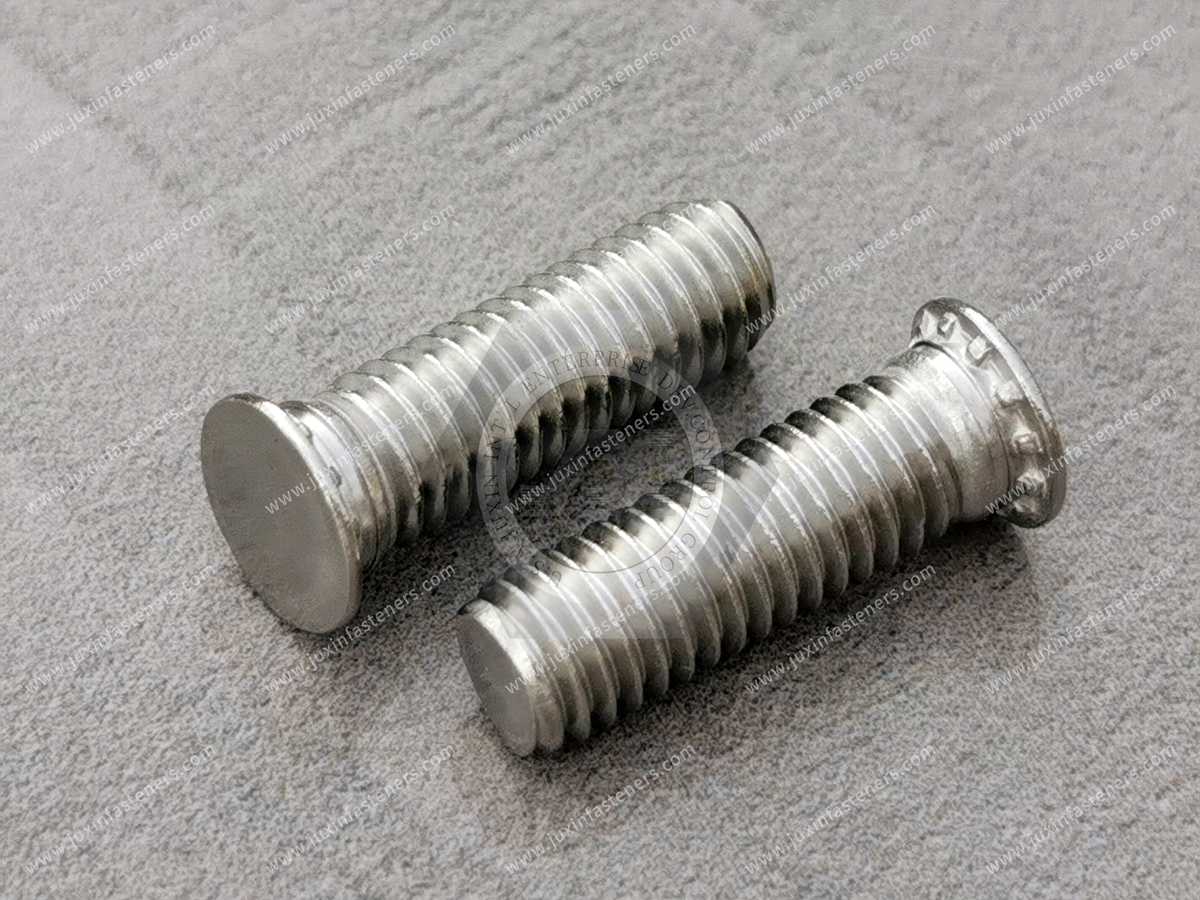
Self-Clinching Studs vs. Ordinary Threaded Studs
An ordinary threaded stud does not necessarily include the geometry needed for self-clinching installation.
A self-clinching stud is specifically designed to be retained by deformation of the surrounding sheet material.
The installation method is therefore part of the fastener's functional design.
A threaded stud with similar nominal dimensions should not automatically be treated as an interchangeable replacement.
How Self-Clinching Threaded Studs Work
The working principle is based on controlled panel material displacement.
During installation, the stud's retention features interact with the panel around the mounting hole.
The panel material flows into an engineered retention area, producing a mechanical lock.
Retention Undercut
The undercut provides space for displaced sheet material.
Proper material flow into this feature contributes to axial and rotational retention.
Anti-Rotation Features
Depending on the design, the stud may include serrations, ribs or other geometry intended to resist rotation.
Not every self-clinching stud uses the same anti-rotation feature.
Flush-Head Geometry
A flush-head design allows the head to sit in its intended position relative to the panel surface after correct installation.
Whether the head is fully flush, slightly recessed or otherwise positioned must be verified against the specific product drawing.
Why Material Flow Matters
If the panel is too hard or otherwise incompatible, the required material flow may not occur.
A stud can appear seated while still having insufficient mechanical retention.
For this reason, visual seating and retention performance should be treated as separate verification considerations.
Self-Clinching Stud Installation: Step-by-Step
A typical installation sequence is as follows.
Step 1: Confirm Panel Compatibility
Check the panel material, thickness, hardness and any specified surface condition.
The selected stud must be suitable for those conditions.
Step 2: Prepare the Mounting Hole
Produce the mounting hole according to the approved stud drawing.
Hole diameter, tolerance and edge distance are critical.
Do not assume that every self-clinching stud requires the same hole preparation.
Step 3: Position the Stud
Insert the stud into the prepared hole in the correct installation direction.
The head and retention features must be positioned as intended by the product design.
Step 4: Support the Panel
Use suitable tooling to support the panel and control stud alignment.
Incorrect support can cause local distortion or incomplete installation.
Step 5: Apply Controlled Pressing Force
Apply the specified installation force using suitable equipment.
The surrounding panel material flows into the stud's retention geometry.
The correct force depends on the fastener and panel combination.
Step 6: Verify the Installed Assembly
Inspect the specified seating condition, alignment and other required characteristics.
Where applicable, verify axial retention and torque-out performance according to the approved test requirements.
Important Installation Note
The correct process is not simply to increase force until the stud appears flush.
Excessive installation force may deform the panel, damage the fastener or reduce assembly quality.
Flush-Head Self-Clinching Stud Types
Different product families are designed for different sheet materials, hardness ranges and installation requirements.
Commercial designations such as FH, FHS, FHA, FH4, FHP, FHL and FHLS may appear in existing supplier specifications.
These designations should be treated as manufacturer-specific product references unless the exact series, drawing and compatibility requirements have been verified.
JUXIN FASTENERS can review customer drawings, samples and required installation geometry for suitable supply or custom manufacturing evaluation.
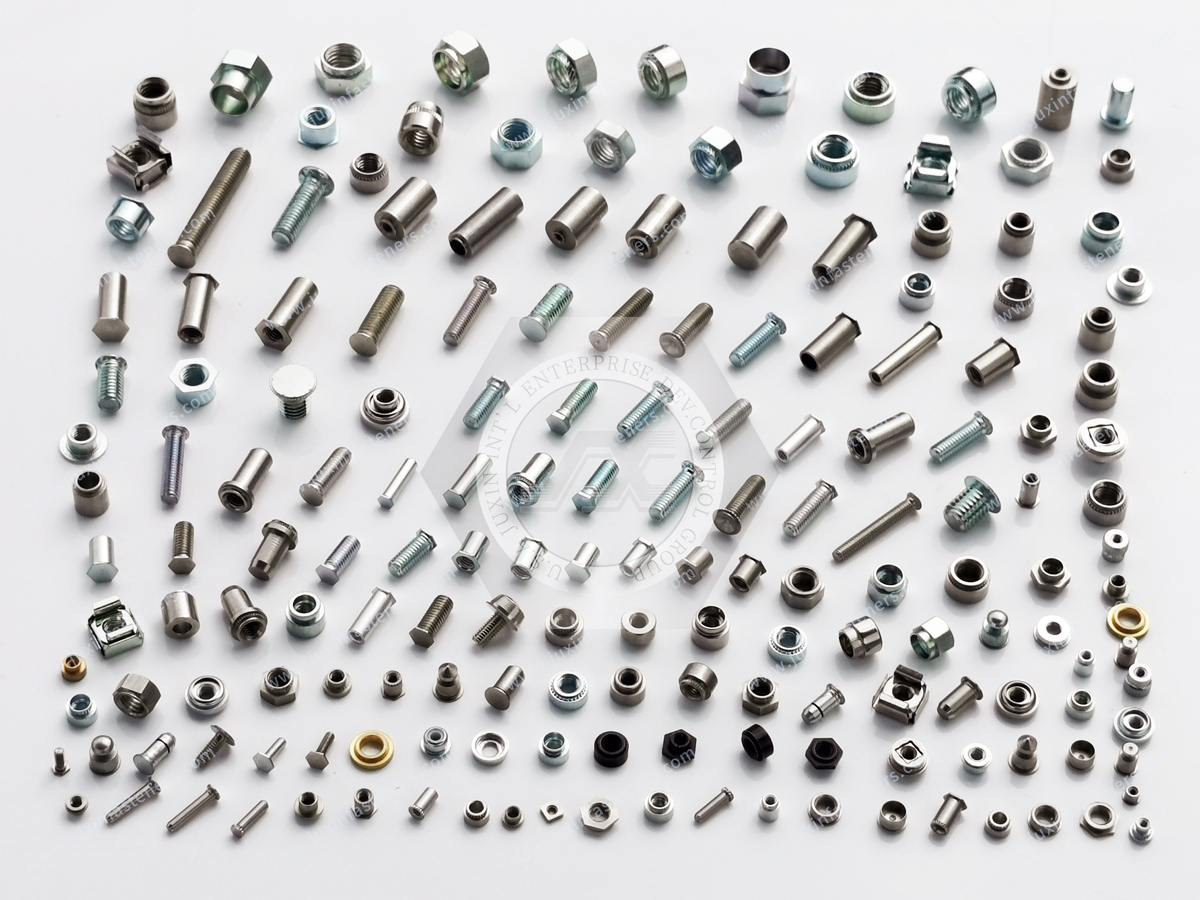
Studs for Aluminum and Low-Carbon Steel Panels
Many self-clinching stud designs are intended for compatible ductile aluminum or low-carbon steel sheet.
Selection should consider:
Panel alloy or steel grade
Material temper or condition
Panel hardness
Thickness
Hole geometry
Required retention performance
The same stud should not be assumed suitable for every aluminum alloy or steel sheet.
Studs for Stainless Steel Panels
Stainless steel sheet may be harder than materials used for conventional self-clinching applications.
Specialized stud designs and installation tooling may be required.
The panel's actual hardness and the fastener's specified installation requirements must be verified.
Extended-Length and Custom Studs
Longer threaded projections may be useful when mounting components at a distance from the panel surface.
However, increasing stud length can influence bending loads, assembly clearance and handling requirements.
The appropriate design should be evaluated against the actual joint.
Do All Thin Panels Require Countersinking?
No.
Some specific stud designs may require special hole preparation for certain panel thicknesses.
However, countersinking should not be applied universally.
Unspecified countersinking may remove material needed for retention.
The approved product drawing determines whether a countersink, chamfer or other hole preparation is permitted or required.
Critical Sheet Metal Design Requirements
Panel Thickness
A self-clinching stud requires a compatible panel thickness.
If the panel is too thin, insufficient material may be available to fill the retention geometry.
If the panel is too thick, the stud may not seat as intended.
The specified minimum or permitted thickness range must be checked for the selected product.
Panel Hardness
Self-clinching depends on controlled deformation of the panel.
If the panel is too hard for the selected stud, proper retention may not develop.
Published hardness limits for one commercial stud series should not be applied to another product without verification.
Mounting-Hole Diameter
Hole diameter affects the amount and position of panel material available for clinching.
An oversized hole can reduce retention.
An undersized hole can interfere with seating or cause unwanted deformation.
Hole-to-Edge Distance
A stud installed too close to a panel edge may cause local distortion or reduced retention.
The minimum edge distance depends on the stud design and panel material.
Installation Direction
The specified installation direction must be followed.
The panel material must be displaced into the intended retention features.
Incorrect orientation can prevent the stud from functioning correctly.
Tooling Alignment
The punch and support tooling should be aligned according to the installation requirements.
Poor alignment can create uneven deformation or tilted studs.
Surface Coatings
Coatings and finishing operations can influence the installation process.
The appropriate sequence for clinching, painting or plating should be established for the specific assembly.
Engineering Selection Matrix
| Design condition | Potential problem | Engineering review |
|---|---|---|
| Thin panel | Insufficient material flow | Minimum compatible thickness |
| Hard stainless steel sheet | Incomplete clinching | Specialized stud and tooling |
| Oversized hole | Reduced retention | Hole diameter and tolerance |
| Stud near panel edge | Edge distortion | Minimum edge distance |
| Long projecting stud | Increased bending demand | Stud length and applied loads |
| High tightening torque | Stud rotation | Torque-out resistance |
| Axial loading | Stud displacement | Pushout or pull-through performance |
| Automated installation | Misalignment or incomplete seating | Tooling and process verification |
Pushout, Pull-Through and Torque-Out: Understanding the Differences
These terms describe different mechanical behaviors.
Pushout Resistance
Pushout resistance concerns the force required to dislodge an installed stud under a defined axial loading condition.
The direction and setup must be specified.
Pull-Through Resistance
Pull-through resistance concerns failure or displacement associated with an axial load in the relevant direction.
Depending on the geometry and test method, this may involve deformation or failure of the panel around the stud.
Torque-Out Resistance
Torque-out resistance concerns the stud's resistance to rotation relative to the panel under a defined torque test.
This is important when a nut is tightened onto the projecting stud.
Why These Characteristics Matter
A stud may perform adequately under one loading condition but not another.
For example, a stud that resists rotation during nut tightening may still require verification under axial service loads.
The acceptance criteria must be based on the actual joint requirements.
Does Self-Clinching Automatically Prevent Vibration Loosening?
No.
Self-clinching retains the stud in the panel.
It does not automatically prevent a mating nut from loosening under vibration.
Where vibration resistance is required, the threaded joint design and any locking features must be evaluated separately.
Common Installation Problems and Corrective Actions
Stud Rotates During Nut Tightening
Potential causes:
Incorrect hole size
Insufficient material flow
Incompatible panel hardness
Improper installation
Applied torque beyond the stud's retention capability
Corrective action should begin with checking the approved installation conditions and actual failure mode.
Stud Pushes Out of the Panel
Potential causes include insufficient panel thickness, incorrect installation or inadequate retention for the applied load.
Stud Head Is Not Properly Seated
Potential causes include incorrect tooling, hole preparation, orientation or panel condition.
Panel Distorts Around the Stud
Potential causes include excessive force, poor support or insufficient edge distance.
Stud Is Tilted After Installation
Potential causes include misalignment, tooling wear or uneven panel support.
Thread Damage During Assembly
Potential causes include incorrect thread compatibility, cross-threading or excessive tightening.
Thread damage does not necessarily indicate a failed clinching mechanism.
Manufacturing Quality Control for Self-Clinching Studs
Depending on customer requirements, inspection may address:
Stud dimensions
Thread conformity
Material specification
Surface treatment
Panel thickness and hardness
Mounting-hole dimensions
Installed head position
Stud perpendicularity
Axial retention
Torque-out resistance
The applicable sampling plan, test methods and acceptance criteria should be agreed for the project.
A supplier's ability to provide particular inspection reports or customer-specific documentation should be confirmed before order acceptance.
Self-Clinching Studs vs. Welded Studs
Both technologies can provide permanently attached threaded mounting points, but their installation mechanisms differ.
Self-clinching studs use mechanical retention through panel material displacement.
Welded studs rely on an approved welding process.
Engineering Comparison
| Factor | Self-clinching stud | Welded stud |
|---|---|---|
| Attachment principle | Mechanical interlock | Welded joint |
| Heat input | No welding heat required | Welding heat involved |
| Panel requirements | Compatible thickness, hardness and ductility | Suitable weldable material and joint design |
| Typical equipment | Press and support tooling | Welding equipment and fixtures |
| Main process risks | Incorrect hole, incomplete clinching, panel distortion | Weld defects, misalignment, heat effects |
| Coating considerations | Installation and finishing sequence | Welding and finishing sequence |
| Automation | Possible with suitable equipment | Possible with suitable equipment |
| Production cost | Depends on stud, tooling, cycle time and volume | Depends on stud, welding process, fixtures and volume |
When Self-Clinching Studs May Be Preferable
Self-clinching may be considered when:
The panel material is compatible
Welding heat is undesirable
The assembly requires a compact threaded mounting feature
Press installation is feasible
The required loads can be supported by the selected stud and panel
When Welded Studs May Be Preferable
Welded studs may be considered when:
The design specifies a welded connection
The panel is unsuitable for conventional clinching
The manufacturing line already uses an approved welding process
The required joint design favors welded attachment
Neither technology should be selected solely on general claims about speed or strength.
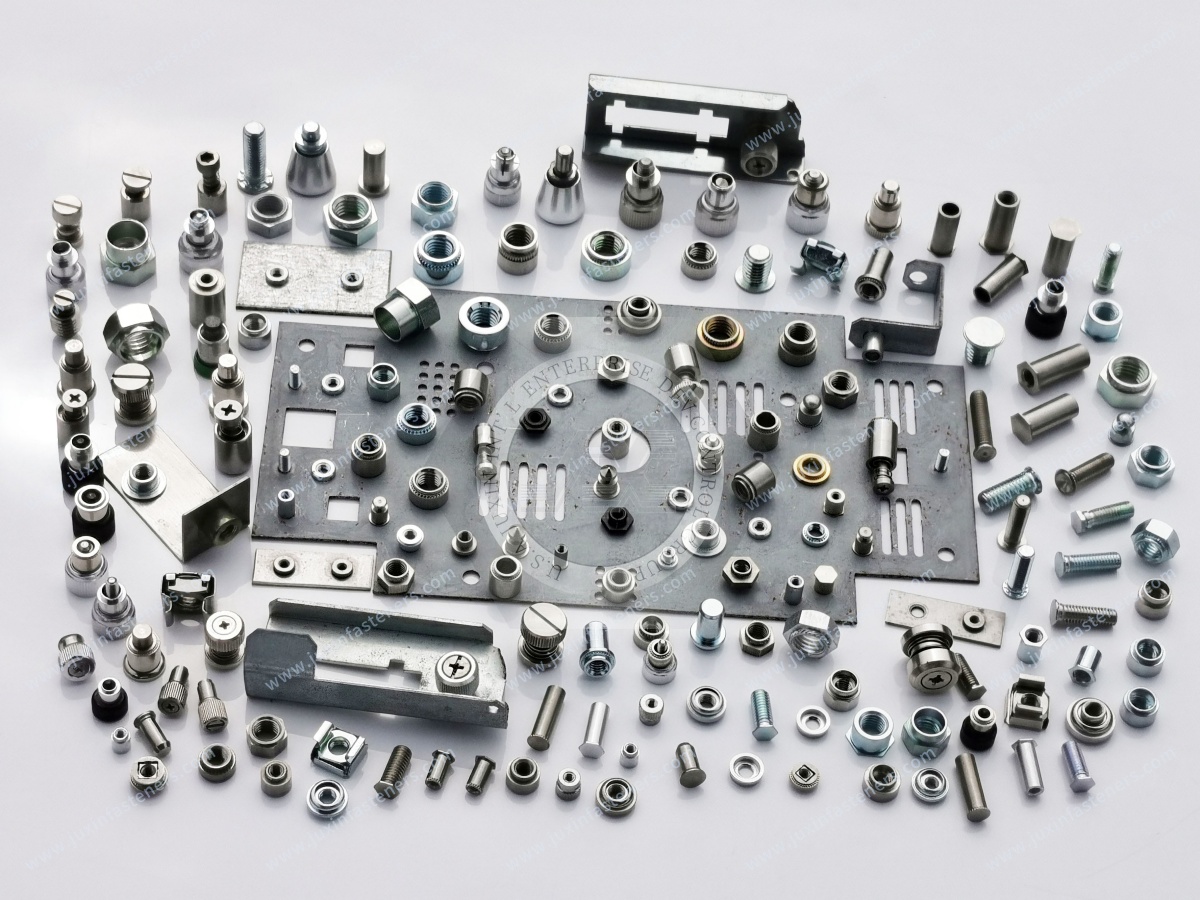
Applications in Automotive and EV Equipment
Self-clinching threaded studs may be used in suitable automotive electronic housings, equipment brackets, EV charging enclosures and other sheet metal assemblies.
Applications should be evaluated according to the actual loads, panel material, vibration exposure and customer requirements.
For safety-critical automotive structures, additional design approval and validation may be necessary.
Telecommunications and Data Center Equipment
Self-clinching studs can provide retained threaded mounting points in:
Network cabinets
Server chassis
Telecommunications equipment
Power distribution enclosures
Cooling equipment housings
These applications may benefit from repeatable sheet metal assembly and reduced loose-hardware handling.
Electrical and Power Conversion Equipment
Applications may include:
Control cabinets
Power electronics enclosures
Inverter housings
Industrial electrical panels
Energy storage equipment
Fastener selection should account for mechanical loading, electrical clearance and corrosion exposure where applicable.
Medical Equipment Housings
Self-clinching studs may be considered for suitable diagnostic equipment, laboratory instruments and equipment enclosures.
Material selection and installation requirements depend on the intended environment and product design.
Use in a regulated medical application requires the applicable customer and regulatory requirements to be addressed.
Rail and Aerospace-Related Equipment
Self-clinching studs may be considered for suitable noncritical equipment housings and interior assemblies where approved.
Use in structural or safety-critical applications requires the applicable engineering approval and qualification.
A general industrial self-clinching stud should not automatically be represented as aerospace-qualified.
Renewable Energy and Industrial Machinery
Potential applications include solar inverter cabinets, industrial automation panels, HVAC equipment and electrical distribution enclosures.
The correct product depends on panel material, operating environment and assembly requirements.
Production Engineering: Preparing for High-Volume Installation
For manufacturing engineers and production managers, self-clinching studs should be evaluated as part of the complete assembly process.
Design for Assembly
A practical production review should consider:
Hole preparation method
Panel support
Stud orientation
Tooling access
Press capability
Stud feeding and handling
Installed height and perpendicularity
In-process inspection
Rework procedures
Installation Consistency
Repeatable installation depends on consistent incoming materials, mounting holes, tooling condition and process settings.
Production control should focus on preventing installation variation rather than relying only on final inspection.
Total Installed Cost
The commercial comparison should include:
Stud price
Hole preparation
Tooling
Installation labor
Inspection
Scrap and rework
Subsequent assembly operations
The lowest fastener unit price does not necessarily produce the lowest total assembly cost.
OEM Supplier Development and Alternative Sourcing
For purchasing managers and supplier development teams, selecting a self-clinching stud supplier requires verification of both product geometry and installation compatibility.
Two studs with the same nominal thread and length may have different retention features.
They should not be treated as interchangeable without engineering review.
Important Supplier Evaluation Criteria
Drawing conformity
Material specification
Thread designation
Head and retention geometry
Panel compatibility
Surface treatment
Mechanical retention requirements
Sample availability
Tooling requirements
MOQ
Lead time
Inspection documentation
Custom Self-Clinching Studs
Custom designs may be appropriate when standard products do not satisfy the required length, head geometry, material or assembly constraints.
However, custom geometry must be evaluated for manufacturing feasibility and installation performance.
Frequently Asked Questions
What is a flush-head self-clinching stud?
It is a self-clinching stud designed to create a retained threaded projection while meeting a specified head seating condition relative to the panel.
Do self-clinching studs require welding?
No. Conventional self-clinching installation uses controlled mechanical pressing.
Can self-clinching studs be installed in stainless steel?
Certain designs are suitable for compatible stainless steel sheet, but panel hardness and tooling requirements must be verified.
Can self-clinching studs be installed in aluminum?
Many designs are suitable for compatible aluminum panels, subject to alloy, temper, thickness and installation requirements.
Should mounting holes always be deburred?
No universal instruction applies. Hole preparation must follow the approved product drawing and installation specification.
Do thin panels always require countersinking?
No. Countersinking is only appropriate where specified for the particular stud design.
What is the difference between torque-out and pushout resistance?
Torque-out concerns resistance to rotation in the panel. Pushout concerns axial displacement under a defined loading condition.
Are self-clinching studs stronger than welded studs?
Not universally. Performance depends on the stud, panel, welding or clinching process and loading conditions.
Can a standard threaded stud replace a self-clinching stud?
Not automatically. A self-clinching stud requires specific retention geometry.
What information is needed for a self-clinching stud RFQ?
The drawing, thread, stud length, material, panel conditions, installation requirements, quantities and any required retention performance should be provided.
JUXIN FASTENERS: Self-Clinching Threaded Studs for OEM Sheet Metal Applications
JUXIN FASTENERS supplies self-clinching studs and related sheet metal fastening components for drawing-based industrial OEM projects.
Relevant products include:
Self-clinching threaded studs
Flush-head self-clinching studs
Self-clinching nuts
Self-clinching standoffs
Blind self-clinching standoffs
Captive fastening components
Custom threaded studs
CNC-machined fastening components
For custom projects, material selection, retention geometry, panel compatibility, surface treatment and manufacturing feasibility are reviewed according to the drawing.
Availability of specific product series, coatings, samples, test documentation and customer approval support must be confirmed during quotation.
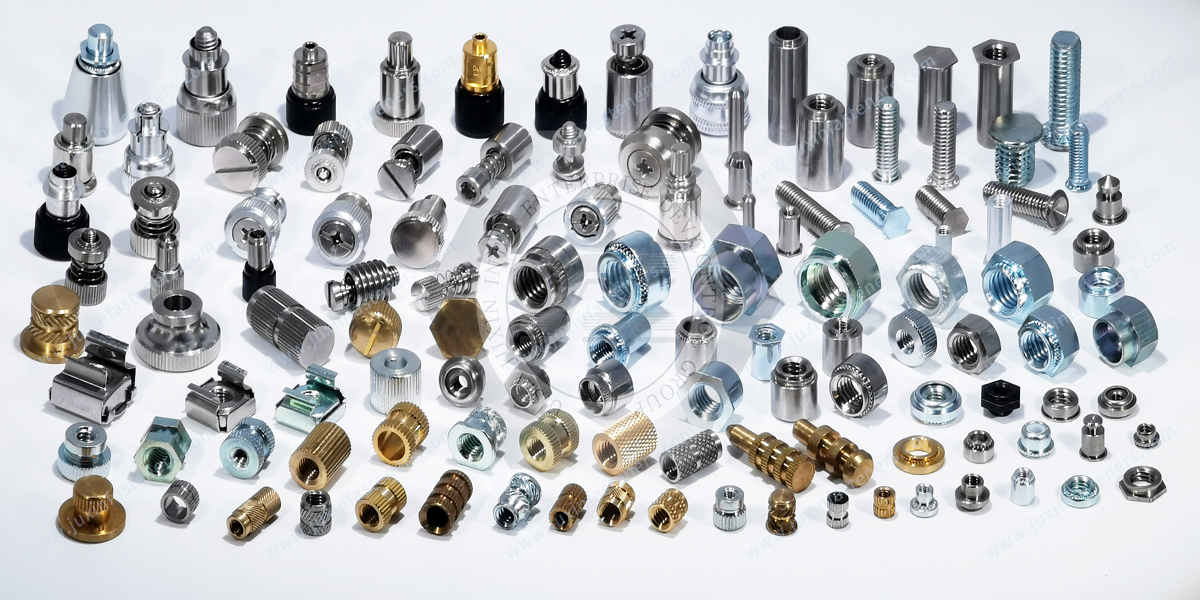
Request a Self-Clinching Threaded Stud RFQ
Are you selecting flush-head studs for a new sheet metal assembly, replacing welded studs or qualifying an alternative supplier for an existing OEM component?
JUXIN FASTENERS welcomes inquiries from design engineers, structural engineers, manufacturing engineers, production managers,
procurement specialists, purchasing managers and supplier development teams.
For an efficient engineering review, please provide:
2D drawing + thread designation + stud length + head geometry + material + panel material + panel thickness + mounting-hole requirements
+ installation method + required retention performance + surface treatment + sample quantity + annual purchasing volume + target delivery schedule
Our team can review suitable product options, custom manufacturing feasibility, sample requirements, MOQ, lead time and quotation details.
Company: JUXIN FASTENERS
Website: https://www.juxinfasteners.com/
Email: info@juxinfasteners.com
Send your self-clinching threaded stud drawings and RFQ to JUXIN FASTENERS for technical evaluation and quotation.
Contact Us
Tel.:
+86 020 8621 0320
+86 020 3121 6067
E-mail:
Technical Support:
Navigation
SEND INQUIREY



