
Call Us
+86 136 6007 9809
Call Us
+86 136 6007 9809

Sep. 20, 2023
An external retaining ring is one of the simplest ways to locate a component axially on a shaft.
But the retaining ring alone does not determine whether the assembly is reliable.
The actual retention system is:
Retained Component → External Retaining Ring → Shaft Groove → Shaft
When axial force acts on the retained component, the load must pass through the ring into the groove and then into the shaft.
This means that a retaining ring that physically fits the shaft is not automatically suitable for the application.
For engineers, the more useful question is:
Can the ring, groove and shaft work together to transfer the required axial force?
For procurement teams, the question becomes:
Does “25 mm external circlip” mean DIN 471 normal type, DIN 471 heavy type, another retaining-ring design or a customer-specific component?
JUXIN FASTENERS supports DIN 471 external retaining rings and drawing-based shaft-retention components for industrial machinery,
automotive and EV equipment, bearings, gearboxes, electric motors, pumps, automation systems, HVAC equipment and other OEM mechanical assemblies.
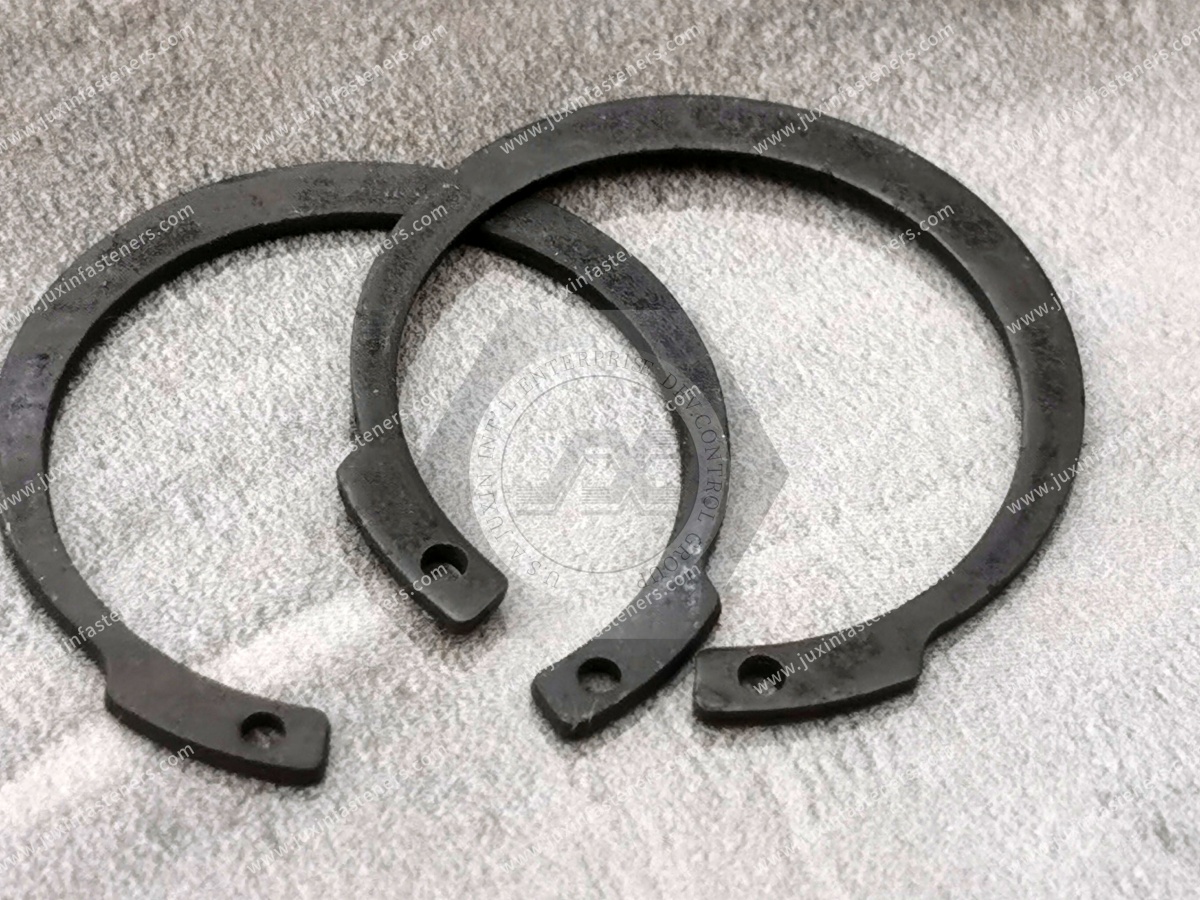
An external retaining ring is a removable mechanical retaining component installed into a groove on the outside diameter of a shaft.
It is commonly called:
external retaining ring;
external circlip;
shaft circlip;
shaft retaining ring;
external snap ring.
After installation, part of the ring extends beyond the shaft groove diameter and forms a mechanical shoulder.
This shoulder can prevent a component from moving axially beyond the designed position.
A typical assembly can be represented as:
Shaft Shoulder → Bearing / Gear / Spacer → External Retaining Ring
or:
Retained Component → External Retaining Ring → Shaft Groove
DIN 471 specifies retaining rings for shafts.
The current edition is:
DIN 471:2026-05 — Retaining Rings for Shafts — Normal Type and Heavy Type
The standard covers retaining rings used to secure components such as rolling bearings on shafts and to transfer axial forces.
DIN 471:2026-05 replaced the previous DIN 471:2011-04 edition.
For new OEM drawings, replacement programs and supplier qualification, engineers and procurement teams should therefore verify which standard edition is controlled by the customer.
DIN 471 and DIN 472 are closely related but apply to opposite installation geometries.
External retaining rings for shafts
The ring expands during installation and seats in an external shaft groove.
Internal retaining rings for bores
The ring compresses during installation and expands into an internal housing groove.
The distinction is simple:
DIN 471 → Shaft → External Circlip
DIN 472 → Bore → Internal Circlip
These products should not be substituted for one another.
The current DIN 471 standard covers both:
Normal Type
and
Heavy Type
external retaining rings.
The heavy type should not automatically be interpreted as the correct choice for every demanding application.
Selection should follow:
applicable drawing;
shaft geometry;
groove geometry;
axial force;
installation requirements;
available space;
complete mechanical design.
If a controlled drawing specifies normal or heavy type, procurement should preserve that requirement.
During installation, an external retaining ring is expanded so that it can pass over the shaft.
Once it reaches the groove, the installation force is released.
The ring contracts into the shaft groove.
During service, axial force from the retained component is transferred approximately through:
Component → Ring → Groove Face → Shaft
This explains one of the most important principles of retaining-ring engineering:
The ring and groove must be designed as a system.
The primary function of a DIN 471 external retaining ring is to restrict axial movement of a component on a shaft.
It should not automatically be described as:
a vibration damper;
a radial bearing;
a friction lock;
a preload spring;
a sealing device.
The ring can operate in equipment exposed to vibration, but:
Axial Retention ≠ Vibration Damping
and:
Axial Retention ≠ Rotational Locking
These are different engineering functions.
A common mistake is to purchase a high-quality retaining ring while ignoring the groove.
The shaft groove determines:
where the ring sits;
how deeply it engages;
how axial load reaches the shaft;
how much shaft material remains beneath the groove.
Therefore:
Correct DIN 471 Ring + Incorrect Groove = Unreliable Retention
The groove should follow the applicable DIN requirement or controlled customer drawing.
Groove diameter influences ring engagement and the remaining shaft cross-section.
An incorrect groove diameter may result in:
insufficient engagement;
incorrect ring seating;
excessive ring projection;
assembly difficulty;
reduced retention performance.
A deeper groove is not automatically better.
Groove width affects the axial fit of the retaining ring.
If the groove is unsuitable, the ring may have:
excessive axial movement;
restricted seating;
uneven load transfer.
The groove width should follow the applicable specification.
The axial position of the groove determines the final position of the retained component.
This can affect:
bearing location;
gear alignment;
spacer stack;
axial clearance;
assembly tolerance.
Therefore, groove position can be a functional dimension rather than merely a manufacturing convenience.
When the retained component pushes against the ring, the ring transfers load into the groove wall.
The groove edge must therefore support the axial load.
Potential limiting conditions can include:
groove-edge deformation;
shaft material yielding;
local shear;
ring deformation;
retained-component deformation.
The retaining system is only as strong as the relevant limiting component.
A high-strength retaining ring does not compensate for an unsuitable shaft.
Shaft material affects:
groove strength;
local deformation;
wear;
manufacturing process;
surface condition.
Therefore:
Strong Ring + Weak Groove ≠ Strong Retaining System
DIN 471 rings are used to transmit axial force.
Potential sources of axial loading include:
bearing thrust;
gear reaction;
spring force;
actuator force;
assembly preload;
transient mechanical loads.
The designer should understand the expected load rather than selecting a ring only because it fits the nominal shaft diameter.
A constant axial force differs from repeated loading.
Applications involving:
repeated thrust;
reversing loads;
impact;
shock;
cyclic machinery
may require additional engineering evaluation.
The maximum static load should not automatically be treated as the complete design criterion for every dynamic application.
Mobile equipment and reciprocating mechanisms can generate transient forces greater than normal steady operating loads.
Examples include:
construction machinery;
agricultural machinery;
material-handling equipment;
actuators;
mechanical stops.
The complete load case should therefore be evaluated.
DIN 471 retaining rings are frequently installed on rotating shafts.
At rotational speed, the complete system may be affected by:
centrifugal effects;
shaft dynamics;
vibration;
ring geometry;
surrounding components.
High-speed applications should therefore be evaluated using the actual operating conditions rather than nominal shaft size alone.
A machined shaft shoulder provides a permanent axial locating feature.
A retaining ring provides a removable retaining feature.
The two can work together:
Shaft Shoulder → Bearing → DIN 471 Retaining Ring
This creates a compact and serviceable axial location arrangement.
A threaded shaft nut can provide axial retention and, depending on the design, controlled clamping.
A retaining ring works differently.
DIN 471 rings are particularly useful where the design prioritizes:
compact axial space;
rapid assembly;
low part count;
removable retention.
However, a retaining ring should not automatically replace a threaded nut where controlled axial preload is required.
Rolling bearings are an important application for DIN 471 external retaining rings.
Potential design arrangement:
Shaft Shoulder → Bearing Inner Ring → DIN 471 External Retaining Ring
The ring can prevent the bearing from moving axially beyond its designed position.
The engineer should consider:
bearing geometry;
shaft groove;
axial load;
assembly sequence;
required axial clearance.
This distinction is important.
A retaining ring can locate a bearing.
It does not automatically establish controlled bearing preload.
If preload is required, additional components or geometry may be necessary.
Therefore:
Retaining Ring → Axial Location
does not automatically mean:
Retaining Ring → Controlled Bearing Preload
For bearing preload applications, JUXIN FASTENERS also provides engineering information on wave spring washers and other axial spring components.
External retaining rings may also be used to locate:
gears;
pulleys;
sprockets;
spacers;
sleeves.
The ring prevents unwanted axial movement but does not automatically transmit the primary drive torque.
Torque transmission may depend on:
splines;
keys;
interference fits;
shaft geometry;
other drive features.
Therefore:
Axial Retention ≠ Torque Transmission
In selected designs, a retaining ring can prevent a pulley or sprocket from moving axially.
However, the drive torque should be handled by the intended torque-transfer feature.
Do not treat a standard retaining ring as a substitute for a key, spline or other torque-transmission system unless specifically engineered.
External retaining rings are commonly installed using suitable circlip pliers.
The general process is:
Verify the ring and shaft size.
Inspect the shaft and groove.
Engage the pliers correctly.
Expand the ring only enough to pass over the shaft.
Move the ring to the groove.
Release the tool in a controlled manner.
Verify that the ring has seated completely.
The exact installation process should follow the applicable assembly specification.
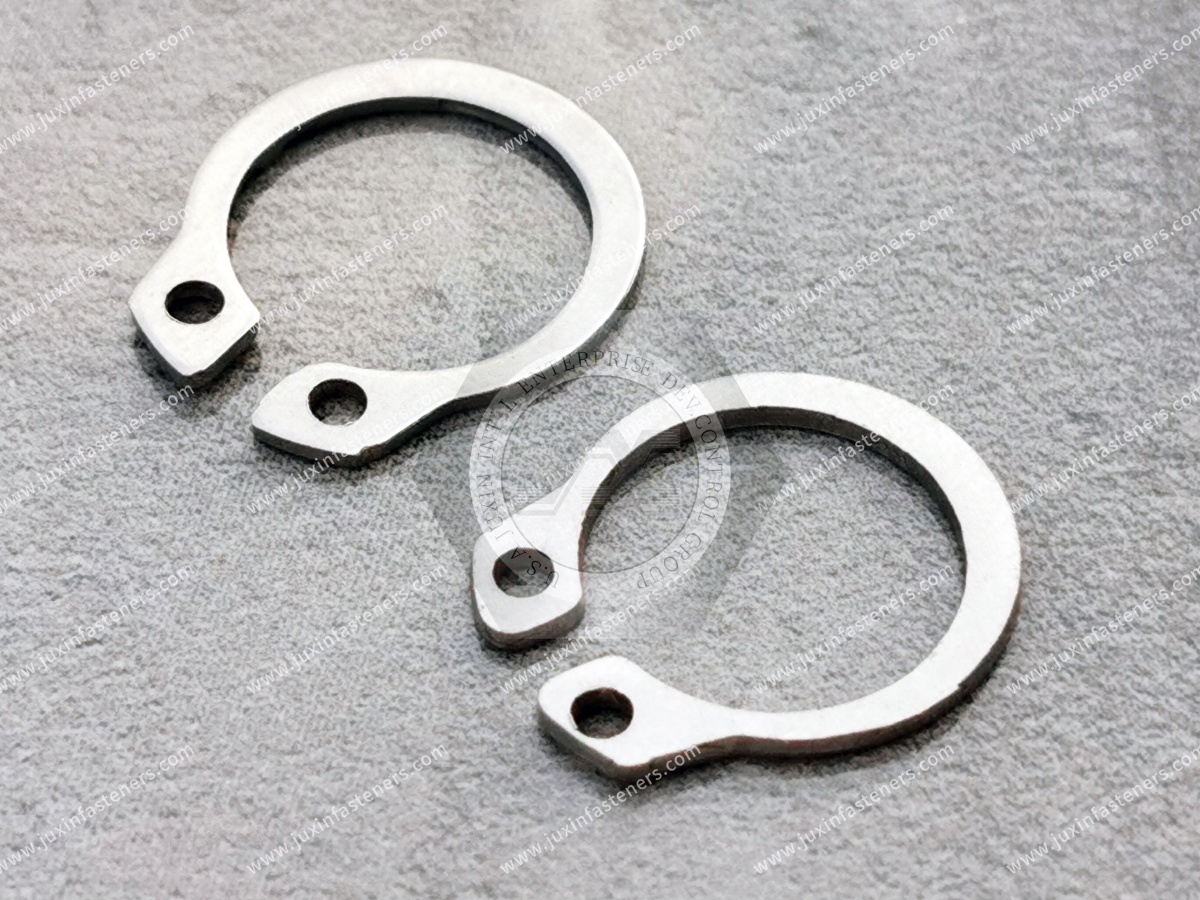
This is the opposite of a DIN 472 internal ring.
For DIN 471:
External Ring → Expand for Installation → Contract into Shaft Groove
For DIN 472:
Internal Ring → Compress for Installation → Expand into Bore Groove
Understanding this difference helps prevent tooling and assembly errors.
An external retaining ring requires elastic expansion during installation.
However:
Required Expansion ≠ Unlimited Expansion
Excessive expansion can cause:
permanent deformation;
reduced spring recovery;
distortion;
installation-hole damage;
poor groove seating.
The installation tool should be appropriate for the ring.
The plier tips should fit the ring's installation holes appropriately.
Incorrect tooling can cause:
slipping;
hole damage;
uncontrolled expansion;
ring distortion;
worker injury.
For production assembly, tooling should be selected as part of the process design.
After installation, confirm that the ring is fully seated in the groove.
A partially seated external circlip may appear installed while lacking proper groove engagement.
Potential causes include:
incorrect groove dimensions;
burrs;
contamination;
wrong ring size;
over-expansion;
damaged ring.
Machining burrs can prevent the ring from seating correctly.
They may also:
scratch the ring;
damage coatings;
create local interference;
affect load transfer.
Groove quality should therefore be included in shaft manufacturing control.
Stamped retaining rings may exhibit manufacturing edge characteristics.
Whether orientation matters depends on:
product geometry;
load direction;
manufacturing process;
assembly requirement.
Avoid universal rules that are not supported by the applicable standard or product specification.
Reuse should not automatically be assumed.
Before reuse, inspect for:
permanent expansion;
distortion;
corrosion;
wear;
installation-hole damage;
edge damage;
loss of spring recovery.
Critical equipment should follow the OEM maintenance procedure.
Spring steel is widely used because the ring must expand elastically during installation and recover into the groove.
Important properties include appropriate:
strength;
elasticity;
hardness;
dimensional stability.
Material and heat treatment should match the product requirement.
Stainless steel may be selected where improved corrosion resistance is required.
However:
Stainless Steel ≠ Corrosion-Proof
Selection still depends on:
environment;
temperature;
chemical exposure;
mating materials;
mechanical requirements.
Depending on the ring material and customer requirement, surface protection may be used to address corrosion or other functional needs.
The coating system should be selected based on the application rather than described simply as “anti-corrosion.”
For hardened spring-steel components, the coating process should consider hydrogen-embrittlement risk where applicable.
High-hardness spring-steel components can require particular attention when electrochemical processing introduces hydrogen.
Risk depends on factors including:
material;
hardness;
manufacturing process;
coating process;
applied stress.
There is no universal treatment recipe suitable for every retaining ring.
The coating and manufacturing route should therefore be controlled according to the applicable specification.
Possible causes include:
incomplete seating;
incorrect groove;
overload;
excessive ring deformation;
wrong ring.
Possible causes include:
excessive axial load;
insufficient shaft material strength;
unsuitable groove geometry.
Possible causes include:
excessive installation expansion;
incorrect tooling;
overload.
Potential causes can include:
material or heat-treatment issues;
excessive installation deformation;
overload;
damage;
environmental effects.
Corrosion can reduce the effective section or impair serviceability.
Incorrect pliers can deform or damage the ring ends.
Contamination, burrs, incorrect dimensions or ring distortion can prevent complete engagement.
A ring may fit around the shaft and enter the groove.
That only establishes dimensional compatibility.
It does not prove:
adequate axial capacity;
correct material;
correct ring type;
correct groove strength;
suitability for dynamic loading.
Therefore:
Fits the Shaft ≠ Validated Retaining System
The current DIN 471 standard recognizes normal and heavy types.
The decision should not be:
“Heavy is always better.”
Instead evaluate:
required axial force;
shaft diameter;
groove geometry;
shaft strength;
available radial space;
adjacent component geometry;
installation requirements.
For replacement programs, follow the controlled drawing unless an engineering change is approved.
DIN 471:2026-05 replaced DIN 471:2011-04.
This creates a practical sourcing situation for older machinery:
Legacy Drawing → DIN 471:2011-04 or Older → Current Supplier → DIN 471:2026-05
Procurement should not silently change the customer's controlled standard reference.
Instead:
Identify Legacy Requirement → Compare Current Requirement → Engineering Review → Approve Replacement
This is particularly important for long-running OEM and MRO programs.
Not every shaft-retention component is a DIN 471 external circlip.
DIN also maintains DIN 6799 retaining washers for shafts, which represents another shaft-retention product family. DIN lists DIN 6799:2026-05 separately from DIN 471.
Therefore:
DIN 471 External Retaining Ring ≠ DIN 6799 Retaining Washer
The correct design depends on the shaft, groove, installation method and retention requirement.
DIN also maintains standards for other retaining-ring geometries, including retaining rings with lugs and round-wire or rectangular-profile snap rings.
This matters when identifying an unknown sample.
Not every circular spring component on a shaft should automatically be called DIN 471.
A better identification process is:
Installation Location → Ring Geometry → Groove Geometry → Standard → Dimensions → Material
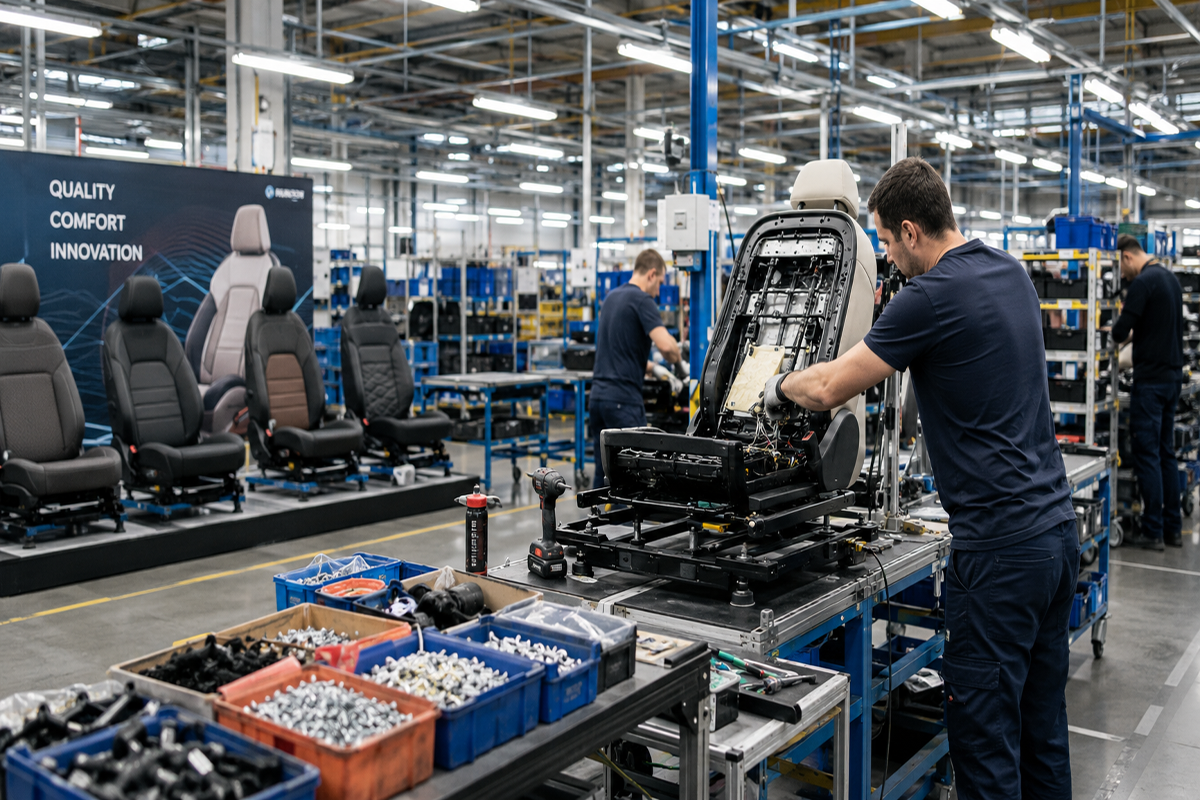
External retaining rings may be used in selected:
transmissions;
electric drive units;
electric motors;
pumps;
actuators;
seat mechanisms;
thermal-management equipment.
Safety-critical automotive applications require the applicable OEM and customer specifications.
A generic DIN 471 ring should not automatically be described as qualified for every automotive assembly.
External retaining rings may be used to locate:
bearings;
sleeves;
rotor-related mechanical components;
shaft-mounted parts.
The ring provides axial retention where appropriate.
Bearing preload and rotor dynamics require separate engineering evaluation.
Potential applications include retention of:
bearings;
gears;
sleeves;
spacers.
Axial forces from gears and bearings should be considered when selecting the retention system.
Shaft retaining rings may be used in selected internal mechanical assemblies.
Potential functions include:
bearing retention;
sleeve positioning;
component location.
The retaining ring is not a fluid sealing component.
Potential applications include:
actuators;
servo systems;
gear units;
rollers;
drive shafts;
compact mechanisms.
The small axial packaging requirement of retaining rings can be useful in space-constrained designs.
AI data center and HPC infrastructure includes mechanical equipment such as:
pumps;
fans;
blowers;
motors;
liquid-cooling equipment;
power-system auxiliaries.
DIN 471 external retaining rings may be used inside these components where the mechanical design requires shaft retention.
The data-center application itself does not establish the ring specification.
Potential applications include:
fan motors;
pumps;
blowers;
compressors;
actuators;
mechanical drives.
The ring provides mechanical axial retention only.
It does not automatically provide:
sealing;
vibration isolation;
electrical grounding.
DIN 471 external retaining rings are relevant to:
machine tools;
production machinery;
packaging equipment;
conveyor systems;
material-handling systems;
rotating machinery;
drive systems.
Mobile equipment can contain shaft retaining rings in:
transmissions;
hydraulic equipment;
bearings;
gear systems;
mechanical actuators.
Shock and cyclic loading should be considered where applicable.
Potential applications include:
motors;
generators;
actuators;
mechanical auxiliary systems.
Electrical performance and mechanical shaft retention are separate engineering requirements.
External retaining rings can be used in appropriate rail-equipment mechanical assemblies.
Safety-critical rail applications require the applicable customer specifications and qualification.
Marine environments can expose retaining rings to:
salt;
moisture;
galvanic interaction;
corrosion.
Material and finish should therefore be selected for the actual environment.
Retaining rings may be used in suitable mechanical components within:
diagnostic equipment;
laboratory instruments;
motors;
positioning systems;
equipment housings.
Use in medical equipment does not automatically imply medical-device certification of the retaining ring.
A generic industrial DIN 471 retaining ring should not automatically be represented as aerospace-qualified hardware.
Aerospace applications may require dedicated:
standards;
materials;
traceability;
inspections;
supplier approvals.
JUXIN FASTENERS can evaluate appropriate drawing-based industrial, tooling, MRO and ground-support requirements subject to customer specifications.
| Design Condition | Engineering Direction |
|---|---|
| Component retained on shaft | External retaining ring may be applicable |
| Component retained inside bore | Evaluate DIN 472 internal ring |
| DIN shaft-retention requirement | Evaluate DIN 471 |
| High axial force | Check ring and groove capacity |
| Weak shaft material | Groove may limit the design |
| Bearing retention | Check bearing thrust and interface |
| Bearing preload required | Use separate preload strategy |
| Gear retention | Separate axial retention from torque transmission |
| Repeated axial load | Evaluate cyclic loading |
| Shock load | Consider transient forces |
| High rotational speed | Review complete rotating system |
| Corrosive environment | Select appropriate material and finish |
| Frequent disassembly | Evaluate inspection and replacement strategy |
| Nonstandard groove | Validate ring/groove compatibility |
Shaft size is the starting point, not the complete specification.
The groove is part of the load path.
DIN 471 is for shafts; DIN 472 is for bores.
Its primary purpose is axial retention.
External retaining rings normally provide axial retention, not the primary torque-transmission function.
Excessive expansion can permanently deform the ring.
Partial engagement can compromise retention.
The groove or shaft may be the limiting component.
Previous installation and service can affect ring condition.
Selection should follow the actual mechanical requirement.
Engineers may search:
DIN 471 retaining ring;
DIN 471 external circlip;
external retaining ring;
external snap ring;
shaft circlip;
shaft retaining ring;
DIN 471 groove dimensions;
external circlip groove;
retaining ring axial load;
shaft circlip failure;
bearing retaining ring;
external circlip installation;
DIN 471 normal vs heavy type.
These searches often indicate an active design, replacement or troubleshooting task.
Procurement teams may search:
DIN 471 supplier;
DIN 471 manufacturer;
external retaining ring supplier;
external circlip manufacturer;
shaft circlip supplier;
stainless external retaining ring;
spring steel circlip supplier;
custom retaining ring manufacturer;
DIN 471 bulk supplier;
OEM retaining ring supplier.
These queries carry strong commercial intent.
For technical and commercial evaluation by JUXIN FASTENERS, provide where applicable:
DIN 471 designation;
standard edition where controlled;
normal or heavy type;
nominal shaft diameter;
customer drawing;
ring dimensions;
shaft drawing;
groove diameter;
groove width;
groove location;
shaft material;
shaft hardness where relevant;
retained component;
expected axial load;
static or cyclic loading;
impact or shock condition;
rotational speed where relevant;
operating temperature;
corrosion environment;
ring material;
surface finish;
installation method;
removal and service requirement;
dimensional tolerances;
inspection requirement;
documentation requirement;
customer part number;
sample quantity;
prototype quantity;
production quantity;
estimated annual demand;
packaging requirement;
labeling requirement;
customer-specific requirements.
DIN 471 specifies retaining rings for shafts in normal and heavy types.
DIN 471:2026-05 is the current edition.
It replaced DIN 471:2011-04.
It is a spring retaining component installed in a groove on the outside of a shaft to restrict axial movement of a retained component.
These terms are commonly used for the same general product category, although the exact standard and geometry should still be confirmed.
DIN 471 covers retaining rings for shafts. DIN 472 covers retaining rings for bores. Both current 2026 editions cover normal and heavy types.
Yes. DIN 471:2026-05 covers normal and heavy types.
Its primary function is axial retention. It should not be treated as a dedicated vibration-damping device.
Yes. DIN identifies securing components such as rolling bearings on shafts as a use of these retaining rings.
It should not automatically be used as the primary torque-transmission feature. Torque transfer may require keys, splines, interference fits or another engineered feature.
No. Groove geometry, axial load, shaft material, ring type and operating conditions may also matter.
Reuse should follow the applicable OEM or maintenance specification rather than being assumed.
JUXIN FASTENERS can evaluate standard and drawing-based external retaining-ring requirements according to shaft size, type, groove, material, finish, quantity and customer specifications.
A buyer may initially send:
“External circlip for 25 mm shaft, 100,000 pcs.”
That is useful information, but it may not fully define the production requirement.
The supplier may still need to determine:
DIN 471 or Another Standard?
Which Standard Edition?
Normal or Heavy Type?
What Groove Geometry?
What Shaft Material?
What Component Is Being Retained?
What Axial Load Must Be Transferred?
What Rotational Speed Is Involved?
What Ring Material Is Required?
What Surface Finish Is Required?
What Corrosion Environment Applies?
The sourcing path becomes:
Retained Component → Shaft → Axial Load → Groove → DIN 471 Type → Ring → Material / Finish → Installation → Validation → Production RFQ
That is the difference between purchasing a circlip that merely fits around a shaft and sourcing a retaining system appropriate for the actual mechanical assembly.
JUXIN FASTENERS supports OEM sourcing of:
DIN 471 external retaining rings;
external circlips;
external snap rings;
shaft retaining rings;
normal-type retaining rings;
heavy-type retaining rings;
spring-steel retaining rings;
stainless steel retaining rings;
drawing-based retaining components;
other industrial fastening and retention components.
Potential application sectors include:
industrial machinery;
automotive and EV equipment;
electric motors;
gearboxes;
pumps and compressors;
industrial automation;
robotics;
HVAC equipment;
AI data center and HPC cooling equipment;
power equipment;
construction machinery;
agricultural machinery;
rail-related equipment;
marine equipment.
For components retained inside housings rather than on shafts, refer to the JUXIN FASTENERS DIN 472 Internal Retaining Rings: Bore Groove, Axial Load & Selection Guide.
For bearing preload applications, refer to the JUXIN FASTENERS Bearing Preload Wave Washers: Load, Working Height, Tolerance Stack & Selection Guide.
For broader washer and axial spring selection, see Industrial Washers: Types, Functions & Selection Guide.
For custom machined shaft and groove components, see Stainless Steel CNC Machining Parts.
For OEM DIN 471 external retaining ring RFQs, send your DIN designation, drawing, shaft size, groove dimensions, shaft material, axial load,
rotational speed where relevant, ring material, finish, quantity and estimated annual demand to:
The correct external retaining ring is not simply:
“the circlip that fits the shaft.”
It is:
“the retaining ring, groove and shaft combination capable of controlling the required axial movement under the actual operating conditions.”
 MORE NEWS
Sep. 27, 2026
Sep. 27, 2026
Sep. 27, 2026
Contact Us
Tel.:
+86 020 8621 0320
+86 020 3121 6067
E-mail:
Technical Support:
Navigation
SEND INQUIREY