
Call Us
+86 136 6007 9809
Call Us
+86 136 6007 9809

Aug. 22, 2023
Electric vehicle battery systems, electrical enclosures and lightweight automotive structures often require threaded attachment points in sheet metal where access to the rear side is limited.
EV automotive blind rivet nuts provide a single-sided method for creating internal threads in panels, brackets and enclosure structures.
Closed-end and sealing configurations can be considered when the assembly has additional requirements related to environmental exposure, enclosure interfaces or contamination control.
However, a critical engineering distinction must be made:
A closed-end or sealing rivet nut does not automatically make an enclosure IP67.
IP protection is evaluated at the enclosure or assembly level. For road vehicles, ISO 20653:2023 addresses degrees of protection provided by electrical-equipment enclosures against foreign objects, access and water ingress.
Therefore, the correct engineering approach is to evaluate the rivet nut together with the panel, gasket, mating screw, sealing interface and complete enclosure design.
JUXIN FASTENERS supplies blind rivet nuts and application-specific fastening components for B2B OEM and industrial requirements.
This guide explains how engineers and procurement teams can select closed-end and sealing rivet nuts for EV battery enclosures and related applications.
An EV automotive blind rivet nut is a threaded insert installed from one side of a sheet-metal component.
During installation, the body deforms behind the parent material and forms a clamping interface.
The resulting internal thread can then accept a mating screw or bolt.
This makes the product useful when:
The rear side of the panel is inaccessible.
The panel is too thin for a conventional tapped thread.
Welding is undesirable.
A serviceable threaded attachment is required.
The enclosure requires a defined fastening interface.
The assembly requires a customized head or body geometry.
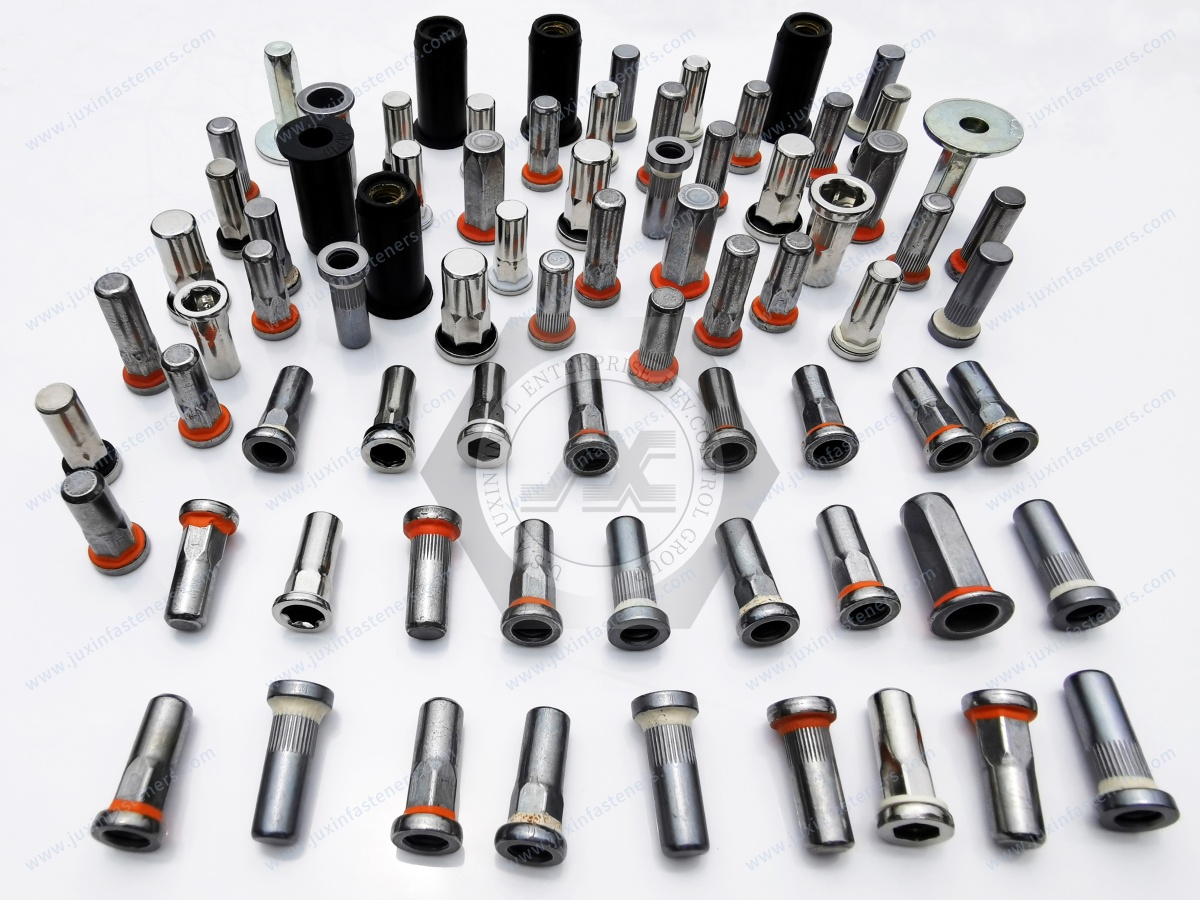
EV platforms contain many sheet-metal and enclosure structures.
These may include:
Battery enclosures
Electrical housings
Electronic control enclosures
Thermal-management components
Charging-system housings
Cable-management brackets
Service panels
Vehicle body brackets
Underbody equipment
Structural equipment enclosures
Blind rivet nuts can create threaded attachment points without requiring access to the opposite side of the panel.
A closed-end rivet nut has a closed rear section rather than an open passage through the complete body.
This configuration can be useful when the design requires a closed insert cavity.
Potential reasons for selecting a closed-end design include:
Limiting an open path through the insert
Supporting an enclosure design
Reducing exposure of the internal cavity
Supporting contamination-control requirements
Providing a specific threaded insert geometry
The exact reason should be defined by the application.
This distinction is essential for EV battery enclosure engineering.
A closed-end construction and a sealed fastening interface are not necessarily the same thing.
The closed rear end addresses the geometry of the insert itself.
A sealing feature addresses the interface between the fastener and the parent component.
The engineer should therefore specify the actual sealing requirement rather than simply requesting a “closed-end waterproof rivet nut.”
A sealing blind rivet nut incorporates a design feature intended to improve sealing at the fastener-to-panel interface or within the fastener construction.
Depending on the design, this may involve:
A sealing flange
A sealing element
A dedicated sealing interface
A closed-end configuration
A combination of fastener and gasket features
The actual sealing mechanism must be defined on the product drawing or technical specification.
Not by itself.
This is one of the most important engineering points in this article.
IP67 is an enclosure-level protection classification.
For road vehicles, ISO 20653:2023 covers IP codes for electrical equipment enclosures, including protection against foreign objects and water ingress.
A rivet nut may contribute to the enclosure sealing system, but the complete assembly must determine whether the required IP classification is achieved.
The complete system can include:
Enclosure panels
Gaskets
Sealing interfaces
Fasteners
Rivet nuts
Mating screws
Cable penetrations
Connectors
Covers
Welded joints
Service openings
When an EV battery enclosure specification includes IP67, the procurement requirement should not simply state:
“IP67 rivet nut.”
A better requirement identifies:
Fastener + sealing interface + panel + gasket + mating hardware + assembly process + validation method.
This prevents a common sourcing problem where the fastener is expected to carry an enclosure-level performance claim by itself.
Battery enclosures require multiple functions at the same time.
The fastening system may need to provide:
Threaded attachment
Mechanical retention
Anti-rotation
Corrosion resistance
Serviceability
Controlled assembly
Compatibility with enclosure materials
Compatibility with sealing systems
The correct rivet nut configuration should be selected according to the specific joint.
A sealing feature and an anti-rotation feature solve different problems.
Sealing addresses a fluid or environmental interface.
Anti-rotation addresses rotational movement of the rivet nut during screw installation or removal.
Axial retention addresses pull-out or pull-through behavior.
These should not be treated as interchangeable performance characteristics.
Anti-rotation designs can include:
Knurled bodies
Ribbed bodies
Semi-hex bodies
Hex bodies
Other application-specific external geometries
The correct configuration depends on the mounting hole and parent material.
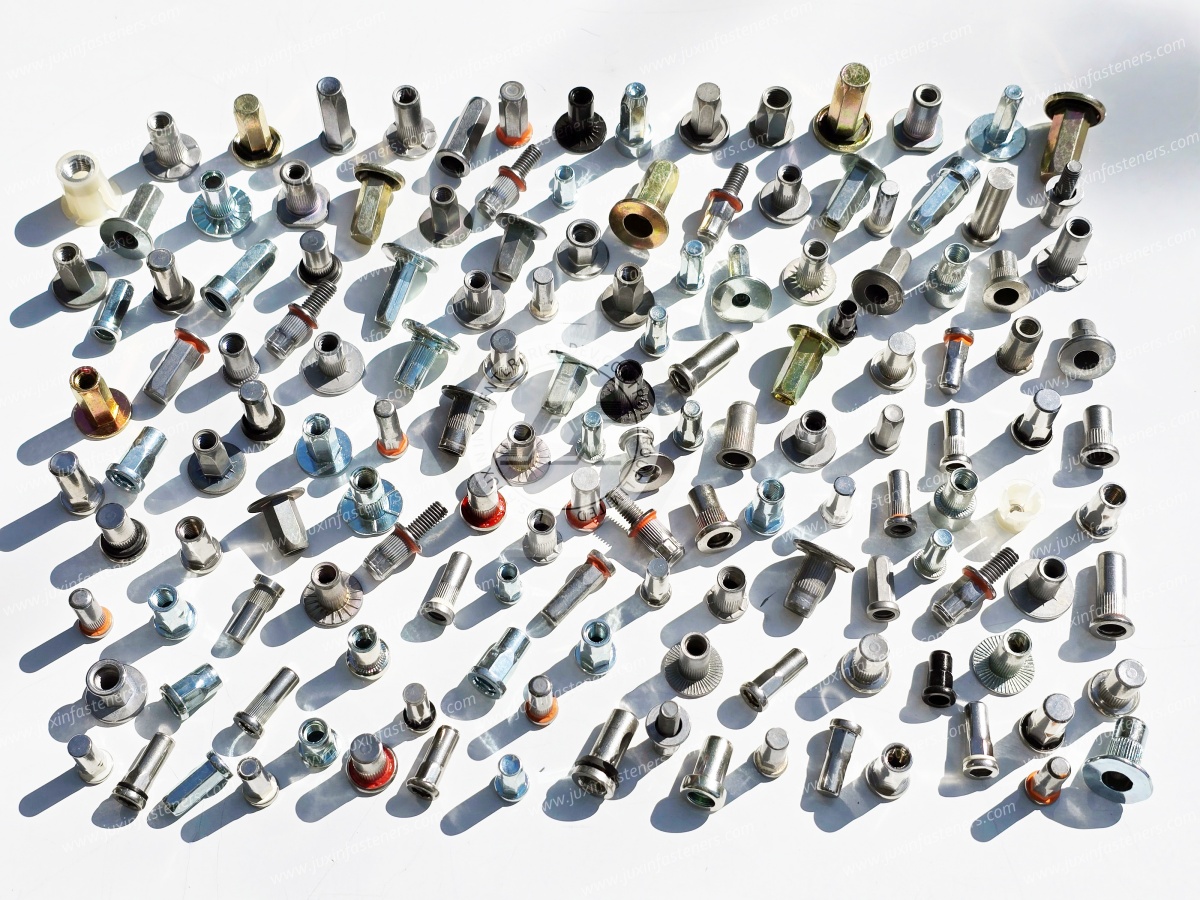
Knurled rivet nuts use external surface geometry to increase mechanical interaction with the parent sheet.
The knurl may help resist rotation after installation.
However, the final performance depends on:
Hole diameter
Hole tolerance
Parent material
Sheet thickness
Knurl geometry
Installation deformation
Installation process
Therefore, “knurled” should not be treated as an independent guarantee of a particular torque-out value.
Some automotive rivet nut designs use external ribs or other raised features.
These features are intended to interact mechanically with the surrounding sheet.
Their effectiveness depends on the actual geometry and installation condition.
For custom EV parts, the rib geometry should be defined on the engineering drawing rather than described only by a marketing term.
Semi-hex and hex bodies can provide a non-round interface with the mounting hole.
This can be useful when rotational resistance is a significant design requirement.
The hole should be designed specifically for the selected body geometry.
A hex-body rivet nut installed into an unsuitable round or oversized hole may not provide the intended anti-rotation behavior.
A useful engineering model is:
Anti-rotation = body geometry + hole geometry + parent material + installation condition.
Changing any one of these factors can change the final result.
This is why the same rivet nut may behave differently when installed into:
Aluminum sheet
Coated steel
Stainless steel
High-strength steel
Different sheet thicknesses
Application validation is therefore more meaningful than relying only on a catalog label.
The hole is not merely an opening for the rivet nut.
It is part of the mechanical interface.
Important parameters include:
Nominal diameter
Diameter tolerance
Roundness
Burr condition
Coating condition
Punching quality
Laser-cut edge condition
Local deformation
Incorrect hole preparation can contribute to:
Spin-out
Inconsistent installation
Reduced retention
Local sheet damage
Variation between production parts
Grip range is the range of parent-material thickness for which a specific rivet nut configuration is intended to be installed.
It is not simply the same thing as the nominal sheet thickness.
Battery enclosure assemblies can contain:
Single panels
Reinforcement layers
Overlapping panels
Brackets
Gaskets
Coated surfaces
The actual stack-up should therefore be measured before the rivet nut is selected.
Grip range can also affect the sealing interface.
If the fastener is not installed within its intended material range, the deformation and clamping condition may change.
That can influence:
Mechanical retention
Panel deformation
Flange contact
Sealing interface
Installation consistency
Therefore, sealing performance should be evaluated at the actual minimum and maximum stack conditions.
Aluminum is widely used in lightweight vehicle and enclosure structures.
When an aluminum panel is combined with a rivet nut, the engineer should consider:
Parent material condition
Sheet thickness
Hole diameter
Local stiffness
Fastener material
Surface treatment
Galvanic compatibility
Installation deformation
The best insert material is not necessarily the material with the lowest density.
Steel remains relevant for many vehicle structures and equipment enclosures.
Steel panels may require different fastener and coating strategies from aluminum panels.
The supplier should understand:
Sheet grade
Coating
Thickness
Environment
Fastener material
Required corrosion protection
Stainless steel rivet nuts may be considered when corrosion resistance or material compatibility is important.
When stainless steel is selected, the engineer should consider the complete fastening system rather than simply selecting a stainless grade.
ISO 3506-1 and ISO 3506-2 specify mechanical and physical properties for particular corrosion-resistant stainless steel bolts/screws/studs and nuts.
They should be applied according to their scope rather than treated as a generic standard for all rivet nut products.
ISO 3506-6 also provides general guidance on selecting stainless steels and nickel alloys for fasteners.
Carbon-steel rivet nuts can be considered when the application requires a steel threaded insert.
The final specification may include:
Material grade
Head geometry
Body geometry
Thread
Grip range
Surface treatment
Corrosion requirement
The correct finish should be selected according to the application environment and customer specification.
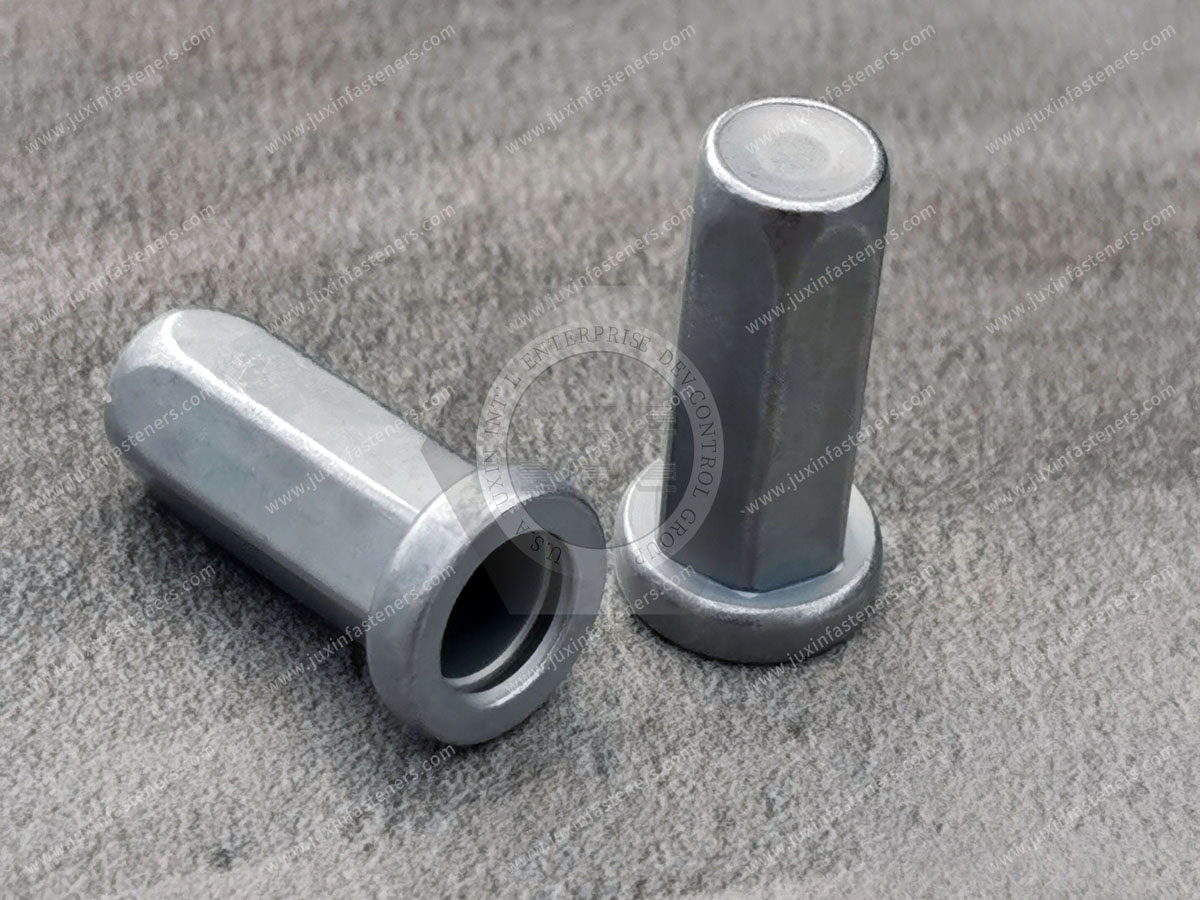
Surface treatment can be important for carbon-steel rivet nuts used in automotive environments.
Depending on the customer specification, possible coating systems may include zinc-based or zinc-nickel-based finishes.
However, coating performance should be specified using actual test requirements rather than a generic statement such as “automotive grade.”
ASTM B117 defines a controlled salt-spray environment for evaluating the relative corrosion resistance of metals and coated metals.
Importantly, ASTM notes that salt-spray results do not necessarily correlate directly with natural environmental performance and should not be treated as a stand-alone lifetime prediction.
Therefore, a statement such as “720-hour salt spray” should only be published for a specific JUXIN FASTENERS product when that result has been verified for the exact material, coating, specimen and test criteria.
Salt-spray exposure time can depend on:
Coating system
Substrate
Surface preparation
Specimen geometry
Test condition
Evaluation criteria
Red-rust definition
Test chamber
Number of specimens
Therefore, this article does not present 720 hours as a universal JUXIN FASTENERS specification.
For an automotive RFQ, the required corrosion test method and acceptance criteria should be specified by the customer.
Battery enclosures can encounter:
Water
Condensation
Road salt
Humidity
Dirt
Temperature cycling
Chemical exposure
The fastener coating should be evaluated together with the enclosure material and other components.
Corrosion resistance is a system consideration.
An aluminum enclosure with a steel or stainless fastener can create a galvanic compatibility question.
The engineer should consider:
Material pairing
Electrolyte exposure
Surface treatment
Isolation
Coating damage
Environmental exposure
A coating can influence the interface, but it should not be treated as a universal solution for every dissimilar-metal combination.
For a sealing rivet nut, the flange-to-panel interface is critical.
The design should consider:
Flange diameter
Flange thickness
Sealing element
Panel flatness
Hole diameter
Panel thickness
Installation deformation
Mating surface
The sealing interface should be validated on the actual enclosure design.
In many enclosure designs, the rivet nut is only one part of the sealing system.
The enclosure may also use:
Rubber gaskets
Foam seals
Liquid-applied sealants
Compression seals
Molded sealing features
The fastener should not interfere with the required gasket compression or sealing path.
The mating screw is part of the complete joint.
Important parameters include:
Thread size
Thread pitch
Screw length
Strength class or material requirement
Head style
Washer
Coating
Installation torque
A high-strength screw does not automatically make a rivet-nut joint stronger.
The complete joint should be evaluated.
Torque-out and spin-out describe rotational failure behavior.
They should not be confused with pull-out.
An EV enclosure engineer should identify the actual rotational load generated by the mating screw and assembly process.
The rivet nut should then be selected and validated against the application requirement.
Axial retention is another separate requirement.
Pull-out relates to the insert separating from the parent material.
Pull-through involves the fastener or flange moving through or damaging the parent sheet.
The relevant failure mode depends on the direction and application of the applied load.
A single torque test cannot fully characterize:
Pull-out
Pull-through
Spin-out
Sealing
Corrosion
Vibration
Thermal cycling
Likewise, a corrosion test cannot establish mechanical retention.
A complete validation program should therefore reflect the actual application risks.
Vehicle battery assemblies experience dynamic loading.
Potential concerns include:
Vibration
Shock
Thermal cycling
Repeated service
Fastener loosening
Local panel deformation
The rivet nut, mating screw and panel should be considered together.
Battery enclosures may experience temperature changes during vehicle operation, charging and environmental exposure.
Different materials can expand at different rates.
This can affect:
Joint interfaces
Gasket compression
Fastener preload
Panel deformation
Sealing behavior
The fastener should therefore be evaluated as part of the complete enclosure assembly.
Some EV enclosure components require service access.
A blind rivet nut can provide a reusable threaded interface for selected serviceable components.
However, repeated screw removal should be considered during the engineering validation process.
The designer should evaluate:
Thread engagement
Fastener material
Assembly torque
Removal torque
Number of service cycles
Parent-sheet condition
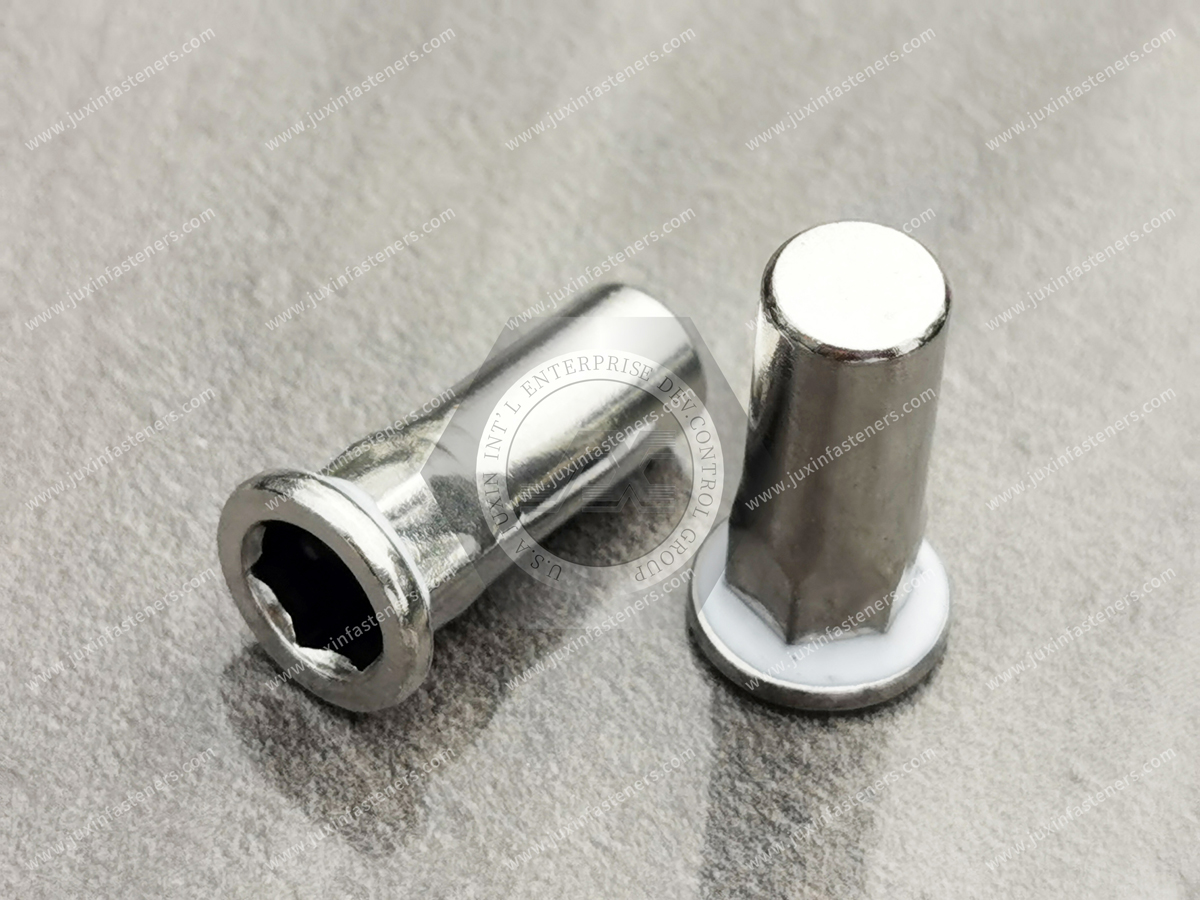
An open-end rivet nut has an open passage through the rear portion of the body.
A closed-end rivet nut closes the rear end.
The selection should depend on the application.
Potential advantages include:
Conventional threaded insert configuration
Flexible screw-length accommodation
Broad application range
Potential advantages may include:
Closed rear geometry
Specific enclosure requirements
Reduced direct passage through the insert
Application-specific sealing configurations
Neither should automatically be described as universally superior.
These terms should also be separated.
Closed-end describes the rear geometry.
Sealing describes an intended sealing function.
A closed-end rivet nut may not provide the sealing interface required for a specific enclosure.
A sealing rivet nut may incorporate additional features to address the panel interface.
The drawing should define which requirement is actually needed.
A practical selection process begins with:
Application → panel → hole → stack → thread → grip → head → body → sealing → material → finish → installation.
This sequence is more reliable than beginning with a generic request for an “IP67 rivet nut.”
For enclosure applications, an engineer should first ask:
Where could water or contamination enter the enclosure?
Potential paths include:
Fastener interfaces
Gasket joints
Cable penetrations
Connectors
Access covers
Welded joints
Drainage features
This prevents the fastener from being treated as the only potential leakage path.
A useful EV fastener selection method is to identify the primary risk.
If the risk is:
Water ingress: focus on the complete sealing interface.
Spin-out: focus on body geometry, hole and installation.
Pull-through: focus on flange, sheet and load direction.
Corrosion: focus on material, coating and environment.
Service failure: focus on thread, mating screw and repeated assembly.
This failure-mode approach produces a more useful specification.
For battery enclosure assemblies, procurement should not specify only:
“1.5 mm aluminum panel.”
The actual assembly may include multiple layers.
The RFQ should identify:
Minimum stack
Maximum stack
Panel materials
Coatings
Gaskets
Reinforcement plates
Hole diameter
This allows the correct grip range to be selected.
A fastener can have strong mechanical retention without providing the required sealing interface.
Conversely, a sealing feature does not automatically define the mechanical retention of the joint.
The RFQ should therefore contain separate requirements for:
Mechanical retention
and
Environmental sealing.
If the customer requires IP67, the purchasing specification should identify the enclosure-level validation requirement.
ISO 20653:2023 is specifically applicable to IP codes for electrical equipment enclosures in road vehicles.
The rivet nut specification should explain its role within that enclosure rather than claiming that the individual fastener itself is “IP67.”
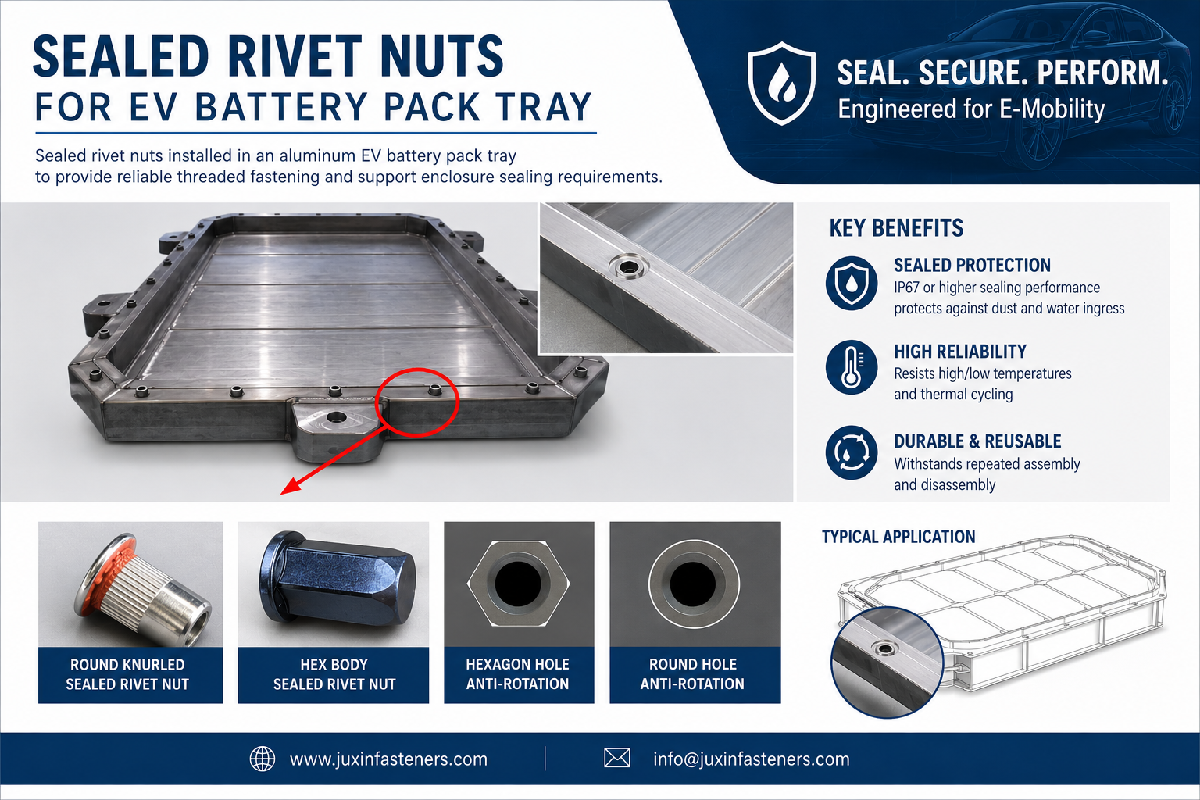
The same fastening principles can be applied to:
EV battery housings
Power electronics enclosures
Inverter housings
Charging equipment
Control boxes
Thermal-management systems
Automotive electrical cabinets
Industrial electrical enclosures
The exact sealing requirement should always follow the equipment specification.
EV assemblies often require more than rivet nuts.
A project may also require:
High-strength bolts
Locking nuts
Weld nuts
Self-clinching fasteners
Custom screws
Stainless steel fasteners
CNC-machined spacers
Plastic fasteners
For related automotive fastening requirements, see industrial and automotive bolts and nuts.
For projects specifically involving sealed rivet nuts and battery enclosure applications, see the JUXIN FASTENERS sealing blind rivet nut solutions for EV battery enclosures.
For closed-end configurations, see closed-end sealing blind rivet nuts for EV battery applications.
These related solutions help engineering and procurement teams compare different enclosure fastening approaches.
EV manufacturers often evaluate total system weight.
Depending on the application, aluminum or engineered polymer components may be considered alongside steel fasteners.
Plastic components can be useful for:
Cable management
Clips
Spacers
Insulation-related components
Lightweight brackets
Non-structural covers
See the automotive plastic fastener solutions for applications where polymer fastening components are appropriate.
Custom EV enclosure projects may also require:
Spacers
Sleeves
Pins
Bushings
Standoffs
Custom machined fasteners
For stainless steel custom-machined components, see stainless steel CNC machining parts.
For a custom EV rivet nut, the drawing should ideally define:
Thread
Thread tolerance
Overall length
Head diameter
Head thickness
Body diameter
Body geometry
Grip range
Hole requirement
Material
Surface treatment
Sealing requirement
Anti-rotation requirement
Inspection requirements
The more clearly the critical characteristics are defined, the easier it becomes to compare supplier quotations.
An EV rivet nut RFQ should ideally include:
Part drawing
Drawing revision
Thread
Parent material
Panel thickness
Minimum and maximum stack-up
Hole diameter
Hole tolerance
Head/flange requirement
Body geometry
Grip range
Closed-end requirement
Sealing requirement
Anti-rotation requirement
Material
Surface treatment
Mating screw
Assembly torque
Environmental requirements
Annual volume
Prototype quantity
Inspection requirements
Documentation requirements
Packaging requirements
This information gives suppliers enough context to quote the actual requirement rather than a generic catalog equivalent.
Supplier-development teams should ask:
Can the supplier manufacture the specified geometry?
Can the supplier work from a customer drawing?
Can the supplier distinguish sealing requirements from mechanical requirements?
Can the supplier control critical dimensions?
Can the supplier provide agreed inspection documentation?
Can the supplier support application-specific samples?
Can the supplier identify risks related to the hole and grip range?
Can the supplier maintain the specified material and surface treatment?
Can the supplier support production quantities?
These questions are useful when qualifying an automotive fastening supplier.
Depending on the customer specification, inspection may include:
Thread dimensions
Head diameter
Head thickness
Overall length
Body dimensions
Grip-related dimensions
Hole-interface dimensions
Surface condition
Material identification
Coating
Visual appearance
Functional validation should be defined according to the application.
If the rivet nut participates in an enclosure sealing requirement, the validation should be performed on the actual interface.
Potential variables include:
Panel material
Panel thickness
Hole size
Fastener geometry
Seal design
Mating screw
Installation condition
Assembly torque
Environmental test method
A component-level statement should not replace assembly-level validation.
Where corrosion resistance is specified, the test method and acceptance criteria should be clearly defined.
ASTM B117 is a salt-spray practice used to create a controlled corrosive environment for relative corrosion-resistance evaluation.
ASTM also states that natural-environment performance cannot always be predicted from salt-spray exposure alone.
Therefore, procurement should specify:
Test method
Exposure period
Specimen configuration
Evaluation criteria
Coating system
Acceptance requirement
rather than simply requesting a generic “salt-spray-resistant fastener.”
Where applicable to the customer's supply chain, procurement may also specify requirements related to:
RoHS
REACH
Restricted substances
Material declarations
Customer-specific environmental requirements
These requirements should be confirmed against the actual customer program rather than assumed for every part.
Automotive procurement requires attention to more than technical fit.
Commercial evaluation may include:
Annual volume
Forecast
Material availability
Surface treatment
Packaging
Inspection
Documentation
Shipping
Production capacity
Engineering changes
Supplier continuity
The quotation should reflect the complete commercial requirement.
A lower unit price can become less attractive if the selected fastener causes:
Assembly problems
Spin-out
Rework
Sealing failures
Corrosion concerns
Difficult service removal
Packaging issues
For automotive sourcing, total joint performance and supply reliability should be considered alongside piece price.
Custom configurations may be required when standard catalog parts do not meet the enclosure design.
Potential customization areas include:
Head diameter
Head thickness
Body diameter
Knurl geometry
Rib geometry
Hex or semi-hex body
Closed-end construction
Thread
Length
Grip range
Material
Surface treatment
Sealing interface
The final specification should be controlled by the customer's engineering drawing.
JUXIN FASTENERS provides B2B fastening solutions for automotive and industrial applications, including blind rivet nuts and application-specific threaded fastening components.
For EV projects, the evaluation can be based on:
Customer drawing
Application
Panel material
Panel thickness
Hole
Stack-up
Thread
Grip range
Head geometry
Anti-rotation requirement
Closed-end requirement
Sealing requirement
Material
Surface treatment
Quantity
This engineering-first approach helps procurement and engineering teams source a part that matches the actual joint.
A successful EV fastener project should connect engineering and procurement requirements.
Geometry
Joint function
Material
Hole
Grip
Sealing
Anti-rotation
Validation
Quantity
Packaging
Commercial terms
Documentation
Delivery requirements
Supplier qualification
Manufacturing capability
Process capability
Quality controls
Supply continuity
Change management
Keeping these responsibilities clear reduces sourcing ambiguity.
A practical workflow is:
1. Identify the enclosure application.
2. Identify the parent panel material.
3. Measure the complete stack-up.
4. Define the mounting hole.
5. Select the thread.
6. Select the required grip range.
7. Determine head/flange requirements.
8. Determine anti-rotation requirements.
9. Determine open-end or closed-end construction.
10. Define the sealing interface.
11. Select material.
12. Select surface treatment.
13. Define the mating screw.
14. Define the installation process.
15. Validate the complete enclosure assembly.
16. Release the production specification.
Before production approval, the application may require validation of:
Installation
Thread engagement
Spin-out
Torque-out
Pull-out
Pull-through
Panel deformation
Corrosion
Sealing
Environmental exposure
Vibration
Thermal cycling
Serviceability
The exact validation program should follow the customer's engineering requirements.
Procurement can request:
Technical drawing
Material specification
Surface-treatment specification
Inspection requirements
Sample parts
Dimensional inspection data when required
Functional test results when required
Packaging specification
Traceability information when required
Regulatory or material documentation where applicable
The required documents should be agreed before production release.
A strong RFQ does not simply say:
“Need M6 closed-end IP67 rivet nuts.”
A better RFQ explains:
M6 thread + parent material + sheet thickness + stack-up + hole + flange + body geometry + grip + closed-end
+ sealing interface + corrosion requirement + mating screw + installation process + validation requirement + annual quantity.
This gives the supplier enough technical information to identify the correct configuration.
Terms such as:
EV rivet nut
Battery rivet nut
Waterproof rivet nut
IP67 rivet nut
Automotive rivet nut
are useful search terms, but they are not complete engineering specifications.
The actual specification begins with the joint.
This is the key difference between product searching and engineering sourcing.
A supplier can manufacture a closed-end or sealing rivet nut.
That does not mean the supplier can independently declare the complete customer enclosure IP rating.
Likewise, a coating can be tested in salt spray, but that does not establish the complete service life of the vehicle.
Engineering specifications should therefore distinguish:
Fastener characteristics
from
Complete assembly performance.
EV fastener selection is sometimes reduced to a single number:
Salt-spray hours
Torque value
Pull-out value
Sheet thickness
IP rating
A better engineering decision uses a group of parameters.
For example:
Sealing requirement = enclosure design + seal interface + fastener + mating hardware + installation + validation.
This produces a more robust specification than any single number.
The recommended sourcing path is:
Application
→ EV battery or electrical enclosure
Panel
→ Material and thickness
Interface
→ Hole and stack-up
Thread
→ Mating screw requirement
Retention
→ Pull-out / pull-through / anti-rotation
Sealing
→ Closed-end / sealing interface / enclosure requirement
Environment
→ Corrosion / moisture / temperature / chemical exposure
Manufacturing
→ Installation method and tooling
Validation
→ Customer-defined testing
Procurement
→ Quantity / packaging / documentation / delivery
RFQ
→ Drawing + complete technical requirement
This is the most efficient path for moving an EV blind rivet nut from engineering concept to production sourcing.
JUXIN FASTENERS works with B2B customers requiring custom and application-specific fastening components.
For EV battery enclosure and automotive sheet-metal projects, the focus should be on matching the fastening component to the customer's actual engineering and procurement requirements.
Potential applications include:
EV battery enclosures
Battery service covers
Electrical equipment housings
Power electronics enclosures
Thermal-management systems
Automotive body structures
Commercial vehicle equipment
Industrial electrical enclosures
Renewable-energy equipment
Transportation equipment
If you are sourcing closed-end, sealing, anti-rotation or custom automotive blind rivet nuts for an EV battery enclosure or sheet-metal assembly, send your drawing or technical specification to:
Email: info@juxinfasteners.com
Please include:
Thread
Parent material
Sheet thickness
Stack-up
Hole diameter
Grip range
Head geometry
Body geometry
Closed-end requirement
Sealing requirement
Anti-rotation requirement
Material
Surface treatment
Mating screw
Application environment
Validation requirements
Prototype quantity
Annual production volume
JUXIN FASTENERS can evaluate the required configuration based on the actual engineering and sourcing requirements and support the development of a suitable blind rivet nut solution.
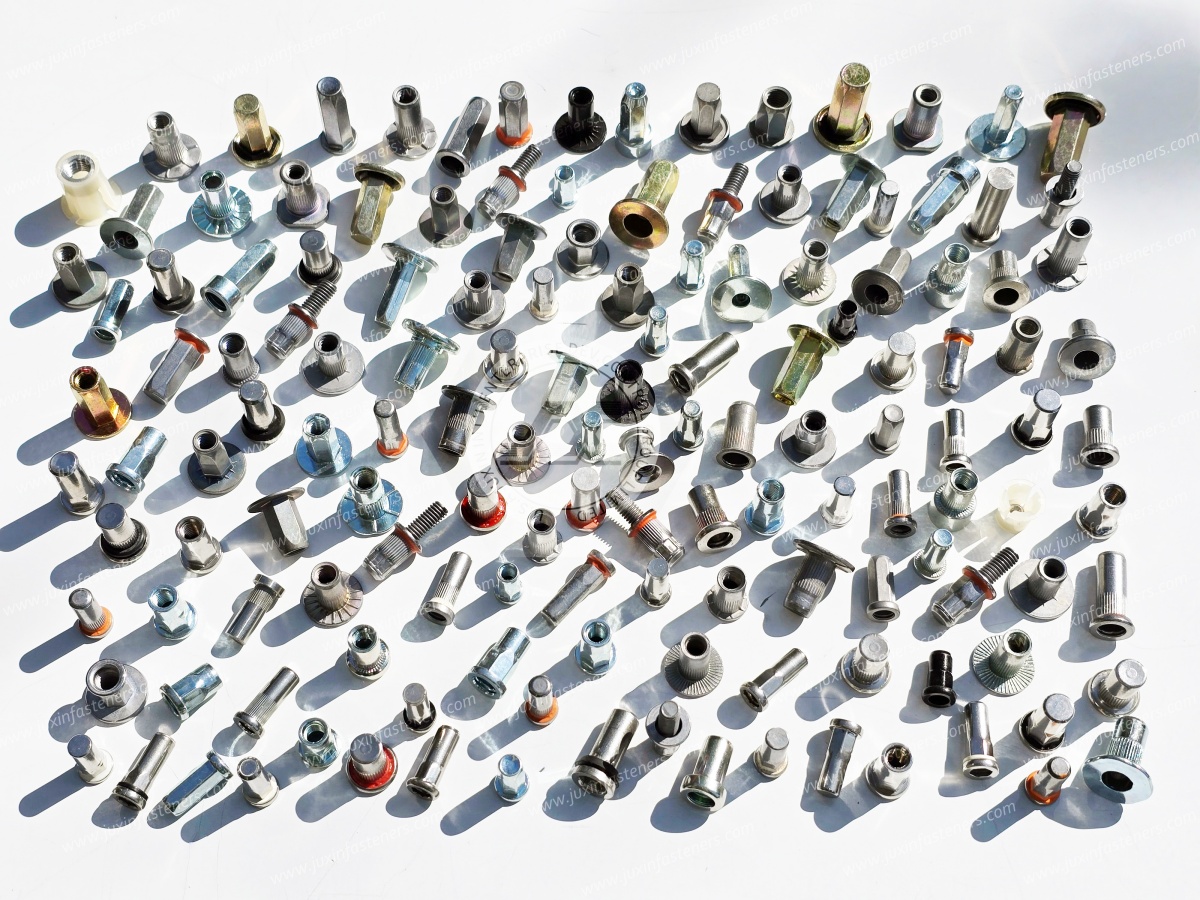
 MORE NEWS
Sep. 25, 2026

Sep. 25, 2026
Sep. 25, 2026
Contact Us
Tel.:
+86 020 8621 0320
+86 020 3121 6067
E-mail:
Technical Support:
Navigation
SEND INQUIREY