
Call Us
+86 136 6007 9809
Call Us
+86 136 6007 9809

Nov. 05, 2024
Weld Fasteners for OEM Manufacturing: Weld Studs, Weld Nuts, Pins and Welding Process Selection
Weld fasteners provide permanent attachment points on compatible metal components by joining a specially designed fastener to the base material through a controlled welding process.
They are widely considered in sheet metal fabrication, automotive production, industrial machinery,
electrical enclosures and equipment manufacturing where threaded or unthreaded attachment points must be integrated into a fabricated assembly.
Unlike a conventional bolt-and-nut connection, a welded fastener is attached to the workpiece before the final mating component is assembled.
This can simplify subsequent installation, improve access to difficult mounting locations and reduce the number of loose hardware components handled on a production line.
However, weld fastener performance depends on more than the fastener itself. Weldability, base-metal thickness, welding parameters,
surface condition, fixture accuracy and inspection requirements all influence the finished connection.
For design engineers, the main questions concern attachment geometry, loading, material compatibility and available welding access.
For manufacturing engineers and production managers, the priorities include welding-cycle consistency, automated feeding, fixture repeatability, thread protection and rework.
Purchasing and supplier development teams must also verify that the supplied fastener is compatible with the customer's actual welding process.
Juxin Fasteners supplies weld studs, weld nuts, weld pins and drawing-specific welding fasteners for suitable industrial and OEM applications.
Product specifications, material options, inspection requirements and manufacturing feasibility are reviewed against the project drawing.
What Are Weld Fasteners?
Weld fasteners are components designed to be permanently joined to a metal workpiece through an appropriate welding process.
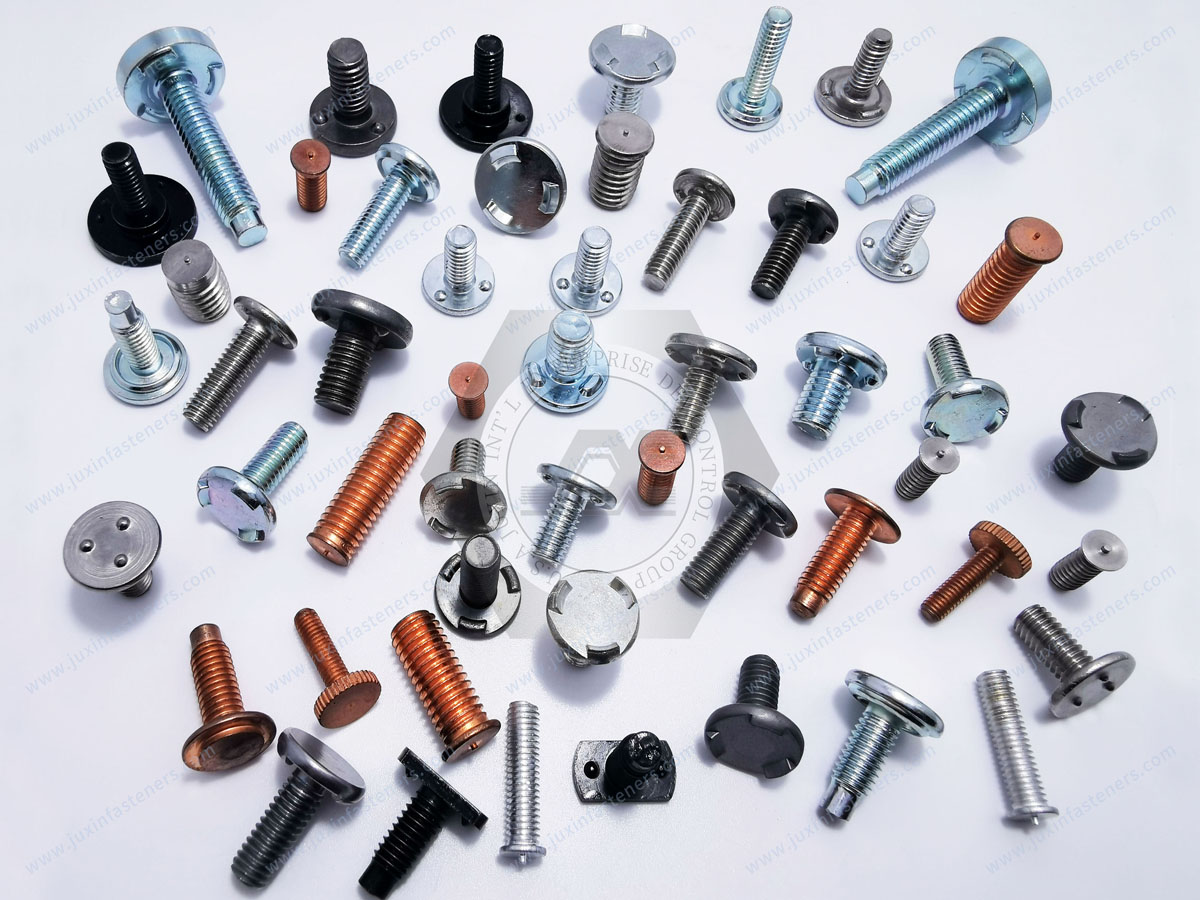
Depending on the product design, they may provide an external thread, an internal thread, a locating feature, an attachment pin or an electrical bonding point.
Common weld fastener families include:
Threaded weld studs
Projection weld studs
Resistance weld nuts
Capacitor discharge weld studs
Arc weld studs
Weld pins
Grounding weld studs
Drawing-specific welded attachment components
Important Engineering Distinction
A weld fastener is not automatically a qualified structural connector.
The allowable load and service conditions depend on the fastener, weld, base material and validated joint design.
Why OEM Manufacturers Use Weld Fasteners
Weld fasteners can provide useful manufacturing and assembly advantages when selected for the correct process.
Potential benefits include permanent attachment of a fastener to the workpiece, reduced handling of loose nuts or studs,
easier downstream component installation, and compatibility with automated fabrication processes.
Some designs may eliminate separate tapping operations or provide an attachment point without a through-hole.
Other designs, particularly certain weld nuts, still require a prepared hole for the mating screw.
The actual process savings therefore depend on the component design.
Weld Fastener Types and Their Functions
| Fastener family | Main function | Typical manufacturing consideration |
|---|---|---|
| Projection weld stud | External threaded attachment point | Projection geometry, current path and electrode access |
| Resistance weld nut | Internal threaded attachment point | Hole alignment, projection collapse and thread protection |
| CD weld stud | Rapid stud attachment with localized heat input | Sheet thickness, surface preparation and backside marking |
| Arc weld stud | Welded attachment for suitable metal sections | Weld penetration, heat input and stud alignment |
| Weld pin | Insulation, positioning or attachment | Pin geometry, welding process and service load |
| Grounding weld stud | Electrical bonding or grounding attachment | Weld integrity, conductivity and electrical validation |
The appropriate product must be selected according to the actual joint rather than treating these families as interchangeable.
Projection Weld Studs for Sheet Metal and Fabricated Assemblies
Projection weld studs incorporate designed contact features that concentrate welding current and pressure at selected locations.
During resistance projection welding, controlled electrical resistance heating and electrode force produce the welded connection.
Depending on the geometry, the projection may be formed as a ring, localized projections or another specified feature.
Relevant Product Configurations
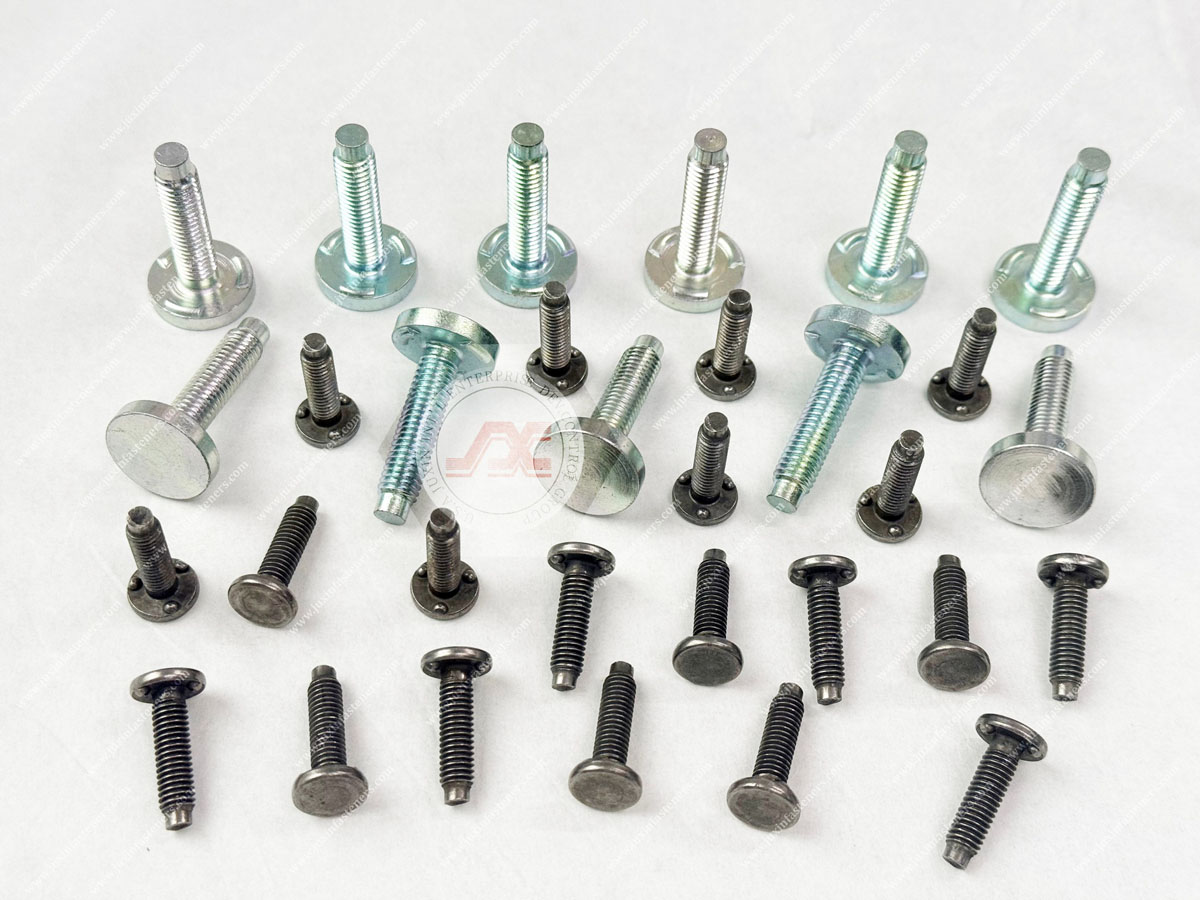
Threaded projection weld studs
Ring projection weld studs
Tab weld studs
Right-angle projection weld studs
Spade weld studs
Drawing-specific projection studs
The original Juxin Fasteners product range also includes IFI 148 Type U3 projection weld studs,
which should be quoted against the exact applicable dimensional specification and customer drawing.
Projection Weld Stud Design Considerations
Engineers should review the projection geometry, weld contact area, stud orientation, base-metal thickness and available electrode access.
The projection design must be compatible with the welding equipment and workpiece material.
Incorrect projection geometry or unsuitable welding parameters may produce incomplete fusion, excessive indentation, spatter or inconsistent weld strength.
Production Recommendation
Validate projection weld studs using the actual production material, electrode tooling and welding parameters before releasing the assembly for volume manufacturing.
Resistance Weld Nuts
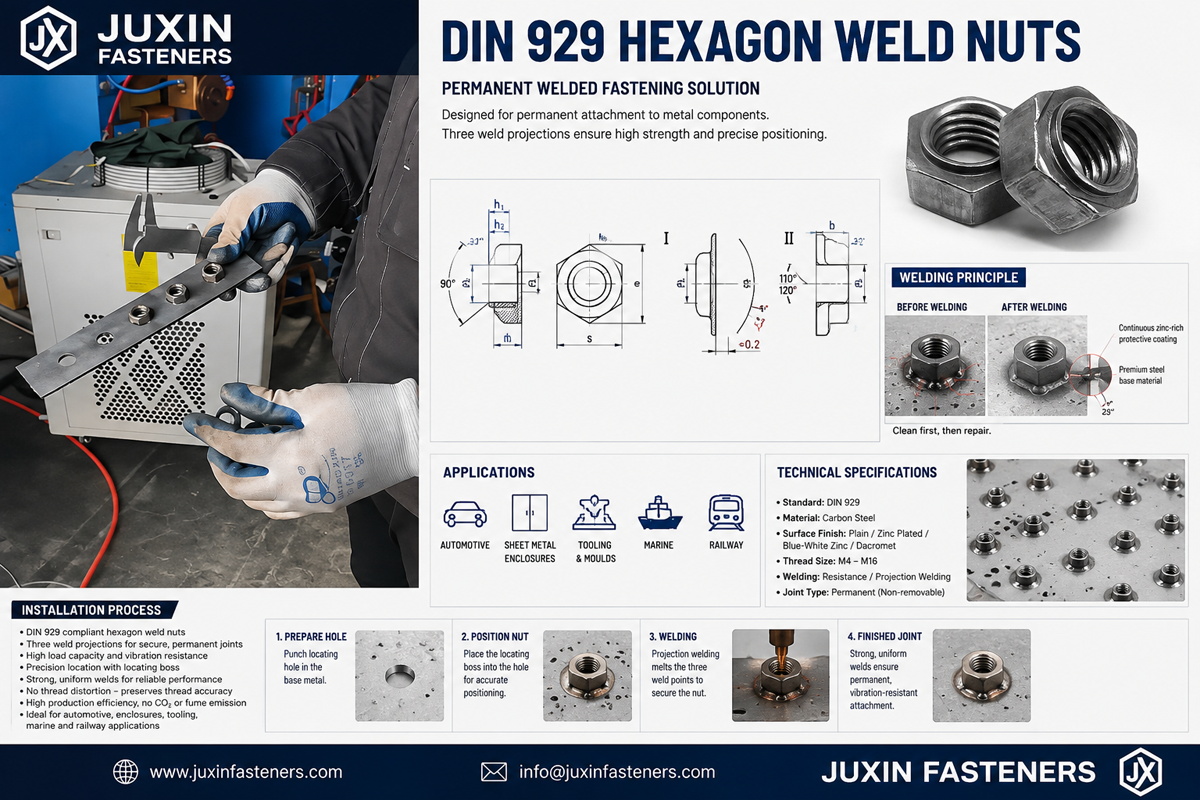
Resistance weld nuts provide an internal threaded attachment point on a compatible metal workpiece.
They are frequently considered for sheet metal assemblies where a nut must be attached before subsequent bolted assembly.
Juxin Fasteners' source product range includes:
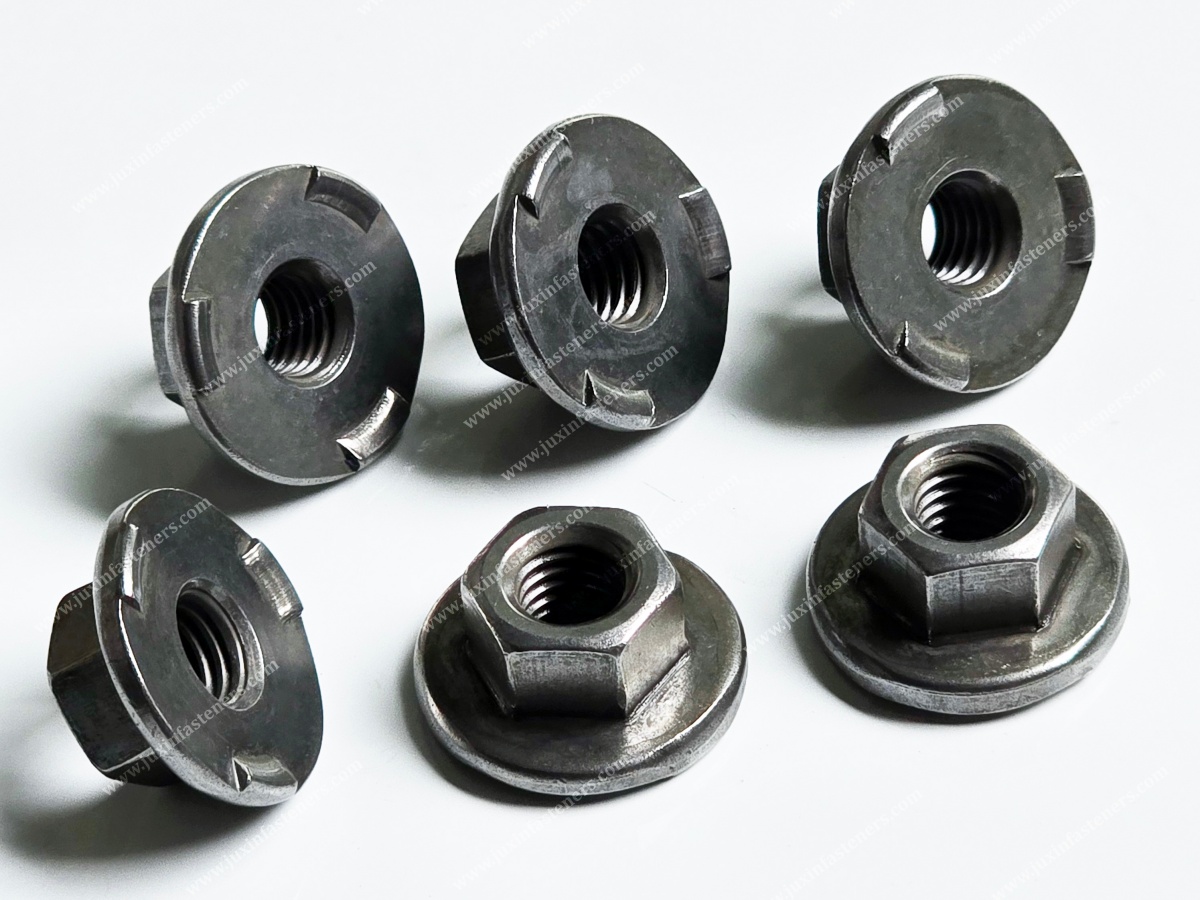
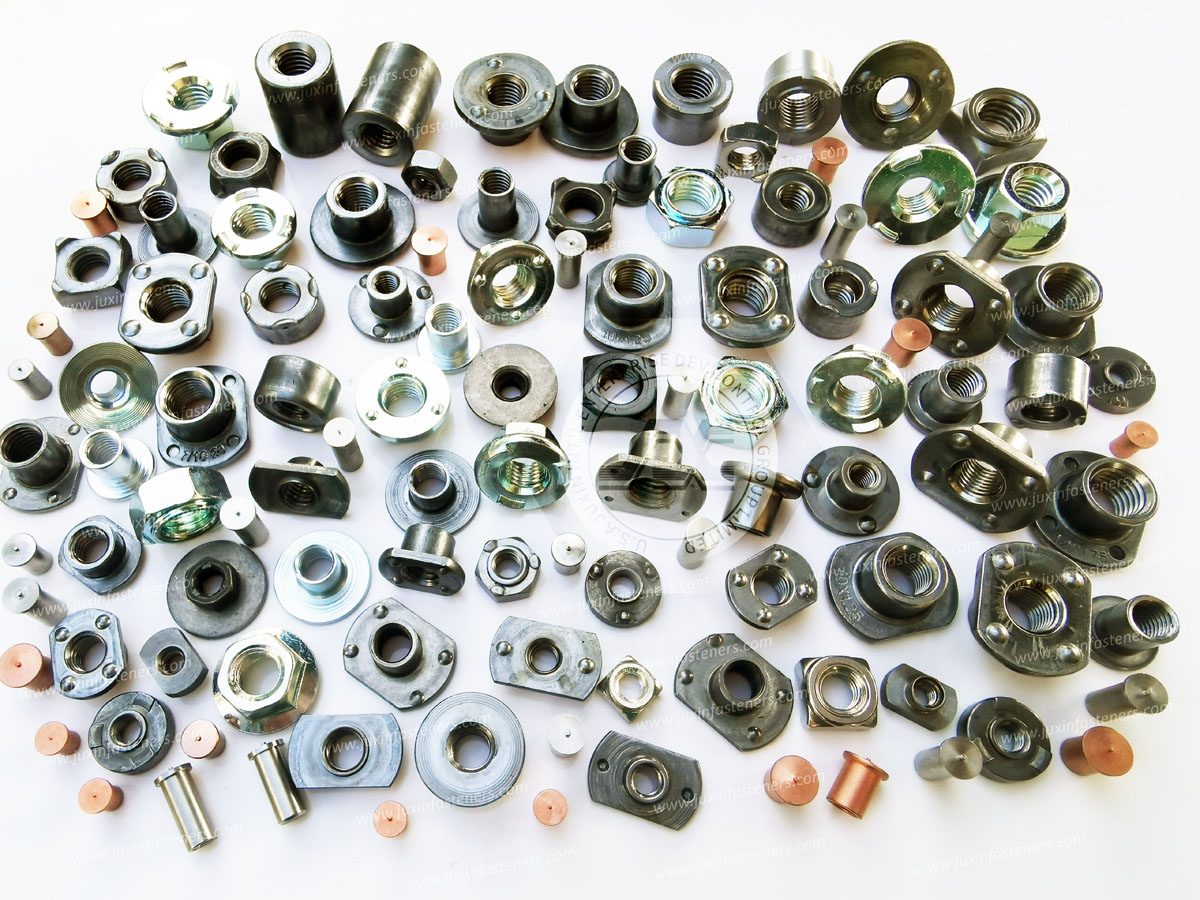
Hex three-projection weld nuts
Hex six-projection weld nuts
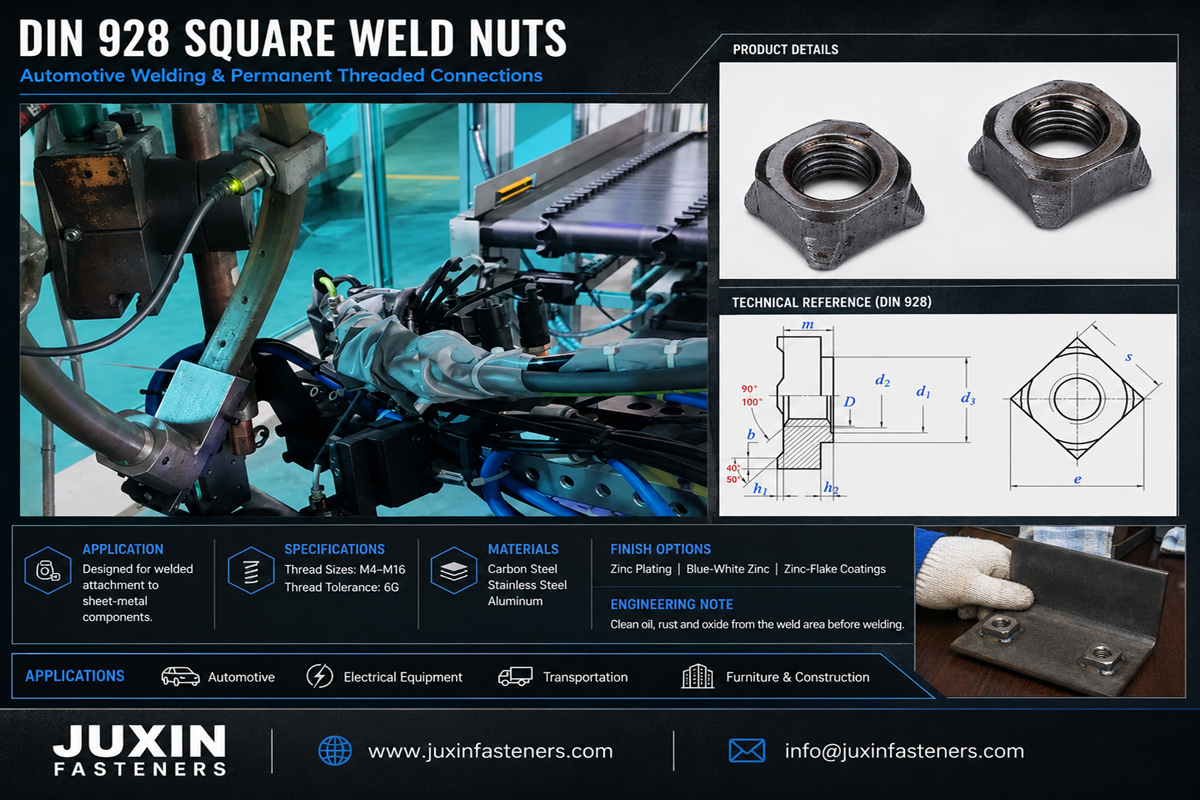
Square projection weld nuts
Round piloted projection weld nuts
Flange projection weld nuts
Stamped flange weld nuts
Tab projection weld nuts
Tab spot weld nuts
Floating cage weld nuts and related assemblies require separate confirmation of their specific retention and welding arrangement.
Projection Weld Nut Geometry
Weld nut performance depends on the interaction between the nut projections and the base material.
Key variables include projection height, projection shape, nut material, sheet thickness, electrode force and welding current.
The welding process must create sufficient fusion without damaging the internal thread or causing unacceptable distortion.
Weld Nut Pilot Holes and Alignment
Many weld nut designs are positioned relative to a prepared hole in the sheet.
Misalignment can prevent the mating bolt from entering correctly, even when the weld appears visually acceptable.
Engineering Considerations
Hole diameter and tolerance
Nut pilot geometry
Nut-to-hole concentricity
Perpendicularity
Thread accessibility
Electrode alignment
Production Recommendation
Include post-weld thread accessibility and alignment checks where required by the assembly drawing.
Thread Damage During Weld Nut Installation
Potential causes include weld spatter, excessive heat, misaligned electrodes and deformation of the nut body.
A damaged internal thread may increase downstream assembly torque or cause cross-threading.
Engineering Recommendation
Where necessary, specify thread protection and post-weld functional inspection.
Weld Pins for Insulation, Positioning and Component Attachment
Weld pins provide unthreaded attachment or locating features.
Depending on the design, they may be used to secure insulation, position components or provide an attachment feature in an industrial assembly.
Product types may include:
Spot weld pins
Projection weld pins
Arc weld pins
CD weld pins
Flanged weld pins
Non-flanged weld pins
Grounding weld pins
Engineering Considerations
The correct pin design depends on the attached material, required retention, welding process, base-metal thickness and environmental exposure.
For insulation applications, the designer must also consider the retaining washer or other securing component.
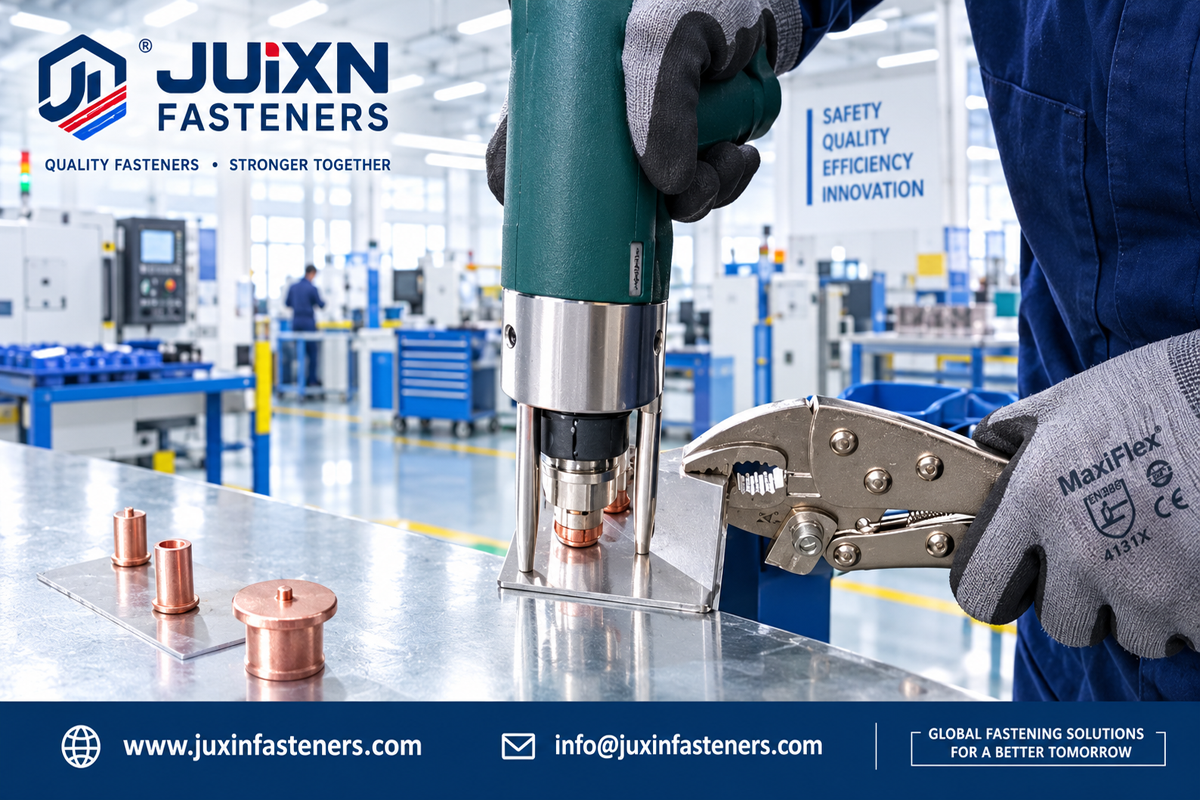
Capacitor Discharge (CD) Weld Studs
Capacitor discharge stud welding uses stored electrical energy to create a rapid welding cycle.
CD stud welding is often considered for relatively thin metal components where localized heat input and surface appearance are important.
Potential products include:
CD threaded weld studs
Flanged CD weld studs
Non-flanged CD weld studs
CD weld pins
CD collar studs
CD weld standoffs
CD grounding studs
Potential Advantages
CD welding can offer short welding cycles, localized heating and relatively limited distortion in suitable materials.
However, low heat input does not guarantee an invisible weld or an undamaged opposite surface.
Backside Marking and Thin-Sheet Distortion
Thin sheet metal may exhibit backside marking, discoloration or local distortion after stud welding.
The result depends on:
Sheet thickness
Material thermal properties
Surface finish
Stud diameter
Welding energy
Fixture support
Welding equipment
Engineering Recommendation
For decorative panels or exposed exterior surfaces, specify acceptable backside appearance and inspect representative production samples.
CD Weld Studs and Material Compatibility
Not every stud material can be welded successfully to every sheet material.
Weldability depends on metallurgical compatibility and the process.
Engineering Recommendation
Verify the exact stud and base-metal grades, including any coatings, before approving the weld fastener.
Arc Weld Studs
Arc stud welding uses an electric arc to heat and join the stud and workpiece.
Depending on the process variant, it may be used for threaded studs, unthreaded studs and other welded attachment components.
Potential products include:
Fully threaded arc weld studs
Partially threaded arc weld studs
Arc collar studs
Arc weld pins
Engineering Considerations
Stud diameter and geometry
Base-metal thickness
Weld penetration
Heat input
Welding position
Surface preparation
Process shielding or other required welding accessories
Welding equipment capacity
Important Distinction
Arc welding should not be described as universally suitable for heavy structural work merely because the process can produce substantial welds.
Structural applications require the correct stud system, qualified welding procedure and applicable design approvals.
Grounding Weld Studs and Electrical Bonding
Grounding weld studs may provide a connection point for protective bonding or electrical continuity in suitable equipment.
Potential applications include:
Electrical cabinets
Control panels
Industrial enclosures
Power distribution equipment
Selected battery and electrical systems
Important Engineering Distinction
A welded stud does not automatically guarantee a compliant protective-earth connection.
The complete bonding path must be evaluated for electrical resistance, corrosion, mechanical integrity and the applicable equipment safety requirements.
Engineering Recommendation
Specify electrical continuity testing and other verification where required by the equipment design.
Choosing Between CD Welding, Arc Welding and Resistance Projection Welding
The welding method must be selected according to the fastener geometry, base metal, available equipment and performance requirements.
| Welding process | Typical product families | Key selection factors | Main risks to control |
|---|---|---|---|
| Capacitor discharge stud welding | CD studs, pins, standoffs | Thin-sheet compatibility, heat input, backside appearance | Incomplete fusion, marking, surface contamination |
| Arc stud welding | Threaded studs, pins and specified structural stud systems | Base-metal thickness, heat input, stud geometry | Inadequate fusion, excessive heat, weld defects |
| Resistance projection welding | Projection weld nuts and studs | Projection geometry, electrode force, current path, sheet material | Projection collapse variation, spatter, misalignment |
Why There Is No Universal Diameter Range
The original article grouped welding methods into fixed stud-diameter ranges.
In practice, available diameters depend on the exact welding process variant, equipment, fastener design and applicable specification.
Engineering Recommendation
Use the manufacturer's equipment capability and the relevant product or welding specification rather than treating a general diameter range as a guaranteed capability.
Sheet Thickness and Weld Fastener Selection
Base-metal thickness is one of the most important variables in welded attachment design.
Thin sheets may be vulnerable to burn-through, distortion or backside marking.
Thicker sections may require different heat input, weld geometry or welding equipment.
Key Questions
What is the nominal sheet thickness?
What is the sheet material and grade?
Is the reverse surface visible?
Is the sheet coated?
Is the attachment load tensile, shear or combined?
Is the fastener installed before or after forming and painting?
Engineering Recommendation
Review sheet thickness and material together with the selected weld fastener and process.
Weld Fastener Material Selection
Potential material families include carbon steel, stainless steel, aluminum and selected alloy materials, depending on the product and process.
| Material family | Potential application reason | Welding consideration |
|---|---|---|
| Carbon steel | General industrial attachment | Grade, surface condition and weldability |
| Stainless steel | Suitable corrosion-resistant assemblies | Exact grade, welding behavior and corrosion performance |
| Aluminum | Lightweight compatible assemblies | Alloy, temper, oxide layer and process compatibility |
| Alloy steel | Selected mechanical requirements | Composition, heat treatment and weldability |
| Copper alloys | Selected electrical or specialized applications | Thermal and electrical properties; process compatibility |
Important Limitation
High mechanical strength does not automatically mean good weldability.
A fastener material must be suitable for the welding process and the required post-weld mechanical properties.
Heat Treatment and Weldability
Heat-treated materials may experience changes in local microstructure and properties near the weld.
Engineering Recommendation
For strength-critical welded fasteners, confirm material condition and welding compatibility rather than specifying a high-strength fastener grade without evaluating the weld.
Surface Coatings and Welding Compatibility
Surface finishes can affect welding current, contact resistance, heat generation and weld quality.
Potential issues include:
Coating contamination
Spatter
Incomplete fusion
Fume generation
Weld-area corrosion
Appearance changes
Engineering Recommendation
Specify whether the fastener and workpiece are welded before or after coating.
Do not assume that a coating suitable for ordinary threaded fasteners is automatically suitable for welding.
Post-Weld Corrosion Protection
Welding may locally disturb protective coatings.
For outdoor or corrosive environments, engineers should review whether the finished weld region requires additional protection.
Important Limitation
A corrosion-resistant fastener material alone does not guarantee corrosion resistance of the complete welded joint.
Weld Fastener Joint Strength and Failure Modes
A welded attachment may experience tensile, shear, bending or combined loading.
Potential failure modes include:
Failure within the fastener
Fracture through the weld
Failure in the heat-affected zone
Sheet pull-out
Local sheet deformation
Fatigue cracking
Thread stripping in the attached nut
Corrosion-assisted degradation
Engineering Recommendation
Evaluate the complete load path, including the base material and weld.
Why Stud Strength Does Not Equal Weld Strength
A threaded stud may have adequate nominal mechanical strength while the welded attachment remains limited by the weld area or connected sheet.
Important Distinction
The fastener's material strength alone cannot establish the allowable load of the welded joint.
Engineering Recommendation
Use application-specific calculations and appropriate weld qualification or testing.
Weld Stud Alignment and Perpendicularity
Stud alignment affects downstream assembly.
A tilted stud may cause difficulty installing a bracket or mating nut.
Production Considerations
Fixture accuracy
Welding gun alignment
Workpiece flatness
Stud feeding
Welding force
Distortion
Engineering Recommendation
Define acceptable stud position and perpendicularity where functionally important.
Weld Nut Push-Out and Torque Performance
For suitable weld nut applications, functional tests may include push-out resistance, torque resistance or other specified checks.
Important Limitation
The test method, loading direction and acceptance criteria must match the actual application.
A push-out test alone does not prove that the joint is suitable for all service loads.
Weld Stud Pull Testing
Pull testing may be used to evaluate selected welded stud attachments.
Engineering Considerations
Test fixture
Loading direction
Base-metal thickness
Failure location
Acceptance criteria
Important Limitation
Destructive pull tests are not interchangeable with all other weld-quality assessments.
Production Recommendation
Define sampling frequency and acceptance criteria as part of the agreed control plan.
Weld Defects and Corrective Actions
| Problem | Possible contributing factor | Recommended investigation |
|---|---|---|
| Incomplete fusion | Insufficient energy, contamination or poor contact | Review welding parameters and surface preparation |
| Excessive spatter | Unsuitable parameters or material condition | Review current, force and process setup |
| Sheet burn-through | Excessive heat input for the sheet | Review sheet thickness and welding process |
| Backside marking | Local heat and deformation | Review energy, support and appearance criteria |
| Misaligned weld stud | Fixture or gun alignment | Check positioning and welding equipment |
| Weld nut thread damage | Spatter, heat or deformation | Inspect thread protection and welding conditions |
| Inconsistent weld strength | Process variation or material differences | Review parameter control and incoming material |
| Corrosion near weld | Coating damage or unsuitable protection | Review post-weld corrosion treatment |
Engineering Recommendation
Investigate the root cause using the actual welding process before changing the fastener geometry.
Automotive Body-in-White and Electric Vehicle Manufacturing
Weld nuts and projection weld studs are commonly considered in automotive sheet metal manufacturing because they can create attachment points before downstream vehicle assembly.
Potential applications include:
Body-in-white brackets
Equipment mounting points
Wiring harness supports
Heat shield attachments
Selected battery enclosure components
Interior equipment attachments
Engineering Considerations
Sheet material and thickness
Weld nut positioning
Automated feeding
Robotic welding access
Corrosion protection
Downstream bolt installation
Production traceability
Important Limitation
Battery structural joints, crash-critical components, brake systems and chassis safety connections require dedicated design approval and manufacturing validation.
Production Recommendation
For high-volume automotive programs, review weld fastener dimensional consistency and process compatibility before approving a new supplier.
Electrical Equipment and Control Cabinets
Weld studs, weld nuts and grounding studs may be used in suitable:
Electrical enclosures
Switchgear cabinets
Power distribution panels
Industrial control cabinets
Automation equipment housings
Engineering Considerations
Sheet thickness
Internal clearance
Surface appearance
Thread accessibility
Corrosion protection
Electrical continuity where required
Production Recommendation
Select fasteners compatible with the cabinet fabrication sequence, including welding, coating and final assembly.
Industrial Machinery and Heavy Equipment
Potential applications include:
Machine guards
Fabricated equipment housings
Mounting brackets
Agricultural machinery panels
Construction equipment accessories
Material handling equipment
Engineering Considerations
Shock and vibration
Weld fatigue
Component access
Coating durability
Service requirements
Important Limitation
Highly loaded structural attachments require dedicated engineering evaluation.
Structural Steel and Construction Applications
Certain stud welding systems are used in structural steel fabrication.
However, general-purpose weld studs, projection weld studs and qualified structural shear connectors are not interchangeable.
Important Distinction
A structural stud system must meet the applicable project design, product and welding requirements.
Engineering Recommendation
For structural projects, confirm the exact stud type and required qualification before quotation.
Railway and Rail Transit Equipment
Potential applications include selected:
Electrical cabinets
Interior equipment
Auxiliary brackets
Fabricated equipment housings
Important Limitation
Rail vehicle structural and safety-critical applications require project-specific qualification.
Marine Equipment
Weld fasteners may be considered for compatible marine equipment and fabricated assemblies.
Engineering Considerations
Material weldability
Saltwater exposure
Corrosion protection
Coating repair
Fatigue loading
Important Limitation
Marine corrosion performance must be evaluated for the complete welded assembly.
Aerospace-Related Equipment
Selected weld fasteners may be used in ground-support equipment and other suitable industrial applications associated with aerospace operations.
Important Limitation
Aircraft structural or flight-critical use requires verified product, process and supplier qualification.
General industrial weld fasteners should not be presented as aerospace-qualified without evidence.
Production-Line Integration of Weld Fasteners
Weld fasteners can be incorporated into manual, semi-automated or automated production processes depending on the product and equipment.
Production Considerations
Part feeding
Stud or nut orientation
Fixture positioning
Welding equipment access
Electrode maintenance
Welding parameter control
Thread protection
Cycle time
Inspection
Scrap and rework
Production Recommendation
Evaluate the total process cost rather than only the fastener unit price.
Automated Feeding and Dimensional Consistency
Automatic feeding systems require consistent fastener geometry.
Potential problems include:
Incorrect orientation
Feeding jams
Variation in flange or projection dimensions
Thread damage
Positioning errors
Engineering Recommendation
Define dimensions and tolerances that are critical to the feeding and welding process.
Fixture Design and Welding Repeatability
Fixtures help control workpiece position and welding alignment.
Key Factors
Component location
Clamping force
Thermal distortion
Electrode access
Maintenance access
Production Recommendation
Validate the welding fixture using representative production components.
Quality Control for Weld Fasteners
Quality requirements should be defined according to the product, welding process and customer drawing.
Incoming Fastener Inspection
Potential checks include:
Thread dimensions
Stud length
Head or flange dimensions
Projection geometry
Material identification
Surface condition
Packaging condition
Welding Process Control
Potential controls include:
Welding current
Welding time
Electrode force
Welding energy
Fixture alignment
Electrode wear
The applicable parameters depend on the welding method.
Post-Weld Inspection
Potential checks include:
Fastener position
Perpendicularity
Thread accessibility
Visible weld condition
Weld strength testing where specified
Coating condition
Electrical continuity where applicable
Important Limitation
No single inspection method verifies every aspect of weld fastener performance.
Relevant International Standards
Depending on the product and welding process, applicable references may include:
IFI 148 for the relevant projection weld stud configuration specified in the original product information
ISO 13918 for studs and ceramic ferrules used in arc stud welding, where applicable
ISO 14555 for arc stud welding of metallic materials, where applicable
Resistance projection welding and customer-specific weld nut programs require the relevant product drawing, welding procedure and inspection requirements.
Important Distinction
A fastener dimensional standard does not by itself qualify the finished weld.
The product standard and welding-process requirements must be evaluated separately.
Metric and Inch Thread Specifications
Weld studs and weld nuts may be specified using different thread systems.
ISO Metric Threads
Metric threads use metric diameter and pitch designations.
Unified Inch Threads
UNC and UNF threads follow separate unified inch-thread specifications.
Important Distinction
Metric, UNC, UNF and legacy British thread systems are not directly interchangeable.
Engineering Recommendation
Confirm the exact thread designation, tolerance and mating component before approving a replacement weld fastener.
OEM Custom Weld Fasteners
Juxin Fasteners welcomes inquiries for standard and drawing-specific welded attachment components.
Potential requirements include:
Custom stud diameter and length
Special weld projection geometry
Custom weld nut dimensions
Material selection
Thread specifications
Surface treatment
Welding-process compatibility
Dimensional inspection
Functional testing requirements
Packaging
Manufacturing feasibility and commercial availability depend on the actual drawing, material and order requirements.
Supplier Qualification for Weld Fasteners
Purchasing managers and supplier development teams should evaluate:
Product drawing and revision
Applicable dimensional standard
Fastener material grade
Weldability
Welding-process compatibility
Projection geometry
Thread quality
Surface condition
Sample approval
Inspection requirements
Material documentation
Annual demand
MOQ
Lead time
Packaging
Change control
Alternative Supplier Validation
A replacement weld nut or weld stud should be evaluated for more than nominal thread size.
Small differences in projection geometry, flange dimensions, material condition or coating can affect welding behavior.
Engineering Recommendation
Validate an alternative supplier's fasteners using the customer's actual welding equipment and production materials.
Total Installed Cost
The lowest fastener unit price does not necessarily produce the lowest total assembly cost.
Relevant factors include:
Welding cycle time
Part feeding
Fixture setup
Electrode wear
Scrap
Rework
Thread damage
Inspection
Downstream assembly problems
Procurement Recommendation
Compare suppliers using the complete manufacturing process and required quality level.
Frequently Asked Questions
What is a weld fastener?
A fastener designed to be permanently joined to a compatible metal workpiece through an appropriate welding process.
What is the difference between a weld stud and a weld nut?
A weld stud typically provides an external threaded attachment point, while a weld nut provides an internal threaded attachment point.
What is the difference between CD and arc stud welding?
CD welding uses stored electrical energy in a rapid cycle, while arc stud welding uses an electric arc.
The appropriate method depends on the materials, geometry and equipment.
Can weld studs be used on thin sheet metal?
Potentially, but sheet thickness, material, welding energy and backside appearance must be evaluated.
Do weld nuts require a hole in the sheet?
Many weld nut designs are aligned with a prepared hole, although the exact requirement depends on the product geometry.
Can a weld fastener be installed on a coated sheet?
Only when the coating and welding process are compatible and the resulting joint meets the required acceptance criteria.
Are weld studs suitable for electrical grounding?
Certain grounding stud designs may be suitable, but electrical continuity and mechanical integrity must be verified.
Are all weld studs suitable for structural applications?
No. Structural applications require the appropriate stud system, welding procedure and project-specific qualification.
Can Juxin Fasteners supply custom weld studs and weld nuts?
Juxin Fasteners welcomes drawing-specific inquiries. Material, dimensions, weldability, inspection scope and commercial terms require confirmation.
Juxin Fasteners: Weld Studs, Weld Nuts and OEM Welding Fasteners
Juxin Fasteners supplies industrial weld fasteners and drawing-specific fastening components.
Relevant product categories include:
Projection weld studs
IFI 148 Type U3 projection weld studs
Resistance weld nuts
Hex projection weld nuts
Square projection weld nuts
Round piloted weld nuts
CD weld studs
Arc weld studs
Weld pins
Grounding weld studs
Custom welding fasteners
Exact product availability, material grades, dimensions, inspection documentation, MOQ and lead times are subject to technical and commercial confirmation.
Request a Quote for Weld Fasteners
Are you sourcing weld studs, projection weld studs, resistance weld nuts, CD weld studs, arc weld studs, weld pins or custom OEM welding fasteners?
Juxin Fasteners welcomes inquiries from design engineers, mechanical engineers, manufacturing engineers, production managers, purchasing specialists and supplier development teams.
For technical review and quotation, please provide:
Fastener drawing and revision + applicable product standard + fastener type + thread designation + dimensions and tolerances
+ material grade + surface finish + base-metal grade and thickness + intended welding process + welding equipment or process requirements
+ installation position + joint loading + required weld performance + inspection and test requirements + prototype quantity + annual demand + packaging + target delivery schedule.
Company: Juxin Fasteners
Website: https://www.juxinfasteners.com/
Email: info@juxinfasteners.com
Send your weld fastener drawings and OEM RFQ to Juxin Fasteners for technical confirmation, product selection and quotation.
Contact Us
Tel.:
+86 020 8621 0320
+86 020 3121 6067
E-mail:
Technical Support:
Navigation
SEND INQUIREY



