
Call Us
+86 136 6007 9809
Call Us
+86 136 6007 9809

Aug. 15, 2026
Expansion Bolt Solutions for Automotive Manufacturing and Industrial Facilities
Engineering Guide to Automotive Plant Equipment Anchoring, Production-Line Installation, Robot Cells, Safety Infrastructure and OEM Fastener Procurement
Automotive manufacturing facilities depend on reliable mechanical connections throughout their production systems, equipment installations and supporting infrastructure.
Vehicle assembly plants, automotive component factories, stamping facilities, body shops, paint shops,
battery manufacturing facilities and automated production lines contain machinery, conveyors, robotic workstations, safety barriers and utility systems that require secure installation.
Expansion bolts and post-installed concrete anchors may be used for suitable applications involving equipment supports, fabricated base plates,
conveyor structures, machine guards, maintenance platforms and industrial brackets.
Unlike ordinary building installations, automotive production facilities must coordinate mechanical reliability with production efficiency, equipment alignment, installation access and planned maintenance.
An incorrectly specified or installed anchor may cause rework, equipment movement, installation delays or unplanned maintenance.
In critical applications, the consequences can extend beyond the cost of the fastener itself.
For automotive OEMs, Tier-1 and Tier-2 manufacturers, automation system integrators, manufacturing engineers, production managers and procurement teams,
the correct fastening solution must address the entire connection—not simply the nominal bolt diameter.
Juxin Fasteners supplies industrial fastening components for automotive manufacturing, machinery, construction, infrastructure and drawing-based OEM applications.
Our product range includes expansion bolts, concrete anchoring hardware, bolts, nuts, washers, flange fasteners, rivet nuts, welding nuts, self-clinching fasteners and customized threaded components.
This guide examines engineering selection, installation reliability, factory retrofit considerations, quality control and industrial fastener sourcing for automotive manufacturing facilities.
What Are Expansion Bolts Used for in Automotive Manufacturing Facilities?
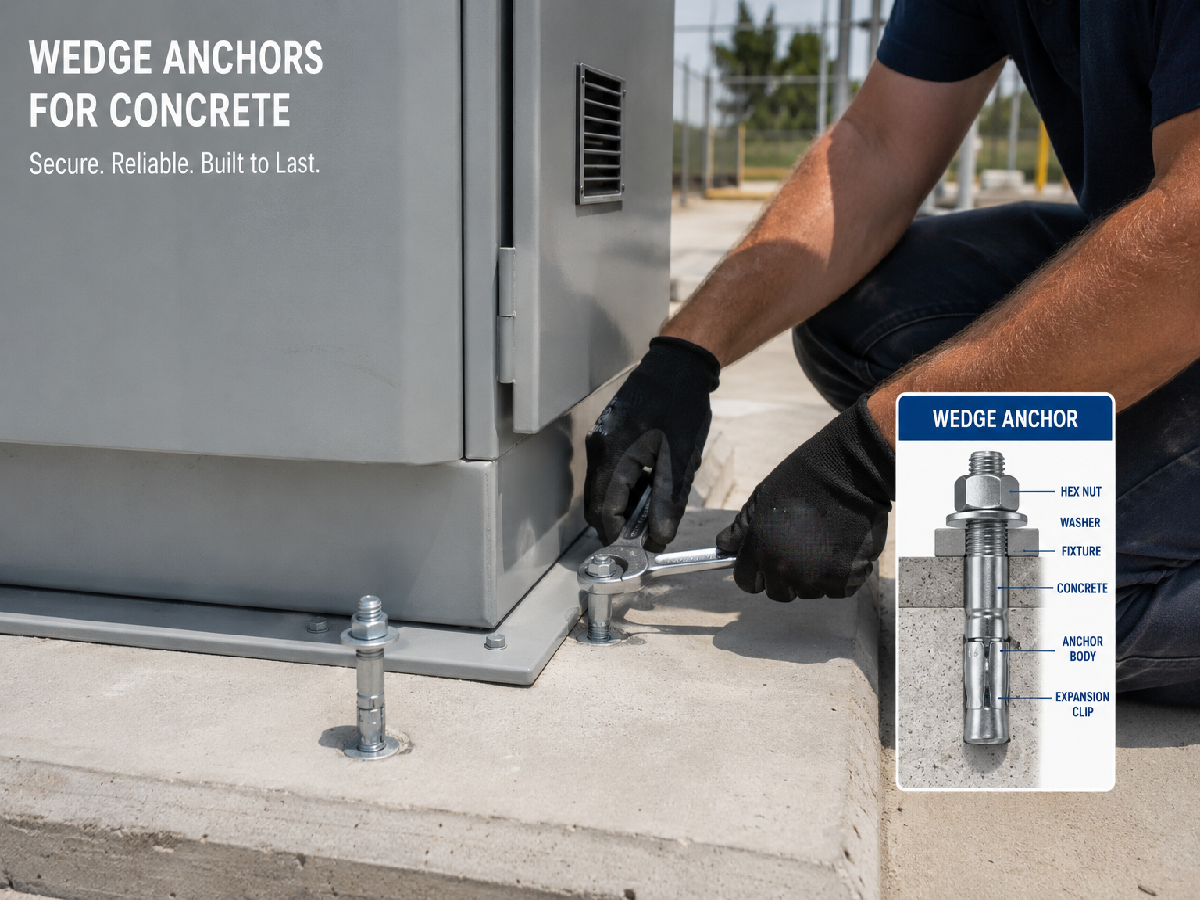
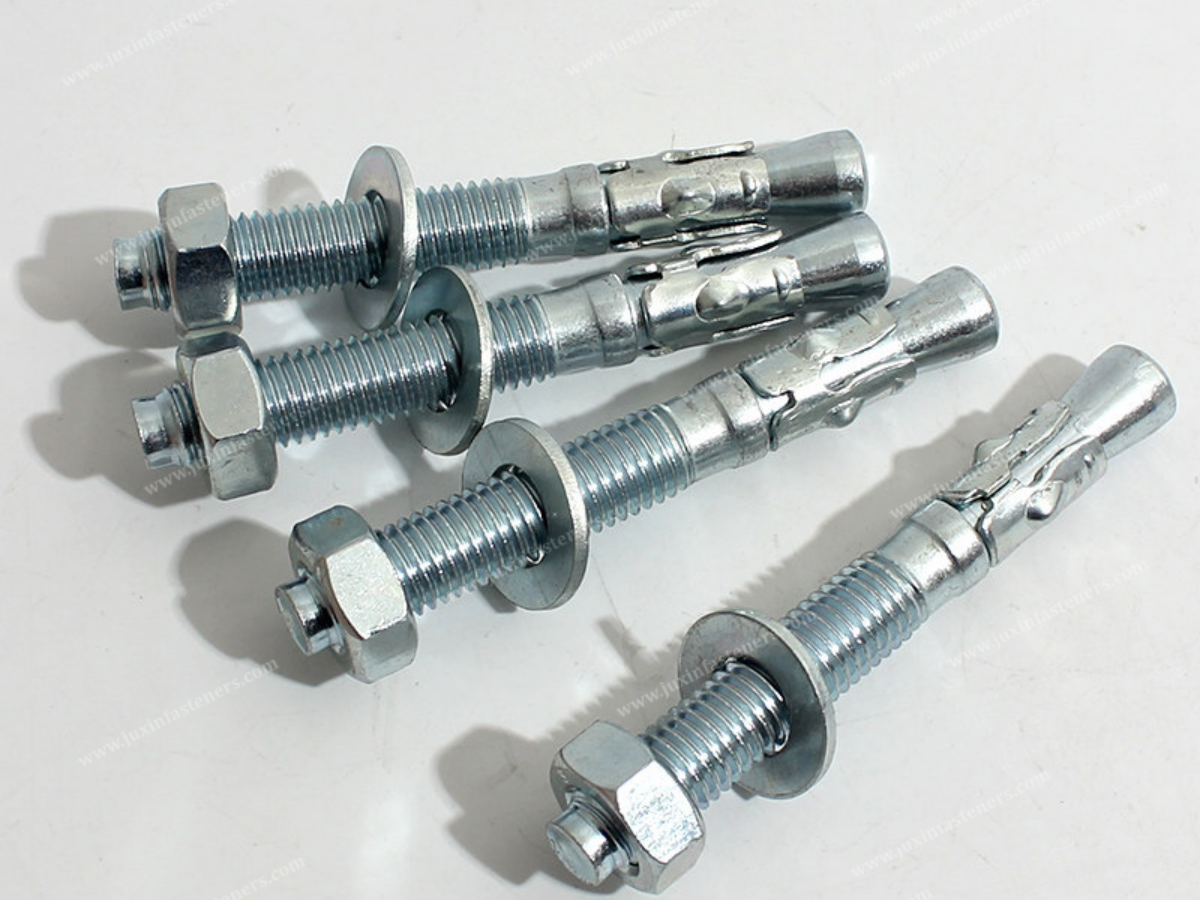
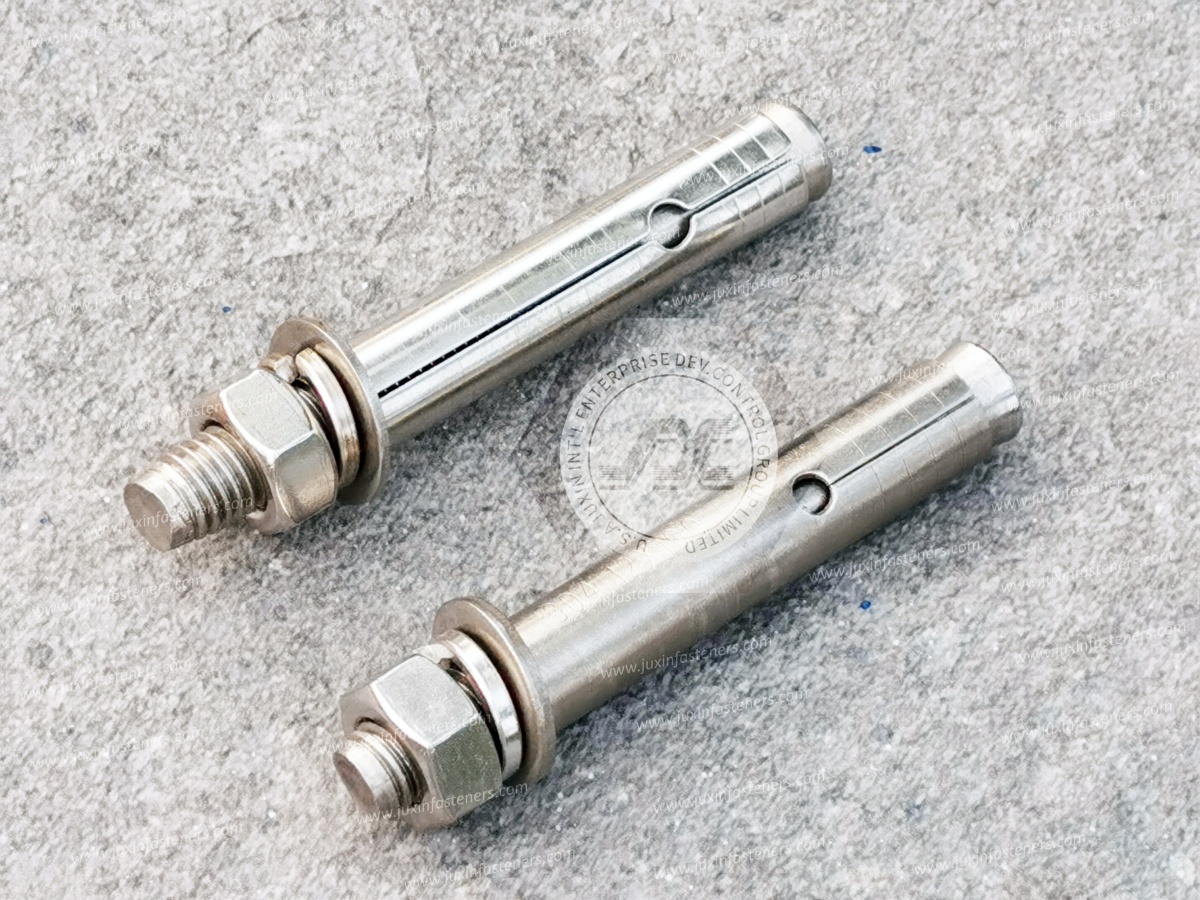
Expansion bolts are post-installed mechanical anchors designed to secure suitable fixtures to concrete or other base materials for which the specific anchor has been qualified.
Depending on the design, a mechanical expansion anchor may include:
Threaded stud or bolt
Expansion clip or sleeve
Tapered wedge or cone
Nut and washer
Product-specific setting components
The expansion mechanism develops engagement with the surrounding substrate when installed according to the manufacturer's specified procedure.
The anchoring system then transfers applicable tensile and shear forces from the equipment fixture into the concrete.
Common International Product Terms
Industrial buyers and engineers may search for:
Automotive factory expansion bolts
Automotive plant concrete anchors
Production line equipment anchors
Industrial equipment expansion anchors
Conveyor support concrete anchors
Industrial robot base anchors
Machine base anchoring bolts
Factory infrastructure fasteners
Safety fencing floor anchors
Post-installed mechanical anchors
Wedge anchors for industrial equipment
Sleeve anchors for factory equipment
These terms describe related applications but do not establish that different anchor types or products are interchangeable.
Factory Infrastructure Anchors vs. Automotive Vehicle Fasteners
Automotive manufacturing involves two distinct fastening categories.
Factory Infrastructure Fasteners
Used to install production equipment, conveyors, support structures, safety fencing and factory utilities.
Vehicle Assembly Fasteners
Used directly in vehicles or automotive components, including bolts, flange nuts, clips, weld nuts, rivet nuts and other application-specific fasteners.
Concrete expansion anchors belong primarily to the factory infrastructure category.
They should not be described as direct vehicle assembly fasteners.
Engineering Information Gain: Automotive Plant Procurement Requires Two Different Specifications
A vehicle component fastener may be governed by a vehicle assembly drawing and automotive production requirements.
A concrete anchor used to secure a factory conveyor must be selected according to the equipment, concrete substrate, structural loading and anchoring requirements.
Even when the same purchasing department sources both categories, their technical approval processes may be different.
Expansion Bolt Applications in Automotive Plants
Potential applications include:
Production-line equipment
Assembly stations
Conveyor support frames
Robotic workstations
Equipment bases
Industrial machinery
Machine guards
Safety fencing
Protective barriers
Cable trays
Utility piping
HVAC equipment
Maintenance platforms
Factory support structures
The selected anchor must be suitable for the actual application.
Automotive Factory Anchoring Application Matrix
| Application | Potential connection | Main engineering consideration |
|---|---|---|
| Assembly equipment | Equipment base to concrete | Loading and alignment |
| Conveyor support | Steel frame to concrete | Repeated loads and support geometry |
| Robot cell equipment | Approved base to concrete | Dynamic forces and equipment instructions |
| Machine guard | Guard post to concrete | Safety-system requirements |
| Safety fencing | Fence post to floor | Stability and impact considerations |
| Cable tray support | Bracket to concrete | Distributed loading |
| Compressed-air piping | Pipe support to structure | Vibration and movement |
| HVAC equipment | Equipment support to concrete | Vibration and service access |
| Maintenance platform | Steel support to foundation | Structural and personnel loading |
| Factory retrofit | New equipment to existing concrete | Substrate verification and drilling constraints |
Expansion Bolts for Automotive Production Equipment
Automotive manufacturing equipment often operates continuously or through repeated production cycles.
Potential anchoring applications include:
Assembly machine frames
Auxiliary machine supports
Inspection equipment frames
Production workstations
Selected equipment bases
Equipment service structures
Equipment Weight
The equipment mass and center of gravity influence anchorage demands.
Operating Forces
Machinery may generate horizontal, vertical or overturning forces.
Vibration
Repeated operation can introduce cyclic loading.
Equipment Alignment
Some machinery requires controlled position and leveling.
Concrete Condition
The foundation must meet the selected anchor's requirements.
Maintenance Access
The anchoring arrangement should permit inspection and servicing.
Information Gain: Equipment Stability and Equipment Alignment Are Different Requirements
An anchor can help restrain equipment movement, but it does not automatically establish precise machine alignment.
Equipment leveling, grout, shims, support stiffness and anchorage must be coordinated according to the equipment manufacturer's instructions.
For precision production equipment, the anchoring arrangement should not introduce unacceptable distortion into the machine base.
Industrial Robot Base Anchoring
Robotic workstations are common in automotive body shops, welding lines, material handling and assembly operations.
Potential applications include:
Robot pedestals
Auxiliary robot cell structures
Equipment support frames
Positioning equipment
Peripheral automation equipment
Cable management structures
Robot base anchoring is a specialized application.
Robot Motion
Acceleration, deceleration and changes in direction can generate dynamic reactions.
Base Plate Geometry
The robot mounting interface influences the connection layout.
Foundation Stiffness
The supporting concrete and foundation design affect equipment behavior.
Positioning Accuracy
Some robot applications require strict installation and alignment control.
Equipment Instructions
Robot manufacturers and system integrators may specify particular foundation and anchoring arrangements.
Information Gain: Robot Base Loads Cannot Be Estimated from Robot Weight Alone
Robot movement, payload, reach, acceleration and operating cycles can influence base reactions.
An anchor suitable for a stationary machine of similar weight may not be appropriate for a moving industrial robot.
Critical Engineering Boundary
Ordinary expansion bolts should not automatically be specified for industrial robot bases.
The final anchorage must follow the equipment manufacturer's requirements, the engineering design and the technical qualifications of the selected anchoring system.
Production-Line Conveyor Anchoring
Conveyor systems are widely used in automotive assembly, component handling and manufacturing logistics.
Potential fastening applications include:
Conveyor support legs
Fabricated conveyor frames
Transfer station supports
Auxiliary equipment brackets
Cable support structures
Selected conveyor guarding supports
Repeated Operating Loads
Conveyors may experience continuous or cyclic forces.
Support Spacing
The arrangement of support points influences the load transferred to each base.
Floor Geometry
Existing floors may have joints, edges, trenches or embedded services.
Thermal Movement
Long conveyor systems may require appropriate movement allowances.
Installation Sequence
Conveyor alignment and anchoring must be coordinated.
Information Gain: Conveyor Support Anchoring Must Consider the Complete Line
A conveyor support may appear adequately anchored when evaluated individually.
However, accumulated alignment errors, movement restraints or interactions between support points can affect the overall installation.
Anchor layout should be coordinated with the conveyor manufacturer's installation requirements.
Expansion Anchors for Automotive Factory Infrastructure
A modern automotive factory contains extensive supporting infrastructure beyond the production equipment.
Typical systems include:
Electrical distribution
Compressed-air piping
HVAC equipment
Fire protection systems
Cable management
Utility piping
Maintenance access structures
Industrial ventilation
Equipment service brackets
Suitable expansion anchors may be used for approved support connections throughout these systems.
Electrical Infrastructure
Concrete anchors may secure selected cable tray supports, conduit brackets and equipment support frames.
Compressed-Air Systems
Pipe supports may require consideration of vibration, thermal movement and maintenance.
HVAC Equipment
Anchoring requirements may include equipment vibration and support geometry.
Fire Protection Systems
Seismic bracing, fire protection piping and life-safety installations may require specifically approved systems and applicable design requirements.
Maintenance Platforms
Structures supporting personnel require engineering evaluation of the complete assembly.
Information Gain: Factory Utilities Need Different Anchoring Categories
A cable tray bracket, vibrating HVAC unit and fire protection support may all attach to concrete, but their loading, qualification and inspection requirements can differ.
Using one generic expansion anchor specification across every utility system can create unnecessary technical risks.
Fastening Solutions for Production-Line Safety
Safety barriers and machine guards help separate personnel from hazardous machinery and automated equipment.
Potential anchoring applications include:
Safety fencing
Machine guards
Protective barriers
Guard posts
Maintenance access structures
Selected equipment enclosures
Machine Guarding Requirements
Guard design must address the actual hazards and applicable safety requirements.
Impact and Applied Loads
Certain barriers may be subjected to impact or other specified forces.
Concrete Conditions
The floor or foundation must support the anchorage.
Guard Geometry
Post height and base plate configuration influence connection forces.
Maintenance
Safety structures may need to be removed and reinstalled during equipment servicing.
Information Gain: Guarding Performance Cannot Be Determined from Anchor Strength Alone
A strong anchor does not automatically make a machine guard compliant.
The guard panel, posts, base plates, connection hardware, installation and overall safeguarding arrangement must be evaluated together.
Relevant Safety Standards
ISO 10218-2 addresses safety requirements for industrial robot applications and robot cells.
ISO 14120 addresses general requirements for the design and construction of fixed and movable guards.
These are machinery safety standards, not standalone approvals for concrete expansion bolts.
Critical Safety Boundary
An anchor should not be marketed as suitable for a safety-critical guarding system solely because it fits the mounting hole.
The complete guarding arrangement must satisfy the applicable design and safety requirements.
Concrete Substrate Conditions in Automotive Factories
The concrete substrate is a critical part of the anchoring system.
Existing Factory Floors
Older manufacturing facilities may have unknown concrete properties or previous modifications.
Cracked Concrete
Some mechanical anchors are qualified for cracked concrete, while others are limited to uncracked concrete.
Concrete Slab Thickness
The available thickness must satisfy the selected anchor's requirements.
Floor Joints
Construction and movement joints may restrict anchor placement.
Embedded Services
Industrial floors may contain:
Electrical conduits
Utility piping
Reinforcement
Embedded channels
Drainage systems
Other concealed services
Floor Coatings
Protective coatings and floor finishes may affect installation access and fixture bearing conditions.
Information Gain: Factory Retrofit Drilling Is a Production and Engineering Risk
An existing automotive plant floor may contain embedded services that are not visible at the surface.
Drilling should be planned using appropriate site records, surveys and authorization procedures.
A suitable anchor design does not eliminate the risk of damaging concealed infrastructure.
Expansion Bolt Selection for Machine Bases and Support Frames
Important parameters include:
Anchor type
Nominal diameter
Overall length
Effective embedment
Concrete strength
Concrete thickness
Anchor spacing
Edge distance
Fixture thickness
Base plate stiffness
Applied tension and shear
Dynamic loading
Installation procedure
Anchor Diameter
The nominal diameter identifies the product size but does not independently establish connection resistance.
Effective Embedment
Effective embedment is a product-specific parameter used in anchoring design.
It should not be confused with the overall anchor length.
Fixture Thickness
The base plate and any specified intermediate components influence the required anchor length.
Anchor Spacing
Closely spaced anchors may interact through the concrete.
Edge Distance
Anchors near edges may be limited by concrete breakout or splitting.
Base Plate Stiffness
The fixture influences the distribution of forces among anchors.
Information Gain: A Machine Base Is an Anchor Group, Not a Collection of Independent Bolts
Equipment base plates can transfer combined tension, shear and moments to the anchorage.
The design must account for the complete connection geometry.
Increasing the number or diameter of anchors does not necessarily solve inadequate concrete edge distance, foundation thickness or plate stiffness.
Mechanical Expansion Anchors vs. Other Equipment Anchoring Systems
Automotive manufacturing facilities may use several anchoring technologies.
| Anchoring system | Potential application | Key consideration |
|---|---|---|
| Mechanical expansion anchor | Suitable post-installed equipment support | Concrete and expansion conditions |
| Concrete screw anchor | Qualified concrete fixing | Product-specific installation |
| Bonded anchor | Engineered post-installed connection | Hole preparation and curing |
| Undercut anchor | Specialized mechanical connection | Approved setting method |
| Cast-in foundation bolt | Planned equipment foundation | Foundation design and construction sequence |
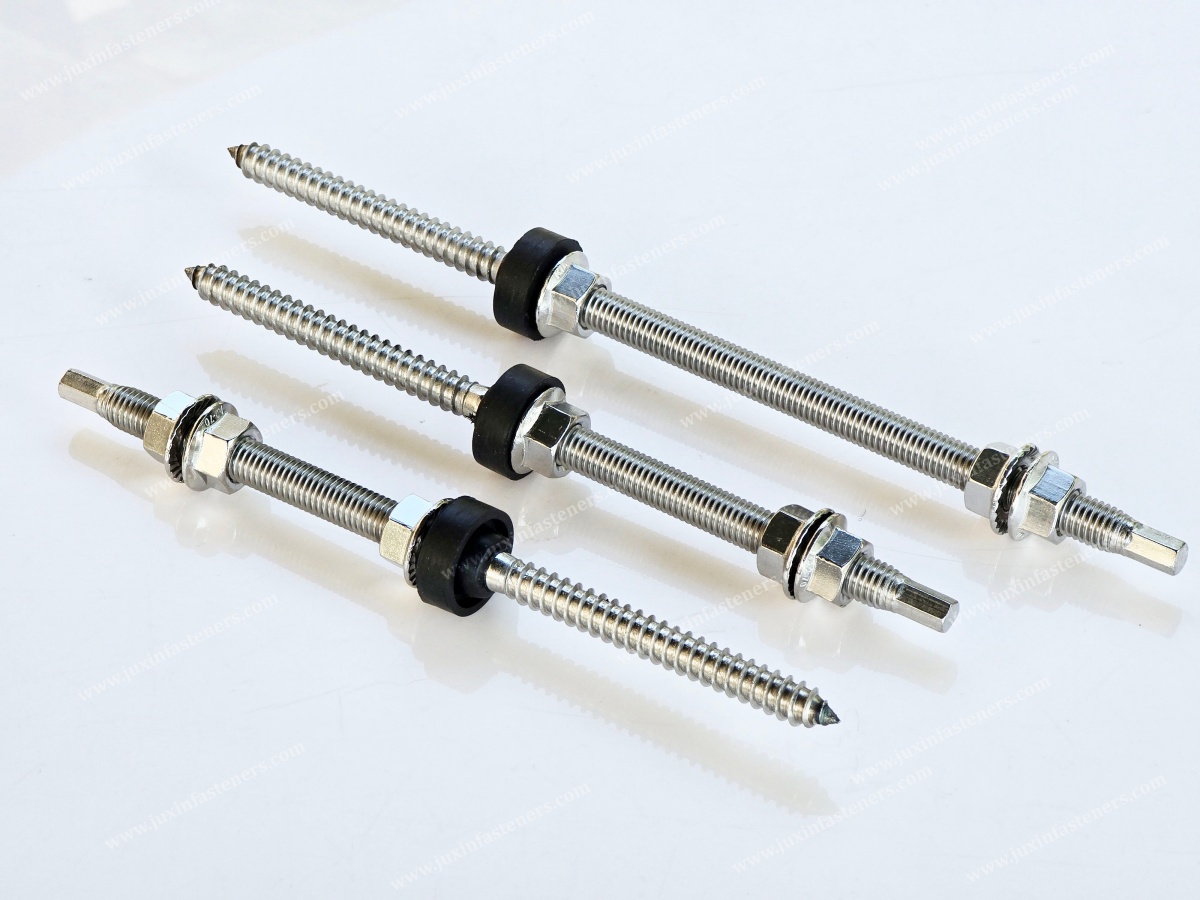
| Engineered machine foundation system | Specialized equipment installation | Equipment-specific loading and alignment |
Mechanical Expansion Anchors
May be practical for selected equipment supports and factory infrastructure.
Bonded Anchors
May be considered where their product qualifications and installation conditions permit.
Cast-In Foundation Bolts
May be preferred for certain new machine foundations.
Specialized Equipment Foundations
Heavy presses, high-dynamic-load machines and precision equipment may require engineered foundation systems.
Information Gain: Installation Convenience Does Not Determine Anchor Suitability
Post-installed anchors can simplify certain retrofit projects.
However, their convenience does not make them appropriate substitutes for cast-in or specially engineered foundation anchorage.
Vibration and Dynamic Loading in Automotive Plants
Automotive facilities contain machinery with different operating characteristics.
Examples include:
Conveyors
Industrial robots
Assembly equipment
Compressors
HVAC equipment
Selected production machines
Dynamic loading may influence:
Anchor fatigue
Connection stiffness
Equipment movement
Foundation response
Inspection requirements
Vibration Resistance Is Not a Universal Anchor Property
A general-purpose anchor should not be described as vibration-proof or fatigue-resistant without appropriate product-specific supporting evidence.
Information Gain: Dynamic Equipment Requires a Defined Load Spectrum
A static load value may be insufficient for certain machinery.
The engineering team may need information about load direction, frequency, cycles, operating conditions and equipment reactions.
Automotive Factory Retrofitting and Equipment Relocation
Automotive manufacturers frequently modify production lines to introduce new models, equipment or manufacturing processes.
Potential activities include:
Equipment replacement
Conveyor reconfiguration
Robot cell expansion
Safety fencing relocation
New utility supports
Production line upgrades
Additional inspection stations
Post-installed anchors may provide flexibility for suitable retrofit installations.
Existing Anchor Holes
Previous holes may restrict new anchor placement.
Concrete Condition
Existing floors require verification.
Installation Access
Operating machinery can limit available work space.
Shutdown Planning
Installation may need to be completed during scheduled maintenance periods.
Product Availability
Approved fastener specifications must be available when needed.
Inspection and Commissioning
The installation must be checked before equipment returns to service.
Information Gain: Retrofit Anchor Selection Should Include the Installation Window
A technically suitable anchor may still create practical problems if the installation process requires access,
curing time or inspection procedures incompatible with the planned shutdown.
The selection should consider the approved installation process and project schedule without compromising engineering requirements.
Production Manager Considerations: Installation Efficiency and Downtime
For production managers, the cost of a fastening component is only one part of the installation decision.
Relevant factors include:
Number of fixing points
Drilling and installation time
Required installation tools
Operator training
Inspection time
Product identification
Replacement accessibility
Installation rework
Planned shutdown duration
Spare-part availability
Information Gain: Installation Efficiency Must Be Evaluated Without Relaxing Technical Requirements
Reducing installation steps is not beneficial if it increases incorrect setting, rework or connection failures.
A standardized, approved anchor schedule and installation procedure may improve consistency across repeated applications.
Installation Planning Matrix
| Production concern | Fastening consideration |
|---|---|
| Short shutdown window | Approved installation sequence |
| Repeated anchor locations | Standardized drawings and identification |
| Limited access | Tool clearance and installation method |
| Mixed anchor sizes | Packaging and labeling |
| Quality variation | Controlled setting and inspection |
| Equipment relocation | Approved removal and replacement procedure |
| Maintenance planning | Accessible inspection points |
| Supplier substitution | Engineering change control |
Corrosion Protection for Automotive Facilities
Automotive factories may contain different environmental zones.
Dry Indoor Production Areas
Certain coated carbon steel systems may be suitable.
Outdoor Utility Areas
Enhanced corrosion protection may be required.
Washdown Areas
Frequent moisture and cleaning chemicals may influence material selection.
Paint Shop Environments
Chemical exposure and process conditions may require specific corrosion assessment.
Battery Manufacturing Facilities
The actual process environment and cleaning conditions should guide material selection.
Potential Material and Finish Options
Zinc-plated carbon steel
Zinc-based protective coatings
Hot-dip galvanized systems
Stainless steel
Other project-specified materials
The selected material and coating must be appropriate for the actual anchor product and environment.
Corrosion Selection Matrix
| Factory environment | Potential concern | Selection approach |
|---|---|---|
| Dry assembly hall | Atmospheric corrosion | Suitable coated steel |
| Outdoor conveyor area | Weather exposure | Qualified outdoor protection |
| Washdown area | Moisture and cleaning agents | Exposure-specific material |
| Paint shop support | Chemical environment | Compatibility assessment |
| Coastal automotive plant | Chloride exposure | Suitable corrosion-resistant system |
| Mixed-metal assembly | Galvanic corrosion | Material compatibility review |
Information Gain: The Complete Anchor Assembly Determines Corrosion Performance
The stud, expansion clip, nut, washer and other components may have different material or coating specifications.
The corrosion resistance of one component does not establish the durability of the entire anchoring system.
Material and Coating Standards
Depending on the actual fastener and application, relevant standards may include:
ISO 898-1 for applicable carbon and alloy steel fastener mechanical properties
ISO 3506 for applicable stainless steel fastener mechanical properties
ISO 4042 for electroplated fastener coatings
ISO 10684 for applicable hot-dip galvanized fasteners
ISO 9227 and ASTM B117 for laboratory salt spray testing
These standards do not independently establish concrete anchoring resistance or machine safety compliance.
Hydrogen Embrittlement Considerations
Certain hardened or high-strength steel fasteners may be susceptible to hydrogen embrittlement.
Material selection, heat treatment and surface treatment processes should be evaluated where relevant.
Installation Quality Control for Automotive Plant Anchors
The manufacturer's instructions and project requirements govern the installation.
Verify the Product
Confirm the anchor model, size, material and required technical qualification.
Inspect the Concrete
Check substrate suitability and installation conditions.
Review Embedded Services
Identify potential conduits, reinforcement and other concealed infrastructure.
Confirm Anchor Geometry
Verify:
Edge distance
Spacing
Concrete thickness
Fixture thickness
Effective embedment
Installation orientation
Drill the Hole
Use the specified diameter, depth and drilling method.
Prepare the Hole
Follow the product-specific cleaning requirements.
Install the Anchor
Use the approved setting procedure.
Apply the Required Setting Torque
For torque-controlled anchors, use the specified torque and approved tools.
Inspect the Installation
Verify the required acceptance criteria.
Information Gain: Installation Torque Is Not a Generic Bolt Tightening Value
A torque-controlled expansion anchor depends on the specified setting process.
Using a torque value from an unrelated conventional bolt specification may result in incorrect installation.
Installation Quality-Control Matrix
| Checkpoint | Purpose |
|---|---|
| Product identification | Prevent incorrect anchor substitution |
| Concrete condition | Confirm substrate suitability |
| Embedded service review | Reduce drilling risks |
| Anchor layout | Verify approved geometry |
| Drill diameter | Support correct expansion |
| Hole depth | Meet installation requirements |
| Hole preparation | Follow product instructions |
| Setting procedure | Achieve specified installation |
| Corrosion configuration | Confirm required material and coating |
| Inspection records | Support traceability |
Common Expansion Anchor Problems in Automotive Facilities
Incorrect Anchor Selection
May result in inadequate performance for the substrate or loading.
Insufficient Embedment
May reduce anchoring resistance.
Incorrect Setting Procedure
May prevent proper expansion or damage the connection.
Concrete Edge Damage
May indicate unsuitable geometry or installation.
Base Plate Misalignment
May cause assembly and equipment positioning problems.
Vibration-Related Problems
May require reassessment of the complete equipment anchorage.
Corrosion
May reduce long-term durability.
Unapproved Product Substitution
May invalidate the original design assumptions.
Damage to Embedded Services
May cause production disruption and safety risks.
Information Gain: Anchor Failures Should Be Investigated as Connection-System Problems
A loose or damaged anchor should not automatically be treated as a defective fastener.
Possible contributing factors include substrate conditions, equipment loads, fixture geometry, installation method and product selection.
Corrective action should address the actual cause.
International Engineering and Machinery Safety Standards
EN 1992-4 — Design of Fastenings for Use in Concrete
Provides European design provisions for applicable concrete fastening systems.
ACI 318 Chapter 17
Provides concrete anchoring design provisions for applicable projects.
ACI 355.2
Addresses qualification of post-installed mechanical anchors in concrete.
European Technical Assessments
A product-specific ETA may provide assessed characteristics and installation conditions.
ICC-ES Evaluation Reports
An ICC-ES report may provide product-specific evaluation information under stated conditions.
ISO 10218-2:2025
Addresses safety requirements for industrial robot applications and robot cells.
ISO 14120
Addresses general requirements for the design and construction of machinery guards.
Critical Qualification Boundary
Machinery safety standards do not automatically qualify a concrete anchor.
Likewise, an anchor with an appropriate concrete evaluation does not independently establish the safety compliance of an entire robot cell or guarding system.
Metric and Inch-Based Fastener Specifications
Automotive manufacturing facilities may contain equipment designed using different thread systems.
Common systems include:
Metric threads
UNC threads
UNF threads
BSW threads
BSF threads
These thread systems are not directly interchangeable.
Dimensional conversions are reference values only.
The actual thread designation must be confirmed from the product drawing or equipment specification.
OEM Automotive Fastening Components Beyond Concrete Anchors
Automotive factories may also require fasteners used in production equipment and vehicle component manufacturing.
Juxin Fasteners supplies industrial fastener categories including:
Bolts and screws
Flange bolts
Flange nuts
Lock nuts
Washers
Rivet nuts
Weld nuts
Self-clinching fasteners
Sheet-metal fastening components
Drawing-based custom parts
Potential OEM requirements may involve:
Equipment assemblies
Sheet-metal enclosures
Automotive component manufacturing
Fabricated brackets
Production fixtures
Electrical equipment
Maintenance components
Information Gain: Consolidated Sourcing Requires Separate Technical Approval
A procurement team may source concrete anchors and OEM assembly fasteners from the same industrial supplier.
However, each product category should retain its own drawing, material requirements, inspection criteria and approval process.
Consolidating purchasing should not eliminate engineering control.
Industrial Fastener Procurement for Automotive Manufacturers
Automotive production environments often require consistent specifications and reliable replenishment.
Typical procurement requirements include:
Dimensional Consistency
Stable dimensions support repeatable assembly.
Material Specifications
The specified material and mechanical properties must be confirmed.
Surface Treatment
The coating must match the application environment.
Product Identification
Clear labeling helps prevent mixed parts.
Batch Control
Traceability requirements should be agreed before supply.
Inspection Documentation
Required records should be identified in the purchasing specification.
Packaging
Packaging may be designed around installation locations or production requirements.
Change Control
Material, geometry, coating or supplier changes may require technical review.
Supply Planning
Order quantities, MOQ, lead time and repeat-order requirements should be discussed during supplier qualification.
Procurement Evaluation Matrix
| Requirement | Engineering or purchasing purpose |
|---|---|
| Product drawing | Confirm geometry |
| Anchor mechanism | Prevent unsuitable substitution |
| Concrete qualification | Support technical approval |
| Material specification | Verify mechanical requirements |
| Coating specification | Address corrosion |
| Installation instructions | Support site consistency |
| Inspection criteria | Control quality |
| Traceability | Support production records |
| Packaging | Improve installation logistics |
| Change control | Protect approved specifications |
| Lead time and MOQ | Support purchasing plans |
Information Gain: Total Cost of Ownership Matters More Than Unit Price Alone
For factory infrastructure, purchasing decisions should consider:
Component price
Installation labor
Drilling and tool requirements
Inspection
Rework
Maintenance access
Spare parts
Downtime risk
Supply consistency
The lowest unit-price anchor may not provide the lowest overall installed cost.
However, any cost comparison must be made between technically acceptable products.
Approved Anchor Substitution in Automotive Factory Projects
Equipment retrofits and purchasing changes may create requests for alternative anchors.
Two anchors with the same nominal diameter and length may differ in:
Expansion mechanism
Effective embedment
Concrete qualification
Installation torque
Fixture-hole requirements
Corrosion configuration
Technical evaluation
Installation instructions
Information Gain: Anchor Substitution Is an Engineering Decision
A purchasing department should not approve a replacement based solely on dimensional similarity or price.
Where required, the design engineer or engineer of record should review the proposed alternative and supporting documentation.
OEM Customization and Drawing-Based Fastening Solutions
Automotive equipment manufacturers and industrial suppliers may require:
Special fastener dimensions
Metric or inch thread configurations
Material specifications
Surface finishes
Custom threaded components
Special nuts and washers
Equipment-specific fastening assemblies
Packaging and identification requirements
Technical feasibility must be confirmed for each inquiry.
Important Limitation
Changing the geometry, material, coating or expansion mechanism of a qualified anchor may affect its evaluated performance.
A customized product must not automatically be represented as retaining an existing ETA, ICC-ES report or other technical approval.
Why Source Industrial Fasteners from Juxin Fasteners?
Juxin Fasteners has more than 20 years of experience in international industrial fastener supply.
Our product portfolio includes:
Expansion bolts
Concrete anchoring hardware
Industrial bolts and screws
Flange fasteners
Nuts and washers
Rivet nuts
Weld nuts
Self-clinching fasteners
Automotive fastening components
Drawing-based OEM fasteners
We welcome inquiries involving:
Automotive manufacturing facilities
Production equipment
Conveyor systems
Factory infrastructure
Industrial automation
Automotive component manufacturing
Equipment maintenance
Industrial OEM applications
Our team can review drawings, specifications, materials, surface finishes, quantities, packaging requirements and delivery expectations for technical and commercial feasibility.
Specific product availability, qualification documentation, MOQ, customization feasibility and lead times must be confirmed for each inquiry.
Frequently Asked Questions About Automotive Factory Expansion Bolts
Are expansion bolts used in automotive factories?
Yes. Suitable mechanical anchors may be used for production equipment supports, conveyor systems, machine guards, cable trays, utility brackets and other factory infrastructure.
Are expansion bolts automotive vehicle fasteners?
No. Concrete expansion anchors are primarily industrial or construction anchoring products.
They are different from fasteners installed directly in vehicles.
Can expansion bolts be used for industrial robot bases?
Only when the selected anchoring system meets the robot manufacturer's requirements and the applicable engineering design.
Can expansion bolts be used for conveyor supports?
Suitable anchors may be used where the loading, concrete conditions and installation requirements permit.
Are expansion bolts suitable for machine guards?
They may be part of an engineered guarding installation, but anchor suitability alone does not establish the safety compliance of the complete guarding system.
Can expansion bolts be used in cracked concrete?
Some mechanical anchors are qualified for cracked concrete. Others are not.
What is effective embedment?
Effective embedment is a product-specific design parameter used in concrete anchoring calculations.
Are expansion bolts suitable for vibrating machinery?
Some anchor systems may be suitable for defined dynamic applications. Product qualification and the actual operating loads must be reviewed.
Can existing anchor holes be reused?
Reuse depends on the selected product, concrete condition, existing hole geometry and engineering approval. It should not be assumed.
What installation torque should be used?
Use the specified setting procedure and torque for the exact anchor product.
Can an alternative anchor replace an approved product?
Only after the required engineering and documentation review.
Can Juxin Fasteners review automotive factory OEM fastener drawings?
Yes. Drawing-based industrial fastening inquiries can be reviewed for technical and commercial feasibility.
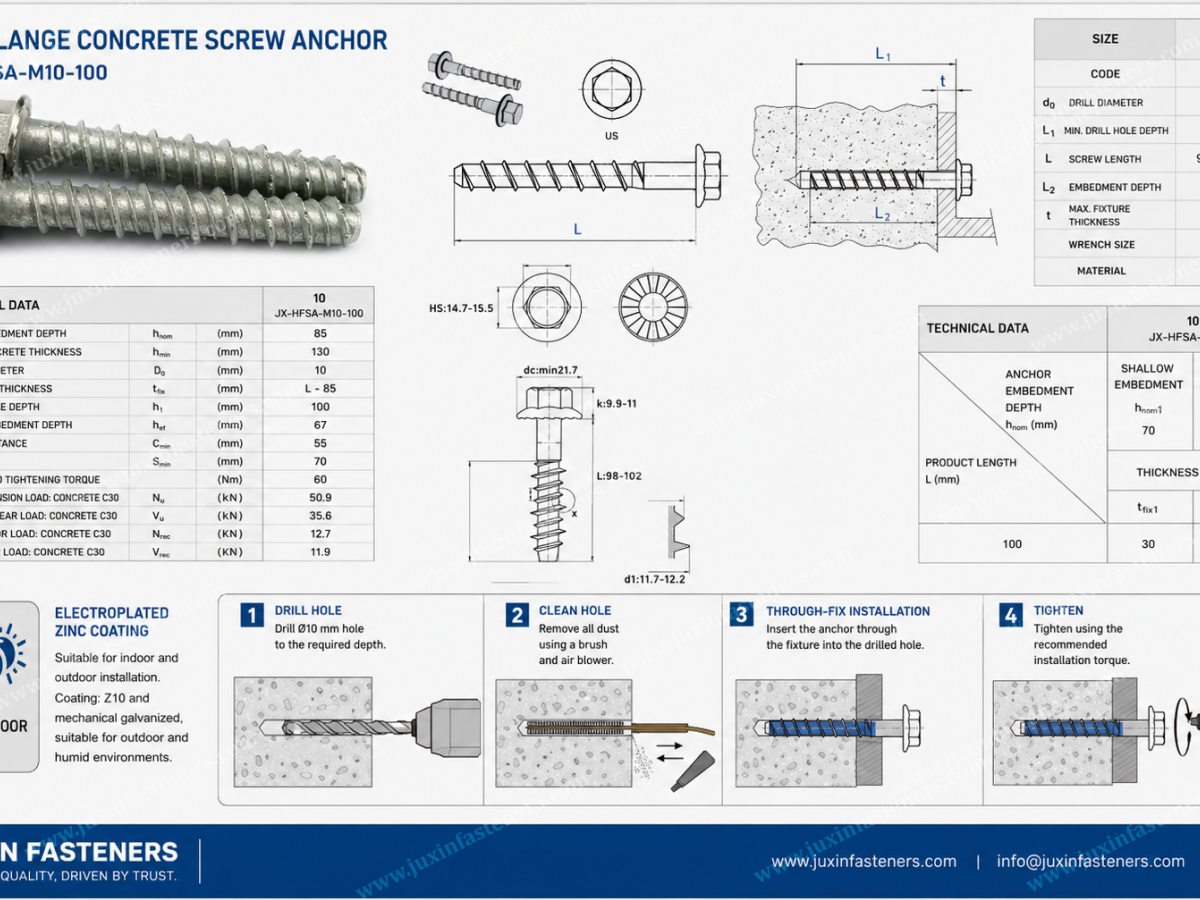
Automotive Manufacturing Expansion Bolt RFQ Checklist
For efficient technical review and quotation, provide the following information where available.
Product Information
Anchor type
Existing product reference
Technical drawing
Nominal diameter
Overall length
Thread designation
Material
Surface finish
Nut and washer configuration
Equipment Information
Equipment type
Equipment manufacturer
Base plate drawing
Mounting-hole pattern
Equipment weight
Operating loads
Vibration or dynamic requirements
Installation orientation
Concrete Information
Concrete strength
Cracked or uncracked condition
Concrete thickness
Edge distance
Anchor spacing
Existing floor condition
Embedded service constraints
Engineering Requirements
Tensile load
Shear load
Combined loading
Bending moment
Effective embedment
Required technical qualification
Applicable design standard
Installation Requirements
Drill diameter
Hole depth
Hole preparation
Setting procedure
Installation tools
Inspection requirements
Planned installation window
Commercial Requirements
Sample quantity
Initial order quantity
Annual forecast
MOQ expectations
Packaging
Required lead time
Delivery destination
Request Expansion Bolts and OEM Fastening Solutions for Automotive Manufacturing Facilities
Juxin Fasteners welcomes inquiries from automotive OEMs, Tier-1 and Tier-2 manufacturers, industrial automation integrators,
production equipment manufacturers, manufacturing engineers, mechanical engineers, structural engineers, production managers,
supplier development teams and international procurement professionals.
Whether your project requires expansion bolts, concrete anchoring hardware, conveyor support fasteners, industrial bolts, nuts,
washers, sheet-metal fasteners or drawing-specific OEM components, reliable selection begins with understanding the equipment, substrate, loading conditions and installation requirements.
Send us your drawings, product specifications, material requirements, surface treatment details, quantities and delivery requirements for technical and commercial review.
For safety-critical equipment, industrial robot installations and specialized machine foundations, include the required engineering and product qualification documentation.
Company: Juxin Fasteners
Website: https://www.juxinfasteners.com/
Email: info@juxinfasteners.com
Reliable Automotive Manufacturing Infrastructure Depends on Suitable Equipment Anchoring, Controlled Installation, Production-Focused Engineering and Consistent Industrial Fastener Supply.
 MORE NEWS


Oct. 13, 2026
Contact Us
Tel.:
+86 020 8621 0320
+86 020 3121 6067
E-mail:
Technical Support:
Navigation
SEND INQUIREY