
Call Us
+86 136 6007 9809
Call Us
+86 136 6007 9809

Jul. 03, 2024
Industrial Fastener Selection Guide: Bolts, Nuts, Inserts and OEM Assembly Solutions
Selecting the right industrial fastener is a critical engineering and procurement decision.
A bolt, nut, screw, stud or threaded insert may represent only a small portion of an equipment assembly,
but an unsuitable fastening choice can lead to joint loosening, thread damage, corrosion, production delays, maintenance problems or premature equipment failure.
Industrial fasteners are used throughout automotive manufacturing, electric vehicle equipment, electrical distribution systems, data centers, semiconductor machinery,
industrial automation, HVAC equipment, renewable energy systems and precision mechanical assemblies.
However, there is no single fastener that provides the best performance for every application.
The correct selection depends on the relationship between the fastener, the connected materials, the loading conditions, the manufacturing process and the operating environment.
For example:
A high-strength hex bolt may be suitable for a heavily loaded steel machinery connection.
A self-clinching nut may provide a reusable internal thread in a suitable thin sheet metal panel.
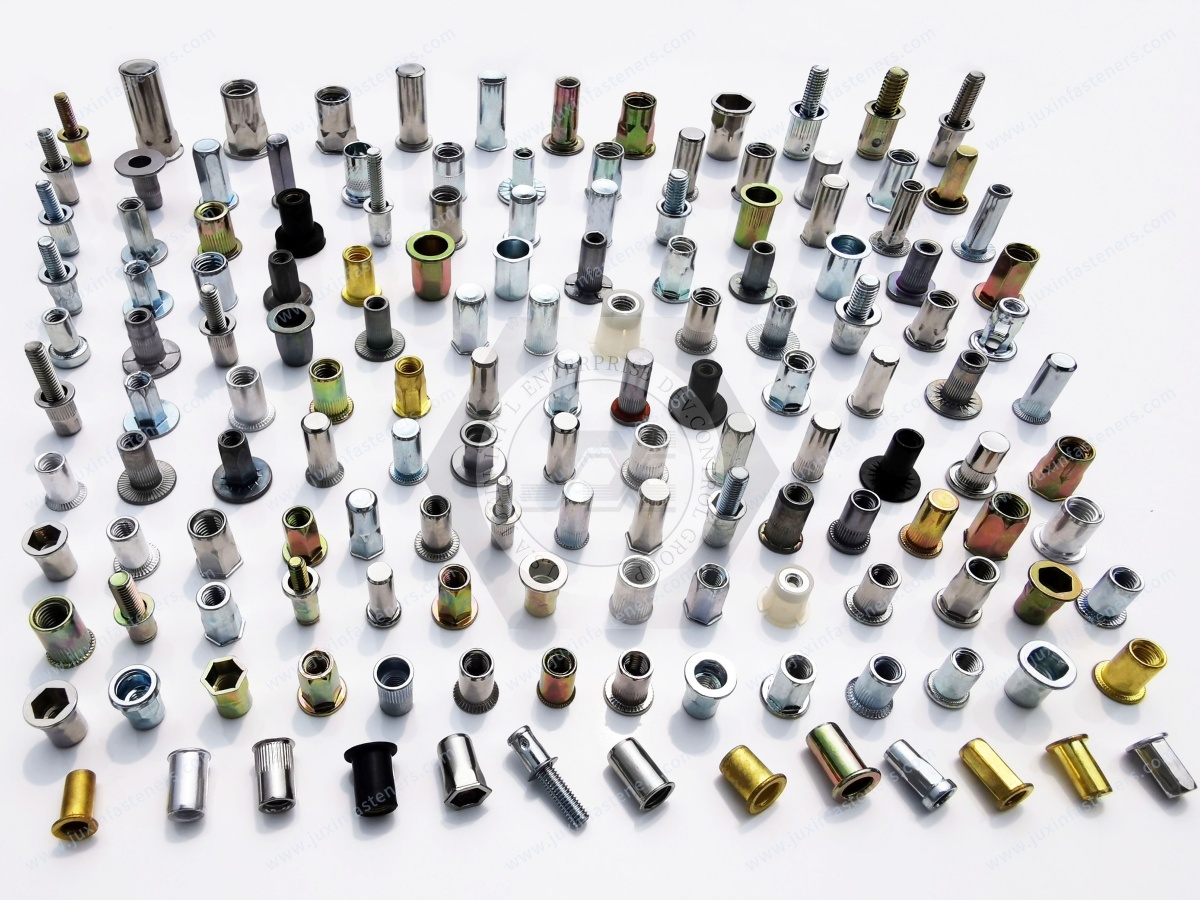
A blind rivet nut may be appropriate when installation access is available from only one side.
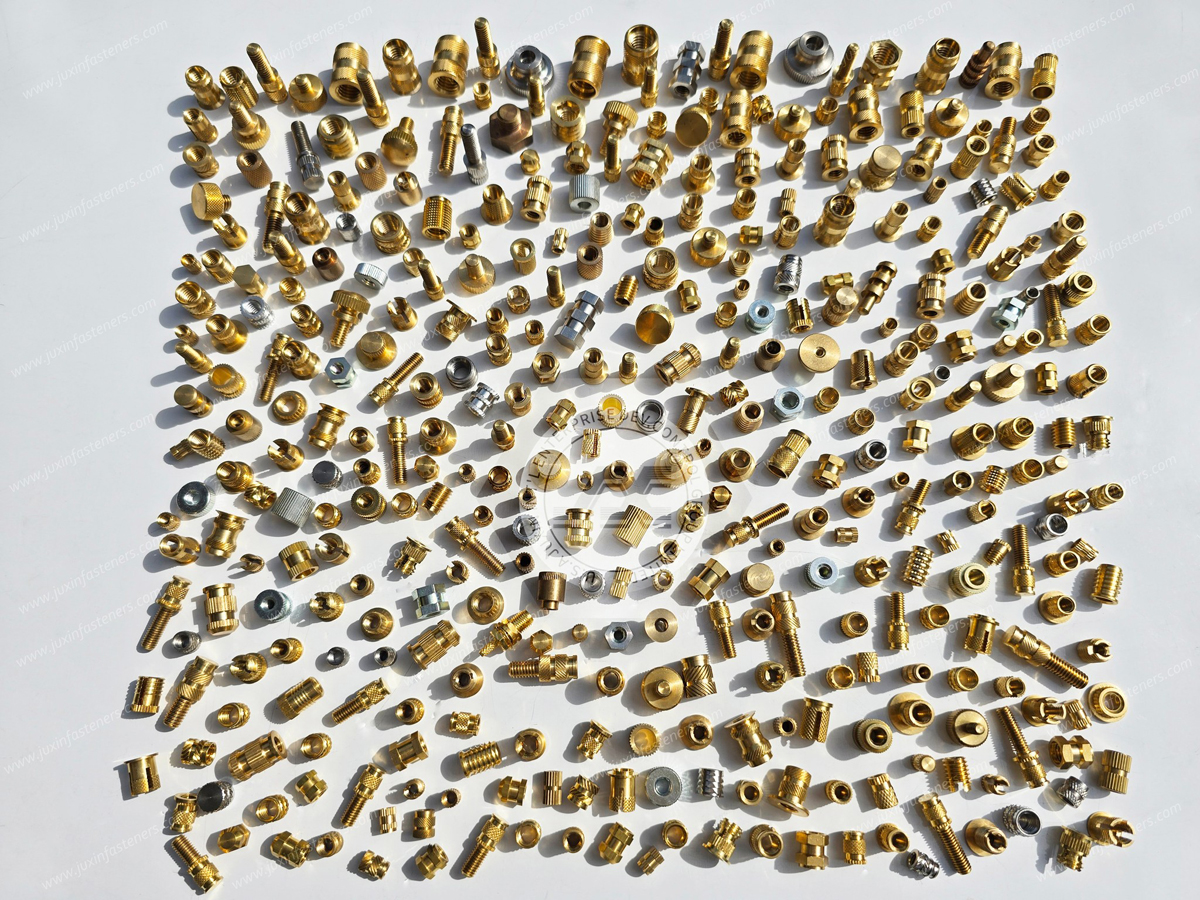
A brass threaded insert may improve thread durability in a properly designed thermoplastic component.
A nylon insert lock nut or all-metal prevailing-torque nut may be selected for a joint requiring additional resistance to loosening.
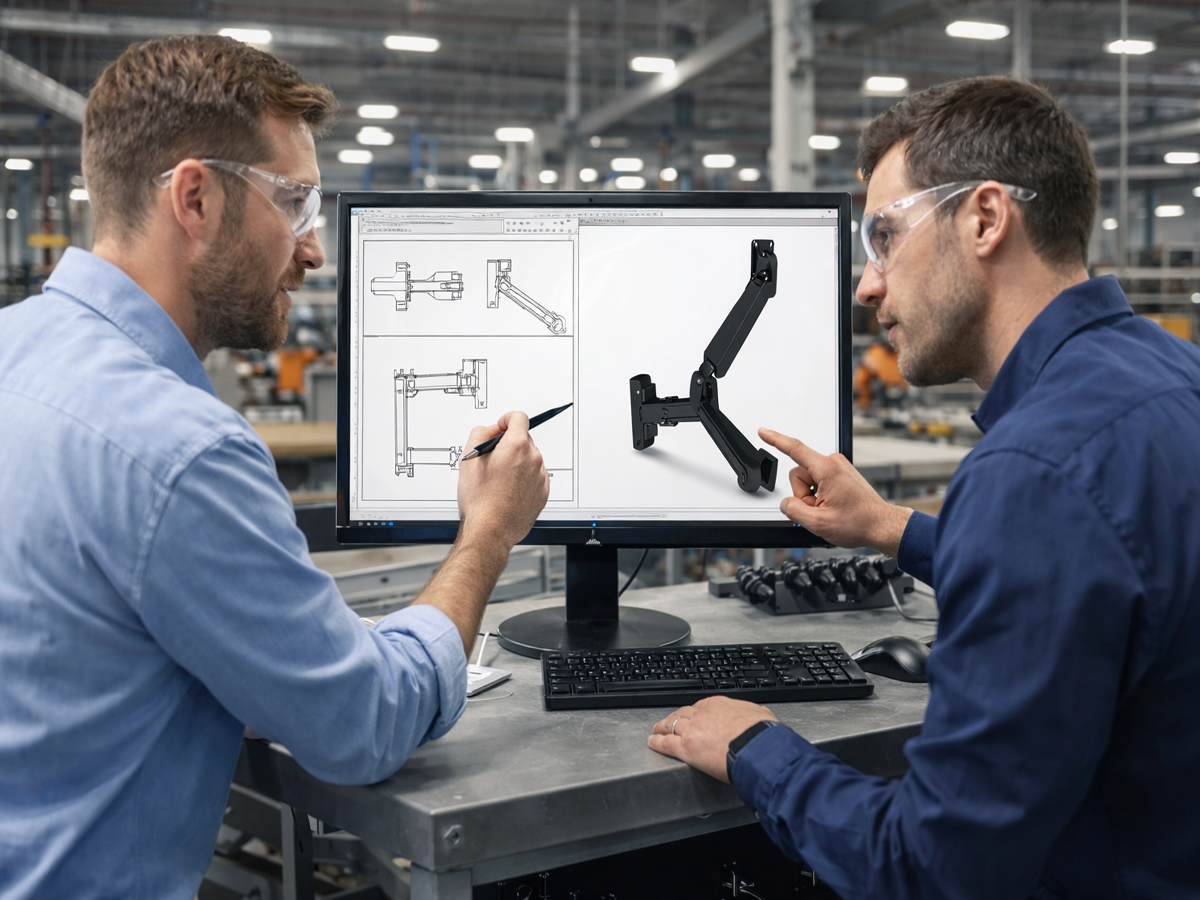
A custom CNC-machined fastener may be required when standard geometry cannot satisfy the equipment design.
These solutions are not universally interchangeable.
JUXIN FASTENERS supplies industrial bolts, screws, nuts, self-clinching fasteners, weld fasteners,
blind rivet nuts, threaded inserts, plastic fastening components and drawing-based OEM precision parts for international industrial customers.
This guide provides a practical engineering framework for selecting suitable fastening solutions while helping manufacturing and procurement teams evaluate assembly reliability,
production consistency and sourcing requirements.
What Are Industrial Fasteners?
Industrial fasteners are components used to connect, secure, locate or retain parts in mechanical assemblies.
Depending on the product and installation method, the resulting connection may be removable, reusable, mechanically retained or effectively permanent.
Common industrial fastening categories include:
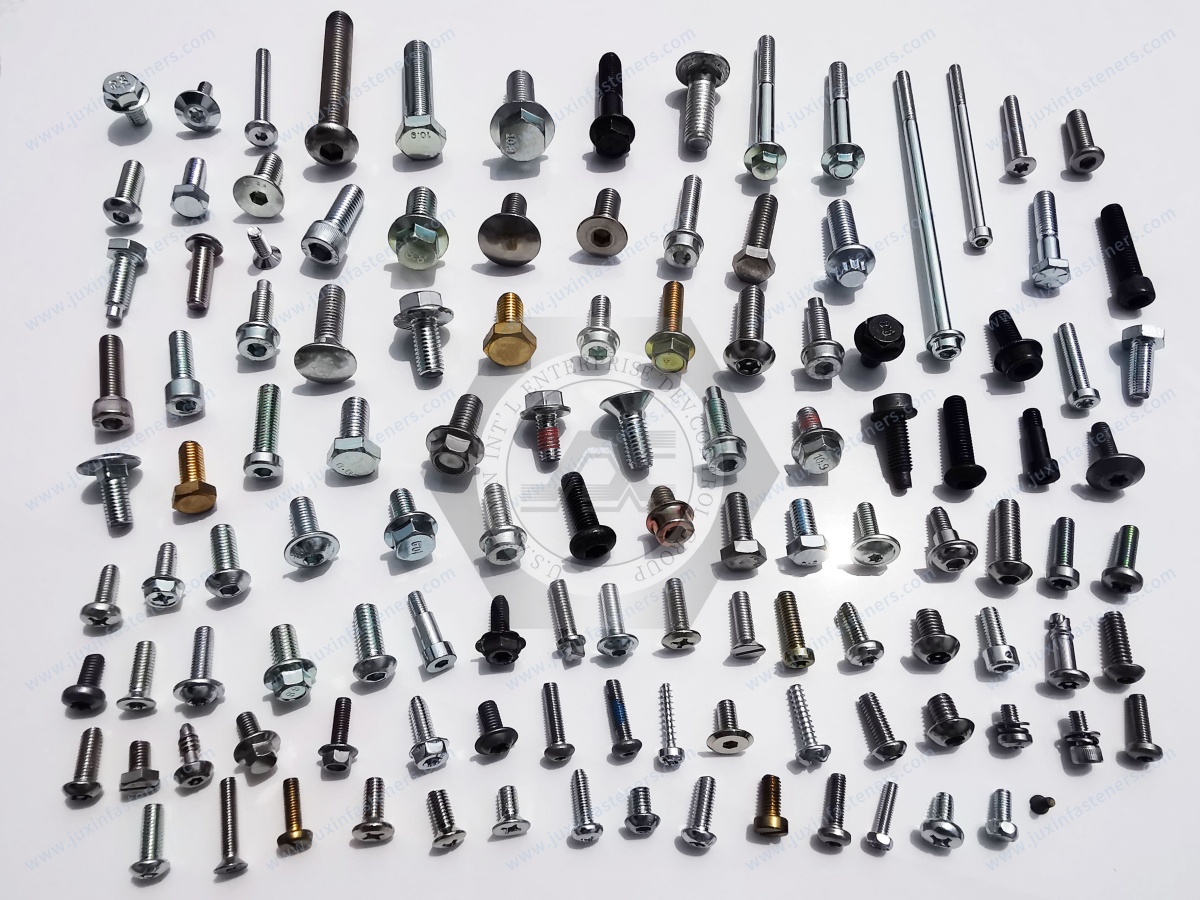
Hex bolts and hex head screws
Socket head cap screws
Flange bolts and flange screws
Machine screws
Stainless steel screws
Hex nuts and lock nuts
Threaded studs
Weld nuts and weld studs
Self-clinching nuts, studs and standoffs
Blind rivet nuts
Brass threaded inserts for plastics
Plastic rivets and retaining clips
PCB mounting hardware
Custom CNC-machined fasteners
The purpose of fastener selection is not simply to identify a product that fits into a hole.
It is to establish a reliable connection between specific materials under defined mechanical and environmental conditions.
The Six-Stage Industrial Fastener Selection Framework
A practical OEM fastener selection process can be organized into six engineering stages.
| Selection stage | Key question | Engineering decision |
|---|---|---|
| Joint loading | What forces act on the connection? | Fastener strength and joint configuration |
| Host materials | What components are being connected? | Fastener type and material compatibility |
| Installation | How will the fastener be installed? | Head style, access and fastening method |
| Environment | What exposure will the joint experience? | Material and surface protection |
| Production | Can the assembly process be repeated reliably? | Tooling, inspection and installation controls |
| Procurement | Can the specified component be sourced consistently? | Drawings, approval, MOQ, lead time and quality requirements |
This sequence helps prevent a common purchasing mistake: selecting a fastener by nominal size and price before confirming whether it is suitable for the complete assembly.
1. Evaluate Joint Loading and Mechanical Strength
The first engineering decision is to determine how the joint will be loaded.
Industrial fasteners may experience:
Axial tension
Transverse shear
Combined tension and shear
Static loading
Impact loading
Cyclic loading
Vibration
Thermal expansion and contraction
The load path must be considered at the complete joint level.
Tensile Loading
Tensile loading acts along the bolt axis.
Relevant considerations include:
Fastener tensile capacity
Required preload
Thread engagement
Mating nut strength
Joint stiffness
Potential joint separation
Shear Loading
Shear loading acts across the fastener axis.
Depending on the design, transverse loads may be transferred through friction between clamped components, direct bearing or other joint features.
The location of the shear plane relative to the threaded portion may influence the design.
Cyclic Loading and Fatigue
Repeated loading can contribute to fatigue failure.
Factors include:
Stress range
Initial preload
Joint stiffness
Thread geometry
Material properties
Manufacturing condition
A higher nominal strength class does not automatically guarantee better fatigue performance in every assembly.
Impact and Shock Loading
Shock-loaded connections may require special consideration of joint stiffness, ductility, preload and potential loosening.
Engineering Recommendation
Define the actual loading conditions before selecting the bolt diameter, material or mechanical property class.
For safety-critical connections, appropriate engineering calculations and validation are essential.
Selecting High-Strength Bolts
Carbon and alloy steel bolts are available in different mechanical property classes.
For applicable metric carbon and alloy steel bolts, ISO 898-1 defines relevant mechanical properties.
Common property classes include:
8.8
10.9
12.9
These classes have different mechanical requirements and should not be substituted without engineering evaluation.
Typical Engineering Considerations
Class 8.8 may be suitable for many industrial machinery connections.
Class 10.9 may be considered where higher mechanical capacity is required and the joint design supports its use.
Class 12.9 may be used in selected demanding applications, but its suitability depends on joint design, environment and applicable product requirements.
Important Limitation
Increasing bolt strength does not automatically correct:
Insufficient thread engagement
Weak connected materials
Poor preload control
Joint separation
Excessive bearing pressure
Vibration-related loosening
The entire connection must be evaluated.
2. Select Fasteners According to the Connected Materials
The connected material often determines which fastening method is technically suitable.
A threaded connection designed for a thick steel component may not work in thin aluminum sheet or a plastic housing.
Fastener Selection by Host Material
| Host material | Potential fastening solutions | Main engineering consideration |
|---|---|---|
| Thick steel components | Hex bolts, socket screws, studs | Strength, preload and thread engagement |
| Thin steel sheet | Self-clinching nuts, studs, weld nuts, rivet nuts | Sheet thickness, hardness and installation |
| Aluminum sheet | Suitable self-clinching fasteners, rivet nuts, bolts | Local deformation and galvanic compatibility |
| Stainless steel sheet | Compatible clinch fasteners, weld fasteners, rivet nuts | Hardness, installation and corrosion |
| Thermoplastic components | Brass threaded inserts, plastic fasteners | Creep, temperature and installation method |
| Electronic circuit boards | PCB spacers, supports, plastic clips | Board thickness, clearance and retention |
| Custom machined parts | Standard screws or drawing-based fasteners | Thread geometry, tolerances and assembly |
Steel-to-Steel Connections
Conventional bolts and nuts are widely used where the connected components provide suitable bearing surfaces and mechanical strength.
For tapped holes, thread engagement must be sufficient for the required joint performance.
Aluminum Connections
Aluminum components may require additional consideration of:
Thread stripping
Local bearing deformation
Galvanic corrosion
Thermal expansion
Repeated assembly
A steel or stainless steel fastener should not be assumed to be compatible solely because the thread size matches.
Plastic Connections
Plastics behave differently from metals.
Depending on the polymer, relevant concerns may include:
Creep
Stress relaxation
Temperature sensitivity
Moisture absorption
Repeated assembly
Boss cracking
Thread pullout
A suitable brass threaded insert may provide a more durable internal thread than directly threading into some plastic components.
However, the insert installation method must match the polymer and part design.
3. Choose the Correct Fastening Method
The fastening method should be selected according to assembly access, connected materials, expected loads and service requirements.
Conventional Bolts and Nuts
Hex bolts, flange bolts and socket head cap screws are commonly used for removable mechanical connections.
Potential advantages include:
Established dimensional standards
Wide application range
Serviceability
Availability of different materials and strengths
Important design considerations include:
Tool clearance
Head bearing geometry
Thread engagement
Preload
Joint stiffness
Mating nut compatibility
Self-Clinching Fasteners
Self-clinching nuts, studs and standoffs provide mechanically retained threaded features in suitable sheet metal.
The installation relies on controlled deformation of the host sheet into the fastener's retention geometry.
Critical requirements include:
Sheet thickness
Sheet hardness
Installation hole diameter
Edge distance
Press tooling
Pushout resistance
Torque-out resistance
Self-clinching fasteners are not suitable for every sheet material or thickness.
Weld Nuts and Weld Studs
Weld fasteners create attachment points through a suitable welding process.
JUXIN FASTENERS supplies relevant products such as square weld nuts, weld screws and weld studs.
Applications may include:
Automotive structures
Machinery housings
Metal brackets
Fabricated steel assemblies
Selection depends on the base material, weld process, joint loads, access and inspection requirements.
Blind Rivet Nuts
Blind rivet nuts create internal threaded mounting points in suitable components where installation access is available from one side.
Available configurations may include:
Open-end and closed-end designs
Flat-head and reduced-head designs
Round-body designs
Half-hexagonal and full-hexagonal bodies
Steel, stainless steel and brass options
The correct design depends on:
Grip range
Hole geometry
Material thickness
Required torque resistance
Installation tooling
Corrosion conditions
Threaded Inserts for Plastics
Brass threaded inserts may be installed using suitable:
Heat installation
Ultrasonic installation
Press-in installation
These processes are not interchangeable.
For example, a heat-install insert requires a compatible thermoplastic and appropriate boss geometry.
A press-in insert requires a design suitable for the host material and interference conditions.
Custom CNC-Machined Fasteners
Drawing-based precision fasteners may be required for:
Special head configurations
Custom shoulders
Nonstandard lengths
Precision spacers
Special threaded studs
Complex machined interfaces
The correct manufacturing route depends on geometry, material, tolerances, quantity and commercial feasibility.
Fastening Method Decision Matrix
| Assembly requirement | Potential solution | Main limitation |
|---|---|---|
| Removable steel joint | Hex bolt and nut | Access and preload requirements |
| Compact removable joint | Socket head cap screw | Tool access and drive strength |
| Integrated bearing surface | Flange bolt | Bearing geometry still requires evaluation |
| Internal thread in thin sheet | Self-clinching nut | Sheet compatibility |
| External thread in thin sheet | Self-clinching stud | Installation and retention |
| One-sided installation | Blind rivet nut | Grip range and hole design |
| Welded metal attachment | Weld nut or weld stud | Welding compatibility |
| Reusable thread in plastic | Brass threaded insert | Polymer and installation compatibility |
| PCB component mounting | Plastic support or spacer | Board geometry and retention |
| Special precision geometry | CNC-machined fastener | Drawing and manufacturing feasibility |
4. Material Selection and Corrosion Resistance
Material selection must balance mechanical properties, corrosion exposure, temperature and cost.
Carbon Steel Fasteners
Carbon steel fasteners are widely used in industrial equipment.
Potential advantages include:
Broad application range
Availability of multiple mechanical property classes
Compatibility with various surface treatments
Cost efficiency in suitable environments
Corrosion protection may be required depending on the application.
Alloy Steel Fasteners
Alloy steel may be selected where particular mechanical properties or heat-treatment responses are required.
The exact grade and finished-fastener requirements must be specified.
304 Stainless Steel Fasteners
304 stainless steel is commonly used for suitable general industrial applications.
Potential uses include:
Electrical equipment
Industrial machinery
Indoor equipment
Selected food-processing machinery
Automation systems
316 Stainless Steel Fasteners
316 stainless steel generally provides improved resistance to certain localized corrosion mechanisms compared with 304.
Potential applications include:
Selected coastal equipment
Chemical-processing machinery
Outdoor industrial assemblies
Equipment exposed to suitable cleaning environments
However, 316 is not immune to pitting, crevice corrosion or chemical attack.
Aluminum Fasteners
Aluminum fasteners may be considered for selected lightweight or corrosion-sensitive assemblies.
Their mechanical capacity, thread durability and galvanic compatibility must be evaluated.
Engineering Recommendation
Do not select fastener materials based only on the general labels high strength, stainless steel or corrosion resistant.
Specify the material and mechanical requirements appropriate to the actual application.
Surface Treatments for Industrial Fasteners
Carbon steel fasteners may require surface protection.
Common options include:
Zinc Electroplating
Often used for general industrial corrosion protection.
Suitability depends on coating specification, thickness and operating conditions.
Zinc-Nickel Plating
May be specified for applications requiring a particular corrosion-protection system.
Performance depends on the complete coating specification and validation requirements.
Zinc-Flake Coatings
May be considered for suitable industrial and automotive fasteners.
Coating thickness, friction behavior, corrosion requirements and application suitability should be verified.
Black Oxide
Black oxide may provide a dark appearance and limited corrosion protection when used with suitable supplementary treatment.
It should not be treated as equivalent to a high-performance corrosion-resistant coating.
PTFE-Based Coatings
Certain PTFE-based coating systems may be used to modify friction or provide other specified surface characteristics.
However, performance depends on the actual coating formulation and application.
A PTFE-based coating does not automatically prevent galling or guarantee a particular tightening preload.
Hydrogen Embrittlement Considerations
Some high-strength steel fasteners may be susceptible to hydrogen embrittlement associated with certain manufacturing and surface-treatment processes.
Risk management depends on:
Material strength
Manufacturing route
Surface preparation
Coating process
Applicable process controls
Product specification
For relevant electroplated fasteners, ISO 4042 provides applicable coating-related requirements.
Coating Selection Matrix
| Surface condition | Potential purpose | Important limitation |
|---|---|---|
| Zinc plating | General corrosion protection | Environment and hydrogen-related risks |
| Zinc-nickel plating | Specified corrosion protection | Coating system must be validated |
| Zinc-flake coating | Corrosion protection and defined friction properties | Thickness and friction requirements |
| Black oxide | Appearance and limited protection | Not suitable as universal outdoor protection |
| PTFE-based coating | Defined friction or surface performance | Application-specific qualification |
| Uncoated stainless steel | Corrosion resistance from suitable alloy | Not immune to corrosion or galling |
5. Select the Correct Thread System and International Standard
Thread compatibility is essential.
A bolt and nut must use matching thread designations and suitable tolerance requirements.
Metric Threads
Metric threads are commonly used in ISO-based equipment.
Examples include:
M4
M6
M8
M10
M12
The thread pitch must be specified where required.
Unified Inch-Series Threads
Common North American thread systems include:
UNC — Unified National Coarse
UNF — Unified National Fine
Examples include:
1/4-20 UNC
5/16-18 UNC
3/8-16 UNC
1/4-28 UNF
British Thread Systems
BSW and BSF are separate thread systems encountered in selected equipment and legacy applications.
Important Compatibility Warning
Metric, UNC, UNF, BSW and BSF threads are not directly interchangeable.
A close nominal diameter does not establish compatibility.
For example, a metric M6 thread and a 1/4-inch Unified thread must not be treated as equivalent.
Inch-to-metric conversion may be used for reference, but not as proof of thread interchangeability.
Relevant International Standards
| Standard | Relevant application |
|---|---|
| ISO 4014 | Metric hexagon head bolts |
| ISO 4017 | Metric hexagon head screws |
| ISO 4762 | Metric hexagon socket head cap screws |
| ISO 898-1 | Mechanical properties of specified carbon and alloy steel bolts, screws and studs |
| ISO 3506-1 | Mechanical properties of specified corrosion-resistant stainless steel bolts, screws and studs |
| ISO 965 series | ISO metric screw thread tolerances |
| ASME B1.1 | Unified inch-series screw threads |
| ASME B18.2.1 | Specified inch-series square and hex bolts and screws |
| ASME B18.3 | Specified socket screw products |
| ISO 4042 | Electroplated coating requirements for applicable fasteners |
Other standards may apply according to the specific fastener, material, coating or customer drawing.
Important Procurement Principle
A dimensional standard does not automatically establish the required material, mechanical property class or surface finish.
The purchase specification must identify these requirements separately where necessary.
6. Joint Preload, Tightening Torque and Vibration Resistance
Fastener reliability depends on the complete joint, not merely the strength of the fastener.
Understanding Preload
Preload is the tensile force introduced into a bolt during tightening.
In many joints, the resulting clamping force helps maintain contact between connected components.
Insufficient Preload May Cause
Joint separation
Relative movement
Fretting
Loosening
Fatigue damage
Excessive Preload May Cause
Bolt yielding
Thread stripping
Component deformation
Gasket damage
Torque Is Not Equal to Preload
Applied tightening torque is affected by:
Thread friction
Underhead friction
Lubrication
Surface coating
Washer condition
Mating material
Installation method
Therefore, a tightening torque should not be selected solely from the nominal bolt diameter.
Vibration-Resistant Fastening Solutions
JUXIN FASTENERS supplies several locking fastener categories, including:
Nylon insert lock nuts
All-metal prevailing-torque lock nuts
Flange lock nuts
Selected specialized locking fasteners
Nylon Insert Lock Nuts
These use a polymer insert to create prevailing torque.
Their suitability depends on temperature, chemical exposure, installation and reuse requirements.
All-Metal Prevailing-Torque Lock Nuts
These use a metallic locking mechanism and may be suitable for applications where polymer inserts are inappropriate.
The exact design and performance requirements must be verified.
Serrated Flange Nuts
Serrated bearing surfaces may provide resistance to relative rotation in suitable applications.
However, serrations can damage mating surfaces or coatings and may be unsuitable for some materials.
Spring Washers
Conventional split spring washers should not be assumed to provide reliable vibration locking in every bolted joint.
Their effectiveness depends on the joint and loading conditions.
Threadlocking Compounds
Suitable compounds may be used in approved applications, but their compatibility with materials, temperature, cleanliness and service requirements must be evaluated.
Engineering Recommendation
Choose locking methods according to the actual joint design, vibration conditions, preload requirements and maintenance strategy.
No single locking device guarantees prevention of loosening under all conditions.
7. Installation Access, Production Efficiency and Maintenance
Manufacturing engineers and production managers must consider how the fastener will be installed in actual production.
A technically suitable fastener may still create unnecessary production costs if the installation method is poorly matched to the assembly.
Important Assembly Questions
Can the installation tool reach the fastener?
Is access available from one side or both sides?
Is the fastener installed before or after coating?
Is the joint assembled manually or automatically?
Is controlled tightening required?
Will the assembly be disassembled for maintenance?
Can the installation be inspected?
What happens if the fastener is damaged?
Examples
A blind rivet nut may reduce the need for rear-side access.
A self-clinching nut may create a captive internal thread during sheet metal fabrication.
A flange bolt may reduce separate washer handling in a suitable design.
A captive fastener may simplify maintenance where loose hardware must be controlled.
A brass insert may support repeated screw installation in a suitable plastic component.
However, these benefits must be validated for the specific design.
Production Process Comparison
| Fastener solution | Production consideration | Potential issue |
|---|---|---|
| Conventional bolt and nut | Two-component assembly | Access and part handling |
| Flange bolt | Integrated bearing feature | Surface pressure and joint geometry |
| Self-clinching nut | Press installation before final assembly | Sheet and hole compatibility |
| Blind rivet nut | One-sided installation | Tool setting and grip range |
| Weld nut | Welding operation | Weld quality and distortion |
| Brass insert | Insert installation process | Boss damage and retention |
| Captive fastener | Retained hardware | Installation and maintenance geometry |
Production Recommendation
Evaluate installation cycle time, tooling, rework and inspection together rather than comparing only fastener unit prices.
8. Common Fastener Selection Failures and Prevention
Failure: Thread Stripping
Possible causes:
Insufficient engagement
Weak host material
Incorrect thread specification
Excessive tightening
Damaged threads
Recommended Review
Check thread engagement, material properties and installation requirements.
Failure: Joint Loosening
Possible causes:
Inadequate preload
Joint settlement
Vibration
Thermal cycling
Unsuitable locking method
Recommended Review
Evaluate the complete joint and approved tightening procedure.
Failure: Corrosion
Possible causes:
Unsuitable material
Inadequate coating
Galvanic interaction
Aggressive environment
Crevice formation
Recommended Review
Assess the actual operating environment and connected materials.
Failure: Fastener Fracture
Possible causes:
Excessive loading
Fatigue
Material mismatch
Installation damage
Environmental degradation
Recommended Review
Investigate the failure mechanism before selecting a stronger replacement.
Failure: Sheet Metal Deformation
Possible causes:
Excessive bearing pressure
Insufficient sheet thickness
Incorrect hole geometry
Unsuitable clinching or riveting process
Recommended Review
Check the sheet design, fastener geometry and installation method.
Failure: Plastic Boss Cracking
Possible causes:
Incorrect insert geometry
Excessive installation interference
Unsuitable installation temperature
Insufficient boss wall thickness
Recommended Review
Evaluate the insert, polymer and boss design as a system.
Failure Prevention Matrix
| Observed problem | First engineering check | Potential corrective direction |
|---|---|---|
| Bolt loosens | Preload and joint movement | Joint or locking redesign |
| Thread strips | Engagement and host material | Thread geometry or insert |
| Stud rotates in sheet | Installed torque resistance | Sheet and installation review |
| Rivet nut spins | Grip range and hole condition | Correct body and installation |
| Plastic insert pulls out | Boss geometry and polymer | Insert design and process |
| Corrosion appears | Material and environment | Approved material or coating change |
| Bolt fractures | Load and failure mechanism | Joint engineering investigation |
| Assembly time is excessive | Tool access and handling | Fastening method optimization |
9. Industrial Fastener Selection by Application
Automotive and Electric Vehicle Manufacturing
Potential applications include:
Automotive brackets
Electronic module housings
Battery equipment
Vehicle interior assemblies
Production fixtures
Mechanical support structures
Relevant fastener categories may include:
High-strength bolts
Flange bolts
Nylon insert lock nuts
All-metal lock nuts
Weld nuts
Weld studs
Self-clinching fasteners
Custom drawing-based fasteners
Engineering Priorities
Vibration
Fatigue
Corrosion
Joint preload
Assembly repeatability
Material compatibility
Safety-critical and high-voltage assemblies require application-specific engineering qualification.
Electrical Distribution and Control Equipment
Potential applications include:
Electrical cabinets
Control panels
Power distribution equipment
Switchgear housings
Mechanical mounting brackets
Relevant fastening options may include:
Self-clinching nuts
Self-clinching studs
Weld studs
Cage nuts
Blind rivet nuts
Stainless steel screws
Custom standoffs
Engineering Priorities
Sheet thickness
Installation access
Mechanical stability
Corrosion exposure
Electrical clearance
Serviceability
Mechanical fastener selection does not replace electrical insulation, grounding or clearance requirements.
AI Data Centers and Server Equipment
Potential applications include:
Server chassis
Rack cabinets
UPS equipment housings
Power distribution enclosures
Liquid-cooling equipment supports
Mechanical cable-management structures
Relevant fastening options may include:
Self-clinching standoffs
Captive nuts
Cage nuts
Threaded studs
Stainless steel screws
Plastic PCB supports
Custom CNC-machined spacers
Engineering Priorities
Compact assembly
Sheet metal compatibility
Maintenance access
Electrical requirements
Vibration
Corrosion
Production consistency
For liquid-cooling equipment, fastening and sealing requirements must be evaluated as separate but interacting functions.
Semiconductor Equipment and Precision Machinery
Potential applications include:
Equipment housings
Precision brackets
Instrument frames
Mechanical supports
Service panels
Relevant fastening options may include:
Stainless steel screws
Socket head cap screws
Precision standoffs
Custom CNC-machined components
Selected plastic fastening hardware
Engineering Priorities
Dimensional accuracy
Cleanliness requirements
Material compatibility
Corrosion
Tool access
Maintenance
Applications with stringent cleanliness or contamination requirements need project-specific material and process approval.
Industrial Automation and Machinery
Potential applications include:
Machine frames
Motion-system supports
Control housings
Production equipment
Mechanical fixtures
Relevant fastening options may include:
High-strength hex bolts
Socket head cap screws
Lock nuts
Flange nuts
Threaded studs
Custom CNC fasteners
Engineering Priorities
Mechanical strength
Joint stiffness
Vibration
Fatigue
Assembly and maintenance
HVAC and Refrigeration Equipment
Potential applications include:
Sheet metal housings
Equipment brackets
Fan assemblies
Compressor-related supports
Electrical control compartments
Relevant fastening options may include:
Weld nuts
Self-clinching fasteners
Rivet nuts
Flange bolts
Lock nuts
Corrosion-resistant screws
Engineering Priorities
Vibration
Moisture
Temperature cycling
Sheet metal thickness
Production assembly
Renewable Energy and Energy Storage Equipment
Potential applications include:
Energy storage cabinets
Electrical equipment enclosures
Solar equipment housings
Wind equipment auxiliary assemblies
Power conversion equipment
Engineering Priorities
Outdoor exposure
Corrosion
Thermal cycling
Joint reliability
Maintenance access
Structural and electrical safety requirements must be evaluated for the specific equipment.
Medical and Laboratory Equipment
Potential applications include approved:
Equipment housings
Instrument brackets
Laboratory machinery
Diagnostic equipment structures
Relevant fastening options may include:
Stainless steel screws
Precision machined fasteners
Plastic mounting hardware
Selected threaded inserts
Engineering Priorities
Cleaning requirements
Corrosion
Surface condition
Dimensional consistency
Regulatory suitability
General industrial fasteners are not automatically qualified for implantable medical devices or other regulated applications.
10. Head Style Selection for Screws and Bolts
Head geometry influences tool access, bearing pressure, appearance and assembly efficiency.
Hex Head Bolts
Suitable where external wrench access is available.
Socket Head Cap Screws
Useful where cylindrical head geometry and internal hexagon tool engagement meet the assembly requirements.
Button Head Hex Socket Screws
May be selected for suitable low-profile appearance and clearance requirements.
Their drive and head geometry must be checked against the required tightening conditions.
Pan Head Screws
Common in equipment housings, electronics and general industrial assemblies.
The drive style and dimensional standard should be specified.
Extra-Wide Truss Head Screws
An enlarged bearing surface may help distribute clamping force over suitable thin materials.
However, the joint still requires verification of bearing pressure, material deformation and preload.
Flange Bolts
An integrated flange provides a defined bearing geometry and may reduce the need for a separate washer in suitable designs.
Countersunk Screws
May be selected where a flush head is required.
Countersink dimensions, head angle and material thickness must be compatible.
JIS-Specified Screws
For Japanese equipment, use the applicable JIS product and thread specifications.
Do not assume all JIS screws have smaller heads than corresponding ISO products. Dimensional differences must be checked against the actual standard and drawing.
Head Style Decision Matrix
| Head style | Main selection reason | Key limitation |
|---|---|---|
| Hex head | External wrench engagement | Tool clearance |
| Socket head | Internal drive and cylindrical head | Socket access |
| Button head | Low-profile geometry | Drive capacity |
| Pan head | General equipment assembly | Head clearance |
| Wide truss head | Enlarged bearing area | Material and preload |
| Flange head | Integrated bearing geometry | Surface compatibility |
| Countersunk head | Flush mounting | Countersink geometry |
11. Standard Fasteners vs. Drawing-Based OEM Fasteners
Standard fasteners are often the preferred starting point when they satisfy the engineering requirements.
Potential benefits include:
Established dimensional specifications
Easier purchasing identification
Simplified maintenance
Reduced custom tooling requirements
More straightforward supplier comparison
However, a custom fastener may be necessary when standard products cannot meet the design.
When to Consider OEM Customization
Nonstandard dimensions
Special head or shank geometry
Custom thread lengths
Unique retention features
Special material requirements
Tight tolerances
Application-specific surface treatments
Special assembly interfaces
Engineering Recommendation
Before requesting a custom fastener, determine whether a suitable standard component can meet the same functional requirements.
If customization is necessary, provide the complete drawing and operating requirements.
12. OEM Fastener Supplier Qualification
For procurement specialists, purchasing managers, supplier development teams and supply chain managers, fastener selection continues beyond engineering approval.
A technically correct design must also be supported by a commercially workable supply arrangement.
Supplier Evaluation Criteria
Product and material specification
Drawing review
Manufacturing feasibility
Sample approval
Dimensional inspection requirements
Mechanical property verification
Surface treatment requirements
Packaging
MOQ
Production lead time
Delivery schedule
Order consistency
Change control
Material and Product Traceability
Where required, the purchasing specification should define the necessary material identification, batch records and inspection documentation.
Documentation availability should be confirmed during supplier qualification rather than assumed.
Sample Evaluation
Samples should be assessed against the approved drawing and application requirements.
For installation-sensitive products, sample evaluation should use the actual mating components or representative host materials.
Examples include:
Clinch studs installed in specified sheet metal
Rivet nuts installed in the required grip range
Brass inserts installed in the intended plastic
Lock nuts evaluated against the specified mating thread
Bolts tightened using the approved assembly conditions
Commercial Considerations
MOQ and lead time may vary according to:
Standard versus custom design
Material
Surface treatment
Quantity
Tooling
Inspection requirements
Packaging
Production schedule
These details should be confirmed during quotation.
13. Total Installed Cost: Beyond the Fastener Unit Price
The lowest-priced fastener is not always the lowest-cost solution for OEM manufacturing.
Total installed cost may include:
Unit purchase price
Installation labor
Tooling
Assembly cycle time
Additional washers or nuts
Inspection
Rework
Scrap
Maintenance
Inventory
Logistics
Example: Conventional Nut vs. Self-Clinching Nut
A conventional nut may have a lower unit price.
However, a suitable self-clinching nut may reduce handling during final assembly after it has been installed in the panel.
The actual cost advantage depends on installation equipment, production volume, sheet compatibility and rework.
Example: Standard Bolt vs. Flange Bolt
A flange bolt may reduce separate washer handling where the joint design permits.
However, it should not replace a bolt-and-washer assembly without reviewing bearing geometry and preload.
Example: Direct Plastic Thread vs. Brass Insert
A brass insert adds component and installation cost.
In suitable applications, it may improve thread durability or support repeated assembly.
The decision depends on the plastic, boss design, loading and expected maintenance cycles.
Procurement Recommendation
Compare alternatives using the complete installed assembly, not only the individual fastener quotation.
14. OEM Fastener RFQ Preparation Checklist
A complete RFQ helps reduce clarification cycles and avoid quoting the wrong product.
| RFQ item | Required information |
|---|---|
| Product type | Bolt, screw, nut, stud, insert or other fastener |
| Drawing | 2D drawing, approved specification or sample reference |
| Thread | Metric, UNC, UNF or other specified system |
| Dimensions | Diameter, length, pitch, head and functional geometry |
| Material | Grade and required mechanical properties |
| Surface treatment | Coating or finish specification |
| Host material | Steel, aluminum, stainless steel, plastic or other |
| Installation | Pressing, welding, riveting, threading or other method |
| Loading | Tensile, shear, vibration or other relevant conditions |
| Environment | Temperature, moisture, chemicals and corrosion exposure |
| Inspection | Dimensional, material and performance requirements |
| Samples | Required sample quantity and approval procedure |
| Volume | Order quantity and annual forecast |
| Packaging | Bag, carton, labeling or other requirements |
| Delivery | Required schedule and destination |
Recommended RFQ Workflow
Engineering drawing → Material and performance review → Manufacturing feasibility → Quantity and tooling review → Sample confirmation
→ Inspection requirements → Lead-time confirmation → Commercial quotation.
15. Frequently Asked Questions
How do I choose the correct industrial fastener?
Start with joint loading, host materials, installation access, operating environment and service requirements.
Then determine the appropriate fastener type, material, mechanical properties, dimensions and quality requirements.
What is the difference between a bolt and a screw?
The distinction depends on the applicable product standard and intended assembly method.
A bolt is commonly associated with use alongside a nut, while screws may engage an internal thread in a component. Actual terminology should follow the specified product standard.
Are stainless steel fasteners stronger than carbon steel fasteners?
Not necessarily. Strength depends on the specific material and mechanical property class.
Can 316 stainless steel fasteners be used in marine equipment?
They may be suitable for selected applications, but 316 is not immune to chloride-related corrosion. The actual exposure and joint geometry must be evaluated.
Do flange bolts prevent vibration loosening?
A flange head alone does not guarantee resistance to loosening. Joint preload and any locking features must be evaluated.
When should I use a self-clinching nut instead of a rivet nut?
Consider self-clinching nuts when the sheet material, thickness and press installation process are suitable.
Blind rivet nuts may be appropriate where one-sided installation is required. The final choice depends on the application.
When are brass threaded inserts suitable for plastics?
They may be suitable when the polymer, insert geometry, installation method and boss design support the required mechanical performance.
Can metric fasteners replace UNC or UNF fasteners?
Not directly. Thread geometry and pitch must match the specified system. Dimensional conversion alone does not establish interchangeability.
Which fasteners are suitable for vibration?
The appropriate solution depends on joint design and preload. Nylon insert lock nuts, all-metal lock nuts and other approved locking methods may be considered.
What information should be included in an OEM fastener RFQ?
Provide drawings, thread specifications, dimensions, material, mechanical requirements, surface finish, installation conditions, quantity, inspection criteria and delivery requirements.
Can JUXIN FASTENERS review custom fastener drawings?
Yes. JUXIN FASTENERS supports drawing-based industrial fastening inquiries and can review relevant technical and commercial requirements.
JUXIN FASTENERS: Industrial Fasteners and Drawing-Based OEM Solutions
JUXIN FASTENERS supplies industrial fastening components for international OEM manufacturers, engineering teams and industrial purchasing organizations.
Relevant product categories include:
Hex bolts and high-strength bolts
Stainless steel screws
Socket head cap screws
Flange bolts
Nylon insert lock nuts
All-metal lock nuts
Weld nuts and weld studs
Self-clinching nuts, studs and standoffs
Blind rivet nuts
Brass threaded inserts for plastics
Plastic rivets and PCB hardware
Custom CNC-machined fasteners
Product selection should be based on the actual engineering requirements.
Specific materials, dimensions, finishes, inspection criteria, sample arrangements, MOQ and lead times are confirmed during project review.
Request an Industrial Fastener Selection Review and OEM RFQ
Are you sourcing bolts, screws, nuts, self-clinching fasteners, weld fasteners, blind rivet nuts, threaded inserts or custom CNC-machined fastening components?
JUXIN FASTENERS welcomes inquiries from:
Procurement and supplier development teams
Purchasing specialists and purchasing managers
Supply chain managers
Structural and design engineers
Mechanical engineers
Manufacturing engineers
Production managers
For an efficient technical and commercial review, please provide:
2D drawing or applicable standard + product dimensions + thread designation + material + mechanical property requirements
+ surface finish + mating materials + installation conditions + operating environment + sample requirements + order quantity + annual forecast + target delivery schedule.
Our team can review your specifications, discuss suitable standard or drawing-based alternatives, confirm sample arrangements and prepare quotation information.
Company: Juxin Fasteners
Website: https://www.juxinfasteners.com/
Email: info@juxinfasteners.com
Send your industrial fastener drawings, assembly requirements and RFQ to JUXIN FASTENERS for technical evaluation and quotation.
Contact Us
Tel.:
+86 020 8621 0320
+86 020 3121 6067
E-mail:
Technical Support:
Navigation
SEND INQUIREY



