
Call Us
+86 136 6007 9809
Call Us
+86 136 6007 9809

Jul. 03, 2024
Self-Clinching Threaded Studs: Sheet Metal Installation, Failure Prevention and OEM Guide
Self-clinching threaded studs are permanent externally threaded fasteners designed to create mounting points in suitable sheet metal components without welding.
They are widely used in electrical enclosures, control cabinets, telecom equipment, server chassis, industrial automation systems, automotive electronics and precision sheet metal assemblies.
Unlike conventional bolts that require access to a separate nut or internally threaded component, self-clinching studs are installed directly into a prepared sheet metal hole.
Once properly installed, the stud remains mechanically retained in the host panel, allowing mating components to be assembled using a suitable nut.
However, the reliability of a self-clinching stud depends on more than the stud itself.
The installation system includes:
Stud material and retention geometry
Host sheet material
Sheet thickness and hardness
Prepared hole diameter
Hole-to-edge distance
Installation force and tooling
Panel support
Required pushout and torque-out performance
For structural and mechanical engineers, the main challenge is selecting a stud and panel combination capable of supporting the intended loads.
For manufacturing engineers and production managers, the challenge is achieving consistent installation without damaging the stud or deforming the sheet metal.
For procurement and supplier development teams, the challenge is sourcing a technically compatible product with suitable quality requirements,
approved samples and commercially viable production arrangements.
JUXIN FASTENERS supplies self-clinching threaded studs, self-clinching nuts, standoffs and drawing-based OEM sheet metal fastening components for international manufacturers.
This guide explains the installation principles, engineering selection criteria, common failure modes and purchasing requirements for self-clinching threaded studs.
What Is a Self-Clinching Threaded Stud?
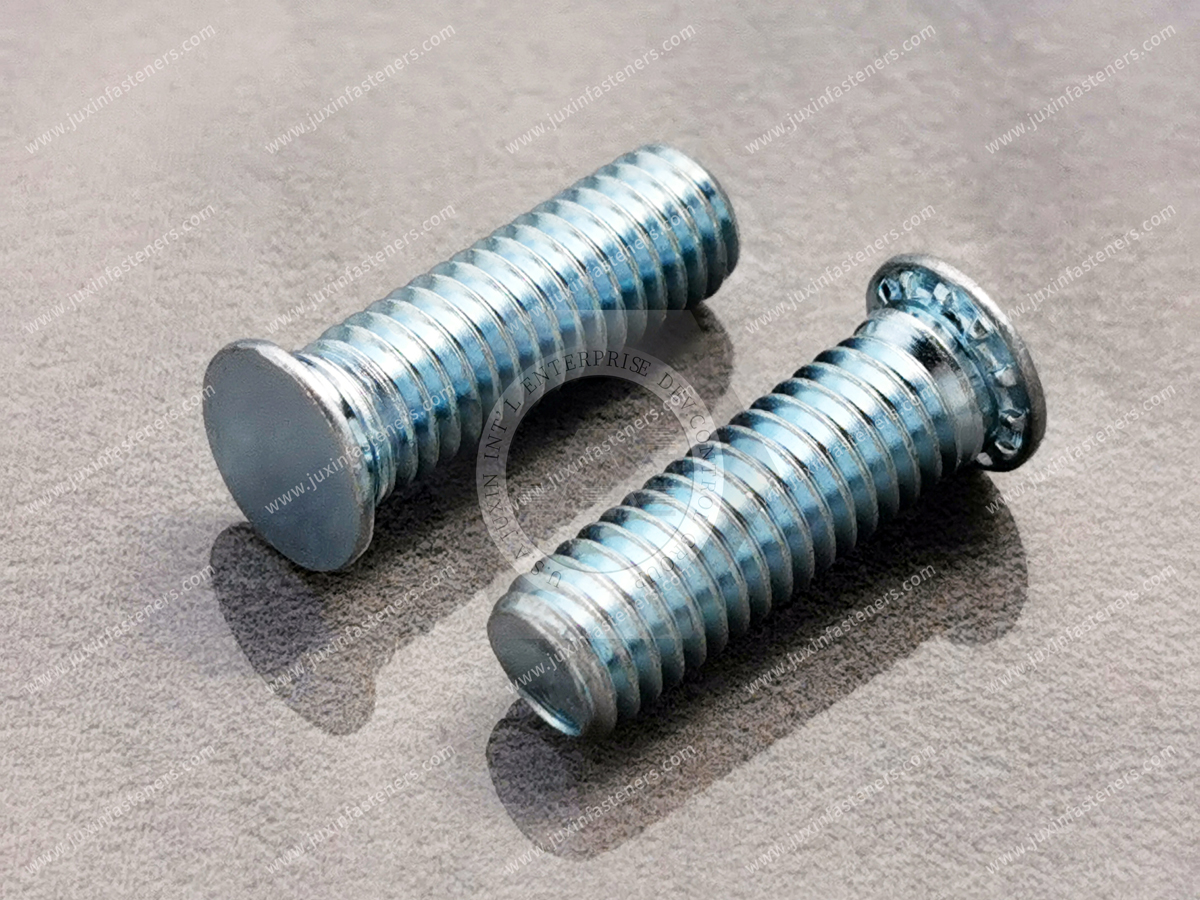
A self-clinching threaded stud is an externally threaded fastener designed for permanent mechanical retention in a suitable metal sheet.
Depending on the product design, the stud may include:
External threaded shank
Clinching head
Displacer feature
Serrations or anti-rotation geometry
Undercut or retention feature
During installation, controlled pressing force causes the surrounding sheet material to flow into the fastener's retention features.
This creates mechanical interlocking between the stud and the panel.
Important Engineering Distinction
Self-clinching installation is not simply a conventional interference fit.
The process depends on suitable plastic deformation of the host material and correct engagement with the fastener's locking geometry.
The sheet must be capable of flowing into the retention features without unacceptable cracking, distortion or loss of strength.
Common Industry Terminology
International purchasing and engineering documents may use:
Self-clinching threaded stud
Self-clinching stud
Clinch stud
Press-in threaded stud
Press-fit threaded stud
Sheet metal threaded stud
Flush-head clinch stud
Concealed-head clinch stud
These terms are useful for technical communication and product searches, but they do not establish dimensional or functional interchangeability.
Engineering Recommendation
Self-clinching threaded studs from different suppliers should be evaluated against the approved engineering drawing,
installation requirements and specified mechanical performance before substitution.
How Self-Clinching Studs Work
The installation process generally involves positioning the stud in a correctly prepared panel hole and applying controlled axial force using suitable press tooling.
As the stud is pressed into the sheet, the surrounding panel material is displaced into the stud's locking features.
When the correct geometry and installation conditions are used, this mechanical interlock provides resistance to axial removal and rotation.
Two Important Performance Characteristics
Pushout Resistance
Pushout resistance describes the force required to dislodge an installed stud under a defined axial test condition.
Torque-Out Resistance
Torque-out resistance describes resistance to rotation of the installed stud under a defined torque test condition.
These characteristics depend on:
Stud geometry
Stud material and hardness
Panel material
Panel hardness
Panel thickness
Hole quality
Installation process
They cannot be assumed from nominal thread size alone.
Why Self-Clinching Studs Are Used in Sheet Metal Assemblies
Self-clinching studs may offer advantages when properly matched to the panel and application.
Potential benefits include:
Permanent externally threaded mounting points
No welding operation
Reduced welding-related heat distortion
Suitability for repeatable press installation
Potential assembly efficiency improvements
Compact fastening geometry
Compatibility with selected automated manufacturing processes
However, these benefits are conditional.
For example, a self-clinching stud installed in an unsuitable sheet material may exhibit low retention strength even if its external dimensions appear correct.
Sheet Metal Thickness: The First Critical Selection Factor
Minimum sheet thickness is one of the most important parameters in self-clinching stud selection.
The panel must provide enough material to engage the stud's retention geometry.
What Happens When the Sheet Is Too Thin?
Potential problems include:
Incomplete mechanical interlock
Low pushout resistance
Panel distortion
Local cracking
Reduced torque-out resistance
What Happens When the Sheet Is Thicker?
A thicker panel does not automatically guarantee better installation.
The stud geometry and installation tooling must still be suitable for the selected sheet thickness.
Engineering Recommendation
Use the minimum sheet thickness specified for the exact stud design and host material.
Do not apply a minimum thickness value from one clinch stud design to another without verification.
Sheet Hardness: Why Material Compatibility Matters
Self-clinching studs depend on the host sheet material flowing into the retention features.
For this reason, the relative hardness and deformation characteristics of the stud and sheet are critical.
General Principle
The stud's installation features must be suitable for the hardness and formability of the host sheet.
A stud intended for relatively soft sheet metal may not install correctly in a harder stainless steel panel.
Common Host Materials
Potential sheet materials include:
Low-carbon steel
Cold-rolled steel
Aluminum alloys
Selected stainless steel sheets
Other suitable sheet metals
Compatibility must be verified for the specific stud and sheet combination.
Important Caution
Not every stainless steel clinch stud is suitable for every stainless steel sheet.
The fastener's material designation alone does not establish its ability to clinch into the host panel.
Sheet Material Selection Matrix
| Host material | Main engineering concern | Required verification |
|---|---|---|
| Low-carbon steel | Sheet hardness and thickness | Stud design compatibility |
| Cold-rolled steel | Hole quality and material condition | Installation and retention |
| Aluminum alloy | Local deformation and bearing strength | Pushout and torque-out |
| Stainless steel sheet | Higher hardness and reduced material flow in some conditions | Approved stud and sheet combination |
| Coated sheet metal | Coating effects and hole condition | Installation sequence and corrosion requirements |
Engineering Recommendation
Confirm the sheet material specification, hardness range and thickness before finalizing the stud.
Installation Hole Diameter and Hole Quality
The mounting hole is a functional part of the clinching system.
A hole that is too large may not provide sufficient material engagement.
A hole that is too small may interfere with correct seating or cause unwanted deformation.
Critical Hole Requirements
Hole diameter
Hole roundness
Hole position
Burr condition
Sheet flatness
Distance to nearby features
Punching vs. Drilling
Both punched and drilled holes may be considered where permitted by the stud specification.
However, hole preparation must produce the required geometry and edge condition.
Burr Orientation
Burrs can interfere with stud seating and panel support.
The appropriate burr-removal and installation-side requirements should follow the approved installation specification.
Important Recommendation
Do not countersink or chamfer the installation hole unless the specific stud design requires it.
Removing material around the hole may reduce the material available for clinching.
Minimum Hole-to-Edge Distance
The distance between the installation hole and the edge of the sheet affects the surrounding material's ability to support the clinching process.
Insufficient edge distance may cause:
Edge bulging
Local cracking
Panel distortion
Reduced retention strength
Design Considerations
Check the distance to:
External sheet edges
Adjacent holes
Bends
Formed features
Cutouts
Other installed fasteners
Engineering Recommendation
Use the minimum edge-distance requirement for the exact stud design.
Where the design cannot provide the required edge distance, consider another fastening method or revise the panel geometry.
Press Installation: Correct Equipment and Process
Self-clinching studs are normally installed using controlled press equipment and appropriate tooling.
Recommended Installation Sequence
Step 1: Confirm the Stud and Panel Specification
Verify:
Stud part number or drawing
Thread designation
Sheet material
Sheet thickness
Sheet hardness
Hole diameter
Installation orientation
Step 2: Prepare the Installation Hole
Check that the hole meets the required dimensions and edge condition.
Step 3: Position the Stud
Align the stud correctly with the prepared hole.
Avoid tilted installation.
Step 4: Support the Panel
Use suitable anvil support and tooling to maintain the intended panel geometry.
Step 5: Apply Controlled Pressing Force
Apply axial force in accordance with the approved installation method.
Step 6: Verify Seating
Confirm that the stud is seated correctly and that the panel has not been damaged.
Step 7: Inspect Functional Performance
Where required, verify pushout resistance, torque-out resistance and other acceptance criteria.
Important Installation Cautions
Avoid:
Hammer installation
Uncontrolled impact
Excessive pressing force
Incorrect tool alignment
Inadequate panel support
Repeated pressing without an approved procedure
Excessive force does not automatically improve retention.
It may deform the sheet or damage the fastener.
Installation Force vs. Retention Strength
Installation force and installed retention strength are different parameters.
A higher press force does not necessarily produce higher pushout or torque-out resistance.
Once the stud has seated correctly, additional force may create undesirable deformation.
Engineering Recommendation
Establish the installation process using the actual stud, sheet material and tooling.
For production release, verify that the selected process achieves the required installed performance without unacceptable panel distortion.
Flush-Head Self-Clinching Studs
Some self-clinching stud designs are intended to provide a flush or near-flush installation on the specified side of the sheet.
Potential benefits include:
Reduced external protrusion
Cleaner equipment appearance
Improved clearance for adjacent components
However, the actual head condition depends on the stud design and installation specification.
Design Checks
Head geometry
Required panel thickness
Installation side
Flushness tolerance
Panel deformation
Tooling support
Important Limitation
Do not assume that every self-clinching threaded stud produces a perfectly flush external surface.
Concealed-Head Self-Clinching Studs
Concealed-head studs are a specialized fastening option for selected sheet metal designs where visible head features must be minimized or eliminated.
These designs may require a specially prepared recess or other dedicated installation geometry.
Potential Applications
Precision equipment housings
Electronic enclosures
Display equipment
Decorative sheet metal panels
Selected consumer electronic assemblies
Engineering Considerations
Panel thickness
Recess geometry
Remaining material thickness
Installation process
Surface finish
Pullout resistance
Torque resistance
Important Distinction
Concealed-head studs should not be treated as dimensionally or procedurally equivalent to ordinary self-clinching studs.
They require their own approved drawings and installation conditions.
Waterproofing and Dust Protection
A concealed or flush-head stud may support an enclosure design with appearance or clearance requirements.
However, the clinching process itself does not automatically create a waterproof or dustproof seal.
Where sealing is required, the complete enclosure design must be evaluated.
Self-Clinching Studs vs. Weld Studs
Self-clinching and welded studs create permanent threaded attachment points using different installation methods.
Self-Clinching Studs
Potential advantages include:
No welding heat input
Suitability for selected press-based assembly processes
Potential reduction in welding-related distortion
Weld Studs
Potential advantages include:
Suitability for certain weldable structures
No requirement for a conventional clinching hole in some designs
Different mechanical attachment possibilities
Selection Factors
Sheet material
Sheet thickness
Welding suitability
Installation access
Corrosion requirements
Production volume
Mechanical loads
Equipment availability
Important Engineering Principle
Self-clinching studs are not universally stronger, faster or more economical than weld studs.
The appropriate choice depends on the complete manufacturing process.
Self-Clinching Studs vs. Rivet Studs
Rivet studs use a different mechanical retention method and may be suitable where conventional clinching is impractical.
Some designs may provide advantages in particular access or sheet-material conditions.
However, suitability depends on the specific product.
Self-Clinching Studs vs. Threaded Inserts
Threaded inserts generally provide internal threads, while threaded studs provide external threads.
These products solve different assembly requirements.
For example:
A self-clinching stud may provide an external mounting post for a bracket.
A self-clinching nut may provide an internal threaded mounting point.
A blind rivet nut may provide internal threads where only one side of the assembly is accessible.
A brass threaded insert may provide internal threads in suitable plastic components.
Fastening Method Comparison
| Method | Main function | Key selection factor |
|---|---|---|
| Self-clinching threaded stud | Permanent external thread in suitable sheet metal | Sheet flow and installation geometry |
| Weld stud | Welded external thread attachment | Weldability and process control |
| Rivet stud | Mechanically retained external thread | Product-specific installation conditions |
| Self-clinching nut | Permanent internal thread in suitable sheet metal | Sheet compatibility |
| Blind rivet nut | Internal thread for selected blind-access applications | Grip range and hole geometry |
| Threaded insert | Internal thread in suitable host material | Host material and installation method |
Engineering Recommendation
Choose the fastening method according to joint function, host material, access, manufacturing process and required performance.
Common Self-Clinching Stud Installation Failures
Failure: Low Pushout Resistance
Possible causes:
Oversized hole
Insufficient sheet thickness
Unsuitable sheet hardness
Incorrect stud design
Incomplete installation
Recommended Review
Verify the hole, sheet and stud combination before increasing press force.
Failure: Low Torque-Out Resistance
Possible causes:
Insufficient material flow
Incorrect locking geometry for the sheet
Improper hole size
Installation misalignment
Recommended Review
Evaluate the installed locking features and the specified torque-out acceptance criteria.
Failure: Panel Bulging
Possible causes:
Insufficient edge distance
Excessive installation force
Inadequate support
Unsuitable sheet thickness
Recommended Review
Check tooling support, edge distance and approved installation conditions.
Failure: Stud Tilt
Possible causes:
Poor alignment
Incorrect tooling
Distorted sheet
Hole positioning error
Recommended Review
Inspect the installation setup and panel geometry.
Failure: Thread Damage
Possible causes:
Tool interference
Incorrect handling
Damaged installation tooling
Improper mating nut installation
Recommended Review
Protect the threaded section and verify tool clearance.
Failure: Stud Rotation During Final Assembly
Possible causes:
Insufficient torque-out resistance
Excessive tightening torque
Inappropriate panel material
Installation defects
Recommended Review
Compare the actual assembly torque with the installed stud's validated torque-out performance.
Important Distinction
Torque-out resistance of the clinched stud is not the same as the tightening torque or locking performance of the mating nut.
Production-Line Quality Control
For manufacturing engineers and production managers, installation repeatability is essential.
A suitable process-control plan may include:
Incoming Fastener Checks
Part identification
Thread dimensions
Head dimensions
Material specification
Surface condition
Sheet Metal Checks
Material identification
Sheet thickness
Hole diameter
Hole location
Burr condition
Panel flatness
Press Setup Verification
Tool alignment
Anvil support
Installation orientation
Press settings
Seating condition
Installed Part Inspection
Stud perpendicularity
Head seating
Panel distortion
Thread condition
Required pushout testing
Required torque-out testing
Inspection frequency and acceptance criteria should be established according to the customer's approved quality plan.

Production Problem Matrix
| Production problem | Possible cause | Recommended action |
|---|---|---|
| Stud pushes out | Incomplete interlock | Check hole, sheet and stud compatibility |
| Stud rotates | Low torque-out resistance | Verify locking geometry and installation |
| Panel bulges | Insufficient edge distance or excessive force | Review panel design and press setup |
| Stud tilts | Misalignment | Check tooling and hole position |
| Thread damaged | Tool interference | Review installation tooling |
| High scrap rate | Process variation | Validate installation conditions |
| Inconsistent seating | Sheet or tooling variation | Review material and setup |
| Assembly nut loosens | Joint preload or locking issue | Review final joint design |
Industrial Applications
Automotive Electronics and EV Equipment
Potential applications include:
Electronic control unit housings
Battery management system enclosures
Sensor brackets
Equipment mounting panels
Selected battery enclosure components
Engineering Priorities
Sheet thickness
Vibration
Corrosion
Installation consistency
Approved mechanical performance
Safety-critical or high-voltage applications require project-specific engineering qualification.
Electrical Enclosures and Control Cabinets
Potential applications include:
Electrical control cabinets
Power distribution equipment
Switchgear housings
Industrial control panels
Engineering Priorities
Thin sheet metal design
Internal mounting points
Assembly access
Corrosion protection
Serviceability
Telecom Equipment and Server Cabinets
Potential applications include:
Server racks
Network cabinets
Communication chassis
Data center equipment housings
Engineering Priorities
Compact mounting geometry
Repeatable production
Sheet metal compatibility
Equipment maintenance
Assembly cycle time
Consumer Electronics and Precision Equipment
Potential applications include:
Display equipment
Audio equipment
Precision instrument housings
Electronic chassis assemblies
Engineering Priorities
External appearance
Panel flatness
Flush or concealed-head requirements
Tight assembly clearances
Medical and Laboratory Equipment
Potential applications include approved:
Medical equipment housings
Laboratory instrument frames
Diagnostic equipment enclosures
Equipment mounting panels
Engineering Priorities
Material compatibility
Cleaning requirements
Corrosion exposure
Surface condition
Equipment-specific regulatory requirements
General industrial self-clinching studs are not automatically qualified for implantable or other regulated medical applications.
Industrial Machinery and Automation
Potential applications include:
Machine control panels
Equipment housings
Automation cabinets
Production fixtures
Mechanical support panels
Engineering Priorities
Retention strength
Installation efficiency
Vibration
Maintenance access
Batch consistency
Material and Surface Treatment Selection
Self-clinching studs may be specified in suitable carbon steel, stainless steel or other approved materials.
Carbon Steel Studs
Potentially suitable for selected industrial sheet metal assemblies.
Corrosion protection may require an appropriate finish.
Stainless Steel Studs
Potentially suitable where corrosion resistance is important.
However, installation compatibility with the host sheet must be verified.
Zinc-Plated Studs
Zinc plating may be specified for suitable carbon steel fasteners.
The coating requirements should be selected according to the intended environment and application.
Important Engineering Considerations
Material hardness
Host sheet compatibility
Corrosion exposure
Coating thickness
Installation behavior
Thread fit
Relevant International Standards
Self-clinching studs are commonly defined by product-specific specifications or customer drawings rather than one universal dimensional standard covering every clinch-stud design.
Where applicable, supporting standards may include:
ISO metric thread specifications
ASME B1.1 for Unified inch-series threads
ISO 4042 for electroplated coatings on applicable fasteners
Relevant material and mechanical property specifications defined by the customer
Important Compatibility Rule
Metric, UNC, UNF, BSW and BSF thread systems must be specified separately.
They are not directly interchangeable.
OEM Custom Self-Clinching Studs
Standard stud designs may not satisfy every OEM application.
Drawing-based custom requirements may include:
Thread diameter
Thread pitch
Stud length
Thread length
Head diameter
Head height
Retention geometry
Installation hole requirements
Material
Surface treatment
Dimensional tolerances
Manufacturing Feasibility
The appropriate manufacturing process depends on:
Stud geometry
Material
Mechanical properties
Production quantity
Tolerance requirements
JUXIN FASTENERS supports drawing-based inquiries for custom industrial fastening components.
Specific manufacturing routes and commercial terms are confirmed during technical review.
OEM Supplier Qualification and Purchasing Decisions
Procurement and supplier development teams should evaluate self-clinching studs using complete installation and performance requirements.
Recommended RFQ Information
| Requirement | Information to provide |
|---|---|
| Product | Self-clinching threaded stud |
| Drawing | 2D drawing or approved reference |
| Thread | Metric, UNC or UNF designation |
| Stud length | Required overall and thread dimensions |
| Head | Head and retention geometry |
| Material | Stud material specification |
| Surface | Required coating or finish |
| Host sheet | Material and hardness |
| Sheet thickness | Actual panel thickness |
| Installation hole | Diameter and tolerance |
| Edge distance | Available clearance |
| Installation | Press method and tooling constraints |
| Performance | Pushout and torque-out requirements |
| Inspection | Acceptance criteria |
| Samples | Prototype or approval quantity |
| Volume | Batch quantity and annual forecast |
| Delivery | Target schedule |
Supplier Substitution Checklist
Before approving an alternative clinch stud, verify:
Thread compatibility
Stud length
Head dimensions
Retention geometry
Host sheet compatibility
Minimum sheet thickness
Hole diameter
Edge distance
Pushout performance
Torque-out performance
Surface treatment
Installation tooling
A visually similar stud may not be functionally interchangeable.
Total Installed Cost
For high-volume OEM production, purchasing decisions should consider:
Fastener unit price
Installation equipment
Tooling
Press cycle time
Hole preparation
Scrap rate
Inspection
Rework
Inventory
Supplier qualification
Delivery reliability
A lower stud purchase price does not always produce the lowest installed cost.
Frequently Asked Questions
What is a self-clinching threaded stud?
It is an externally threaded fastener mechanically retained in a suitable sheet metal panel through controlled installation and material flow into the fastener's locking features.
Can self-clinching studs be installed in stainless steel sheets?
Some designs are suitable for specified stainless steel sheets. Compatibility depends on the exact stud design, sheet hardness, thickness and installation conditions.
What is the minimum sheet thickness for a self-clinching stud?
There is no universal minimum applicable to every design. Use the specified minimum for the exact stud and host material.
Can self-clinching studs be installed with a hammer?
Hammer installation is generally unsuitable for conventional self-clinching studs because the process requires controlled alignment and pressing.
Do self-clinching studs prevent vibration loosening?
The stud may resist rotation and removal from the panel, but the mating nut and final joint still require appropriate preload and locking design.
What is the difference between pushout and torque-out resistance?
Pushout resistance concerns axial removal of the installed stud. Torque-out resistance concerns rotation of the stud relative to the panel.
Are concealed-head studs waterproof?
Not automatically. Waterproofing depends on the complete enclosure and sealing design.
Can a weld stud be replaced with a self-clinching stud?
Possibly, but the panel material, thickness, installation geometry and required mechanical performance must be evaluated.
Can JUXIN FASTENERS review custom self-clinching stud drawings?
Yes. Drawing-based inquiries can be reviewed for dimensions, material, sheet compatibility, installation requirements and quotation feasibility.
JUXIN FASTENERS: Self-Clinching Studs and Sheet Metal Fastening Solutions
JUXIN FASTENERS supplies industrial fastening components and supports drawing-based OEM inquiries for international manufacturers.
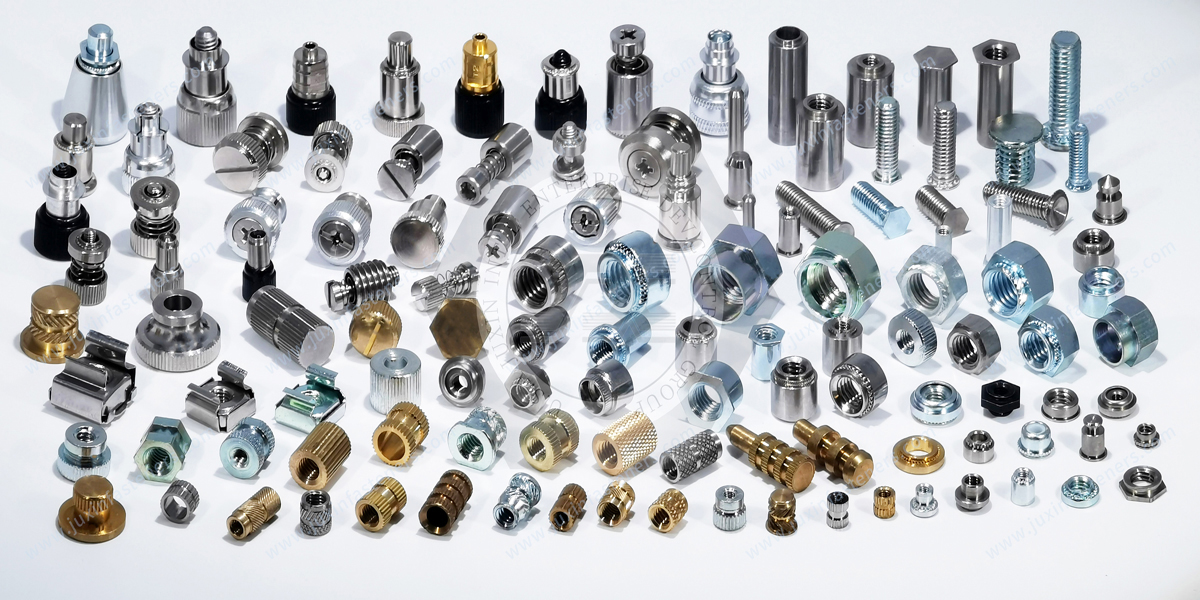
Relevant product categories include:
Self-clinching threaded studs
Self-clinching nuts
Self-clinching standoffs
Blind self-clinching standoffs
Concealed-head fastening components
Weld studs
Weld nuts
Blind rivet nuts
Threaded inserts
Custom CNC-machined fasteners
Specific dimensions, materials, installation requirements, inspection criteria, MOQ and lead times are confirmed during project review.
Request a Self-Clinching Stud Engineering Review and OEM RFQ
Are you sourcing self-clinching threaded studs, flush-head clinch studs, concealed-head studs or custom threaded fastening components for industrial sheet metal assemblies?
JUXIN FASTENERS welcomes inquiries from design engineers, structural engineers, mechanical engineers, manufacturing engineers, production managers,
procurement specialists, purchasing managers, supplier development teams and supply chain managers.
For an efficient technical and commercial review, please provide:
2D drawing or approved reference + thread designation + stud length + head dimensions + stud material + surface finish + sheet material + sheet hardness
+ sheet thickness + installation hole diameter + edge distance + required pushout and torque-out performance + sample quantity + annual purchasing volume + target delivery schedule
Our team can review your requirements, discuss suitable standard or drawing-based options, confirm sample arrangements and prepare quotation information.
Company: Juxin Fasteners
Website: https://www.juxinfasteners.com/
Email: info@juxinfasteners.com
Send your self-clinching stud drawings, sheet metal specifications and RFQ to JUXIN FASTENERS for technical evaluation and quotation.
Contact Us
Tel.:
+86 020 8621 0320
+86 020 3121 6067
E-mail:
Technical Support:
Navigation
SEND INQUIREY



