
Call Us
+86 136 6007 9809
Call Us
+86 136 6007 9809

Oct. 30, 2023
Flat washers—also called plain washers—are among the simplest components in a bolted joint, but their dimensions, material,
hardness and surface condition can influence how load is transferred from a bolt head or nut into the assembled component.
A flat washer is typically positioned beneath a bolt head, screw head or nut to provide a defined bearing surface.
Depending on the joint design, it may help distribute bearing pressure over a larger area, protect the mating surface,
bridge an oversized or irregular clearance hole, or provide a suitable interface between the fastener and component.
Flat washers should not, however, be treated as universal anti-loosening devices.
A conventional flat washer does not by itself guarantee resistance to vibration loosening. If joint locking is required, the complete bolted-joint design and an appropriate locking method should be evaluated separately.
For engineers and sourcing teams, flat washer selection should therefore follow:
fastener size → clearance hole → washer ID → washer OD → thickness → material → hardness → finish → mating surface → environment → validation
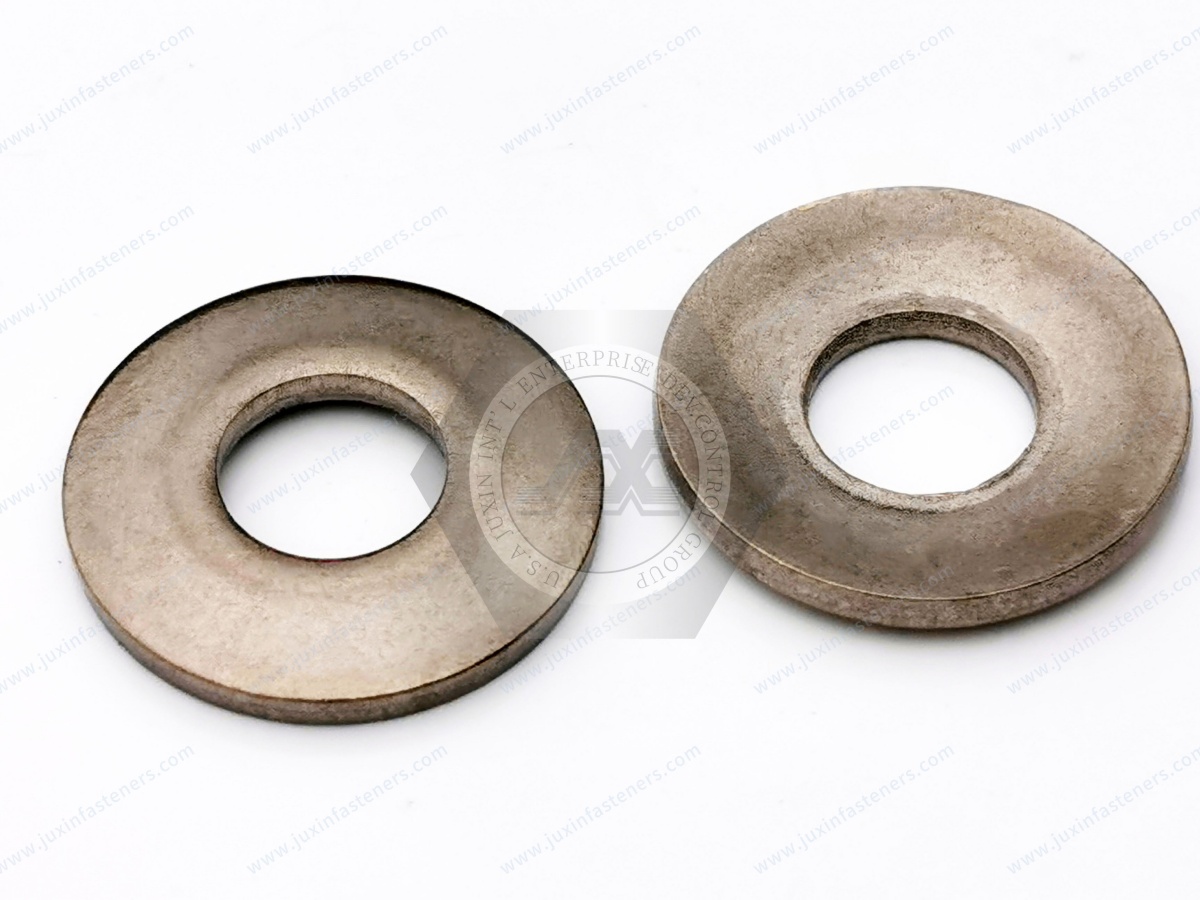
A flat washer is generally a thin component with a central hole installed between a threaded fastener and the surface of the assembled part.
Common international dimensional references for metric plain washers include ISO 7089 and related ISO washer standards. DIN 125 is also widely recognized in legacy drawings and commercial specifications.
The applicable standard should be confirmed from the customer's drawing, specification or approved part rather than assumed from the description “flat washer.”
Flat washers may be produced as:
Standard metric flat washers
Inch-series flat washers
Large-OD washers
Small-OD washers
Thick washers
Thin washers
Hardened washers
Stainless steel washers
Non-ferrous metal washers
Nylon and plastic washers
Drawing-controlled custom washers
Although these products can appear visually similar, they are not necessarily interchangeable.
The engineering function depends on the joint.
A washer increases the bearing area beneath a bolt head or nut.
This can be useful where the mating material could otherwise experience excessive local bearing stress.
The benefit depends on:
Washer outside diameter
Washer thickness
Washer stiffness
Washer hardness
Mating material
Fastener preload
Hole geometry
A larger washer is not automatically better. The surrounding component must have sufficient supporting area.
A washer can provide an intermediate bearing surface between a rotating fastener and the assembled component.
This may help reduce direct marking or localized surface damage during tightening, depending on material, finish and assembly conditions.
This consideration can be important for:
Coated sheet metal
Painted components
Aluminum components
Electrical enclosures
Finished equipment surfaces
However, whether surface damage is acceptable should be verified under the actual tightening process.
A washer can provide additional bearing area around a clearance hole.
Selection must consider the relationship between:
bolt diameter → clearance-hole diameter → washer ID → washer OD
The washer should provide adequate support without interfering with nearby features.
In engineered bolted joints, washer hardness, flatness and geometry may be important to maintaining a suitable bearing interface.
This becomes increasingly relevant when the joint uses higher-strength fasteners or relatively soft mating materials.
A common engineering mistake is assigning functions to a plain washer that the component cannot independently guarantee.
A standard flat washer does not automatically:
Prevent vibration loosening
Lock a threaded joint
Seal against liquids or gases
Electrically insulate a joint
Provide a defined spring force
Compensate for every misalignment condition
These functions may require different components or engineered systems.
Examples include:
Locking fasteners for loosening resistance
Sealing washers for fluid sealing
Spring elements for controlled elasticity
Insulating washers for electrical isolation
Correct technology selection begins by defining the actual joint problem.
Procurement teams should avoid specifying a washer only as “M6 washer” or “1/4-inch washer.”
Several dimensions define whether the washer will fit and function correctly.
The washer inside diameter must provide the required relationship with the bolt or screw.
Too small, and assembly may be impossible.
Too large, and the available bearing area around the hole may be reduced.
The outside diameter controls much of the available bearing footprint.
OD selection should consider:
Component geometry
Edge distance
Nearby features
Clearance
Bearing-pressure requirements
Appearance requirements
Thickness influences washer stiffness and resistance to deformation.
A thin washer over a large clearance hole may deform differently from a thicker washer of the same ID and OD.
Thickness therefore should not be changed casually during second-source qualification.
For precision assemblies, washer form and flatness may also affect the bearing interface.
Drawing-controlled applications should define the required dimensional tolerances rather than relying solely on a generic commercial description.
Carbon steel is widely used for industrial flat washers.
Depending on the application, carbon steel washers can be supplied with different:
Material requirements
Hardness requirements
Dimensions
Surface finishes
Corrosion-protection systems
Common applications include:
Industrial machinery
Automotive assemblies
Equipment frames
Electrical equipment
Commercial equipment
General OEM assemblies
The steel grade and hardness should be selected according to the joint requirements rather than assuming that all carbon steel washers have the same mechanical properties.
Washer hardness is an important but frequently overlooked parameter.
Consider a highly loaded bolted joint using a relatively soft washer.
Under the bearing pressure generated by the fastener, the washer may experience excessive indentation or deformation.
That can affect the bearing interface and potentially influence joint behavior.
For this reason, engineers should consider the relationship between:
bolt property class → nut → washer hardness → mating material → preload
A generic low-hardness commercial washer should not automatically replace a washer specified for a mechanically demanding bolted joint.
Where hardness is functionally important, it should be defined on the drawing or purchasing specification.
Zinc plating is commonly specified for carbon steel washers where a metallic corrosion-protection finish is required.
However, “zinc plated” alone may not completely define the customer's requirement.
Depending on the project, sourcing specifications may also need to identify:
Finish type
Appearance
Passivation
Coating requirement
Corrosion-performance requirement
Compatibility with mating fasteners
The washer finish should also be considered together with the bolt, nut and assembled component.
For more detail, see our Fastener Surface Treatments engineering guide.
Stainless steel flat washers are commonly selected where corrosion resistance, material compatibility or appearance is important.
Potential applications include:
Food-service equipment
HVAC equipment
Outdoor equipment
Industrial machinery
Commercial equipment
Marine-related equipment
Electrical enclosures
However, the statement “stainless steel washer” is not a complete engineering specification.
The required stainless steel grade should be defined according to:
Environment
Mating fastener
Mechanical requirements
Corrosion conditions
Customer specification
Stainless steel washers should not automatically be classified as suitable only for light loads.
Mechanical suitability depends on the specified material, dimensions, hardness or property requirements and the complete bolted joint.
Copper and copper-alloy washers can be considered where their specific material characteristics are useful.
Depending on the design, potential considerations include:
Electrical conductivity
Thermal conductivity
Material compatibility
Conformability
Corrosion environment
Applications can include certain:
Electrical assemblies
Power equipment
Thermal systems
Automotive components
Industrial equipment
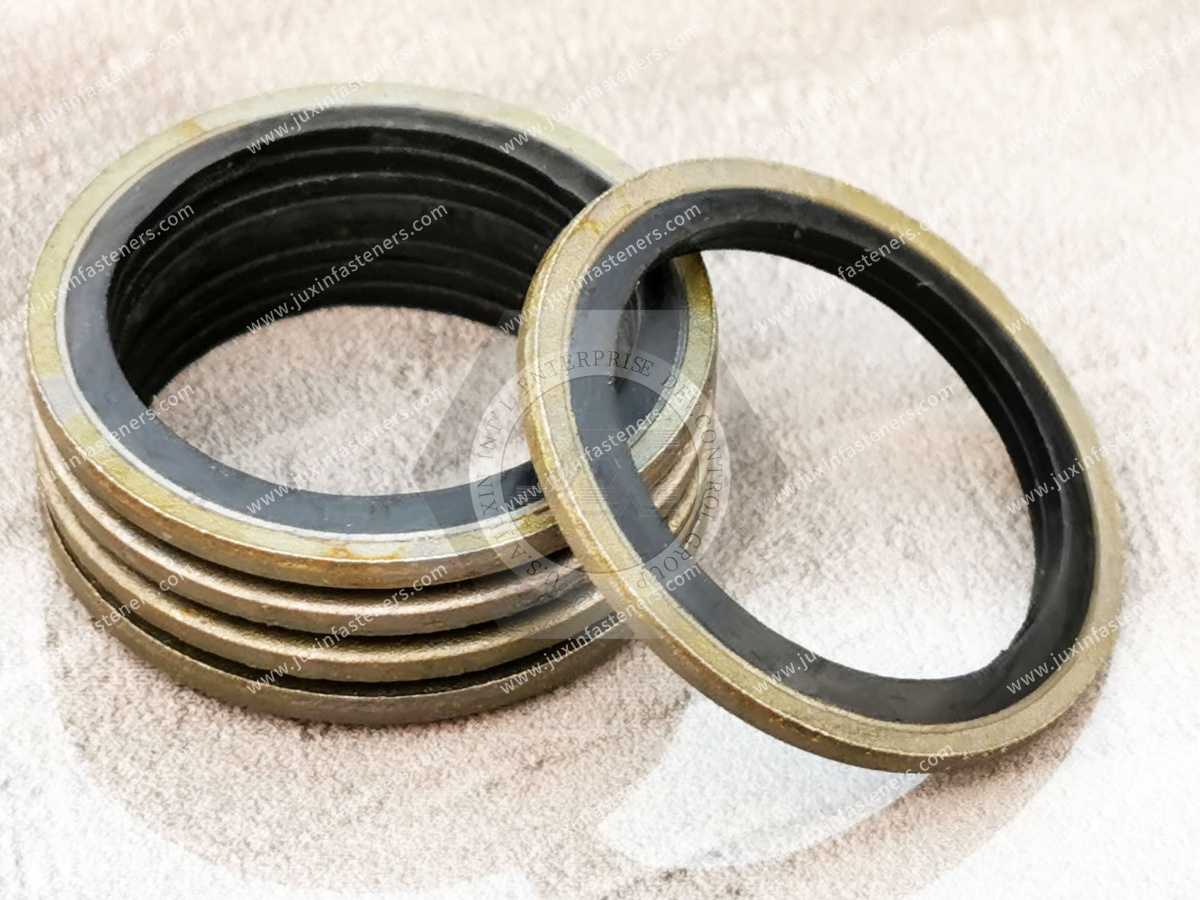
However, a conventional copper flat washer should not automatically be described as a sealing washer.
If sealing is required, the washer geometry, material condition, mating surfaces, pressure, temperature and medium must be engineered for that purpose.
Plastic washers are a separate engineering category from metallic flat washers.
Materials can include, depending on application and customer specification:
PA / Nylon
Glass-fiber-reinforced nylon
PC
PP
PPS
PVC
PVDF
Other engineering polymers
Potential reasons for selecting a plastic washer include:
Electrical insulation
Reduced weight
Separation of dissimilar materials
Protection of finished surfaces
Chemical compatibility
Non-metallic component requirements
But the selection cannot be based simply on “plastic versus metal.”
Polymer behavior differs significantly from steel.
Engineers should consider:
Creep
Stress relaxation
Moisture absorption
Temperature
Chemical exposure
Washer thickness
Bearing pressure
Assembly torque
Long-term clamping requirements
For example, nylon can absorb moisture, which can affect dimensions and mechanical behavior.
A plastic washer subjected to sustained compression can also exhibit creep or stress relaxation.
Therefore, a plastic washer should not automatically replace a metal washer in a preload-critical joint.
For polymer applications, see our Nylon and Plastic Washers material-selection guide.
A practical engineering selection process can begin with the assembly environment.
Consider:
Carbon steel
Required hardness
Suitable surface finish
Then evaluate the joint load and corrosion conditions.
Evaluate:
Stainless steel
Coated carbon steel
Other corrosion-compatible materials
Material selection should consider the entire assembly rather than the washer alone.
Evaluate:
Nylon
Engineering plastics
Application-specific insulating materials
Then verify temperature, voltage-related design requirements, creep and assembly pressure.
Evaluate whether a suitable copper or other conductive washer is appropriate for the actual design.
Do not infer electrical performance from appearance alone.
Prioritize:
Mechanical properties
Washer hardness
Thickness
Bearing area
Mating-material strength
Do not select only by corrosion resistance.
One of the most useful washer-selection principles is understanding the relationship between washer OD and the supporting component.
Increasing washer OD can increase the nominal bearing area.
But that benefit is only useful if the underlying component can support the washer.
If part of a large washer extends over:
An unsupported opening
A thin edge
A slot
A flexible flange
the expected load-distribution benefit may not be achieved.
Washer geometry should therefore be evaluated together with the component underneath it.
Thickness is sometimes treated as a purchasing detail rather than a functional dimension.
That can be a mistake.
Under load, washer deformation depends on factors including:
Thickness
OD
ID
Material
Hardness
Bearing pressure
Support beneath the washer
Changing washer thickness during cost reduction or second-source development can therefore change joint behavior.
For drawing-controlled components, thickness tolerance should be included in supplier comparison.
Slotted holes require additional attention.
The washer must provide sufficient bearing coverage throughout the intended assembly position.
Engineers should evaluate:
Slot width
Slot length
Fastener position
Washer OD
Washer thickness
Edge support
Expected load direction
A standard washer may not provide sufficient coverage for every slotted-hole geometry.
A larger OD or drawing-controlled washer may be more appropriate depending on the joint.
Automotive applications can involve:
Body structures
Chassis-related assemblies
Battery-system components
Thermal-management equipment
Brackets
Electrical equipment
Interior structures
Washer selection may need to account for:
Fastener property class
Sheet thickness
Coatings
Corrosion environment
Vibration
Assembly torque
Automated installation
Joint service conditions
The washer should be validated as part of the complete bolted joint.
Flat washers are widely used in:
Electrical cabinets
Power distribution equipment
Switchgear
UPS systems
Energy-storage equipment
Data center infrastructure
Industrial control equipment
Material selection may be driven by:
Mechanical loading
Corrosion environment
Electrical isolation
Conductivity requirements
Component finish
Service temperature
Mechanical and electrical requirements should be defined separately.
A metallic washer should not automatically be assumed to provide a controlled electrical connection,
and a plastic washer should not automatically be assumed to meet a specific electrical insulation requirement without validation.
Industrial machinery often contains both general-purpose and highly loaded bolted joints.
Applications can include:
Equipment frames
Covers
Mounting brackets
Machine guards
Motor assemblies
Automation equipment
Fixtures
The selection process should distinguish between a general assembly washer and a washer forming part of a mechanically critical joint.
A standard ISO, DIN, ASME/ANSI or other established washer may be appropriate when its dimensions and properties meet the assembly requirement.
A custom washer may be considered when the design requires:
Non-standard ID
Non-standard OD
Special thickness
Special material
Special hardness
Special surface finish
Unusual shape
Tight dimensional tolerance
Drawing-controlled geometry
The decision should be based on functional requirements rather than making a standard washer custom without engineering benefit.
“M8 washer” may not completely define ID, OD, thickness, hardness or standard.
Better approach: specify the applicable standard or complete dimensions.
A plain flat washer is not inherently a locking fastener.
Better approach: evaluate the actual loosening mechanism and select an appropriate locking system if required.
This can create problems in highly loaded bolted joints.
Better approach: evaluate washer mechanical properties relative to the bolt and mating material.
Different stainless materials and mechanical requirements are not interchangeable.
Better approach: define the required grade or specification.
Plastic washers behave differently under sustained compression and temperature.
Better approach: evaluate creep, stress relaxation, moisture and service environment.
A washer that looks identical may have a different thickness or mechanical behavior.
Better approach: compare the complete drawing and functional specification.
When a washer-related assembly shows unexpected behavior, inspect the complete interface.
Check:
Washer thickness
Unsupported area
Clearance-hole size
Material
Hardness
Fastener load
Check:
Mating-material hardness
Washer OD
Washer hardness
Applied preload
Surface condition
Check:
Washer material
Finish
Mating materials
Moisture exposure
Chemical environment
Coating damage
Check:
Bearing pressure
Temperature
Creep
Material selection
Washer thickness
Assembly torque
The correct solution should address the failure mechanism rather than simply changing washer size.
Flat washers are often considered simple commodity components, but uncontrolled substitution can create dimensional or joint-performance differences.
For second-source development, compare:
existing drawing → approved sample → standard → ID → OD → thickness → material → hardness → finish → functional requirement
Also confirm:
Dimensional tolerances
Surface condition
Mating bolt or screw
Mating nut
Component material
Assembly process
Packaging requirements
Annual volume
A visually similar washer should not automatically be considered equivalent.
For a standard washer, provide:
Applicable ISO, DIN, ASME/ANSI or other required standard
Fastener size
Material
Finish
Required quantity
Annual demand
For a drawing-controlled washer, provide:
2D drawing
Inside diameter
Outside diameter
Thickness
Dimensional tolerances
Material
Hardness where required
Surface finish
Quantity
Annual demand
For a new engineering application, provide:
Mating bolt or screw
Clearance-hole dimensions
Component material
Expected joint loading
Required bearing area
Environment
Corrosion requirement
Electrical requirements where applicable
Production quantity
For second-source development, provide:
Existing drawing
Approved sample
Current standard/specification
Material
Hardness requirement
Surface treatment
Mating fastener
Application information
Annual demand
Engineers and procurement teams evaluating washer systems may also need to consider:
Stainless Steel Fasteners
Custom Washers
Nylon and Plastic Washers
High-Strength Bolts
Fastener Surface Treatments
Automotive Fasteners
Custom Fasteners
Custom Stamped Components
CNC Machined Components
These technologies should be selected according to the complete assembly rather than treated as interchangeable components.
JUXIN FASTENERS supports standard and drawing-controlled fasteners for industrial OEM, procurement and supplier-development projects.
Relevant sourcing capabilities include:
Standard flat washers
Stainless steel washers
Carbon steel washers
Nylon and plastic washers
Drawing-controlled custom washers
Custom stamped components
Standard fasteners
Custom fasteners
Automotive fasteners
CNC machined components
Projects can begin from:
International standard
Customer drawing
Existing sample
Application requirements
Existing production part
Second-source project
For a standard washer, specify the required standard, size, material and finish.
For a custom or drawing-controlled washer, define the ID, OD, thickness, tolerances, material, hardness where applicable and surface treatment.
For design engineers:
fastener → clearance hole → washer ID → washer OD → thickness → material/hardness → finish → mating surface → load → validation
For procurement and supplier-development teams:
standard/drawing → dimensions → material → hardness → finish → approved sample → quantity → annual demand → qualification
The key sourcing principle is simple:
Do not specify a flat washer by bolt size alone when dimensions or mechanical properties matter to the joint.
A reliable washer specification should define the geometry, material and functional requirements necessary for the actual assembly.
For standard flat washers, stainless steel washers, plastic washers or custom drawing-controlled washers, send JUXIN FASTENERS your specification, drawing, sample or application requirements.
For second-source development, include the existing drawing or standard, approved sample, material, hardness where required, finish, mating fastener and annual demand.
Email: info@juxinfasteners.com
Website: www.juxinfasteners.com
 MORE NEWS
Sep. 27, 2026
Sep. 27, 2026
Sep. 27, 2026
Contact Us
Tel.:
+86 020 8621 0320
+86 020 3121 6067
E-mail:
Technical Support:
Navigation
SEND INQUIREY