
Call Us
+86 136 6007 9809
Call Us
+86 136 6007 9809

Oct. 30, 2023
Automotive plastic fasteners are used throughout vehicle assemblies to retain trim panels, wire harnesses, hoses, carpets, shields, covers, electrical components and other lightweight structures.
Unlike a conventional bolt or nut, an automotive plastic clip often performs several functions simultaneously: locating the component,
creating installation retention, controlling removal force, isolating vibration, protecting finished surfaces or organizing cables and hoses.
This makes the selection process more complex than simply matching the visible shape of an existing clip.
For automotive engineers and sourcing teams, a more reliable selection path is:
application → mounting hole → panel thickness → retention geometry → installation method → material → temperature/environment → serviceability → validation
For replacement or second-source projects, the existing sample is useful, but the surrounding assembly conditions are equally important.
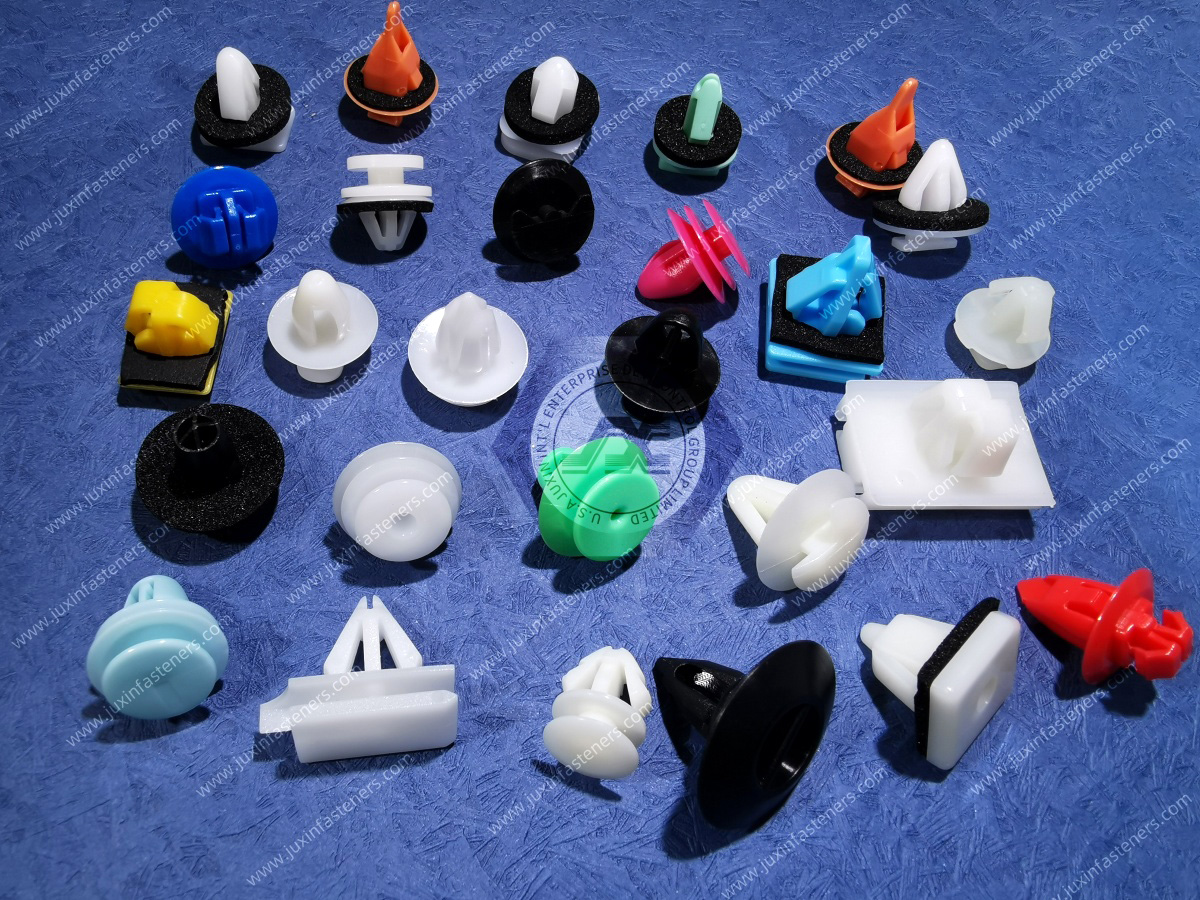
Automotive plastic fasteners are non-metallic fastening and retention components designed for vehicle assembly.
Common product families include:
Plastic push rivets
Push-in clips
Fir tree clips
Christmas tree clips
Trim panel clips
Interior panel retainers
Exterior trim clips
Plastic nuts
Plastic screw grommets
Plastic push pins
Cable and wire harness clips
Automotive cable ties
Hose and tube retaining clips
Plastic pipe clamps
Routing retainers
Custom molded fastening components
Depending on the component, these fasteners may be designed for one-time installation, controlled removal, repeated service or permanent retention.
The terms used by automotive OEMs and Tier suppliers also vary. A component described as a trim clip, panel retainer, push clip, fir tree clip, push rivet or plastic fastener clip may use a similar retention principle but have very different dimensions and functional requirements.
A plastic clip that looks correct can still fail in the vehicle.
For example, two clips may have nearly identical heads but different:
Stem diameters
Retention-fin geometry
Panel-thickness ranges
Insertion forces
Extraction forces
Materials
Temperature behavior
Serviceability
Environmental resistance
This is why automotive plastic fasteners should not be qualified by appearance alone.
The engineering question is not:
“Does this clip look the same?”
The better question is:
“Does this clip produce the required retention behavior in the actual hole, panel stack and operating environment?”
Push-in fasteners are among the most common automotive plastic clips.
They are inserted into a prepared hole and use flexible retention features to engage the sheet metal, plastic panel or other substrate.
Typical applications include:
Door trim panels
Interior panels
Trunk trim
Wheel-arch liners
Underbody covers
Splash shields
Carpet retention
Dashboard components
Pillar trim
Exterior trim
Protective covers
Push-in clips are attractive for high-volume assembly because they can reduce installation steps and may eliminate separate nuts or threaded operations.
However, installation performance depends heavily on the relationship between the fastener and mounting hole.
Fir tree clips—also commonly called Christmas tree clips—use multiple flexible ribs or fins along the stem.
During installation, the ribs deflect as the fastener enters the mounting hole and then create retention against the substrate.
These fasteners are widely used for:
Interior trim
Acoustic insulation
Carpeting
Wire harness routing
Lightweight covers
Protective panels
Upholstery
Underbody components
The retention characteristics depend on much more than nominal stem diameter.
Important variables include:
Mounting-hole diameter
Panel thickness
Rib geometry
Number of retention ribs
Material stiffness
Temperature
Installation direction
Substrate material
A fir tree clip optimized for thin sheet metal may behave differently when installed into a thicker plastic panel.
Plastic push rivets typically use a body and a pin or expanding feature.
Installation expands or locks the body against the mounting hole.
Depending on the design, they may be used for:
Fender liners
Engine-compartment covers
Interior trim
Splash guards
Underbody panels
Air-management components
Lightweight shields
Some designs allow removal and reuse, while others are intended primarily for one installation cycle.
Reuse should therefore never be assumed solely because a fastener can physically be removed.
The design engineer should establish whether the component must survive:
initial installation only → scheduled service → repeated maintenance cycles
Automotive trim clips are used to attach decorative or functional trim components to the vehicle structure.
Applications include:
Door panels
Pillar trim
Instrument-panel components
Center-console components
Threshold and sill trim
Exterior molding
Trunk trim
Interior decorative panels
A trim clip may need to balance two competing requirements:
low enough insertion force for efficient assembly + sufficient retention force for vehicle service
Too much installation force can cause assembly difficulty or damage.
Too little retention can produce looseness, rattling or disengagement.
This balance must be established for the specific clip and assembly.
Plastic nuts and screw grommets provide another fastening method for automotive sheet-metal and plastic assemblies.
They may be installed into:
Round holes
Square holes
Rectangular openings
Panel edges
Dedicated molded features
A mating screw can then create the required retention.
Applications can include:
Interior panels
Covers
Trim components
Electrical components
Lightweight brackets
Protective panels
Plastic nuts can provide advantages where low mass, corrosion resistance, electrical isolation or simplified assembly is useful.
However, the screw and plastic nut form a fastening system.
The engineer should evaluate:
Mating screw geometry
Thread-forming behavior
Pilot feature
Plastic material
Installation torque
Strip resistance
Panel thickness
Hole geometry
Number of service cycles
The installation torque for a plastic nut should not be assumed from a metal threaded joint.
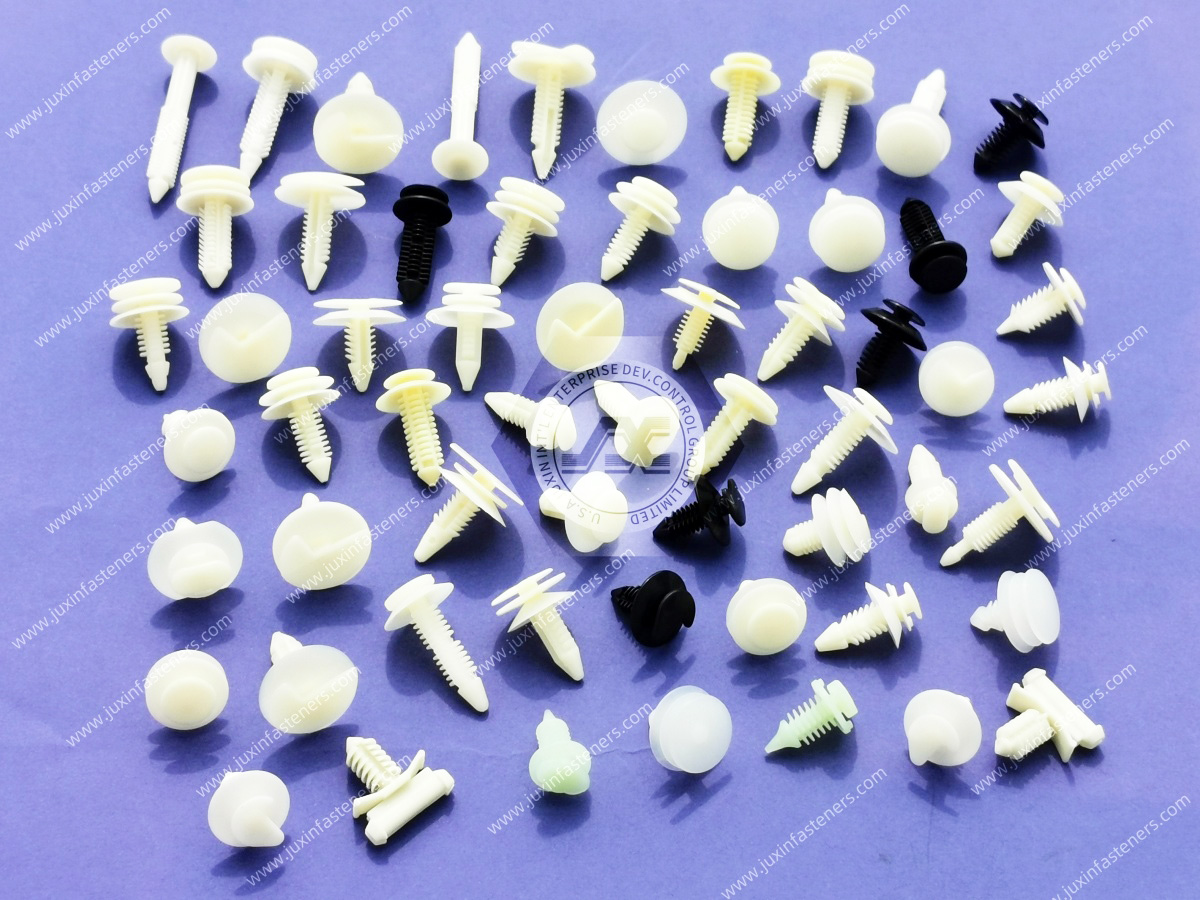
Depending on design requirements, plastic nuts can be produced for metric or inch-thread applications.
Potential configurations include:
Hex plastic nuts
Flanged plastic nuts
Cap-style plastic nuts
Locking designs
Panel-mounted plastic nuts
Custom molded nuts
Common engineering plastics may include nylon and other application-specific polymers.
Thread geometry, material and mechanical performance must be validated for the actual application.
For conventional threaded polymer fasteners, see our Custom Plastic & Nylon Fasteners engineering guide.
Modern vehicles contain extensive electrical and electronic systems, making wire-harness management an important fastening application.
Harness clips may be used for:
Sensor wiring
Power distribution
Lighting harnesses
Battery-system wiring
Electronic control systems
HVAC wiring
Engine-compartment harnesses
Interior electronics
ADAS-related wiring
A wire harness clip may combine a cable-retention feature with a panel attachment feature.
This allows one component to both organize the harness and attach it to the vehicle structure.
Harness-retention components should be evaluated for more than basic pull-out strength.
Consider:
Harness diameter
Harness bundle geometry
Mounting-hole size
Panel thickness
Routing direction
Bend radius
Nearby heat sources
Vibration
Abrasion risk
Chemical exposure
Service access
The clip should secure the harness without creating damaging local stress or abrasion.
Plastic cable ties are used extensively for vehicle wire and tube management.
Automotive versions may include integrated mounting features such as:
Push-in anchors
Fir tree mounts
Panel-edge attachments
Stud-mounted bases
Dedicated routing features
They may be used for:
Wire harnesses
Sensor cables
HVAC routing
Fluid lines
Lightweight tubes
Electrical assemblies
Selection should consider the complete service environment rather than simply tie length and width.
Vehicles contain numerous tubes, hoses and lines that require controlled routing.
Plastic retaining clips and pipe clamps may be used in:
Cooling systems
HVAC systems
Washer-fluid systems
Vacuum lines
Cable routing
Low-pressure fluid routing
Electrical conduit management
Thermal-management assemblies
Attachment methods can include:
Push-in panel mounting
Stud mounting
Screw mounting
Integrated snap features
Custom molded mounting interfaces
The clip geometry should match both the retained line and the vehicle-side mounting condition.
Material selection is critical because polymer properties change with temperature, moisture, time and chemical exposure.
Common engineering materials used in plastic fastening applications can include:
PA6
PA66
POM
PP
PC
PPS
Other engineering polymers and reinforced grades
The correct material depends on the actual operating environment.
Nylon is widely used in plastic fastening systems because it can provide a useful combination of:
Toughness
Flexibility
Fatigue behavior
Moldability
Wear characteristics
Electrical insulation
But nylon behavior is affected by moisture.
Moisture absorption can influence:
Dimensions
Stiffness
Strength
Flexibility
Installation behavior
Therefore, the condition of the material during testing should be considered when validating a nylon clip.
POM can be useful for components requiring characteristics such as dimensional stability, low friction and suitable mechanical behavior.
Applications may include selected:
Clips
Retainers
Sliding features
Snap components
Precision molded fasteners
Material selection must still consider temperature, chemical exposure and the complete application environment.
Components near heat sources may require higher-temperature engineering polymers.
Examples can include fastening systems located near:
Power electronics
Thermal-management equipment
Motors
Engine-compartment components
High-temperature electrical systems
A material should not be classified as “high-temperature” without considering the actual:
Continuous operating temperature
Peak temperature
Exposure duration
Mechanical load
Chemical environment
Moisture is particularly important when specifying nylon fasteners.
Nylon can absorb moisture from its environment.
This can change both dimensional and mechanical behavior.
For a precision plastic clip, moisture can therefore affect:
Stem dimensions
Flexibility
Snap behavior
Insertion force
Retention behavior
For engineering validation, material condition should be controlled or documented where it can materially influence performance.
Metal fastener design logic should not be transferred directly to plastic fasteners.
Polymers can deform gradually under sustained load.
This time-dependent deformation is commonly described as creep.
A related issue is stress relaxation, where the stress generated by an initially deflected plastic feature can decrease over time.
These effects matter for:
Snap-fit clips
Plastic nuts
Hose retainers
Cable ties
Panel clips
Plastic washers
Threaded plastic components
A clip that performs well immediately after assembly may behave differently after prolonged exposure to load and temperature.
Long-term retention should therefore be validated under representative conditions when it is functionally important.
Temperature can change polymer stiffness and flexibility.
At low temperatures, some materials can become less tolerant of impact or deflection.
At elevated temperatures, stiffness and retention behavior may decrease.
This means a clip validated only at room temperature may not fully represent vehicle performance.
Depending on the application, validation may need to consider:
Cold installation
Hot service
Thermal cycling
Long-term elevated-temperature exposure
Automotive plastic fasteners can be exposed to:
Oils
Greases
Cleaning agents
Coolants
Road contaminants
Washer fluids
Fuels or vapors in relevant systems
Other process or service chemicals
Chemical compatibility must be assessed for the specific polymer and exposure conditions.
A generic statement that a plastic fastener is “chemical resistant” is not sufficient for engineering specification.
Insertion force and extraction or retention force are important characteristics for many automotive clips.
However, there is no single universal insertion-force or pull-out-force value suitable for every automotive plastic fastener.
Performance depends on:
Clip geometry
Material
Mounting-hole diameter
Panel thickness
Substrate material
Temperature
Moisture condition
Installation speed
Number of installation cycles
Therefore, requirements should come from the customer's drawing, OEM specification, assembly requirements or validated test plan.
One of the most common mistakes in clip sourcing is treating mounting-hole diameter as a minor detail.
For many push-in clips, hole diameter directly influences:
Installation force
Retention
Clip deformation
Panel damage
Rattle performance
Removal behavior
A small dimensional change in the mating hole can produce a meaningful difference in fastening behavior.
For RFQs, the mounting-hole specification should be supplied whenever possible.
The same clip may behave differently across different panel thicknesses.
The effective grip or engagement condition can influence:
Seating
Retention
Head contact
Clip deformation
Removal
When qualifying a replacement clip, specify the actual panel stack rather than only the nominal mounting-hole diameter.
Automotive plastic fasteners can be designed for different mounting features.
These include:
Round holes
Square holes
Rectangular holes
Slots
Panel edges
Welded studs
Threaded studs
Molded bosses
The mounting interface should be considered part of the fastener specification.
Service strategy is another important design parameter.
Some components need to be removed during:
Vehicle servicing
Electrical repair
Interior maintenance
Component replacement
Diagnostic access
Other clips are intended to remain installed throughout normal service.
The fastener design should therefore answer:
Does this joint need to be serviced?
If yes, consider:
Removal method
Required tools
Risk of clip damage
Risk of panel damage
Number of expected cycles
Replacement strategy
Plastic clips can be attractive when the assembly requires:
Fast push-in installation
Reduced component count
Lightweight construction
Electrical isolation
Corrosion-free polymer components
Trim-friendly contact
Integrated cable or hose routing
Snap-fit assembly
Metal fasteners may be more appropriate where the joint requires:
High sustained clamp load
High structural load
High-temperature mechanical performance
Defined bolt preload
Repeated high-load threaded service
The correct technology depends on the joint function.
A molded plastic clip and a threaded insert solve different problems.
If a plastic component needs repeated screw assembly, controlled threaded engagement or higher thread durability, a threaded insert for plastic may be more appropriate than directly threading into the polymer.
Potential technologies include:
Heat-staked inserts
Ultrasonic inserts
Mold-in inserts
Press-in inserts
Application-specific threaded inserts
See our Threaded Inserts for Plastic engineering guide for material and installation selection.
Plastic fasteners are widely used throughout vehicle interiors.
Applications include:
Door trim
Center consoles
Instrument panels
Pillar trim
Carpets
Seat-related trim
Trunk liners
Headliners
Threshold covers
Decorative panels
Important considerations include:
Installation force
Retention
Squeak and rattle behavior
Surface protection
Serviceability
Appearance
Temperature cycling
Exterior applications may include:
Wheel-arch liners
Splash shields
Underbody covers
Exterior trim
Lightweight aerodynamic components
Protective covers
These locations can introduce additional exposure to:
Water
Dirt
Road debris
Temperature cycling
Chemicals
Vibration
Material and geometry should be validated accordingly.
EV platforms and increasingly electronic vehicle architectures create additional opportunities for engineered plastic fastening systems.
Potential applications include:
Low-voltage harness routing
Electrical enclosure components
Thermal-management line routing
Sensor harnesses
Power-electronics peripheral assemblies
Lightweight protective covers
Interior electronics
Cable management
Where high-voltage systems are involved, the fastener must be evaluated within the customer's complete electrical and safety design.
A plastic component should not automatically be assumed to provide a specified level of electrical insulation simply because it is non-metallic.
Two clips can look identical but perform differently.
Better approach: compare geometry, material, mounting hole, panel thickness and retention requirements.
A clip cannot be properly specified without understanding the substrate interface.
Better approach: provide hole diameter and tolerance where possible.
Plastic nuts and screw grommets behave differently from metallic threads.
Better approach: validate the complete screw/plastic interface.
Retention requirements vary substantially by application.
Better approach: use drawing- or application-specific performance requirements.
Nylon properties can change with moisture content.
Better approach: define relevant material conditioning during validation.
Initial retention does not automatically represent long-term performance.
Better approach: evaluate time, temperature and sustained loading.
Polymer family alone does not establish a flame-retardancy rating.
Better approach: specify and verify the required material grade and applicable performance requirement.
Many procurement projects begin with an existing part rather than a complete drawing.
A useful reverse-engineering process is:
sample identification → application → mounting interface → critical dimensions → material → functional testing → prototype/sample → assembly validation
Critical dimensions can include:
Head diameter
Head thickness
Overall length
Stem diameter
Retention geometry
Mounting-hole diameter
Panel thickness
Cable or hose diameter where applicable
However, dimensional duplication alone does not guarantee functional equivalence.
Material and molding behavior can also affect performance.
For automotive supplier-development teams, second-source qualification should compare more than piece price.
A practical comparison includes:
existing part → drawing/sample → material → critical dimensions → mounting interface → insertion behavior → retention behavior → environment → assembly validation → production controls
For a molded plastic fastener, tooling and process stability can influence dimensional consistency and performance.
For faster technical evaluation, provide as much of the following information as possible:
2D drawing
3D model where available
Existing sample
OEM or internal part number
Fastener type
Mounting-hole dimensions
Panel thickness
Substrate material
Critical dimensions and tolerances
Plastic material or required performance
Service temperature
Chemical exposure
Installation method
Required insertion force if specified
Required retention/pull-out force if specified
Removal or reuse requirement
Cable/hose dimensions where applicable
Color
Annual demand
Program volume
Packaging requirements
If the existing material is unknown, provide the sample and application information rather than guessing the polymer grade.
Automotive engineers and procurement teams may also need:
Custom Plastic & Nylon Fasteners
Nylon Fasteners
Plastic Washers
Threaded Inserts for Plastic
Automotive Custom Fasteners
Automotive Metal Fasteners
Custom Fasteners
CNC Machined Components
These product families should be selected according to their actual fastening function rather than treated as interchangeable solutions.
JUXIN FASTENERS supports standard and custom fastening components for global OEM, Tier-1/Tier-2, industrial and supplier-development projects.
Relevant capabilities include:
Automotive plastic clips
Push-in clips
Fir tree clips
Plastic push rivets
Plastic nuts
Nylon fasteners
Plastic washers
Wire harness clips
Cable-retention components
Hose and tube retaining clips
Custom plastic fasteners
Threaded inserts
Standard metal fasteners
Drawing-controlled custom fasteners
CNC machined components
Projects can begin from:
Customer drawing
3D model
Existing sample
Existing production component
Application requirements
Second-source project
For design engineers:
application → mounting interface → panel thickness → geometry → material → environment → retention requirement → validation
For procurement and supplier-development teams:
drawing/sample → material → critical dimensions → functional requirements → tooling/sample → assembly test → approval → production
For an existing component with incomplete documentation:
send the sample + explain where and how it is installed
That information is often more useful than simply requesting a visually similar clip.
If you are developing or second-sourcing automotive plastic clips, plastic push rivets, trim clips, plastic nuts, wire harness clips,
nylon fasteners or custom molded fastening components, send JUXIN FASTENERS your drawing, 3D model, existing sample or application requirements.
For automotive projects, please include the mounting-hole dimensions, panel thickness, substrate material, operating environment,
required retention performance and annual demand whenever available.
Email: info@juxinfasteners.com
Website: www.juxinfasteners.com
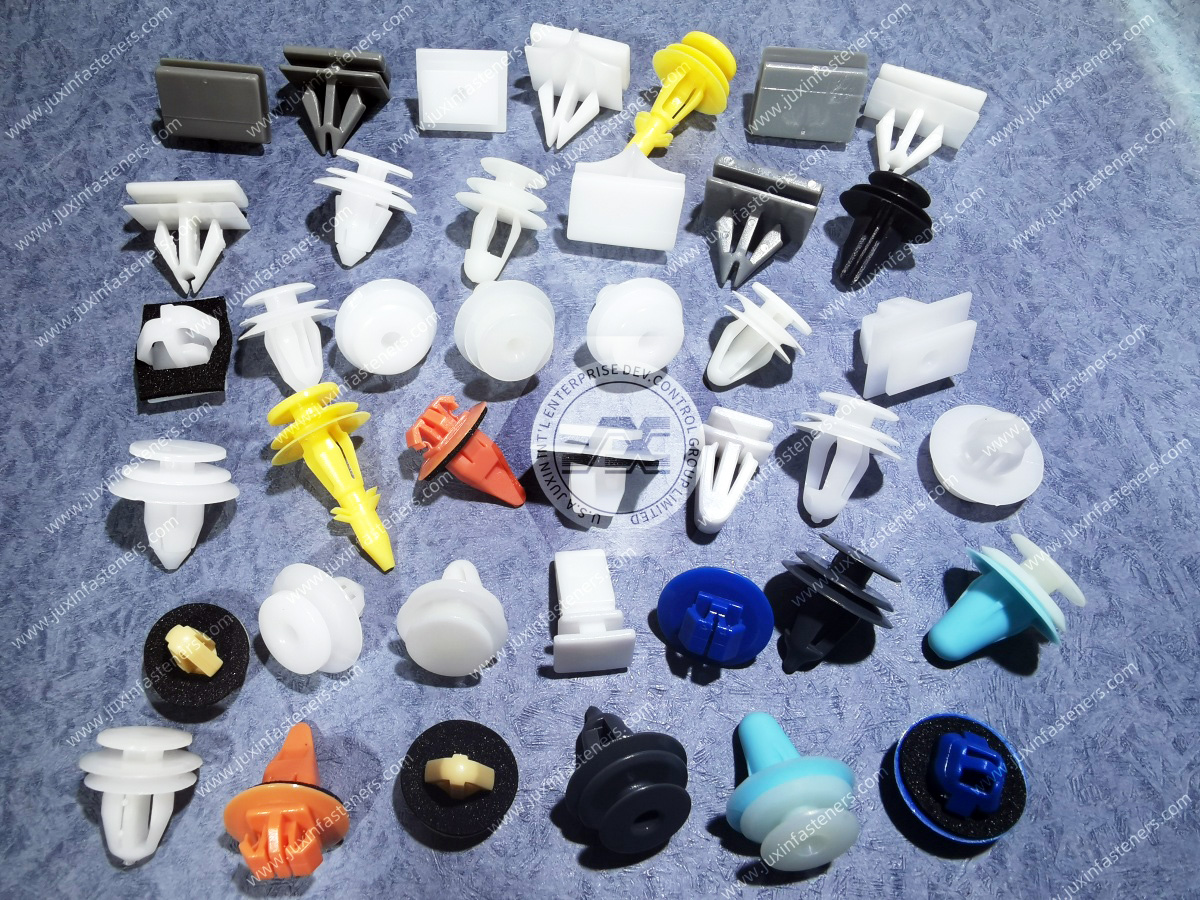
 MORE NEWS
Sep. 27, 2026
Sep. 27, 2026
Sep. 27, 2026
Contact Us
Tel.:
+86 020 8621 0320
+86 020 3121 6067
E-mail:
Technical Support:
Navigation
SEND INQUIREY