
Call Us
+86 136 6007 9809
Call Us
+86 136 6007 9809

Nov. 01, 2024
Countersunk Solid Rivets: Flush-Mount Hole Design, Sheet Thickness and OEM Assembly
Countersunk solid rivets, also known as flush-mount solid rivets or flush head rivets,
are permanent mechanical fasteners designed to create a low-profile or flush surface on the factory-head side of an assembly.
Unlike round head or domed head rivets, a countersunk rivet has a tapered head intended to fit into a corresponding countersink in the connected component.
When correctly designed and installed, the head can sit approximately level with the surrounding surface.
This geometry is useful where a protruding rivet head would interfere with adjacent components, sliding surfaces, equipment covers or appearance requirements.
However, the flush surface comes with an engineering tradeoff: the countersink removes material from the connected component.
For thin sheet metal or highly loaded joints, this reduction in local material thickness may be a critical design constraint.
The correct solution therefore depends on rivet head geometry, countersink depth, sheet thickness, material, hole quality and the riveting process.
For design engineers, the main concerns include local bearing, head seating, sheet deformation and joint strength.
For manufacturing engineers and production managers, the priorities include countersink consistency, tool alignment, closing-head formation, surface protection and repeatable flushness.
For purchasing and supplier development teams, reliable sourcing requires matching the rivet drawing to the actual hole design, material requirements and production process.
Juxin Fasteners supplies solid rivets and drawing-specific industrial fastening components for suitable OEM assemblies.
What Is a Countersunk Solid Rivet?
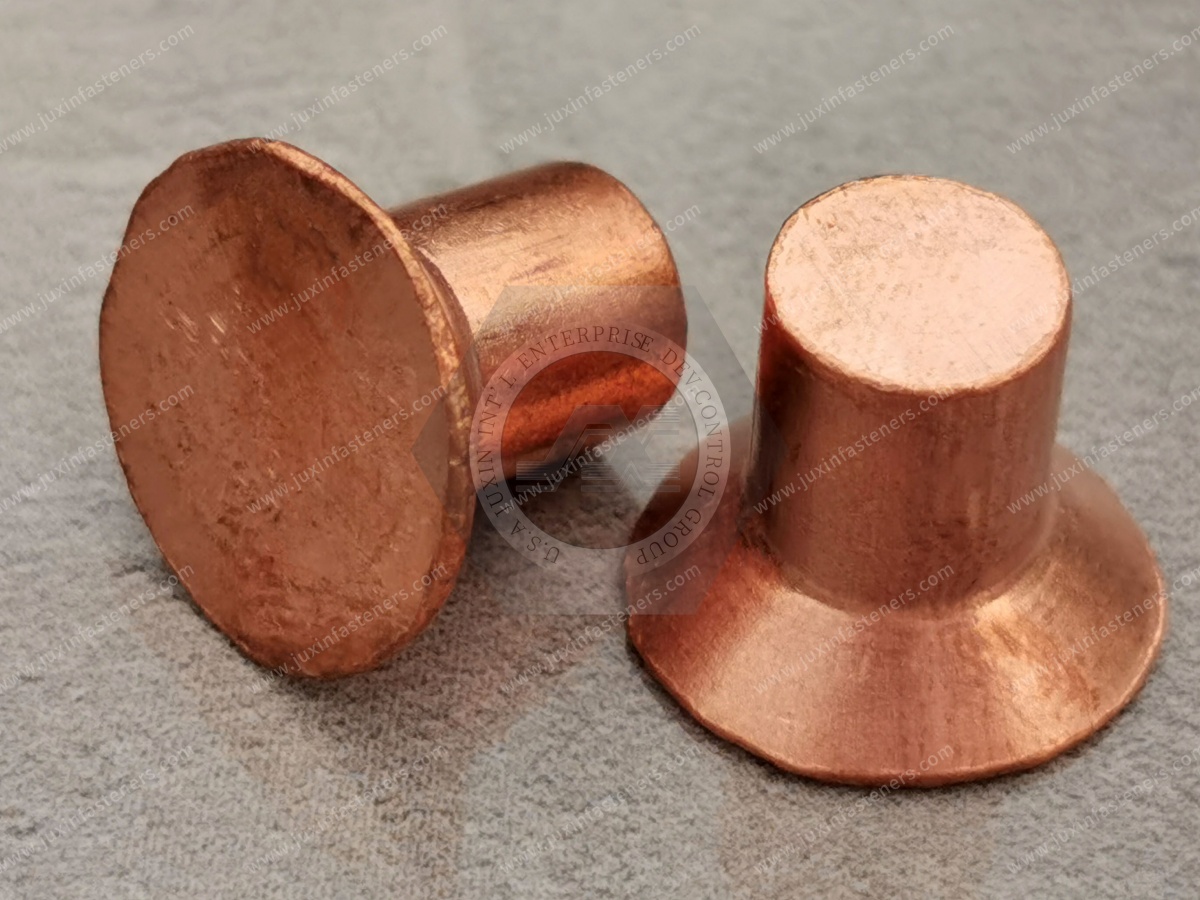
A countersunk solid rivet is a solid-shank rivet with a tapered factory head.
The head is designed to fit into a matching countersunk hole.
During installation, the free end of the shank is plastically deformed to form a closing head on the opposite side.
Main Features
Tapered factory head
Solid cylindrical shank
Permanent mechanical fastening
Flush or low-profile factory-head installation
Closing-head formation on the opposite side
Important Distinction
The factory-head side may be flush, but the formed closing head generally protrudes unless the assembly uses a separately engineered flush-closing-head arrangement.
Why Use Flush-Mount Solid Rivets?
Countersunk rivets may be selected when surface clearance is an important design requirement.
Potential Advantages
Reduced protrusion on the factory-head side
Improved clearance for adjacent components
Smooth external appearance
Suitability for selected sliding or contact surfaces
Permanent mechanical fastening
Important Limitations
A countersunk head does not automatically provide greater joint strength, better fatigue resistance or superior corrosion protection.
Those characteristics depend on the complete assembly.
Countersunk Rivets Versus Round Head Rivets
| Design factor | Countersunk solid rivet | Round head solid rivet |
|---|---|---|
| Factory-head profile | Tapered and potentially flush | Domed and protruding |
| Hole preparation | Requires a compatible countersink | Typically does not require a head countersink |
| Local sheet thickness | Reduced by countersinking | Generally retains more thickness beneath the head |
| Surface clearance | Advantageous where a flush surface is needed | Requires head clearance |
| Installation sensitivity | Countersink geometry is critical | Head support and forming remain critical |
| Joint capacity | Must be calculated and validated | Must be calculated and validated |
Engineering Recommendation
Choose countersunk rivets because the assembly needs a flush head, not because they are assumed to be universally stronger.
Countersink Angle: A Critical Dimensional Requirement
The countersink angle must match the specified rivet head geometry.
Different rivet families and standards may use different head angles.
Important Variables
Included countersink angle
Head diameter
Head height
Hole diameter
Countersink depth
Head seating condition
Engineering Recommendation
Do not apply one countersink angle to every flush head rivet.
Use the actual rivet standard or customer drawing.
Countersink Depth and Head Flushness
Countersink depth determines how the rivet head sits relative to the surrounding surface.
Insufficient Depth
The factory head may protrude above the surface.
Excessive Depth
The head may sit below the surface, and unnecessary material removal may weaken the local sheet.
Incorrect Angle
The head may contact the countersink unevenly.
Engineering Recommendation
Specify an acceptable installed head height or flushness range rather than relying on visual judgment alone.
Countersink Geometry: Why Small Errors Matter
For an ideal conical countersink, the axial depth depends on the difference between the countersink diameter and the original hole diameter.
For a simplified geometric relationship:
h = (D − d) / [2 tan(θ/2)]
Where:
h = theoretical axial depth of the conical section
D = countersink major diameter
d = original hole diameter
θ = included countersink angle
This equation describes ideal geometry.
Important Limitation
Actual rivet head seating depends on the manufactured head profile, edge radii, tolerances and installation deformation.
The equation should not replace the applicable drawing or installation specification.
Minimum Sheet Thickness for Countersunk Rivets
Sheet thickness is one of the most important constraints in flush riveting.
A countersink removes material from the sheet around the hole.
If the sheet is too thin, insufficient material may remain to support the rivet head.
Potential Failure Risks
Local sheet deformation
Head pull-through
Excessive countersink depth
Cracking around the hole
Reduced bearing capacity
Unacceptable surface distortion
Engineering Recommendation
Verify the remaining sheet thickness beneath the countersunk head.
Do not assume that a rivet is suitable merely because its nominal diameter matches the hole.
A Practical Thin-Sheet Design Decision
When the required countersink approaches the available sheet thickness, engineers should evaluate alternative designs.
Possible approaches include:
Selecting a smaller compatible rivet
Revising the head geometry
Increasing the local sheet thickness
Using a suitable dimpled-sheet arrangement where approved
Selecting another fastening method
Important Limitation
Dimpling is not a universal substitute for countersinking. It requires suitable sheet material, tooling and joint qualification.
Hole Diameter and Tolerance
Correct hole diameter supports rivet insertion and proper installed geometry.
Relevant Factors
Nominal shank diameter
Hole tolerance
Hole roundness
Alignment
Burrs
Surface condition
Manufacturing method
Oversized Holes
May contribute to:
Poor rivet alignment
Local movement
Uneven bearing
Unfavorable deformation
Undersized Holes
May cause:
Insertion difficulty
Shank damage
Hole damage
Assembly delays
Engineering Recommendation
Use the applicable hole preparation requirements for the rivet and joint.
Countersunk Hole Preparation
Countersunk holes may be produced through suitable drilling, machining or other controlled manufacturing processes.
Production Considerations
Tool geometry
Tool wear
Hole alignment
Burr control
Surface finish
Countersink depth
Countersink concentricity
Important Limitation
A visually acceptable countersink may still have an incorrect angle or depth.
Production Recommendation
Inspect representative countersinks using appropriate measurement methods.
Rivet Diameter and Joint Loading
Rivet diameter influences shank area, hole size and available bearing geometry.
For a circular solid shank:
A = πd² / 4
Where:
A = nominal shank cross-sectional area
d = nominal shank diameter
Important Limitation
Nominal shank area alone does not determine allowable joint load.
The connected sheet and countersunk head region may govern the design.
Rivet Length and Grip Thickness
Rivet length must accommodate the complete material stack and provide sufficient material for closing-head formation.
Relevant Variables
Total grip thickness
Rivet diameter
Material
Closing-head geometry
Forming method
Installation equipment
Engineering Recommendation
Use the specified rivet length and closing-head requirements.
Do not rely on a universal extra-length allowance for every material and diameter.
Joint Strength: The Countersunk Head Tradeoff
A flush head provides geometric advantages but changes how load is transferred through the connected material.
Potential Joint Failure Modes
Rivet shank shear
Sheet bearing deformation
Net-section failure
Edge tear-out
Countersunk head pull-through
Closing-head failure
Fatigue cracking
Engineering Recommendation
Check the complete load path, including the reduced sheet thickness around the countersink.
Head Pull-Through
Head pull-through occurs when the rivet head forces its way through the connected material.
Risk may increase when:
Sheet thickness is insufficient
Countersink depth is excessive
Head geometry is unsuitable
Sheet material is relatively soft
Applied loading exceeds the joint's capacity
Engineering Recommendation
Evaluate head support and connected-material strength for the actual joint.
Edge Distance and Rivet Pitch
The distance from the rivet hole to the sheet edge and the spacing between rivets influence joint behavior.
Relevant Factors
Rivet diameter
Sheet thickness
Sheet material
Load direction
Number of rivets
Countersink geometry
Important Limitation
One universal edge-distance or pitch rule should not be applied to all countersunk riveted assemblies.
Engineering Recommendation
Determine these dimensions using the applicable product or structural design requirements.
Countersunk Rivets Under Fatigue Loading
Cyclic loading may initiate cracks at stress concentrations in the rivet or connected sheet.
Relevant Factors
Hole quality
Countersink geometry
Sheet thickness
Joint slip
Material condition
Installation quality
Load spectrum
Important Limitation
A flush surface does not guarantee improved fatigue performance.
Engineering Recommendation
For cyclically loaded assemblies, evaluate the complete joint under representative conditions.
Material Selection for Flush-Mount Solid Rivets
Material selection must account for both service performance and the ability to form the closing head.
Brass Countersunk Solid Rivets
Brass rivets may be suitable for selected electrical, decorative and mechanical applications.
Potential Considerations
Formability
Appearance
Electrical conductivity
Corrosion behavior
Compatibility with the connected materials
Important Limitation
Brass rivets should not automatically be selected for high-strength structural joints.
Aluminum Countersunk Solid Rivets
Aluminum rivets may be considered where low weight and compatible joining materials are important.
Engineering Considerations
Alloy and temper
Formability
Mechanical requirements
Galvanic compatibility
Surface protection
Important Limitation
Different aluminum alloys and tempers have different installation and mechanical characteristics.
Stainless Steel Countersunk Solid Rivets
Stainless steel rivets may be selected for suitable corrosion-resistant applications.
Potential material groups include 304-type and 316-type stainless steels where specified.
Engineering Considerations
Forming force
Work hardening
Corrosion exposure
Galvanic compatibility
Tooling capacity
Important Limitation
Stainless steel is not universally corrosion-proof, and its forming requirements may differ from those of brass or aluminum.
Carbon Steel Countersunk Solid Rivets
Carbon steel may be considered for suitable industrial assemblies.
Engineering Considerations
Material condition
Formability
Mechanical requirements
Corrosion protection
Installation process
Copper Countersunk Solid Rivets
Copper rivets may be considered for selected electrical and industrial applications.
Engineering Considerations
Conductivity
Formability
Mechanical strength
Material compatibility
Surface condition
Material Comparison for OEM Selection
| Material | Potential selection reason | Main engineering consideration |
|---|---|---|
| Brass | Appearance, conductivity, formability | Strength and material compatibility |
| Aluminum | Low weight and compatible assemblies | Alloy, temper and galvanic corrosion |
| Stainless steel | Corrosion resistance in suitable environments | Forming force and localized corrosion |
| Carbon steel | General industrial mechanical applications | Corrosion protection and formability |
| Copper | Conductivity and selected mechanical applications | Mechanical strength and deformation |
Engineering Recommendation
Specify the exact material grade and condition rather than using only a broad material family.
Surface Finishes for Countersunk Rivets
Surface treatment may be required for appearance, corrosion resistance or other functional needs.
Potential finishes include:
Zinc-based coatings
Nickel plating
Black oxide
Other drawing-specific finishes
Important Limitation
Not every coating is suitable for every rivet material or forming process.
Coating Damage During Riveting
Closing-head formation involves plastic deformation.
Certain coatings may crack, flake or become discontinuous during installation.
Engineering Recommendation
Evaluate the coating on the installed rivet, not only the uninstalled product.
Galvanic Corrosion in Mixed-Metal Assemblies
Countersunk rivets may join different metals.
When dissimilar metals are electrically connected in the presence of an electrolyte, galvanic corrosion may occur.
Engineering Considerations
Rivet material
Sheet material
Exposure conditions
Coating
Electrical isolation
Joint sealing
Engineering Recommendation
For aluminum panels joined with stainless steel, brass or copper rivets, evaluate galvanic compatibility.
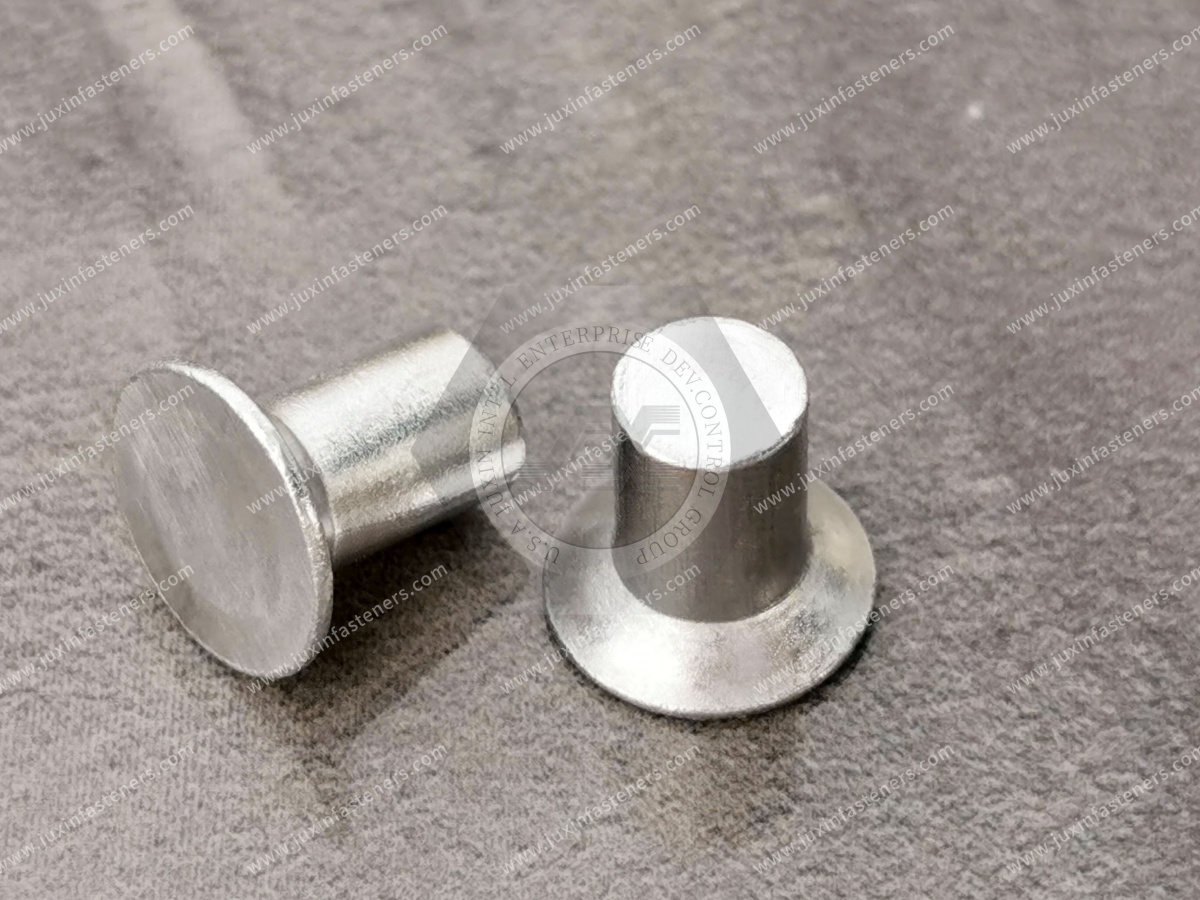
Countersunk Solid Rivet Installation
Installation requires suitable access to the factory head and the free end of the rivet.
Typical Installation Sequence
Verify the rivet drawing and material.
Prepare the hole and countersink.
Check the countersink geometry.
Insert the rivet.
Support the factory head with suitable tooling.
Form the closing head.
Inspect flushness and installed geometry.
Important Limitation
The exact installation procedure depends on the rivet specification, material and equipment.
Factory-Head Support
The factory head must be supported appropriately during closing-head formation.
Potential Problems
Head deformation
Surface damage
Rivet misalignment
Poor seating
Uneven closing-head formation
Production Recommendation
Use tooling matched to the head geometry and surrounding surface.
Closing-Head Formation
The free end of the rivet is formed into a closing head.
Relevant Characteristics
Head diameter
Head height
Symmetry
Cracks
Surface condition
Joint seating
Engineering Recommendation
Define installed closing-head acceptance criteria in the process specification.
Flushness Inspection
Flushness should be evaluated according to the drawing or installation requirements.
Possible Conditions
Protruding head
Approximately flush head
Recessed head
Tilted or unevenly seated head
Important Limitation
A recessed head is not automatically acceptable simply because it does not protrude.
Production Recommendation
Specify the acceptable flushness range and inspection method.
Riveting Equipment and Assembly Efficiency
Depending on the product, installation may use:
Riveting presses
Pneumatic riveting tools
Hydraulic riveting equipment
Specialized forming fixtures
Production Considerations
Forming force
Tool alignment
Cycle time
Workpiece support
Countersink consistency
Surface protection
Tool wear
Inspection
Production Recommendation
Validate the selected rivet using representative production tooling and actual component materials.
When Countersunk Solid Rivets Are Not the Best Choice
Flush riveting may not be suitable when:
The sheet is too thin for the required countersink
Two-sided installation access is unavailable
The joint requires frequent disassembly
The available forming force is insufficient
Surface damage cannot be tolerated
The joint requires a different approved fastening system
Engineering Recommendation
Evaluate the assembly requirements before selecting a flush head solely for appearance.
Industrial Enclosures and Equipment Panels
Countersunk solid rivets may be suitable for:
Electrical cabinets
Equipment covers
Industrial enclosures
Sheet metal panels
Mechanical housings
Engineering Considerations
Panel thickness
Flushness
Tooling access
Corrosion exposure
Assembly cost
Automotive Manufacturing Applications
Potential applications include suitable:
Interior equipment components
Auxiliary brackets
Noncritical sheet metal assemblies
Production fixtures
Equipment housings
Engineering Considerations
Joint loading
Material compatibility
Sheet thickness
Installation repeatability
Production cycle time
Important Limitation
Automotive chassis, battery structural systems and other safety-critical applications require dedicated engineering approval.
Railway and Rail Transit Equipment
Countersunk rivets may be considered for selected equipment components requiring low-profile surfaces.
Potential Applications
Equipment panels
Interior assemblies
Auxiliary brackets
Approved mechanical components
Important Limitation
Safety-critical railway applications require project-specific qualification.
Marine Equipment Applications
Potential applications include:
Interior panels
Marine equipment housings
Selected fittings
Noncritical brackets
Engineering Considerations
Corrosion
Material compatibility
Joint sealing
Maintenance access
Important Limitation
A countersunk rivet does not automatically provide a watertight connection.
Aerospace-Related Applications
Flush rivets are used in aerospace engineering where surface profile may be important.
However, aircraft structural rivets require specialized material, dimensional, installation and qualification requirements.
Important Distinction
A general industrial countersunk rivet should not be described as a qualified aerospace or military-specification rivet without verified approval.
Suitable industrial inquiries may include ground-support equipment and non-flight-critical fixtures.
Architectural and Decorative Metal Assemblies
Countersunk rivets may be considered for:
Decorative panels
Metal trim
Equipment facades
Selected architectural fittings
Engineering Considerations
Appearance
Surface finish
Corrosion exposure
Panel thickness
Installation access
Important Limitation
Structural facade applications require the applicable engineering and regulatory approvals.

Quality Inspection of Countersunk Solid Rivets
Inspection should follow the applicable product standard and customer drawing.
Dimensional Inspection
Potential checks include:
Shank diameter
Rivet length
Head diameter
Head height
Countersink angle
Head profile
Surface condition
Material Verification
Depending on the specification:
Material identification
Material documentation
Mechanical property verification
Hardness testing where applicable
Surface Finish Inspection
Potential checks include:
Coating type
Coating thickness
Appearance
Surface defects
Installed Joint Inspection
Potential checks include:
Head flushness
Head seating
Closing-head geometry
Visible cracking
Joint alignment
Surface deformation
Important Limitation
Inspection methods and acceptance criteria must be defined for the actual application.
OEM Custom Countersunk Solid Rivets
Juxin Fasteners welcomes drawing-specific inquiries for:
Custom diameter
Custom length
Special head geometry
Material selection
Dimensional tolerances
Surface finish
Inspection requirements
Packaging
Manufacturing feasibility depends on the actual design, material and expected production volume.
Supplier Qualification for Flush-Mount Rivets
Purchasing managers and supplier development teams should evaluate:
Applicable product standard
Drawing conformity
Head angle and geometry
Shank diameter
Length
Material grade and condition
Forming compatibility
Surface finish
Dimensional consistency
Sample approval
Inspection documentation
MOQ
Lead time
Annual demand
Packaging
Change control
Alternative Supplier Validation
A replacement countersunk rivet should be checked for more than nominal diameter and length.
Small differences in head angle, head diameter or head height may affect seating and flushness.
Engineering Recommendation
Validate alternative rivets using the actual countersunk holes and installation equipment.
Total Installed Cost
The lowest rivet unit price does not always produce the lowest assembly cost.
Relevant factors include:
Countersink machining time
Tool wear
Installation cycle time
Surface damage
Rework
Inspection
Scrap
Supplier consistency
Procurement Recommendation
Compare suppliers using the complete assembly process and quality requirements.
Common Countersunk Rivet Problems and Corrective Actions
| Problem | Possible cause | Recommended investigation |
|---|---|---|
| Head protrusion | Insufficient countersink depth or incorrect geometry | Verify head and countersink dimensions |
| Head recessed too deeply | Excessive countersink depth | Review hole preparation and sheet thickness |
| Sheet deformation | Inadequate support or excessive forming force | Review tooling and forming process |
| Head pull-through | Insufficient sheet support or excessive load | Reassess joint design |
| Cracked closing head | Material or forming incompatibility | Review material condition and installation |
| Uneven head seating | Misalignment or geometry mismatch | Inspect hole and countersink concentricity |
| Corrosion near rivet | Material incompatibility or coating damage | Review exposure and corrosion protection |
Engineering Recommendation
Investigate the root cause before changing rivet size or increasing installation force.
Frequently Asked Questions
What is a countersunk solid rivet?
A solid-shank rivet with a tapered factory head designed to fit into a matching countersunk hole.
Are flush-mount solid rivets stronger than round head rivets?
Not necessarily. Joint strength depends on rivet material, geometry, connected sheet and installation quality.
Does a countersunk rivet sit flush on both sides?
Not automatically. The factory-head side may be flush, while the formed closing head generally protrudes unless a special design is used.
What countersink angle should be used?
The angle must match the specified rivet head geometry and applicable standard or drawing.
Can countersunk solid rivets be used in thin sheet metal?
Potentially, but the remaining sheet thickness and local head support must be evaluated.
Are brass countersunk rivets suitable for electrical equipment?
They may be suitable for selected applications, depending on conductivity, mechanical requirements and material compatibility.
Can stainless steel countersunk rivets be used with aluminum panels?
Potentially, but galvanic corrosion and joint design must be evaluated.
Are countersunk rivets suitable for aerospace structures?
Only when the exact rivet, material, process and supplier meet the applicable aerospace qualification requirements.
Can countersunk solid rivets be installed from one side?
Conventional solid riveting generally requires access to both sides of the joint.
Can Juxin Fasteners supply custom countersunk solid rivets?
Juxin Fasteners welcomes drawing-specific inquiries. Material, dimensions, manufacturing feasibility, inspection requirements and commercial terms require confirmation.
Juxin Fasteners: Countersunk Solid Rivets and OEM Supply
Juxin Fasteners supplies industrial solid rivets and drawing-specific fastening components.
Relevant product categories include:
Brass countersunk solid rivets
Aluminum countersunk solid rivets
Stainless steel countersunk solid rivets
Steel countersunk solid rivets
Copper countersunk solid rivets
Custom flush head solid rivets
Drawing-specific industrial rivets
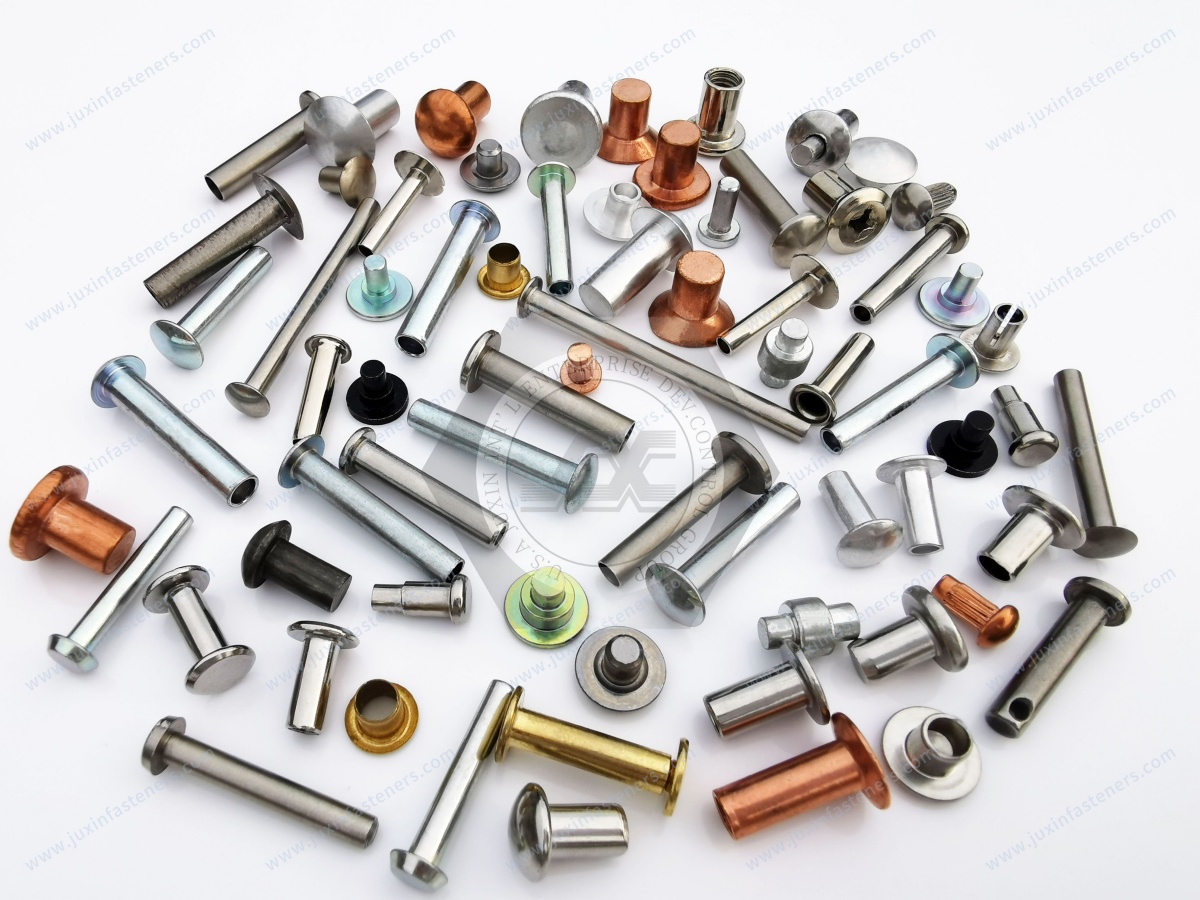
Other head styles and material options may be reviewed according to customer requirements.
Exact materials, dimensions, inspection scope, MOQ and lead times are subject to technical and commercial confirmation.
Request a Quote for Countersunk Solid Rivets
Are you sourcing flush-mount solid rivets, brass countersunk rivets, stainless steel countersunk rivets or drawing-specific permanent fastening components for an OEM project?
Juxin Fasteners welcomes inquiries from design engineers, mechanical engineers, manufacturing engineers, production managers, purchasing specialists and supplier development teams.
For technical review and quotation, please provide:
Rivet drawing and revision + applicable product standard + nominal shank diameter + length + head diameter and height
+ countersink angle + material grade and condition + surface finish + connected sheet material and thickness + grip thickness
+ hole diameter and tolerance + countersink depth + required head flushness + installation method + closing-head requirements
+ inspection documentation + prototype quantity + annual demand + packaging + target delivery schedule.
Company: Juxin Fasteners
Website: https://www.juxinfasteners.com/
Email: info@juxinfasteners.com
Send your countersunk solid rivet drawings and OEM RFQ to Juxin Fasteners for technical confirmation, product selection and quotation.
Contact Us
Tel.:
+86 020 8621 0320
+86 020 3121 6067
E-mail:
Technical Support:
Navigation
SEND INQUIREY



