
Call Us
+86 136 6007 9809
Call Us
+86 136 6007 9809

Sep. 24, 2026
In high-density electronic packaging, server chassis, telecommunications equipment, aerospace electronics, medical equipment, semiconductor systems,
and precision instrumentation, a threaded attachment point can create a packaging problem long before it creates a strength problem.
A conventional nut or standard self-clinching nut may provide the required internal thread, yet its projecting geometry can interfere with a slide rail, adjacent enclosure,
PCB assembly, cable path, cover, guide mechanism, or other component located close to the sheet surface.
This is where flush self-clinching nuts become an important engineering option.
Flush self-clinching nuts are engineered threaded fasteners designed to create a permanent female thread in sheet metal
while minimizing or eliminating unwanted fastener projection at the specified surface or surfaces, depending on the particular fastener design and installation configuration.
They may also be described in sourcing and engineering searches as flush clinch nuts, flush press nuts, zero-protrusion clinch nuts, flush threaded inserts for sheet metal, or double-flush self-clinching fasteners.
However, selecting a flush clinch nut is not simply a matter of choosing a thread size.
Reliable performance depends on the relationship between the fastener geometry and the host sheet, including:
sheet material
sheet hardness
sheet thickness
mounting-hole diameter and condition
fastener material and hardness
clinching and anti-rotation geometry
installation tooling
press alignment and installation force
thread requirements
corrosion environment
required push-out and torque-out performance
available clearance on each side of the sheet
For OEM engineering and procurement teams, these variables should be evaluated as an assembly system rather than treating the clinch nut as an isolated catalog component.
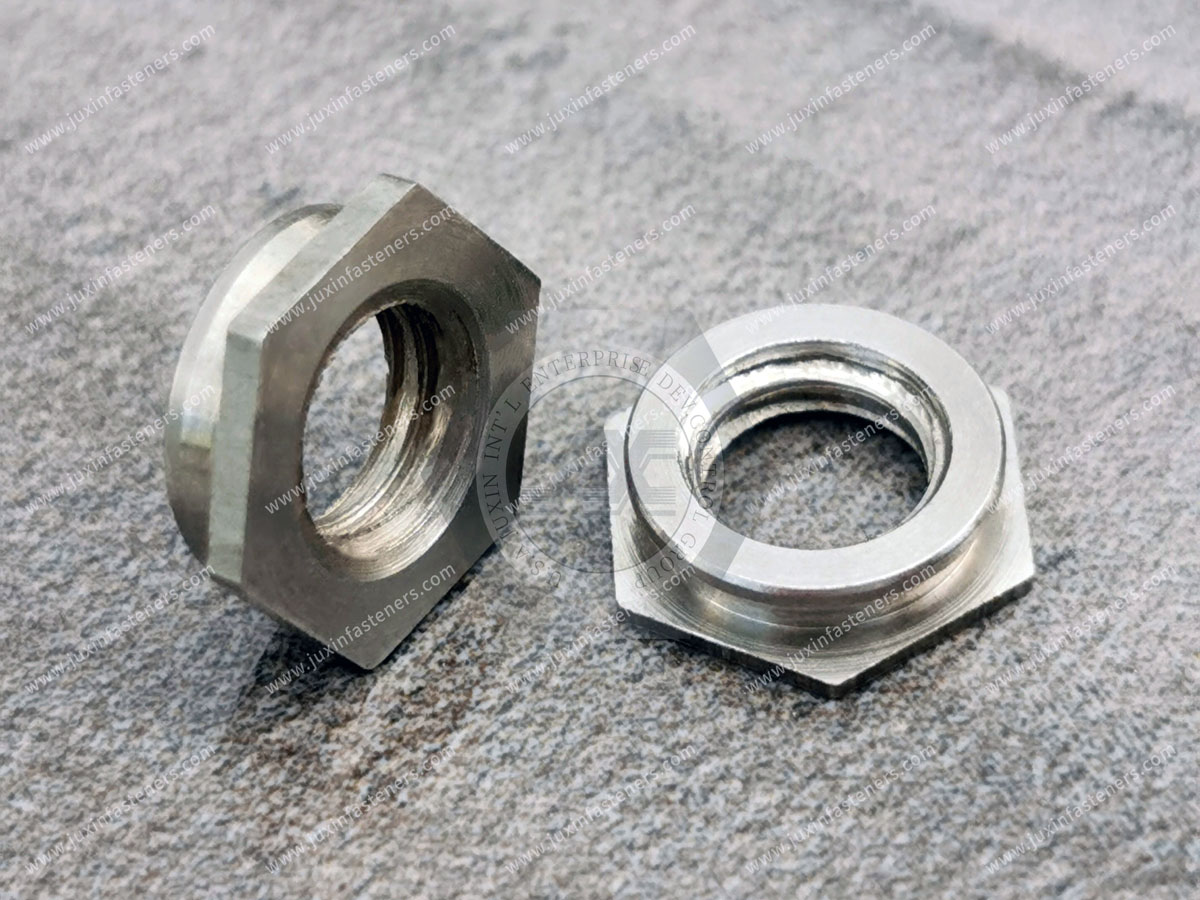
A flush self-clinching nut is a mechanically installed threaded fastener intended to become permanently retained in a prepared
sheet-metal mounting hole through controlled pressing rather than welding, loose-nut assembly, or adhesive bonding.
Unlike conventional nut-and-bolt assemblies, access to a loose nut during final assembly is not required after the clinch fastener has been installed.
Unlike many conventional self-clinching nut configurations that intentionally retain a flange or other feature above one surface,
a flush configuration is selected when surface projection must be reduced or eliminated in accordance with the specific fastener design.
This distinction is important in compact equipment.
The design question is not simply:
“Do we need a threaded hole?”
A better engineering question is:
“Where can the fastener occupy space after installation without interfering with the surrounding assembly?”
If the available answer is effectively “inside the sheet envelope,” a flush self-clinching solution may deserve evaluation.
Self-clinching fasteners rely on controlled deformation of the host sheet around engineered retention features.
During installation, a press applies controlled squeezing force between appropriate tooling surfaces. The fastener geometry displaces sheet material,
and sufficiently ductile host material flows into or around the fastener's retention features.
After installation, this mechanically interlocked material contributes to axial retention.
Anti-rotation resistance may be provided by non-round, serrated, lobed, knurled, or other engineered geometry depending on the particular flush nut design.
Some flush clinch nut designs use a polygonal or hexagonal body or shank geometry. Under controlled installation,
the interaction between this geometry and the prepared hole helps resist fastener rotation when a mating screw is tightened or removed.
The resulting joint therefore depends on several interacting mechanisms:
mechanical interlock between fastener and displaced sheet material
anti-rotation geometry
sufficient sheet volume around the installation hole
compatibility between fastener hardness and sheet properties
correct installation depth
suitable tooling and alignment
This explains why the same nominal thread size can perform differently when installed in different sheet materials or thicknesses.
One of the most important specification mistakes is treating “flush” as a universal dimensional property.
It is not.
Whether a fastener achieves the required installed surface condition depends on the actual fastener geometry,
host sheet thickness, mounting-hole preparation, installation tooling, and press setup.
A flush nut intended for one sheet-thickness range should not automatically be assumed suitable for another.
Likewise, a part that is flush on a laboratory sample is not automatically qualified for a production panel manufactured from a different alloy,
hardness condition, coating system, or thickness tolerance.
For this reason, engineering teams should define the required installed condition on the drawing.
Examples include:
flush required on the rail-facing surface
flush required on the enclosure exterior
projection limited to a specified maximum
opposite-side projection permitted
no interference permitted within a defined clearance envelope
installed fastener must remain below an adjacent sliding path
This converts the vague requirement of “flush” into a measurable assembly requirement.
Both standard and flush self-clinching nuts can create permanent reusable female threads in sheet metal, but they solve different packaging problems.
| Design Consideration | Standard Self-Clinching Nut | Flush Self-Clinching Nut |
|---|---|---|
| Primary objective | Permanent threaded attachment in sheet metal | Permanent thread with restricted surface projection |
| Installed profile | May include a projecting head or flange depending on design | Designed for a specified flush or reduced-projection condition |
| Clearance demand | Suitable when local protrusion is acceptable | Useful where rails, covers, adjacent panels, or components require additional clearance |
| Retention method | Clinching features mechanically engage displaced sheet material | Engineered clinching geometry mechanically engages displaced sheet material |
| Anti-rotation method | Depends on fastener design | Depends on fastener design and may include polygonal or other anti-rotation geometry |
| Sheet requirements | Product-specific | Product-specific and particularly important to installed flushness |
| Installation | Controlled pressing | Controlled pressing with close attention to installed surface condition |
| Typical design driver | Thread strength and assembly efficiency | Thread retention plus packaging and surface-clearance control |
The flush version should therefore not automatically be considered an “upgrade” from a conventional clinch nut.
It is a different packaging solution.
If surface projection causes no interference, a conventional self-clinching nut may be entirely appropriate.
If every fraction of available clearance matters, a flush configuration can solve a problem that a conventional protruding fastener cannot.
Sheet thickness is one of the first variables that should be reviewed when specifying flush self-clinching hardware.
The host panel must provide enough material and geometric compatibility for the selected fastener to achieve its intended installed condition and retention mechanism.
The required relationship is product-specific.
Rather than applying a universal thickness formula across all flush clinch nut designs, engineers should compare:
specified fastener dimensions
manufacturer's recommended sheet-thickness range
actual production sheet tolerance
installation-side and opposite-side surface requirements
required retention performance
This becomes especially important when several sheet gauges are used within the same enclosure family.
A single thread size does not necessarily mean that a single fastener configuration is appropriate for every panel thickness.
For OEM platforms using multiple sheet thicknesses, purchasing teams should therefore avoid consolidating part numbers until engineering has verified installation compatibility.
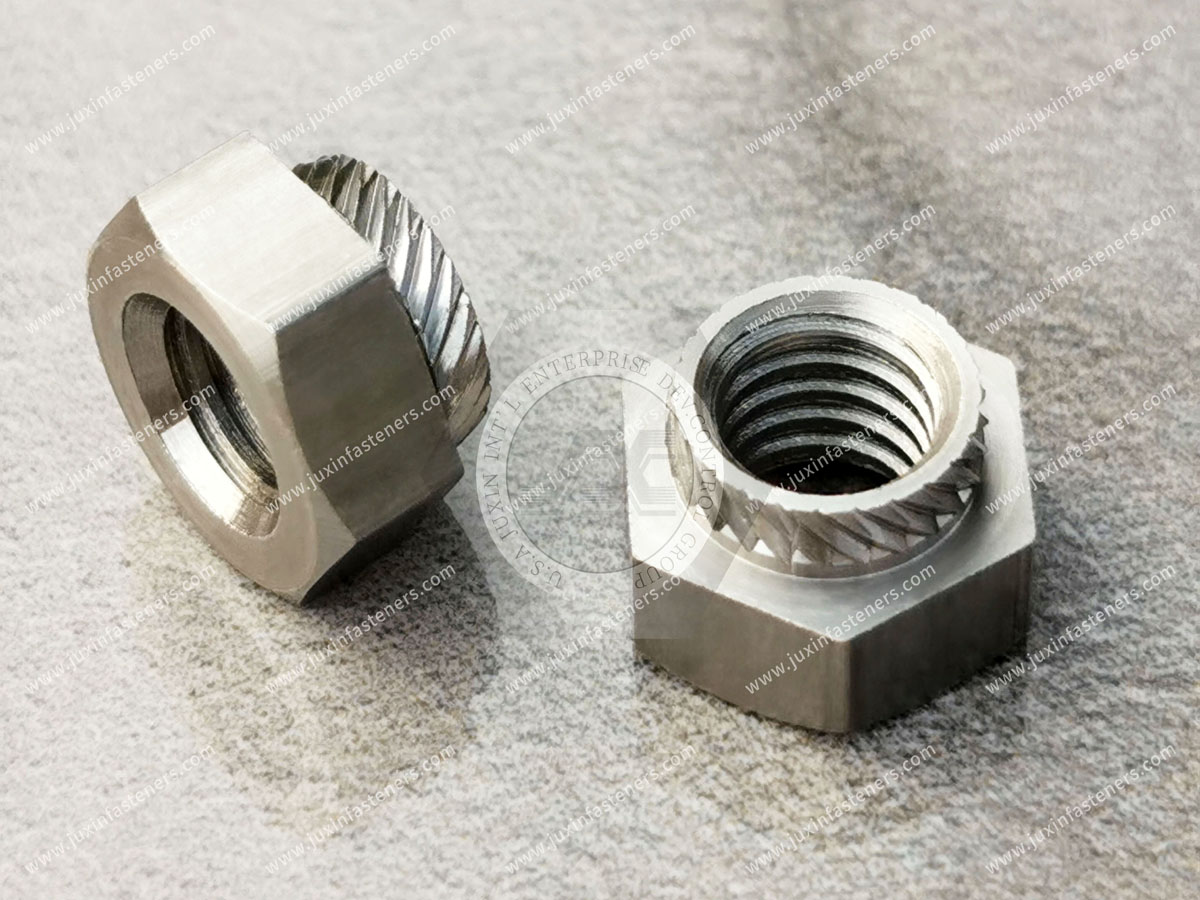
Self-clinching relies on controlled deformation of the host material.
The sheet must therefore be compatible with the selected fastener and its clinching mechanism.
Common host materials may include:
carbon steel sheet
stainless steel sheet
aluminum alloys
other ductile sheet materials suitable for the particular fastener design
Material name alone is insufficient.
Hardness, temper, work hardening, coating condition, thickness, and manufacturing process can influence installation behavior.
For example, two stainless steel panels of nominally similar chemistry may behave differently if their hardness conditions differ significantly.
The correct approach is to evaluate the actual production material against the fastener supplier's application limits and, where necessary, perform installation trials using representative production sheet.
The mounting hole is not merely an empty space into which the nut is inserted.
Its diameter, shape, edge condition, position, and relationship to nearby bends or panel edges affect installation quality and retention.
An oversized hole may reduce material engagement.
An undersized hole may interfere with insertion or cause uncontrolled deformation.
Unapproved chamfers, countersinks, or excessive edge removal can change the amount of material available for clinching.
Heavy burrs can prevent correct seating.
Hole preparation should therefore follow the dimensional requirements for the selected fastener rather than a generic shop-floor hole size.
Engineering drawings and manufacturing instructions should control relevant variables such as:
hole diameter and tolerance
permissible burr condition
hole-to-edge distance
hole-to-bend distance
panel flatness around the installation zone
coating or finish condition where relevant
When qualifying a functional equivalent from a second source, mounting-hole compatibility deserves particular attention. A fastener with the same thread may require a different installation hole or retention geometry.
Flush self-clinching nuts are normally installed through controlled squeezing rather than impact.
The objective is to deform the host sheet in a predictable manner while preserving thread geometry, panel flatness, and the required installed surface condition.
Installation variables may include:
press force
punch and anvil geometry
tooling hardness
tooling parallelism
fastener orientation
panel support
installation depth
press stroke control
sheet hardness and thickness
Applying more force is not automatically better.
Insufficient force may leave the fastener incompletely seated or reduce material engagement.
Excessive force can distort the sheet, damage the fastener, affect the thread, or alter the intended surface condition.
For high-volume OEM production, the installation process should therefore be treated as a controlled manufacturing operation.
Sample installation trials can be used to establish appropriate settings before production release.
Two mechanical characteristics are frequently discussed when qualifying self-clinching nuts: push-out resistance and torque-out resistance.
They describe different failure modes.
Push-out resistance concerns the fastener's resistance to axial displacement from the sheet.
Torque-out resistance concerns the fastener's resistance to rotation within the sheet when rotational load is applied.
A fastener can perform well in one mode without necessarily providing equivalent performance in the other.
Actual results depend on the complete installed system, including:
fastener geometry
fastener material
sheet material
sheet hardness
sheet thickness
hole dimensions
edge distance
installation conditions
For critical OEM programs, values should not simply be copied from a nominally similar application.
Testing should use representative fasteners installed into representative production sheet under controlled production-like conditions.
Traditional fastener selection often starts with thread size.
For dense mechanical packaging, that sequence can be incomplete.
Consider a server chassis side wall.
A conventional threaded fastener may satisfy thread-load requirements but project into the narrow gap occupied by a telescoping rail.
Changing from M4 to M3 does not necessarily solve the problem if both designs still project into the forbidden clearance zone.
The engineering constraint is therefore not simply fastener diameter.
It is the three-dimensional clearance envelope after installation.
A useful design workflow is:
Define the no-interference envelope.
Determine which sheet surface must remain flush or nearly flush.
Establish the required thread and service load.
Review available sheet thickness and material.
Select a compatible flush fastening architecture.
Validate installation and mechanical performance in the actual panel.
This approach helps prevent late-stage chassis redesign caused by treating fastening as a secondary detail.
AI computing infrastructure is increasing packaging density inside server, storage, networking, and power equipment.
GPU server platforms, accelerator trays, network switches, storage systems, and rack-level equipment may place slide rails,
PCBs, cooling components, cable management, power distribution, and service-access mechanisms within tightly controlled mechanical envelopes.
Potential applications for flush self-clinching nuts include:
1U and 2U server chassis
GPU compute chassis
rack-mount network equipment
storage enclosures
chassis side walls
telescoping rail attachment areas
hot-swappable module guide structures
internal partitions
card cages
power and control enclosures
A common engineering problem occurs where a threaded attachment is required in a chassis side wall but the external surface operates immediately beside a slide rail.
A projecting nut head can consume rail clearance or create mechanical interference.
A correctly specified flush clinch nut can move the threaded attachment into the sheet-metal architecture rather than adding unnecessary projection into the rail clearance envelope.
For server OEMs and chassis fabricators, qualification should still consider vibration, repeated servicing, rail loading, panel material, installation repeatability, and actual assembly tolerances.
Telecommunications equipment frequently combines high port density with limited enclosure volume.
Optical networking systems, switching equipment, telecom power systems, radio equipment,
and modular communication enclosures can require reusable threads in thin sheet structures without sacrificing internal or external clearance.
Flush threaded fastening may be useful around:
optical switch enclosures
network chassis
communication equipment drawers
side panels
internal card cages
guide structures
modular equipment trays
Where modules slide into closely controlled guides, even a small projecting fastener can become an interference point.
The correct fastener architecture can therefore contribute directly to serviceability and modular equipment replacement.

Aerospace electronics often operate within tightly constrained packaging envelopes.
Potential applications include:
avionics enclosures
telemetry equipment
flight-control electronics
instrumentation housings
communication modules
display electronics
navigation electronics
test and measurement assemblies
In these applications, a flush self-clinching nut may be considered when conventional fastening geometry conflicts with an adjacent assembly or defined enclosure envelope.
However, aerospace applications can involve program-specific material, traceability, documentation, environmental, vibration, fatigue, and qualification requirements.
The existence of a flush geometry alone does not establish suitability for an aerospace program.
Fastener material, finish, thread specification, installation method, mechanical performance, documentation, and customer-specific requirements should be reviewed for the actual application.
Medical and laboratory equipment often combines sheet-metal structures with sliding mechanisms, covers, electronic modules, optical assemblies, and serviceable internal components.
Potential applications include:
diagnostic equipment enclosures
laboratory automation systems
medical carts
equipment drawers
analyzer housings
optical instrument structures
display and control assemblies
Flush hardware can reduce unwanted mechanical projection and simplify the packaging of adjacent structures.
Where cleanability matters, a smoother external architecture may also support enclosure design objectives,
but fastener flushness alone should not be interpreted as establishing hygiene, sterilization, or medical compliance.
Those requirements depend on the complete equipment design, materials, surface treatment, cleaning procedure, and applicable regulatory specifications.
Semiconductor manufacturing equipment, optical systems, metrology platforms, and precision instruments often require dense packaging combined with accurate mechanical alignment.
Potential installation areas include:
control cabinets
precision sheet-metal covers
electronic modules
optical instrument housings
equipment drawers
sliding service modules
instrumentation chassis
Here, the value of a flush clinch nut may be less about appearance and more about protecting the designed movement or alignment path.
A projecting fastener located near a guide, carriage, cover, or removable module can create an interference condition that only becomes visible during final integration.
Evaluating fastener projection during the CAD packaging stage helps avoid this problem.
Automotive electronic assemblies increasingly combine thin sheet structures with compact modules, displays, power electronics, sensors, communication systems, and serviceable components.
Flush self-clinching hardware may be evaluated for applications where packaging clearance and reusable threads are required, including:
electronic control enclosures
infotainment hardware
communication modules
instrument assemblies
power-electronics enclosures
selected battery or energy-system sheet-metal structures
Suitability depends on the actual automotive program requirements, including material compatibility,
corrosion exposure, vibration, thermal cycling, mechanical loads, production process, and customer-specific validation.
No clinch fastener should be assumed suitable for a safety-critical or high-load automotive application solely because its nominal dimensions match an existing part.
Good engineering sourcing includes knowing when not to use a product.
A flush self-clinching nut may not be the preferred solution when:
the sheet cannot provide the required installation conditions
the host material is outside the fastener's recommended hardness or ductility range
available sheet thickness is incompatible with the required fastener geometry
installation access for press tooling is unavailable
the assembly requires blind-side installation after enclosure formation
the joint requires movement or intentional float
welding is already integrated into the manufacturing process and better suits the structural requirement
the required load exceeds what the selected sheet-fastener combination can reliably support
Alternative technologies may include standard self-clinching nuts, floating clinch nuts, blind rivet nuts, weld nuts, threaded inserts, cage nuts, or redesigned sheet-metal features.
The best solution depends on the assembly rather than the product name.
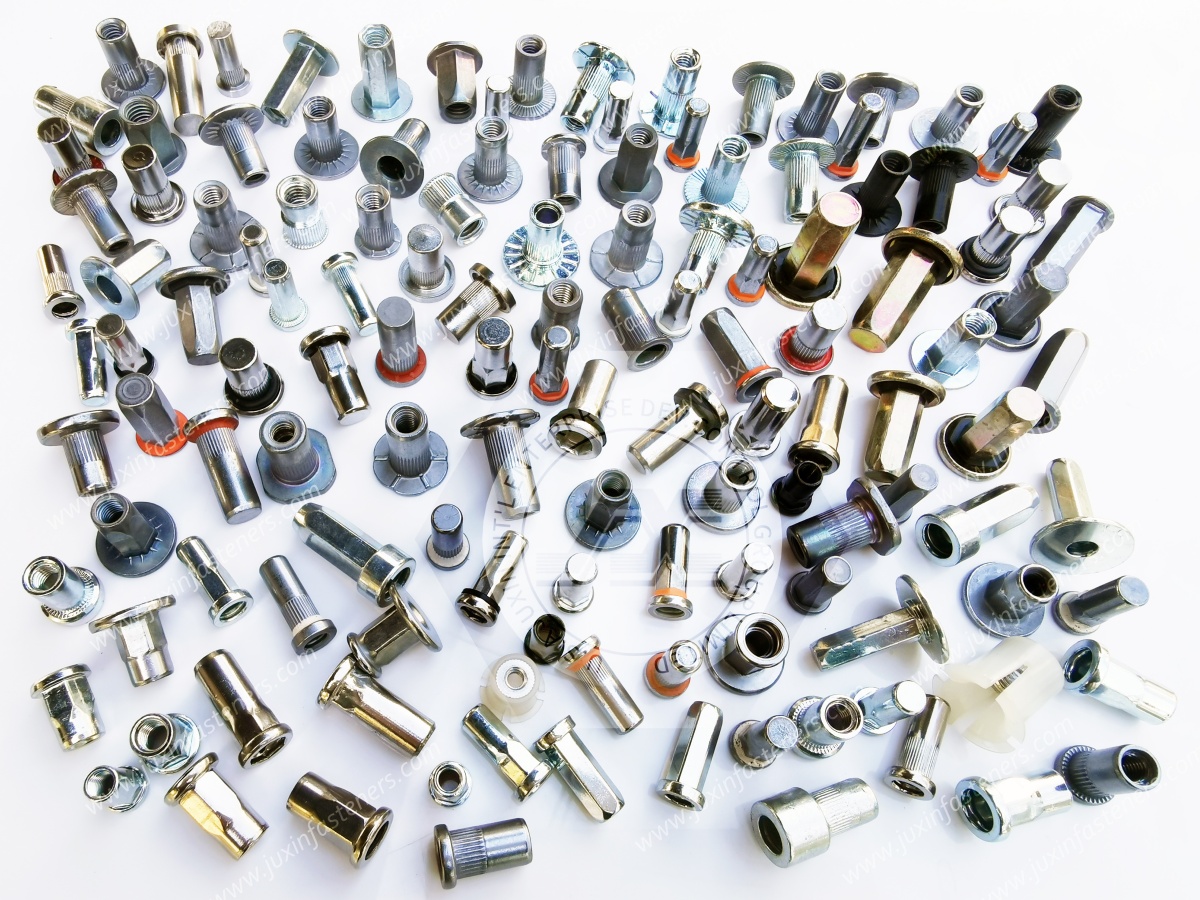
Both technologies create female threads in sheet material, but their installation logic differs.
A blind rivet nut is particularly useful where installation is performed from one accessible side of the workpiece.
A self-clinching nut generally requires controlled pressing and suitable tooling access during installation.
A flush self-clinching nut can be attractive when the fastener is installed during panel fabrication and the finished assembly requires minimal surface projection.
A rivet nut can be more practical when the enclosure has already been formed or only one side is accessible.
This distinction matters during design-for-manufacturing reviews.
The correct question is not which technology is universally stronger or better.
It is which fastening process fits the panel geometry, access conditions, load requirements, production sequence, service requirements, and target cost.
Weld nuts provide permanent female threads and can be appropriate for many structural sheet-metal assemblies.
However, welding introduces a different manufacturing process and different engineering considerations.
Depending on the application, these may include:
heat input
distortion
weld quality control
coating sequence
spatter management
corrosion protection
welding access
process automation
Self-clinching hardware uses mechanical installation instead of welding.
This can be useful where the manufacturing process favors pressing or where thermal effects from welding are undesirable.
The decision should be based on the complete production system rather than assuming one technology universally replaces the other.
Fastener material and finish should be selected according to the host sheet, service environment, corrosion requirements, installation behavior, and customer specification.
Depending on the product design and application, sourcing discussions may include:
carbon steel
stainless steel
corrosion-resistant surface treatments
zinc-based coatings
zinc-nickel systems
passivation or other application-specific finishes
Finish selection should not be made independently of dimensional and installation considerations.
A coating can affect dimensional interfaces, thread fit, friction behavior, corrosion performance, and compatibility with the surrounding assembly.
For this reason, an RFQ should identify the required finish and applicable corrosion or environmental requirement rather than simply requesting “corrosion resistant.”
If a specific test standard, exposure requirement, or customer specification applies, it should be stated directly.
Global OEM programs may require metric or inch-series threads.
Thread specification should be clearly defined on the customer drawing or RFQ rather than relying only on a nominal diameter.
Relevant information may include:
nominal thread size
pitch or threads per inch
internal thread tolerance or class
mating screw requirement
applicable thread standard
thread coating condition where relevant
Depending on the program, metric thread requirements may reference applicable ISO standards, while inch-series threads may reference applicable ASME/ANSI standards.
The governing drawing and customer specification should determine the requirement.
Procurement teams frequently search for a second source because of lead-time risk, regional supply-chain requirements, cost pressure, supplier consolidation, capacity constraints, or business-continuity planning.
For flush self-clinching nuts, a functional-equivalent review should go beyond matching the thread designation.
Two parts can both be described as an M4 flush clinch nut yet differ in installation geometry and assembly behavior.
A technical cross-reference should review parameters such as:
thread specification
fastener overall dimensions
installed profile
mounting-hole requirement
compatible sheet-thickness range
host sheet material and hardness limits
anti-rotation geometry
clinching geometry
edge-distance requirements
material
hardness
surface finish
required mechanical performance
installation tooling
customer drawing tolerances
This is especially important when an existing panel has already been tooled.
Changing the fastener must not unintentionally require a mounting-hole or installation-process change unless engineering approves it.
For procurement and supplier-development teams, a structured qualification sequence reduces the risk of selecting an alternative part based only on catalog appearance.
Provide the current 2D drawing, specification, part number, or physical sample where available.
The purpose is to understand the complete geometry and application requirement rather than simply identify the thread.
Document:
sheet material
thickness
hardness where controlled
mounting-hole dimensions
coating condition
edge and bend proximity
required installed surface profile
This establishes the actual installation environment.
Review the proposed alternative against the original requirement, including retention and anti-rotation features.
A visual similarity is not enough.
Whenever practical, use production-equivalent sheet rather than an arbitrary laboratory coupon.
This allows the engineering team to inspect:
seating
panel distortion
surface flushness
thread condition
fastener rotation
installation repeatability
Depending on the assembly, this may include:
push-out testing
torque-out testing
mating-screw installation testing
repeated assembly and disassembly
dimensional inspection
corrosion testing
vibration or environmental testing
The test plan should reflect the actual OEM requirement.
Once geometry, installation, performance, finish, and documentation requirements are confirmed, procurement can move from sample evaluation to production supplier qualification.
This sequence is more reliable than approving a second source solely because a catalog cross-reference lists the same nominal thread.
One of the most useful qualification improvements is also one of the simplest: test the fastener in the sheet material actually used in production.
A generic test coupon can demonstrate basic installation behavior, but it may not reproduce:
actual material hardness
actual thickness tolerance
coating condition
work hardening from forming
nearby bends
real edge distance
production hole quality
For critical assemblies, these variables can influence retention and installed profile.
A drawing-based review should therefore be followed by representative installation validation when performance is important.
A fastener that can be installed once is not necessarily ready for mass production.
OEM manufacturing teams should consider process capability.
Questions include:
Can the fastener be consistently oriented?
Can the installation station support the panel without distortion?
Is the required tooling accessible?
Can the press detect incomplete installation?
Does the panel remain flat after clinching?
Is the required flush condition measurable?
Can the process accommodate sheet-thickness tolerance?
Can the fastener be installed before coatings or downstream assembly operations?
Does the process support the required takt time?
These questions become increasingly important as annual volumes increase.
A successful prototype installation proves feasibility.
A controlled production process proves manufacturability.
Engineering drawings should communicate the characteristics that procurement must preserve when qualifying another source.
Useful information may include:
thread designation
fastener material
surface finish
installation hole
sheet thickness or approved range
host sheet material
installed surface requirement
critical dimensions
mechanical performance requirements where applicable
applicable standards
inspection requirements
customer-specific notes
This reduces the risk of procurement receiving multiple quotations for products that share a thread size but are not functionally interchangeable.
A technically useful supplier discussion should go beyond unit price.
Questions may include:
What sheet materials are compatible with the proposed fastener?
What sheet-thickness range applies to this exact configuration?
What mounting-hole dimensions are required?
What installation tooling is recommended?
What fastener materials and finishes are available?
Can the supplier review an existing customer drawing?
Can samples be supplied for installation validation?
Can a custom geometry be evaluated when a standard configuration does not fit?
What inspection documentation is available for the proposed production program?
Can packaging and lot-identification requirements be supported?
What production volume and forecast information is required for quotation?
These questions help separate a simple catalog match from an engineering-supported sourcing program.
A complete RFQ reduces clarification cycles and allows the supplier to evaluate manufacturability, tooling, material, finish, testing, and volume requirements together.
For flush self-clinching nuts or other zero-protrusion sheet metal threaded inserts, include as much of the following information as possible:
2D drawing
3D model or STEP file where available
existing part number or reference part
physical sample where cross-referencing is required
thread size and pitch
thread tolerance or class where specified
fastener material
surface finish
host sheet material
host sheet thickness
host sheet hardness where controlled
mounting-hole diameter and tolerance
required installed surface condition
edge and bend constraints
required push-out performance
required torque-out performance
corrosion or environmental requirements
sample quantity
prototype or pilot quantity
Estimated Annual Usage (EAU)
packaging requirements
documentation requirements
target production schedule
If the fastener is part of an existing production assembly, sending the current drawing is often the fastest way to begin a technical review.
Not every application fits a standard catalog geometry.
A custom or drawing-based solution may be appropriate when the project requires:
non-standard thread
unusual sheet thickness
restricted mounting-hole geometry
special installed height
specific anti-rotation features
non-standard material
special surface finish
unique clearance envelope
customer-specific mechanical requirements
replacement of an obsolete or difficult-to-source component
The decision to customize should consider tooling cost, annual volume, validation requirements, and whether a standard functional alternative can satisfy the assembly.
For higher-volume OEM programs, a drawing-based fastener can sometimes simplify the surrounding sheet-metal design enough to justify the additional development work.
The commercial path for a flush self-clinching nut should begin with the assembly problem, not with a generic catalog request.
A productive sourcing sequence is:
Clearance problem → sheet and thread definition → fastener geometry review → drawing comparison → sample installation → mechanical validation → production qualification → volume sourcing
For engineers, the starting point may be a CAD interference problem.
For procurement, it may be a second-source requirement.
For supplier-development teams, it may be an existing part requiring functional-equivalent qualification.
For manufacturing engineers, it may be inconsistent installation on the production line.
All four paths eventually require the same core technical information: the fastener must be evaluated together with the sheet and installation process.
JUXIN FASTENERS supplies engineered self-clinching hardware, flush clinch nuts, threaded inserts, panel fasteners, and custom fastening components for OEM and industrial applications.
For projects involving flush self-clinching nuts, zero-protrusion clinch fasteners, or flush threaded inserts for sheet metal,
our team can review customer drawings and application requirements to evaluate the appropriate manufacturing and sourcing path.
Technical review can begin from:
a customer 2D drawing
a 3D model
an existing fastener specification
a physical sample
host-panel information
a functional-equivalent requirement
a new OEM fastening application
Where performance depends on the installed assembly, sample validation using representative production sheet is recommended before final production approval.
For drawing review, sample evaluation, functional-equivalent sourcing, or volume quotation, send your technical requirements to JUXIN FASTENERS.
Email: info@juxinfasteners.com
Website: www.juxinfasteners.com
 MORE NEWS
Sep. 24, 2026
Contact Us
Tel.:
+86 020 8621 0320
+86 020 3121 6067
E-mail:
Technical Support:
Navigation
SEND INQUIREY