
Call Us
+86 136 6007 9809
Call Us
+86 136 6007 9809

Aug. 14, 2026
Heavy-Duty Hex Head Concrete Screws: Masonry Fixing, Installation and OEM Supply
Engineering Selection Guide for Concrete Screw Anchors, Masonry Tapping Screws and Industrial Fixing Systems
Heavy-duty hex head concrete screws are specialized mechanical fasteners used to secure suitable fixtures, steel brackets,
building-services supports and industrial equipment to concrete or approved masonry substrates.
Unlike ordinary self-tapping screws intended for sheet metal or plastic,
concrete screw anchors are designed with thread geometry and material characteristics suited to mechanical engagement in a drilled mineral substrate.
A reliable concrete screw connection depends on the complete installation system:
Substrate type and strength
Concrete cracking condition
Screw geometry and material
Pilot hole diameter and depth
Effective embedment
Fixture thickness and geometry
Anchor spacing and edge distance
Applied tension and shear
Installation tooling and procedure
Corrosion exposure
Product-specific technical qualification
For structural or safety-related installations, the selected screw anchor must have appropriate evaluation data for the intended application.
Juxin Fasteners supplies industrial fastening components and supports inquiries for heavy-duty hex head concrete screws,
masonry tapping screws and customized OEM fastening hardware, subject to product specifications and technical feasibility.
This guide connects engineering design, manufacturing considerations,
field installation and industrial procurement requirements to help customers select and source the appropriate fastening system.
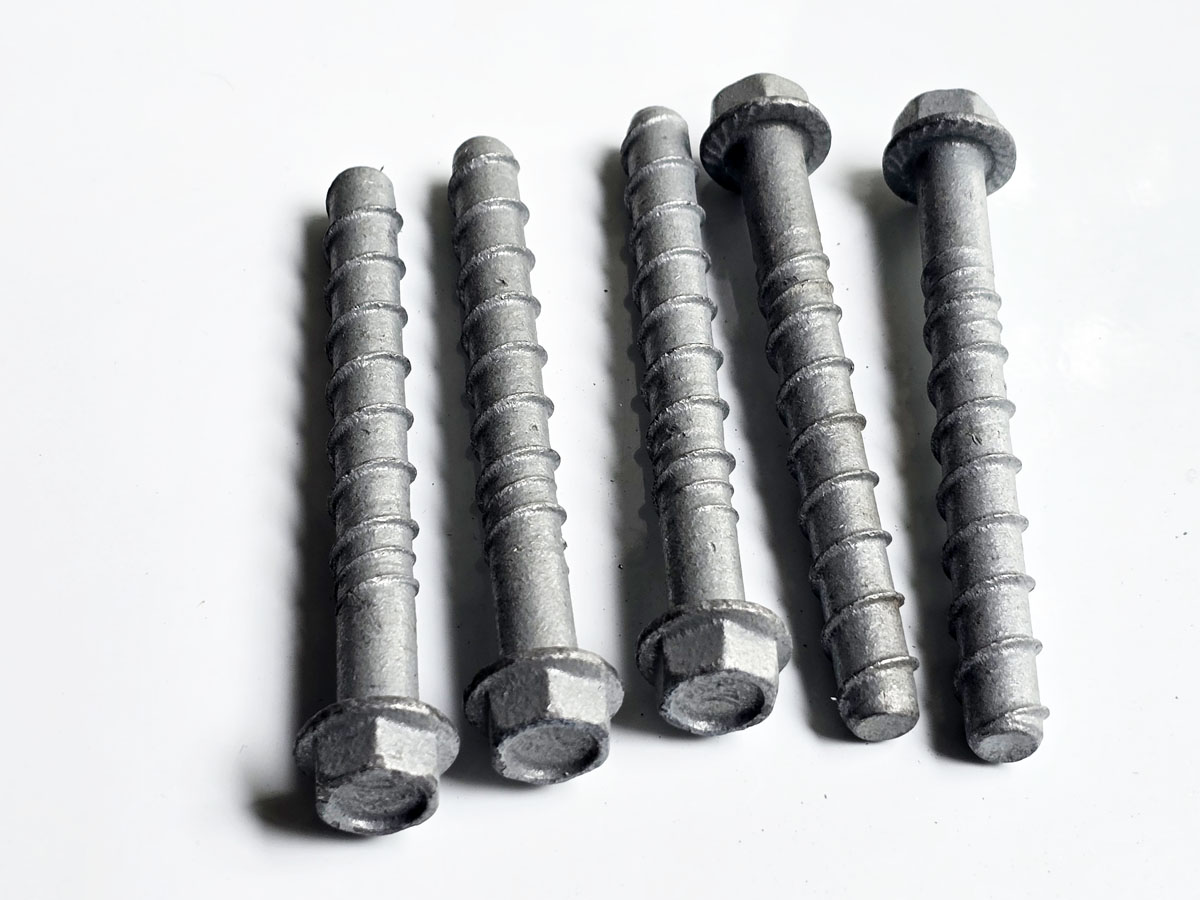
What Are Heavy-Duty Hex Head Concrete Screws?
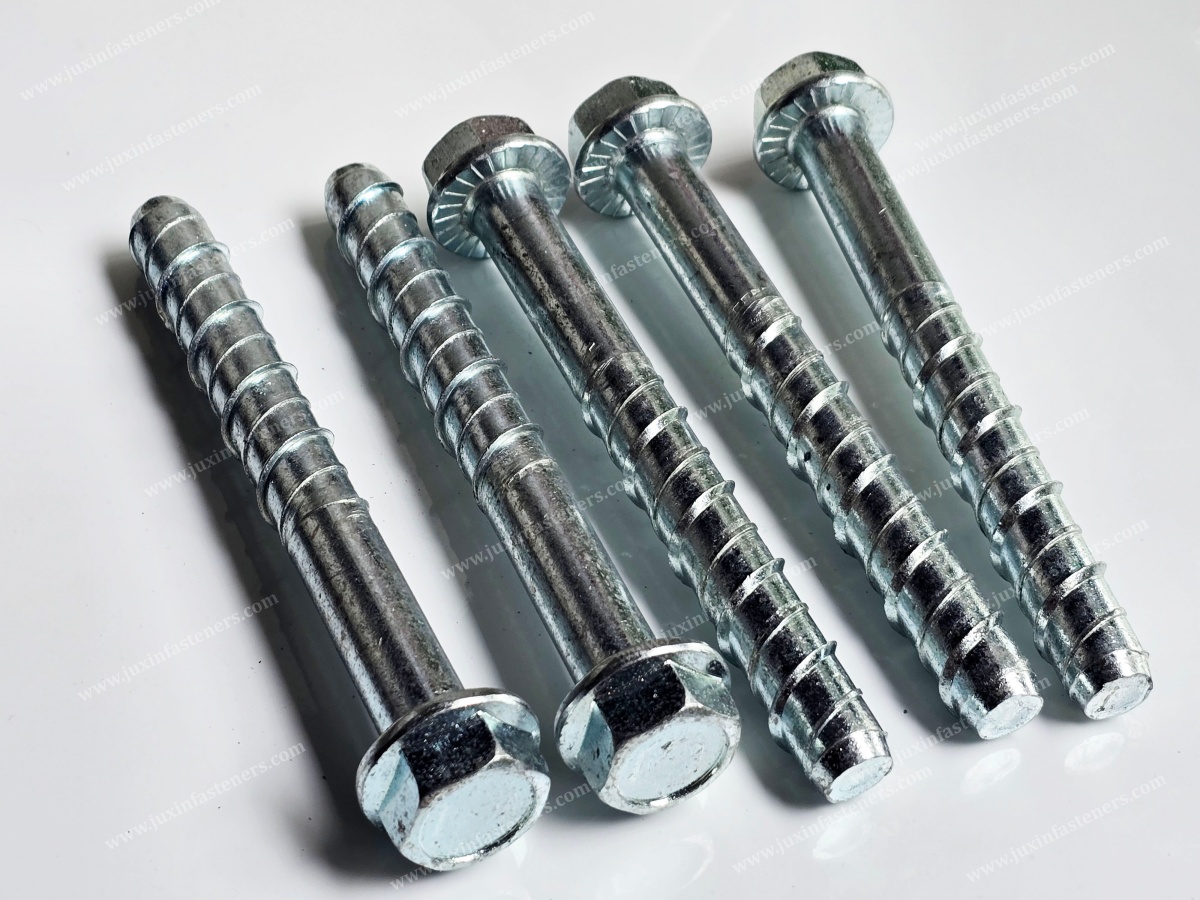
A heavy-duty hex head concrete screw is a mechanical screw anchor designed to develop anchoring resistance through engagement
between its specially shaped thread and a properly prepared hole in concrete.
Depending on the product design, the thread cuts or forms engagement with the surrounding material during installation.
A typical concrete screw anchor may feature:
Hexagonal head or hex washer head
Integral bearing flange, depending on design
Specialized cutting or forming thread
Hardened or otherwise engineered thread region
Product-specific tip geometry
Protective coating or corrosion-resistant material
The actual construction varies by manufacturer and product family.
Common Industrial Product Names
These fasteners may be described as:
Heavy-duty concrete screws
Hex head concrete screw anchors
Concrete tapping screws
Concrete screw bolts
Self-tapping concrete screws
Self-cutting concrete anchors
Mechanical screw anchors
Masonry screw anchors
Hex washer head concrete anchors
The terms are related but not always technically identical.
For procurement and engineering approval, use the exact product designation, drawing and relevant evaluation documentation.
Concrete Screw Anchors vs. Ordinary Hex Head Tapping Screws
The distinction is important.
Ordinary Hex Head Tapping Screws
Conventional tapping screws may be designed to form or cut mating threads in sheet metal, plastic or other specified materials.
Their geometry and mechanical properties are not necessarily suitable for concrete.
Concrete Screw Anchors
Concrete screw anchors use a thread system engineered for engagement with a mineral substrate.
Their anchoring performance must be evaluated as part of the complete screw-and-substrate system.
Engineering Rule
A conventional high-strength hex bolt or sheet-metal tapping screw does not become a qualified concrete anchor merely because it has a hexagonal head or hardened steel construction.
How Concrete Screw Anchors Transfer Loads
The load path in a typical concrete screw connection is:
Attached equipment → mounting bracket or base plate → screw head and shank → engaged screw thread → concrete or qualified masonry substrate.
The anchor develops resistance through mechanical interaction between its thread and the material surrounding the drilled hole.
Tensile Loading
Tension acts approximately along the screw axis and tends to pull the anchor from the substrate.
Resistance depends on the specific product and relevant substrate failure mechanisms.
Shear Loading
Shear acts approximately across the screw axis.
Resistance may depend on the steel screw, concrete or masonry, fixture geometry and edge conditions.
Combined Loading
Equipment brackets and base plates may experience tension and shear simultaneously.
The connection must be checked according to the applicable design method.
Why Thread Geometry Matters
Concrete screw performance is influenced by characteristics such as:
Thread pitch
Thread depth
Thread flank geometry
Core diameter
Cutting geometry
Tip design
Thread hardness
Installation engagement length
These characteristics affect installation behavior and the way loads are transferred into the substrate.
They cannot be freely changed in a qualified anchor without evaluating the consequences for performance.
Why Steel Strength Alone Is Insufficient
A stronger screw body does not necessarily improve anchoring resistance when concrete breakout, masonry failure or thread engagement governs the connection.
The complete fastening system determines the applicable design resistance.
Concrete vs. Masonry: Selecting the Correct Substrate
Concrete and masonry are not interchangeable anchoring substrates.
Normal-Weight Concrete
Many concrete screw anchor systems are designed and qualified for specified normal-weight concrete conditions.
The approved concrete strength range must be verified.
Cracked Concrete
Certain concrete screw anchors are qualified for cracked concrete.
Others are not.
Where cracking is expected, the exact product must have the required qualification.
Uncracked Concrete
Some screw anchors are qualified for uncracked concrete only.
An uncracked-concrete qualification does not automatically permit use in cracked concrete.
Lightweight Concrete
Suitability depends on the product's assessed application range.
Precast Concrete
Precast components may require special consideration of member thickness, reinforcement, edge distance and installation access.
Solid Brick
A concrete screw should not automatically be assumed suitable for solid brick.
Masonry-specific technical data are required.
Solid Concrete Masonry Units
Some screw anchors are qualified for particular concrete masonry unit configurations.
Hollow Concrete Masonry Units
Hollow CMU presents different load-transfer conditions from solid concrete.
Only products specifically evaluated for the relevant hollow masonry configuration should be considered.
Grouted vs. Ungrouted Masonry
Fully grouted and ungrouted masonry may have different anchor resistance and installation requirements.
Mortar Joints
Installation into mortar joints may be restricted or require separate evaluation.
Substrate Qualification Matrix
| Base material | Main selection concern | Required verification |
|---|---|---|
| Normal-weight concrete | Strength and condition | Product's concrete qualification |
| Cracked concrete | Crack effects on anchorage | Cracked-concrete approval |
| Lightweight concrete | Different substrate behavior | Specific assessed application |
| Precast concrete | Thickness and reinforcement | Design and product compatibility |
| Solid brick | Masonry properties | Masonry-specific technical data |
| Fully grouted CMU | Masonry strength and geometry | Applicable masonry evaluation |
| Hollow CMU | Web and face-shell behavior | Hollow masonry approval |
| Deteriorated concrete | Uncertain substrate resistance | Engineering assessment |
Engineering Information Gain: One Screw Cannot Be Specified for Every Substrate by Name Alone
A supplier may advertise a product as a concrete and masonry screw.
That description does not establish that every size and length is suitable for concrete, brick, hollow CMU and grouted masonry.
Engineering and purchasing teams must verify the exact assessed product, substrate and installation configuration.
Heavy-Duty Concrete Screw Installation
Installation requirements vary by product.
A typical procedure includes the following activities.
Verify the Substrate
Confirm that the substrate is covered by the intended product's technical documentation.
Check the Anchor Location
Verify edge distance, anchor spacing, member thickness and reinforcement restrictions.
Drill the Pilot Hole
Use the specified drill diameter, depth, drilling method and bit.
Prepare the Hole
Remove debris where required by the product instructions.
Some qualified concrete screw systems permit specific no-cleaning installation conditions.
Others require cleaning.
Do not assume that one procedure applies to all concrete screw anchors.
Position the Fixture
Check fixture thickness, hole diameter, bearing surfaces and alignment.
Drive the Screw
Use the specified installation tool and procedure.
Confirm the Installed Condition
Verify the required seating, embedment and other installation acceptance criteria.
Inspect the Completed Connection
Apply the product and project-specific inspection requirements.
Pilot Hole Diameter: A Critical Engineering Variable
Concrete screw threads engage with the material surrounding the drilled hole.
An incorrectly sized hole can compromise that engagement.
Oversized Pilot Hole
May reduce thread engagement and anchoring resistance.
Undersized Pilot Hole
May increase installation resistance, damage the screw or damage the substrate.
Incorrect Drilling Method
May produce a hole geometry outside the approved installation conditions.
Procurement Implication
The pilot hole requirement must be associated with the exact screw anchor model and size.
It should not be taken from a generic tapping screw drill chart.
Hole Depth and Embedment
The drilled-hole depth must accommodate the installation requirements.
The effective embedment depth is a separate engineering parameter related to anchoring resistance.
Overall screw length, fixture thickness, nominal embedment and effective embedment must not be confused.
Hex Head and Hex Washer Head Design
A hexagonal head provides access for suitable socket or wrench tooling.
An integral washer or flange may provide a bearing surface against the fixture.
However, an integral flange does not automatically eliminate a separate washer where the applicable product instructions or project design require one.
Installation Torque and Tooling
Concrete screw anchors do not all use the same installation procedure.
Some products use controlled torque requirements.
Others are designed for specific powered installation methods or seating criteria.
The installation procedure must come from the actual product documentation.
Installation Torque Is Not a Universal Load Rating
A high driving torque does not demonstrate that the screw has adequate anchoring resistance.
Excessive installation resistance can instead indicate a problem with the hole, screw, tooling or substrate.
Installation Failure Matrix
| Installation problem | Potential cause | Recommended action |
|---|---|---|
| Screw stops before seating | Incorrect hole size or insufficient depth | Check product drilling instructions |
| Screw thread becomes damaged | Incorrect substrate or excessive installation resistance | Inspect screw and installation conditions |
| Screw spins without proper engagement | Damaged or oversized hole | Obtain product-specific remediation guidance |
| Concrete cracks near the screw | Edge distance, member thickness or substrate condition | Review design and installation |
| Fixture does not seat properly | Hole misalignment or fixture interference | Check geometry and installation sequence |
| Screw head fractures | Excessive installation force or unsuitable component | Stop installation and investigate |
| Installation results vary between sites | Inconsistent drilling or tooling | Standardize the approved process |
| Corrosion develops | Inadequate material or finish | Review exposure and product specification |
Engineering Caution
Where a screw anchor fails to install correctly, simply replacing it with a larger screw in the same hole is not a universally acceptable repair.
Any corrective method must follow the product's approved instructions and the responsible engineer's assessment.
Can Concrete Screws Be Removed or Reused?
These are three different questions.
Removability
Some concrete screw anchors can be unscrewed and removed.
Reinstallation
A product may permit a defined adjustment or reinstallation procedure.
Reusability
Certain specially qualified systems may allow reuse under restricted conditions, sometimes requiring inspection with a dedicated wear gauge.
These capabilities are not universal.
A product permitted for reuse in a new drilled hole is not necessarily permitted for repeated installation into the same hole.
Engineering Rule
Never infer reuse permission from the fact that a screw can be physically removed.
Concrete Screw Anchor Design: Tension, Shear and Failure Modes
A concrete screw connection can be limited by different failure mechanisms.
Steel Failure in Tension
The screw may yield or fracture under tensile loading.
Steel Failure in Shear
The screw may fail under transverse loading.
Concrete Cone Breakout
A portion of the concrete may fracture under tension.
Pullout or Loss of Thread Engagement
The anchor may lose its mechanical engagement with the substrate.
Concrete Splitting
Concrete may split because of installation conditions, member geometry or loading.
Concrete Edge Breakout
Concrete near an edge may fail under shear.
Concrete Pryout
Certain shear-loading conditions may produce pryout failure.
Anchor Group Effects
Closely spaced screw anchors may have interacting failure regions.
Masonry Failure
In masonry, the relevant failure modes and resistance may differ according to unit type, grouting and installation position.
Fixture Failure
A mounting bracket or base plate may deform or fail before the screw anchor reaches its design resistance.
Why Concrete Edge Distance Matters
Concrete screws are sometimes marketed as useful for installations with relatively small edge distances.
However, no universal edge-distance advantage applies to every concrete screw.
The permitted dimensions depend on the exact anchor and assessed conditions.
Why Anchor Spacing Matters
Anchor groups can experience interaction between concrete failure regions.
The minimum permitted spacing and spacing required to achieve a particular design resistance may differ.
Stand-Off Installations
A fixture mounted above the concrete surface may introduce bending in the exposed screw or anchor assembly.
This requires specific engineering evaluation.
Overturning and Eccentric Loads
Equipment cabinets, tall support frames and wall-mounted brackets may create uneven loading across an anchor group.
The load distribution should be evaluated as part of the complete connection.
International Standards and Technical Evaluation
EN 1992-4: Design of Fastenings for Use in Concrete
EN 1992-4 provides European design rules for relevant fastening systems used in concrete.
The design considers tension, shear, combined loading and applicable failure mechanisms.
European Technical Assessment (ETA)
An ETA provides assessed characteristics and intended-use information for a specific construction product.
For a concrete screw anchor, the relevant ETA may identify:
Product model
Covered sizes
Base material
Installation requirements
Embedment configurations
Characteristic resistance
Cracked-concrete suitability
Seismic or other evaluated conditions
Environmental limitations
EAD 330232-02-0601
This European Assessment Document addresses mechanical fasteners for use in concrete.
The applicable ETA and assessment basis must be checked for the exact product.
ACI 318 Chapter 17
ACI 318 Chapter 17 contains design provisions for anchoring to concrete in applicable North American projects.
The governing code edition depends on the adopted building code and project requirements.
ACI CODE-355.2
ACI CODE-355.2 addresses qualification of post-installed mechanical anchors for concrete.
The applicable edition and product qualification scope must be verified.
ICC-ES Evaluation Reports
ICC-ES evaluation reports provide product-specific information for stated code applications.
A report may distinguish between concrete and masonry.
Masonry Design Requirements
Masonry anchoring may involve applicable TMS 402 provisions and product-specific masonry evaluation reports.
Concrete design data must not automatically be used for masonry.
Material and Thread Standards
Material standards, coating standards and thread standards serve different purposes from concrete anchor qualification.
Compliance with a material standard does not establish a concrete screw's design resistance.
Product Approval Is Not Transferable
An ETA, ICC-ES report or load table issued for one manufacturer's product cannot be applied to another similar-looking screw.
The exact assessed geometry, material, coating and installation conditions matter.
Concrete Screw Materials and Heat Treatment
Concrete screw anchors require a balance between thread performance and structural integrity.
Carbon Steel
Carbon steel may be used in suitably engineered and heat-treated concrete screw systems.
Alloy Steel
Alloy steels may be considered for drawing-specific applications where their properties are appropriate.
Thread Hardness
Thread hardness can influence the ability of a screw to form engagement in the substrate.
Core Strength and Ductility
The screw body must resist the required loading without unacceptable brittle behavior.
Heat Treatment
Heat-treatment specifications may influence:
Hardness
Strength
Ductility
Installation performance
Susceptibility to cracking
Product consistency
Why Higher Hardness Is Not Always Better
Excessive hardness may increase the risk of brittle behavior or other material-related failures.
The correct combination of material, geometry and heat treatment must be established through product engineering and qualification.
Concrete Screw Anchors vs. ISO Property Class 10.9 Bolts
A conventional ISO property class 10.9 bolt is a different product category from a concrete screw anchor.
ISO 898-1 addresses mechanical properties of specified carbon and alloy steel bolts, screws and studs.
It does not by itself establish concrete screw anchoring performance.
A concrete screw must be evaluated according to its actual anchor design and intended substrate.
OEM Manufacturing Considerations
Depending on the product design, manufacturing may involve:
Cold forming
CNC machining
Thread forming or rolling
Heat treatment
Surface finishing
Inspection
Packaging
The manufacturing route must be compatible with the product's geometry, material and performance requirements.
For Juxin Fasteners, drawing-based material, heat-treatment and manufacturing requirements can be reviewed for technical feasibility.
No specific strength, fatigue or anchoring performance should be assumed without relevant product evidence.
Corrosion Protection for Concrete and Masonry Screws
Environmental exposure influences material and finish selection.
Zinc-Plated Carbon Steel
May be suitable for certain dry indoor applications.
Zinc-Based Protective Coatings
Different zinc-based coating systems may offer different levels of protection.
Zinc-Nickel Coatings
May be considered for compatible fastening components where specified, but suitability for a concrete screw anchor must be evaluated as part of the actual product system.
Stainless Steel
Certain concrete screw systems are available in stainless steel configurations.
However, stainless steel grades, cutting-thread construction and approved applications differ by product.
304 and 316 Stainless Steel
304 and 316 stainless steel may provide improved corrosion resistance in suitable environments.
316 stainless steel is not immune to pitting or crevice corrosion.
Coating Changes Affect More Than Appearance
A coating can influence:
Thread geometry
Friction
Installation resistance
Corrosion performance
Component compatibility
An alternative finish must not be substituted into a qualified anchor system without appropriate review.
Hydrogen Embrittlement
Certain hardened steel fasteners may be susceptible to hydrogen embrittlement, depending on material properties and processing conditions.
This risk should be considered where relevant to coating and manufacturing decisions.
Salt Spray Testing
ASTM B117 and ISO 9227 provide laboratory corrosion test methods.
Salt spray exposure hours do not translate directly into guaranteed service life.
Environmental Selection Matrix
| Environment | Preliminary material consideration | Important limitation |
|---|---|---|
| Dry indoor building | Suitable coated carbon steel | Verify actual product approval |
| Humid mechanical room | Enhanced corrosion protection | Evaluate condensation |
| Outdoor equipment | Appropriate corrosion-resistant system | Check long-term exposure |
| Coastal facility | Suitable stainless or other qualified system | Evaluate chloride corrosion |
| Industrial chemical area | Application-specific material and finish | Verify chemical compatibility |
Industrial Applications for Hex Head Concrete Screw Anchors
Mechanical, Electrical and Plumbing Installations
Concrete screw anchors may be considered for qualified installations involving:
Pipe support brackets
HVAC supports
Cable trays
Electrical conduit brackets
Utility support frames
Mechanical equipment accessories
For overhead supports, use products evaluated for the applicable installation and loading conditions.
Industrial Machinery and Production Equipment
Potential applications include:
Equipment guards
Auxiliary machine supports
Maintenance brackets
Factory service installations
Cable management systems
Selected equipment mounting assemblies
Dynamic loading, vibration and foundation conditions require engineering review.
Electrical Cabinets and Power Equipment
Concrete screw anchors may be used in qualified mounting arrangements for:
Electrical enclosures
Control cabinets
UPS equipment
Power distribution support frames
Industrial electrical accessories
The mounting system should be designed for actual equipment loads and installation conditions.
Warehouse and Material Handling Facilities
Potential applications include:
Storage accessories
Equipment barriers
Service brackets
Selected racking-related attachments
Safety-critical rack anchorage requires the relevant equipment design and qualified anchor system.
Renovation, Maintenance and Retrofit Projects
Concrete screws can be attractive for some retrofit installations because the fastening process may involve drilling and direct screw installation.
Potential applications include:
Replacement equipment brackets
Utility upgrades
Facility maintenance
Service supports
Temporary construction installations
Removal and reuse must follow the exact product instructions.
Secondary Steelwork and Building Services
Potential applications include:
Secondary steel brackets
Light-gauge framing supports
Building-services supports
Non-primary equipment attachments
The distinction between primary and secondary steelwork does not eliminate the need for structural design where loads or safety require it.
Curtain Walls and Facade Brackets
Facade and cladding connections can be safety-critical.
Concrete screw anchors may be considered only where the specific system has the required product qualification and the connection has been engineered for the actual loads and substrate.
A generic masonry tapping screw should not be recommended as a universal facade anchor.
Railings, Handrails and Safety Barriers
These connections may be subject to human safety requirements.
Use an appropriately qualified anchor system and a verified structural design.
Rail and Transportation Infrastructure
Potential applications include:
Station equipment
Auxiliary support brackets
Cable management
Maintenance structures
Equipment enclosures
Project-specific vibration, environmental and qualification requirements must be addressed.
Wind Power and Renewable Energy Facilities
Concrete screw anchors may be considered for selected auxiliary equipment and support installations where appropriately designed.
They should not be confused with the specialized high-strength bolting systems used in major wind turbine structural connections.
Power Generation and Industrial Electrification
Potential applications include selected electrical and mechanical supports, equipment accessories and service infrastructure.
The actual fastening design depends on equipment loads and project requirements.
AI Data Centers and Cooling Infrastructure
Concrete screw anchors may be relevant to selected facility equipment, such as:
Mechanical cooling supports
Electrical service brackets
Auxiliary equipment frames
Facility maintenance installations
Not every server rack or data center enclosure requires concrete anchoring.
Industry Application Matrix
| Application | Main engineering concern | Procurement and installation priority |
|---|---|---|
| HVAC support | Suspended loads and access | Approved product and installation method |
| Cable tray bracket | Load and anchor layout | Substrate and spacing verification |
| Electrical cabinet | Stability and overturning | Base plate and fixture design |
| Machinery accessory | Vibration and service loading | Product qualification and durability |
| Facility retrofit | Existing substrate condition | Drilling and inspection controls |
| Safety railing | Human safety | Structural design and qualified anchors |
| Facade bracket | Structural and environmental exposure | Project-specific approval |
| Rail equipment | Vibration and corrosion | Technical documentation |
| Outdoor electrical support | Corrosion and service life | Material and finish |
| Data center cooling equipment | Equipment mounting reliability | Repeatable installation |
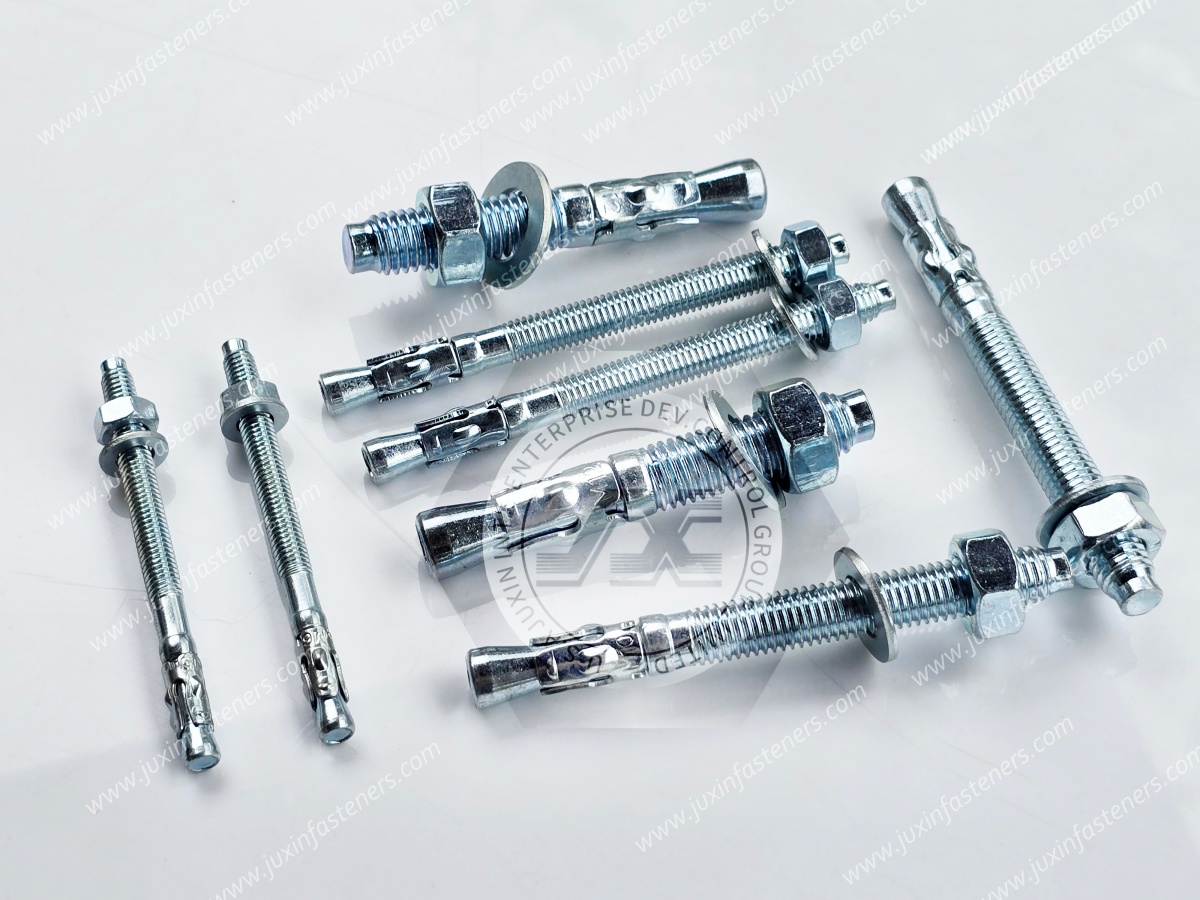
Concrete Screw Anchors vs. Wedge Anchors and Bonded Anchors
These technologies use different load-transfer mechanisms.
| Feature | Concrete Screw Anchors | Wedge Anchors | Bonded Anchors |
|---|---|---|---|
| Primary mechanism | Thread engagement in substrate | Mechanical expansion | Bond between anchor, adhesive and substrate |
| Installation | Drill and drive screw | Drill, insert and set expansion | Drill, prepare hole, install adhesive and anchor |
| Typical hardware | Specialized screw anchor | Stud, expansion component, nut and washer | Approved adhesive system and compatible anchor |
| Removal | Possible for certain products | Fixture may be removable | Usually not intended for routine removal |
| Reuse | Only where expressly permitted | Not assumed | Not assumed |
| Cracked-concrete use | Product-specific | Product-specific | Product-specific |
| Seismic applications | Product-specific | Product-specific | Product-specific |
| Design resistance | Product-specific | Product-specific | Product-specific |
Which Anchor Is Stronger?
There is no universal answer.
Compare the specific qualified products under equivalent substrate, loading, embedment and geometric conditions.
Which Is Faster to Install?
Concrete screws may reduce installation steps in some projects.
However, drilling, cleaning, setting, inspection and rework can change the total installed time.
Which Is Better Near an Edge?
Use the actual product's approved edge-distance and design-resistance data.
No generic category is universally best.
Production Manager and Manufacturing Engineer Considerations
For repeat industrial installations, production efficiency depends on controlling the entire process.
Product Standardization
Use an exact part number or drawing rather than a generic product description.
Drilling Consistency
Specify the approved bit, hole diameter, drilling method and hole depth.
Tooling Compatibility
Check socket access, driver requirements and installation procedure.
Fixture Tolerances
Control mounting-hole location and fixture thickness.
Part Identification
Prevent mixing of different screw lengths, coatings and approved configurations.
Inspection Criteria
Define what constitutes an acceptable installation.
Rework Procedure
Establish a product-specific process for failed installations.
Packaging
Consider packaging by equipment assembly or installation set.
Traceability
Define lot identification requirements where appropriate.
Information Gain: Installed Cost Matters More Than Unit Price Alone
The total cost of a concrete screw installation may include:
Screw purchase cost
Drilling time
Hole cleaning
Driver setup
Installation labor
Inspection
Rework
Replacement
Equipment downtime
A product with a lower unit price may have a higher total installed cost if it creates inconsistent installation or additional rework.
OEM Concrete Screw Manufacturing and Quality Requirements
Industrial customers may need standard concrete screw anchors or drawing-specific fastening components.
Potential requirements include:
Head geometry
Screw dimensions
Thread design
Material specification
Heat-treatment requirements
Surface finish
Dimensional tolerances
Inspection criteria
Packaging
Order quantities
Important Qualification Boundary
A customized screw with concrete-style threads is not automatically a qualified structural concrete anchor.
Any change to the assessed geometry, material, heat treatment or coating may affect anchoring performance and require appropriate qualification.
Quality Control Considerations
Depending on the product and specification, inspection may include:
Head dimensions
Shank and core diameter
Thread geometry
Thread length
Material verification
Hardness
Surface finish
Visual defects
Packaging and labeling
Where required, additional product-level testing and qualification documentation must be established.
Routine dimensional and hardness inspection cannot replace concrete anchor performance evaluation.
Why Thread Consistency Matters in Bulk Production
The specialized thread is a functional feature of a concrete screw anchor.
Variations in thread profile, pitch, core diameter or hardness may affect:
Installation resistance
Thread engagement
Screw damage risk
Substrate interaction
Repeatability of installation
For OEM and distributor programs, controlled product configuration and change management are therefore important.
Supplier Development and Procurement Requirements
Industrial buyers should distinguish between sourcing a standard screw and sourcing an engineered concrete anchor.
Product Identification
Confirm the exact manufacturer, model, diameter, length and head type.
Substrate Compatibility
Confirm whether the product is intended for concrete, solid masonry, grouted CMU or hollow masonry.
Technical Qualification
Request the required ETA, ICC-ES report or other project-specific evidence.
Installation Documentation
Verify pilot hole dimensions, embedment, tooling and installation conditions.
Material and Coating
Confirm the specified material and corrosion protection.
Manufacturing Consistency
Define relevant dimensional and mechanical inspection requirements.
Change Control
Require technical review before changing the screw design, material, heat treatment or finish.
Commercial Conditions
Confirm:
Sample availability
MOQ
Initial order quantity
Annual forecast
Production lead time
Packaging requirements
Delivery destination
Repeat-order expectations
Supplier Evaluation Matrix
| Supplier qualification item | Why it matters |
|---|---|
| Exact product designation | Prevents substitution errors |
| Substrate qualification | Confirms intended base material |
| Technical evaluation report | Establishes assessed use |
| Installation instructions | Supports repeatable installation |
| Thread geometry | Influences mechanical engagement |
| Material and heat treatment | Influences mechanical behavior |
| Surface finish | Supports environmental suitability |
| Dimensional inspection | Supports manufacturing consistency |
| Lot identification | Supports traceability |
| Change control | Protects approved product configuration |
| MOQ and lead time | Supports procurement planning |
Why Work with Juxin Fasteners?
Juxin Fasteners has more than 20 years of experience supplying industrial fastening components for international OEM and industrial applications.
We support inquiries for:
Heavy-duty hex head concrete screws
Concrete tapping screws
Masonry fastening components
Industrial threaded fasteners
Special mounting screws
Custom bolts and studs
CNC machined fastening components
Drawing-specific OEM hardware
Depending on product specifications and feasibility, requirements may involve forming, machining, thread processing, heat treatment, surface finishing, inspection and packaging.
Specific manufacturing processes, product availability, performance testing and qualification documents must be confirmed for each requested product.
Our objective is to help engineering and purchasing teams translate application requirements into a clear, technically reviewable fastener specification.
Frequently Asked Questions
What is a heavy-duty hex head concrete screw?
It is a specialized mechanical screw anchor with a hexagonal head and a thread designed to engage a suitable drilled concrete substrate.
Are concrete screws the same as ordinary self-tapping screws?
No. Concrete screw anchors require geometry and material properties appropriate for mineral substrates.
Can concrete screws be used in masonry?
Some products are qualified for specific masonry materials. Suitability must be verified for the exact product and substrate.
Can concrete screws be installed in hollow blocks?
Only where the product is specifically evaluated for the relevant hollow masonry configuration.
Can concrete screws be used in cracked concrete?
Certain qualified products can. The exact approval scope must be checked.
What drill bit size is required?
Use the product-specific pilot hole diameter and approved drilling method.
How deep should a concrete screw be installed?
Use the required embedment and hole depth stated in the product's technical documentation.
Do concrete screws require installation torque?
Installation requirements vary. Follow the exact product's specified procedure rather than a generic torque chart.
Can concrete screws be removed?
Some can be removed. Removal does not automatically establish permission for reuse.
Can concrete screws be reused?
Only where the specific product documentation permits reuse under defined conditions.
Are concrete screws stronger than wedge anchors?
Neither product category is universally stronger. Compare qualified products under equivalent design conditions.
Are concrete screws suitable for outdoor applications?
Only where the specific material, coating and product approval are appropriate for the exposure.
Can 10.9 grade hex bolts replace concrete screw anchors?
No. A conventional 10.9 bolt does not automatically provide the thread geometry or anchoring qualification required for concrete.
Does every concrete screw have an ETA or ICC-ES report?
No. Technical evaluations are product-specific and must be verified.
Can Juxin Fasteners supply customized concrete screws?
Juxin Fasteners can review drawing-based requirements, subject to manufacturing feasibility and any required product qualification.
OEM Concrete Screw RFQ Checklist
To request a technically accurate quotation, provide the following information where available.
Product Specification
Concrete screw or masonry screw type
Existing product reference or drawing
Head configuration
Nominal diameter
Overall length
Thread geometry or applicable product designation
Material
Heat-treatment requirements
Surface treatment
Substrate and Application
Concrete or masonry type
Concrete strength, if applicable
Cracked or uncracked condition
Grouted or hollow masonry condition
Fixture drawing
Fixture thickness
Member thickness
Edge distance
Anchor spacing
Loads and Design
Tension
Shear
Combined loading
Dynamic loading
Seismic requirements, where applicable
Required service life
Applicable design standard
Installation
Pilot hole diameter
Hole depth
Effective embedment
Drilling method
Hole cleaning
Installation tooling
Setting procedure
Reuse requirements, if applicable
Quality and Documentation
Required ETA or ICC-ES evaluation
Material documentation
Hardness requirements
Dimensional tolerances
Coating specification
Lot traceability
Inspection requirements
Commercial Requirements
Sample quantity
Initial order quantity
Annual forecast
MOQ expectations
Required lead time
Packaging and labeling
Delivery destination
Request a Heavy-Duty Concrete Screw or Masonry Fastener Quotation
Juxin Fasteners welcomes inquiries from industrial equipment manufacturers, building-services suppliers, engineering companies,
construction product distributors, manufacturing engineers, production managers and international purchasing teams.
Whether you require standard hex head concrete screw anchors, masonry tapping screws,
special mounting screws or customized industrial fastening components, begin with the actual application and product specification.
For structural, overhead or safety-related anchoring applications, include the required product qualification and design documentation.
Send your technical drawings, dimensions, material requirements, surface treatment, expected quantities and delivery requirements for review.
Company: Juxin Fasteners
Website: https://www.juxinfasteners.com/
Email: info@juxinfasteners.com
Engineered Fastening Starts With the Right Substrate, Correct Screw Geometry and Controlled Installation.
 MORE NEWS


Oct. 13, 2026
Contact Us
Tel.:
+86 020 8621 0320
+86 020 3121 6067
E-mail:
Technical Support:
Navigation
SEND INQUIREY