
Call Us
+86 136 6007 9809
Call Us
+86 136 6007 9809

Aug. 14, 2026
Heavy Duty Hex Head Tapping Screws for Masonry and Concrete
Industrial Fixing Solutions for Precast Concrete, Building Services, Equipment Mounting and OEM Applications
Heavy-duty hex head tapping screws for masonry and concrete are specialized mechanical fasteners designed to secure suitable fixtures, steel brackets,
service supports and equipment components to qualified concrete or masonry substrates.
Unlike conventional tapping screws used in sheet metal, concrete screw anchors require specialized thread geometry,
appropriate mechanical properties and controlled installation conditions to develop mechanical engagement within a drilled mineral substrate.
For industrial OEMs, construction product distributors, structural engineers and procurement teams,
selecting the correct concrete fastening solution involves more than comparing nominal diameter, length and unit price.
The complete connection must be evaluated, including substrate properties, screw design, drilling requirements, embedment,
fixture thickness, applied loads, corrosion exposure and applicable product qualification.
Juxin Fasteners supplies industrial fastening components and supports inquiries for heavy-duty hex head tapping screws, concrete screw anchors,
masonry fastening hardware and drawing-based OEM components.
This guide explains the technical differences, industrial applications,
installation considerations and purchasing requirements that help engineering and supply chain teams make informed decisions.
What Are Heavy-Duty Hex Head Tapping Screws for Concrete and Masonry?
A concrete tapping screw is a mechanical screw anchor designed to engage with a suitable drilled substrate through its specially engineered thread.
Depending on the product, the thread cuts or forms an engagement path in the surrounding concrete or masonry during installation.
Typical features may include:
External hexagonal head for socket-driven installation
Integral washer or flange, depending on head configuration
Specialized thread profile for mineral substrates
Engineered thread hardness and core properties
Product-specific tip geometry
Protective coating or corrosion-resistant material
These characteristics vary between manufacturers and product families.
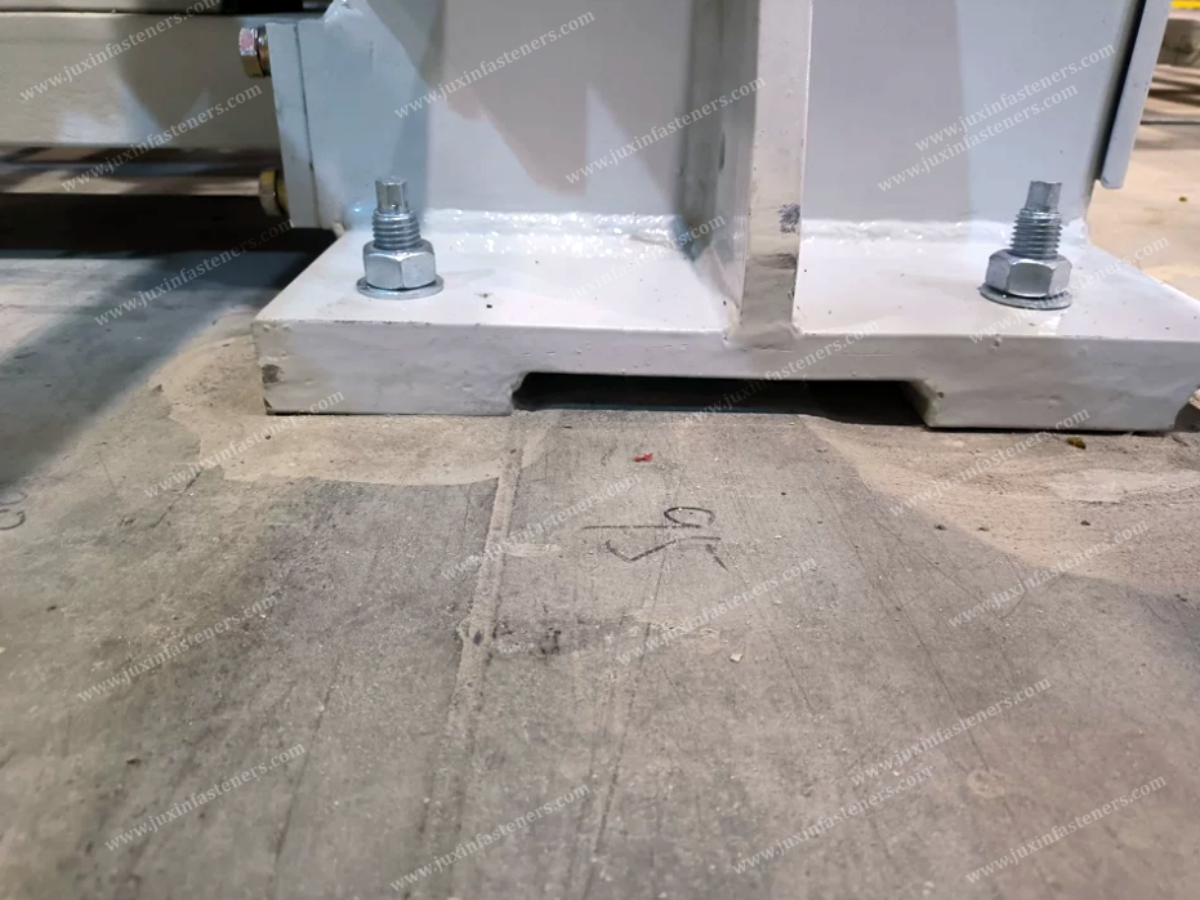
Common International Product Terminology
Related search and purchasing terms include:
Heavy-duty hex head tapping screws
Hex head concrete screws
Hex washer head concrete screws
Concrete tapping screws
Self-tapping concrete screws
Concrete screw anchors
Masonry tapping screws
Masonry screw anchors
Concrete screw bolts
Mechanical screw anchors
Industrial concrete fixing screws
These names can describe related products, but they should not be treated as exact technical equivalents without a drawing or product designation.
Important Engineering Distinction
An ordinary hex head self-tapping screw is not automatically a concrete screw anchor.
Likewise, a conventional high-strength hex bolt does not become a concrete anchor simply because it is manufactured from hardened steel.
How Concrete Tapping Screws Work
Concrete screw anchors develop resistance through mechanical interaction between their specially shaped threads and the surrounding substrate.
A typical load path is:
Attached fixture → screw head and shank → engaged screw threads → concrete or masonry substrate.
When the screw is installed into the specified pilot hole, its thread engages the base material.
The connection may be subjected to:
Axial tension
Transverse shear
Combined tension and shear
Eccentric loading
Equipment vibration
Environmental exposure
The applicable resistance depends on the complete anchor system and substrate, not simply the screw's steel strength.
Thread Geometry and Mechanical Engagement
Concrete screw performance is influenced by several design characteristics.
Thread Pitch
Thread spacing influences how the screw engages the substrate and behaves during installation.
Thread Depth
Thread depth affects the interaction between the screw and the material surrounding the hole.
Core Diameter
The screw's core geometry influences its steel resistance and installation behavior.
Thread Flank Geometry
The shape of the thread flanks affects mechanical engagement and load transfer.
Tip Design
The tip must be compatible with the specified installation procedure and substrate.
Material Hardness
Appropriate thread hardness can support engagement with mineral substrates, but excessive hardness may create brittle-fracture concerns.
Engineering Information Gain: Why More Aggressive Threads Are Not Always Better
Increasing thread depth or hardness does not automatically improve anchor performance.
A more aggressive thread may increase installation resistance, damage a weak substrate or create undesirable stresses in the screw.
The correct design balances thread engagement, steel integrity, substrate interaction and installation consistency.
For an evaluated concrete anchor, changes to thread geometry, material or heat treatment require technical review.
Concrete and Masonry Are Different Fastening Substrates
One of the most important selection decisions is identifying the actual base material.
A screw anchor qualified for normal-weight concrete is not automatically suitable for brick, hollow masonry or lightweight concrete.
Normal-Weight Concrete
Concrete screw anchors may be used in specified normal-weight concrete applications when the product's technical evaluation covers the required conditions.
Relevant variables include:
Concrete compressive strength
Cracked or uncracked condition
Concrete member thickness
Reinforcement location
Anchor edge distance
Anchor spacing
Required embedment
Cracked Concrete
Some concrete screw anchors are qualified for cracked concrete under defined conditions.
Others are limited to uncracked concrete.
The exact approval scope must be checked.
Precast Concrete
Precast components can present additional installation constraints.
These may include:
Thin concrete sections
Limited edge distances
Dense reinforcement
Factory-produced mounting holes
Restricted installation access
Requirements for repeatable assembly
The engineer should verify that the selected screw anchor is suitable for the actual precast element.
Solid Brick
Masonry tapping screws may be considered for solid brick where the product is suitable for the specific material.
Brick strength, condition, installation location and product-specific evaluation are important.
Concrete Masonry Units
Concrete masonry units may be:
Solid
Fully grouted
Partially grouted
Hollow and ungrouted
These conditions can have substantially different anchoring behavior.
A product evaluated for fully grouted CMU must not automatically be assumed suitable for hollow CMU.
Mortar Joints
Installation into mortar joints may be restricted or require separate technical evaluation.
Lightweight or Deteriorated Substrates
Weak, porous, cracked or deteriorated substrates may not develop adequate thread engagement.
Engineering assessment or a different fastening approach may be required.
Substrate Selection Table
| Substrate | Key engineering concern | Selection requirement |
|---|---|---|
| Normal-weight concrete | Strength and load resistance | Product-specific concrete qualification |
| Cracked concrete | Crack effects on anchoring | Cracked-concrete approval |
| Precast concrete | Member thickness and edge distance | Compatible anchor and precast design |
| Solid brick | Variable masonry properties | Masonry-specific evaluation |
| Fully grouted CMU | Unit and grout properties | Applicable masonry technical data |
| Hollow CMU | Face-shell and web behavior | Explicit hollow-masonry qualification |
| Lightweight concrete | Different substrate resistance | Product-specific approval |
| Deteriorated concrete | Uncertain material condition | Engineering investigation |
Practical Rule
The correct question is not simply whether a screw is described as suitable for masonry.
It is whether the exact screw model, size and installation configuration are suitable for the actual masonry construction.
Why Choose a Hex Head Configuration?
A hexagonal head provides a practical interface for installation using compatible sockets and drivers.
Installation Tool Access
External hex heads can be convenient where the fixture provides adequate socket clearance.
Repeatable Tooling
A standardized head configuration can simplify tool selection across multiple installations.
Fixture Bearing
Certain products use an integral washer or flange to provide a bearing surface against the fixture.
Assembly Productivity
Where permitted by the manufacturer's instructions, compatible powered installation tools can improve repeatability and reduce manual handling.
Head Design Limitations
The hex head must not be selected independently of the fixture design.
Check:
Socket clearance
Head height
Fixture-hole diameter
Bearing area
Washer requirements
Access for inspection
Interference with adjacent equipment
An integral washer head does not automatically replace a separate washer required by the design or applicable installation instructions.
Concrete Screw Installation: From Engineering Drawing to Field Assembly
Installation quality has a direct influence on the performance of concrete screw anchors.
The exact procedure must follow the manufacturer's published instructions and project requirements.
Verify the Fastener
Confirm the correct:
Product model
Diameter and length
Head configuration
Material and finish
Required embedment
Approved substrate
Installation procedure
Verify the Substrate
Check concrete or masonry type, condition and relevant geometry.
Confirm the Anchor Layout
Review the fixture drawing and anchor locations.
Pay particular attention to concrete edges, anchor spacing and reinforcement restrictions.
Drill the Pilot Hole
Use the specified:
Drill bit diameter
Drilling method
Hole depth
Drilling equipment
An incorrectly sized hole may affect thread engagement and installation performance.
Prepare the Hole
Follow the actual product's cleaning requirements.
Some qualified concrete screw systems permit installation without a separate cleaning operation under specified conditions.
Other systems require cleaning.
A universal cleaning rule should not be substituted for the approved installation instructions.
Position the Fixture
Confirm alignment, fixture thickness and installation access.
Drive the Screw
Use the specified driver and installation procedure.
Do not assume that all concrete screws permit the same impact tool or tightening method.
Verify the Installed Condition
Inspect the screw seating, fixture condition and other required acceptance criteria.
Record Critical Installations
Where project requirements call for inspection records, maintain the required installation documentation.
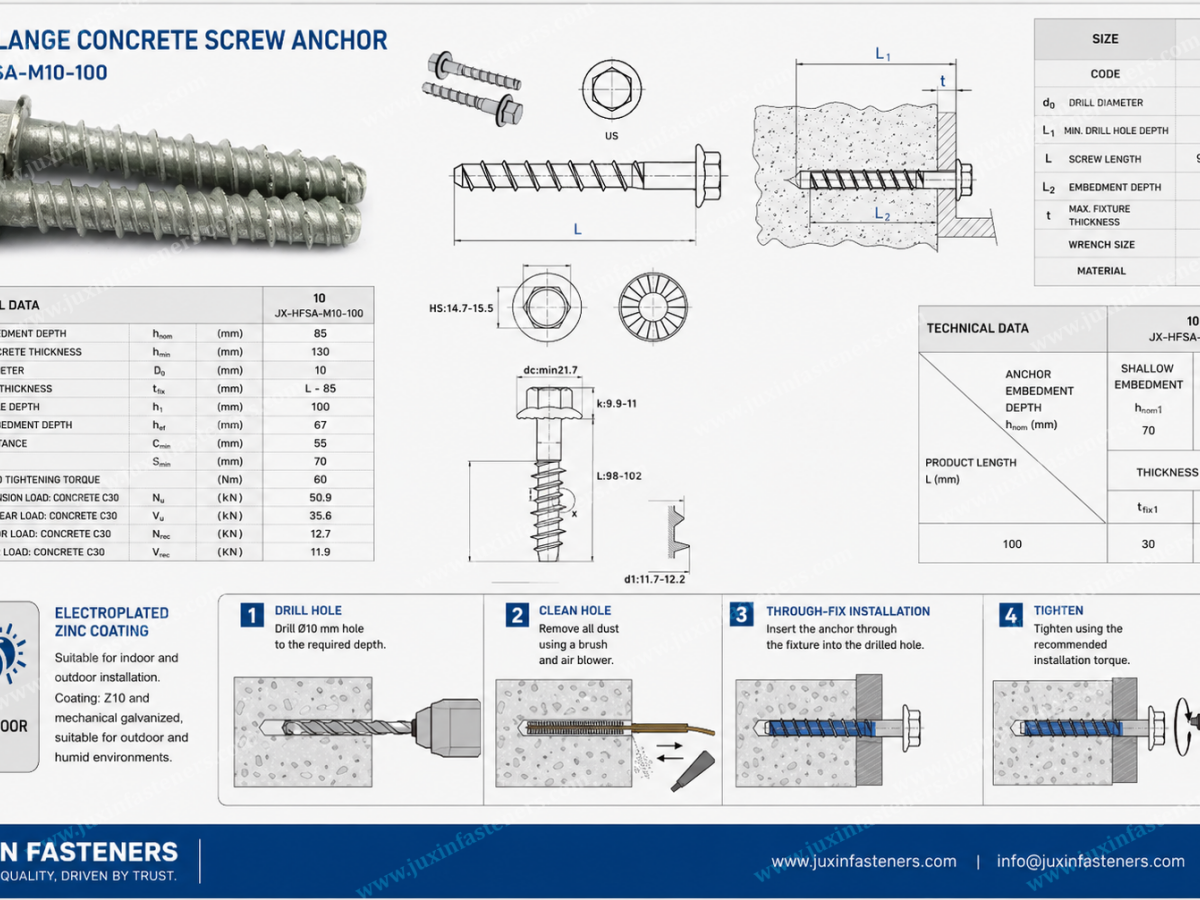
Pilot Hole Diameter, Hole Depth and Effective Embedment
These dimensions are related but not interchangeable.
| Parameter | Meaning | Common specification error |
|---|---|---|
| Screw diameter | Product size designation | Assuming it equals every thread dimension |
| Pilot hole diameter | Specified drilled-hole size | Using a generic tapping screw drill chart |
| Drilled-hole depth | Depth of prepared hole | Confusing it with embedment |
| Overall screw length | Product length | Ignoring fixture thickness |
| Effective embedment | Design-related anchoring depth | Assuming longer screws always provide greater resistance |
| Fixture thickness | Thickness of attached component | Selecting inadequate screw length |
| Edge distance | Distance to substrate edge | Overlooking breakout or splitting |
| Anchor spacing | Distance between anchors | Ignoring anchor-group interaction |
Why Pilot Hole Accuracy Matters
An oversized hole may reduce mechanical thread engagement.
An undersized hole may increase installation resistance or damage the screw or substrate.
The correct drilling dimensions must be obtained from the exact product's technical documentation.
Why Overall Length Is Not Enough
A long screw does not necessarily provide the required effective embedment.
The fixture thickness, installation geometry and approved embedment configuration must all be considered.
Why Fixture Thickness Matters
An equipment bracket with a thicker base plate may require a different screw length or installation configuration.
For OEM procurement, fixture thickness should be included in the RFQ rather than left for the supplier to assume.
Installation Torque and Screw Damage
Concrete screw installation is different from tightening a conventional machine bolt.
The applied torque or driving resistance may reflect thread formation, friction and interaction with the substrate.
Excessive Installation Resistance
Possible causes include:
Incorrect hole diameter
Insufficient hole depth
Unsuitable drilling method
Wrong substrate
Damaged screw threads
Incorrect installation tool
Insufficient Engagement
Possible causes include:
Oversized hole
Deteriorated substrate
Incorrect screw selection
Previously damaged hole
Engineering Rule
Do not use ordinary bolt-tightening torque charts to determine the installation procedure for concrete screw anchors.
Use the exact anchor manufacturer's instructions.
Can Concrete Tapping Screws Be Removed and Reused?
Removability, reinstallation and reuse are separate technical conditions.
Removal
Certain concrete screw anchors can be unscrewed from the substrate.
Reinstallation
Some products permit specified adjustment or reinstallation procedures.
Reuse
Certain specially evaluated systems permit reuse under restricted conditions, potentially including inspection with a dedicated wear gauge.
These capabilities must not be assumed for every product.
A Removable Screw Is Not Necessarily a Reusable Anchor
Removing a screw does not prove that it can safely be installed again in the same hole.
For safety-related applications, the reuse procedure must be supported by the product's technical documentation.
Load Resistance and Failure Modes
A heavy-duty concrete screw connection may be governed by several failure mechanisms.
Steel Failure in Tension
The screw may fail under excessive axial tensile loading.
Steel Failure in Shear
The screw may fail under transverse loading.
Concrete Cone Breakout
A region of concrete may fracture around the anchor.
Pullout or Loss of Mechanical Engagement
The screw may lose its intended engagement with the substrate.
Concrete Splitting
The concrete may split because of geometry, loading or installation effects.
Concrete Edge Breakout
Concrete near an edge may fail under shear.
Concrete Pryout
Certain shear-loading conditions may cause pryout failure.
Anchor Group Effects
Closely spaced screws may have interacting concrete failure regions.
Fixture Failure
A bracket or base plate may bend or fail before the anchor reaches its resistance.
Why Higher Steel Strength Does Not Guarantee a Stronger Connection
If the concrete substrate controls the failure mode, increasing screw steel strength may not increase the design resistance.
The engineer must assess the complete connection.
Edge Distance and Anchor Spacing
Some concrete screw systems are evaluated for relatively compact anchor layouts.
However, minimum edge distance and spacing are product-specific.
A screw that is suitable near an edge in one approved configuration may not be suitable under a different loading or embedment condition.
Combined Tension and Shear
Equipment brackets may experience tension and shear simultaneously.
The connection must be evaluated using the applicable design method and product data.
Vibration and Dynamic Loads
Machinery, transportation equipment and industrial facilities may expose connections to dynamic loads.
Do not assume that a concrete screw is suitable for significant fatigue loading merely because it has a hardened thread.
Overhead Installations
Suspended MEP supports and other overhead attachments can be safety-critical.
Use a product evaluated for the intended installation and load conditions.
Industrial Applications and Engineering Solutions
Construction and Building Services
Heavy-duty concrete screws may be considered for qualified installations involving:
Metal brackets
Secondary framing
Building-service supports
Construction accessories
Architectural fixtures
Maintenance attachments
The selected anchor must match the actual substrate and design requirements.
HVAC and Mechanical Equipment
Potential applications include:
HVAC equipment brackets
Pipe-support accessories
Mechanical service frames
Duct support components
Selected equipment mounting hardware
Engineering priorities include load resistance, vibration, corrosion exposure and installation access.
Electrical and MEP Systems
Concrete screw anchors may be relevant to:
Electrical conduit supports
Cable tray brackets
Junction-box mounting
Control panel support brackets
Electrical service frames
Mechanical and electrical installation accessories
For overhead or seismic applications, the required qualification and engineering design must be verified.
Precast Concrete Manufacturing and Installation
Precast concrete presents a useful example of the relationship between product design and installation productivity.
An OEM or precast manufacturer may need to coordinate:
Concrete element dimensions
Embedded reinforcement
Anchor layout
Factory drilling operations
Fixture-hole tolerances
Installation tooling
Product traceability
Information Gain: Design for Repeatable Precast Installation
Where the same bracket is installed across many precast elements, an early review of drilling access and anchor location may prevent substantial downstream rework.
A technically suitable anchor may still be impractical if the installer cannot position the drill or driver correctly.
Industrial Equipment Installation
Potential applications include:
Equipment support brackets
Machinery accessories
Industrial cabinets
Guarding systems
Maintenance fixtures
Auxiliary mounting hardware
For heavy machinery, impact loads or significant vibration, the responsible engineer must confirm that the anchor system is suitable.
Infrastructure and Civil Engineering
Potential applications include selected:
Utility supports
Roadside equipment brackets
Service fixtures
Infrastructure maintenance hardware
Precast attachments
Equipment enclosures
Environmental exposure and project-specific design requirements are particularly important.
Rail and Transportation Facilities
Concrete screw anchors may be considered for qualified auxiliary equipment and support installations.
Rail-related applications may require additional evaluation of vibration, fatigue, corrosion and project specifications.
Data Centers and Industrial Power Infrastructure
Selected applications may include:
Electrical support brackets
UPS equipment accessories
Cooling-system support components
Mechanical plant equipment
Facility maintenance installations
Not every data center cabinet or server rack requires concrete anchoring.
The actual equipment design determines the fastening requirement.
Industrial Application Matrix
| Application | Engineering priority | Production or procurement priority |
|---|---|---|
| HVAC supports | Applied loads and vibration | Repeatable installation |
| Electrical brackets | Substrate and anchor layout | Correct product identification |
| Precast concrete | Thickness and reinforcement | Drilling access and tolerances |
| Industrial cabinets | Stability and fixture geometry | Standardized mounting hardware |
| Machinery accessories | Dynamic loading | Installation reliability |
| Infrastructure fixtures | Durability and safety | Product documentation |
| Rail auxiliary equipment | Vibration and corrosion | Project-specific qualification |
| MEP installations | Overhead loading | Tooling and installation controls |
| Facility retrofits | Existing substrate condition | Rework prevention |
Corrosion Resistance and Material Selection
Concrete screw anchors may be exposed to indoor humidity, condensation, outdoor weather or industrial chemicals.
Material and coating selection should reflect the actual service environment.
Coated Carbon Steel
Coated carbon steel may be suitable for certain indoor applications.
The coating type and thickness must be specified where relevant.
Zinc-Based Coatings
Zinc-based systems may provide corrosion protection, but their suitability depends on the coating specification and exposure.
Stainless Steel Concrete Screws
Some commercial concrete screw anchors use stainless steel constructions.
The actual design may involve specialized cutting-thread features or other material arrangements.
Do not assume that any ordinary stainless steel screw can cut threads effectively into concrete.
410 Stainless Steel
Certain hardened screw products use martensitic stainless steel grades.
However, corrosion resistance and mechanical behavior differ from austenitic stainless steels.
304 and 316 Stainless Steel
These grades may provide improved corrosion resistance in appropriate environments.
Their suitability for a concrete screw anchor depends on the actual product design and qualification.
Material Selection Matrix
| Exposure condition | Preliminary consideration | Required verification |
|---|---|---|
| Dry indoor installation | Suitable coated carbon steel | Product approval and coating |
| Humid industrial building | Enhanced corrosion protection | Condensation and exposure |
| Outdoor equipment | Appropriate corrosion-resistant system | Environmental suitability |
| Coastal facility | Suitable stainless or other qualified system | Chloride-related corrosion |
| Chemical processing area | Application-specific material | Chemical compatibility |
Coating Changes Can Affect Installation
A coating may change thread dimensions, friction and installation behavior.
An alternative finish should not be substituted into an evaluated anchor system without technical review.
Hydrogen Embrittlement
Certain hardened steel fasteners may be susceptible to hydrogen embrittlement under relevant processing and service conditions.
Material strength, heat treatment and coating processes should be considered.
Corrosion Testing
ASTM B117 and ISO 9227 are laboratory corrosion test methods.
Salt spray test duration should not be presented as a direct guarantee of outdoor service life.
Concrete Screw Anchors vs. Expansion Anchors and Bonded Anchors
These fastening technologies operate differently.
| System | Primary mechanism | Important consideration |
|---|---|---|
| Concrete screw anchor | Thread engagement with substrate | Correct hole and screw geometry |
| Wedge expansion anchor | Mechanical expansion | Setting procedure and concrete geometry |
| Sleeve expansion anchor | Expansion of sleeve assembly | Product-specific installation |
| Bonded anchor | Bond between anchor, adhesive and substrate | Hole preparation, curing and installation conditions |
| Structural steel bolt | Steel-to-steel connection | Structural connection design, not concrete anchoring |
Are Concrete Screws Faster to Install?
They can reduce installation steps in certain applications.
However, total installation time depends on drilling, cleaning, tooling, inspection and rework.
Are Concrete Screws Stronger Than Wedge Anchors?
Neither product category is universally stronger.
Design resistance must be compared using product-specific data under equivalent conditions.
Can Concrete Screws Replace Bonded Anchors?
Only where engineering review confirms that the alternative system satisfies the required loads, geometry, substrate and qualification.
Concrete Screws Are Not Structural Steel Bolts
A concrete screw anchor is designed to fasten a component to an appropriate concrete or masonry substrate.
A structural steel bolt is designed for a different connection system.
Conventional high-strength bolts used in steel-to-steel connections cannot be substituted for concrete screw anchors based solely on diameter or steel strength.
International Technical Standards and Product Evaluation
EN 1992-4
EN 1992-4 provides European design provisions for applicable fastenings used in concrete.
The design addresses relevant resistance and failure mechanisms.
European Technical Assessment
An ETA provides assessed characteristics and intended-use information for a particular construction product.
It may define:
Product models and sizes
Substrate conditions
Embedment configurations
Installation instructions
Characteristic resistance
Cracked-concrete suitability
Seismic conditions, where assessed
Environmental limitations
EAD 330232-02-0601
This European Assessment Document concerns mechanical fasteners for use in concrete.
The actual ETA and its assessment basis must be verified for the specific anchor.
ACI 318 Chapter 17
ACI 318 Chapter 17 provides design provisions for anchoring to concrete in applicable North American projects.
The governing edition depends on the adopted building code.
ACI 355.2
ACI 355.2 addresses qualification of post-installed mechanical anchors for concrete.
ICC-ES Evaluation Reports
An ICC-ES report provides product-specific evaluation information under stated conditions.
Concrete and masonry may be covered by separate reports or provisions.
TMS 402
Applicable masonry anchoring design may involve TMS 402 provisions together with product-specific technical evaluations.
Important Standards Distinction
Material, thread and coating standards do not automatically establish anchoring resistance.
An ISO material designation or ASTM coating specification is not a substitute for concrete anchor qualification.
Metric and Inch-Based Products
Metric concrete screw products and inch-based products must be identified by their actual dimensions and product specifications.
Where an anchor includes a machine-thread interface, metric, UNC, UNF, BSW and BSF threads must not be treated as directly interchangeable.
Inch conversions of metric dimensions are reference values, not automatic replacement specifications.
OEM Manufacturing and Product Consistency
For industrial buyers, concrete screw sourcing involves both the physical fastener and its required technical documentation.
Potential manufacturing considerations include:
Head forming
Shank dimensions
Specialized thread geometry
Material specification
Heat treatment
Surface finishing
Dimensional inspection
Packaging and identification
The actual manufacturing route depends on the product design.
Why Thread Geometry Consistency Matters
Variation in thread geometry can affect:
Driving resistance
Thread engagement
Installation repeatability
Screw damage risk
Substrate interaction
Why Heat Treatment Consistency Matters
Heat-treatment variation can influence hardness, strength and brittle-fracture susceptibility.
Why Packaging Matters
Mixing different lengths, materials or anchor configurations can cause installation errors.
Clear labeling and controlled packaging help production teams use the intended product.
Critical Qualification Boundary
Routine dimensional inspection, material testing or hardness testing does not replace product-level concrete anchor qualification.
A customized concrete-style screw must not be presented as an approved structural anchor without the relevant evaluation.
Production Efficiency and Installation Quality
Production managers and manufacturing engineers should evaluate the total installation process.
Standardize Product References
Use an exact product designation or drawing.
Standardize Drilling
Control the required drill size, method and depth.
Standardize Tooling
Use compatible drivers and approved installation methods.
Control Fixture Dimensions
Verify mounting-hole location, thickness and access.
Prevent Component Mixing
Separate different screw sizes, materials and coatings.
Establish Inspection Criteria
Define acceptable seating and installation conditions.
Control Rework
Use a product-specific corrective procedure when an installation fails.
Information Gain: Total Installed Cost
A concrete screw with a lower unit price may create higher project costs if installation inconsistency causes:
Damaged holes
Broken screws
Misaligned fixtures
Additional drilling
Engineering reassessment
Installation downtime
Replacement hardware
For repeat OEM projects, reliable installation and consistent supply may be more valuable than a small reduction in fastener purchase price.
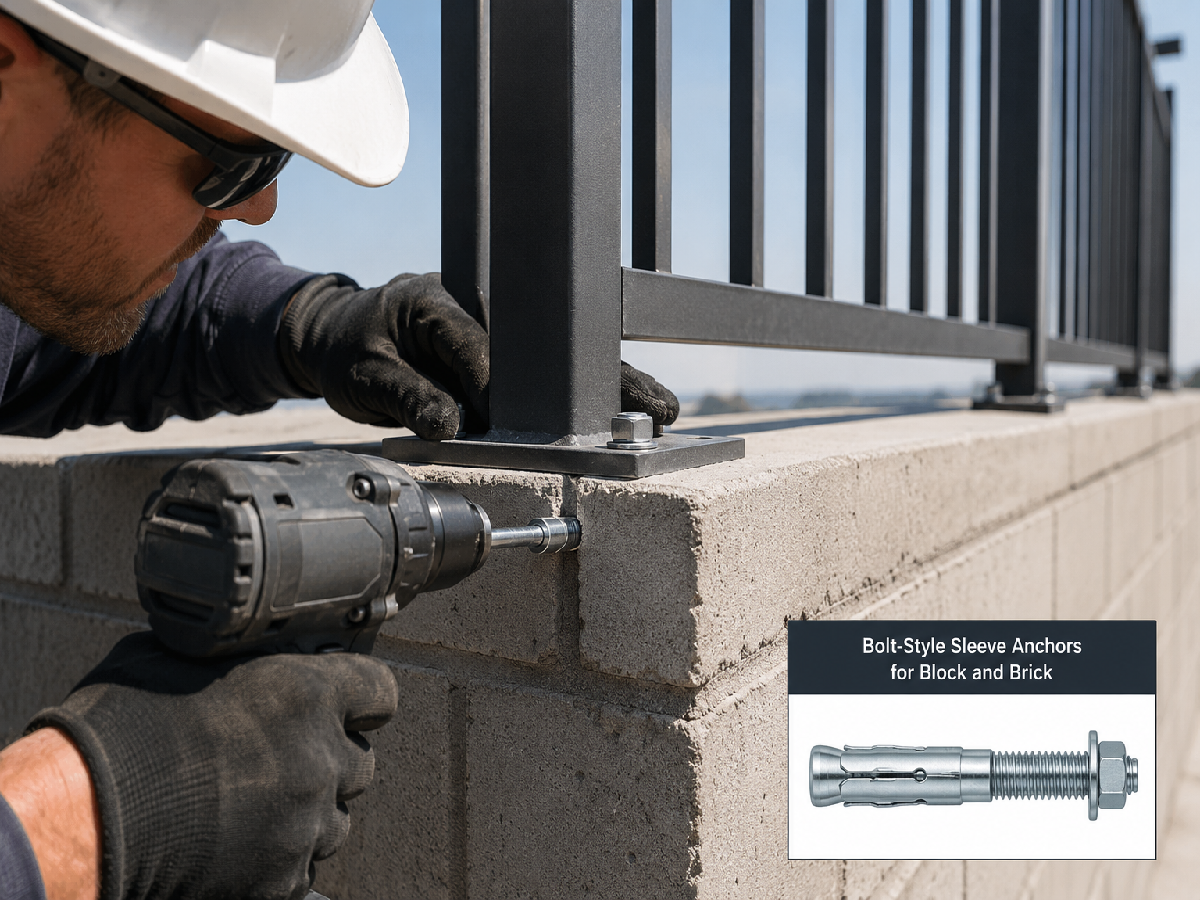
Supplier Development and Industrial Procurement
Procurement teams should distinguish between sourcing an ordinary tapping screw and sourcing an engineered concrete anchor.
Exact Product Identification
Confirm the required product model, head configuration, diameter and length.
Substrate Compatibility
Verify the actual concrete or masonry application.
Technical Documentation
Request the necessary drawings, installation instructions and evaluation reports.
Material and Finish
Specify the required material and corrosion protection.
Quality Requirements
Define relevant inspection, traceability and documentation requirements.
Change Control
Review any proposed changes to:
Thread geometry
Material
Heat treatment
Surface finish
Head design
Manufacturing process affecting performance
Commercial Requirements
Confirm:
Sample requirements
MOQ
Initial order quantity
Annual forecast
Lead time
Packaging
Delivery destination
Repeat-order requirements
Supplier Evaluation Table
| Requirement | Why it matters |
|---|---|
| Product model and drawing | Prevents incorrect substitution |
| Concrete or masonry qualification | Confirms intended use |
| Installation documentation | Supports controlled assembly |
| Thread geometry | Influences engagement |
| Material and heat treatment | Influences mechanical behavior |
| Corrosion protection | Supports durability |
| Dimensional inspection | Supports product consistency |
| Lot identification | Supports traceability |
| Change control | Protects approved configuration |
| MOQ and lead time | Supports procurement planning |
| Packaging specification | Reduces installation errors |
Juxin Fasteners: Concrete and Masonry Fastening Solutions
Juxin Fasteners has more than 20 years of experience in international industrial fastener supply.
We support technical and commercial inquiries for:
Heavy-duty hex head tapping screws
Concrete tapping screws
Masonry fastening components
Industrial mounting screws
Special threaded fasteners
Custom bolts and studs
CNC machined fastening components
Drawing-based OEM hardware
Depending on the requested product, technical review may cover:
Dimensions and tolerances
Head configuration
Thread specifications
Material selection
Heat-treatment requirements
Surface finish
Inspection requirements
Packaging
Order quantities
Specific availability, manufacturing feasibility, lead times and technical documentation must be confirmed for each inquiry.
For structural or safety-related anchoring, product qualification and engineering design remain essential.
Frequently Asked Questions
What are heavy-duty hex head tapping screws used for?
They are used to attach suitable fixtures, brackets, equipment accessories and building-services components to approved concrete or masonry substrates.
Are concrete tapping screws the same as ordinary self-tapping screws?
No. Concrete screw anchors require specialized thread geometry and material properties suitable for the intended substrate.
Can concrete screws be used in brick?
Some masonry screw products can be used in specified brick substrates. Suitability must be verified for the exact product and brick construction.
Can concrete screws be installed in hollow blocks?
Only where the selected product is specifically evaluated for the relevant hollow masonry conditions.
Can concrete screws be used in cracked concrete?
Some qualified products can. The exact approval scope must be checked.
What pilot hole diameter should be used?
Use the diameter specified by the exact concrete screw manufacturer.
How deep should a concrete screw be installed?
Follow the product's required hole depth and approved embedment configuration.
Are hex head concrete screws suitable for powered installation?
Some are, subject to the manufacturer's approved tools and procedures.
Can concrete screws be removed?
Certain products can be unscrewed. Removal does not automatically establish permission for reuse.
Can a concrete screw be reinstalled in the same hole?
Only where the product documentation specifically permits the procedure.
Are concrete screws stronger than expansion anchors?
Neither category is universally stronger. Compare approved design resistance under equivalent conditions.
Can concrete screws be used outdoors?
Yes, where the selected product and corrosion-protection system are appropriate for the environment.
Can an ordinary ISO 10.9 bolt replace a concrete screw anchor?
No. A conventional high-strength bolt does not automatically have the geometry or qualification needed for concrete anchoring.
Do all concrete screws have ETA or ICC-ES evaluation reports?
No. Technical evaluation is product-specific.
Can Juxin Fasteners review customized concrete fastening requirements?
Yes. Drawing-based fastening inquiries can be reviewed for technical and commercial feasibility.
Required anchor qualification must be established separately.
OEM Concrete and Masonry Tapping Screw RFQ Checklist
For a technically accurate quotation, provide the following information where available.
Product Details
Product name or reference
Technical drawing
Head configuration
Nominal diameter
Overall length
Thread specification
Material
Heat treatment
Surface finish
Application
Concrete or masonry substrate
Concrete strength, if applicable
Cracked or uncracked condition
Precast or cast-in-place construction
Masonry unit and grouting condition
Fixture drawing
Fixture thickness
Member thickness
Edge distance
Anchor spacing
Engineering Requirements
Tension
Shear
Combined loading
Dynamic loading
Seismic requirements, if applicable
Required embedment
Applicable design standard
Required ETA or ICC-ES documentation
Installation Requirements
Pilot hole diameter
Drilling method
Hole depth
Installation tool
Setting procedure
Inspection requirements
Removal or reuse requirements, if applicable
Commercial Requirements
Sample quantity
Initial order quantity
Annual forecast
MOQ expectations
Required delivery schedule
Packaging
Delivery destination
Request a Heavy-Duty Hex Head Tapping Screw Quotation
Juxin Fasteners welcomes inquiries from industrial OEMs, construction product distributors, equipment manufacturers,
engineering contractors, production managers, supplier development teams and international procurement professionals.
Whether your project requires standard heavy-duty concrete tapping screws, masonry fastening hardware or drawing-based industrial fixing components,
begin with the actual product and application requirements.
Send us your drawings, dimensions, material specifications, surface treatment requirements, expected quantities and delivery requirements.
For structural or safety-related concrete and masonry anchoring, please include the required technical evaluation and engineering documentation.
Company: Juxin Fasteners
Website: https://www.juxinfasteners.com/
Email: info@juxinfasteners.com
Reliable Industrial Fixing Begins With Correct Product Selection, Verified Substrate Compatibility and Consistent Installation.
 MORE NEWS
Oct. 13, 2026
Contact Us
Tel.:
+86 020 8621 0320
+86 020 3121 6067
E-mail:
Technical Support:
Navigation
SEND INQUIREY