Call Us
+86 136 6007 9809
Call Us
+86 136 6007 9809

Jun. 27, 2024
Hexagon Bolt Materials, Strength Classes and OEM Selection Guide
Hexagon head bolts are among the most widely used threaded fasteners in industrial machinery, automotive equipment, mechanical structures and OEM manufacturing.
Their external hexagonal heads allow installation using suitable wrenches or sockets, while their threaded shanks provide removable mechanical connections.
However, two hex bolts with the same nominal thread diameter may have substantially different mechanical properties, corrosion resistance, thread lengths and installation requirements.
For design engineers, selecting the correct hex bolt involves evaluating joint loading, material properties, bolt geometry, thread engagement and service conditions.
For manufacturing engineers and production managers, the fastener must also support repeatable tightening, practical installation access, inspection and consistent assembly quality.
For procurement specialists and supplier development teams, correct specifications are essential when comparing suppliers,
evaluating replacement products and sourcing standard or customized OEM bolts.
JUXIN FASTENERS supplies industrial hexagon head bolts, high-strength fasteners, stainless steel bolts and drawing-based custom fastening components for international OEM applications.
This guide explains the material, dimensional and mechanical factors that should govern hex bolt selection.
What Is a Hexagon Head Bolt?
A hexagon head bolt is an externally threaded fastener with a six-sided head.
Depending on the design, it may be used with a mating nut or installed into a suitable internally threaded component.
Main Components
Hexagonal head
Underhead bearing surface
Shank
External thread
Thread end
Common Installation Tools
Open-end or box wrenches
Hexagonal sockets
Torque wrenches
Suitable powered assembly tools
Typical Industrial Applications
Machine frames
Mechanical brackets
Industrial equipment
Automotive auxiliary assemblies
Electrical equipment supports
Maintenance and serviceable joints
Engineering Principle
The head shape provides a practical drive interface.
The strength and reliability of the connection depend on the complete bolt and joint specification.
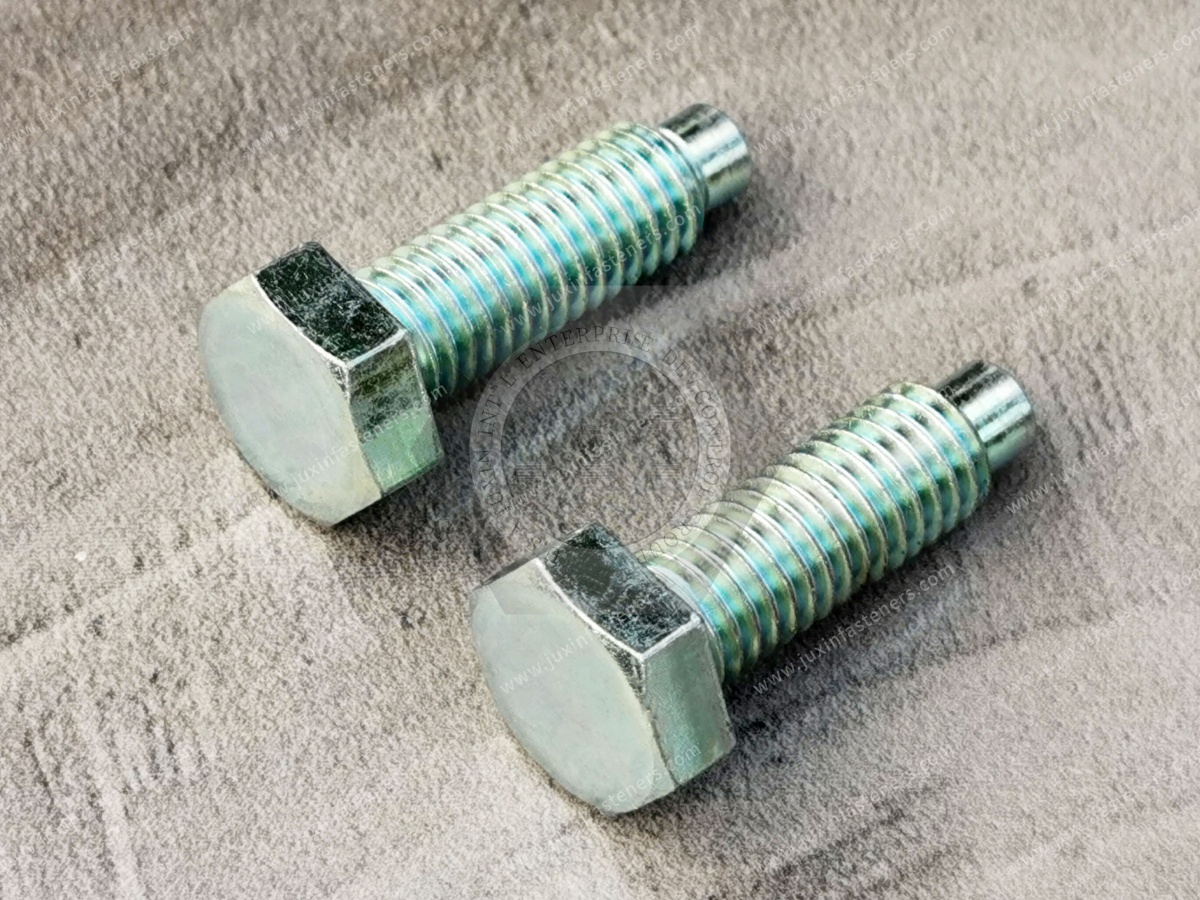
Why Hex Bolt Material Selection Matters
Material selection affects:
Mechanical properties
Temperature suitability
Corrosion behavior
Manufacturing characteristics
Surface treatment compatibility
Cost
The material should be selected according to the application rather than assuming that one steel grade is suitable for every industrial connection.
Carbon Steel Hex Bolts
Carbon steel is widely used in general industrial threaded fasteners.
Different carbon steel compositions and manufacturing processes may be used to achieve specified mechanical properties.
Potential Advantages
Broad industrial applicability
Established manufacturing methods
Compatibility with suitable surface treatments
Cost-effective options for many applications
Typical Applications
General machinery
Equipment frames
Industrial brackets
Electrical equipment
Construction machinery accessories
Important Limitation
The term carbon steel does not establish a particular tensile strength or property class.
The required mechanical properties must be specified separately.
Alloy Steel Hex Bolts
Alloy steels may be selected for applications requiring particular mechanical properties or heat-treatment responses.
Typical Engineering Requirements
Higher specified tensile strength
Defined proof-load performance
Suitable hardness
Controlled mechanical properties
Compatibility with the operating environment
Potential Applications
Heavy machinery
Industrial gearboxes
Automotive mechanical equipment
High-load mechanical assemblies
Material Grade vs. Property Class
A steel grade describes material composition and related requirements.
A bolt property class describes specified mechanical performance.
These are not interchangeable concepts.
Example
A drawing that specifies class 10.9 does not automatically identify one unique alloy steel grade.
Similarly, naming an alloy steel does not independently establish that the finished bolt meets class 10.9.
The finished fastener must meet the applicable mechanical requirements.
Stainless Steel Hex Bolts
Stainless steel bolts may be selected where suitable corrosion resistance is required.
Common material families include austenitic stainless steels associated with A2 and A4 fastener designations.
A2 Stainless Steel
Often considered for general corrosion-resistant industrial applications.
A4 Stainless Steel
May be considered for environments where additional resistance to certain corrosive conditions is required.
Important Limitation
Neither A2 nor A4 is universally suitable for every chemical or marine environment.
Mechanical Properties
Stainless steel fastener mechanical properties may be specified according to ISO 3506-1, where applicable.
These designations must not be confused with carbon steel property classes under ISO 898-1.
Potential Applications
Food-processing equipment
Industrial enclosures
Selected outdoor machinery
Chemical-processing accessories
Marine-related auxiliary equipment
Stainless Steel Galling
Certain stainless steel threaded combinations may be susceptible to galling.
Thread fit, installation speed, surface condition and suitable lubrication should be considered.
Carbon Steel vs. Alloy Steel vs. Stainless Steel Hex Bolts
| Selection factor | Carbon steel | Alloy steel | Stainless steel |
|---|---|---|---|
| General industrial use | Common | Common | Common where suitable |
| High-strength applications | Depends on specification | Frequently considered | Depends on grade and design |
| Corrosion resistance | Usually requires suitable protection | Usually requires suitable protection | Depends on stainless grade and environment |
| Heat treatment | Depends on product | Often important | Depends on grade and product |
| Cost | Application-dependent | Application-dependent | Application-dependent |
| Typical selection driver | General mechanical requirements | Specified mechanical properties | Corrosion and material compatibility |
Engineering Recommendation
Do not select bolt material based on a single property.
Mechanical strength, corrosion behavior, temperature and total application requirements should be evaluated together.
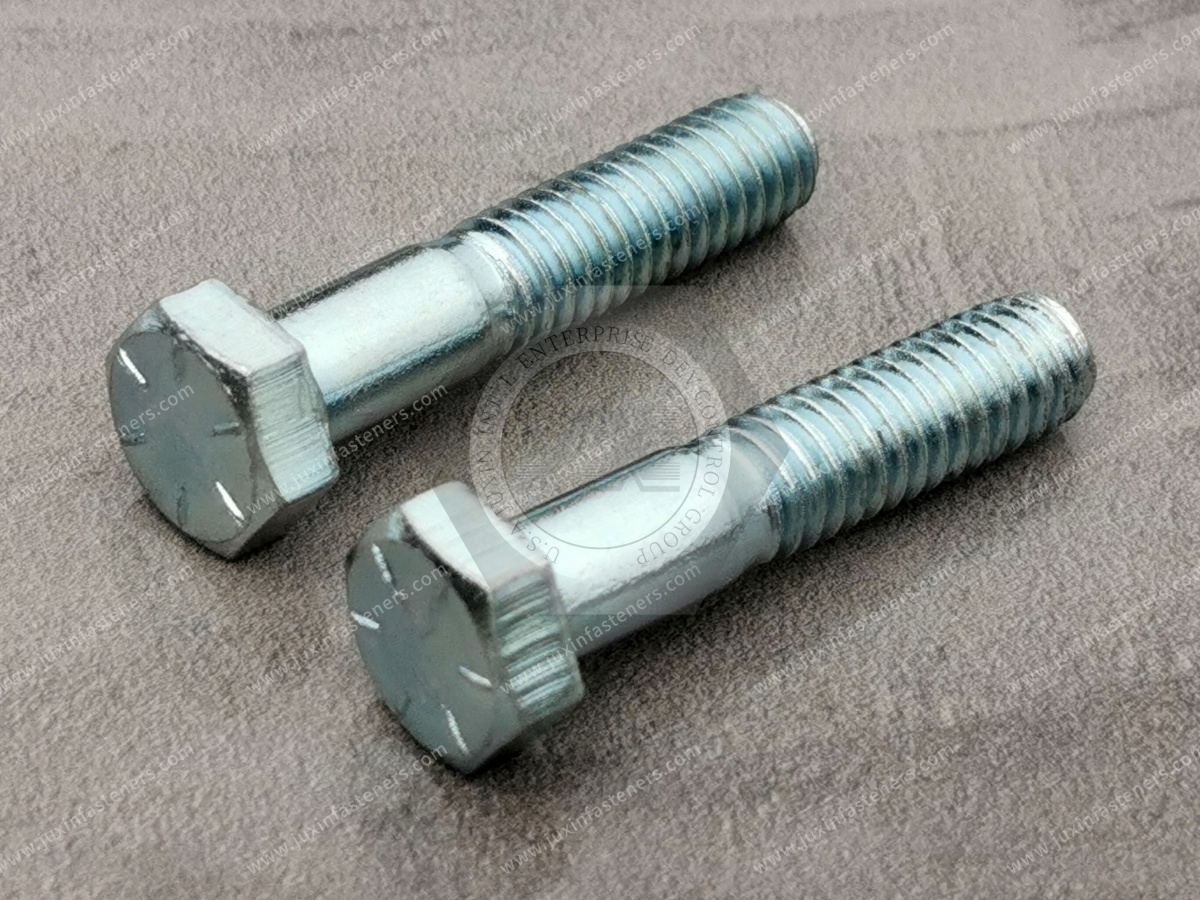
Hexagon Bolt Standards: DIN 931, DIN 933, ISO 4014 and ISO 4017
Dimensional standards define important characteristics of industrial hex bolts.
DIN 931
A traditional designation for partially threaded hexagon head bolts.
DIN 933
A traditional designation for fully threaded hexagon head screws.
ISO 4014
Covers specified hexagon head bolts with partial threading.
ISO 4017
Covers specified hexagon head screws with full threading.
Important Compatibility Note
Traditional DIN designations and their related ISO standards should not automatically be treated as dimensionally identical in every size and detail.
When replacing an existing fastener, compare the actual requirements.
Key Dimensions to Verify
Nominal thread diameter
Thread pitch
Bolt length
Thread length
Shank diameter
Head width across flats
Head height
Underhead bearing geometry
Dimensional Substitution
A replacement should be approved against the actual engineering drawing or applicable product standard.
Metric Hex Bolt Sizes
Metric hex bolts use an M designation followed by the nominal thread diameter.
Examples include:
M3
M4
M5
M6
M8
M10
M12
M14
M16
M20
M24
M30
M36
The list represents common metric designations, not a statement that every size is available in every material, strength class or length.
Example: M12
M12 identifies a nominal metric thread diameter of 12 mm.
It does not independently specify:
Thread pitch
Bolt length
Mechanical property class
Material
Coating
Head dimensions
A complete purchasing specification requires these additional details.
Metric Coarse and Fine Threads
Metric coarse and fine threads have different pitches.
They must be specified correctly.
Inch-Series Hex Bolts
UNC and UNF are Unified inch-series thread systems.
They are different from metric threads.
BSW and BSF are also distinct thread systems.
Important Engineering Principle
Metric, UNC, UNF, BSW and BSF threads are not directly interchangeable.
A dimensional conversion is only a reference and does not establish thread compatibility.
Hex Bolt Strength Classes: 4.8, 8.8, 10.9 and 12.9
Metric carbon steel and alloy steel bolts may be specified using mechanical property classes under ISO 898-1, where applicable.
The property class defines mechanical requirements for the finished fastener.
Class 4.8 Hex Bolts
May be used in suitable general industrial applications.
The required loading and joint design must be evaluated.
Class 8.8 Hex Bolts
Widely used in industrial machinery and mechanical assemblies requiring specified mechanical performance.
Class 10.9 Hex Bolts
May be selected for applications requiring higher specified mechanical properties.
Class 12.9 Hex Bolts
May be considered for demanding applications where the specified mechanical properties and operating conditions justify their use.
Important Limitation
Higher property class does not automatically mean:
Better fatigue performance
Better vibration resistance
Better corrosion resistance
Longer service life
Greater suitability for every joint
The complete application must be considered.
How Metric Property Class Numbers Work
For commonly used ISO 898-1 property classes, the designation is related to specified tensile strength and yield or proof characteristics.
Example: Class 8.8
The first number relates to nominal tensile strength.
The second number relates to the nominal yield-strength ratio.
The exact minimum mechanical requirements are defined by the applicable standard.
Engineering Recommendation
Use the actual standard requirements and product specification rather than relying solely on simplified class-number calculations.
Metric Property Class vs. SAE Grade
Metric property classes and SAE inch-series grades use different systems.
SAE J429 may apply to specified inch-series bolts and screws.
Important Limitation
Metric class 8.8 is not automatically equivalent to SAE Grade 8.
Neither designation should be substituted for another without reviewing the applicable requirements.
Partial Thread vs. Full Thread Hex Bolts
Thread configuration can affect the mechanical behavior of a bolted joint.
Partially Threaded Hex Bolts
A partially threaded bolt has an unthreaded shank beneath the head.
Potential Advantages
Smooth shank in selected joint regions
Suitable geometry for certain shear-loaded connections
Compatibility with specified joint designs
Important Limitation
A partially threaded bolt does not automatically provide greater shear capacity in every assembly.
The shear plane must be evaluated.
Fully Threaded Hex Bolts
A fully threaded bolt has external threading extending over the specified length.
Potential Advantages
Flexible thread engagement arrangements
Suitability for certain short grip lengths
Compatibility with many general industrial assemblies
Engineering Considerations
Thread location
Grip length
Shear-plane position
Thread engagement
Fatigue loading
Joint stiffness
Shear Plane: Why Thread Location Matters
The cross-sectional area at the shear plane influences the fastener's behavior under shear loading.
Unthreaded Shank at the Shear Plane
The relevant area is based on the unthreaded shank geometry.
Threaded Region at the Shear Plane
The effective section differs from the unthreaded shank.
Engineering Principle
Do not assume two bolts with the same nominal diameter have identical shear behavior if their thread positions differ.
Grip Length and Thread Engagement
Grip length is the combined thickness of the components being clamped.
Thread engagement must be sufficient for the mating materials and loading conditions.
Potential Problems
Insufficient thread engagement
Thread runout in an unsuitable location
Bottoming in a blind hole
Excessive bolt projection
Inadequate nut engagement
Selection Recommendation
Verify the actual bolt length, thread length, grip and mating thread requirements.
Bolt Preload and Tightening Torque
Bolt preload is the tensile force developed during tightening.
It is a central consideration in many bolted joint designs.
Why Preload Matters
A suitable preload may help maintain joint contact and resist relative movement.
However, the required preload depends on the complete joint.
Simplified Torque Relationship
T ≈ K × F × d
Where:
T = applied tightening torque
K = simplified torque coefficient
F = bolt preload
d = nominal bolt diameter
This approximation is not a universal tightening specification.
Factors Affecting Torque and Preload
Thread friction
Underhead friction
Surface coating
Lubrication
Bolt geometry
Joint stiffness
Tightening method
Important Engineering Principle
Two bolts of the same nominal diameter and property class may produce different preload when tightened to the same torque if their friction conditions differ.
Production Implication
Changing a coating, lubricant or mating component may require tightening-process validation.
Hex Bolt Bearing Pressure and Washer Selection
The bearing interface beneath the bolt head can affect local contact pressure.
Potential Factors
Head bearing diameter
Mating material
Surface hardness
Washer geometry
Joint preload
When Washers May Be Useful
A suitable washer may be specified to:
Provide a defined bearing surface
Protect the mating component
Meet a particular joint requirement
Important Limitation
A washer is not mandatory in every hex bolt assembly.
Likewise, adding a washer does not automatically improve joint reliability.
Corrosion Protection and Surface Treatments
Surface treatment should be selected according to the actual service environment.
Zinc Plating
May provide suitable corrosion protection for selected industrial environments.
Zinc-Nickel Plating
May be considered where a particular corrosion protection system is required.
Zinc-Flake Coating
May be suitable for certain industrial fasteners depending on the specified coating system.
Black Oxide
Primarily provides a dark surface appearance and may offer limited corrosion protection depending on subsequent treatment.
Phosphate Coating
May be used as part of specified surface treatment or lubrication systems.
Important Limitation
Black oxide and phosphate coatings should not automatically be treated as suitable for long-term outdoor corrosion protection.
Relevant Coating Standards
Depending on the coating system, standards such as ISO 4042 for electroplated fasteners or ISO 10683 for non-electrolytically applied zinc-flake coating systems may be relevant.
The actual specification must be confirmed.
Hydrogen Embrittlement Risk
Certain high-strength steel fasteners may be susceptible to hydrogen embrittlement under particular processing and service conditions.
Selection Considerations
Material and mechanical properties
Coating process
Processing controls
Operating environment
Applicable specifications
Engineering Recommendation
Coating selection for high-strength bolts should consider both corrosion protection and mechanical integrity.
Hex Bolt Fatigue and Vibration Performance
Fatigue behavior depends on the complete joint and loading conditions.
Potential Influences
Bolt preload
Alternating stress
Joint stiffness
Thread geometry
Surface condition
Material
Manufacturing quality
Important Limitation
A higher property class does not automatically guarantee better fatigue life.
Vibration Resistance
A conventional hex bolt is not inherently self-locking.
Where loosening is a concern, the joint may require an appropriate locking system.
Potential options include:
Nylon insert lock nuts
All-metal prevailing torque nuts
Suitable mechanical locking features
Approved threadlocking systems
The locking solution must be compatible with the complete assembly.
Automotive and EV Equipment Applications
Hex bolts may be used in suitable automotive mechanical assemblies.
Potential Applications
Auxiliary engine equipment
Mechanical brackets
EV battery equipment supports
Charging equipment frames
Production fixtures
Engineering Considerations
Mechanical loading
Vibration
Temperature
Corrosion
Tightening process
Electrical clearance
Safety-Critical Limitation
Steering, braking, suspension and other safety-critical automotive connections require application-specific engineering approval.
A general industrial hex bolt should not automatically be substituted.
Heavy Machinery and Construction Equipment
Heavy machinery may require fasteners suitable for high mechanical loading and demanding environments.
Potential Applications
Excavators
Loaders
Mining machinery
Agricultural equipment
Industrial gearboxes
Selection Factors
Tensile loading
Shear loading
Fatigue
Corrosion
Maintenance
Joint preload
Engineering Principle
High-strength bolts should be selected according to the actual joint requirements rather than the assumption that the highest available property class is always preferable.
Industrial Machinery and Robotics
Industrial machinery may require serviceable connections and efficient production assembly.
Potential Applications
CNC machinery
Industrial automation
Robotics equipment
Conveyors
Mechanical frames
Production fixtures
Production Considerations
Tool access
Installation torque
Fastener feeding
Inspection
Rework
Maintenance
Engineering Consideration
Bolt geometry and coating consistency may affect automated assembly performance.
Rail Transit Equipment
Rail equipment may use hex bolts in suitable auxiliary mechanical assemblies.
Potential Applications
Equipment brackets
Electrical equipment supports
Mechanical housings
Maintenance assemblies
Important Limitation
General industrial hex bolts are not automatically approved for safety-critical rail connections.
The applicable project requirements must govern selection.
Construction and Structural Applications
Hex bolts are used in various construction-related mechanical assemblies.
However, structural steel connections may require specialized bolting assemblies and project-specific standards.
Important Distinction
A general ISO 4014 or ISO 4017 hex bolt is not automatically equivalent to a qualified structural bolting assembly.
For structural steelwork, applicable specifications may include EN 14399 or EN 15048, depending on the connection design and project requirements.
Engineering Recommendation
Use the fastener and assembly specified by the structural engineer.
Electrical Cabinets and Power Equipment
Potential applications include:
Electrical cabinet structures
Control panel supports
UPS equipment
Power distribution enclosures
Industrial mounting brackets
Engineering Considerations
Sheet metal thickness
Thread engagement
Electrical clearance
Corrosion
Maintenance access
Alternative Fastening Components
Where conventional hex bolts are unsuitable, alternatives may include:
Self-clinching nuts
Weld nuts
Blind rivet nuts
Cage nuts
Clip-on nuts
JUXIN FASTENERS supplies these industrial fastening categories.
HVAC and Cooling Equipment
Hex bolts may be used in suitable HVAC mechanical assemblies.
Potential Applications
Fan equipment
Compressor mounting structures
Auxiliary frames
Mechanical brackets
Selection Factors
Vibration
Moisture
Temperature
Corrosion
Maintenance frequency
Energy and Power Equipment
Potential applications include:
Power generation equipment
Renewable energy equipment supports
Industrial motors
Mechanical frames
Electrical infrastructure
Engineering Considerations
Dynamic loading
Temperature
Corrosion
Maintenance
Application-specific qualification
Marine and Coastal Equipment
Marine-related equipment may require suitable corrosion-resistant fasteners.
Selection Considerations
Chloride exposure
Galvanic compatibility
Material strength
Coating
Maintenance
Stainless steel or coated carbon steel may be considered according to the actual environment.
Neither option is universally suitable for every marine application.
Industrial Hex Bolt Selection Matrix
| Application | Potential material or specification | Main engineering concern |
|---|---|---|
| General machinery | Suitable carbon steel hex bolt | Loading and assembly |
| Heavy equipment | Specified high-strength steel bolt | Fatigue and dynamic loading |
| Automotive equipment | Approved property class and coating | Vibration and tightening |
| EV equipment | Application-specific hex bolt | Thermal and electrical requirements |
| Robotics | Suitable precision mechanical fastener | Clearance and repeatability |
| Rail auxiliary equipment | Approved industrial bolt | Qualification and vibration |
| Electrical cabinets | Suitable coated or stainless bolt | Sheet metal and corrosion |
| HVAC equipment | Application-specific fastener | Moisture and vibration |
| Marine-related equipment | Suitable stainless or coated steel | Corrosion compatibility |
| Structural steelwork | Qualified structural bolting assembly | Applicable structural standard |
Manufacturing and Assembly Considerations
For production managers and manufacturing engineers, bolt selection affects more than purchase price.
Tool Compatibility
Head dimensions must suit the installation tooling.
Assembly Repeatability
Thread condition, coating and lubrication may influence tightening results.
Fastener Feeding
Automated equipment should be evaluated for compatibility with the bolt geometry.
Inspection
Relevant characteristics may include:
Dimensions
Thread fit
Mechanical properties
Coating
Head geometry
Surface condition
Rework
The quality plan should define when a fastener must be replaced after removal.
Production Decision Matrix
| Production issue | Potential cause | Recommended review |
|---|---|---|
| Variable tightening torque | Coating or friction variation | Tightening process |
| Thread damage | Incorrect thread engagement | Thread specification |
| Tool access difficulty | Head clearance | Assembly geometry |
| Bolt bottoming | Incorrect length | Grip and hole depth |
| Corrosion complaints | Inadequate coating | Environmental requirements |
| Fastener breakage | Loading or material mismatch | Joint design and properties |
| Assembly inconsistency | Dimensional variation | Inspection requirements |
OEM Supplier Qualification: What Purchasing Teams Should Specify
A complete purchasing specification should include:
| Requirement | Information to provide |
|---|---|
| Product type | Hexagon head bolt or screw |
| Standard | DIN, ISO, ASME or approved drawing |
| Thread | Diameter and pitch |
| Length | Underhead length |
| Thread configuration | Full or partial thread |
| Material | Approved material |
| Mechanical properties | Property class or grade |
| Coating | Surface treatment |
| Application | Equipment and operating conditions |
| Inspection | Required acceptance criteria |
| Samples | Prototype or approval quantity |
| Quantity | Batch and annual volume |
| Delivery | Target schedule |
Supplier Substitution Review
Before approving a replacement, confirm:
Dimensional compatibility
Thread compatibility
Mechanical properties
Material
Coating
Tightening requirements
Application approval
Total Installed Cost
Procurement teams should consider:
Unit price
Assembly labor
Tooling
Inspection
Rework
Inventory
Maintenance
Supplier qualification
The lowest unit price does not necessarily provide the lowest total installed cost.
Frequently Asked Questions
What materials are used for hex bolts?
Common material categories include carbon steel, alloy steel and stainless steel.
What is the difference between class 8.8 and class 10.9 hex bolts?
They have different specified mechanical properties under the applicable standard.
Are class 12.9 bolts always better than class 8.8 bolts?
No. Selection depends on loading, environment, joint design and application requirements.
Are DIN 931 and ISO 4014 identical?
Not automatically. The relevant dimensional requirements should be compared.
Are DIN 933 and ISO 4017 identical?
Not automatically. The applicable dimensions and product requirements must be verified.
Are stainless steel hex bolts stronger than carbon steel bolts?
Not necessarily. Mechanical properties depend on the actual material and product specification.
Can a fully threaded hex bolt replace a partially threaded bolt?
Only after reviewing grip length, thread position, loading and joint requirements.
Can metric hex bolts replace UNC or UNF bolts?
No. These thread systems are not directly interchangeable.
Do high-strength bolts prevent vibration loosening?
No. Vibration resistance depends on the complete joint and any required locking method.
Can JUXIN FASTENERS review custom hex bolt drawings?
Yes. Drawing-based inquiries can be reviewed for dimensions, materials, mechanical properties, coatings and quotation requirements.
JUXIN FASTENERS: Hexagon Head Bolts and OEM Fastening Solutions
JUXIN FASTENERS supplies industrial fastening products and supports drawing-based OEM inquiries for international manufacturers.
Relevant product categories include:
DIN 931 hexagon head bolts
DIN 933 hexagon head screws
ISO 4014 hexagon head bolts
ISO 4017 hexagon head screws
Carbon steel hex bolts
Alloy steel hex bolts
Stainless steel hex bolts
High-strength industrial bolts
Drawing-specific threaded components
CNC-machined fastening parts
Specific dimensions, materials, mechanical property classes, coatings, inspection requirements, MOQ and lead time are confirmed during project review.
Request a Hexagon Bolt Material Review and OEM RFQ
Are you sourcing carbon steel, alloy steel, stainless steel or high-strength hex bolts for industrial machinery, automotive equipment,
EV systems, electrical cabinets, robotics, HVAC, rail equipment or heavy machinery?
JUXIN FASTENERS welcomes inquiries from design engineers, mechanical engineers, structural engineers, manufacturing engineers,
production managers, procurement specialists, purchasing managers, supplier development teams and supply chain managers.
For an efficient technical and commercial review, please provide:
2D drawing or applicable standard + thread designation + bolt length + thread configuration + material + mechanical property class + coating
+ application + inspection requirements + sample quantity + annual purchasing volume + target delivery schedule
Our team can review your requirements, discuss suitable fastening options, confirm sample arrangements and provide quotation information.
Company: JUXIN FASTENERS
Website: https://www.juxinfasteners.com/
Email: info@juxinfasteners.com
Send your hexagon bolt drawings and RFQ to JUXIN FASTENERS for technical evaluation and quotation.
Contact Us
Tel.:
+86 020 8621 0320
+86 020 3121 6067
E-mail:
Technical Support:
Navigation
SEND INQUIREY