Call Us
+86 136 6007 9809
Call Us
+86 136 6007 9809

Jun. 27, 2024
Hex Flange Bolt Specifications: Dimensions, Strength Grades, Materials and Industrial Selection
Hexagonal flange bolts are externally threaded fasteners with a six-sided head and an integrated flange beneath the head.
They are used in suitable industrial mechanical assemblies where a defined bearing surface, conventional hexagonal tooling and removable threaded connections are required.
Common product names include hex flange bolts, hexagon flange bolts, flange head bolts and DIN 6921 flange bolts.
For design engineers, selecting a flange bolt requires more than choosing a nominal diameter and mechanical property class.
The flange geometry, thread length, material, coating and mating joint must be compatible with the equipment design.
For manufacturing engineers and production managers, dimensional consistency and tightening behavior affect assembly repeatability, tooling and production quality.
For procurement and supplier development teams, a complete specification helps prevent incorrect substitutions, unnecessary technical clarification and purchasing delays.
JUXIN FASTENERS supplies industrial fastening products and supports drawing-based inquiries for standard and customized hex flange bolts.
This technical guide focuses on flange bolt specifications, materials, mechanical property classes, coating selection and engineering applications.
What Are Hexagonal Flange Bolts?
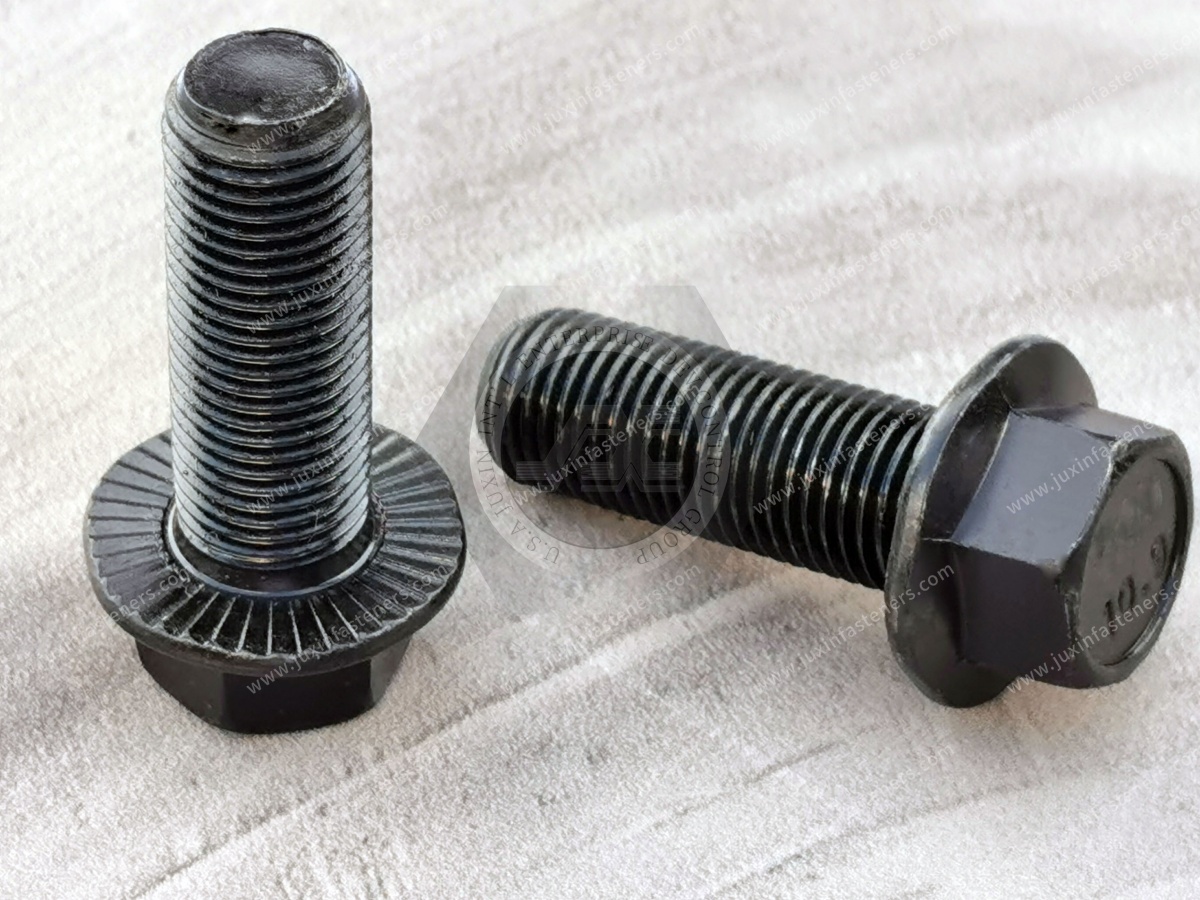
A hexagonal flange bolt consists of:
External hexagonal drive head
Integrated circular flange
Underhead bearing surface
Externally threaded shank
Optional unthreaded grip section, depending on the specification
The flange provides a bearing surface against the connected component.
Compared with certain conventional hex head geometries, the integrated flange can provide a larger underhead contact area.
This may help distribute the applied compressive load and reduce the need for a separate washer where the approved joint design permits.
However, a flange bolt does not inherently generate higher preload or guarantee resistance to vibration loosening.
Hex Flange Bolt Specifications: What Must Be Defined?
A complete flange bolt specification normally includes:
| Specification | Engineering significance |
|---|---|
| Applicable standard | Establishes the dimensional reference |
| Nominal diameter | Identifies the thread size |
| Thread pitch | Determines mating-thread compatibility |
| Bolt length | Defines the required assembly length |
| Thread length | Influences grip and engagement |
| Head dimensions | Determines tool compatibility |
| Flange diameter | Influences bearing geometry |
| Flange thickness | Affects fit and dimensional conformity |
| Bearing-surface configuration | Smooth or serrated contact |
| Material | Determines available mechanical and environmental properties |
| Mechanical property class | Defines applicable mechanical requirements |
| Surface treatment | Addresses corrosion and friction requirements |
| Inspection requirements | Defines product acceptance criteria |
Why Nominal Size Alone Is Insufficient
An M8 flange bolt is not fully specified by the designation M8.
The drawing or purchase specification must also define the applicable thread pitch, length, standard, mechanical properties and other requirements.
Two M8 flange bolts may have different flange dimensions, thread lengths or surface treatments.
They should not automatically be treated as interchangeable.
DIN 6921 Hex Flange Bolt Specifications
DIN 6921 is a recognized dimensional designation for metric hexagon flange bolts.
It is commonly referenced in industrial purchasing and engineering documentation.
However, the standard designation must be used together with the appropriate material, property class, surface treatment and other project requirements.
DIN 6921 vs. ISO 4162
ISO 4162 specifies hexagon flange bolts with a small series flange.
Although the products belong to related fastener categories, their dimensional requirements should not automatically be treated as identical.
Before substitution, compare the actual standard requirements and approved drawing.
Relevant International Standards
| Standard | Application |
|---|---|
| DIN 6921 | Metric hexagon flange bolt dimensional reference |
| ISO 4162 | Hexagon flange bolts with small series flange |
| ISO 261 | General-purpose metric thread plan |
| ISO 965 | Metric thread tolerances |
| ISO 898-1 | Mechanical properties of applicable carbon steel and alloy steel fasteners |
| ISO 3506-1 | Mechanical properties of applicable stainless steel fasteners |
| ISO 4042 | Electroplated coating requirements within its scope |
| ISO 10683 | Non-electrolytically applied zinc-flake coating requirements within its scope |
| SAE J429 | Mechanical requirements for applicable inch-series externally threaded fasteners |
The applicable standards should be selected according to the actual product and customer specification.
Common Metric Hex Flange Bolt Sizes
Metric flange bolts are identified by nominal thread diameter, pitch and length.
Common search and purchasing designations include:
M5 flange bolts
M6 flange bolts
M8 flange bolts
M10 flange bolts
M12 flange bolts
M16 flange bolts
M20 flange bolts
These are nominal size designations, not a statement that every size or configuration is available from stock.
Actual availability depends on the selected standard, property class, length, coating and supplier.
Example of a Metric Flange Bolt Specification
An illustrative purchasing designation might identify:
M10 × 1.5 × 40 — Property Class 10.9
This indicates:
M10 nominal metric thread diameter
1.5 mm thread pitch
40 mm nominal bolt length
Metric property class 10.9
However, the designation still needs the applicable flange bolt standard, finish, thread-length requirements and any additional drawing requirements.
Bolt Length Measurement
For conventional hexagon flange bolts, nominal length is generally measured from the underhead bearing reference to the bolt end, according to the applicable product standard.
The flange geometry must be considered when confirming the correct measurement reference.
Thread Length
Thread length affects:
Available thread engagement
Grip thickness
Joint geometry
Position of threads relative to loaded interfaces
A fully threaded bolt and a partially threaded bolt should not be substituted without reviewing the joint.
Metric vs. UNC, UNF and Other Thread Systems
Metric flange bolts use specified metric thread designations.
Inch-series fasteners may use UNC or UNF threads.
BSW and BSF are separate thread systems.
These thread forms and pitches are not interchangeable.
Dimensional conversion between millimeters and inches does not establish thread compatibility.
Hex Flange Bolt Materials: Carbon Steel, Alloy Steel and Stainless Steel
Material selection affects mechanical properties, manufacturability, corrosion behavior and cost.
The correct material should be selected according to the finished fastener requirements rather than raw material designation alone.
Low-Carbon Steel Flange Bolts
Examples of SAE/AISI low-carbon steel designations include:
SAE/AISI 1008
SAE/AISI 1015
SAE/AISI 1018
SAE/AISI 1022
These materials may be relevant to suitable lower-strength fastening applications, depending on the manufacturing process and required finished properties.
Potential applications include:
General industrial equipment
Electrical equipment assemblies
Light mechanical structures
Auxiliary fastening components
Engineering Limitation
A raw material designation does not independently establish the finished bolt's mechanical property class.
Medium-Carbon Steel Flange Bolts
Examples of SAE/AISI medium-carbon steel designations include:
SAE/AISI 1035
SAE/AISI 1039
SAE/AISI 1045
Suitable medium-carbon steels may be considered for fasteners requiring specified mechanical properties.
However, the finished bolt's performance depends on material condition, manufacturing and any required heat treatment.
Alloy Steel Flange Bolts
Alloy steels may be selected for higher-strength fastener applications.
The appropriate material and processing route must be capable of achieving the specified finished-fastener requirements.
Examples of application requirements include:
Higher mechanical loading
Controlled mechanical properties
Fatigue-sensitive assemblies
Specified heat-treatment conditions
Stainless Steel Hex Flange Bolts
Stainless steel may be considered where corrosion resistance is important.
Common material families include:
A2 stainless steel
A4 stainless steel
The actual stainless steel grade and property class should be specified according to the applicable requirements.
Stainless Steel Selection Considerations
Corrosion environment
Chloride exposure
Galvanic compatibility
Mechanical properties
Thread galling
Cleaning chemicals
Operating temperature
Stainless steel is not universally corrosion-proof.
Hex Flange Bolt Strength Grades: 8.8, 10.9 and 12.9
For applicable metric carbon steel and alloy steel bolts, ISO 898-1 defines mechanical property classes.
The class designation provides information about the fastener's specified mechanical properties.
Property Class 8.8
Class 8.8 bolts are commonly considered for suitable industrial mechanical connections.
Potential applications include:
General machinery
Equipment mounting
Industrial frames
Selected automotive auxiliary assemblies
Property Class 10.9
Class 10.9 bolts may be considered where higher specified mechanical properties are required.
Potential applications include:
Heavy machinery
Industrial equipment
Selected automotive mechanical assemblies
High-load fastening systems
Property Class 12.9
Class 12.9 bolts may be specified for suitable applications requiring higher mechanical properties.
However, material selection, environmental conditions and the complete joint design require careful review.
Comparison of Metric Mechanical Property Classes
The following table shows the nominal strength relationships associated with the property-class designations.
Actual acceptance requirements are governed by the applicable standard.
| Property class | Nominal tensile strength designation | Nominal yield-strength ratio |
|---|---|---|
| 8.8 | 800 MPa | 0.8 |
| 10.9 | 1,000 MPa | 0.9 |
| 12.9 | 1,200 MPa | 0.9 |
These nominal designation values are not a substitute for the complete ISO 898-1 mechanical property requirements.
Why Higher Property Class Does Not Always Mean Better Joint Performance
A stronger bolt may not solve a problem caused by:
Insufficient internal thread engagement
Weak mating material
Excessive bearing pressure
Incorrect tightening
Joint relaxation
Fatigue loading
Corrosion
Inadequate locking design
The bolt and mating components must be evaluated as a complete mechanical joint.
SAE Grade vs. Metric Property Class
SAE Grade 5 and SAE Grade 8 are inch-series fastener designations.
They are not equivalent to metric property classes 8.8 or 10.9.
The applicable mechanical standard, dimensions and thread system must be used when evaluating an alternative.
Flange Diameter and Bearing Pressure
One of the principal design functions of the integrated flange is to provide an underhead bearing surface.
A larger effective bearing area can reduce average bearing pressure under the same compressive load.
A simplified relationship is:
p = F / A
Where:
p = average bearing pressure
F = compressive force
A = effective bearing contact area
Actual contact pressure is affected by flange geometry, surface flatness, component stiffness and joint deformation.
When Bearing Pressure Matters
Bearing pressure is especially relevant where the connected component includes:
Aluminum
Thin sheet metal
Soft metallic materials
Coated surfaces
Components with limited local stiffness
Important Engineering Limitation
A larger flange does not automatically generate higher clamping force.
The achievable preload depends on bolt properties, joint design, friction and tightening procedure.
Flange Diameter vs. Washer Selection
An integrated flange may eliminate a separate washer where the approved design permits.
However, a flange bolt and a conventional hex bolt with washer may have different:
Bearing geometry
Friction conditions
Surface contact
Installation clearances
Assembly behavior
A substitution requires engineering review.
Surface Treatment Options for Hex Flange Bolts
Surface treatment selection should consider corrosion exposure, friction, coating compatibility and mechanical property class.
Zinc-Plated Hex Flange Bolts
Zinc plating may provide economical corrosion protection for selected industrial environments.
Potential applications include:
General machinery
Electrical equipment
Indoor industrial assemblies
The actual corrosion performance depends on the complete coating specification.
Yellow-Passivated Zinc Flange Bolts
Yellow appearance may result from a specified passivation or conversion treatment.
However, color alone does not establish corrosion performance.
The coating system and acceptance requirements must be defined.
Zinc-Nickel-Coated Flange Bolts
Zinc-nickel coatings may be considered for applications requiring a specified corrosion protection system.
Potential applications include selected automotive and industrial equipment.
The required coating thickness, passivation and corrosion criteria should be established by the project specification.
Zinc-Flake-Coated Flange Bolts
Zinc-flake coating systems may be used in selected industrial applications.
Examples include specified non-electrolytically applied coating systems.
The applicable coating requirements should be reviewed against ISO 10683 where relevant.
Black Oxide and Other Finishes
Black oxide may be specified for selected applications.
It should not automatically be treated as equivalent to a qualified zinc-based corrosion protection system.
Stainless Steel
Stainless steel may be considered as an alternative material approach where appropriate.
Its suitability depends on the actual exposure conditions.
Coating Selection Matrix
| Environment or requirement | Potential approach | Required verification |
|---|---|---|
| General indoor machinery | Specified zinc plating | Coating and corrosion requirements |
| Automotive equipment | Specified zinc-nickel or zinc-flake system | Corrosion, friction and OEM approval |
| Outdoor industrial equipment | Project-specific protective coating | Environmental exposure |
| Humid equipment | Suitable coating or stainless steel | Material and corrosion compatibility |
| Marine auxiliary equipment | Application-specific material/coating | Chloride and galvanic corrosion |
| High-strength steel fasteners | Compatible coating process | Hydrogen embrittlement risk |
Hydrogen Embrittlement Considerations
Certain high-strength steel fasteners may be susceptible to hydrogen embrittlement under particular manufacturing and service conditions.
Coating and processing requirements must be selected accordingly.
Why Coating Changes Affect Tightening
Coating systems may change thread and underhead friction.
Therefore, changing the coating can change the relationship between tightening torque and achieved preload.
For OEM production, coating substitutions may require tightening-process validation.
Smooth Flange vs. Serrated Flange Bolts
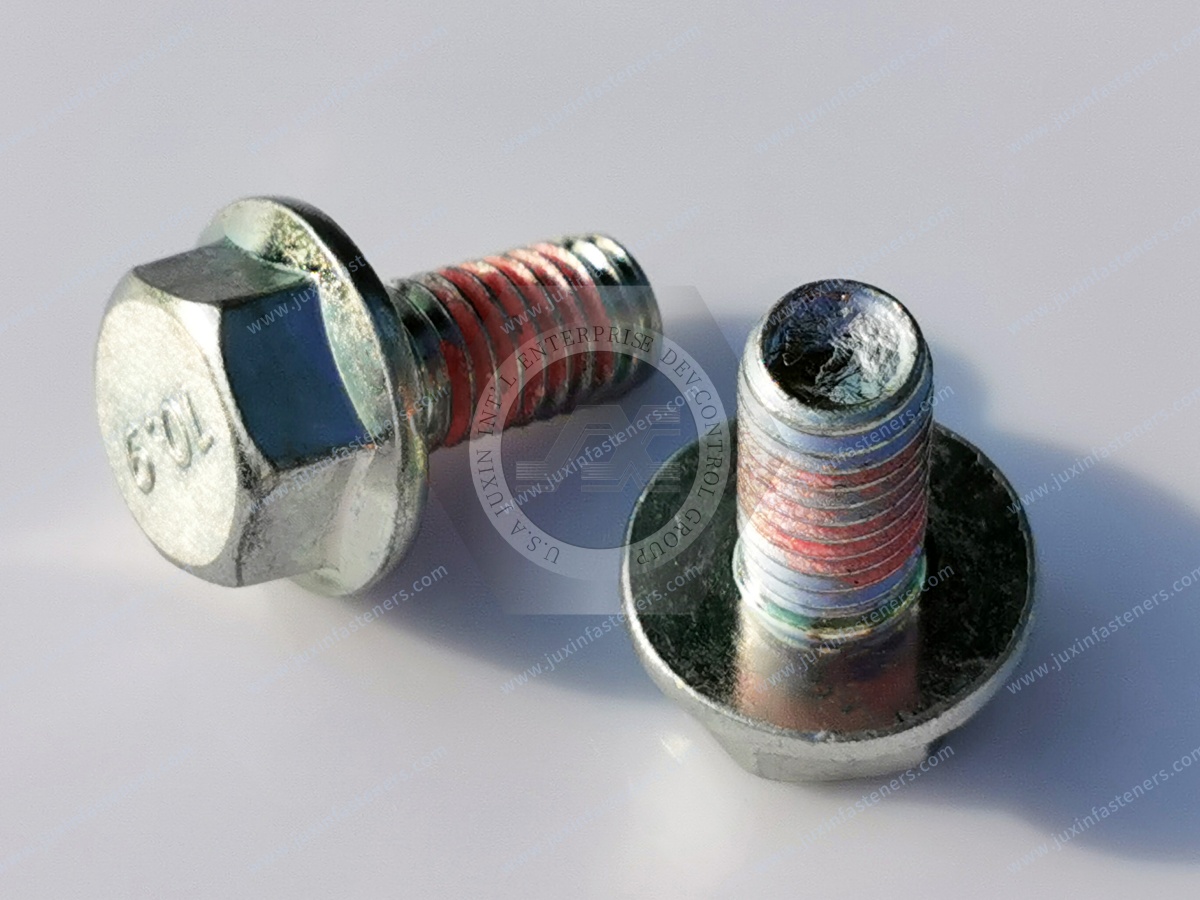
Hex flange bolts may have smooth or serrated underhead bearing surfaces.
Smooth Flange Bolts
These provide a comparatively continuous bearing surface.
They may be appropriate where the joint requires a defined contact interface without intentional serrations.
Serrated Flange Bolts
These incorporate serrations beneath the flange.
The serrations may be designed to increase resistance to rotation at the bearing interface.
Important Limitations
Serrated flanges may:
Mark the mating surface
Disturb protective coatings
Affect tightening friction
Be unsuitable for certain soft materials
Serrated flange bolts do not guarantee vibration resistance.
Smooth and serrated flange designs should not be substituted without engineering review.
Fine-Thread Hex Flange Bolts
Some flange bolt applications may require fine threads.
Fine-thread selection can affect:
Thread engagement
Adjustment resolution
Tensile stress area
Assembly compatibility
Fatigue behavior
However, fine threads do not inherently prevent vibration loosening.
The complete thread designation must be specified.
Cross-Recessed Hex Flange Bolts
Some drawing-specific fasteners combine a hexagonal head with an additional drive feature.
These should be treated as separate product configurations where the additional drive geometry is not covered by the selected standard.
Self-Locking Flange Fasteners
A locking feature may be incorporated into a suitable fastening system.
However, a flange head alone does not make a bolt self-locking.
Any locking feature must be defined and validated for the application.
Automotive Manufacturing Applications
Hex flange bolts may be used in suitable automotive mechanical assemblies.
Potential applications include:
Engine-related brackets
Transmission-related equipment
Auxiliary chassis components
Equipment mounting structures
Automotive manufacturing fixtures
Engineering Requirements
Mechanical loading
Vibration
Temperature changes
Corrosion
Tightening control
Component compatibility
Safety-Critical Limitation
Braking, steering, suspension and other safety-critical vehicle systems require application-specific engineering approval.
A general industrial flange bolt should not automatically be substituted.
Electric Vehicle and Battery Equipment
Potential applications include:
Battery equipment frames
Battery tray brackets
Motor mounting systems
Charging equipment
Power electronics support structures
Thermal Expansion
Different materials may expand at different rates during temperature changes.
This can influence joint loading.
Electrical Requirements
Metal flange bolts are electrically conductive.
Where electrical isolation is required, the complete fastening arrangement must provide the necessary insulation.
Battery Safety
Fastener selection must not compromise the approved mechanical, electrical or enclosure requirements.
Heavy Machinery and Construction Equipment
Potential applications include:
Excavators
Loaders
Agricultural machinery
Mining equipment
Industrial gearboxes
Mechanical support assemblies
Engineering Priorities
Applied loading
Mechanical property class
Joint stiffness
Bearing pressure
Fatigue
Corrosion protection
Maintenance access
Industrial Machinery and Robotics
Hex flange bolts may be used in suitable assemblies for:
CNC machinery
Industrial automation
Robotics equipment
Conveyors
Production equipment
Mechanical frames
Production Considerations
An integrated flange may reduce loose washer handling where the design permits.
However, the flange diameter must fit the available installation space.
Rail Transportation Equipment
Potential applications include:
Auxiliary railway equipment
Equipment mounting brackets
Maintenance structures
Mechanical support systems
Engineering Requirements
Rail applications may require vibration assessment, traceability and project-specific qualification.
A general flange bolt is not automatically approved for safety-critical railway connections.
Marine and Coastal Industrial Equipment
Potential applications include:
Marine auxiliary machinery
Port equipment
Coastal mechanical structures
Equipment support brackets
Corrosion Considerations
Material and coating selection should account for:
Chloride exposure
Galvanic compatibility
Moisture
Maintenance conditions
Required mechanical properties
Construction and Structural Steel
Hex flange bolts may be suitable for selected construction equipment and noncritical mechanical assemblies.
However, general DIN 6921 flange bolts should not automatically be used as structural bolting assemblies for buildings or bridges.
Structural connections require the applicable project specifications and approved bolting systems.
Pipeline and Pressure Equipment: Important Distinction
A hex flange bolt is defined by its head geometry.
A pipe flange joint is a separate engineering assembly involving flanges, a gasket where applicable, and specified bolting.
These terms should not be confused.
A general DIN 6921 hex flange bolt is not automatically suitable for pressure-containing pipe flange connections.
Pressure equipment requires application-specific bolting materials, joint design and installation procedures.
Industry Selection Matrix
| Industry | Potential application | Primary selection concern |
|---|---|---|
| Automotive | Auxiliary mechanical assemblies | Vibration and tightening |
| EV equipment | Battery equipment brackets | Thermal and electrical requirements |
| Heavy machinery | Equipment mounting | Mechanical loading and fatigue |
| Industrial machinery | Frames and brackets | Assembly access and preload |
| Robotics | Mechanical support assemblies | Clearance and repeatability |
| Rail equipment | Auxiliary mechanical connections | Qualification and vibration |
| Marine machinery | Equipment supports | Corrosion |
| Construction equipment | Mechanical assemblies | Loading and environmental exposure |
| Pressure equipment | Only where specifically approved | Applicable pressure-joint requirements |
Installation Guidelines for Hex Flange Bolts
Correct installation is essential to achieving the required joint performance.
Verify the Specification
Confirm:
Thread designation
Bolt length
Material
Property class
Flange geometry
Coating
Mating thread
Inspect the Bearing Surface
The flange should seat correctly against the intended surface.
Check for interference, damage or unsuitable contact conditions.
Confirm Thread Engagement
The internal thread must provide sufficient engagement for the design.
Use the Approved Tightening Method
Tightening may be controlled by torque, angle or another validated method, depending on the application.
Do Not Assume a Universal Torque Value
The required tightening procedure depends on friction, bolt properties and joint design.
Multiple-Bolt Connections
Where a joint uses multiple bolts, the tightening sequence should follow the approved assembly procedure.
A diagonal or staged sequence may be appropriate for certain flange joints, but it is not a universal requirement for every hex flange bolt installation.
Verify the Completed Assembly
Inspection requirements should be defined by the application and quality plan.
Common Hex Flange Bolt Specification Errors
Incorrect Flange Diameter
May cause interference or unsuitable bearing contact.
Incorrect Thread Pitch
May prevent proper engagement or damage the mating thread.
Incorrect Bolt Length
May cause bottoming, insufficient engagement or assembly interference.
Incorrect Property Class
May result in unsuitable mechanical performance.
Unapproved Coating Substitution
May change corrosion protection and tightening friction.
Smooth vs. Serrated Flange Confusion
May alter the contact conditions.
Unverified Standard Substitution
May introduce dimensional incompatibility.
Engineering Recommendation
Evaluate the complete specification before approving an alternative product.
OEM Flange Bolt Specification and RFQ Checklist
For accurate technical evaluation and quotation, provide:
| Requirement | Information needed |
|---|---|
| Drawing | Approved 2D drawing or applicable standard |
| Thread | Diameter, pitch and thread system |
| Length | Nominal bolt length |
| Thread length | Full or partial thread |
| Head | Required head dimensions |
| Flange | Diameter, thickness and surface configuration |
| Material | Approved material specification |
| Mechanical properties | Property class or grade |
| Coating | Required surface treatment |
| Application | Equipment and operating environment |
| Inspection | Acceptance requirements |
| Quantity | Sample, batch and annual demand |
| Packaging | Project-specific requirements |
| Delivery | Target lead time |
Supplier Qualification Considerations
Purchasing and supplier development teams should confirm:
Dimensional conformity
Material specification
Mechanical property requirements
Surface treatment
Inspection documentation
Sample approval
MOQ
Lead time
Production quantity
Change-control requirements
Why Complete Drawings Improve RFQ Accuracy
A complete drawing reduces ambiguity.
For example, an inquiry for "M10 high-strength flange bolts" does not define the full product.
A complete RFQ should specify the standard, thread pitch, length, flange dimensions, property class, coating and quantity.
Standard vs. Custom Hex Flange Bolts
Standard flange bolts may be appropriate when the approved design matches the applicable product standard.
Custom flange bolts may be required where the design specifies:
Special flange dimensions
Custom bolt length
Special thread length
Drawing-specific head geometry
Selected material
Special surface treatment
Project-specific inspection
Manufacturing feasibility, MOQ, sample arrangements and lead time depend on the individual project.
Frequently Asked Questions
What information is needed to specify a hex flange bolt?
The specification should identify the applicable standard, thread size and pitch, bolt length, flange geometry, material, property class, coating and inspection requirements.
What is the difference between DIN 6921 and ISO 4162?
They are related hexagon flange bolt dimensional standards, but their requirements should not automatically be treated as identical.
What do classes 8.8, 10.9 and 12.9 mean?
They identify mechanical property classes for applicable metric steel fasteners under ISO 898-1.
Does a larger flange produce higher preload?
Not inherently. Preload depends on the complete joint and tightening conditions.
Are serrated flange bolts vibration-proof?
No. Serrations may affect resistance to rotation, but the complete joint must be evaluated.
Can a class 10.9 bolt replace a class 8.8 bolt?
Not automatically. The joint and approved specification must be reviewed.
Can zinc-nickel coating replace zinc plating?
Only after confirming the corrosion, friction, dimensional and other applicable requirements.
Can DIN 6921 flange bolts be used for pipe flange joints?
Not automatically. Pressure-containing pipe flange joints require their own applicable bolting specifications.
Are metric and UNC flange bolts interchangeable?
No. The thread systems are different.
Can JUXIN FASTENERS review custom flange bolt drawings?
Yes. Drawing-based inquiries can be reviewed for dimensions, materials, mechanical properties, coatings, manufacturing feasibility and quotation.
JUXIN FASTENERS: Hex Flange Bolt Specifications and OEM Fastening Solutions
JUXIN FASTENERS supplies industrial fastening products and supports drawing-based OEM inquiries for international manufacturers.
Relevant product categories include:
DIN 6921 hex flange bolts
High-strength industrial bolts
Custom hex head bolts
Drawing-specific flange bolts
Industrial locking nuts
CNC-machined threaded components
Other custom fastening products
Specific dimensions, materials, property classes, coatings, inspection requirements, MOQ and lead time are confirmed during project review.
Request a Hex Flange Bolt Specification Review and RFQ
Are you sourcing hex flange bolts for automotive equipment, EV components, heavy machinery, industrial automation, rail equipment or another OEM mechanical assembly?
JUXIN FASTENERS welcomes inquiries from design engineers, mechanical engineers, structural engineers, manufacturing engineers, production managers,
procurement specialists, purchasing managers, supplier development teams and supply chain managers.
For an efficient technical and commercial review, please send:
2D drawing or applicable standard + thread designation + diameter + length + flange dimensions + material + property class + coating + application
+ inspection requirements + sample quantity + annual purchasing volume + target delivery schedule
Our team can review your requirements, discuss suitable fastening options, confirm sample arrangements and provide quotation information.
Company: JUXIN FASTENERS
Website: https://www.juxinfasteners.com/
Email: info@juxinfasteners.com
Send your hex flange bolt specifications, engineering drawings and RFQ to JUXIN FASTENERS for technical evaluation and quotation.
Contact Us
Tel.:
+86 020 8621 0320
+86 020 3121 6067
E-mail:
Technical Support:
Navigation
SEND INQUIREY