
Call Us
+86 136 6007 9809
Call Us
+86 136 6007 9809

Jun. 29, 2024
Hex Flange Bolt Installation: Torque Control, Joint Design and OEM Assembly Guide
Hexagonal flange screws, also known as hex flange bolts or hex head flange screws, are widely used in industrial mechanical assemblies where compact fastening,
controlled installation and an integrated bearing surface are desirable.
Unlike a conventional hexagon head bolt used with a separate washer, a hex flange bolt incorporates a flange beneath its head.
This integral flange can provide a larger bearing area than an otherwise comparable plain hex head, depending on the specified geometry.
The design may reduce the number of assembly components and simplify installation.
However, the flange does not automatically eliminate the need for every washer, prevent loosening or guarantee more uniform preload.
Reliable performance depends on the complete bolted joint.
Design engineers must consider flange diameter, contact pressure, material strength, thread engagement and joint stiffness.
Manufacturing engineers and production managers must establish suitable tightening procedures, tool access, friction conditions and inspection requirements.
Procurement managers and supplier development teams must also verify product standards, mechanical properties, coatings and technical equivalence before approving alternative fasteners.
JUXIN FASTENERS supplies hexagonal flange screws, hex flange bolts and drawing-based OEM fastening components for international industrial applications.
This guide focuses on installation methods, engineering limitations, production reliability and supplier qualification.
What Is a Hexagonal Flange Screw?
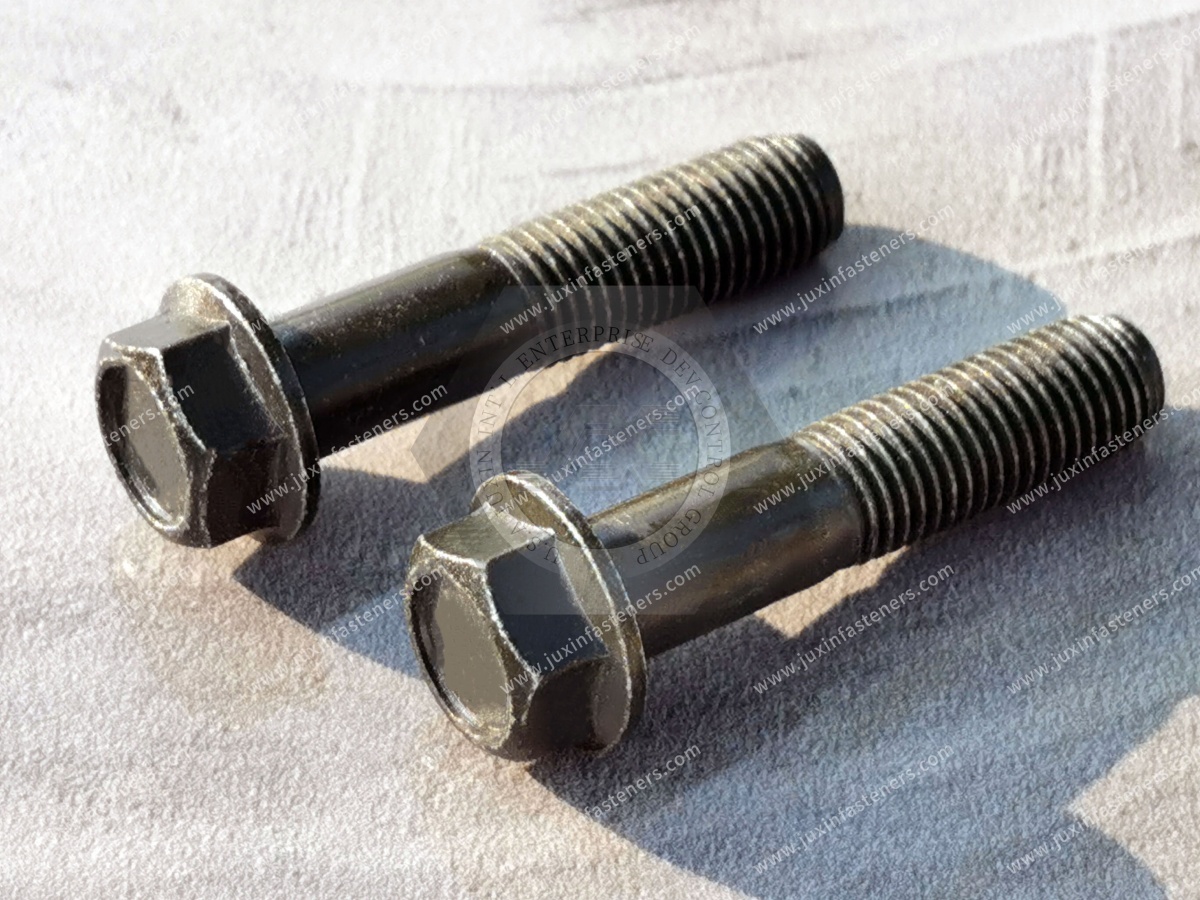
A hexagonal flange screw is an externally threaded fastener with an external hexagonal head and an integral flange beneath the head.
Its principal features are:
External hexagonal drive
Integral bearing flange
Threaded shank
Defined head and flange dimensions
Specified thread length and screw length
The integral flange increases the available bearing area relative to certain conventional hex head designs.
Depending on the joint, this may help distribute the clamping load over a larger contact area.
However, the actual contact pressure depends on flange geometry, mating-surface flatness, material properties and achieved preload.
Hex Flange Screws vs. Hex Bolts with Washers
Both arrangements can provide reliable threaded connections when properly designed.
| Feature | Hex flange screw | Hex bolt with separate washer |
|---|---|---|
| Bearing arrangement | Integral flange | Separate washer |
| Component count | Potentially fewer parts | Additional component |
| Assembly handling | May simplify feeding and installation | Requires washer handling |
| Bearing area | Defined by flange geometry | Defined by washer geometry |
| Surface compatibility | Must be evaluated | Washer may offer additional options |
| Replacement | Requires dimensional review | Requires complete joint review |
| Preload performance | Depends on friction and joint design | Depends on friction and joint design |
Engineering Principle
A flange screw is not automatically a direct replacement for a conventional bolt-and-washer assembly.
The original washer may provide a specific bearing diameter, hardness, thickness, sealing function or other required characteristic.
Before substitution, compare the complete joint requirements.
Serrated vs. Non-Serrated Hex Flange Bolts
Hex flange screws may be supplied with different bearing-surface configurations.
Non-Serrated Flange Screws
A non-serrated flange provides a bearing surface without intentional locking serrations.
Potential applications include:
Machinery housings
Mechanical brackets
Equipment frames
Electrical enclosures
General industrial assemblies
Selection should consider the contact surface, friction requirements and joint loading.
Serrated Flange Screws
A serrated flange incorporates teeth or serrations beneath the head.
These features may increase resistance to rotation in certain joint configurations by interacting with the mating surface.
However, effectiveness depends on the material, surface finish, preload and service conditions.
Important Limitations
Serrated flange screws may be unsuitable where:
Surface indentation is unacceptable
Decorative coatings must remain intact
The mating material is too soft
Repeated removal may damage the bearing surface
Electrical contact requirements are not validated
The locking function has not been confirmed for the application
Engineering Recommendation
Do not assume serrations provide universal vibration resistance. Evaluate the actual joint and its operating conditions.
International Standards for Hex Flange Screws
Different standards apply to different dimensional and mechanical requirements.
DIN 6921
DIN 6921 is a commonly encountered designation for hexagon flange screws.
ISO 4162
ISO 4162 covers hexagon flange bolts with small series dimensions within its specified scope.
Important Dimensional Distinction
DIN 6921 and ISO 4162 should not be treated as automatically interchangeable.
Flange diameter, head geometry and other dimensions must be checked against the applicable standard and drawing.
ISO 898-1
ISO 898-1 specifies mechanical and physical properties for defined carbon steel and alloy steel bolts, screws and studs.
ISO 3506-1
ISO 3506-1 may be relevant for specified corrosion-resistant stainless steel fasteners.
SAE J429
SAE J429 addresses mechanical and material requirements for applicable inch-series externally threaded fasteners.
ASME and Inch-Series Products
Where UNC or UNF flange screws are required, the applicable inch-series dimensional specification must be confirmed.
A metric flange screw cannot be substituted merely by converting its nominal diameter into inches.
Thread Compatibility
Metric, UNC, UNF, BSW and BSF threads are different systems and are not directly interchangeable.
Engineering Recommendation
Identify the complete product standard, thread designation, material,
mechanical property requirements and coating rather than listing unrelated standards as interchangeable alternatives.
Flange Bearing Area and Contact Pressure
One of the main engineering reasons to select a hex flange bolt is its integral bearing surface.
The flange can spread the underhead load over a larger contact area than certain plain hex head configurations.
However, a larger nominal flange does not guarantee uniform contact pressure.
Factors Affecting Contact Pressure
Flange diameter
Effective contact area
Mating-surface flatness
Surface roughness
Material hardness
Joint preload
Local component stiffness
Thin Sheet Metal Considerations
A flange may help reduce localized bearing pressure in some thin-sheet assemblies.
However, excessive preload can still cause:
Local indentation
Permanent deformation
Coating damage
Joint relaxation
Loss of clamping force
Engineering Recommendation
For thin sheet metal, evaluate the complete fastening arrangement.
Where a threaded connection cannot be formed directly in the sheet,
suitable alternatives may include self-clinching nuts, blind rivet nuts, weld nuts or cage nuts.
JUXIN FASTENERS supplies these industrial fastening categories for suitable OEM applications.
Selecting Hex Flange Bolt Materials
Material selection should be based on mechanical loading, corrosion exposure, temperature and the applicable product specification.
Carbon Steel Flange Screws
Carbon steel may be suitable for general industrial assemblies.
Relevant considerations include:
Required mechanical properties
Coating
Joint loading
Environmental conditions
Alloy Steel Flange Screws
Alloy steel may be selected for applications requiring specified higher mechanical properties.
Potential applications include:
Heavy machinery
Automotive auxiliary equipment
Industrial gearboxes
Mechanical supports
Production equipment
The material designation alone does not establish the finished fastener's property class.
Stainless Steel Flange Screws
Stainless steel may be selected where suitable corrosion resistance is required.
A2 and A4 are common stainless steel fastener designations.
However, their mechanical properties and corrosion behavior must be checked for the specific environment.
Material Comparison
| Material category | Typical selection reason | Critical review |
|---|---|---|
| Carbon steel | General industrial use | Strength and corrosion protection |
| Alloy steel | Specified mechanical properties | Heat treatment and joint loading |
| A2 stainless steel | Suitable corrosion-sensitive equipment | Environment and strength |
| A4 stainless steel | Selected more demanding corrosive conditions | Chemical exposure and mechanical properties |
Strength Classes and Joint Requirements
Metric flange screws may be specified in different mechanical property classes depending on the product standard.
Classes such as 8.8 and 10.9 are commonly relevant to industrial steel fasteners.
However, a higher strength class does not automatically improve joint reliability.
Important Factors
Bolt preload
Mating thread strength
Bearing pressure
Joint stiffness
Fatigue loading
Surface treatment
Installation conditions
Engineering Principle
The correct property class is the one that satisfies the complete joint design, not necessarily the highest available class.
How to Install Hex Flange Bolts Correctly
The installation procedure should be based on the actual joint and its engineering requirements.
Step 1: Verify the Fastener Specification
Confirm:
Nominal thread diameter
Thread pitch
Screw length
Flange dimensions
Material
Mechanical property class
Surface treatment
Step 2: Inspect the Mating Components
Check:
Thread compatibility
Thread condition
Hole alignment
Bearing-surface condition
Component thickness
Required clearance
Step 3: Position the Components
Align the components without forcing the screw into an incorrect position.
Misalignment may cause cross-threading or uneven contact.
Step 4: Start the Thread Correctly
Where practical, begin engagement carefully to avoid cross-threading.
For automated assembly, validate the screw-feeding and thread-starting process.
Step 5: Apply the Approved Tightening Method
Use the specified tool and tightening procedure.
The method may involve controlled torque or another approved process appropriate to the joint.
Step 6: Verify the Assembly
Check the required acceptance criteria.
Depending on the application, these may include tool-process records, visual inspection, joint position or other approved checks.
Important Installation Limitation
A tightening torque value should not be selected solely from nominal screw diameter or property class.
The actual friction conditions and joint requirements must be considered.
Torque and Preload Control
Tightening torque is used to generate bolt tension, but the relationship between torque and preload is affected by friction.
A simplified relationship is:
T ≈ K × F × d
Where:
T = applied torque
K = simplified torque coefficient
F = bolt preload
d = nominal diameter
This is an approximation, not a universal tightening specification.
Factors Affecting Torque-to-Preload Behavior
Thread friction
Flange bearing-surface friction
Lubrication
Surface coating
Material condition
Tightening speed
Tooling
Joint stiffness
Why Flange Geometry Matters
The effective friction radius beneath a flange head may differ from that of a conventional bolt-and-washer arrangement.
Therefore, replacing a conventional hex bolt with a flange screw may change the relationship between applied torque and achieved preload.
Production Recommendation
Validate tightening conditions using the actual flange screw, mating components and coating.
Manual Installation vs. Controlled Tightening
Different applications require different installation controls.
Manual Assembly
Manual tools may be appropriate for suitable low-risk applications where the engineering specification permits them.
Torque-Controlled Assembly
A calibrated torque tool may be appropriate where a defined tightening process is required.
However, torque control does not directly measure bolt preload.
Automated Assembly
Automated tightening may improve repeatability when the process is properly designed and validated.
Relevant factors include:
Screw feeding
Tool alignment
Socket engagement
Tightening program
Tool wear
Process monitoring
Important Distinction: Hex Flange Screws vs. Piping Flange Bolting
The term flange bolt is used in more than one engineering context.
A hex flange screw has an integral flange beneath its head.
A pressure-piping flange joint uses a bolted flange connection between larger mechanical components.
These are different fastening arrangements.
Pressure-Piping Flange Procedures
Cross-pattern tightening sequences, gasket compression procedures and hydraulic bolt tensioning may be appropriate for certain pressure-piping or large bolted flange joints.
However, those procedures should not automatically be applied to ordinary hex flange screws in machinery or automotive assemblies.
Engineering Recommendation
Use the installation procedure approved for the actual joint.
Do not transfer tightening sequences from pressure-piping systems to unrelated fastener applications.
Surface Treatments and Installation Reliability
Surface treatment affects corrosion resistance and may influence tightening friction.
Zinc Plating
May provide suitable corrosion protection for selected industrial environments.
Zinc-Nickel Coating
May be considered where specified corrosion protection is required.
Zinc-Flake Coating
May be suitable for certain industrial fasteners depending on the coating system and requirements.
Black Oxide
Provides a dark appearance with corrosion performance dependent on the complete treatment.
Hot-Dip Galvanizing
May be suitable for specified fastener systems where coating thickness, thread fit and applicable standards are properly addressed.
Relevant Standards
ISO 4042 may apply to electroplated fasteners.
ISO 10683 may apply to specified non-electrolytically applied zinc-flake coating systems.
High-Strength Fastener Consideration
Certain high-strength steel fasteners may be susceptible to hydrogen embrittlement under particular processing and service conditions.
Coating selection should therefore consider both corrosion protection and mechanical integrity.
Production Implication
A coating change may alter friction and tightening behavior.
A supplier substitution involving a different coating should be reviewed before production approval.
Common Hex Flange Bolt Installation Failures
Insufficient Preload
Possible causes include friction variation, incorrect tightening or joint relaxation.
Thread Stripping
May result from insufficient engagement, unsuitable mating material or excessive loading.
Surface Indentation
May occur when bearing pressure exceeds what the mating component can tolerate.
Serration Damage
Serrated flanges may damage certain coatings or soft bearing surfaces.
Vibration Loosening
May occur when the joint permits relative movement or loses clamping force.
Fatigue Failure
May occur under repeated loading when the joint design is unsuitable.
Corrosion Damage
May result from an inappropriate material or coating.
Failure Prevention Matrix
| Failure mode | Possible cause | Recommended review |
|---|---|---|
| Low preload | Friction or tightening variation | Process validation |
| Thread stripping | Insufficient engagement | Thread design |
| Surface indentation | Excessive contact pressure | Bearing geometry |
| Coating damage | Serration interaction | Surface compatibility |
| Vibration loosening | Joint movement | Preload and locking design |
| Fatigue cracking | Cyclic loading | Joint stiffness and stress |
| Corrosion | Unsuitable finish | Environmental specification |
Hex Flange Bolt Applications in Automotive Manufacturing
Hex flange screws are widely used in suitable automotive mechanical assemblies.
Potential applications include:
Equipment brackets
Powertrain-related auxiliary components
EV battery equipment supports
Vehicle production fixtures
Mechanical housings
Engineering Considerations
Vibration
Temperature
Corrosion
Joint stiffness
Tightening consistency
Surface compatibility
Important Limitation
General industrial flange screws are not automatically qualified for safety-critical steering, braking, suspension or other regulated automotive connections.
Heavy Machinery and Agricultural Equipment
Potential applications include:
Excavators
Loaders
Agricultural machinery
Industrial gearboxes
Equipment housings
Engineering Priorities
Dynamic loading
Corrosion
Bearing pressure
Maintenance
Thread engagement
Industrial Automation and Robotics
Flange screws may be used in suitable automation assemblies.
Potential applications include:
Mechanical brackets
Equipment frames
Motor supports
Production fixtures
Material handling systems
Production Priorities
Assembly speed
Tool accessibility
Fastener feeding
Tightening repeatability
Inspection
Electrical Enclosures and Power Equipment
Potential applications include:
Electrical cabinets
UPS equipment
Industrial control panels
Power conversion equipment
Mechanical support assemblies
Engineering Considerations
Sheet metal thickness
Electrical clearance
Coating compatibility
Thread engagement
Tool access
Construction and Structural Steelwork
Hex flange screws may be used in selected construction-related equipment and mechanical assemblies.
However, ordinary industrial flange screws should not automatically be substituted into structural steel connections.
Where applicable, qualified structural bolting assemblies and relevant standards such as EN 14399 or EN 15048 must govern selection.
Railway Equipment
Hex flange screws may be used in approved rail-related auxiliary mechanical equipment.
Safety-critical rail connections require the relevant application-specific qualification.
Renewable Energy and Energy Storage Equipment
Potential applications include:
Solar equipment
Energy storage enclosures
Industrial power equipment
Mechanical supports
Renewable energy equipment accessories
Engineering Considerations
Corrosion
Vibration
Temperature
Maintenance access
Application-specific requirements
Production-Line Quality Control
For manufacturing engineers and production managers, hex flange screws should be evaluated as part of the complete assembly process.
Incoming Inspection
Depending on project requirements, relevant checks may include:
Thread dimensions
Screw length
Flange diameter
Head dimensions
Material identification
Mechanical properties
Coating condition
Visual appearance
Tooling Control
Confirm that sockets and tightening tools are compatible with the fastener head and assembly access.
Assembly Validation
Verify the approved tightening procedure using the actual joint and fastener configuration.
In-Process Monitoring
Depending on the application, suitable checks may include tightening-process monitoring and selected joint inspections.
Rework Control
Define replacement requirements for damaged threads, deformed flanges or unsuitable reused fasteners.
Production Decision Matrix
| Production concern | Potential consequence | Recommended action |
|---|---|---|
| Incorrect flange diameter | Contact or clearance problem | Drawing verification |
| Inconsistent coating friction | Variable preload | Tightening validation |
| Serration damage | Surface deterioration | Material compatibility review |
| Incorrect screw length | Bottoming or inadequate engagement | Assembly stack-up review |
| Worn tooling | Inconsistent tightening | Tool maintenance |
| Supplier substitution | Changed geometry or friction | Technical approval |
OEM Procurement and Supplier Qualification
Procurement managers should compare flange screws using complete specifications rather than generic product descriptions.
Recommended RFQ Information
| Requirement | Information to provide |
|---|---|
| Product | Hexagonal flange screw |
| Standard | DIN 6921, applicable ISO standard or approved drawing |
| Thread | Nominal diameter and pitch |
| Length | Underhead screw length |
| Flange type | Serrated or non-serrated |
| Flange dimensions | Diameter and relevant geometry |
| Material | Approved material |
| Mechanical properties | Required property class |
| Coating | Surface treatment and requirements |
| Application | Equipment and operating environment |
| Assembly | Tightening and locking requirements |
| Inspection | Acceptance criteria |
| Samples | Prototype or approval quantity |
| Purchasing volume | Batch quantity and annual forecast |
| Delivery | Target schedule |
Supplier Substitution Checklist
Before approving an alternative flange screw, verify:
Thread compatibility
Head and flange geometry
Serration configuration
Material
Mechanical properties
Coating
Tightening behavior
Application approval
A flange screw that appears dimensionally similar may behave differently during assembly.
Total Installed Cost
Purchasing managers should consider:
Unit price
Washer elimination where approved
Assembly handling
Tooling
Inspection
Rework
Maintenance
Inventory
Supplier qualification
Delivery reliability
A flange screw may reduce component count, but the actual cost benefit depends on the assembly and production process.
Frequently Asked Questions
What is the advantage of a hex flange screw?
Its integral flange provides a defined bearing surface and may simplify assembly by reducing the need for a separate washer where the joint design permits.
Can a flange screw replace a bolt and washer?
Only after verifying bearing geometry, surface requirements, mechanical properties and the complete joint design.
Are hex flange screws stronger than conventional hex bolts?
Not automatically. Strength depends on the applicable mechanical property requirements.
Do serrated flange screws prevent loosening?
They may increase resistance to rotation in certain assemblies, but performance must be validated for the actual joint.
Does a flange screw require a different tightening torque?
Possibly. Differences in bearing geometry, coating and friction may affect the torque-to-preload relationship.
Are DIN 6921 and ISO 4162 interchangeable?
Not automatically. Their dimensional requirements must be checked before substitution.
Can hex flange screws be used in thin sheet metal?
Yes, in suitable designs, but bearing pressure, sheet deformation and thread engagement must be evaluated.
Can a general flange screw be used in structural steelwork?
Only when the fastener or bolting assembly satisfies the applicable structural requirements and project approval.
Can JUXIN FASTENERS review custom hex flange bolt drawings?
Yes. Drawing-based inquiries can be reviewed for dimensions, materials, mechanical properties, coatings and quotation requirements.
JUXIN FASTENERS: Hex Flange Bolts and OEM Fastening Solutions
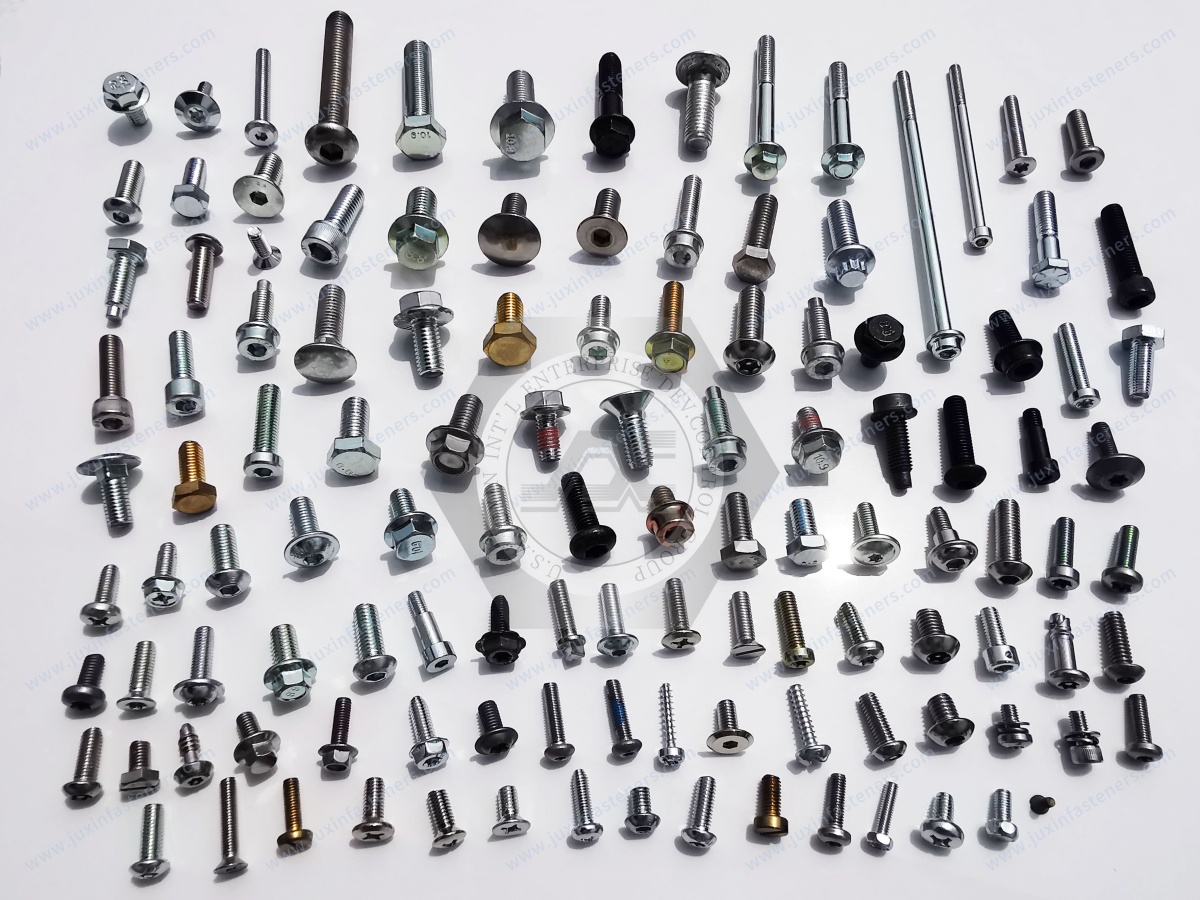
JUXIN FASTENERS supplies industrial fastening components and supports drawing-based OEM inquiries for international manufacturers.
Relevant product categories include:
Hexagonal flange screws
Hex flange bolts
Serrated flange screws
Non-serrated flange screws
Carbon steel flange screws
Alloy steel flange screws
Stainless steel flange screws
Hexagon head bolts
Socket head cap screws
Nylon insert lock nuts
All-metal locking nuts
Weld nuts
Blind rivet nuts
Self-clinching nuts
Custom CNC-machined fasteners
Specific dimensions, materials, property classes, coatings, inspection requirements, MOQ and lead time are confirmed during project review.
Request a Hex Flange Bolt Engineering Review and OEM RFQ
Are you sourcing hex flange bolts for automotive equipment, industrial machinery, automation, agricultural equipment, electrical enclosures or other OEM applications?
Or are you evaluating a replacement for a conventional hex bolt-and-washer assembly?
JUXIN FASTENERS welcomes inquiries from design engineers, structural engineers, mechanical engineers, manufacturing engineers, production managers,
procurement specialists, purchasing managers, supplier development teams and supply chain managers.
For an efficient technical and commercial review, please provide:
2D drawing or applicable standard + thread designation + screw length + flange dimensions + serration type + material + property class
+ coating + application + tightening requirements + inspection criteria + sample quantity + annual purchasing volume + target delivery schedule
Our team can review your requirements, discuss suitable standard or drawing-based options, confirm sample arrangements and prepare quotation information.
Company: Juxin Fasteners
Website: https://www.juxinfasteners.com/
Email: info@juxinfasteners.com
Send your hex flange bolt drawings and RFQ to JUXIN FASTENERS for technical evaluation and quotation.
Contact Us
Tel.:
+86 020 8621 0320
+86 020 3121 6067
E-mail:
Technical Support:
Navigation
SEND INQUIREY



