
Call Us
+86 136 6007 9809
Call Us
+86 136 6007 9809

Oct. 31, 2024
High-Strength Alloy Steel Flat Point Set Screws: DIN 913, ISO 4026 and OEM Shaft Positioning
High-strength alloy steel hex socket flat point set screws are compact, headless threaded fasteners used for mechanical positioning,
adjustment and selected component-retention applications.
Their defining feature is a flat contact end rather than a cup, cone or projecting dog point.
This distinction is important because the point geometry affects contact pressure, surface indentation, holding behavior and serviceability.
Flat point set screws may be considered where a component must be positioned against a mating surface without the concentrated penetration associated with some alternative point styles.
However, a flat point does not guarantee a damage-free surface, and it does not automatically provide the same holding performance as a cup point screw.
For design engineers, selection depends on the contact geometry, mating material, required holding force and operating conditions.
For manufacturing engineers and production managers, the screw must also support controlled installation torque, repeatable positioning and reliable tooling engagement.
For purchasing and supplier development teams, the applicable standard, alloy steel grade, mechanical requirements,
coating specification and dimensional consistency are essential when approving a supplier.
Juxin Fasteners supplies industrial set screws and drawing-specific fastening components for OEM manufacturing applications.
What Is a Hex Socket Flat Point Set Screw?
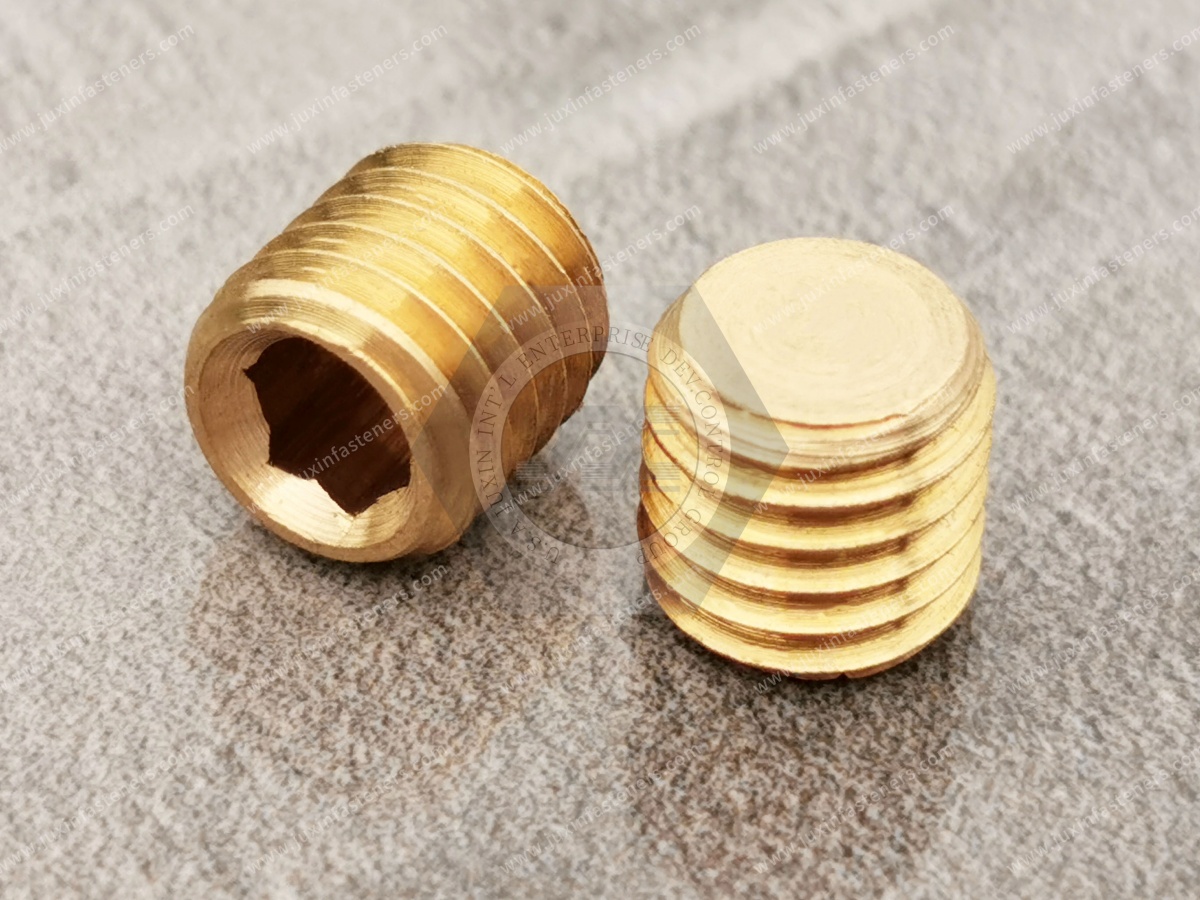
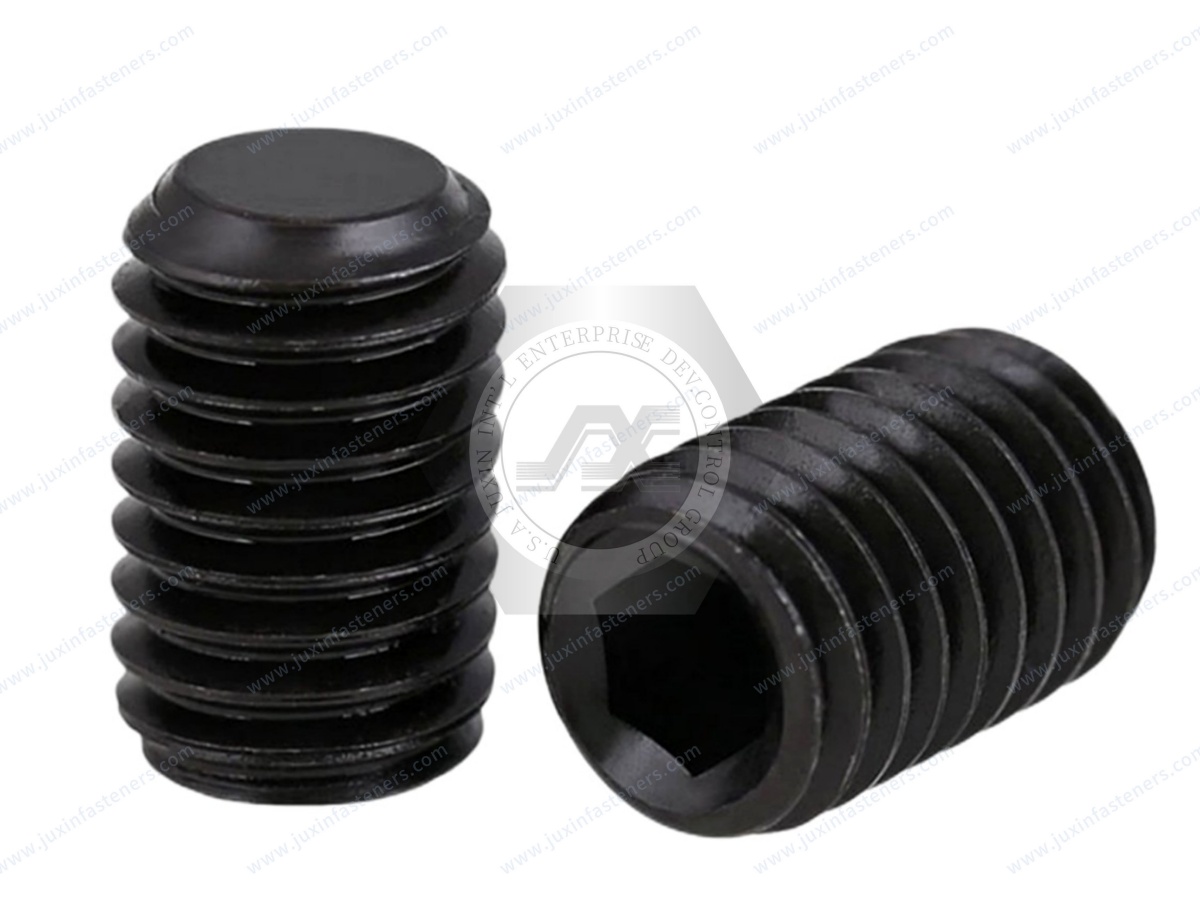
A hex socket flat point set screw is a headless threaded fastener with an internal hex drive and a flat end.
The screw is installed through a threaded hole in a component such as a collar, hub, fixture or adjustment mechanism.
When tightened, the flat end presses against the mating surface.
The resulting contact force can help position the component or resist relative movement.
Typical Applications
Mechanical adjustment mechanisms
Shaft collars
Equipment fixtures
Precision positioning assemblies
Machine components
Selected hub and shaft connections
Important Limitation
A flat point set screw should not automatically be treated as a high-capacity torque-transmitting shaft connection.
The complete joint must be evaluated.
DIN 913 / ISO 4026: Standards for Flat Point Set Screws
DIN 913 and ISO 4026 are commonly associated with hexagon socket set screws with flat points.
Other point styles use different standards.
| Point style | DIN reference | ISO reference | Main engineering consideration |
|---|---|---|---|
| Flat point | DIN 913 | ISO 4026 | Contact against a mating surface |
| Cup point | DIN 916 | ISO 4029 | Annular edge engagement and possible indentation |
| Cone point | DIN 914 | ISO 4027 | Concentrated point contact |
| Dog point | DIN 915 | ISO 4028 | Engagement with a suitable locating feature |
Engineering Recommendation
Specify the correct point style and dimensional standard on the purchase drawing.
A flat point set screw is not functionally identical to a cup point set screw.
ASME B18.3 and Inch-Series Set Screws
ASME B18.3 covers applicable inch-series socket screw products, including socket set screws.
An inch-series flat point set screw must be specified according to the relevant dimensional and thread requirements.
Important Distinction
ASME B18.3 inch-series products and DIN 913 / ISO 4026 metric products should not be assumed interchangeable.
The thread system, length, socket dimensions and point geometry must be checked.
How Flat Point Set Screws Work
The flat end applies force over a contact region against the mating surface.
The contact condition depends on the actual flatness, alignment, surface roughness and material properties.
Potential Advantages
Headless installation
Compact design
Defined flat contact geometry
Suitability for selected adjustment mechanisms
Reduced tendency toward concentrated penetration compared with certain pointed designs
Important Limitation
A flat point may still leave marks or cause local deformation under sufficient force.
Flat Point Contact Mechanics
The contact pressure beneath a flat point is not necessarily uniform.
It may be affected by:
Point diameter
Surface flatness
Screw alignment
Mating material hardness
Surface roughness
Tightening force
Elastic or plastic deformation
Engineering Recommendation
Do not assume that a flat point distributes load uniformly or prevents all surface damage.
Flat Point Versus Cup Point Set Screws
The main difference is the contact geometry.
Flat Point
A flat end may be preferred where controlled contact and reduced localized penetration are important.
Cup Point
A concave end has an annular edge that can indent the mating surface and contribute to mechanical engagement.
Selection Considerations
| Requirement | Flat point | Cup point |
|---|---|---|
| Reduced concentrated penetration | Often advantageous | Less suitable where indentation is unacceptable |
| Local shaft engagement | Application-dependent | Annular edge may create indentation |
| Frequent adjustment | May be preferable in suitable designs | Repeated repositioning may leave marks |
| Holding force | Must be validated | Must be validated |
| Shaft surface preservation | Not guaranteed | Surface marking may be more pronounced |
Engineering Recommendation
Choose the point geometry according to the intended contact behavior rather than assuming one style is universally stronger.
Flat Point Set Screws and Shaft Hardness
Shaft hardness influences contact deformation.
Relatively Soft Shaft Materials
Possible effects include:
Local indentation
Surface marking
Permanent deformation
Changes in positioning after repeated tightening
Harder Shaft Materials
A harder surface may resist indentation but can also change frictional contact behavior.
Engineering Recommendation
Evaluate the actual mating material and surface hardness.
Precision Positioning and Repeatability
Flat point set screws may be used in adjustable mechanical assemblies.
However, positioning repeatability depends on more than the screw point.
Relevant Factors
Thread backlash
Contact geometry
Surface condition
Tightening torque
Component stiffness
Thermal expansion
Repeated adjustment
Engineering Recommendation
For precision positioning systems, validate repeatability after multiple adjustment cycles.
Alloy Steel Materials for Flat Point Set Screws
Alloy steels may be selected where hardness, mechanical strength and wear resistance are important.
The source article identifies SCM435 and SCM440 as possible material grades.
These material names may appear on existing OEM drawings or supplier specifications.
However, a material designation alone does not establish the finished screw's mechanical properties.
Engineering Recommendation
Specify the applicable material requirements, heat-treatment condition and finished-product acceptance criteria.
SCM435 Alloy Steel Set Screws
SCM435 is a chromium-molybdenum alloy steel designation.
It may be considered for suitable heat-treated fastener applications.
Important Considerations
Material condition
Heat-treatment process
Hardness
Thread geometry
Point geometry
Mechanical requirements
SCM440 Alloy Steel Set Screws
SCM440 is another chromium-molybdenum alloy steel designation.
Its suitability depends on the required finished-product properties and manufacturing process.
Important Limitation
SCM440 should not automatically be described as stronger than SCM435 in every finished fastener.
Heat treatment, dimensions and specification requirements influence performance.
Heat Treatment of Alloy Steel Set Screws
Heat treatment may be used to achieve specified hardness and mechanical properties.
Typical engineering considerations include:
Austenitizing conditions
Quenching
Tempering
Hardness consistency
Distortion
Surface condition
Important Limitation
A generic heat-treatment description does not prove that a particular production batch meets the required properties.
Engineering Recommendation
Use measurable mechanical and dimensional acceptance requirements.
Mechanical Strength and Hardness
The mechanical performance of a high-strength alloy steel set screw depends on the finished product.
Relevant requirements may include:
Hardness
Torsional performance
Thread integrity
Point condition
Dimensional conformity
Material condition
Important Distinction
Do not apply a universal tensile-strength or yield-strength figure to every alloy steel set screw.
Engineering Recommendation
Use the applicable product standard and customer drawing to define the required properties.
Thread Engagement in the Mating Component
The threaded hole must provide adequate engagement for the required installation force.
Insufficient Thread Engagement
Possible consequences include:
Internal thread stripping
Reduced tightening capacity
Poor alignment
Assembly failure
Excessive Screw Length
Possible consequences include:
Unwanted protrusion
Tool interference
Assembly access problems
Engineering Recommendation
Determine the required engagement based on the mating material, thread dimensions and tightening requirements.
Metric Thread Specifications
Metric flat point set screws are commonly specified using ISO metric thread designations.
Examples include:
M3
M4
M5
M6
M8
M10
M12
These are examples of thread designations, not a statement of current stock or complete manufacturing range.
Metric Thread Standards
Applicable metric thread requirements may reference ISO 261, ISO 965 and other relevant specifications.
Inch-Series Thread Specifications
Inch-series flat point set screws may use UNC or UNF thread designations.
Their thread requirements are different from ISO metric threads.
Important Distinction
Metric, UNC, UNF, BSW and BSF thread systems are not directly interchangeable.
Engineering Recommendation
Confirm nominal diameter, pitch or threads per inch, tolerance, length and drive dimensions before approving a substitute.
Hex Socket Geometry and Tool Engagement
The internal hex socket allows installation without an external head.
Potential Advantages
Compact design
Access in confined spaces
Compatibility with suitable manual and powered tools
Common Problems
Rounded socket
Incorrect driver size
Tool misalignment
Excessive torque
Poor socket dimensional accuracy
Production Recommendation
Use the specified driver and validate tool engagement during sample approval.
Installation Torque and Contact Force
Tightening torque influences the force applied by the flat point.
However, torque does not directly equal holding force.
The relationship depends on:
Thread friction
Material
Lubrication
Surface finish
Thread geometry
Contact deformation
Component stiffness
Over-Tightening
Possible consequences include:
Socket damage
Thread stripping
Surface indentation
Screw damage
Hub deformation
Under-Tightening
Possible consequences include:
Component movement
Loss of positioning
Insufficient retention
Engineering Recommendation
Use application-specific installation torque requirements and validate the resulting joint.
Vibration and Loosening
Flat point geometry does not automatically prevent loosening under vibration.
Relevant Factors
Dynamic loading
Thread friction
Contact force
Surface condition
Thermal cycling
Assembly geometry
Possible Retention Measures
Depending on the application:
Thread-locking compounds
Secondary locking features
Alternative point styles
Positive locating features
Clamping connections
Engineering Recommendation
For vibration-sensitive assemblies, validate retention under representative operating conditions.
Fatigue and Repeated Loading
Industrial machinery may experience cyclic loading.
The fatigue performance of a set screw assembly depends on:
Load amplitude
Contact conditions
Thread geometry
Surface condition
Material properties
Stress concentration
Installation quality
Important Limitation
High material hardness or strength does not guarantee high fatigue resistance.
Engineering Recommendation
Use application-specific fatigue evaluation where required.
Surface Treatments for Alloy Steel Flat Point Set Screws
Surface treatment may be required to protect alloy steel against corrosion.
The appropriate coating depends on environmental exposure and mechanical requirements.
Black Oxide Coating
Black oxide is commonly used on steel fasteners.
Potential Advantages
Dark appearance
Limited dimensional change
Compatibility with selected industrial applications
Important Limitation
Black oxide alone generally provides limited corrosion protection.
Additional protective measures may be necessary.
Zinc Plating
Zinc plating can provide sacrificial corrosion protection in suitable environments.
Engineering Considerations
Coating thickness
Thread fit
Corrosion requirements
Hydrogen embrittlement risk
Applicable processing controls
Zinc-Nickel Coating
Zinc-nickel coatings may be selected for improved corrosion performance in certain industrial applications.
Engineering Considerations
Coating specification
Corrosion performance
Thread fit
Process compatibility
Hydrogen embrittlement risk
Nickel and Chrome Coatings
Nickel or chromium-containing coating systems may be considered for particular functional or appearance requirements.
Their suitability depends on the actual coating system and application.
Important Limitation
A coating should not be described as suitable for marine or chemical exposure without appropriate performance validation.
Hydrogen Embrittlement Risk in High-Strength Alloy Steel Fasteners
High-strength steel fasteners can be susceptible to hydrogen embrittlement under certain conditions.
Hydrogen may be introduced during some manufacturing or surface-treatment processes.
Why This Matters
Delayed cracking may occur after installation, even when the fastener initially appears acceptable.
Risk Factors
High material hardness
High sustained stress
Hydrogen-generating processes
Surface condition
Environmental exposure
Possible Controls
Depending on the specification:
Process selection
Appropriate pretreatment
Hydrogen embrittlement risk assessment
Applicable post-treatment controls
Relevant testing
Important Limitation
Baking or other post-treatment does not guarantee complete elimination of hydrogen embrittlement risk.
Engineering Recommendation
For high-strength set screws requiring electroplated coatings, define the applicable hydrogen embrittlement prevention and verification requirements before production.
Coating Selection Table
| Surface treatment | Typical selection reason | Main limitation |
|---|---|---|
| Black oxide | Appearance and selected indoor uses | Limited corrosion protection |
| Zinc plating | General corrosion protection | Process controls and hydrogen risk |
| Zinc-nickel | Enhanced corrosion protection in suitable systems | Cost and process qualification |
| Nickel plating | Selected functional or appearance requirements | Application-specific corrosion behavior |
| Custom coating | OEM environmental requirements | Requires validation |
Industrial Machinery Applications
Alloy steel flat point set screws may be used in:
Machine tools
Mechanical fixtures
Adjustment mechanisms
Equipment positioning systems
Selected shaft and hub assemblies
Engineering Considerations
Contact force
Shaft hardness
Installation torque
Vibration
Repeated adjustment
Maintenance requirements
Important Limitation
A flat point set screw should not be assumed suitable for high-torque power transmission without joint validation.
Automation and Robotics
Potential applications include:
Adjustment mechanisms
Equipment fixtures
Positioning components
Mechanical stops
Auxiliary motion-control assemblies
Engineering Considerations
Positioning repeatability
Contact deformation
Repeated adjustment
Dynamic loading
Tool access
Production Recommendation
Use controlled installation procedures to maintain repeatability.
Automotive Manufacturing Equipment
Flat point set screws may be suitable for selected production equipment, tooling and noncritical mechanical assemblies.
Potential Applications
Assembly fixtures
Equipment adjustment mechanisms
Auxiliary mechanical modules
Production tooling
Important Limitation
Vehicle safety-critical applications require dedicated engineering approval and qualification.
Energy and Heavy Equipment
Potential applications include:
Industrial adjustment systems
Equipment fixtures
Auxiliary mechanical assemblies
Machinery positioning components
Engineering Considerations
Vibration
Corrosion exposure
Maintenance access
Load requirements
Chemical and Marine-Related Equipment
Alloy steel set screws may be used in selected protected equipment assemblies.
However, coating selection must be based on actual environmental requirements.
Important Limitation
A plated alloy steel set screw should not automatically be considered suitable for direct seawater or aggressive chemical exposure.
Engineering Recommendation
Evaluate material and coating options against the intended service environment.
Common Flat Point Set Screw Failure Modes
Surface Indentation
Possible causes include excessive contact force or a relatively soft mating surface.
Thread Stripping
Possible causes include insufficient engagement, unsuitable mating material or excessive installation torque.
Socket Rounding
Possible causes include incorrect tooling, excessive torque or poor socket geometry.
Loss of Positioning
Possible causes include insufficient contact force, vibration or unsuitable joint design.
Corrosion
Possible causes include unsuitable coating, coating damage or environmental exposure.
Delayed Cracking
Possible causes may include hydrogen embrittlement in susceptible high-strength steel components.
Engineering Recommendation
Identify the actual failure mechanism before increasing screw hardness, changing coatings or tightening torque.
Quality Inspection of Alloy Steel Flat Point Set Screws
Inspection requirements should be based on the applicable standard and customer drawing.
Dimensional Inspection
Potential checks include:
Thread diameter
Thread pitch
Length
Thread tolerance
Hex socket dimensions
Flat point geometry
Surface condition
Mechanical Property Verification
Depending on the specification:
Hardness testing
Material verification
Mechanical property testing
Heat-treatment documentation
Coating Inspection
Potential checks include:
Coating type
Coating thickness
Appearance
Thread fit
Corrosion performance where specified
Functional Inspection
Application-specific checks may include:
Thread fit
Driver engagement
Installation torque behavior
Contact performance
Retention testing
Important Limitation
The exact inspection plan, sampling frequency and acceptance criteria depend on the purchase specification.
Production-Line Assembly Considerations
For high-volume OEM manufacturing, a set screw must be compatible with the actual assembly process.
Key Factors
Screw feeding
Driver engagement
Torque control
Tool accessibility
Installation cycle time
Thread cleanliness
Coating consistency
Batch variation
Production Recommendation
Validate the selected screw using representative production tooling and mating components.
Custom Alloy Steel Flat Point Set Screws
OEM projects may require drawing-specific:
Diameter
Length
Thread pitch
Flat point geometry
Hex socket dimensions
Material grade
Heat-treatment requirements
Surface treatment
Dimensional tolerances
Packaging
Manufacturing feasibility depends on the actual design, material and order volume.
Supplier Qualification for High-Strength Set Screws
Purchasing managers and supplier development teams should evaluate:
Applicable standard
Material grade
Heat-treatment requirements
Mechanical properties
Drawing conformity
Point geometry
Thread accuracy
Hex socket quality
Surface treatment
Hydrogen embrittlement controls where relevant
Inspection documentation
Sample approval
MOQ
Lead time
Annual demand
Packaging
Change control
Alternative Supplier Qualification
A replacement set screw should be evaluated for more than nominal thread diameter and length.
The point geometry, hardness, socket dimensions, coating and installation behavior may affect functional interchangeability.
Total Installed Cost
The lowest unit price does not always provide the lowest assembly cost.
Additional cost factors may include:
Installation time
Driver wear
Rework
Component damage
Coating requirements
Inspection
Supplier consistency
Delivery reliability
Procurement Recommendation
Compare suppliers using the complete application and production requirements.
Frequently Asked Questions
What is a flat point set screw?
A headless threaded fastener with a flat contact end, used for positioning and selected retention applications.
What is the difference between DIN 913 and DIN 916?
DIN 913 refers to flat point hex socket set screws. DIN 916 refers to cup point hex socket set screws.
What is ISO 4026?
ISO 4026 is a dimensional standard associated with hexagon socket set screws with flat points.
Is ASME B18.3 the same as DIN 913?
No. ASME B18.3 covers applicable inch-series socket screw products, while DIN 913 is associated with metric flat point set screws.
Are flat point set screws suitable for precision equipment?
They may be suitable for selected adjustment and positioning mechanisms, but repeatability and contact behavior must be validated.
Do flat point set screws prevent shaft damage?
Not necessarily. They may reduce concentrated penetration compared with certain pointed designs, but surface marking or deformation can still occur.
Are SCM435 and SCM440 suitable for high-strength set screws?
They may be suitable for selected applications, depending on the required finished-product properties and manufacturing process.
Can alloy steel flat point set screws be zinc plated?
Potentially, but high-strength steel fasteners require consideration of hydrogen embrittlement and applicable coating process controls.
Does black oxide provide strong corrosion protection?
Not by itself. Black oxide generally provides limited corrosion protection unless combined with suitable protective measures.
Can flat point set screws resist vibration?
They may provide retention in suitable joints, but vibration resistance must be validated for the actual operating conditions.
Can Juxin Fasteners supply custom alloy steel flat point set screws?
Juxin Fasteners welcomes drawing-specific inquiries. Materials, dimensions, heat treatment, coatings, inspection and commercial terms require confirmation.
Juxin Fasteners: Alloy Steel Flat Point Set Screws and OEM Solutions
Juxin Fasteners supplies industrial set screws and drawing-specific fastening components.
Relevant product categories include:
High-strength alloy steel flat point set screws
DIN 913 / ISO 4026 flat point set screws
Applicable ASME B18.3 inch-series set screws
Alloy steel socket set screws
Custom headless threaded fasteners
Drawing-specific industrial positioning screws
Material grades, mechanical requirements, coating options, inspection scope, MOQ and lead times are subject to technical and commercial confirmation.
Request a Quote for High-Strength Alloy Steel Flat Point Set Screws
Are you sourcing alloy steel flat point set screws for industrial machinery, automation equipment, precision positioning systems or an OEM manufacturing project?
Juxin Fasteners welcomes inquiries from design engineers, mechanical engineers, manufacturing engineers, production managers, purchasing specialists and supplier development teams.
For technical review and quotation, please provide:
Screw drawing and revision + DIN 913 / ISO 4026 or applicable ASME B18.3 specification + metric or inch thread designation
+ diameter and pitch + length + flat point geometry + hex socket dimensions + material grade + hardness or mechanical requirements
+ heat-treatment specification + surface treatment + hydrogen embrittlement requirements where applicable + mating material and hardness
+ installation torque requirements + inspection documentation + prototype quantity + annual demand + packaging + target delivery schedule.
Company: Juxin Fasteners
Website: https://www.juxinfasteners.com/
Email: info@juxinfasteners.com
Send your alloy steel flat point set screw drawings and OEM RFQ to Juxin Fasteners for technical confirmation, product selection and quotation.
Contact Us
Tel.:
+86 020 8621 0320
+86 020 3121 6067
E-mail:
Technical Support:
Navigation
SEND INQUIREY



