
Call Us
+86 136 6007 9809
Call Us
+86 136 6007 9809

Jun. 22, 2024
How Do Self-Clinching Fasteners Work? Installation, Design and OEM Engineering Guide
Self-clinching fasteners create mechanically retained threaded or mounting features in suitable sheet metal without requiring a conventional welded joint.
Their operating principle is based on controlled plastic deformation of the panel material.
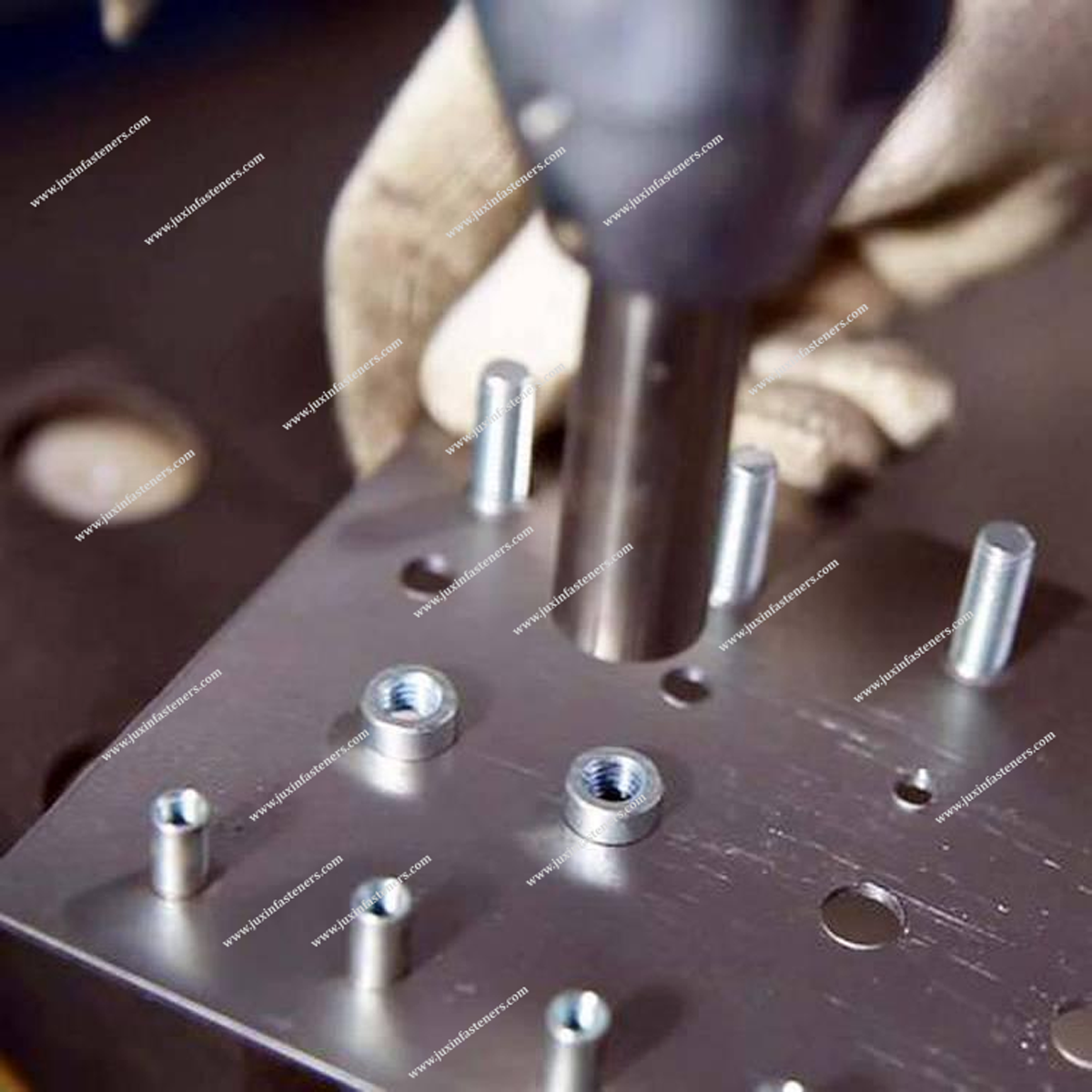
During installation, a properly designed fastener is pressed into a prepared hole.
The surrounding sheet material flows into an engineered undercut or retention feature, forming a mechanical interlock.
This allows manufacturers to incorporate nuts, studs and standoffs into thin metal panels while reducing the need to handle separate loose components during subsequent assembly.
However, successful installation depends on more than applying pressure.
Panel thickness, material hardness, hole geometry, edge distance, tooling alignment and fastener design must all be compatible.
JUXIN FASTENERS supplies self-clinching nuts, self-clinching studs, self-clinching standoffs, blind standoffs and drawing-based custom sheet metal fastening components for industrial OEM applications.
This guide explains how self-clinching technology works, why installations fail and how engineering and procurement teams can select suitable fastening solutions.
What Is a Self-Clinching Fastener?
A self-clinching fastener is a mechanical component designed to become permanently retained in suitable sheet material through a controlled pressing operation.
Unlike a loose nut, it remains attached to the panel after installation.
Unlike a welded nut, a conventional self-clinching fastener does not require welding heat to create the attachment.
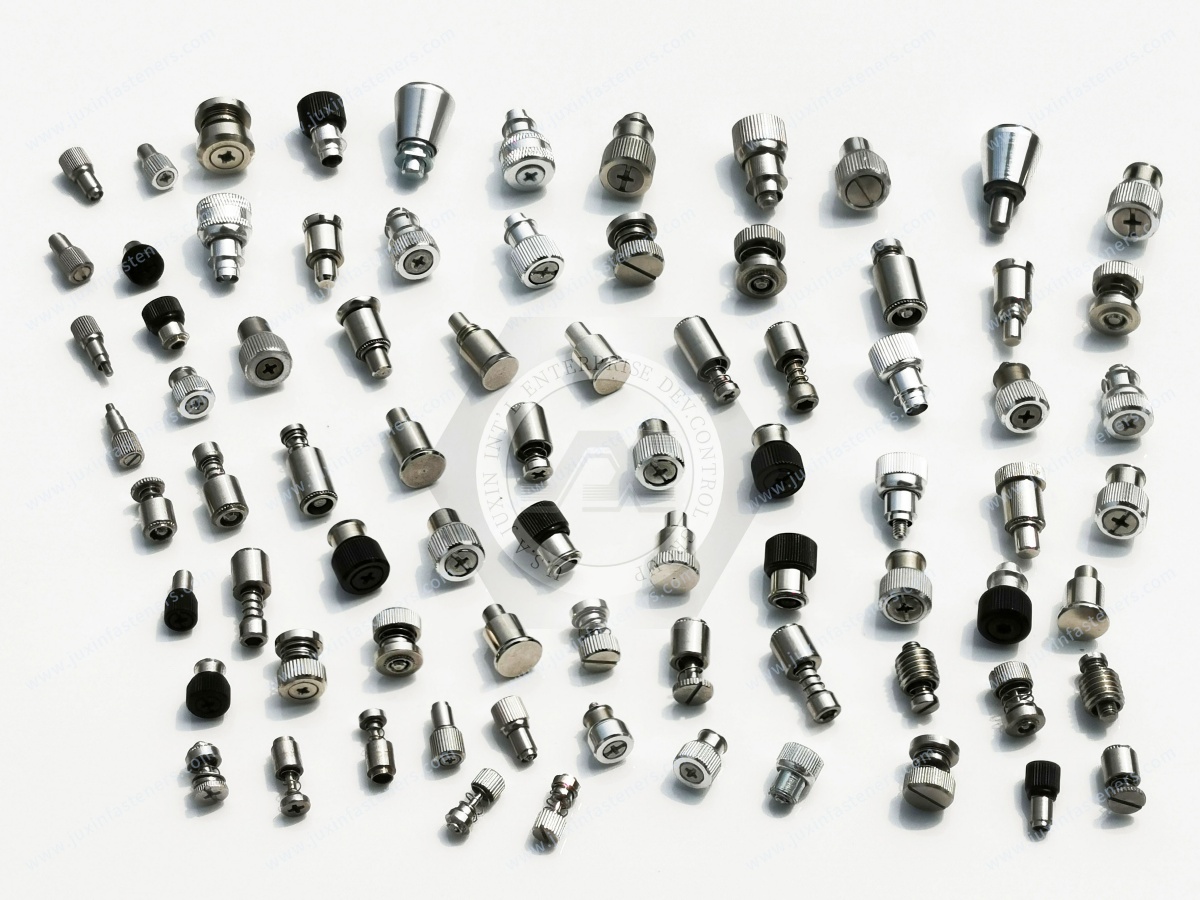
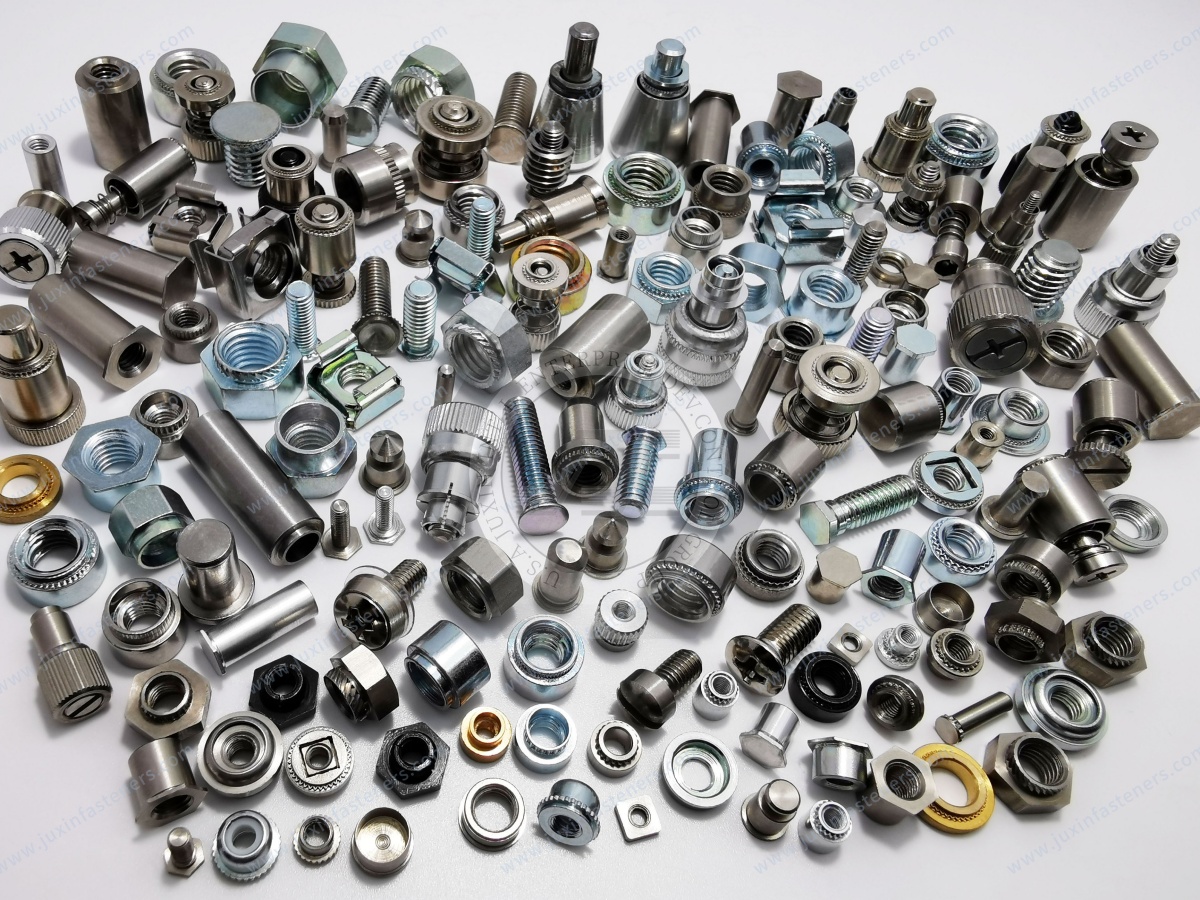
Common product families include:
Self-clinching nuts that provide internal threads
Self-clinching studs that provide external threaded mounting points
Self-clinching standoffs that provide spacing and threaded attachment
Blind self-clinching standoffs that provide closed-end threaded mounting features
Selected concealed-head and specialty self-clinching components
Captive panel screw assemblies may also use self-clinching retainers, but captive screws and ordinary self-clinching nuts are not the same product.
How Does the Self-Clinching Mechanism Work?
The self-clinching mechanism depends on the interaction between the fastener's retention geometry and the panel material.
Two important design elements are the material displacement feature and the retention undercut.
Material Displacement Features
A self-clinching fastener includes geometry designed to displace the surrounding panel material during installation.
Depending on the product, these features may include a specially shaped head, annular feature, ribs or other engineered geometry.
Not every self-clinching fastener uses a knurled ring.
The correct retention structure depends on the specific product design.
The Retention Undercut
An undercut provides a space into which the displaced panel material can flow.
As the installation force is applied, the surrounding sheet metal plastically deforms and fills the available retention geometry.
After installation, the mechanical interlock resists movement of the fastener relative to the panel.
Why Panel Material Flow Is Essential
Self-clinching fasteners rely on the ability of the panel material to deform appropriately.
If the panel is too hard, too thin or otherwise incompatible with the fastener design, sufficient material flow may not occur.
A fastener may appear seated while providing inadequate retention.
This is why dimensional appearance alone is not always sufficient to establish installation quality.
Step-by-Step Self-Clinching Installation Process
A typical installation process for a compatible self-clinching fastener includes the following stages.
1. Prepare the Mounting Hole
Produce the mounting hole according to the approved fastener specification.
The specified diameter, tolerance, hole condition and edge distance must be observed.
2. Position the Fastener
Insert the fastener into the prepared hole in the correct orientation.
The fastener's installation direction is important because its retention geometry must interact with the panel as intended.
3. Support the Panel
Position the assembly using suitable installation tooling.
Proper support helps control panel deformation and fastener alignment.
4. Apply Controlled Pressing Force
Apply force using an appropriate press and tooling arrangement.
The panel material flows into the fastener's retention features.
The required force depends on the specific fastener, panel material and thickness.
5. Verify Installation
Confirm the specified seating condition and any required dimensional or mechanical characteristics.
Where required by the application, verify retention performance using an agreed test method.
What Happens After Installation?
The fastener becomes mechanically retained in the panel.
For a self-clinching nut, the resulting assembly provides a fixed internally threaded mounting point.
For a self-clinching stud, it provides a retained projecting stud.
For a self-clinching standoff, it provides a controlled spacing feature and threaded attachment.
These functions are different and should be selected according to the joint design.
How Self-Clinching Nuts Work
Self-clinching nuts provide permanent internal threads in suitable sheet metal.
A properly installed self-clinching nut can eliminate the need to hold a separate loose nut during final assembly.
Typical Applications
Electrical enclosure panels
Industrial control cabinets
Automotive electronic housings
Telecommunications chassis
Server equipment
Sheet metal brackets
Engineering Considerations
The engineer must evaluate the required thread size, panel thickness, material hardness, mounting-hole dimensions and installation access.
Thread strength must also be considered.
A self-clinching nut may be firmly retained in the panel while the threaded connection remains limited by the nut's material or engagement characteristics.
Does a Self-Clinching Nut Prevent Bolt Loosening?
Not automatically.
The nut's clinching mechanism resists movement relative to the panel.
It does not inherently provide a prevailing-torque locking function for the mating screw.
Where vibration-related loosening is a concern, the joint must be evaluated separately.
How Self-Clinching Studs Work
Self-clinching studs provide permanent externally threaded mounting points.
They are useful where an assembly requires a projecting threaded feature but a conventional loose bolt is inconvenient.
During installation, the stud's retention features create a mechanical interlock with the panel.
Typical Applications
Electrical equipment mounting
Automotive electronic brackets
Industrial machine panels
Chassis-mounted components
Sheet metal equipment assemblies
Important Design Factors
The stud's thread size, projection length, installation geometry and required mechanical retention must be compatible with the panel.
A self-clinching stud should not automatically be considered suitable for a safety-critical structural connection.
The actual application loads and customer requirements must be evaluated.
How Self-Clinching Standoffs Work
Self-clinching standoffs combine mechanical panel retention with a spacing function.
They are commonly used to support components above a sheet metal surface.
Typical Applications
PCB mounting
Electronic control modules
Server chassis
Telecommunications equipment
Industrial electronics
Power conversion equipment
Why Standoff Height Matters
A standoff's height affects component spacing, assembly clearance and alignment.
For PCB mounting, the engineer should consider board thickness, component clearance, mounting-hole geometry and the forces transmitted through the standoff.
A standoff should not be selected solely by thread size.
Blind Self-Clinching Standoffs
Blind standoffs provide a closed-end threaded feature.
They may be useful where a through-hole thread is undesirable.
However, a blind threaded feature should not automatically be treated as a pressure-tight or environmental seal.
Any sealing requirement must be separately specified and validated.
Critical Design Requirements for Self-Clinching Fasteners
Successful self-clinching installation depends on several interacting variables.
Panel Thickness
Every self-clinching fastener has a defined compatible panel thickness or thickness range.
If the sheet is too thin, the available material may be insufficient to fill the retention undercut.
If the sheet is too thick, the fastener may not seat correctly.
The correct thickness must be determined from the specific product drawing.
Panel Material Hardness
Panel hardness is one of the most important selection criteria.
The panel must be sufficiently ductile for the required material flow.
A harder panel may require a different self-clinching fastener design or an alternative fastening method.
Can Self-Clinching Fasteners Be Installed in Stainless Steel?
Some self-clinching fasteners are specifically designed for compatible stainless steel sheet.
However, conventional fasteners intended for softer panels may not work correctly in harder stainless steel materials.
The stainless steel grade, condition, hardness and fastener specification must be checked.
Can Self-Clinching Fasteners Be Installed in Aluminum?
Many self-clinching fasteners can be used in suitable aluminum sheet.
Nevertheless, aluminum alloys and tempers have different mechanical characteristics.
The actual panel material and thickness must be considered.
Mounting-Hole Diameter
An incorrect mounting-hole diameter can cause installation problems.
An oversized hole may reduce the available material for the intended interlock.
An undersized hole may prevent correct installation or cause unwanted deformation.
Hole dimensions should follow the fastener specification.
Hole-to-Edge Distance
A self-clinching fastener installed too close to a panel edge may cause edge deformation or reduced retention.
The minimum edge distance depends on the product and panel material.
There is no single universal value for all self-clinching fasteners.
Installation Tooling and Access
Self-clinching installation generally requires controlled force and suitable support.
The press type, tooling configuration and installation direction should match the product.
Production planning must account for access to both the fastener and supporting tooling.
Panel Coatings and Surface Condition
Surface coatings, burrs and other panel conditions may affect installation.
Some processes are better performed before painting or finishing.
However, the sequence must be established for the actual fastener and panel specification.
Engineering Selection Matrix
| Design condition | Main risk | Recommended engineering review |
|---|---|---|
| Thin sheet metal | Insufficient material for clinching | Minimum panel thickness |
| Hard stainless steel panel | Inadequate material flow | Compatible fastener design and panel hardness |
| Hole near panel edge | Local distortion or weak retention | Minimum edge distance |
| Oversized mounting hole | Reduced mechanical interlock | Hole diameter and tolerance |
| High tightening torque | Fastener rotation in panel | Torque-out requirements |
| Axial loading | Fastener displacement | Pushout or pull-through requirements |
| Coated panel | Seating or coating damage | Installation sequence and surface condition |
| Automated assembly | Incorrect orientation or incomplete seating | Tooling, feeding and verification |
The selection should be based on the complete assembly rather than one isolated parameter.
Pushout Resistance vs. Torque-Out Resistance
Two common performance characteristics of self-clinching fasteners are pushout resistance and torque-out resistance.
They describe different mechanical behaviors.
Pushout Resistance
Pushout resistance concerns the force required to dislodge an installed fastener under a defined axial loading condition.
It is influenced by the fastener design, panel material, thickness and installation quality.
Torque-Out Resistance
Torque-out resistance concerns the fastener's resistance to rotation in the panel under a defined test condition.
It is especially relevant when a screw is tightened into a self-clinching nut or onto a retained stud.
Why These Values Are Not Interchangeable
A fastener may resist axial displacement but still rotate under an unsuitable applied torque.
Likewise, a fastener with good torque-out resistance may not meet a demanding axial retention requirement.
Both characteristics should be evaluated when relevant to the assembly.
Is Removal Force Equal to Installation Force?
No.
The force required to install a self-clinching fastener is not a universal measure of its final retention strength.
Installation force and pushout resistance describe different mechanical processes.
A higher installation force does not automatically create higher retention performance.
Excessive force may damage the panel or fastener.
Self-Clinching Fasteners vs. Weld Nuts
Self-clinching fasteners and weld nuts both provide retained fastening features, but they use different attachment mechanisms.
A self-clinching fastener creates a mechanical interlock through panel material displacement.
A weld nut is attached through a specified welding process.
Engineering Comparison
| Selection factor | Self-clinching fastener | Weld nut |
|---|---|---|
| Attachment method | Mechanical clinching | Welding |
| Installation heat | No welding heat required | Welding heat involved |
| Panel compatibility | Requires suitable material flow | Requires suitable weldable materials and joint design |
| Typical tooling | Press and supporting tooling | Welding equipment and fixtures |
| Main retention mechanism | Mechanical interlock | Welded joint |
| Key process risks | Incorrect hole, hardness, seating or material flow | Weld quality, alignment and heat effects |
| Surface finishing | Installation sequence must be evaluated | Welding and coating sequence must be evaluated |
| Production economics | Depends on tooling, cycle time and volume | Depends on welding process, fixtures and volume |
Neither process is universally superior.
When Self-Clinching May Be Preferable
Self-clinching may be attractive when:
The panel material is compatible
Welding is undesirable
Thin sheet metal requires a compact threaded feature
The production line can support press installation
The joint loads are compatible with the selected fastener
When Weld Nuts May Be Preferable
Weld nuts may be considered when:
The approved design specifies welded attachment
The panel or application is unsuitable for conventional self-clinching
The welding process is already integrated into production
The required joint design favors welded hardware
The choice must be based on engineering requirements and manufacturing economics.
Common Self-Clinching Installation Failures
Fastener Rotates During Tightening
Possible causes include:
Incorrect mounting-hole diameter
Incompatible panel material
Insufficient material flow
Incomplete installation
Applied torque exceeding the assembly's retention capability
The solution requires identifying the actual cause rather than simply increasing press force.
Fastener Pushes Out of the Panel
Potential causes include insufficient panel thickness, incorrect installation or inadequate axial retention.
Panel Deforms Around the Fastener
Potential causes include excessive installation force, poor panel support or insufficient edge distance.
Fastener Does Not Seat Flush
Potential causes include hole defects, incorrect orientation, unsuitable tooling or interference from the panel condition.
Thread Damage During Assembly
Potential causes include cross-threading, incorrect thread designation, excessive tightening or contamination.
Thread damage is not necessarily evidence of a failed clinching mechanism.
Production Quality: What Should Be Verified?
Depending on the application, verification may include:
Correct fastener identification
Panel material and thickness
Mounting-hole dimensions
Installation orientation
Seating condition
Dimensional conformity
Specified pushout resistance
Specified torque-out resistance
Thread condition
Inspection and testing requirements should be agreed before production.
Specific equipment, test capability and documentation availability must be confirmed for each project.
Why Self-Clinching Fasteners Matter to Production Managers
For high-volume sheet metal manufacturing, installation reliability is closely connected to line efficiency.
A poorly selected fastener can cause repeated installation problems even when the individual fastener dimensions appear acceptable.
Design for Assembly
Manufacturing engineers should evaluate:
Press access and tooling clearance
Fastener feeding and orientation
Panel support
Hole preparation consistency
Installation sequence
Operator access
In-process verification
Rework implications
Production Cost Is More Than Fastener Price
The total installed cost may include:
Fastener unit price
Hole preparation
Installation equipment
Tooling
Labor
Inspection
Scrap and rework
Subsequent assembly operations
A self-clinching solution may reduce the need for loose nuts or welding operations, but the actual cost benefit must be assessed for the specific production process.
Industrial Applications
Automotive and EV Equipment
Self-clinching nuts, studs and standoffs may be used in suitable automotive electronic housings, EV charging equipment, battery-related enclosures and nonstructural sheet metal assemblies.
The application must be reviewed for panel material, loads, vibration, corrosion and any customer-specific requirements.
AI Data Centers and Server Chassis
Self-clinching fasteners can provide compact mounting points in server chassis, network equipment and power distribution enclosures.
Self-clinching standoffs may support PCB assemblies and other internal components.
Telecommunications Cabinets
Telecommunications equipment often uses fabricated sheet metal enclosures.
Self-clinching fasteners can support threaded attachment points where welding or loose hardware would complicate assembly.
Medical Equipment
Suitable self-clinching fasteners may be used in medical equipment housings, diagnostic equipment and laboratory instruments.
Material selection and assembly requirements depend on the actual equipment design and operating environment.
Industrial Electrical Equipment
Applications may include control cabinets, electrical enclosures, power conversion equipment and industrial automation panels.
The fastener must be selected according to panel geometry and the required mechanical performance.
Outdoor and Marine-Related Equipment
Corrosion-resistant materials and suitable surface treatments may be considered for outdoor equipment.
However, environmental suitability must be evaluated against actual exposure conditions.
A stainless steel fastener is not automatically suitable for every marine environment.
OEM Procurement: Selecting a Self-Clinching Fastener Supplier
For procurement and supplier development teams, a self-clinching fastener should not be sourced solely by thread size.
Two products with the same nominal thread may have different installation geometry and retention performance.
A substitute product must be evaluated against the complete drawing and panel conditions.
Supplier Qualification Considerations
Important factors include:
Product drawing conformity
Material specification
Panel compatibility
Installation dimensions
Retention requirements
Surface treatment
Sample approval
Inspection requirements
MOQ
Lead time
Long-term supply planning
Custom Self-Clinching Fasteners
Custom designs may be appropriate where standard dimensions do not satisfy the required installation geometry or assembly function.
However, custom tooling and manufacturing feasibility must be reviewed.
A proposed design change should be evaluated for installation performance and production cost before approval.
Drawing-Based RFQ Requirements
To obtain an accurate quotation, the customer should provide:
2D drawing
Fastener type
Thread designation
Panel material
Panel thickness
Mounting-hole dimensions
Required installation method
Mechanical retention requirements
Surface treatment
Sample quantity
Annual purchasing volume
Delivery requirements
If the customer is developing an alternative supplier, the existing approved part drawing and any relevant installation requirements should also be included.
Frequently Asked Questions
How do self-clinching fasteners stay in sheet metal?
They rely on controlled plastic deformation of compatible panel material into engineered retention features, creating a mechanical interlock.
Do self-clinching fasteners require welding?
Conventional self-clinching installation does not require welding.
Can self-clinching nuts be used in stainless steel sheet?
Some designs are suitable for compatible stainless steel panels. Panel hardness and the specific fastener requirements must be checked.
What happens if the mounting hole is too large?
The fastener may not develop sufficient mechanical retention because the available material and geometry are incorrect.
Does higher installation pressure always improve retention?
No. Excessive force may damage the panel or fastener.
What is the difference between pushout and torque-out resistance?
Pushout resistance concerns axial displacement. Torque-out resistance concerns rotation of the fastener in the panel.
Are self-clinching nuts vibration-proof?
No. Clinching retains the nut in the panel, but it does not automatically prevent loosening of the mating screw.
Can self-clinching fasteners replace weld nuts?
In some applications, yes, but the substitution requires review of panel compatibility, joint loading, installation and customer approval.
Are self-clinching fasteners suitable for aluminum panels?
Many are suitable for compatible aluminum sheet, but the alloy, temper, thickness and installation requirements must be verified.
What is the best self-clinching fastener for PCB mounting?
A suitable self-clinching standoff is often considered, but the required height, thread, panel material and assembly loads determine the correct design.
JUXIN FASTENERS: Self-Clinching Nuts, Studs and Standoffs for OEM Applications
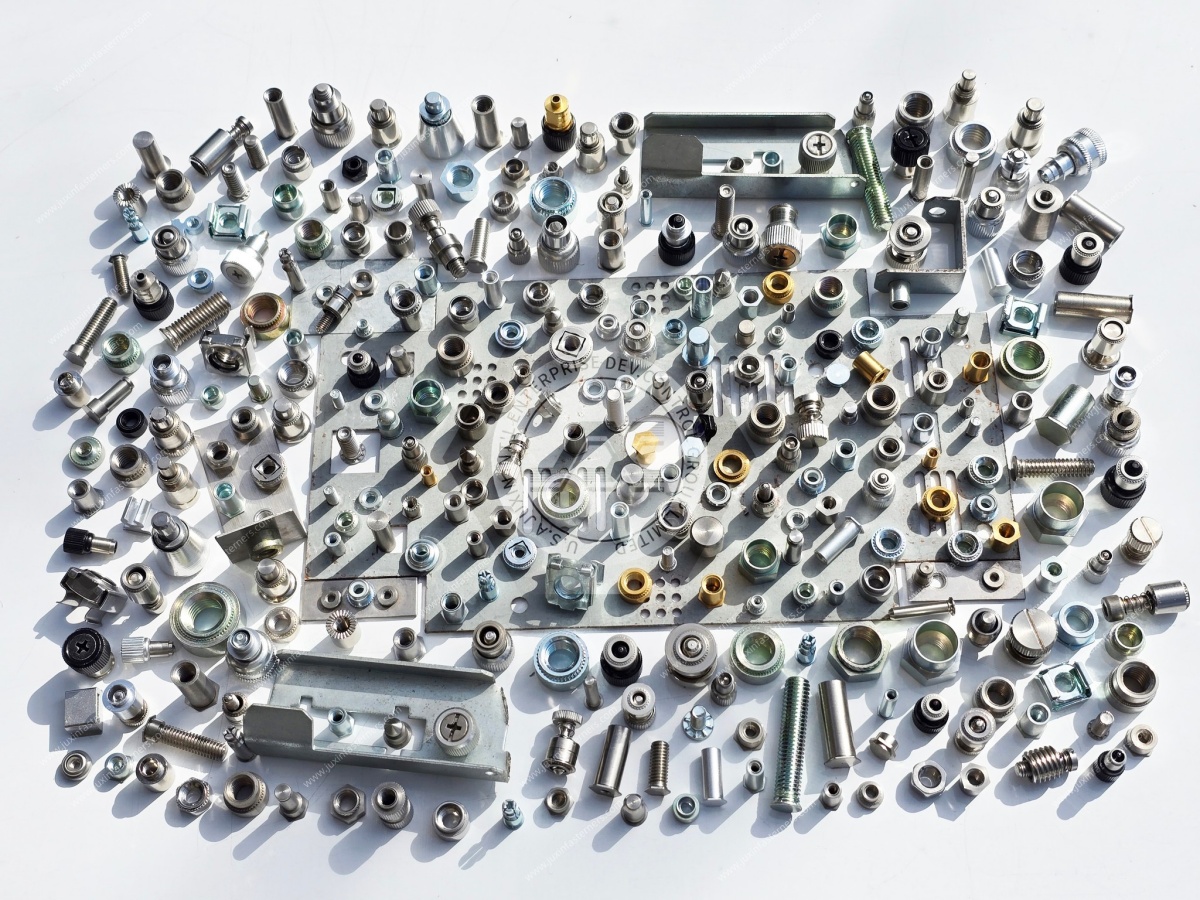
JUXIN FASTENERS supplies industrial sheet metal fastening components for drawing-based OEM and custom manufacturing projects.
Relevant products include:
Self-clinching nuts
Self-clinching studs
Self-clinching standoffs
Blind self-clinching standoffs
Concealed-head self-clinching components
Captive fastening components
Threaded inserts
Custom CNC-machined threaded parts
Product selection should be based on the actual panel material, installation geometry, mechanical requirements and customer specifications.
Material availability, manufacturing feasibility, samples, MOQ, lead time and inspection requirements are confirmed during project evaluation.
Request a Self-Clinching Fastener Engineering Review and OEM RFQ
Are you developing a new sheet metal enclosure, selecting a self-clinching nut, replacing a welded mounting feature or qualifying an alternative supplier?
JUXIN FASTENERS welcomes inquiries from structural and mechanical engineers, design engineers, manufacturing engineers, production managers,
procurement specialists, purchasing managers and supplier development teams.
Please send:
2D drawing + fastener type + thread designation + panel material + panel thickness + mounting-hole requirements + installation method
+ required pushout or torque-out performance + surface treatment + sample quantity + annual purchasing volume + target delivery schedule
Our team can review suitable product options, drawing feasibility, installation compatibility, sample arrangements and commercial quotation requirements.
Company: JUXIN FASTENERS
Website: https://www.juxinfasteners.com/
Email: info@juxinfasteners.com
Send your self-clinching fastener drawings and RFQ to JUXIN FASTENERS for technical evaluation and quotation.
Contact Us
Tel.:
+86 020 8621 0320
+86 020 3121 6067
E-mail:
Technical Support:
Navigation
SEND INQUIREY



