
Call Us
+86 136 6007 9809
Call Us
+86 136 6007 9809

Apr. 14, 2026
CD Weld Stud Quality and Welding Consistency in High-Volume OEM Manufacturing
Capacitor discharge (CD) stud welding is an established joining process used in sheet-metal fabrication, electrical equipment, automotive components and industrial machinery.
Its short-duration welding cycle enables suitable fastening components to be attached to metallic substrates without requiring a conventional drilled-and-tapped connection.
In high-volume manufacturing, the performance of CD weld studs depends on the interaction between the fastening component, base material and welding process.
Dimensional accuracy, material characteristics, ignition-tip geometry and surface condition can all influence welding repeatability.
Even small variations in these characteristics may affect stud positioning, weld initiation and the mechanical performance of the finished joint.
For OEM manufacturing applications, CD weld stud quality therefore involves more than dimensional conformity.
It includes the consistency of the component characteristics that interact directly with the welding process.
The Relationship Between CD Weld Stud Geometry and Welding Performance
The geometry of a CD weld stud influences both mechanical assembly and welding behavior.
Critical dimensions depend on the stud configuration and may include:
Thread diameter and pitch
Overall length
Threaded length
Shank diameter
Head or flange dimensions
Welding-tip geometry
Straightness
Dimensional variation can affect how the stud is positioned against the base material and how consistently it interacts with the welding equipment.
In automated production, these geometric characteristics also influence feeding and handling.
A stud that satisfies basic thread and length requirements may still present manufacturing difficulties if its straightness or welding feature is inconsistent.
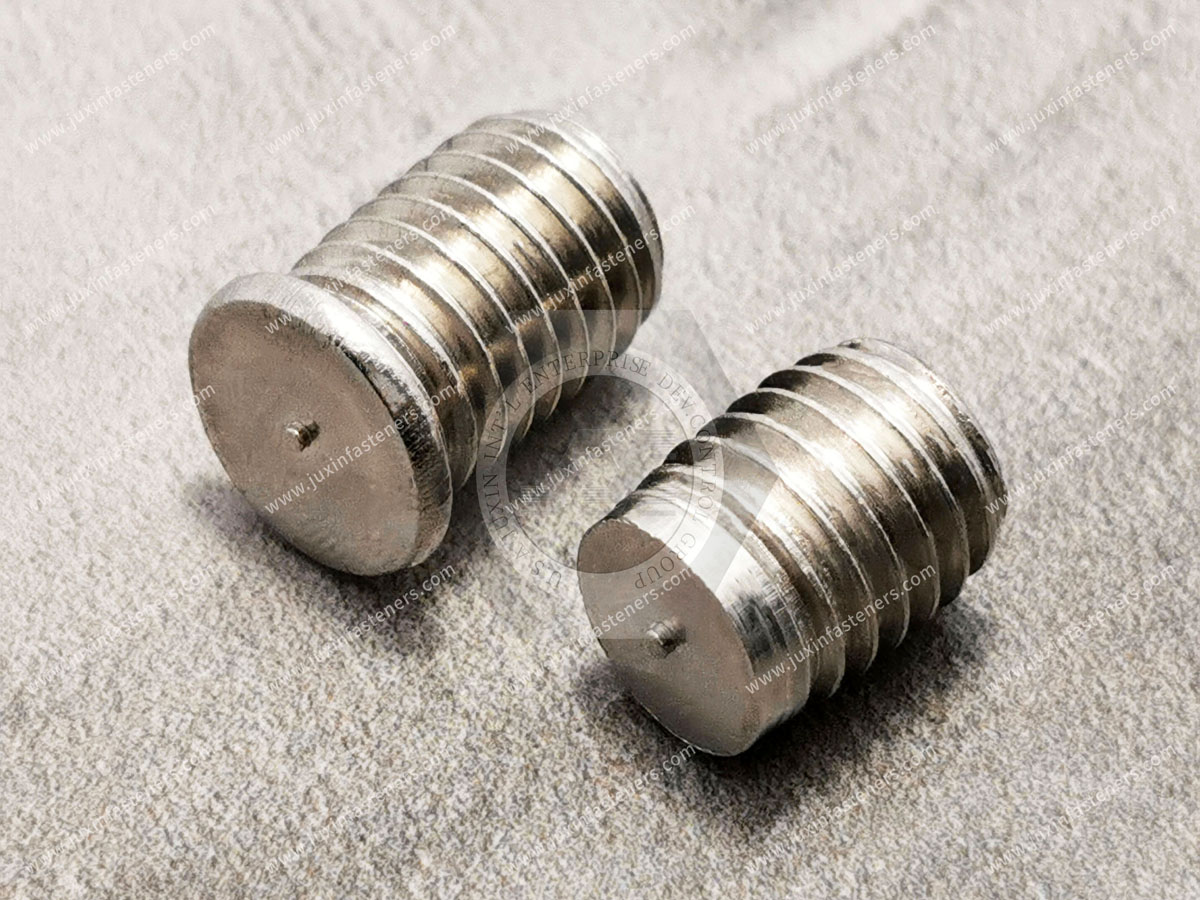
Stud Straightness and Automated Positioning
Straightness is particularly relevant for studs handled by automatic feeding and positioning equipment.
Excessive bending may affect:
Stud orientation
Feeding reliability
Alignment with the welding gun
Contact position on the substrate
Finished stud perpendicularity
The effect depends on stud length, diameter, equipment configuration and permitted geometric tolerances.
Longer or more slender stud configurations may be more sensitive to certain alignment deviations.
Consistent straightness contributes to repeatable component presentation during automated welding operations.
Ignition-Tip Geometry and Weld Initiation
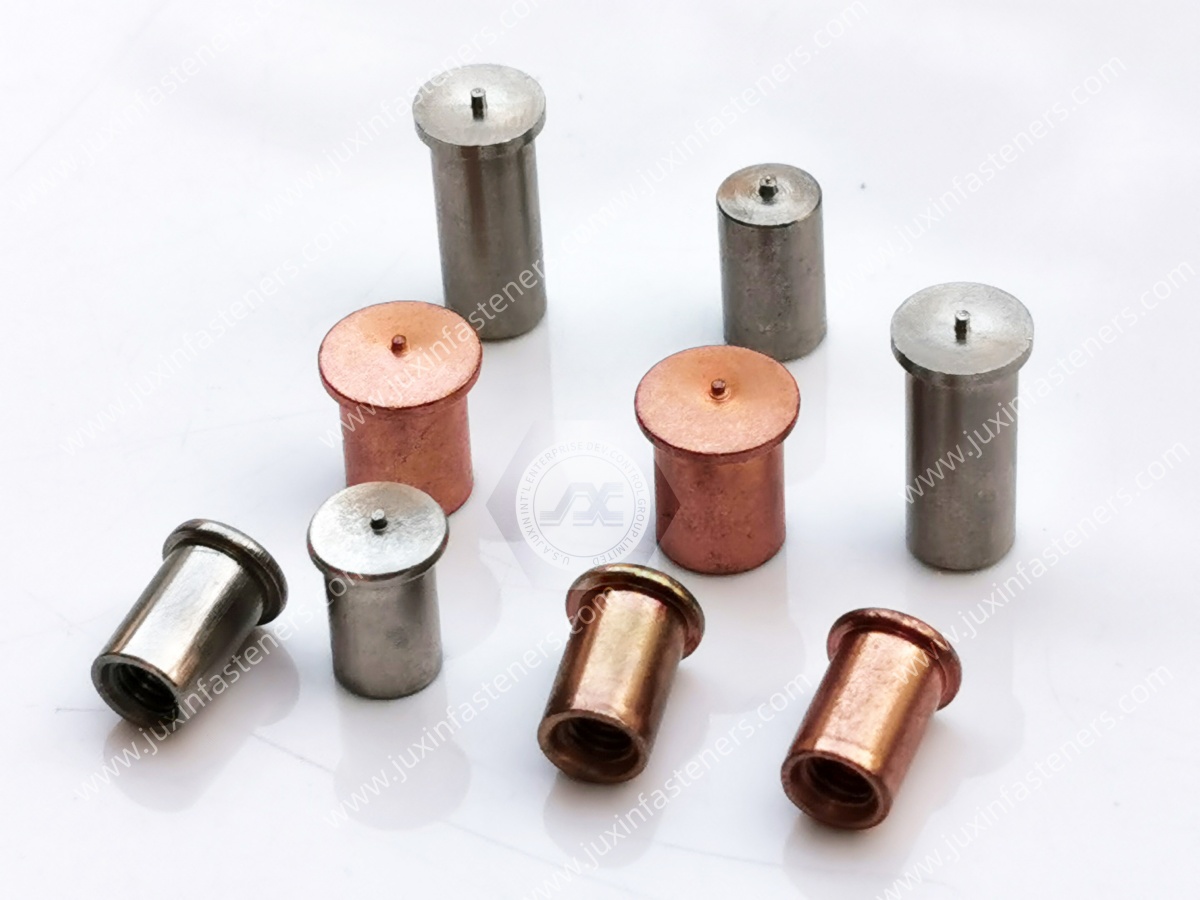
Certain CD weld stud designs incorporate an ignition tip at the welding end.
This feature participates in the initial interaction between the stud and the base material during the capacitor discharge welding cycle.
Its geometry is therefore relevant to the welding process rather than merely the external appearance of the fastener.
Variations in ignition-tip formation may influence:
Initial electrical contact
Localized heating
Weld initiation behavior
Stud-to-substrate interaction
Process repeatability
The relationship is influenced by welding equipment, material properties and process settings.
Consistent ignition-tip geometry supports more repeatable component conditions, although it does not independently guarantee a satisfactory weld.
Thread Integrity and Finished Assembly Performance
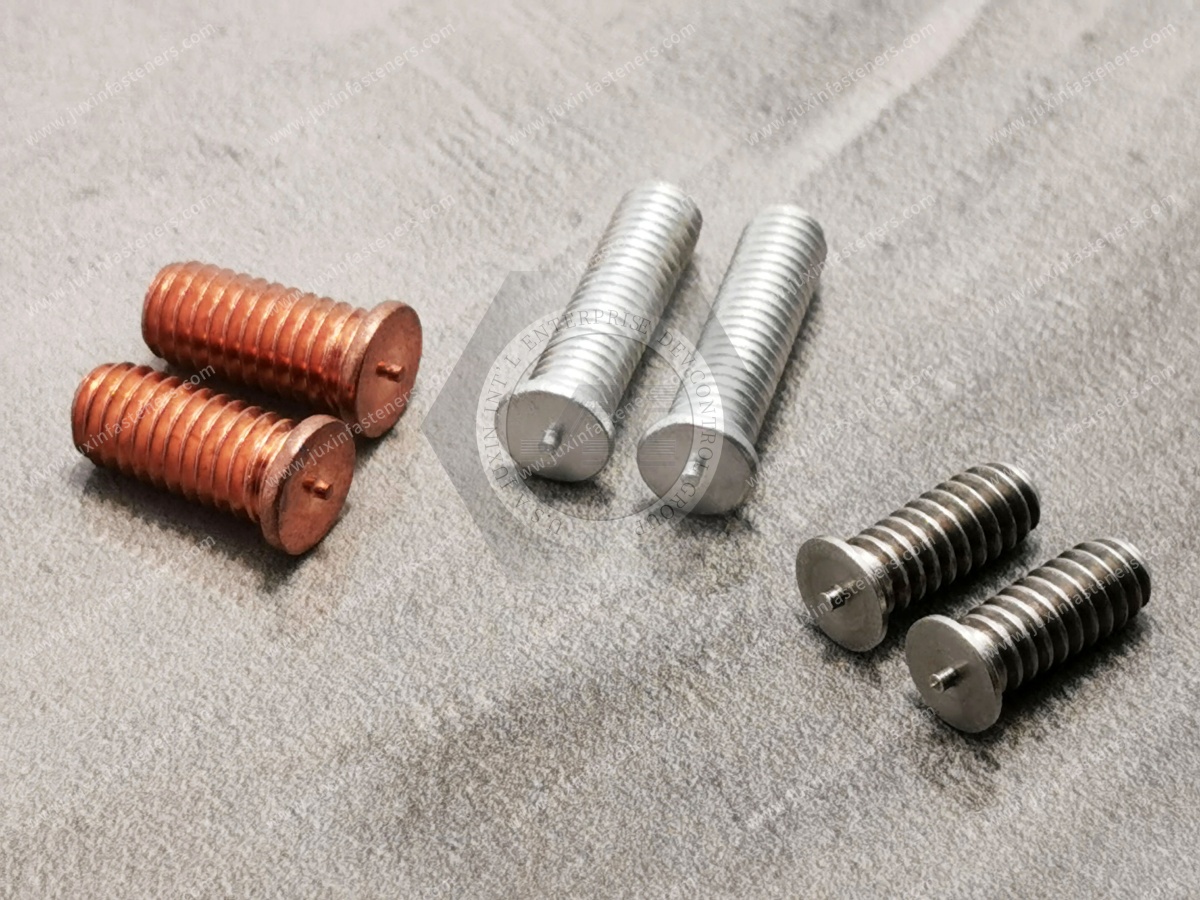
The threaded portion of a CD weld stud serves the subsequent mechanical fastening operation.
Thread quality influences:
Mating nut engagement
Assembly fit
Installation consistency
Load transfer through the threaded connection
Serviceability
Thread damage, burrs or dimensional deviation may create assembly problems even when the welded attachment itself is acceptable.
This creates two distinct quality considerations: the welded interface and the threaded fastening interface.
Both are relevant to the performance of the finished assembly.
Material Compatibility in Capacitor Discharge Stud Welding
CD stud welding involves rapid energy transfer and localized heating.
The response of the welded interface depends on the materials involved.
Relevant characteristics include:
Electrical conductivity
Thermal conductivity
Melting behavior
Surface condition
Material composition
Base-metal thickness
The same stud geometry may produce different welding results when used with different base materials.
Carbon Steel Applications
Carbon steel CD weld studs may be used in suitable steel sheet-metal assemblies.
Material grade, surface condition and welding parameters influence the resulting joint.
Stainless Steel Applications
Stainless steel weld studs may be considered for applications requiring particular corrosion or material properties.
Welding behavior depends on the selected stainless steel grade and the substrate.
Dissimilar Material Considerations
Joining different metallic materials introduces additional complexity because their thermal, electrical and metallurgical properties may differ.
The suitability of a particular combination depends on the welding process and required joint performance.
Base Material Thickness and Heat Input
The thickness of the base material influences the thermal and mechanical conditions of the welded joint.
Thin sheet-metal components are often associated with CD stud welding applications because the process uses a short-duration energy discharge.
However, the resulting heat-affected region and possible reverse-side effects depend on the actual material, stud size, equipment settings and joint geometry.
A short welding cycle does not guarantee the absence of visible marking, distortion or metallurgical changes.
The interaction between stud diameter, substrate thickness and welding energy is therefore an important aspect of application suitability.
Welding Energy and Process Repeatability
In capacitor discharge stud welding, electrical energy stored in capacitors is released during the welding cycle.
The nominal stored energy of a capacitor system can be expressed as:
E = ½ CV²
Where:
E = stored electrical energy
C = capacitance
V = charging voltage
This relationship describes the stored energy available in the capacitor system.
It does not directly establish the amount of energy effectively transferred into the welded interface.
Actual welding behavior also depends on:
Electrical circuit characteristics
Contact resistance
Welding equipment
Stud movement
Surface condition
Material properties
Process timing
Two welding systems operating at the same nominal stored energy may not necessarily produce identical welded joints.
The relationship between component geometry and process settings is therefore central to welding repeatability.
Surface Condition and Welding Consistency
The surfaces of the stud and base material form the initial welding interface.
Their condition can influence electrical contact and localized heating.
Potential variables include:
Oxidation
Oil or grease
Surface contamination
Protective coatings
Surface roughness
Local damage
A consistent stud geometry does not eliminate variation introduced by the substrate surface.
Similarly, a clean and dimensionally accurate stud may produce inconsistent results if the base material or equipment conditions vary.
This distinction is important when analyzing welding defects in production.
Mechanical Performance of the Welded Joint
The quality of a CD welded connection cannot be determined solely from the appearance or dimensions of the stud.
Mechanical performance depends on the complete welded assembly.
Relevant factors include:
Stud material
Base material
Welded interface
Joint geometry
Loading direction
Welding parameters
Surface condition
Depending on the application, welded joints may be subjected to tensile, shear, bending or combined loading.
The required performance is defined by the engineering application and governing specification.
Weld Failure Modes
Different failure locations may indicate different mechanical behaviors.
Potential failure modes include:
Fracture within the stud
Separation at the welded interface
Failure in the base material
Local deformation around the welded region
The interpretation of a test result depends on the loading method, joint geometry and applicable acceptance criteria.
A high measured failure load alone does not provide a complete description of weld quality without considering the failure mode.
Weld Testing and Process Validation
Depending on the applicable welding specification, joint evaluation may involve:
Visual examination
Bend testing
Tensile or pull testing
Other mechanical tests
Application-specific functional testing
Test conditions and acceptance criteria are established by the relevant specification or customer engineering requirements.
Component dimensional inspection and welded joint testing address different aspects of product performance.
Component Inspection and Welded Joint Validation
CD weld stud quality can be considered at three technical levels.
| Quality aspect | Main characteristics | Relationship to production |
|---|---|---|
| Component geometry | Dimensions, straightness, threads and welding features | Feeding, positioning and assembly |
| Material and surface condition | Material grade, surface condition and cleanliness | Welding compatibility and repeatability |
| Welded joint performance | Weld integrity, mechanical behavior and failure mode | Finished assembly reliability |
A conforming component does not automatically establish the performance of the finished welded joint.
Conversely, welding variation may originate from equipment or substrate conditions rather than the stud.
The distinction between these factors is important for consistent industrial production.
Dimensional Inspection and Batch Consistency
Industrial CD weld studs may be produced and supplied in substantial quantities.
For high-volume applications, consistency between individual parts and production batches can influence manufacturing efficiency.
Relevant characteristics may include:
Overall dimensions
Straightness
Thread conformity
Welding-tip formation
Surface defects
Material identification
Inspection methods depend on the characteristic being evaluated.
Visual or automated screening may be appropriate for certain detectable defects.
Dimensional measurements may be performed using suitable measuring equipment or gauges.
Material verification and destructive welding tests require different approaches.
100% Inspection and Its Technical Scope
In industrial fastener quality control, 100% inspection refers to checking every part for specifically defined characteristics.
It does not necessarily mean that every dimension, material property or welding-performance characteristic has been tested on every component.
For example, individual-part screening may be applied to defined visible or geometric defects, while other characteristics are evaluated using an agreed sampling or testing plan.
The technical value of inspection depends on:
The characteristics being controlled
Measurement capability
Acceptance criteria
Inspection repeatability
Defect detection capability
Inspection coverage and manufacturing process control are complementary aspects of production quality.
Automated Welding and Production-Line Stability
Automated stud welding introduces additional requirements beyond individual weld performance.
The component must be compatible with the complete production system.
Relevant factors include:
Feeding geometry
Stud orientation
Positioning repeatability
Welding gun compatibility
Fixturing
Equipment settings
Part handling
Packaging
Dimensional variation may contribute to feeding interruptions or alignment problems.
Surface and material variation may affect welding behavior.
Equipment wear, fixture conditions and process settings may also influence production results.
Consequently, welding consistency is a system-level characteristic rather than a property of the stud alone.
Production Efficiency and Component Consistency
For high-volume manufacturers, the cost of a fastening component extends beyond its purchase price.
Production-related costs may include:
Equipment downtime
Incoming inspection
Sorting
Rework
Scrap
Welding equipment adjustment
Assembly interruptions
A component that is inexpensive to purchase may still generate additional manufacturing costs if its geometry or quality varies excessively.
At the same time, inspection requirements introduce their own costs and should correspond to the application's actual risk.
The relevant commercial consideration is the relationship between component cost, process stability and the number of acceptable finished assemblies.
CD Weld Stud Applications in Automotive Manufacturing
Automotive production includes numerous sheet-metal and mechanical attachment applications.
CD weld studs may be considered for suitable components requiring welded threaded attachments.
Relevant engineering considerations include:
Sheet-metal thickness
Material compatibility
Welding repeatability
Component positioning
Dimensional consistency
Finished joint loading
Corrosion exposure
Automotive OEM and Tier-1 programs may also impose specific quality documentation and production approval requirements.
The term automotive-grade does not independently establish compliance with a particular OEM specification or certification.
Electrical Enclosures and Industrial Control Equipment
CD weld studs may be used for suitable mounting and fastening applications in:
Electrical cabinets
Control enclosures
Equipment housings
Sheet-metal panels
Industrial power equipment
Typical considerations include:
Panel thickness
Stud positioning
Assembly clearance
Thread engagement
Surface finish
Mechanical loading
Where electrical continuity, grounding or current-carrying functions are involved, additional electrical and mechanical requirements may apply.
A welded mechanical attachment does not automatically establish compliance with electrical connection requirements.
Industrial Machinery and Equipment Manufacturing
Industrial equipment manufacturers may use CD weld studs for selected:
Equipment housings
Access panels
Mounting brackets
Fabricated sheet-metal components
Internal fastening points
Component consistency can be important where multiple welded attachment points are incorporated into repeatable production assemblies.
The appropriate stud configuration depends on the joint design, loading conditions and manufacturing process.
Relevant International Standards
ISO 13918 — Studs and Ceramic Ferrules for Arc Stud Welding
ISO 13918 specifies requirements for covered stud configurations and associated products used in arc stud welding applications.
It provides a relevant technical reference for certain standardized CD weld stud designs.
The applicability of individual requirements depends on the stud configuration and specification.
ISO 14555 — Arc Stud Welding of Metallic Materials
ISO 14555 addresses arc stud welding requirements for metallic materials.
It is relevant to welding process control, examination and qualification considerations within its scope.
Product Standards and Welding Requirements
A standardized weld stud design and a qualified welding process address different technical requirements.
Product conformity concerns the fastening component.
Welding conformity concerns the process and resulting joint.
Both may be relevant to an OEM production application.
Metric and Inch Thread Specifications
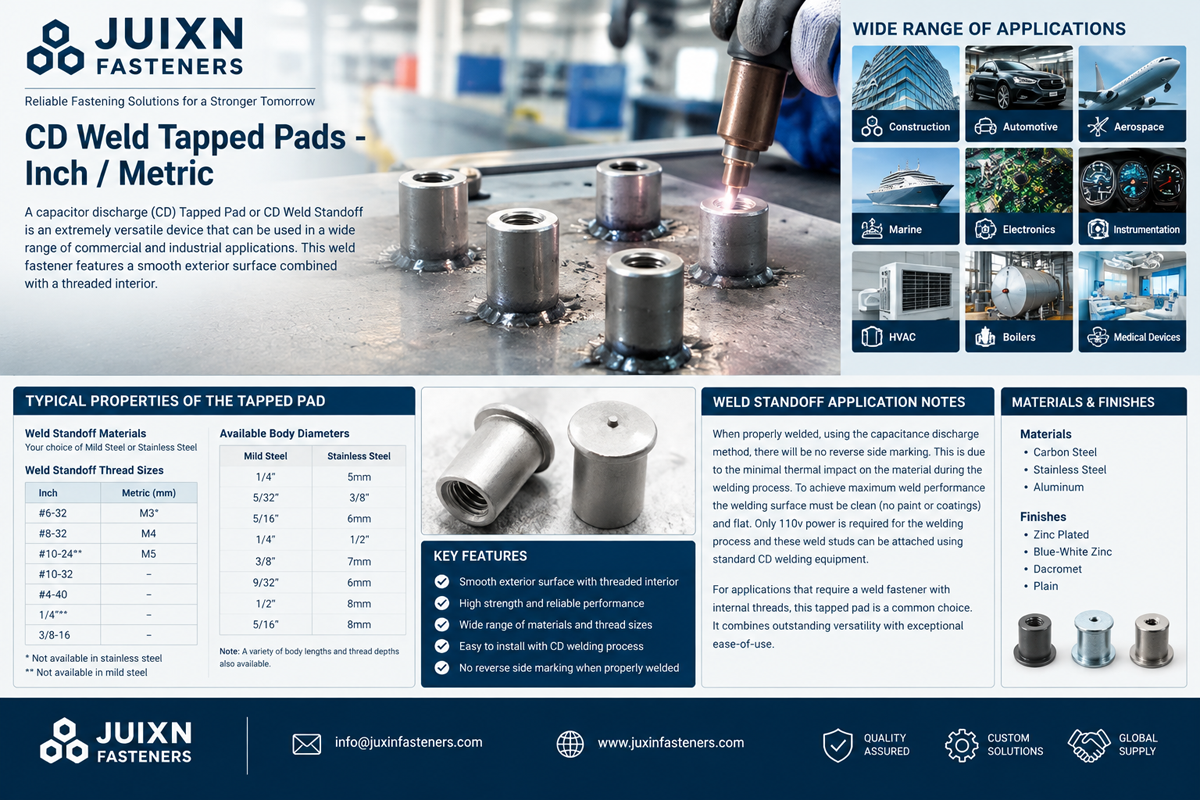
CD weld studs may be specified with metric or inch-series threads, depending on the customer drawing and actual product configuration.
Metric and UNC/UNF threads are different systems and are not directly interchangeable.
Thread form, pitch, tolerance and mating component compatibility must correspond to the approved design.
Technical Characteristics Relevant to OEM Sourcing
For industrial procurement and supplier development, CD weld stud specifications typically involve both component and manufacturing requirements.
| Technical area | Relevant specification |
|---|---|
| Stud design | Configuration and approved drawing |
| Thread | Diameter, pitch and tolerance |
| Geometry | Overall length, straightness and welding features |
| Material | Required grade and material condition |
| Base material | Alloy, thickness and surface condition |
| Welding process | Equipment and process requirements |
| Mechanical performance | Required joint properties and acceptance criteria |
| Inspection | Critical characteristics and agreed methods |
| Documentation | Material and inspection records |
| Packaging | Protection of threads and welding features |
| Supply | Prototype quantities, annual demand and delivery requirements |
The combination of these requirements determines whether a proposed stud is suitable for a particular OEM manufacturing program.
CD Weld Studs and Industrial Fastening Solutions from Juxin Fasteners
Juxin Fasteners has more than 20 years of experience serving international industrial fastening customers.
Our product portfolio includes CD weld studs, DIN 34817 weld studs, weld nuts, self-clinching fasteners, blind rivet nuts,
industrial nuts, rivets and drawing-based OEM fastening components.
For CD weld stud applications, technical and commercial review may involve:
Stud geometry and drawing requirements
Material selection
Thread specifications
Welding feature dimensions
Base-material compatibility
Inspection requirements
Prototype and production quantities
Packaging and delivery conditions
Specific manufacturing feasibility, inspection coverage, sample arrangements, documentation and supply terms are confirmed according to the project requirements.
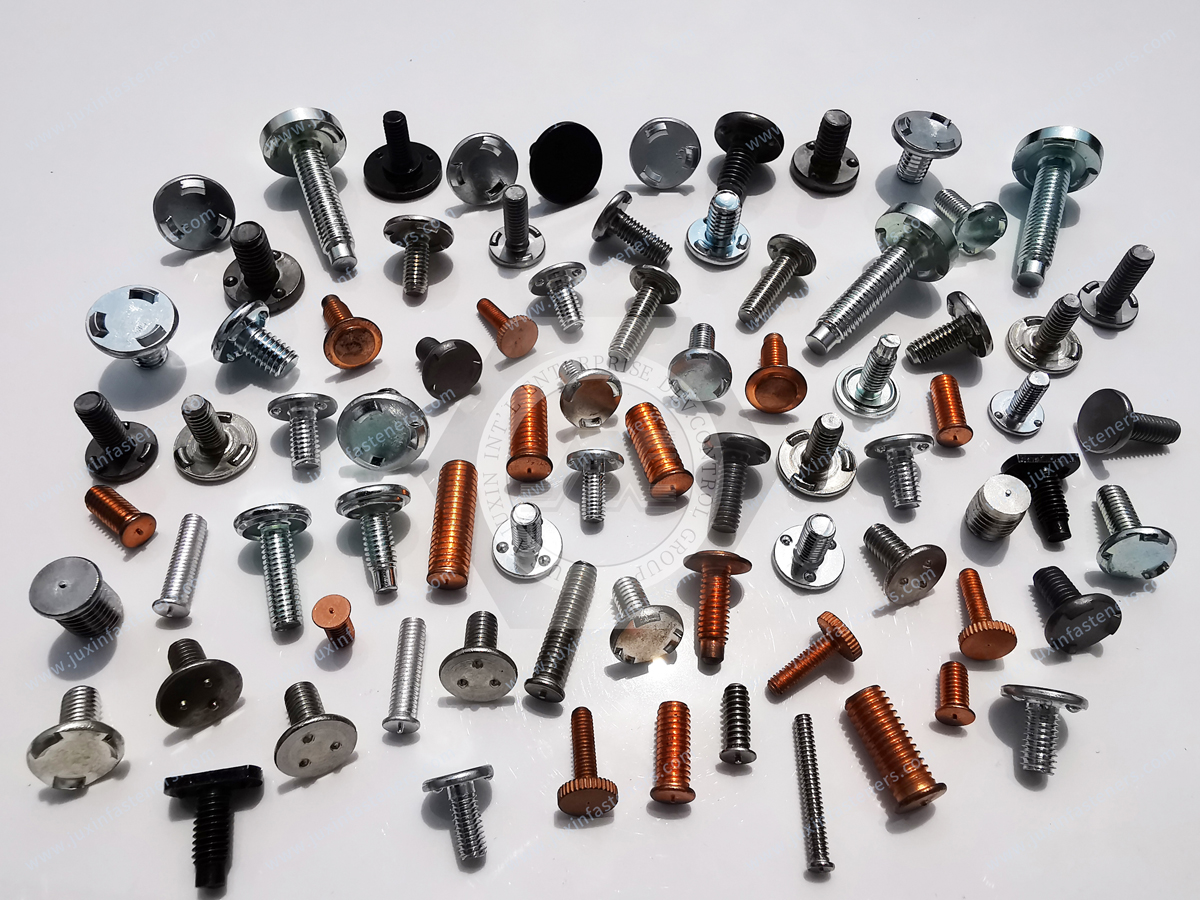
CD Weld Stud OEM RFQ and Technical Inquiry
Juxin Fasteners welcomes CD weld stud inquiries for automotive components, electrical enclosures,
industrial sheet-metal assemblies and automated manufacturing applications.
For technical review and quotation, relevant information includes:
2D/3D drawings and drawing revision
Applicable ISO or customer specification
Stud configuration and dimensions
Material grade
Metric or inch thread requirements
Ignition-tip or welding-feature geometry
Base material and sheet thickness
Welding equipment or process information
Required mechanical performance
Inspection and documentation requirements
Sample quantity and estimated annual demand
Packaging and delivery schedule
Company: Juxin Fasteners
Website: https://www.juxinfasteners.com/
Email: info@juxinfasteners.com
For CD weld stud drawings, technical specifications and OEM volume inquiries,
contact Juxin Fasteners for product feasibility review and quotation.
Contact Us
Tel.:
+86 020 8621 0320
+86 020 3121 6067
E-mail:
Technical Support:
Navigation
SEND INQUIREY



