
Call Us
+86 136 6007 9809
Call Us
+86 136 6007 9809

Sep. 08, 2023
Industrial washers are simple components, but they perform several very different functions in mechanical fastening systems.
A washer may be used to distribute bearing load, protect a surface, provide a controlled bearing interface, introduce axial spring behavior,
support a sealing system, provide spacing or meet a specific drawing requirement.
This means the correct engineering question is not simply:
“What washer fits this bolt?”
The better question is:
“What does this joint require the washer to do?”
For engineers, purchasing teams and supplier-development professionals, a practical selection path is:
Application → Joint Requirement → Washer Function → Washer Type → Fastener Interface → Parent Material → Dimensions → Material → Surface Treatment → Applicable Standard → Validation
JUXIN FASTENERS supplies industrial washers and related screws, bolts, nuts, locking fasteners and custom fastening components for OEM
and drawing-controlled applications across machinery, automotive equipment, electrical systems, power equipment, HVAC, industrial automation and other engineered assemblies.
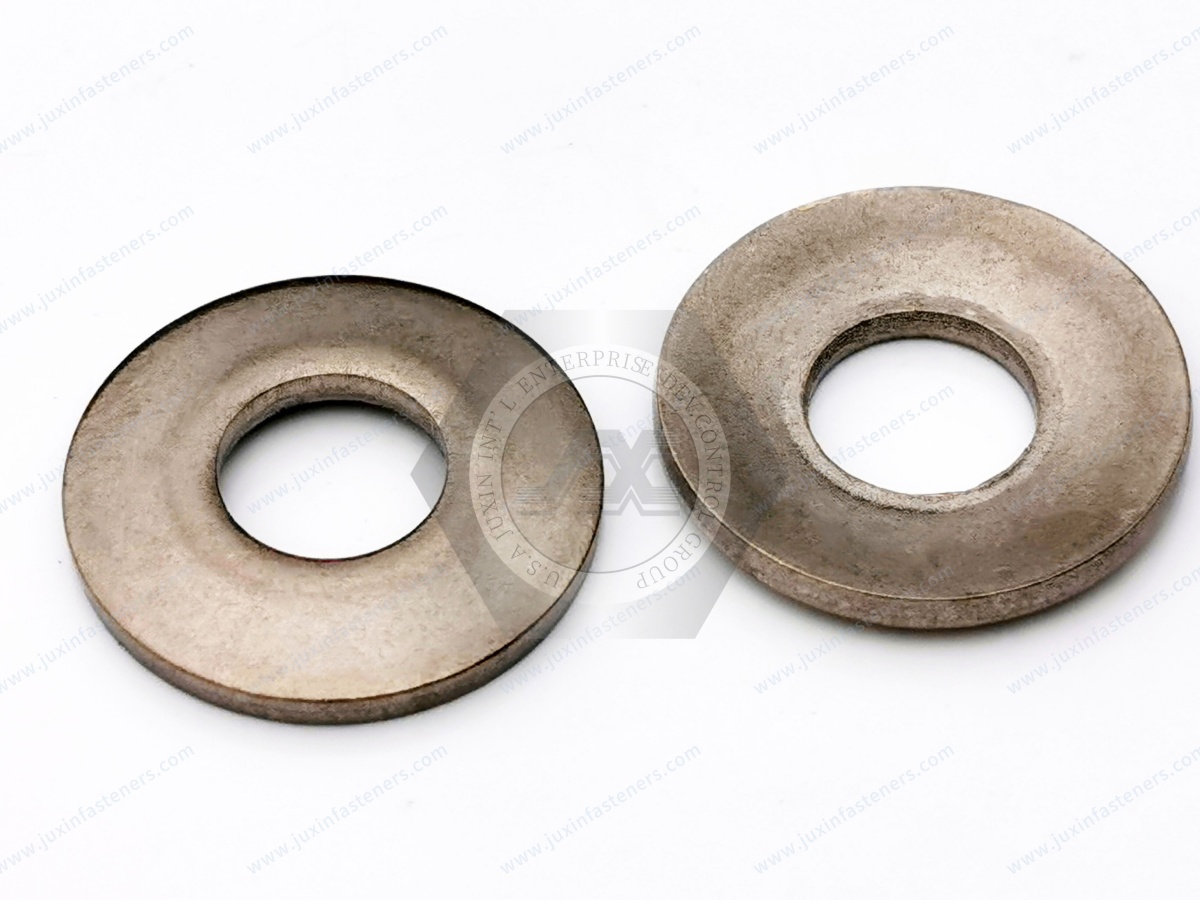
An industrial washer is a component installed in a fastening or mechanical assembly to perform one or more defined interface functions.
Depending on its design, a washer can be used to:
distribute bearing load;
protect a component surface;
reduce localized indentation;
provide a controlled bearing surface;
bridge an appropriate clearance hole;
introduce axial spring force;
control axial clearance;
support a sealing interface;
provide spacing;
satisfy a drawing-controlled mechanical requirement.
Not every washer performs all of these functions.
That distinction is fundamental to correct washer selection.
A common sourcing mistake is to begin with a familiar product name and then try to make that washer solve the application.
A more reliable method starts with the required function.
For example:
Need bearing load distribution → evaluate a plain/flat washer
Need axial compliance → evaluate an appropriate spring, wave or disc washer
Need fluid sealing → evaluate a dedicated sealing washer/system
Need rotational locking → evaluate the complete locking strategy
Need spacing → evaluate washer/spacer dimensions and stack-up
The product follows the engineering problem.
Flat washers are among the most widely used industrial washer types.
Their primary functions can include:
distributing bearing pressure;
protecting mating surfaces;
providing a defined bearing interface;
supporting a bolt head or nut;
bridging an appropriate clearance hole.
Selection involves more than matching the washer bore to the nominal bolt diameter.
Engineers should consider:
inside diameter;
outside diameter;
thickness;
dimensional series;
material;
hardness where applicable;
surface finish;
parent material;
hole geometry.
For applicable metric applications, ISO 7089 specifies plain washers of the normal series, Product Grade A.
It can be relevant where the drawing or fastening specification calls for this washer series.
However, ISO 7089 should not be used as a generic designation for every metric washer.
The actual standard required by the joint should be identified in the drawing or procurement specification.
ISO 7090 covers plain washers, chamfered, normal series, Product Grade A.
Chamfered and non-chamfered washers should not be treated as interchangeable solely because they are intended for the same nominal fastener diameter.
Geometry remains part of the controlled component specification.
A nominal fastener size does not fully define the washer.
Two washers intended for the same nominal bolt can differ in:
inside diameter;
outside diameter;
thickness;
dimensional series;
chamfer;
hardness;
material requirements;
applicable standard.
Therefore:
Same Bolt Size ≠ Same Industrial Washer
This becomes particularly important when procurement teams replace an existing supplier or consolidate part numbers.
When a bolt head or nut bears directly against a component, clamp load is transferred through the local contact area.
A suitably specified washer can increase the effective bearing area.
This may be useful when the clamped material is:
relatively soft;
thin;
coated;
polymeric;
aluminum;
otherwise sensitive to localized indentation.
However:
Larger Washer ≠ Automatically Stronger Joint
The parent material, hole geometry, edge distance, washer thickness and complete load path still matter.
Some washer specifications include hardness requirements.
Terms such as:
100 HV;
200 HV;
300 HV;
hardened washer
may appear in drawings and procurement requirements.
These should not be treated as generic quality rankings.
Washer hardness must be interpreted according to the applicable washer standard and joint requirement.
For a detailed engineering discussion, see Flat Washer Hardness & Bolt Grade Selection Guide.
Hardened washers may be required in fastening systems where the bearing interface is subjected to substantial compressive loading.
The required washer specification depends on the fastener system and application.
A washer should not be called “high strength” simply because it is harder than a general-purpose washer.
The correct properties come from the governing specification.
For applicable American fastening systems, ASTM F436/F436M covers hardened steel washers within its defined scope.
The current specification covers chemical, mechanical and dimensional requirements for hardened steel washers for specified inch and metric fastener sizes and identifies applicable types and styles.
This can be relevant to mechanical and structural bolting systems where ASTM F436/F436M is specified.
It should not be treated as the default standard for every industrial flat washer.
Spring washers use elastic geometry to provide a spring response.
This broad category can include different designs such as:
split/helical spring washers;
wave washers;
curved washers;
disc springs;
other engineered elastic washer geometries.
Their mechanical behavior can differ substantially.
A spring washer should therefore be selected according to its intended function rather than simply because the application experiences vibration.
Traditional descriptions frequently say that spring washers prevent bolts from loosening.
That statement is too broad.
ASME B18.21.1 covers applicable inch-series helical spring-lock, tooth-lock and plain washers and explicitly notes that the historical use
of the word “lock” in product names does not imply indefinite permanency of the attachment.
For vibration-critical joints, engineers should evaluate the complete locking mechanism rather than assume that a washer alone will prevent rotational loosening.
Wave washers provide axial elastic behavior through formed wave geometry.
Depending on the design, they can be used for:
axial clearance control;
bearing assemblies;
electric motors;
shaft systems;
rotating equipment;
compact mechanical assemblies.
Selection should be based on required force-deflection behavior and installed height.
A wave washer is not simply a different shape of lock washer.
Conical disc springs can provide significant axial spring force within a compact installation envelope.
Engineering selection can involve:
load;
deflection;
inside diameter;
outside diameter;
thickness;
free height;
installed height;
stacking arrangement;
material;
temperature;
fatigue requirements.
These products should be treated as engineered spring components rather than generic flat washers.
The term lock washer can refer to different washer geometries historically intended or marketed for resistance to fastener movement.
However, the product name alone does not establish locking performance.
If rotational self-loosening is the actual engineering problem, the complete joint may need evaluation of:
prevailing-torque nuts;
nylon-insert locknuts;
all-metal locknuts;
thread-locking systems;
mechanical locking methods;
preload and joint stiffness.
For another locking approach, see Nylon Insert Locknuts for Anti-Vibration Applications.
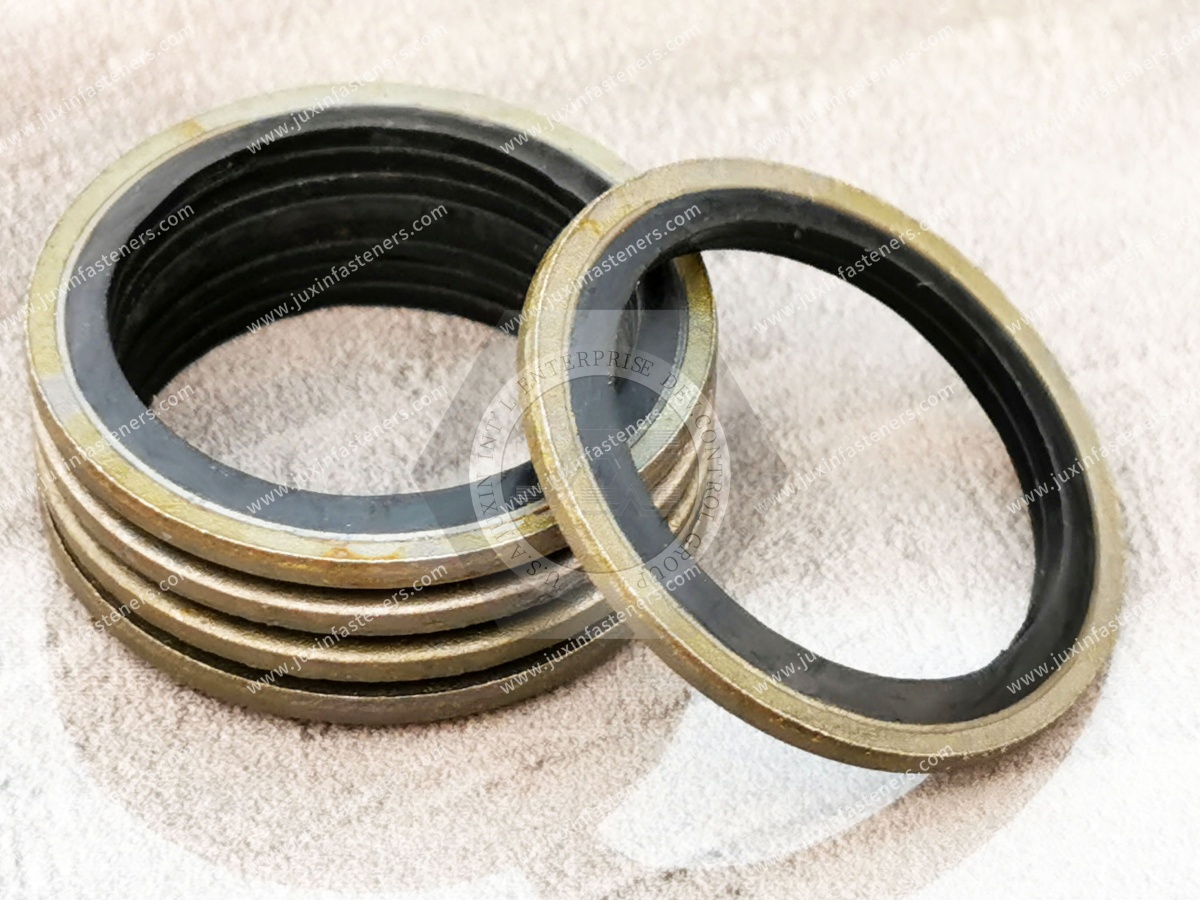
Sealing washers are designed to participate in a sealing interface.
Depending on the application, they may use:
metallic deformation;
soft-metal sealing;
elastomeric elements;
bonded sealing materials;
other engineered sealing geometries.
A standard flat washer should not automatically be described as a sealing washer.
Leakage performance depends on the complete sealing system.
Important variables can include:
fluid;
pressure;
temperature;
washer geometry;
sealing material;
surface finish;
mating surfaces;
installation load;
reuse requirements.
Therefore:
Sealing Washer ≠ Automatic Leak-Proof Joint
The assembly must be specified and validated for the intended service condition.
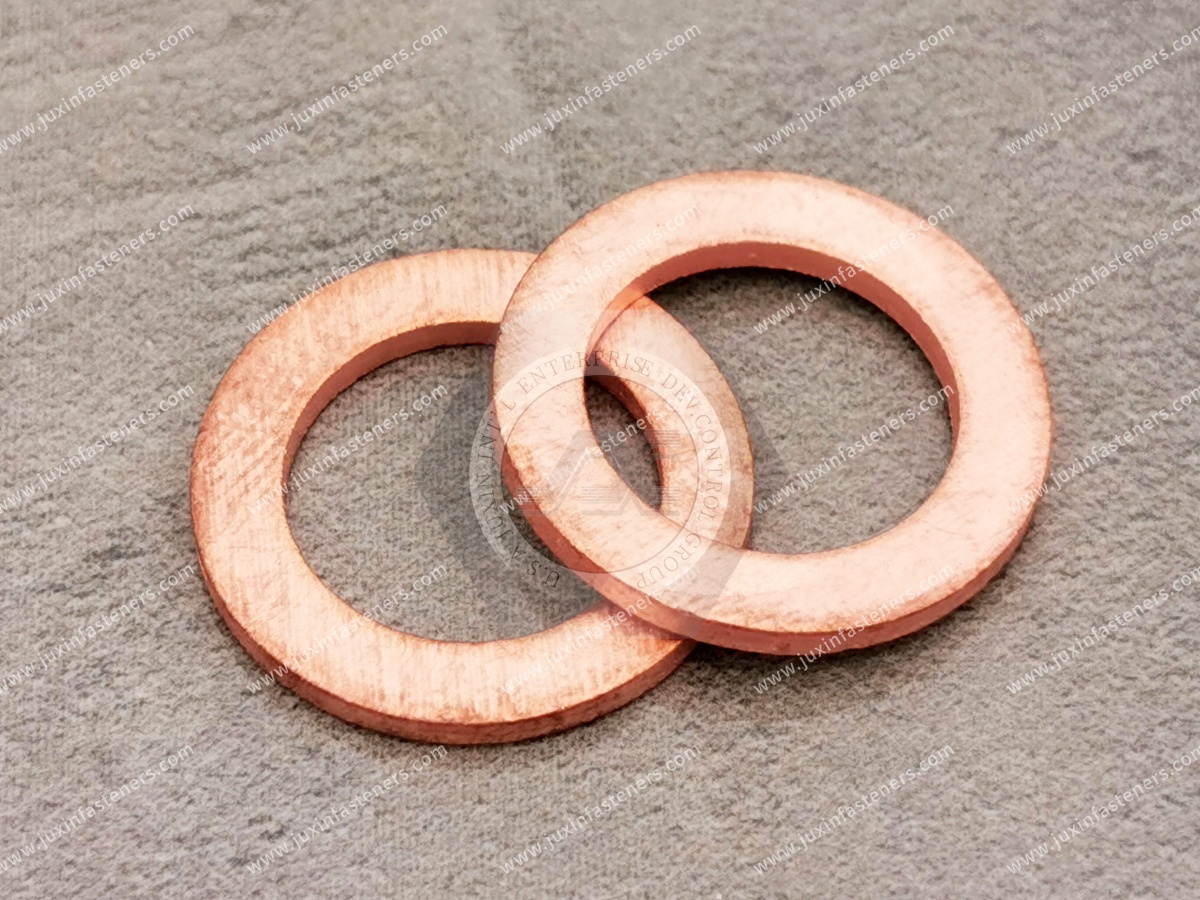
Copper washers are commonly encountered in certain sealing applications because copper can provide useful deformation characteristics.
Potential applications can include appropriate:
hydraulic connections;
fluid systems;
automotive mechanical systems;
industrial equipment.
But material alone does not establish sealing performance.
A copper washer should be selected according to geometry, material condition, mating surfaces, pressure, temperature and installation requirements.
Bonded sealing washers combine metallic and elastomeric elements.
They may be used where the fastener interface also needs to participate in environmental or fluid sealing.
Selection can involve:
bolt size;
washer dimensions;
elastomer material;
fluid compatibility;
temperature;
pressure;
surface condition.
The complete joint determines sealing performance.
Not every industrial washer is defined by a standard catalog geometry.
Custom washers may be required for:
unusual hole sizes;
limited installation envelopes;
special outside diameters;
non-standard thicknesses;
electrical insulation;
thermal isolation;
equipment-specific interfaces.
For custom washer sourcing, the drawing should define the actual requirement.
Common industrial washer material families can include:
carbon steel;
spring steel;
stainless steel;
copper;
brass;
aluminum;
engineering plastics;
project-specific alloys.
The correct material depends on function.
Material should not be selected solely from a generic statement such as:
“Stainless for corrosion”
or:
“Copper for sealing.”
The service environment and joint requirement still control the decision.
Carbon steel washers are widely used in general industrial fastening systems.
Depending on the application, they can provide an economical mechanical solution and may use a protective surface treatment.
The specification should define:
washer geometry;
material requirement;
hardness where applicable;
coating;
corrosion requirement.
Stainless steel washers can be selected for corrosion-sensitive applications.
However:
Stainless Steel ≠ Corrosion-Proof
Selection can depend on:
stainless grade;
chloride exposure;
humidity;
cleaning chemicals;
temperature;
mating materials;
galvanic conditions.
The grade should follow the actual environmental requirement.
Copper and brass washers can be used for project-specific requirements involving:
deformation behavior;
corrosion considerations;
electrical properties;
sealing interfaces.
Electrical conductivity of the raw material does not automatically mean that a washer creates an approved grounding or bonding connection.
Electrical performance requires system-level design and validation.
Aluminum washers may be considered where low mass or material compatibility is important.
However, engineers should consider:
bearing pressure;
material strength;
galvanic interaction;
temperature;
surface treatment;
mating materials.
Aluminum should not be substituted directly for steel without reviewing the joint.
Polymer washers can provide functions that differ from metallic washers.
Depending on the polymer and application, they may be used for:
electrical isolation;
surface protection;
spacing;
reduced mass;
non-metallic interfaces.
Material options can include engineering polymers selected according to the project requirement.
Polymer washers require consideration of:
temperature;
creep;
moisture absorption where applicable;
chemical exposure;
compression;
dimensional stability.
For example, nylon should not be treated as mechanically equivalent to a steel washer.
A useful industrial washer specification considers:
Function → Geometry → Dimensions → Material → Material Condition → Surface Treatment → Joint Interface → Environment
Material alone does not determine finished-component performance.
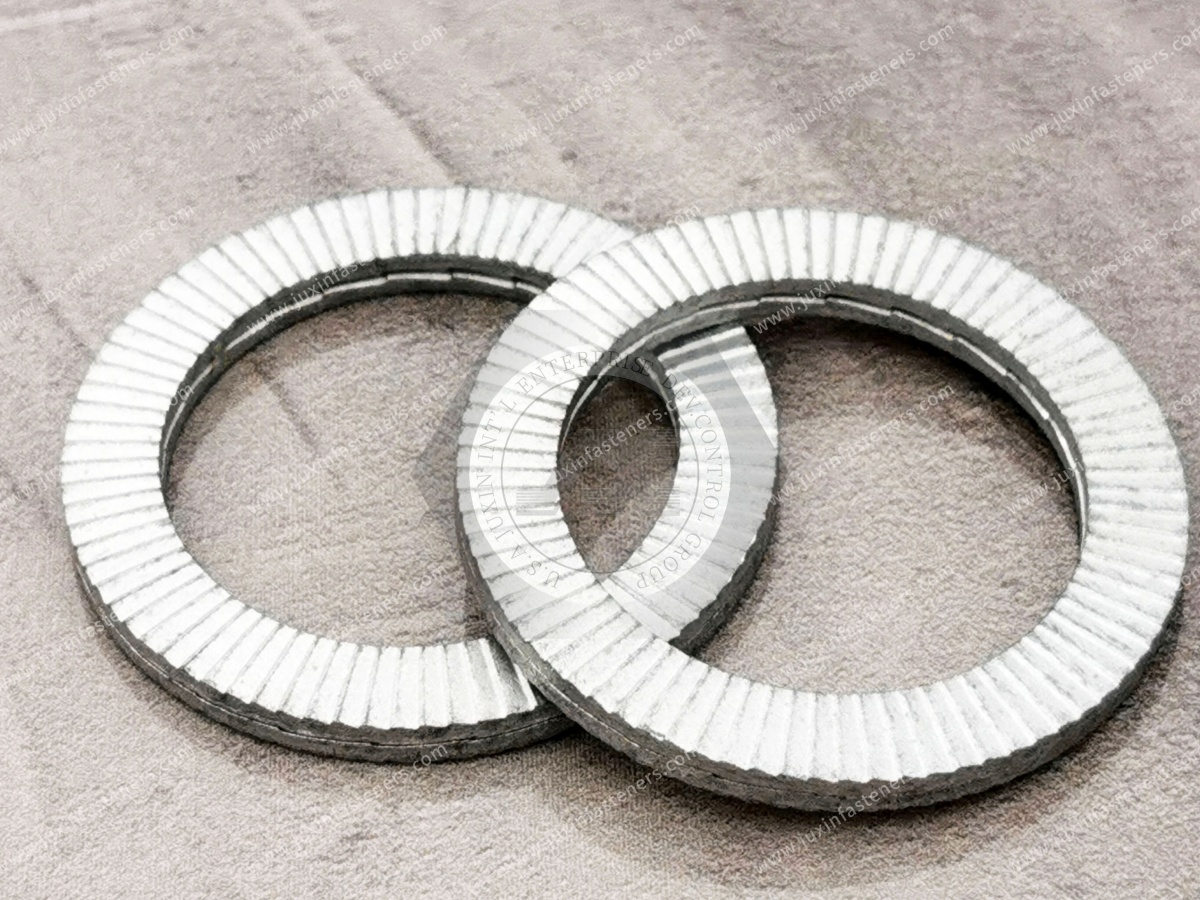
Carbon and spring steel washers may require corrosion protection.
Depending on the project, surface treatment can include appropriate:
zinc-based coatings;
trivalent chromium passivation;
phosphate-based finishes;
other customer-specified systems.
For applicable JUXIN FASTENERS projects, environmentally compliant trivalent chromium zinc systems can be evaluated where required.
A professional RFQ may need to define:
coating system;
coating thickness;
passivation;
appearance;
corrosion test;
test duration;
acceptance criteria;
RoHS/REACH requirements.
This reduces ambiguity between purchasing, engineering and supplier quality teams.
Where salt spray/fog testing is required, ASTM B117 may be specified as the test method.
However, salt spray hours are not a direct prediction of real-world service life.
The project should define:
test method;
duration;
acceptance criteria;
coating requirement.
Corrosion validation should match the actual customer specification.
A washer sits directly between materials in a mechanical joint.
That makes material compatibility important.
For example, combinations involving:
stainless steel;
aluminum;
carbon steel;
copper alloys
may require consideration of galvanic behavior when exposed to an electrolyte.
Washer selection should therefore consider the entire material stack.
Inside diameter affects fit around the mating fastener.
The washer must provide suitable clearance according to the applicable standard or drawing.
An oversized bore can reduce available bearing area, while insufficient clearance can create installation problems.
Nominal bolt diameter alone is not enough to define the correct washer.
Outside diameter influences available bearing area.
Larger-diameter washers can be useful in certain soft-material, thin-sheet or oversized-hole conditions.
But increasing outside diameter can create interference with:
nearby walls;
bends;
brackets;
recesses;
adjacent fasteners;
equipment housings.
The correct diameter depends on the actual assembly.
Thickness influences washer stiffness and assembly stack height.
Too little thickness may allow undesirable deformation in some joints.
Excessive thickness can affect:
available thread engagement;
bolt length;
packaging;
assembly height;
surrounding clearance.
Thickness should therefore be treated as an engineering dimension.
A washer transfers load into the material underneath it.
That means washer selection cannot ignore the parent component.
Possible parent materials include:
structural steel;
sheet steel;
aluminum;
polymers;
composites;
coated panels.
A high-strength bolt and hard washer do not automatically protect a weak parent material from local deformation.
Thin sheet requires particular attention to:
sheet thickness;
hole diameter;
washer outside diameter;
edge distance;
local bearing pressure;
deformation;
load path.
A washer can increase bearing area, but it cannot automatically convert thin sheet into a high-load structural joint.
When clamping polymers, aluminum or other relatively soft materials, the designer may need to manage localized bearing stress.
A washer can help distribute load.
However, engineers should also evaluate:
material creep;
relaxation;
surface indentation;
temperature;
clamp force.
The washer is only one part of the joint.
Oversized holes and slots can create special washer requirements.
Selection may involve:
sufficient hole coverage;
outside diameter;
washer thickness;
joint movement;
structural specification;
installation position.
A standard washer should not automatically be substituted into an oversized-hole joint.
Washers form part of the bearing interface during bolt tightening.
Their:
material;
coating;
lubrication;
surface finish
can influence friction under the rotating fastener surface.
Since friction affects the relationship between applied torque and achieved preload, changing washer finish can alter an established tightening process.
Applied torque is an indirect method of developing bolt tension.
Thread friction and bearing friction can consume a substantial part of the tightening torque.
Therefore, changing:
washer;
coating;
lubrication;
mating surface
can affect the torque-preload relationship.
For controlled joints, the fastening system should be evaluated as a complete assembly.
Machinery can use washers in:
motors;
pumps;
compressors;
gearboxes;
equipment frames;
brackets;
guards;
service covers.
Selection should reflect:
load;
fastener specification;
parent material;
vibration environment;
corrosion exposure;
maintenance requirements.
Automotive equipment uses washers across many different mechanical assemblies.
Potential applications can include:
brackets;
equipment mounts;
sheet-metal structures;
electrical equipment;
accessory systems;
serviceable mechanical assemblies.
Safety-critical applications require specific joint engineering and validation.
A general industrial washer should not automatically be promoted for wheel, brake, suspension or crash-critical joints.
For broader fastener-system selection, see Automotive High-Strength Fasteners: Bolts, Nuts & Clamps.
EV platforms, battery systems and power electronics equipment contain many mechanical interfaces.
Potential washer applications can include:
auxiliary brackets;
electronics housings;
service structures;
control equipment;
enclosure hardware.
A standard washer should not automatically be represented as providing:
IP sealing;
grounding;
EMI/RFI shielding;
battery enclosure structural integrity.
These are separate engineering requirements.
Modern data centers and high-power electrical systems can contain:
equipment racks;
UPS equipment;
AC/DC and DC/DC conversion systems;
power distribution equipment;
cooling systems;
control cabinets.
Washers used in these assemblies should be selected according to the mechanical joint, material compatibility and service environment.
Washers can be used in:
electrical cabinets;
control enclosures;
switchgear-related mechanical assemblies;
mounting brackets;
service panels.
Where grounding or bonding is required, the electrical connection must be separately specified.
A generic metallic washer is not automatically a qualified grounding washer.
HVAC systems can contain washers in:
air-handling units;
fan equipment;
compressor assemblies;
equipment frames;
control cabinets;
service panels.
Selection may need to account for:
humidity;
condensation;
outdoor exposure;
vibration;
maintenance access.
Automation and robotics equipment can require washers in:
machine frames;
motor mounts;
sensor brackets;
equipment covers;
control cabinets;
modular assemblies.
Compact packaging can make washer outside diameter and thickness particularly important.
Construction, mining and agricultural machinery can expose bolted joints to:
substantial loads;
contamination;
outdoor environments;
vibration;
repeated service.
The washer must be selected together with the bolt, nut, parent material and joint requirement.
The hardest available washer is not automatically the correct choice.
Rail systems contain fastening applications ranging from equipment cabinets to highly controlled structural assemblies.
Washer selection must reflect the specific component and applicable project requirements.
A general commercial washer should not be represented as automatically suitable for safety-critical railway joints.
Marine and offshore environments can introduce:
chloride exposure;
moisture;
galvanic corrosion;
temperature variation.
Washer material and coating should therefore be selected as part of the complete material system.
Stainless steel alone is not a complete marine specification.
Industrial washers can also appear in mechanical parts of:
diagnostic equipment;
laboratory equipment;
equipment carts;
enclosures;
brackets;
serviceable housings.
Material and cleaning requirements should follow the customer's equipment specification.
A generic washer should not automatically be described as medically certified, biocompatible or suitable for sterile environments.

Wind, energy-storage and power-distribution equipment can contain many bolted assemblies.
The requirements can range from ordinary enclosure hardware to highly engineered structural joints.
Washer selection should therefore follow the actual application classification rather than a broad “energy industry” label.
Engineering searches often begin with problems:
what type of washer should I use;
flat washer vs spring washer;
washer for high-strength bolt;
washer for soft material;
washer for oversized hole;
stainless vs carbon steel washer;
sealing washer for fluid connection;
washer hardness selection.
These are engineering-decision searches.
The content must answer the decision, not simply list products.
Procurement and supplier-development searches often look different:
industrial washer manufacturer;
washer supplier;
custom washer manufacturer;
stainless steel washer supplier;
hardened washer supplier;
OEM washer manufacturer;
bulk industrial washers;
drawing-based washer supplier.
These are commercial searches.
The page should connect these searches to the technical information required for quotation.
Engineering may begin with a functional problem.
Procurement may begin with a supplier search.
Both should converge on:
Approved Washer Specification
That specification should define the component sufficiently for repeat production, inspection and supplier comparison.
| Required Function | Primary Selection Direction |
|---|---|
| Bearing load distribution | Flat/plain washer |
| Surface protection | Flat/plain washer with suitable dimensions/material |
| High-load bearing interface | Applicable hardened washer specification |
| Axial compliance | Wave, disc or other spring washer |
| Rotational locking | Evaluate dedicated locking strategy |
| Fluid/environmental sealing | Dedicated sealing washer/system |
| Electrical isolation | Suitable non-conductive washer/material |
| Spacing | Controlled washer/spacer dimensions |
| Oversized hole | Application-specific coverage and thickness |
| Corrosion exposure | Material + coating + mating-material compatibility |
| Custom interface | Drawing-based custom washer |
Before selecting a washer, ask:
What is the washer expected to do?
What bolt or screw is being used?
What is the bolt property class or specification?
What nut is used?
What material is being clamped?
What is the hole diameter?
Is the hole round, slotted or oversized?
Is the parent material soft or thin?
What bearing area is required?
Is washer hardness specified?
Is corrosion resistance required?
Is sealing required?
Is electrical isolation required?
Is there a space limitation?
What standard or customer drawing controls the part?
These questions often reveal that “washer size” is only one part of the requirement.
A request such as:
“M10 washer”
does not completely specify a washer.
It does not define:
washer series;
inside diameter tolerance;
outside diameter;
thickness;
hardness;
material;
coating;
applicable standard.
Similarly:
“1/2-inch washer”
is not a complete production specification.
For repeat OEM supply, the part must be defined more precisely.
Standardized washers can simplify sourcing when the application fits the relevant standard.
Custom washers may be appropriate when the assembly requires:
special outside diameter;
unusual bore;
special thickness;
non-standard material;
special coating;
unique shape;
insulation;
sealing interface;
equipment-specific geometry.
The decision should follow the engineering requirement, not simply catalog availability.
For a new washer application, prototype evaluation may include:
dimensional fit;
assembly clearance;
bearing interface;
deformation;
coating compatibility;
tightening behavior;
environmental testing where required;
sealing testing where applicable.
The validation plan should match the actual function of the washer.
Procurement should evaluate more than unit price.
Depending on the project, supplier evaluation can include:
drawing interpretation;
material control;
dimensional control;
coating control;
traceability requirements;
packaging;
inspection documentation;
consistency across repeat production.
Requirements should be defined according to the customer's project rather than assumed for every washer order.
For efficient evaluation by JUXIN FASTENERS, provide as much of the following information as available:
2D drawing;
3D model where relevant;
physical sample;
customer part number;
existing/reference part number;
washer type;
washer function;
applicable ISO, DIN, ASME/ANSI, ASTM, SAE, EN, BS or customer specification;
metric or inch system;
mating bolt/screw size;
bolt property class or specification where relevant;
mating nut specification where relevant;
inside diameter;
outside diameter;
thickness;
free height where applicable;
installed height where applicable;
hardness requirement where applicable;
load-deflection requirement where applicable;
washer material;
material grade;
material condition where specified;
surface treatment;
coating thickness where specified;
trivalent chromium zinc requirement where applicable;
RoHS/REACH requirement where applicable;
corrosion test method;
corrosion test duration;
acceptance criteria;
parent material;
parent-material thickness;
hole diameter;
slotted or oversized-hole dimensions;
sealing requirement where applicable;
fluid and pressure where applicable;
operating temperature;
environmental exposure;
electrical requirement where applicable;
sample quantity;
production quantity;
annual demand;
packaging requirements;
labeling requirements;
inspection requirements;
customer-specific requirements.
There is no single function for every washer.
Depending on its design, a washer may distribute bearing load, protect a surface, provide axial compliance, support sealing, provide spacing or perform another defined interface function.
Not all washers do.
A conventional flat washer is primarily a bearing-interface component and should not be treated as a dedicated locking device.
Even products historically called lock washers should be evaluated according to the complete joint and expected loosening mechanism.
A flat washer generally provides a bearing interface.
A spring washer has elastic geometry intended to deflect under load.
The correct choice depends on the required mechanical function.
A hardened washer meets defined mechanical-property requirements according to an applicable specification.
It should not simply be interpreted as a “better” flat washer.
The answer depends on the fastener specification, joint design, washer standard, parent material and application.
For controlled high-strength bolting systems, follow the applicable engineering specification rather than choosing hardness from bolt grade alone.
Neither material is universally better.
Stainless steel may provide advantages in certain corrosion environments, while carbon steel can be appropriate for many mechanical applications and can use protective coatings.
Selection depends on the actual requirement.
Only washers designed as part of a sealing system should be relied upon for sealing.
A standard flat washer does not automatically create a leak-tight joint.
A suitable washer can increase bearing area, but thin-sheet deformation, hole geometry, edge distance and complete joint loading still require evaluation.
No.
Larger outside diameter can increase bearing area, but may create packaging, edge-distance or geometry problems.
The washer must fit the actual assembly.
At minimum, provide the washer type or drawing, dimensions, material, surface treatment, applicable standard, mating fastener and quantity.
For engineered applications, include the parent material, environment and functional requirement.
A buyer may begin with:
“Need industrial washer supplier.”
An engineer may begin with:
“Which washer should I use under this bolt?”
A mature sourcing process connects those two searches:
Engineering Problem → Washer Function → Washer Type → Dimensions → Material → Finish → Standard → Joint Validation → Approved Specification → Supplier RFQ → Production Supply
This is more reliable than selecting a washer from bolt diameter alone.
JUXIN FASTENERS supports OEM sourcing of industrial washers and related fastening components for machinery,
automotive equipment, electrical systems, power electronics, HVAC, automation, heavy equipment and other industrial applications.
Requirements can be evaluated from:
international standards;
engineering drawings;
customer specifications;
existing samples;
application requirements.
For complete bolt-and-washer joint selection, see Washers and Bolts: Fastening Systems Selection Guide.
For washer hardness and high-strength bolt interface selection, see Industrial Washers: Types, Functions & Selection Guide.
For industrial washer RFQs, send your drawing, dimensions, washer function, material, surface treatment, applicable standard, mating fastener and estimated demand to:
The objective is not to choose a washer because it fits over the bolt.
The objective is to specify the correct interface component for the complete fastening system.

 MORE NEWS
Sep. 25, 2026
Sep. 25, 2026
Sep. 25, 2026
Contact Us
Tel.:
+86 020 8621 0320
+86 020 3121 6067
E-mail:
Technical Support:
Navigation
SEND INQUIREY