
Call Us
+86 136 6007 9809
Call Us
+86 136 6007 9809

Nov. 02, 2023
Weld screws are threaded fasteners designed to be permanently attached to compatible metal components through a controlled welding process, creating an externally threaded mounting point for later assembly.
They are widely used in automotive manufacturing, sheet-metal fabrication,
electrical equipment, industrial machinery, equipment enclosures and other OEM assemblies where manufacturers need the threaded fastener to become an integrated part of the fabricated component.
Depending on the design and welding process, these products may be described as weld screws, projection weld screws, three-point weld screws,
welding screws, threaded weld fasteners, weld bolts or automotive weld screws.
However, these names should not be treated as proof that different designs are interchangeable.
For design and manufacturing engineers, successful weld-screw selection depends on the complete welding system:
assembly requirement → parent sheet → weld screw material → projection geometry → surface condition → welding process → joint validation
For procurement and supplier-development teams, this means that thread size, overall length and appearance are not enough to qualify an alternative weld screw.
JUXIN FASTENERS supplies standard and custom weld screws, projection weld screws, automotive weld fasteners, weld nuts,
weld studs and drawing-based fastening components for OEM and industrial manufacturing projects.
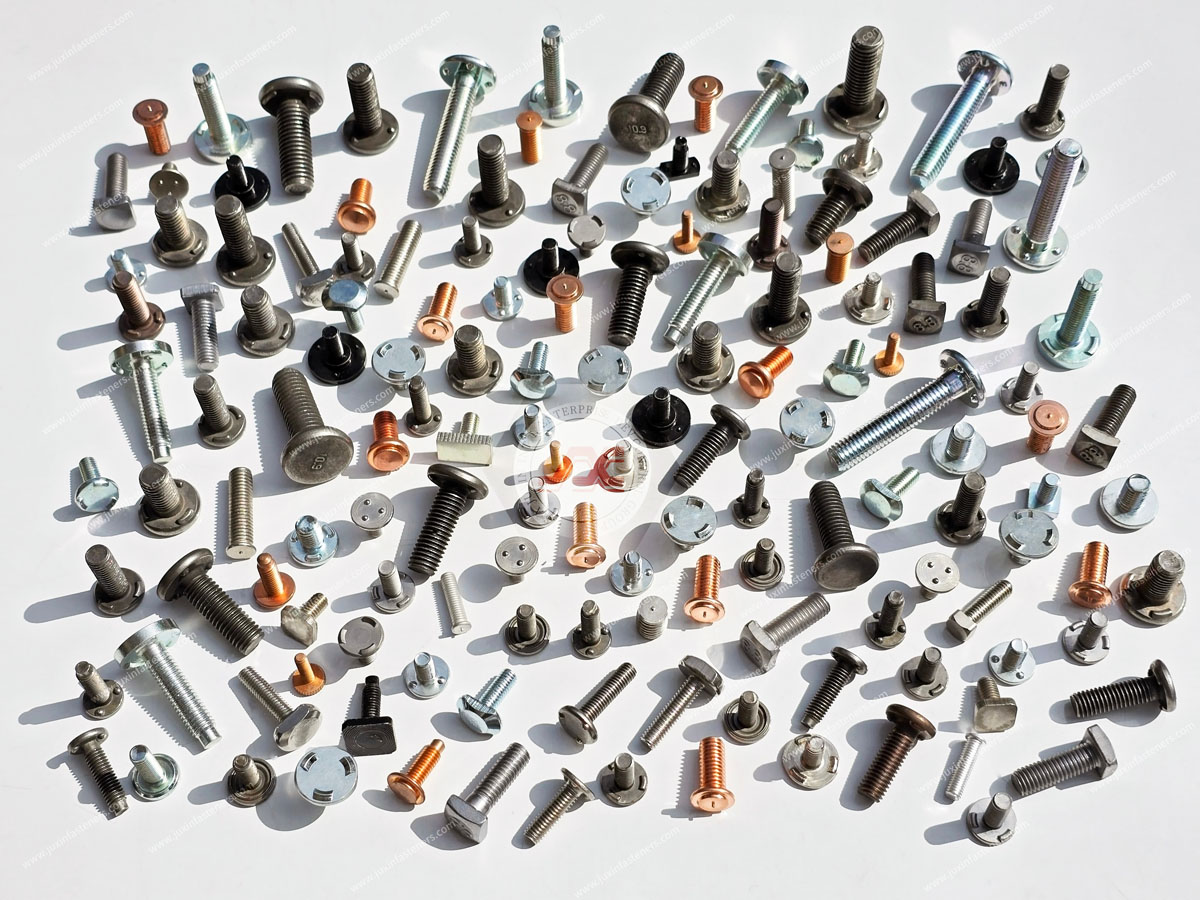
A weld screw is an externally threaded fastener incorporating a head, flange, projection or other welding interface designed for permanent attachment to a compatible metal component.
After welding, the threaded shank remains available for mounting another component using a nut or compatible internally threaded part.
Depending on the design, weld screws can support manufacturing objectives such as:
Pre-positioned threaded mounting points
Reduced loose-fastener handling during final assembly
Integration with automated sheet-metal production
Repeatable fastener location
Simplified downstream assembly
Permanent retention of the threaded fastener
The specific benefit depends on the joint architecture and production process.
A weld screw should therefore be selected as part of the assembly and welding process rather than as an isolated catalog component.
Many weld screws used in sheet-metal and automotive manufacturing are designed for resistance projection welding.
Engineered projections on the fastener concentrate electrical resistance and heat at defined contact locations.
During the welding cycle, the fastener and parent material are subjected to controlled electrode force and electrical current. The projections localize the weld formation at the intended interface.
The resulting weld depends on the interaction between:
Projection geometry
Fastener material
Parent-sheet material
Parent-sheet thickness
Surface condition
Electrode geometry
Electrode force
Welding current
Welding time
Equipment condition
Part positioning
This is why a projection weld screw cannot be qualified only by measuring its thread and overall dimensions.
A three-point weld screw generally uses three engineered welding projections positioned around the welding face of the fastener.
During resistance projection welding, these projections establish defined contact locations between the fastener and parent component.
The three-point arrangement can support controlled positioning and weld formation when the geometry, materials and welding process are correctly matched.
However, three projections do not automatically guarantee:
Higher weld strength
Equal load distribution
Better vibration resistance
Higher torque resistance
Better performance than every alternative geometry
Those outcomes depend on the complete joint and validated welding process.
For engineering drawings, the projections themselves may be critical characteristics because their geometry directly affects weld behavior.
Projection geometry deserves particular attention during both new-product development and second-source qualification.
Relevant characteristics may include:
Number of projections
Projection height
Projection width
Projection profile
Projection location
Projection spacing
Symmetry
Flange or head geometry
Contact surface
Relationship to the thread axis
Small changes to these features can influence contact resistance, heating behavior and projection collapse during welding.
A supplier developing an alternative weld screw should therefore not simply copy the nominal thread and external outline while ignoring the welding features.
The material of a weld screw must satisfy more than the mechanical requirements of the threaded shank.
Engineers may also need to consider:
Weldability
Formability
Mechanical requirements
Material chemistry
Heat-treatment condition where applicable
Thread requirements
Parent-material compatibility
Production process
Environmental exposure
Carbon and alloy steels may be selected for different weld-screw applications according to the customer drawing and functional requirements.
Stainless-steel weld fasteners require separate evaluation because weldability, material grade, parent material,
corrosion environment and welding process can differ significantly from carbon-steel systems.
A higher-strength material is not automatically a better weld-screw material.
The material must work as part of the complete welded joint.
The parent component is one of the most important variables in weld-fastener performance.
Engineers should identify:
Sheet material
Sheet thickness
Sheet coating
Surface condition
Local geometry
Formed features
Weld location
Electrode accessibility
Changing sheet thickness can change the thermal and mechanical behavior of the welding process.
Likewise, changing from an uncoated sheet to a coated sheet may require process review because the surface system can affect resistance welding behavior.
For this reason, a weld screw qualified on one parent material should not automatically be assumed suitable for another without engineering review.
Not in the simple way often assumed.
The length of the externally threaded portion is primarily determined by the downstream assembly requirements, including:
Mating component thickness
Required thread engagement
Nut or mating-thread geometry
Available clearance
Assembly stack
Packaging constraints around the joint
The sheet thickness is highly important to the welding interface, but it does not by itself determine the required screw length.
This distinction helps prevent a common specification error: selecting weld-screw length only from the thickness of the sheet to which it is welded.
Weld screws may use metric or unified inch threads depending on the customer drawing and target market.
Important thread requirements include:
Nominal diameter
Pitch or threads per inch
Thread tolerance
Threaded length
Mating nut or component
Functional assembly requirement
Thread condition after welding
The thread must remain usable after the welding operation.
Thread protection and post-weld functional verification can therefore be important parts of production control.
Welding creates process conditions that can affect nearby fastener features.
Potential thread-related risks include:
Weld spatter
Contamination
Misalignment
Mechanical damage
Distortion
Handling damage
The fastener design, welding equipment and production process should minimize these risks.
Where required by the customer specification, thread verification after welding may include dimensional or functional inspection using appropriate methods.
The important engineering requirement is not simply that the loose screw has an acceptable thread—it is that the thread remains functional after the screw has been welded into the assembly.
The final location of a welded screw can be more important than its loose-part dimensions.
A screw that is tilted or incorrectly positioned after welding can interfere with downstream assembly even when the individual fastener meets dimensional requirements.
Engineers may therefore need to control:
Weld-screw location
Angular orientation
Perpendicularity
Fixture position
Electrode alignment
Mating-hole clearance
Positional tolerance relative to surrounding features
For automated assembly, these factors become particularly important because downstream equipment may have limited ability to compensate for positional variation.
Surface treatment should not be selected independently from the welding process.
Depending on the application, weld screws may use different surface conditions or coatings, including copper-plated weld screw designs where specified.
Other coating systems may be appropriate for different fasteners or stages of the finished assembly.
When selecting or changing a surface treatment, engineers should evaluate:
Effect on electrical resistance
Coating thickness
Surface consistency
Projection condition
Parent-sheet coating
Welding parameters
Thread dimensions
Post-weld corrosion protection
A coating that provides desirable corrosion behavior on a conventional bolt is not automatically suitable for a projection-weld fastener before welding.
For this reason, surface-treatment substitutions should be technically reviewed rather than treated as cosmetic purchasing changes.
The weld screw's pre-weld surface condition is only one part of the corrosion strategy.
Welding may locally affect coatings or protective layers around the joint.
Depending on the manufacturing process, the finished assembly may subsequently receive:
Paint
E-coat
Conversion coating
Additional protective treatment
Sealing systems
Customer-specific corrosion protection
The corrosion strategy should therefore consider:
fastener + parent sheet + weld zone + post-weld processing + mating component + service environment
A weld screw should not automatically be described as corrosion resistant simply because it has a particular pre-weld finish.
Automotive manufacturing is a major application area for projection-welded threaded fasteners.
Depending on the vehicle platform and engineering drawing, weld screws may be used for mounting points associated with:
Body-in-white assemblies
Brackets
Interior structures
Seat-related components
Electrical modules
Equipment supports
Underbody components
Thermal-management hardware
EV-related structures
Covers and auxiliary components
The actual requirements vary considerably between mounting locations.
For example, a threaded mounting point for a lightweight interior component and one used in a more highly loaded assembly should not automatically share the same material, geometry or validation requirements.
Automotive engineers should specify each weld fastener according to the actual joint function.
Electric vehicles and energy-storage systems use extensive sheet-metal structures, electrical enclosures, thermal-management assemblies and equipment brackets.
Projection weld screws may provide permanent threaded mounting points for components such as:
Electrical hardware
Equipment brackets
Covers
Cable-support components
Thermal-management hardware
Enclosure-related components
Where an EV or energy-storage assembly requires sealing, grounding, electrical continuity or specific corrosion performance, those functions should be validated separately.
A welded fastener does not automatically create a sealed or electrically qualified connection.
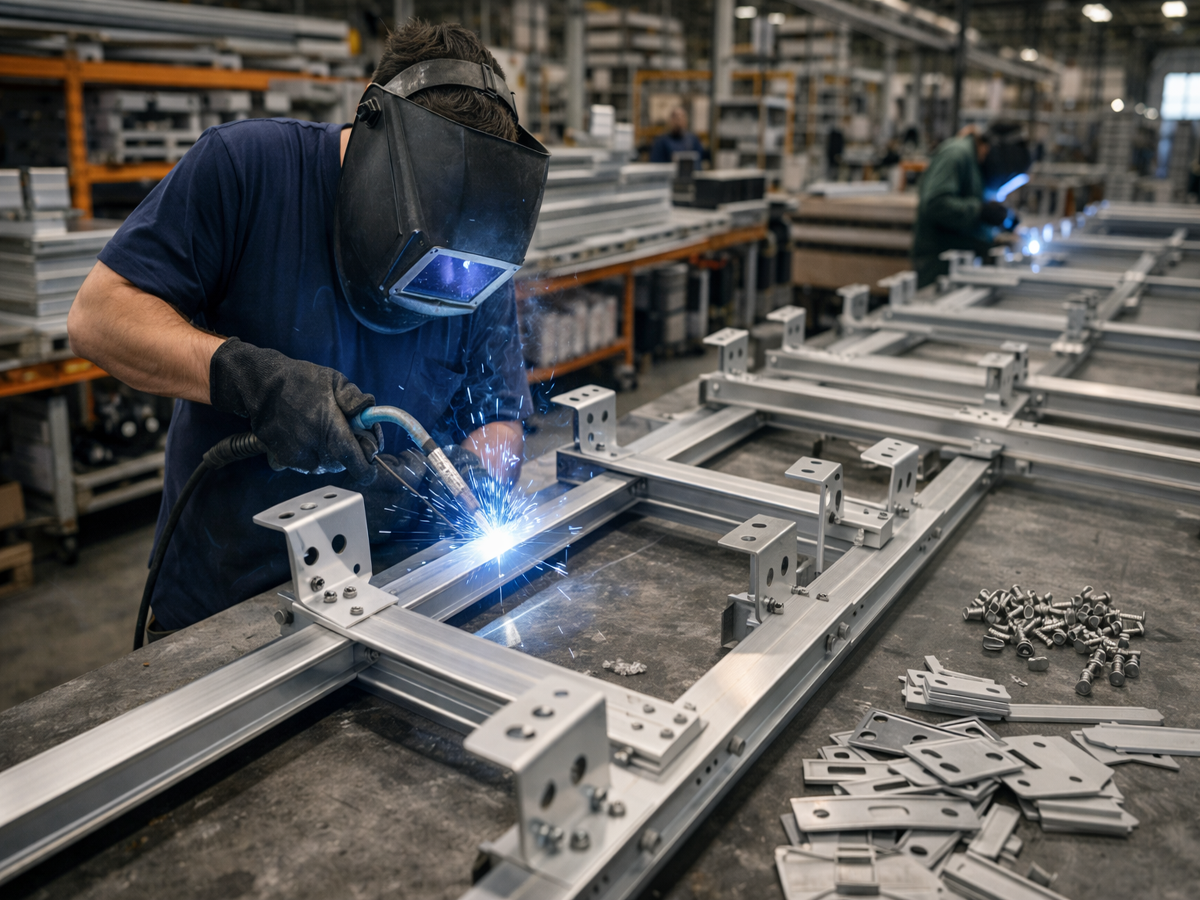
Electrical cabinets and power-distribution equipment frequently require threaded attachment points on fabricated sheet-metal components.
Weld screws may be considered for:
Control cabinets
Electrical enclosures
Power-distribution equipment
Communications hardware
Equipment frames
Mounting brackets
Their principal manufacturing advantage is the ability to establish a permanently retained threaded stud during fabrication for later assembly operations.
If the welded connection also forms part of an electrical bonding or grounding path, the complete electrical interface must be designed and validated for that purpose.
Industrial machinery combines fabricated structures, panels, guards, brackets and control equipment.
Weld screws may be used to attach:
Machine covers
Guards
Sensors
Electrical hardware
Control components
Brackets
Auxiliary equipment
In vibration-exposed machinery, engineers should distinguish between fastener retention to the parent structure and threaded-joint loosening.
Welding permanently retains the weld screw itself, but the mating nut or component still requires appropriate threaded-joint design where vibration loosening is a concern.
HVAC equipment and fabricated equipment housings often use sheet-metal structures that require repeatable threaded mounting points.
Potential applications include:
Equipment covers
Internal brackets
Electrical components
Fan or control-system supports
Service panels
Auxiliary hardware
Engineers should consider assembly access, corrosion environment, sheet thickness, vibration and serviceability when determining whether a welded threaded fastener is appropriate.
“Weld screw” and “weld stud” are sometimes used loosely in commercial terminology, but weld studs can be designed for different welding processes.
Projection weld screws typically use a resistance-welding interface with engineered projections.
Other weld studs may be designed for processes such as capacitor-discharge or drawn-arc stud welding.
The correct selection therefore depends on:
Welding process
Parent material
Parent thickness
Fastener geometry
Production equipment
Thread requirement
Joint performance
Assembly sequence
These products should not be considered interchangeable merely because both result in an externally threaded welded attachment point.
The most obvious difference is the final threaded interface.
A weld screw creates an external male thread.
A weld nut creates an internal female thread.
This affects downstream assembly architecture.
A useful selection question is:
Does the final assembly need a permanently welded male thread or female thread?
Additional factors include:
Available space
Parent-sheet geometry
Welding equipment
Assembly sequence
Mating fastener
Required serviceability
JUXIN FASTENERS supplies both weld screws and weld nuts for drawing-controlled industrial applications.
A rivet nut creates an internally threaded feature by mechanically deforming the rivet-nut body during installation.
A weld screw creates an externally threaded feature through welding.
The technologies solve different assembly problems.
Consider a weld screw when:
A male threaded mounting point is required.
Welding is integrated into the manufacturing process.
The parent component is compatible with the selected welding method.
Consider a rivet nut when:
A female thread is required.
Blind-side installation is important.
Welding is unavailable or undesirable.
The panel and rivet-nut geometry are compatible.
The final choice should be based on the assembly architecture rather than a generic comparison of which fastener is “stronger.”
A conventional bolt normally passes through a hole and forms a threaded joint with a nut or internally threaded component.
A weld screw becomes permanently attached to the parent structure before downstream assembly.
Weld screws can therefore reduce loose-fastener handling and create repeatable mounting locations in suitable production systems.
However, they also introduce:
Welding equipment requirements
Welding-process development
Heat input
Joint validation requirements
Process-control requirements
A conventional bolt may remain preferable where welding is unnecessary or where serviceability and component replacement favor a fully mechanical joint.
Self-clinching studs and weld screws can both create retained externally threaded mounting points in sheet metal, but their installation mechanisms are fundamentally different.
A self-clinching stud relies on controlled mechanical installation into a compatible panel.
A weld screw relies on a welding process.
Selection factors include:
Panel material
Panel thickness
Welding availability
Heat restrictions
Installation equipment
Required retention
Assembly sequence
Surface-finish requirements
Neither technology is universally superior.
The correct solution depends on the complete manufacturing system.
A technically useful weld-screw specification should consider how the joint could fail.
Potential contributors include:
Inadequate welding energy
Incorrect electrode force
Surface contamination
Projection variation
Parent-material variation
Poor fit-up
Potential causes may include:
Excessive heat input
Unsuitable projection geometry
Thin parent material
Incorrect welding conditions
A projection can deform without producing the intended weld if process conditions are unsuitable.
Visual appearance alone may therefore be insufficient to confirm joint quality.
Poor fixturing, electrode alignment or part positioning can produce a tilted or displaced threaded stud.
Spatter, deformation or handling can interfere with downstream assembly.
Local disruption of surface protection may create corrosion concerns if the finished assembly's corrosion system does not adequately address the welded area.
Understanding these failure modes helps engineers define meaningful validation and inspection requirements.
There is no universal weld-strength number applicable to all weld screws.
Validation should be based on the actual application, drawing and customer specification.
Depending on project requirements, validation may include:
Dimensional inspection
Thread verification
Weld-position inspection
Visual examination
Functional assembly testing
Destructive weld testing
Torque-related testing where specified
Push or pull testing where specified
Bend testing where specified
Metallurgical evaluation where required
Corrosion testing where specified
The objective is to verify the performance of the actual fastener + parent sheet + welding process.
For drawing-controlled weld screws, supplier comparison should extend beyond price per piece.
Procurement and supplier-development teams should evaluate whether the proposed source understands and controls:
Material specification
Projection geometry
Thread requirements
Surface condition
Critical dimensions
Drawing revisions
Inspection requirements
Packaging and handling
Sample validation
Required documentation
Production consistency
A lower-cost fastener that requires major welding-process adjustments or creates unstable production behavior may not represent a lower total sourcing cost.
Weld screws deserve particular care during second-source development because a visually similar component can behave differently during welding.
A practical qualification path is:
Identify thread, geometry, material, coating and critical characteristics.
Where available, compare actual projection geometry and manufacturing features with the drawing.
Confirm sheet material, thickness, coating and weld location.
Projection geometry and welding-interface dimensions may require tighter functional attention than non-critical cosmetic features.
Inspect the fasteners before welding.
Do not qualify the alternative source from loose-part dimensional inspection alone.
Use the customer-defined acceptance criteria.
Control critical characteristics and agreed documentation for future production lots.
This process provides a stronger technical basis for supplier development, cost reduction and supply-chain risk mitigation.
A standard product may be appropriate where thread, geometry, material and welding interface match an existing design.
A custom weld screw may be necessary when the application requires:
Non-standard thread
Special threaded length
Unique head geometry
Custom projection pattern
Restricted installation envelope
Specific material
Customer-controlled coating
Special positional requirements
Existing OEM part replacement
Legacy-component second sourcing
For custom components, JUXIN FASTENERS can review customer drawings, samples and application information to determine an appropriate manufacturing approach.
For efficient engineering review and quotation, provide as much of the following information as available:
2D engineering drawing
3D model where relevant
Existing physical sample
Current part number
Thread specification
Threaded length
Overall dimensions
Head or flange geometry
Projection geometry
Fastener material
Mechanical requirements
Surface condition or coating
Parent-sheet material
Parent-sheet thickness
Parent-sheet coating
Welding process
Critical dimensions
Positional requirements
Functional requirements
Required testing
Inspection requirements
Material documentation
Sample quantity
Production quantity
Estimated annual demand
Packaging requirements
For second-source projects, information about the current welding process and mating sheet-metal component can be especially valuable.
Not necessarily.
The terms can overlap commercially, but different products may use projection welding, capacitor-discharge stud welding, drawn-arc welding or other processes.
The drawing and welding method should be confirmed.
Not universally.
The weld screw itself may be welded directly to a surface, but the complete assembly may still contain locating holes, clearance holes or mating-component holes depending on the design.
Not automatically.
Joint performance depends on projection geometry, fastener material, parent material, welding conditions and the validated load case.
They can be used in suitable thin-sheet applications when the fastener geometry and welding process are developed for the actual material and thickness.
Process validation is important because heat input and deformation must be controlled.
No.
A welded fastener should not automatically be considered a sealing solution.
If the assembly requires water, vapor or gas sealing, the complete joint must be specifically designed and validated for that requirement.
Dimensional comparison is necessary but may not be sufficient.
Projection geometry, material, surface condition and actual welding behavior should also be evaluated.
Weld screws are small components, but their performance is closely connected to the manufacturing process in which they are installed.
The most effective engineering and sourcing approach is therefore:
application → assembly architecture → parent material → threaded interface → projection design
→ fastener material → surface condition → welding process → validation → production control
For engineers, this approach improves fastener selection and reduces welding-process risk.
For procurement and supplier-development teams, it creates a technical framework for comparing suppliers, developing alternative sources and qualifying drawing-controlled components.
With more than 20 years of fastener industry experience, JUXIN FASTENERS supports standard and custom weld screws,
projection weld screws, three-point weld screws, copper-plated weld screws, weld nuts, weld studs and automotive fastening components for OEM and industrial manufacturing projects.
For new product development, existing-part replacement or second-source qualification, send your engineering drawing, physical sample and application requirements for technical review and quotation.
JUXIN FASTENERS
Industrial Fastening Solutions Since 2003
Website: www.juxinfasteners.com
Email: info@juxinfasteners.com
 MORE NEWS
Sep. 27, 2026
Sep. 27, 2026
Sep. 27, 2026
Contact Us
Tel.:
+86 020 8621 0320
+86 020 3121 6067
E-mail:
Technical Support:
Navigation
SEND INQUIREY