Call Us
+86 136 6007 9809
Call Us
+86 136 6007 9809

Oct. 24, 2023
Replacing an existing bonded seal is not simply a matter of finding another washer with the same inside diameter.
Metal-bonded sealing washers combine a metal carrier with an elastomeric sealing element,
and apparently similar parts can differ in dimensions, seal profile, metal material, elastomer compound, hardness, coating and installed compression.
This becomes particularly important when an OEM, equipment manufacturer or maintenance team needs to:
qualify a second source
replace an existing supplier
source an obsolete bonded seal
localize an imported component
identify a seal from an old part number
reproduce a drawing-controlled sealing washer
evaluate an alternative material
source a custom bonded seal from a physical sample
For procurement teams, the objective is not merely to find a similar-looking component.
The objective is to establish whether the replacement is technically equivalent to the required specification and then validate it before production approval.
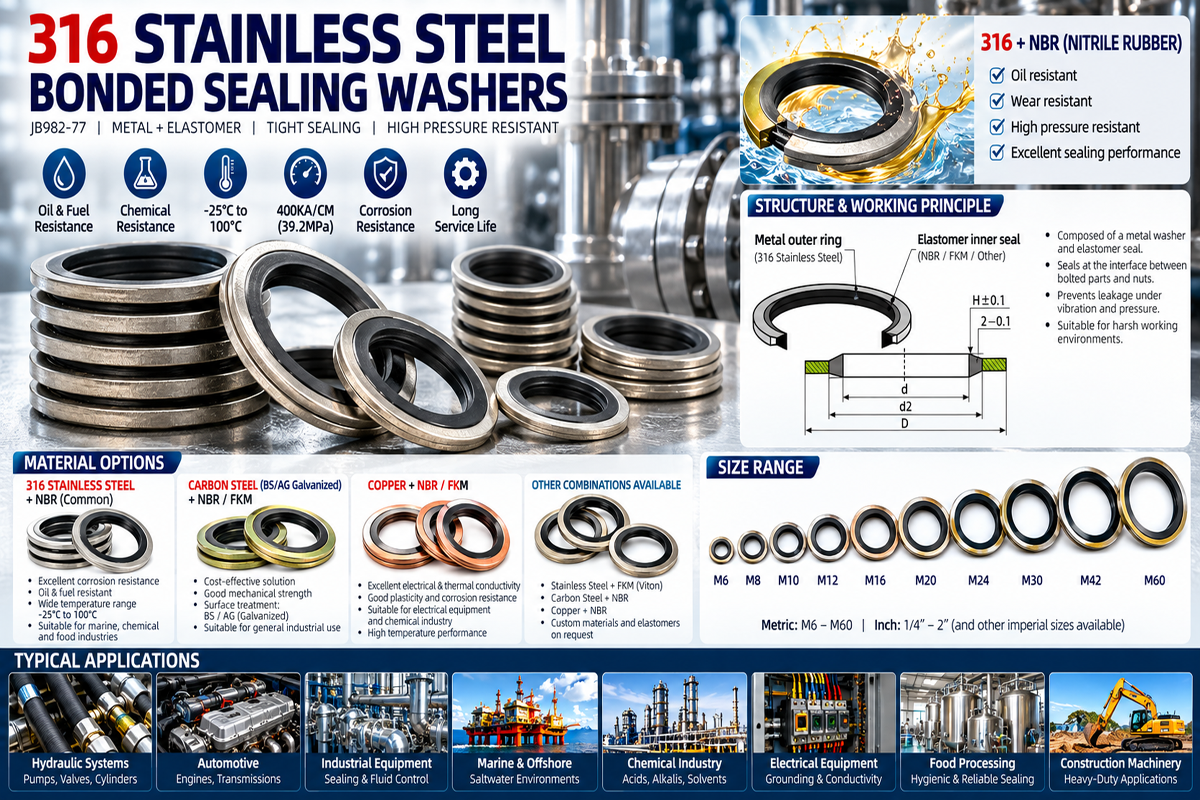
A bonded seal replacement is a sealing component sourced to replace an existing metal-bonded sealing washer in an established assembly.
The original component may be identified by:
OEM part number
supplier part number
equipment model
international specification
customer drawing
dimensional data
physical sample
The amount of available technical information determines how the replacement sourcing process should begin.
A complete drawing provides a much stronger sourcing basis than a photograph or nominal thread size.
Bonded seals can look extremely similar.
Two parts may have approximately the same:
inside diameter
outside diameter
thickness
general appearance
but still differ technically.
Potential differences include:
metal carrier material
metal thickness
surface finish
elastomer family
elastomer compound
hardness
elastomer profile
bonded geometry
dimensional tolerances
This means:
Same Size ≠ Same Material ≠ Same Seal Geometry ≠ Verified Equivalent
A cross-reference should therefore be treated as a technical comparison rather than a catalog-number substitution exercise.
Replacement sourcing becomes progressively more reliable as better technical information becomes available.
A useful hierarchy is:
Approved Drawing
↓
Original Specification
↓
OEM / Supplier Part Number + Technical Data
↓
Approved Physical Sample + Application Data
↓
Measured Sample Only
↓
Photograph / Nominal Size Only
The lower the available information is in this hierarchy, the more engineering assumptions need to be resolved before a replacement can be approved.
This is normally the strongest starting point.
Review the drawing for information such as:
inside diameter
outside diameter
thickness
dimensional tolerances
metal material
elastomer material
hardness
coating or finish
seal profile
applicable specification
inspection requirements
Procurement should send the complete drawing rather than extracting only the nominal dimensions into an RFQ.
Small geometric or material details can be important to the sealing function.
A part number can be useful, but it may not reveal the complete specification.
Where available, provide:
complete part number
manufacturer name
equipment model
existing technical data
drawing revision
application information
known material requirements
A supplier should not claim technical equivalence solely because two catalog descriptions appear similar.
The underlying dimensions and materials should be compared.
This is common in maintenance, legacy equipment and supplier-change projects.
A physical bonded seal can provide useful information about:
ID
OD
thickness
metal geometry
elastomer profile
visible surface finish
general construction
However, a sample does not automatically reveal:
exact elastomer compound
original hardness specification
original metal grade
coating specification
original tolerances
pressure requirements
temperature requirements
fluid compatibility requirements
For this reason, sample-based replacement sourcing should combine physical inspection with application information.
Descriptions such as:
“M10 bonded seal”
“M14 sealing washer”
“M20 hydraulic washer”
are not complete replacement specifications.
The nominal thread or fitting size can help narrow the search, but additional dimensions should be confirmed.
At minimum, review:
inside diameter
outside diameter
thickness
seal geometry
metal material
elastomer
The original assembly should also be considered.
For a replacement metal-bonded sealing washer, compare the complete geometry rather than one dimension.
The ID influences fit around the fastener, plug or fitting and the location of the sealing element.
The OD affects the available bearing and sealing interface and must fit the surrounding joint geometry.
Thickness can influence installed geometry and compression.
A small thickness difference should not automatically be dismissed as insignificant.
The shape and position of the elastomer can affect where sealing contact develops.
Two bonded seals with identical ID and OD may still use different elastomer geometries.
Carrier thickness and shape can influence structural support and compression behavior.
Common bonded sealing washer designs may use materials such as:
carbon steel
stainless steel
copper
other drawing-specified metals
Visual inspection alone should not be used as definitive material identification.
Surface coatings can make carbon steel appear similar to another metal.
Oxidation, contamination and service exposure can also change appearance.
No.
Magnetism can provide limited screening information in some cases, but it is not a reliable method for identifying an exact metal grade.
For example, stainless steels do not all exhibit identical magnetic behavior, and manufacturing processes can influence magnetic response.
Where material identity matters, use appropriate material documentation or analytical verification.
These materials are not automatically interchangeable.
Carbon steel can provide an economical and mechanically suitable carrier for many industrial bonded seals.
Surface protection may be required depending on the environment.
Stainless steel may be specified where the operating environment or customer requirement calls for improved corrosion resistance.
However, stainless steel is not universally corrosion-proof.
The actual environment, chemicals, chlorides, temperature and mating materials should be considered.
Copper has different mechanical, thermal, electrical and corrosion characteristics from carbon steel and stainless steel.
A copper bonded sealing washer should not automatically be substituted for a steel version simply because the dimensions match.
Material selection belongs to the joint specification.
Common elastomer families used in bonded sealing systems may include:
NBR
FKM
EPDM
other application-specific compounds
Color alone does not reliably identify an elastomer.
Likewise, visual inspection cannot normally establish the exact compound.
When replacing an existing bonded seal, the preferred information is:
original material specification
drawing requirement
supplier technical data
customer-approved compound
If these are unavailable, the operating environment becomes particularly important.
To evaluate a replacement elastomer, identify:
fluid or media
normal operating temperature
minimum temperature
peak temperature
pressure requirements
exposure duration
environmental conditions
cleaning chemicals
mating materials
A seal exposed to hydraulic oil has a different material-selection problem from one exposed to water, coolant, fuel or a process chemical.
“Rubber” is therefore not a sufficient material specification for an industrial bonded seal.
Not automatically.
FKM may offer different chemical and temperature characteristics from NBR, but that does not make it a universal upgrade.
Changing elastomer family can affect:
fluid compatibility
low-temperature behavior
hardness requirements
compression response
cost
qualification requirements
If the existing drawing specifies NBR, changing to FKM should be treated as an engineering change requiring review and, where necessary, validation.
The same principle applies to substitutions involving EPDM, HNBR or other elastomers.
Again, not automatically.
A material substitution can change:
mechanical behavior
corrosion interaction
surface condition
mating-material compatibility
dimensional response
customer drawing compliance
Supplier development should distinguish between:
commercially available alternative
and
technically approved equivalent.
They are not necessarily the same thing.
Legacy drawings and catalog pages sometimes contain pressure or temperature values without explaining:
seal geometry
elastomer compound
mating interface
test method
fluid
installation conditions
acceptance criteria
These values should not automatically be transferred to a newly sourced replacement.
Bonded seal performance depends on the complete assembly:
Metal + Elastomer + Fluid + Temperature + Pressure + Geometry + Mating Surface + Compression + Installation
If pressure or temperature capability is critical, define the actual application requirement and validation method.
Industrial equipment may contain components originally specified to legacy, regional or manufacturer-specific standards.
When sourcing for international OEM supply, the old designation can be useful for identifying the historical component, but it should not be automatically converted into an ISO, DIN, EN, BS, ASME/ANSI, SAE or ASTM designation.
A dimensional resemblance does not establish standards equivalence.
The safer process is to extract the actual engineering requirements:
dimensions
tolerances
materials
hardness
finish
seal geometry
performance requirements
The replacement can then be evaluated against those requirements.
A standard bonded seal may be suitable when an established commercially available component matches:
required geometry
metal material
elastomer
operating conditions
joint interface
validation requirements
Using a standard component can simplify sourcing and future availability.
However, standardization should not override the requirements of an existing validated assembly.
Custom manufacturing may be appropriate when the original component has:
non-standard ID or OD
special thickness
unique elastomer profile
drawing-specific tolerances
unusual carrier geometry
special metal material
specified coating
customer-controlled elastomer
OEM-specific inspection requirements
A custom component should be manufactured from the approved specification rather than reverse-engineered from appearance alone.
Second-source qualification should separate three questions:
Review:
dimensions
tolerances
metal
elastomer
hardness
coating
geometry
Review relevant manufacturing and quality-control capability for the component.
Complete the required sample and functional validation before production approval.
This creates a clearer qualification path than approving a supplier based only on quotation price and sample appearance.
A technically complete RFQ should include the information available from the original component and its application.
customer part number
OEM part number
existing supplier part number
equipment model, where relevant
applicable specification
drawing revision
inside diameter
outside diameter
thickness
elastomer profile
carrier geometry
tolerances
metal material
coating or finish
documentation requirements
elastomer family
compound specification, if controlled
hardness
color, if controlled
fluid or media
operating temperature
pressure requirements
mating material
connection type
environmental exposure
sample quantity
initial production quantity
estimated annual usage
inspection requirements
packaging requirements
Do not fill the missing fields with assumptions merely to obtain a quotation.
Instead, separate the information into:
Known
Measured
Inferred
Still Requires Confirmation
For example:
Known: OEM part number and equipment application
Measured: ID, OD and thickness from the sample
Inferred: probable metal family from initial inspection
Requires Confirmation: exact metal grade, elastomer compound and hardness
This approach is particularly useful for supplier development because it prevents assumptions from silently becoming purchasing specifications.
A new supplier's component can pass dimensional inspection and still require functional evaluation.
Depending on the application, sample validation may include:
dimensional inspection
material verification
hardness verification
coating verification
assembly fit
seal positioning
installation behavior
leakage testing under defined conditions
environmental exposure testing
customer-specific functional validation
The validation plan should reflect the actual risk and function of the assembly.
A structured replacement process can follow:
Identify Existing Part
↓
Collect Drawing / Part Number / Sample
↓
Measure Complete Geometry
↓
Confirm Metal Carrier
↓
Confirm Elastomer
↓
Identify Fluid / Temperature / Pressure
↓
Review Mating Interface
↓
Compare Candidate Replacement
↓
Produce Samples
↓
Inspect and Functionally Validate
↓
Approve Production Source
This workflow helps both engineering and procurement teams distinguish a genuine replacement from a merely similar component.
These terms should not be used interchangeably.
A component intended to replace the original part in the assembly.
A component demonstrated to satisfy the defined technical requirements of the original specification.
A different component proposed for the same application but potentially involving changes in material, geometry or specification.
An alternative is not automatically an equivalent.
This distinction is especially important when procurement teams are qualifying a lower-cost or second-source component.
Bonded seal replacement works best when engineering and procurement responsibilities are connected.
functional requirements
geometry
materials
operating conditions
validation criteria
acceptable substitutions
required quantity
annual usage
commercial terms
packaging
supply expectations
documentation requirements
manufacturing feasibility
material control
dimensional capability
inspection requirements
sample qualification process
This creates a clearer path from sourcing request to production approval.
JUXIN FASTENERS supports industrial OEMs, equipment manufacturers and sourcing teams with standard, custom and made-to-drawing fastening and sealing components.
For an existing bonded sealing washer, send the strongest technical reference available:
2D Drawing → Specification → OEM Part Number → Existing Supplier Part Number → Physical Sample
Where only a physical sample is available, also provide:
Application → Fluid → Temperature → Pressure → Mating Interface → Annual Quantity
JUXIN FASTENERS can review the available information to help establish the required dimensions, metal carrier, elastomer and manufacturing requirements before quotation.
For supplier-change and second-source projects, samples can then be produced for customer inspection and application-specific validation before production approval.
Drawing / Sample → Technical Review → Material Confirmation → Quotation → Sample → Validation → Production
For replacement, custom and OEM bonded sealing washer requirements, contact JUXIN FASTENERS.
Email: info@juxinfasteners.com
Website: www.juxinfasteners.com
 MORE NEWS
Sep. 27, 2026
Sep. 27, 2026
Sep. 27, 2026
Contact Us
Tel.:
+86 020 8621 0320
+86 020 3121 6067
E-mail:
Technical Support:
Navigation
SEND INQUIREY