Call Us
+86 136 6007 9809
Call Us
+86 136 6007 9809

Mar. 30, 2026
Knob-Grip Retractable Spring Plungers: Indexing, Fixture Design and OEM Positioning
Modern industrial machinery increasingly requires fast setup changes, repeatable mechanical positioning and efficient adjustment without complex tooling.
In automation equipment, production fixtures, inspection stations and adjustable machine assemblies,
operators often need to release a positioning mechanism, move a component and secure it at a new location.
Knob-grip retractable spring plungers, also known as retractable indexing plungers, pull-knob indexing plungers or spring-loaded indexing pins,
provide a compact mechanical solution for these applications.
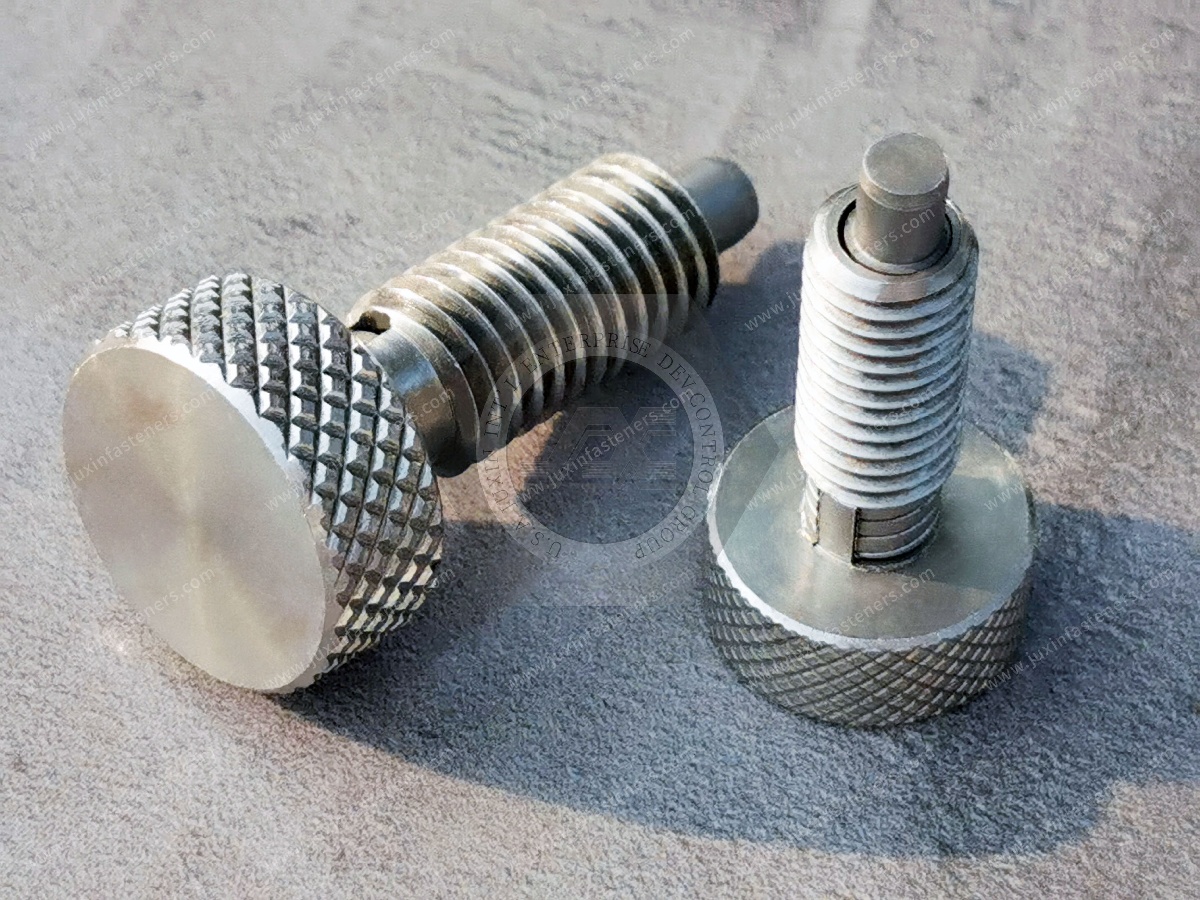
A typical retractable indexing plunger contains a threaded body, a spring-loaded pin and a manually operated knob.
Pulling the knob retracts the pin from a locating hole or mating feature. Releasing the knob allows the spring to move the pin toward its extended position.
When the pin aligns with a suitable locating hole, it can engage and establish a defined mechanical position.
These components may be used in:
Industrial automation equipment
Assembly fixtures and jigs
Adjustable machinery
Inspection tooling
Robotic tooling accessories
Automotive production equipment
Packaging machinery
Laboratory and precision equipment
However, successful indexing depends on more than the plunger itself.
Design engineers must evaluate locating hole geometry, pin engagement, side loading, component stiffness and expected operating cycles.
Manufacturing engineers and production managers must consider changeover time, operator access, installation consistency, wear and maintenance.
Purchasing and supplier development teams must verify dimensions, materials, spring characteristics, locking functions, inspection requirements and supply conditions.
Juxin Fasteners welcomes OEM inquiries for retractable spring plungers and drawing-specific mechanical positioning components.
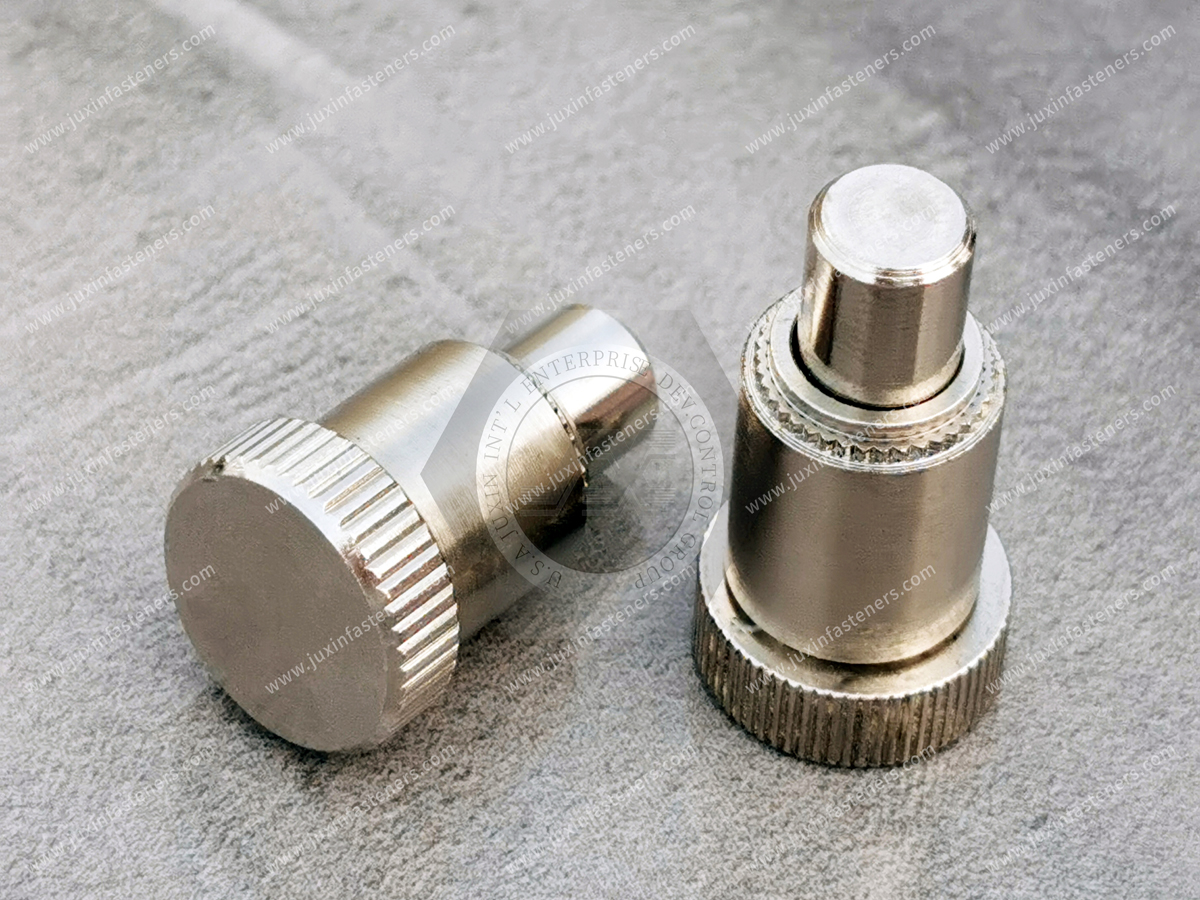
What Is a Knob-Grip Retractable Spring Plunger?
A knob-grip retractable spring plunger is a manually operated indexing component with a spring-biased pin.
Its purpose is to engage a locating hole, slot or other compatible mating feature and provide a repeatable mechanical position.
Typical Components
Threaded Body
The body provides mounting and alignment within the equipment structure.
Plunger Pin
The pin engages the locating feature and transmits the applicable positioning or retaining loads.
Compression Spring
The spring biases the pin toward the engaged position.
Manual Knob
The knob allows the operator to retract the pin.
Optional Locking Mechanism
Some designs include a mechanism that holds the pin in its retracted position.
Not every retractable plunger has this feature.
Operating Sequence
The operator pulls the knob.
The pin retracts from the locating feature.
The movable component is repositioned.
The knob is released.
The spring moves the pin toward the mating feature.
The pin engages when alignment is achieved.
Important Engineering Clarification
The spring does not necessarily force the pin into a misaligned hole.
The surrounding geometry must allow proper engagement.
Retractable Indexing Plungers vs Conventional Spring Plungers
These products serve different mechanical functions.
Retractable Indexing Plungers
Designed for manual pin retraction and engagement with a locating feature.
Spring-Loaded Ball Plungers
Typically use a spring-loaded ball to provide detent action or light positioning resistance.
Spring-Loaded Nose Plungers
May provide contact force or detent positioning without a manual pull-knob mechanism.
Fixed Locating Pins
Provide a locating feature without spring-assisted manual retraction.
Engineering Recommendation
Do not substitute a ball plunger for a retractable indexing pin without reviewing the required holding, engagement and release functions.
Manual Retraction and Quick-Change Fixture Adjustment
Retractable indexing plungers are useful where machinery requires frequent mechanical repositioning.
Potential applications include:
Adjustable fixture plates
Changeover tooling
Machine guards with approved indexing arrangements
Sliding equipment supports
Adjustable workstations
Inspection fixtures
Packaging machinery guides
Potential Production Benefits
Reduced need for separate hand tools
Faster manual release
Repeatable engagement locations
Simplified operator procedures
Reduced handling of loose locating pins
Information Gain: Faster Release Does Not Automatically Mean Faster Changeover
A plunger may retract quickly, but the total changeover time also depends on:
Access to the knob
Weight of the movable component
Alignment of the locating holes
Number of indexing points
Required secondary clamping
Operator ergonomics
Verification after repositioning
Engineering Recommendation
Evaluate the complete changeover procedure rather than measuring only the time required to pull the knob.
Locking and Non-Locking Retractable Plungers
Retractable indexing plungers may be available in different operating configurations.
Non-Locking Retractable Plungers
The pin is spring-biased toward engagement.
The operator must normally keep the knob retracted while repositioning the component.
Locking-Type Retractable Plungers
Certain designs include a mechanism that holds the pin in the retracted position.
This may simplify adjustment when the operator needs both hands for positioning.
Important Clarification
A locking-type indexing plunger does not necessarily provide greater load capacity in the engaged position.
The locking feature may refer only to retention of the pin in its retracted position.
Engineering Recommendation
Specify whether the application requires:
Automatic spring return
Manual hold-open operation
Lockable retracted position
Defined engaged position
Secondary mechanical restraint
The exact operating mechanism must be confirmed from the product drawing.
Positioning Accuracy and Repeatability
Retractable indexing plungers can support repeatable positioning when used with properly designed locating features.
However, positioning accuracy depends on the complete mechanism.
Critical Factors
Pin diameter
Locating hole diameter
Pin-to-hole clearance
Engagement depth
Pin straightness
Mounting alignment
Structural stiffness
Wear
Temperature
Applied side load
Why Clearance Matters
A clearance fit allows the pin to enter the locating hole without excessive interference.
However, clearance also permits some positional movement.
Reducing clearance may improve positional control but can make engagement more difficult when alignment varies.
Engineering Recommendation
Choose the pin-to-hole fit based on the required positional accuracy and practical assembly conditions.
Information Gain: Indexing and Precision Location Are Not Always the Same Function
An indexing plunger may be suitable for selecting a discrete position without providing the full accuracy required for precision machining.
Where very high positioning accuracy is required, the design may need:
Dedicated locating pins
Precision bushings
Datum surfaces
Tapered locating elements
Separate clamping mechanisms
The retractable plunger may then serve primarily as a retention or indexing component.
Spring Force vs Mechanical Load Capacity
Spring force and mechanical load capacity are different characteristics.
Spring Force
The internal spring biases the pin toward engagement.
It influences:
Engagement behavior
Knob pull effort
Resistance to accidental retraction
Return action
Mechanical Load Capacity
The load that the engaged pin can safely resist depends on:
Pin diameter
Pin material
Engagement depth
Support geometry
Side loading
Bending
Shear
Fatigue
Body and thread strength
Important Engineering Clarification
A higher spring force does not automatically mean a higher shear load capacity.
A spring may be strong enough to keep the pin extended while the pin itself remains unsuitable for the applied side load.
Engineering Recommendation
Specify spring characteristics and mechanical loading requirements separately.
Shear Loading and Side-Load Design
In many indexing applications, the engaged pin may experience transverse loading.
This can produce shear and bending stresses.
Single-Shear Conditions
A pin supported on one side of the loaded interface may experience single-shear loading and bending.
Double-Shear Conditions
A suitable two-sided support arrangement may distribute loading differently.
Important Limitation
Actual load capacity depends on the complete support arrangement and cannot be determined from nominal pin diameter alone.
Engineering Considerations
Pin engagement depth
Unsupported pin length
Hole alignment
Load direction
Shock loading
Repeated cycling
Material strength
Local bearing pressure
Engineering Recommendation
For load-bearing indexing applications, request application-specific mechanical evaluation rather than relying only on spring force or nominal dimensions.
Locating Hole Design and Engagement Depth
The mating hole is a critical part of the positioning system.
Hole Diameter
An oversized hole may allow excessive positional movement.
An undersized hole may prevent smooth engagement.
Hole Depth
The hole must provide sufficient engagement without unwanted bottoming.
Hole Edge Condition
Burrs and sharp edges may damage the plunger nose or interfere with engagement.
Hole Alignment
Misalignment may prevent the pin from entering correctly.
Engagement Depth
Insufficient engagement may increase local stress or permit unintended disengagement.
Engineering Recommendation
Define:
Pin diameter
Locating hole diameter
Hole depth
Engagement depth
Positional tolerance
Surface finish
Edge condition
Expected side load
Information Gain: Chamfers Improve Entry but Do Not Eliminate Alignment Requirements
A suitable lead-in chamfer may help the pin enter a locating hole.
However, excessive chamfering can reduce the effective cylindrical engagement length.
Engineering Recommendation
Balance engagement assistance against the required load-bearing contact length.
Material Selection for Retractable Spring Plungers
Material selection should reflect the operating environment, load conditions, wear requirements and mating surfaces.
Steel Nose Spring Plungers
Steel plunger pins may be appropriate for general machinery and fixture applications.
Potential Advantages
Mechanical strength options
Wear resistance depending on grade and heat treatment
Suitability for many industrial positioning applications
Engineering Considerations
Steel grade
Hardness
Surface treatment
Corrosion exposure
Mating surface wear
Stainless Steel Spring Plungers
Stainless steel may be selected for applications involving moisture, cleaning or corrosive environments.
Potential Applications
Food processing equipment
Laboratory machinery
Outdoor industrial equipment
Selected medical equipment mechanisms
Marine-adjacent equipment
Engineering Considerations
Stainless steel grade
Mechanical properties
Corrosion environment
Galling
Cleaning chemicals
Spring material
Important Clarification
A stainless steel body does not necessarily mean every internal component is stainless steel.
The pin, spring and other parts must be specified separately where material compatibility is important.
A2 / 304 and A4 / 316 Material Considerations
304-family stainless steel may be appropriate for many general environments.
316-family stainless steel may offer improved corrosion resistance in selected chloride-containing environments.
However, neither grade is universally corrosion-proof.
Specific availability and material configuration must be confirmed.
Brass Nose Spring Plungers
Brass may be considered for selected contact applications.
Potential Advantages
Different contact characteristics compared with hardened steel
Useful corrosion resistance in suitable environments
Compatibility with selected nonferrous mating materials
Engineering Limitations
Lower hardness than many hardened steel options
Potential wear under repeated loading
Material transfer or surface marking depending on contact conditions
Brass should not automatically be described as non-marking.
Acetal Nose Spring Plungers
Acetal or other engineered polymer nose materials may be considered where contact surface protection is important.
Potential Advantages
Lower contact hardness than steel
Reduced risk of scratching in suitable applications
Lightweight nose construction
Engineering Limitations
Lower load capacity in many designs
Temperature sensitivity
Wear
Creep
Chemical compatibility
Important Clarification
An acetal nose is not automatically non-marking under every load or contact condition.
Material Comparison
| Nose material | Potential advantage | Main consideration |
|---|---|---|
| Steel | Strength and wear resistance options | Corrosion and mating surface damage |
| Stainless steel | Corrosion resistance | Grade, galling and load requirements |
| Brass | Different contact characteristics | Wear and deformation |
| Acetal | Softer contact interface | Load, creep and temperature |
Engineering Recommendation
Select the nose material according to the actual mating surface and operating load.
Threaded Body Installation
The threaded body allows the plunger to be installed in a suitable tapped hole or mounting component.
Critical Installation Considerations
Thread designation
Thread engagement length
Mounting wall thickness
Alignment
Installation torque
Access to the knob
Available pin stroke
Engagement depth
Important Clarification
The threaded body should not automatically be tightened using the knob.
Installation should follow the actual product design and approved procedure.
Mounting Security
Depending on the design, a suitable retaining nut or another approved method may be required to maintain the installed position.
Engineering Recommendation
Verify that the body remains securely mounted throughout repeated operating cycles.
Metric and Inch Thread Compatibility
Retractable plungers may be specified with different thread systems.
Metric Threads
ISO 261 and the ISO 965 series may be relevant to applicable metric thread dimensions and tolerances.
Unified Inch Threads
ASME B1.1 covers Unified inch screw threads, including UNC and UNF.
Metric-to-Inch Nominal Diameter References
| Metric size | Approximate nominal diameter |
|---|---|
| M6 | 0.236 in |
| M8 | 0.315 in |
| M10 | 0.394 in |
| M12 | 0.472 in |
| M16 | 0.630 in |
These are dimensional conversions only.
Metric, UNC, UNF, BSW and BSF threads are not directly interchangeable.
Specific thread availability must be confirmed against the drawing.

Industrial Automation and Manufacturing Equipment
Automation systems may require adjustable mechanical positioning for setup and maintenance.
Potential applications include:
Assembly stations
Robotic tooling accessories
Adjustable machine guides
Fixture positioning systems
Packaging machinery
Inspection equipment
Engineering Priorities
Repeatable engagement
Operator access
Mechanical load capacity
Cycle life
Installation consistency
Important Limitation
A manually operated retractable plunger is not automatically suitable for high-speed automatic indexing.
Automated actuation may require a different mechanism.
Automotive Manufacturing Fixtures
Automotive production environments often use jigs, fixtures and adjustable tooling.
Potential applications include:
Component inspection fixtures
Assembly tooling
Welding fixture accessories
Adjustable support structures
Testing equipment
Engineering Priorities
Changeover efficiency
Repeated positioning
Wear resistance
Vibration
Maintenance
Important Limitation
The plunger should not be assumed suitable for holding a workpiece against welding forces or other high loads without engineering validation.
Semiconductor and Electronics Manufacturing
Precision equipment may require controlled positioning and repeatable adjustment.
Potential applications include:
Equipment setup mechanisms
Inspection fixture adjustments
Electronic assembly tooling
Auxiliary positioning systems
Engineering Priorities
Repeatability
Particle generation
Material compatibility
Lubrication
Wear
Cleanliness
Important Clarification
Standard spring plungers are not automatically suitable for cleanroom or semiconductor process environments.
Material, lubrication and contamination requirements must be reviewed.
Medical and Laboratory Equipment
Selected equipment mechanisms may use retractable indexing plungers for adjustment.
Potential applications include:
Laboratory equipment
Diagnostic equipment supports
Adjustable instrument mechanisms
Serviceable equipment fixtures
Engineering Priorities
Material compatibility
Cleaning requirements
Mechanical reliability
Operator ergonomics
Maintenance
Important Limitation
Suitability for medical devices or patient-contact applications requires application-specific qualification.
Aerospace and Energy Equipment
Selected tooling and support mechanisms may use retractable indexing components.
Potential applications include:
Aerospace manufacturing fixtures
Inspection tooling
Energy equipment adjustment
Maintenance fixtures
Industrial support structures
Engineering Priorities
Load capacity
Environmental exposure
Traceability where required
Mechanical reliability
Inspection
Important Limitation
Use in flight-critical or other safety-critical assemblies requires dedicated approval and validation.
Production Efficiency and Changeover Management
For production managers, a retractable indexing plunger can support efficient setup changes when integrated into an appropriate fixture.
Potential Operational Benefits
Reduced handling of separate pins
Simplified manual adjustment
Defined indexing locations
Faster setup procedures
Improved operator accessibility
Production Evaluation Criteria
Changeover time
Number of manual actions
Engagement verification
Operator ergonomics
Wear rate
Maintenance frequency
Replacement time
Information Gain: Engagement Confirmation Matters
An operator may release the knob without the pin fully entering the locating hole.
This can create a false impression that the fixture is correctly positioned.
Engineering Recommendation
For applications where incomplete engagement creates a meaningful risk, consider visual confirmation, mechanical feedback or another validated verification method.
Common Failure Modes
| Failure mode | Potential cause | Recommended evaluation |
|---|---|---|
| Pin does not engage | Hole misalignment | Review locating geometry |
| Pin sticks | Contamination or deformation | Review clearance and maintenance |
| Pin bends | Excessive side load | Review support and loading |
| Pin shears | Overload or inadequate capacity | Review mechanical strength |
| Spring weakens | Fatigue or environmental exposure | Review cycle requirements |
| Knob loosens | Repeated operation or connection failure | Review knob retention |
| Body loosens | Inadequate mounting security | Review installation |
| Locating hole wears | High contact stress | Review material and engagement |
| Positioning becomes inconsistent | Clearance or wear | Review complete locating system |
| Corrosion occurs | Unsuitable material | Review environment and grades |
Quality Control for Retractable Spring Plungers
Quality inspection should cover both dimensions and functional operation.
Dimensional Inspection
Potential characteristics include:
Thread dimensions
Body length
Pin diameter
Pin extension
Retraction stroke
Knob dimensions
Concentricity
Surface finish
Functional Inspection
Potential checks include:
Smooth retraction
Spring return
Full engagement
Locking function where specified
Knob retention
Consistent operation
Mechanical Validation
Depending on the application:
Spring force measurement
Pin load evaluation
Retraction cycling
Wear testing
Mounting retention
Corrosion evaluation
Important Qualification Principle
A plunger may pass dimensional inspection while still being unsuitable for the actual indexing load or operating environment.
Custom OEM Retractable Spring Plungers
Different equipment designs may require drawing-specific positioning components.
Potential custom requirements include:
Thread size
Body length
Pin diameter
Pin extension
Retraction stroke
Nose geometry
Spring characteristics
Material grade
Surface finish
Knob design
Locking function
Packaging
Engineering Recommendation
Provide both the plunger drawing and the mating locating geometry.
The pin-to-hole interface is essential for evaluating positioning performance.
Supplier Qualification and Bulk Procurement
Purchasing and supplier development teams should evaluate technical and commercial requirements together.
Technical Evaluation
Drawing compliance
Material specification
Thread accuracy
Pin dimensions
Spring characteristics
Locking function
Functional testing
Production Evaluation
Dimensional consistency
Assembly quality
Functional repeatability
Inspection requirements
Traceability where required
Engineering change control
Commercial Evaluation
Prototype quantity
MOQ
Annual demand
Unit price
Lead time
Packaging
Supply continuity
Specific commercial conditions require confirmation for each RFQ.
OEM RFQ Checklist
| RFQ item | Information to provide |
|---|---|
| Product drawing | Part number and revision |
| Plunger type | Locking or non-locking |
| Thread | Metric or inch designation |
| Body dimensions | Diameter and length |
| Pin dimensions | Diameter, extension and stroke |
| Nose geometry | Flat, rounded or specified |
| Spring characteristics | Required force or force range |
| Load requirements | Axial, shear and side loading |
| Engagement | Locating hole dimensions |
| Materials | Body, pin, spring and knob |
| Surface finish | Coating or treatment |
| Environment | Temperature, humidity or chemicals |
| Operating cycles | Expected usage |
| Installation | Mounting method |
| Testing | Functional or mechanical requirements |
| Samples | Prototype quantity |
| Annual demand | Volume forecast |
| MOQ | Commercial confirmation |
| Lead time | Required schedule |
| Packaging | Bulk or production-compatible |
Frequently Asked Questions
What is a knob-grip retractable spring plunger?
It is a manually operated indexing component that uses a spring-biased pin to engage a locating hole or mating feature.
What is the difference between a retractable indexing plunger and a ball plunger?
A retractable indexing plunger allows manual withdrawal of a pin, while a ball plunger typically provides spring-loaded detent action.
Can retractable spring plungers hold heavy loads?
Suitability depends on pin geometry, material, engagement depth and support conditions. Spring force alone does not define load capacity.
Are retractable indexing plungers suitable for precision positioning?
They can support repeatable indexing, but positioning accuracy depends on the complete locating geometry and tolerances.
What is a locking-type indexing plunger?
It is a design that includes a mechanism, often used to hold the pin in its retracted position.
Can stainless steel plungers be used in wet environments?
They may be suitable depending on the actual material grades, corrosion exposure and component configuration.
Are acetal nose plungers non-marking?
They may reduce scratching in suitable applications, but performance depends on contact pressure and the mating surface.
Can retractable plungers use UNC or UNF threads?
Drawing-specific inch-thread requirements can be reviewed. Availability must be confirmed, and inch and metric threads are not interchangeable.
What information is needed for an OEM quotation?
Provide the drawing, pin dimensions, thread, spring requirements, material, operating load, locating geometry and annual demand.
Juxin Fasteners: Industrial Positioning and Indexing Components
Juxin Fasteners welcomes inquiries for retractable spring plungers and drawing-specific mechanical positioning components.
Relevant product categories include:
Knob-grip retractable spring plungers
Retractable indexing plungers
Spring-loaded positioning pins
Locking-type indexing plungers
Non-locking retractable plungers
Custom threaded positioning components
Drawing-specific CNC machined components
Specific materials, dimensions, spring characteristics, load ratings, MOQ and delivery schedules require confirmation.
Request a Retractable Spring Plunger Quotation
Are you developing automation equipment, adjustable machinery, production fixtures, inspection tooling or OEM positioning mechanisms requiring repeatable manual indexing?
Juxin Fasteners welcomes inquiries from:
Mechanical engineers
Design engineers
Structural engineers
Manufacturing engineers
Production managers
Purchasing specialists
Procurement managers
Supplier development teams
Supply chain managers
For technical review, please provide:
Product drawing + thread specification + body dimensions + pin diameter + stroke + nose geometry + spring force requirements
+ material grades + locking function + locating hole geometry + applied loads + operating cycles + environmental conditions
+ inspection criteria + prototype quantity + annual demand + packaging + delivery schedule.
Our team can review the requirements and confirm suitable product options, technical feasibility and quotation conditions.
Company: Juxin Fasteners
Website: https://www.juxinfasteners.com/
Email: info@juxinfasteners.com
Send your retractable indexing plunger drawings and OEM RFQ to Juxin Fasteners for technical confirmation and quotation.
Contact Us
Tel.:
+86 020 8621 0320
+86 020 3121 6067
E-mail:
Technical Support:
Navigation
SEND INQUIREY