
Call Us
+86 136 6007 9809
Call Us
+86 136 6007 9809

Sep. 19, 2023
A larger washer is not automatically a stronger washer.
It is also not automatically a better washer.
The engineering reason for increasing washer outside diameter is usually more specific:
The bolted joint needs a larger bearing interface.
That requirement may result from:
soft parent material;
thin sheet;
an oversized clearance hole;
a slotted hole;
a large opening that must be bridged;
surface-protection requirements;
local bearing-stress limitations;
an existing drawing requiring a large-series washer.
For engineers, the important question is therefore not simply:
“Should I use a large washer?”
It is:
“How much bearing area does this joint need, and what washer geometry, thickness and hardness are required to provide it?”
For procurement teams, the question becomes:
“Does ‘M10 large washer’ mean ISO 7093, ISO 7094, a commercial fender washer or a customer-specific large OD washer?”
Those products should not automatically be treated as interchangeable.
JUXIN FASTENERS supports standard and custom large OD flat washers for industrial machinery, automotive and EV equipment, electrical systems,
AI data center equipment, HVAC, energy systems, telecommunications, rail-related equipment, fabricated assemblies and other OEM applications.
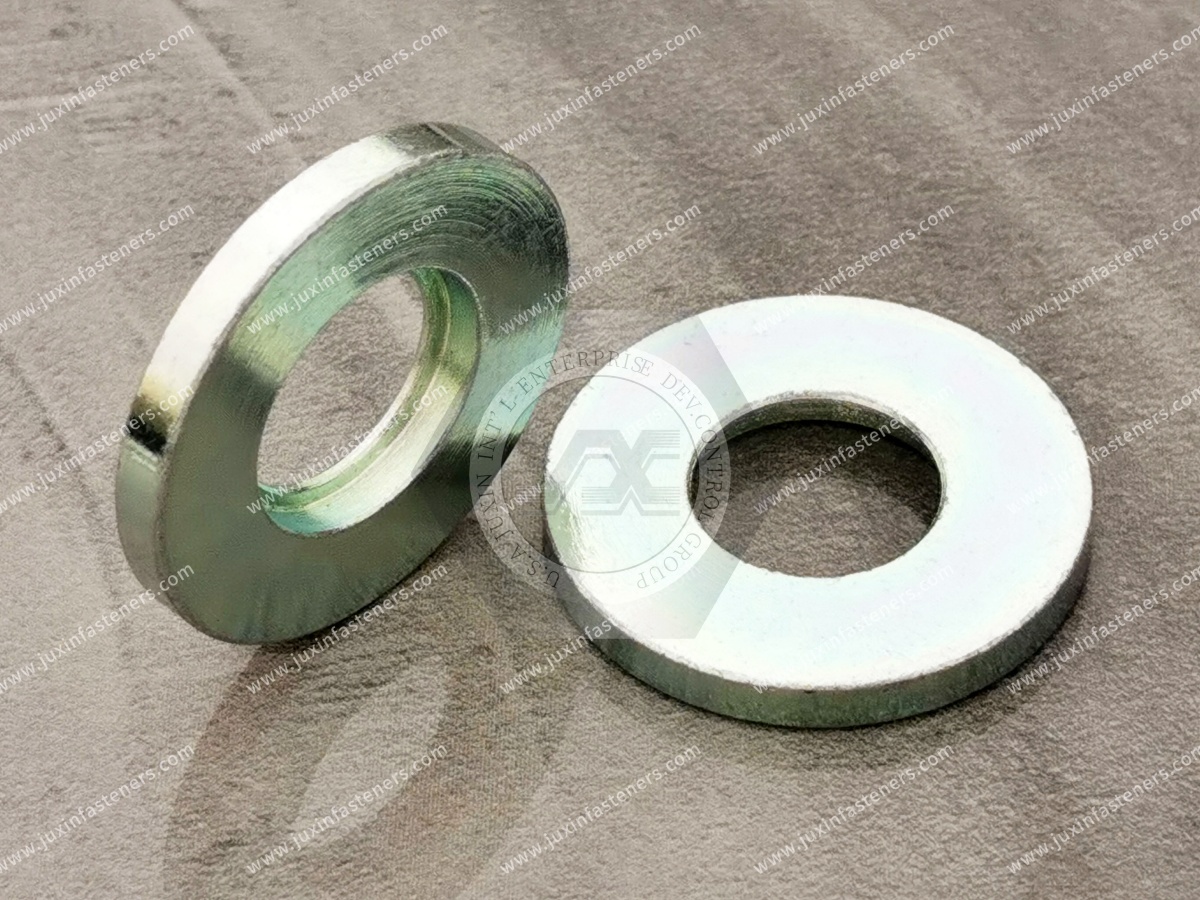
A large OD flat washer is a plain washer with an outside diameter larger than that of a conventional normal-series washer for a comparable nominal fastener size.
Its primary function is generally to increase the bearing area between the rotating fastener interface and the parent component.
Conceptually:
Bolt Head / Nut → Washer → Parent Material
becomes:
Bolt Head / Nut → Larger Bearing Area → Parent Material
The larger washer can distribute the contact load over a wider region.
However, outside diameter is only one part of washer design.
A useful washer specification may also need:
inside diameter;
outside diameter;
thickness;
hardness;
material;
surface finish;
product grade;
applicable standard.
This distinction is important.
A washer can have a large outside diameter but still be relatively thin or made from a material that is unsuitable for a high-bearing-pressure joint.
Therefore:
Large OD ≠ High Strength
and:
Large OD ≠ High Load Capacity
Load-bearing capability depends on the complete washer and joint design.
A large plain washer does not become a locking component simply because it has more surface area.
Its primary function is normally associated with:
bearing area;
load distribution;
hole coverage;
surface protection.
It does not automatically prevent rotational self-loosening.
Therefore:
Large Flat Washer ≠ Lock Washer
If the engineering problem is vibration-induced loosening, the locking strategy should be evaluated separately.
Another common description says that large washers “absorb vibration.”
That is too broad.
A conventional rigid flat washer is not normally selected as a vibration-damping component.
It can change the local bearing interface, but:
Load Distribution ≠ Vibration Damping
If damping is required, the assembly may need another material or dedicated vibration-control component.
The fastener applies clamp load to the joint through relatively small bearing surfaces beneath the bolt head and nut.
A washer increases the interface area.
A larger washer can spread that force over a wider region.
Conceptually:
Bearing Stress ≈ Applied Bearing Load / Effective Bearing Area
Increasing effective bearing area can reduce local average bearing stress, provided the washer itself remains sufficiently stiff and the load is effectively transferred through the washer.
This last condition is important.
A very large but excessively flexible washer may not distribute load uniformly across its full nominal area.
Outside diameter determines the potential bearing footprint.
Thickness influences washer stiffness.
This means:
Large OD + Insufficient Thickness ≠ Automatically Effective Load Distribution
As OD increases, bending of the washer can become more important depending on:
clamp load;
washer material;
washer thickness;
parent material;
hole geometry.
Engineers should therefore evaluate OD and thickness together.
Hardness influences how the washer behaves beneath the bolt head or nut.
A washer that is too soft for the bearing pressure may:
dish;
indent;
embed;
plastically deform.
Therefore:
Large OD + Correct Thickness + Appropriate Hardness
can be more meaningful than simply specifying:
Large Washer
For high-strength fastener systems, washer hardness requires particular attention.
Several joint conditions can justify a larger washer.
Examples can include:
aluminum;
selected polymers;
wood-based structures;
soft metallic materials.
A larger bearing area can reduce local surface pressure.
However, soft materials may still creep or deform over time.
The washer does not eliminate the material's inherent behavior.
Thin sheet can deform locally beneath a small fastener bearing surface.
A larger washer may spread the load over a wider region.
However, thin sheet can still:
dish;
buckle;
pull through;
locally bend.
The complete sheet geometry must be evaluated.
An oversized clearance hole reduces the available supporting material close to the fastener.
A larger washer can help bridge the opening and provide sufficient overlap.
Slotted holes may require a washer with sufficient dimensions to bridge the slot in all permitted fastener positions.
This requires more than checking nominal bolt diameter.
In some maintenance situations, a large washer is used around an enlarged hole.
This should not automatically be treated as a structural repair.
The underlying component damage and load path should be evaluated.
ISO washer standards distinguish between different dimensional series.
For large OD washer selection, three concepts are particularly useful:
Normal Series → Standard Bearing Area
Large Series → Increased Outside Diameter
Extra-Large Series → Still Larger Bearing Footprint
The correct series depends on the joint.
ISO 7093-1:2000 covers:
Plain Washers — Large Series — Part 1: Product Grade A
This is one of the primary international standards for precision large-series plain washers.
It should not be confused with ISO 7092.
A common online error is to describe ISO 7092 as a large washer standard.
That is incorrect.
ISO 7092 covers:
Plain Washers — Small Series — Product Grade A
Therefore:
ISO 7092 → Small Series
ISO 7093 → Large Series
This distinction matters when interpreting drawings and RFQs.
ISO 7093-2:2000 covers:
Plain Washers — Large Series — Part 2: Product Grade C
This provides another large-series washer category.
Product Grade A and Product Grade C should not be treated as identical designations.
The applicable drawing or equipment specification should determine the required product grade.
ISO 7094:2000 covers:
Plain Washers — Extra Large Series — Product Grade C
This gives engineers another standardized geometry when an even larger bearing footprint is required.
Therefore the selection path can become:
Normal Series → Large Series → Extra-Large Series → Custom Large OD Washer
depending on the joint requirement.
ISO 7093-1:2000, ISO 7093-2:2000 and ISO 7094:2000 remain published international standards.
ISO has also initiated revision projects for these washer standards.
For production drawings and RFQs, always identify the applicable standard edition required by the customer.
This is especially important for long-life OEM programs.
The correct choice should not be based on the assumption:
“Bigger is safer.”
Instead evaluate:
required hole coverage;
available assembly space;
parent material;
required bearing area;
washer thickness;
washer stiffness;
fastener strength;
interference with nearby components.
An extra-large washer can create packaging or assembly problems where the larger diameter is unnecessary.
Many legacy European drawings and commercial catalogs use the designation:
DIN 9021
for large OD washers.
Engineers and procurement teams may therefore encounter both:
DIN 9021;
ISO 7093-1.
When replacing legacy parts, do not rely only on the assumption that two standards are automatically identical in every requirement.
Confirm:
dimensions;
product grade;
material;
hardness;
finish;
customer drawing.
A drawing created years ago may reference a legacy DIN designation.
A professional replacement process should be:
Legacy Standard → Identify Original Requirement → Compare Current Standard → Review Differences → Approve Replacement
Do not silently change the drawing callout.
The term fender washer is widely used commercially, especially in North American markets, for a washer with a relatively large outside diameter compared with its hole size.
However:
Fender Washer ≠ One Universal Engineering Standard
Commercial fender washers can vary in:
OD;
thickness;
material;
hardness;
finish.
Therefore, for OEM procurement, actual dimensions and technical requirements are more important than the marketing name alone.
Both can provide a larger bearing area.
But a generic commercial fender washer should not automatically be represented as ISO 7093.
The correct sourcing distinction is:
ISO 7093 Large-Series Washer → Standardized Requirement
Fender Washer → Commercial Large-OD Category
Custom Large OD Washer → Drawing-Controlled Component
ISO 7094 provides a standardized extra-large-series washer.
A fender washer may also have a very large OD.
However:
Similar OD ≠ Standard Equivalence
Check the complete dimensions and technical requirements.
Large OD washers are frequently useful with softer parent materials.
Consider an assembly involving:
Steel Bolt → Small Washer → Polymer Component
The local bearing pressure can be high.
Changing to:
Steel Bolt → Larger Washer → Polymer Component
can distribute the clamp load over a wider region.
But polymers can exhibit:
creep;
stress relaxation;
temperature-dependent behavior.
Therefore:
Larger Washer ≠ Elimination of Polymer Creep
The complete joint must still be designed for the material.
Aluminum components may benefit from increased bearing area in selected joints.
However, the designer should consider:
aluminum alloy;
thickness;
surface treatment;
bearing stress;
washer hardness;
galvanic compatibility.
A large washer can reduce local bearing stress but cannot automatically prevent all aluminum deformation.
Thin sheet presents a different engineering problem from soft bulk material.
Potential failure modes include:
local indentation;
sheet bending;
pull-through;
hole deformation.
A large OD washer may help, but the designer should also evaluate:
sheet thickness;
edge distance;
hole geometry;
fastener preload;
load direction.
For very thin sheet, another fastening architecture may be more appropriate.
Slotted holes are common in:
adjustable brackets;
machinery;
equipment frames;
mounting systems.
A washer should provide adequate coverage throughout the allowed bolt position.
Engineers should check the worst-case location of the fastener within the slot.
The correct question is:
“Does the washer bridge the slot at every permitted position?”
not simply:
“Does it fit the bolt?”
Oversized holes may be required for:
assembly tolerance;
alignment;
field installation;
adjustment.
A larger washer can provide additional overlap.
But hole enlargement can also influence:
slip;
bearing;
load transfer;
joint movement.
The applicable structural or equipment design requirements should control the joint.
Increasing washer OD is sometimes used as an easy response to:
damaged holes;
thin material;
poor alignment;
excessive local deformation.
Sometimes it is appropriate.
Sometimes it merely hides the underlying problem.
The design question should remain:
What failure mode is the larger washer intended to prevent?
These two functions are related but not identical.
The goal is to spread clamp load over more parent material.
The goal is to bridge an opening, slot or oversized hole.
A washer may need a large OD for either reason.
Understanding which problem exists helps determine:
OD;
thickness;
stiffness;
material.
A larger diameter and greater thickness solve different problems.
Primarily increases potential bearing footprint and hole coverage.
Primarily increases washer stiffness and resistance to bending or dishing.
Therefore:
Need More Area → Review OD
Need More Washer Stiffness → Review Thickness
Often both must be evaluated together.
A large OD washer is not necessarily hardened.
A hardened washer is not necessarily large OD.
These are separate design attributes.
For high-strength bolted joints:
Washer Geometry + Washer Hardness + Fastener Property Class + Parent Material
should be evaluated as a system.
Common washer materials can include:
carbon steel;
stainless steel;
other specified alloys.
Material selection depends on:
bearing requirement;
corrosion environment;
fastener material;
parent material;
temperature;
customer specification.
Do not choose material based only on washer diameter.
Carbon steel can provide an economical solution for many industrial assemblies.
Potential surface finishes can be selected according to:
corrosion environment;
friction requirements;
appearance;
customer specification.
The coating should be defined rather than described only as “corrosion resistant.”
Stainless steel large washers may be useful where corrosion resistance is required.
Potential grades can include appropriate austenitic stainless materials.
However:
Stainless Steel ≠ Corrosion-Proof
Environment and material compatibility still require review.
A large washer creates a relatively large contact area with the parent component.
If dissimilar metals are used in a wet or conductive environment, galvanic compatibility can matter.
Potential combinations requiring review include:
stainless washer + aluminum;
carbon steel washer + aluminum;
copper-containing washer + aluminum.
Surface coatings and environmental exposure should be considered.
Possible finishes for carbon-steel washers can include various zinc or zinc-flake systems depending on requirements.
The correct finish depends on:
environment;
fastener coating;
friction requirements;
appearance;
customer specification.
Do not infer a universal corrosion life from the coating name.
A washer is part of the bearing interface beneath a rotating bolt head or nut.
Its surface condition can therefore influence friction.
Changing:
washer material;
coating;
lubrication;
surface roughness
can change the relationship between applied torque and achieved preload.
For preload-sensitive joints, the washer should not be treated as mechanically invisible.
High-strength fasteners can generate significant clamp loads.
The washer must provide an appropriate bearing interface.
A large outside diameter alone does not guarantee suitability.
Engineers should evaluate:
washer hardness;
washer thickness;
bearing area;
fastener property class;
parent material.
For high-strength bolted systems, use the applicable engineering standard rather than substituting a generic large washer.
A large washer used in industrial machinery should not automatically be marketed as a structural-steel washer.
Structural bolting systems can have specific requirements for:
fasteners;
nuts;
washers;
hole geometry;
installation;
preload.
A generic ISO large-series washer should not be substituted into a structural bolting system without the applicable design requirements.
Large OD washers may be used in selected automotive and EV assemblies where increased bearing area is required.
Potential applications include:
equipment brackets;
auxiliary assemblies;
thermal-management equipment;
underbody components;
production equipment;
non-safety-critical mounting systems.
Safety-critical joints require the applicable vehicle or customer specification.
Potential applications may exist in:
battery enclosure equipment;
mounting brackets;
auxiliary structures;
thermal-management hardware;
ESS cabinets.
Large washers can be useful where the joint involves:
aluminum;
sheet metal;
slots;
large clearance holes.
However, the washer does not automatically provide:
sealing;
grounding;
IP protection.
Those functions must be engineered separately.
Potential large OD washer applications include:
equipment frames;
cooling equipment;
pumps;
power-distribution cabinets;
UPS equipment;
server infrastructure;
mechanical mounting systems.
The selection should be based on actual:
hole geometry;
bearing requirement;
parent material;
fastener load.
Large washers may be useful in:
cabinet frames;
mounting rails;
equipment brackets;
transformer or power equipment;
mechanical supports.
A large steel washer does not automatically create a compliant electrical grounding path.
Electrical bonding must be evaluated separately.
Potential applications include:
fan assemblies;
pump frames;
sheet-metal housings;
mounting brackets;
equipment supports.
Large OD washers can help distribute clamp load on sheet metal.
They do not automatically create an airtight or watertight seal.
Large OD washers are commonly relevant to:
machine tools;
automation systems;
production machinery;
conveyor equipment;
material-handling equipment;
equipment frames.
Slotted mounting holes are particularly relevant to this product family.
Heavy equipment contains many:
brackets;
guards;
panels;
mounting structures.
Large washers can be useful where holes are oversized or parent material requires a wider bearing area.
However, joint design should remain application-specific.
Rail-related machinery and equipment can use large washers in appropriate mechanical assemblies.
Do not automatically describe a generic large washer as suitable for safety-critical rail joints without the required qualification.
Stainless or coated large washers may be considered in selected marine equipment.
Material selection should consider:
salt exposure;
galvanic compatibility;
fastener material;
parent material.
A generic industrial large OD washer should not automatically be described as aerospace-qualified.
Drawing-based requirements for:
ground-support equipment;
tooling;
MRO fixtures;
non-flight-critical equipment
can be evaluated where appropriate.
Flight-critical applications require the applicable aerospace specifications and approved sourcing system.
| Joint Condition | Engineering Direction |
|---|---|
| Normal rigid steel interface | Normal-series washer may be sufficient |
| Need greater bearing area | Evaluate large-series washer |
| Need very large bearing footprint | Evaluate extra-large series or custom washer |
| Soft parent material | Increase bearing area and evaluate creep/deformation |
| Thin sheet | Review OD, thickness and sheet deformation |
| Oversized hole | Ensure adequate hole overlap |
| Slotted hole | Check coverage at worst-case bolt position |
| High-strength bolt | Verify washer hardness and thickness |
| Need vibration locking | Use separate locking strategy |
| Need sealing | Use appropriate sealing washer/system |
| Need grounding | Validate electrical interface separately |
| Nonstandard geometry | Use drawing-controlled custom washer |
A useful first-pass engineering workflow is:
Confirm:
thread size;
property class;
head or nut geometry.
Is it:
standard clearance;
oversized;
slotted?
Determine:
material;
thickness;
surface condition.
Is the problem:
local indentation;
hole coverage;
soft material;
thin sheet;
surface protection?
Evaluate:
normal series;
ISO 7093 large series;
ISO 7094 extra-large series;
custom large OD washer.
Do not select by OD alone.
Verify interference with:
bends;
walls;
adjacent fasteners;
equipment features.
Match the environment and joint.
Check fit, bearing behavior and tightening requirements.
Define the complete washer requirement.
ISO 7092 is small series.
ISO 7093 is large series; ISO 7094 is extra-large series.
Thickness and hardness also matter.
Geometry alone does not define load capability.
Plain washers do not automatically prevent rotational loosening.
A rigid flat washer is not inherently a vibration damper.
Commercial terminology does not establish standard conformity.
A large washer can still bend or deform the sheet.
Large bearing area does not compensate for inappropriate hardness.
The underlying failure mechanism should be evaluated.
Engineers may search:
large flat washer;
large OD washer;
large diameter washer;
ISO 7093 washer;
ISO 7094 washer;
ISO 7093 vs ISO 7094;
extra large washer;
fender washer vs flat washer;
washer for oversized hole;
washer for slotted hole;
washer for thin sheet;
washer for aluminum;
large washer bearing area;
large washer thickness.
These searches usually represent an active joint-design or troubleshooting task.
Procurement teams may search:
large flat washer supplier;
large OD washer manufacturer;
ISO 7093 supplier;
ISO 7094 supplier;
DIN 9021 washer supplier;
large diameter washer manufacturer;
fender washer manufacturer;
custom large washer supplier;
stainless large OD washer;
custom stamped washer.
These queries have stronger commercial intent.
For technical and commercial evaluation by JUXIN FASTENERS, provide where applicable:
drawing;
customer part number;
applicable ISO, DIN or other standard;
standard edition where controlled;
nominal fastener size;
inside diameter;
outside diameter;
thickness;
product grade;
washer hardness;
washer material;
surface finish;
fastener property class;
bolt or nut bearing-face geometry;
hole diameter;
slot dimensions where applicable;
parent material;
parent-material thickness;
joint function;
corrosion environment;
temperature;
tightening requirement where controlled;
dimensional tolerances;
flatness requirement where controlled;
inspection requirement;
documentation requirement;
sample quantity;
prototype quantity;
production quantity;
estimated annual demand;
packaging requirement;
labeling requirement;
customer-specific requirements.
It is a plain washer with a relatively large outside diameter designed to provide a wider bearing interface or greater hole coverage.
ISO 7093-1 covers large-series Product Grade A plain washers, while ISO 7093-2 covers large-series Product Grade C plain washers.
ISO 7094 covers extra-large-series Product Grade C plain washers.
No. ISO 7092 covers small-series Product Grade A plain washers.
ISO 7093 covers large-series washers, while ISO 7094 covers extra-large-series washers.
DIN 9021 remains common as a legacy and commercial designation for large OD washers. For replacement sourcing, confirm the actual drawing and dimensional requirements.
Not automatically. Fender washer is a broad commercial term. Standard conformity must be confirmed.
Not by themselves. A plain large OD washer is primarily a bearing component rather than a dedicated anti-loosening device.
They should not be treated as dedicated vibration-damping components.
Not necessarily. Washer strength and stiffness depend on material, hardness, thickness and geometry.
It may help distribute load, but sheet deformation, pull-through, hole geometry and joint preload still require evaluation.
They can reduce local bearing pressure in selected aluminum joints, but material thickness, alloy, surface treatment and washer hardness should be considered.
Yes, where the washer dimensions and stiffness provide adequate coverage throughout the permitted bolt positions.
Potentially, but washer hardness, thickness and the applicable bolted-joint specification must be checked.
Custom washer requirements can be evaluated from drawings, ID, OD, thickness, material, hardness, finish, tolerances and production quantities.
A buyer may initially request:
“M12 large flat washers, 100,000 pcs.”
That does not yet tell the supplier whether the requirement is:
ISO 7093-1;
ISO 7093-2;
ISO 7094;
legacy DIN 9021;
commercial fender washer;
custom large OD washer.
A professional RFQ should answer:
What Is the Required Standard?
What Is the Actual ID?
What Is the Required OD?
What Is the Thickness?
What Product Grade Is Required?
What Washer Hardness Is Required?
What Fastener Property Class Is Used?
What Is the Parent Material?
How Thick Is the Parent Material?
Is the Hole Standard, Oversized or Slotted?
Why Is the Larger Bearing Area Required?
What Material and Finish Are Required?
The commercial path becomes:
Fastener → Hole Geometry → Parent Material → Bearing Requirement → Washer Series → OD → Thickness → Hardness → Material / Finish → Validation → Production RFQ
That is the difference between buying a washer that is simply large and sourcing a washer designed for the actual joint.
JUXIN FASTENERS supports OEM and custom sourcing of:
large OD flat washers;
ISO 7093 large-series washers;
ISO 7094 extra-large-series washers;
large diameter washers;
fender-style washers;
custom stamped washers;
hardened flat washers;
stainless steel washers;
carbon steel washers;
industrial washer systems.
Potential application sectors include:
automotive and EV equipment;
industrial machinery;
electrical equipment;
AI data centers and HPC infrastructure;
HVAC and liquid-cooling equipment;
power generation;
energy storage;
telecommunications;
automation;
agricultural machinery;
construction machinery;
rail-related equipment;
marine equipment.
For general washer-size and bearing-area selection, refer to the JUXIN FASTENERS Flat Washer Selection Guide: Size, Bearing Area, ISO Standards & Industrial Applications.
For washer hardness and bolt compatibility, refer to the JUXIN FASTENERS Flat Washer Selection: Hardness, Bolt Grades & Industrial Applications.
For screw-to-washer compatibility, refer to the JUXIN FASTENERS Screws & Flat Washers: Size, Hardness, Bearing Area & Joint Selection Guide.
For broader washer selection, see Industrial Washers: Types, Functions & Selection Guide.
For high-strength fastener systems, see High-Strength Bolts and Nuts.
For OEM large OD washer RFQs, send your drawing, applicable standard, ID, OD, thickness, material, hardness, finish, fastener property class, parent material,
hole geometry, quantity and estimated annual demand to:
The correct large washer is not simply:
“the washer with the biggest outside diameter.”
It is:
“the washer with the appropriate bearing area, stiffness, hardness and geometry for the actual bolted joint.”
 MORE NEWS
Sep. 27, 2026
Sep. 27, 2026
Sep. 27, 2026
Contact Us
Tel.:
+86 020 8621 0320
+86 020 3121 6067
E-mail:
Technical Support:
Navigation
SEND INQUIREY