
Call Us
+86 136 6007 9809
Call Us
+86 136 6007 9809

Oct. 24, 2023
Clip-on nuts are compact sheet-metal fastening components designed to provide a threaded or screw-retaining feature without requiring a conventional loose nut behind the panel.
Depending on the product design and market terminology, related components may be called:
clip-on nuts
U-nuts
U-clip nuts
spring nuts
spring clip nuts
panel nuts
sheet metal nuts
edge clip nuts
They are widely used where engineers need fast assembly, limited rear access or an economical method of adding a fastening point to sheet metal.
Common applications include:
automotive body and interior assemblies
electrical enclosures
HVAC equipment
industrial machinery
appliances
power distribution equipment
battery and electronics enclosures
agricultural and construction equipment
However, not every spring-style panel fastener works in the same way.
For engineering selection, start with:
Panel Geometry → Panel Thickness → Hole / Edge Position → Screw or Thread → Installation Access → Required Alignment → Load → Vibration → Environment → Assembly Process
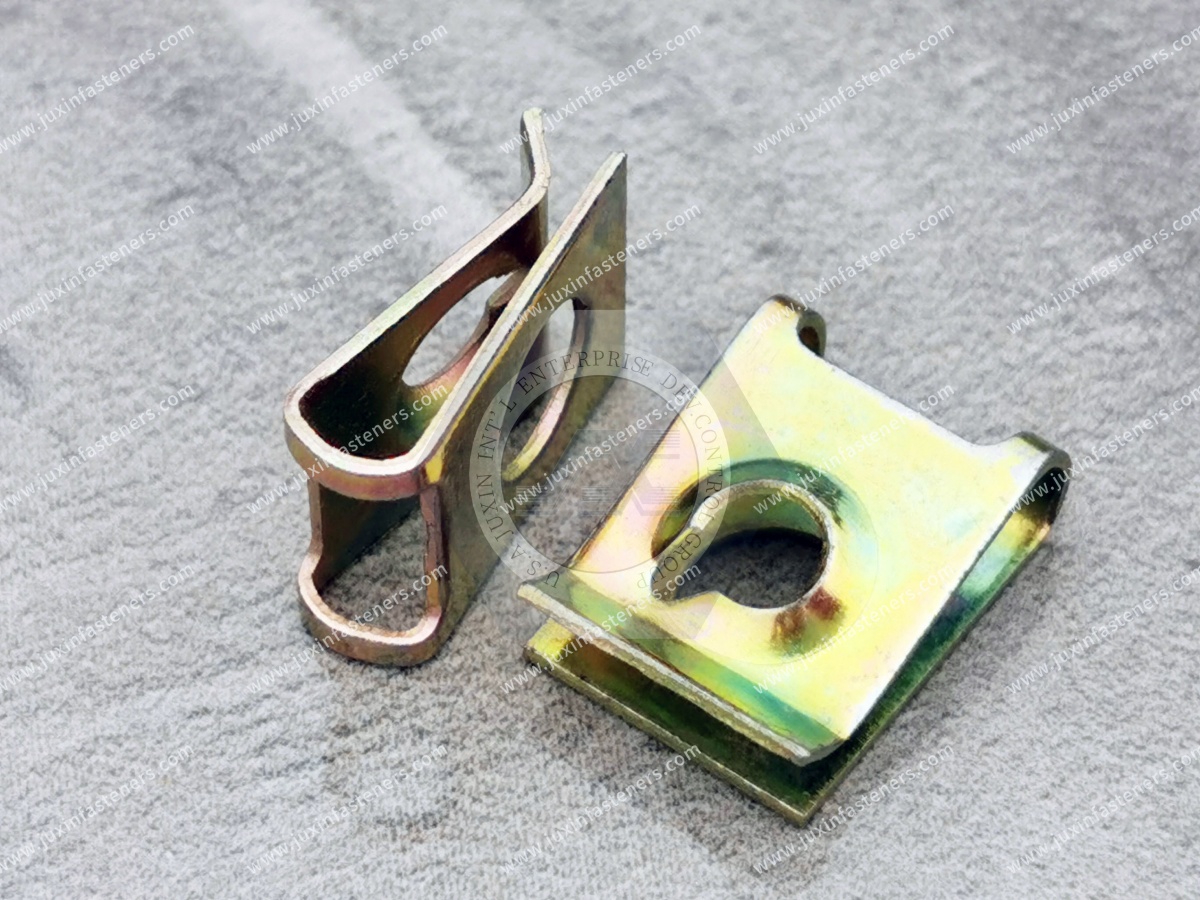
A clip-on nut is a fastening component that attaches to the edge or another designed feature of a panel and provides a location for a mating screw.
Many designs use a formed spring-steel body that creates retention against the panel.
Depending on the design, the threaded or screw-engagement feature may be:
an integrated formed thread
an extruded thread
a threaded barrel
a retained nut element
another engineered screw-engagement feature
This allows the panel assembly to receive a screw without requiring the operator to hold a separate loose nut behind it.
Thin sheet metal creates a common fastening challenge.
The panel itself may not provide enough thickness for the required conventional tapped-thread engagement.
Engineers therefore need another way to create or retain a fastening point.
Possible technologies include:
clip-on nuts
U-nuts
weld nuts
rivet nuts
self-clinching nuts
cage nuts
threaded inserts
The correct technology depends on the assembly.
A clip-on nut becomes particularly interesting when the design needs:
rapid installation
edge access
no welding
no tapping operation
no loose nut behind the panel
removable screw assembly
production-friendly installation
The terms are often used broadly and may overlap in commercial catalogs.
A U-nut generally describes a clip-style fastener whose body wraps around a panel or flange in a U-shaped configuration.
“Clip-on nut” is a broader commercial description and can include several related designs.
For OEM sourcing, terminology alone is therefore not sufficient.
The controlled definition should include:
Geometry + Panel Thickness + Thread + Hole Position + Material + Finish
A supplier should not assume two products are interchangeable merely because both are described as “U-nuts.”
“Leaf spring nut” is sometimes used for clip-style fasteners that use a formed spring section to retain the component against a panel.
The spring feature may provide:
panel retention during handling
installation positioning
controlled contact against the panel
However, the term should not be treated as one universal international standard designation.
For procurement, the drawing, dimensions or physical sample are more reliable than the generic name alone.
A conventional hex nut generally requires access to the opposite side of the assembly unless it is otherwise retained.
A clip-on nut can remain positioned on the panel before the mating screw is installed.
Typically requires:
access behind the joint
operator or tooling to hold the nut
separate nut handling
Can provide:
pre-positioning on the panel
simplified assembly
reduced loose-part handling
easier screw installation in suitable designs
This can be valuable in high-volume manufacturing.
Both technologies can provide a threaded feature on sheet metal, but their manufacturing logic is different.
Typically requires:
weldable materials
welding equipment
controlled welding process
appropriate access and joint design
Potential advantages include a permanently attached threaded component where the design and process support it.
Typically:
installs mechanically
does not require welding
can be installed later in the assembly process
can be replaced more easily in suitable applications
Therefore:
Permanent welded attachment required → Evaluate Weld Nut
Fast mechanical panel installation required → Evaluate Clip-On Nut
The final choice depends on load, panel design and manufacturing process.
Rivet nuts provide an internally threaded insert installed into a prepared hole, often where only one side of the panel is accessible.
Clip-on nuts normally rely on panel-edge or feature engagement.
Consider when:
blind-side installation is required
the fastening point is away from a panel edge
an internally threaded insert is required
the installation process can support rivet-nut setting
Consider when:
panel-edge access is available
rapid clipping is desirable
the geometry supports a clip
separate setting equipment is undesirable
This is an important design distinction.
Self-clinching nuts are installed permanently into properly designed sheet material through a controlled pressing operation.
Clip-on nuts use a different retention principle.
Often considered when:
permanent captive threading is required
panel material and thickness are suitable
press installation is available
controlled hole preparation is possible
Often considered when:
press installation is undesirable
edge mounting is practical
quick mechanical attachment is preferred
replacement or late-stage installation may be useful
Neither technology is universally superior.
The correct choice depends on the assembly architecture.
These products should not automatically be grouped together.
A cage nut generally uses a nut captured within a spring-steel cage and is commonly installed into a compatible panel opening.
The captured nut may provide some positional movement depending on the design.
A U-style clip nut generally attaches differently, often by sliding over a panel edge or flange.
Therefore:
Cage Nut ≠ U-Nut
Both can provide threaded attachment in sheet-metal structures, but their mounting geometry and design intent differ.
“Speed nut” can refer to spring-steel fastening products that engage a screw through formed spring features rather than a conventional fully formed machine thread.
Some clip nuts use similar spring-fastener principles, while others contain a conventional threaded feature.
For engineers and procurement teams, the important question is not the marketing name.
Ask:
What exactly engages the mating screw?
This determines:
screw compatibility
installation behavior
serviceability
tightening strategy
replacement requirements
Panel thickness is one of the first dimensions that should be confirmed when selecting a clip-on nut.
The clip geometry must match the panel or flange it is designed to engage.
If the panel is outside the intended grip range, possible issues can include:
difficult installation
poor retention
excessive deformation
incorrect thread position
loose fit
damage to coating
assembly variation
Therefore:
Same Thread Size ≠ Same Clip Nut
Two M6 clip nuts, for example, may be designed for different panel conditions and should not automatically be considered interchangeable.
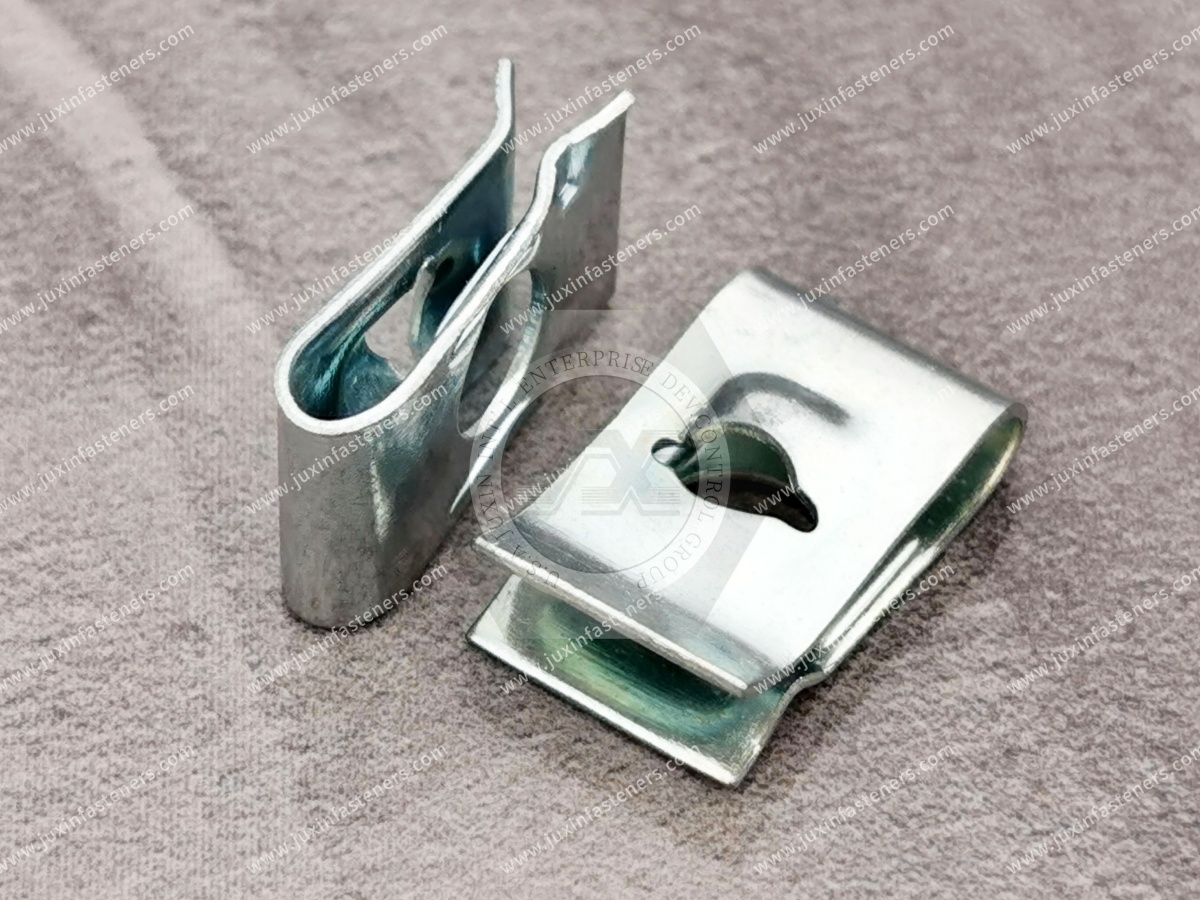
Some clip-on fasteners are designed to accommodate a defined range of panel thicknesses.
The acceptable range depends on the specific component design.
Do not assume that a spring clip will automatically compensate for any sheet thickness.
For OEM projects, provide the actual:
nominal panel thickness
panel-thickness tolerance
coating condition where relevant
This allows the supplier to evaluate the correct clip geometry.
For an edge-mounted clip nut, another critical dimension is the distance between the panel edge and the screw-hole center.
This may be described in different ways depending on the drawing or supplier terminology.
Conceptually:
Panel Edge → Fastening Centerline
must match the clip geometry.
If the clip reach is incorrect:
the threaded feature may not align with the panel hole
installation may be difficult
the screw may enter at an angle
the clip may sit incorrectly on the panel
Therefore, thread size alone is never enough for reliable cross-reference sourcing.
Sheet-metal assemblies accumulate manufacturing tolerances.
A mating screw may not always arrive at the theoretical center of the panel hole.
Some clip-nut designs provide limited positional accommodation, while others locate the thread more rigidly.
This can be useful when an assembly has:
multiple panels
stamped components
molded trim
long tolerance chains
multiple fastening points
But positional movement should not be assumed.
If floating or alignment capability is required, define it in the engineering specification.
A floating fastening feature is designed to accommodate controlled positional variation.
It should not automatically be interpreted as poor manufacturing quality.
For some assemblies, controlled movement can help compensate for stack-up tolerances.
For others, precise fixed positioning is required.
The design intent should determine the product.
Clip-on nuts can be produced for different screw and thread systems depending on the specific design.
For machine-threaded products, engineering should specify:
metric or inch thread
nominal diameter
thread pitch or threads per inch
mating screw requirement
Examples of thread systems may include metric ISO threads or Unified inch threads where applicable.
Do not substitute one thread system for another based only on similar outside diameter.
A correct clip nut can still produce assembly problems if the screw length is wrong.
Review:
panel stack thickness
clip-nut geometry
available clearance behind the panel
required thread engagement
nearby components
An excessively long screw can interfere with components behind the panel.
An insufficiently engaged screw may not meet the joint requirement.
Required engagement should be determined by the actual product design rather than a universal rule.
Clip-on nuts are commonly installed by sliding or pressing the clip onto the designed panel feature.
The exact installation method depends on the geometry.
Before production approval, confirm:
installation direction
panel edge geometry
hole alignment
required installation force
accessibility
tooling if required
Assembly direction can influence both product design and manufacturing-line layout.
In many production environments, the clip nut is installed before the final screw assembly.
The component may then pass through:
handling
transportation
subassembly
coating or finishing steps where applicable
final assembly
The clip should therefore have appropriate pre-assembly retention for the intended process.
This requirement is different from the final joint's clamp load.
Engineers should distinguish:
Clip-to-Panel Retention
from
Screw Joint Performance
They are not the same characteristic.
A spring clip can provide panel retention and may contribute useful spring characteristics to the assembly.
However, a generic statement that every clip-on nut is “vibration proof” or “anti-loosening” is too broad.
Joint behavior depends on:
clip design
screw
thread geometry
tightening condition
clamp load
vibration
joint materials
service environment
If vibration resistance is a critical requirement, the complete joint should be evaluated.
Instead of asking:
“Is this clip nut vibration resistant?”
a more useful engineering question is:
“How does this specific fastened joint behave under the vibration conditions of my application?”
Relevant information may include:
vibration spectrum
joint load
screw specification
installation condition
panel stiffness
required service life
Application-specific testing may be required where joint integrity is critical.
Many clip-on nuts and U-nuts use formed steel components because the clip requires suitable spring characteristics.
Depending on the product design, materials may include:
spring steels
carbon steels
stainless steels
other application-specific materials
The exact material should follow the drawing or approved product specification.
Avoid defining all spring nuts by one material grade.
The clip portion must perform its intended spring function during:
installation
panel retention
assembly
Manufacturing control can therefore involve:
material condition
forming process
heat treatment where applicable
geometry
dimensional control
A component that looks correct may not necessarily provide the same spring behavior if material or processing changes.
This is especially important in second-source qualification.
Steel clip nuts may use various protective finishes depending on the application and customer specification.
Selection should consider:
corrosion environment
appearance
mating components
automotive or OEM requirements
restricted-substance requirements
required corrosion performance
Do not choose a finish only because it is described as “zinc plated” or “black.”
The complete coating specification matters.
Zinc-based coatings are commonly used on steel fastening components.
However, corrosion performance depends on variables such as:
coating system
thickness
passivation
topcoat where specified
component geometry
service environment
Therefore:
Zinc Plated ≠ One Universal Corrosion Rating
If corrosion resistance is important, define the actual requirement.
Stainless steel may be considered where the environment requires corrosion resistance beyond a particular coated-steel solution.
But stainless steel selection also requires engineering review.
Consider:
stainless grade
spring properties
forming requirements
mating screw material
galvanic conditions
cost
“Stainless steel” is not a complete OEM material specification.
Automotive assemblies are one of the major application areas for clip nuts and U-nuts.
Potential uses include suitable:
body panels
fender-related assemblies
underbody components
interior structures
instrument-panel assemblies
brackets
trim mounting
electrical equipment
HVAC-related assemblies
The specific fastener must match the vehicle design and customer specification.
Automotive production benefits from fastening systems that support:
rapid assembly
reduced loose-part handling
pre-positioning
limited rear access
automated or semi-automated production
serviceability
However, automotive applications can also impose requirements for:
corrosion resistance
vibration
dimensional capability
traceability
coating control
production consistency
supplier change management
These requirements should be defined by the customer program.
Clip-on nuts may be useful in appropriate non-cell sheet-metal and equipment assemblies such as:
electrical brackets
covers
protective panels
control enclosures
thermal-management equipment
auxiliary structures
Fastener selection should follow the actual structural, electrical, sealing and service requirements of the assembly.
A clip nut should not automatically be substituted for a sealed threaded insert or structural fastener where those functions are required.
Clip-on nuts can simplify screw attachment in:
electrical cabinets
switchgear enclosures
control cabinets
power distribution equipment
UPS equipment
industrial electrical assemblies
Potential advantages include:
rapid installation
reduced need for loose nuts
accessible service fasteners
efficient sheet-metal assembly
Electrical bonding or grounding requirements, where relevant, must be evaluated separately.
Sheet-metal-intensive HVAC products can use clip-style fasteners in suitable:
covers
panels
brackets
fan assemblies
equipment housings
service-access components
Engineers should consider:
vibration
temperature
moisture
corrosion
service frequency
panel thickness
Clip nuts may also support high-volume sheet-metal assembly in:
appliances
commercial kitchen equipment
vending machines
equipment housings
access panels
Material and finish should be selected according to the actual environment and regulatory requirements of the equipment.
Industrial equipment may use clip-on nuts for:
guards
covers
brackets
control enclosures
service panels
sheet-metal housings
For frequently serviced panels, engineers should consider the expected maintenance process and whether the selected clip and screw system is appropriate for repeated service.
Reuse should not be treated as a universal feature.
Repeated removal and installation may affect:
clip geometry
spring retention
thread condition
coating
panel interface
The acceptable number of service cycles depends on the specific component and application.
For OEM equipment, follow the validated maintenance requirement.
An M5 or M6 thread does not define the complete clip nut.
Also confirm:
panel thickness
reach
geometry
hole position
material
finish
A clip designed for one panel condition may not retain correctly on another.
Similar-looking parts can have different:
reach
grip
thread position
spring geometry
materials
The mounting architecture is different.
Rivet nuts are installed into holes and use a setting process; edge-mounted clip nuts use another retention principle.
Vibration performance belongs to the complete joint.
Visual appearance does not define coating performance.
Serviceability depends on the specific design and application.
If a clip nut moves, falls off or fails to align, investigate the complete system.
correct part?
correct geometry?
damaged?
deformed?
correct thickness?
correct edge geometry?
burrs?
coating buildup?
correct reach?
panel hole correctly positioned?
tolerance stack excessive?
correct thread?
correct length?
correctly aligned?
fully seated?
correct direction?
damaged during assembly?
A stronger clip is not automatically the correct solution.
Clip nuts are often sourced from drawings, customer part numbers or physical samples.
For second-source qualification, compare more than overall dimensions.
Evaluate:
panel grip
reach
thread
thread location
spring geometry
material
hardness or mechanical properties where specified
coating
installation behavior
panel retention
screw assembly
functional performance
A visually identical component can behave differently if spring characteristics or material processing differ.
If a drawing is unavailable, sending only the clip nut may not provide enough information.
Ideally provide:
physical clip sample
mating panel
panel drawing
screw
assembly photographs
This helps the supplier understand the actual interface.
A clip nut is designed around its panel relationship.
Therefore:
Clip Sample Alone < Clip + Panel + Screw + Application
for reliable replacement sourcing.
Depending on the customer and application, quality control may include:
dimensional inspection
thread inspection
material verification
coating verification
spring-feature inspection
visual inspection
panel-fit verification
screw assembly testing
packaging and lot traceability
The appropriate inspection plan should follow the customer drawing and risk requirements.
Clip-on nuts are sensitive to geometry and material behavior.
Changes involving:
material
material condition
heat treatment
tooling
forming process
coating
sub-supplier
may influence the finished component even when basic dimensions remain similar.
For long-term OEM supply, change control should follow the customer's agreed requirements.
For standard or catalog-type sourcing, provide:
product type
thread size
panel thickness
reach / edge-to-hole location
material
finish
quantity
annual usage
For OEM drawing-controlled sourcing, provide:
2D drawing
3D model where useful
thread specification
panel thickness and tolerance
dimensions and tolerances
material
surface treatment
inspection requirements
sample quantity
production quantity
annual forecast
For replacement sourcing, provide:
existing part number
physical sample
panel information
mating screw
application photographs
annual usage
A practical engineering decision path is:
Need a Threaded / Screw-Retaining Feature in Sheet Metal?
↓
Where Is the Fastening Point?
↓
Panel Edge Accessible?
↓
Yes → Evaluate Clip-On Nut / U-Nut
↓
No → Evaluate Rivet Nut / Self-Clinching Nut / Weld Nut / Other Technology
↓
Define Panel Thickness
↓
Define Reach & Hole Position
↓
Define Thread / Screw
↓
Define Load & Vibration
↓
Define Material & Corrosion Requirement
↓
Confirm Assembly Method
↓
Prototype & Validate
↓
Production
This prevents the fastener from being selected only by thread size.
Engineers and procurement teams evaluating clip-on nuts may also review:
U-Nuts for Sheet Metal
Automotive Spring Clip Nuts
J-Nuts
Speed Nuts
Cage Nuts
Weld Nuts
Blind Rivet Nuts
Self-Clinching Nuts
Threaded Inserts
Custom Stamped Fasteners
These technologies solve different sheet-metal fastening problems and should be selected according to the assembly architecture.
JUXIN FASTENERS supplies standard and custom fastening components for industrial OEM and high-volume manufacturing applications.
Our sheet-metal fastening capabilities include:
clip-on nuts
U-nuts
U-clip nuts
spring clip nuts
panel nuts
automotive clip nuts
sheet-metal fasteners
custom stamped fastening components
weld nuts
rivet nuts
self-clinching fasteners
other drawing-controlled fastening components
For a standard clip-nut inquiry, send:
Thread → Panel Thickness → Reach → Material → Finish → Quantity → Annual Demand
For a custom OEM component, send:
Drawing → Panel → Thread → Dimensions → Material → Finish → Inspection → Quantity
For replacement or second-source development, send:
Existing Part → Sample → Panel → Screw → Application → Annual Usage
JUXIN FASTENERS can support drawing review, sample matching, prototype evaluation and production sourcing for clip-on nuts and other sheet-metal fastening components used by global industrial OEMs.
Email: info@juxinfasteners.com
Website: www.juxinfasteners.com
 MORE NEWS
Sep. 27, 2026
Sep. 27, 2026
Sep. 27, 2026
Contact Us
Tel.:
+86 020 8621 0320
+86 020 3121 6067
E-mail:
Technical Support:
Navigation
SEND INQUIREY