
Call Us
+86 136 6007 9809
Call Us
+86 136 6007 9809

Oct. 25, 2023
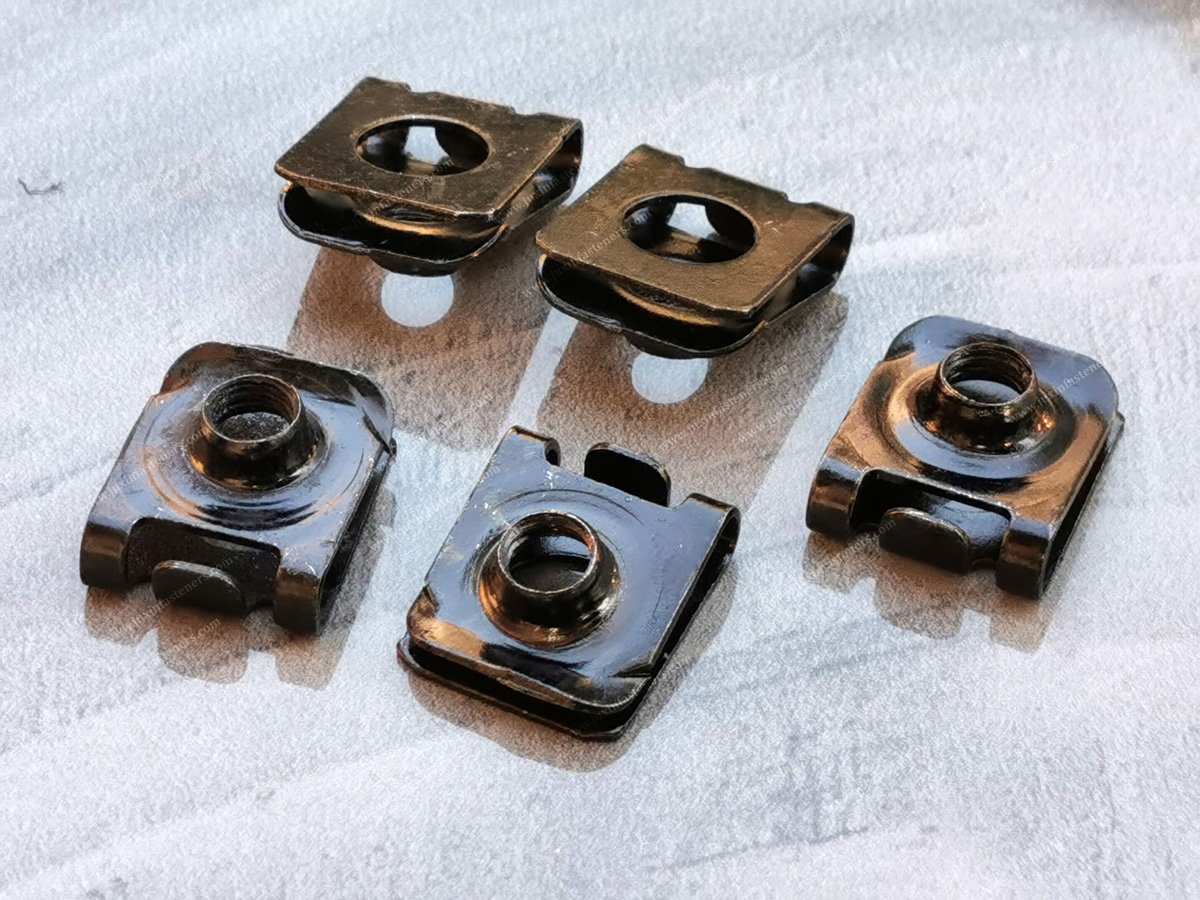
Leaf spring nuts are compact sheet metal fasteners designed to create a convenient screw attachment point without requiring a conventional loose nut behind the panel.
Depending on geometry and industry terminology, these fasteners may also be called:
clip-on nuts
U-nuts
spring nuts
spring clip nuts
U-clip nuts
panel nuts
threaded spring clips
sheet metal clip nuts
Their formed spring body clips onto a panel edge or other compatible sheet-metal feature and positions the threaded or screw-engagement feature for subsequent assembly.
This makes leaf spring nuts particularly useful where manufacturers need:
Fast Installation + Captive Fastening + Limited Rear Access + Compact Packaging + Serviceability
However, selecting a leaf spring nut by thread size alone is a common engineering mistake.
The panel, clip and mating screw form a fastening system and should be evaluated together.
A typical leaf spring nut uses a formed spring-metal body that slides or presses onto a sheet-metal panel.
The spring geometry creates retention against the panel while the threaded feature aligns with the mating hole.
Depending on the design, screw engagement may be provided by:
a formed thread
an extruded thread
a threaded barrel
a retained threaded element
another engineered screw-engagement feature
The basic fastening relationship is:
Panel → Spring Clip → Thread Position → Mating Screw → Final Joint
The clip must remain correctly positioned during handling and screw installation while allowing the mating screw to enter the thread without excessive misalignment.
Conventional nuts can be effective where both sides of an assembly remain accessible.
Sheet-metal products, however, frequently contain enclosed structures, narrow cavities, covers and panels where holding a separate nut during assembly is inconvenient.
Leaf spring nuts can provide a captive fastening point before final assembly.
Potential manufacturing advantages include:
reduced loose-part handling
faster panel assembly
simplified screw installation
reduced need for rear-side nut access
convenient servicing
suitability for repetitive production
The actual benefit depends on the assembly design and production process.
A leaf spring nut should not be selected only from:
M4 / M5 / M6 / 1/4-20 / Other Thread
Instead, start with:
Panel Thickness
↓
Panel Geometry
↓
Edge-to-Hole Distance
↓
Available Clearance
↓
Thread Requirement
↓
Fixed or Floating Position
↓
Environment
↓
Assembly Process
This engineering sequence helps prevent a common sourcing problem: finding a clip nut with the correct thread but the wrong panel interface.
Panel thickness is one of the most important dimensions when selecting a leaf spring nut.
The clip geometry must accommodate the intended sheet thickness while retaining suitable elastic behavior after installation.
Possible problems include:
insufficient clip retention
movement during handling
unstable thread position
clip loss before final assembly
Possible problems include:
excessive installation force
permanent clip deformation
incomplete seating
coating damage
incorrect thread alignment
Therefore:
Same Thread Size ≠ Same Leaf Spring Nut
Two M6 clip nuts, for example, may be intended for completely different panel conditions.
For an edge-mounted U-nut or clip-on nut, the threaded feature must align with the panel hole.
This depends on the relationship between:
panel edge
clip depth
hole center
thread center
If the clip reach is incorrect, the screw may:
miss the thread
enter at an angle
push the clip out of position
cross-thread
create difficult assembly
For OEM sourcing, edge-to-hole distance should therefore be treated as a functional dimension.
The surrounding assembly also affects fastener selection.
Engineers should evaluate:
available space behind the panel
clearance above and below the sheet
nearby bends
flanges
welds
formed features
access for installation
access for the mating screw
A clip that fits the panel thickness may still be unsuitable if surrounding geometry prevents full installation.
Not every assembly requires the threaded feature to be completely fixed.
A fixed configuration can be appropriate where:
panel holes are accurately positioned
mating components are well controlled
precise thread location is required
A controlled floating design can be useful where:
multiple sheet-metal parts must align
tolerance stack-up exists
limited positional adjustment helps screw engagement
Floating movement should be engineered around the actual tolerance requirement.
It should not be used as a substitute for uncontrolled component variation.
Consider an assembly containing:
Panel A + Bracket + Cover + Screw Hole + Clip Nut
Each component can have manufacturing variation.
If all hole positions shift in unfavorable directions, the final screw centerline may not perfectly match a rigid threaded feature.
A controlled floating clip nut can sometimes accommodate limited positional variation.
However:
Floating Range Must Match Assembly Tolerance
Too little movement may not solve alignment problems.
Too much movement may make thread positioning inconsistent.
This distinction is important for engineers and buyers.
A leaf spring nut performs several different functions:
It attaches to the panel.
It positions the thread.
It accepts the mating screw.
The assembled screw joint generates the final clamping condition.
Therefore:
Strong Clip Retention ≠ High Final Joint Strength
The clip-to-panel grip and the final screw-joint performance are related but different engineering characteristics.
Leaf spring nuts are often marketed as “anti-vibration” fasteners, but this description requires care.
The spring clip can help retain the fastener on the panel and maintain positioning.
It does not automatically make the final threaded joint vibration-proof.
Joint behavior depends on factors such as:
screw specification
thread engagement
clamp load
joint stiffness
panel geometry
vibration conditions
thermal cycling
installation process
Where resistance to loosening is critical, the complete joint should be validated for the actual service environment.
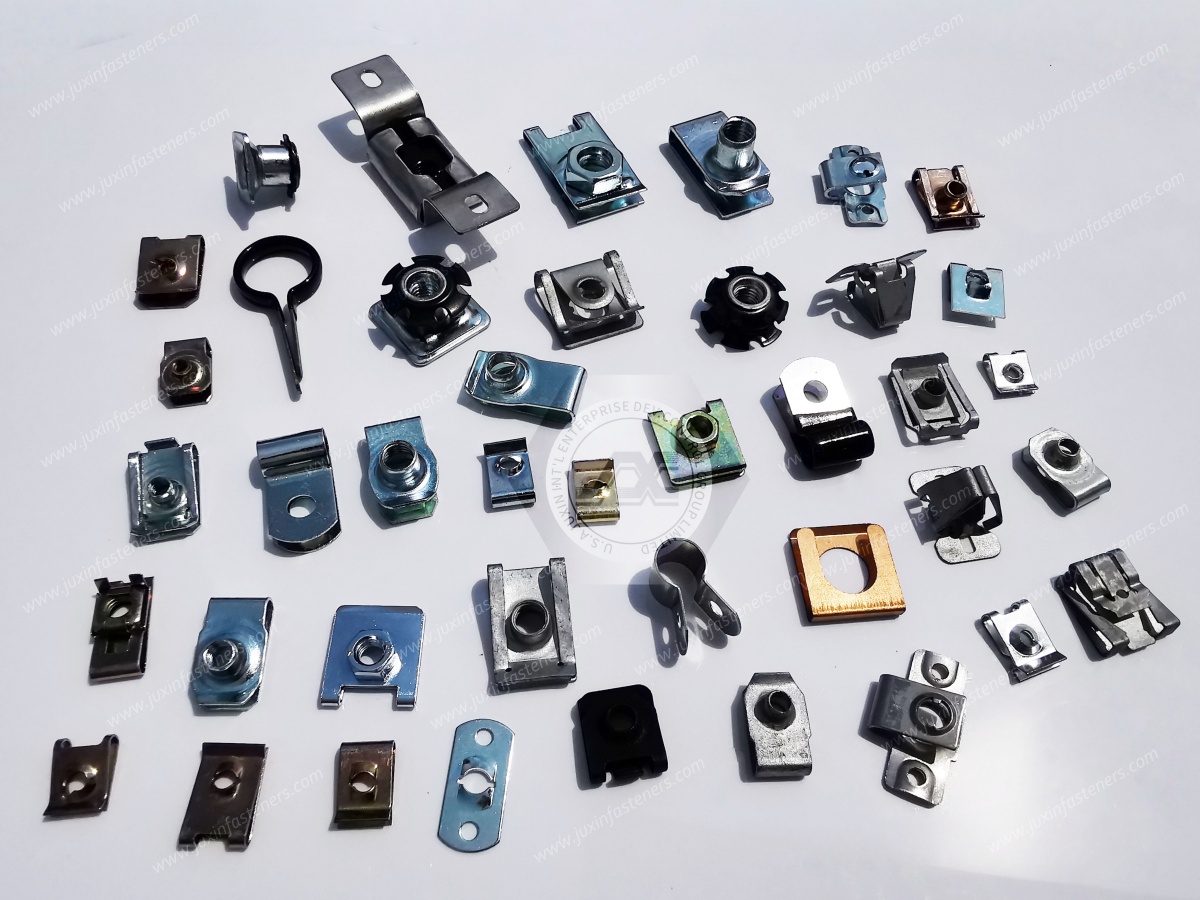
Leaf spring nuts are available in many geometries.
These clip over a panel edge and position a screw-engagement feature relative to the panel hole.
Typical uses include:
sheet-metal covers
brackets
equipment panels
automotive assemblies
A threaded barrel can provide a defined mating thread within the spring clip architecture.
The appropriate engagement depends on the product design and mating screw.
Low-profile designs can be useful where installation clearance is restricted.
Selection should still consider:
panel grip
thread engagement
screw clearance
load requirements
Low profile does not automatically mean light duty or high load capacity.
These provide controlled positional movement to accommodate specified assembly tolerances.
Where standard geometries do not match the application, clips can be developed from:
customer drawings
physical samples
mating panels
assembly requirements
Leaf spring nuts and cage nuts are sometimes grouped together because both can provide captive threads in sheet-metal assemblies.
However, their structures and installation methods differ.
Typically:
clips over a panel edge or compatible feature
uses spring retention
can be installed quickly without a separate setting process
Typically:
contains a nut retained inside a spring cage
installs into a compatible panel opening
may provide controlled nut movement depending on design
The panel architecture normally determines which solution is more appropriate.
A rivet nut creates a threaded attachment point by mechanically setting an insert into a prepared hole.
It is particularly useful where:
only one side is accessible
the threaded point is away from the panel edge
a permanently installed threaded insert is required
A leaf spring nut may be more appropriate where:
the panel edge is accessible
quick clip installation is preferred
a setting operation is undesirable
A simple early decision path is:
Panel Edge Accessible?
Yes → Evaluate Clip-On Nut / U-Nut
No → Evaluate Blind Threaded Insert Technologies Such as Rivet Nuts
Final selection still depends on load, geometry and service requirements.
Weld nuts provide permanently attached threads through a welding process.
They may be appropriate where:
welding is already integrated into manufacturing
permanent attachment is required
panel and nut materials are compatible with the process
Leaf spring nuts may be considered where:
welding should be avoided
mechanical installation is preferred
serviceability is valuable
edge mounting is possible
Neither technology is universally superior.
Self-clinching nuts are installed into prepared holes in compatible sheet material using controlled pressing force.
They create permanent captive threads.
Leaf spring nuts use spring retention instead and can offer:
edge installation
fast mechanical attachment
removal or replacement in suitable designs
Selection should consider both final performance and manufacturing process.
Leaf spring nuts require materials capable of supporting the intended forming and elastic behavior.
Depending on the application and drawing, material families may include:
carbon spring steels
alloy spring steels
stainless spring materials
other specified strip materials
Applicable international material requirements may be based on relevant EN, DIN, ASTM, SAE or customer-specific specifications.
The material should be selected according to the actual mechanical and environmental requirements.
Specifying only “spring steel” may not completely define clip performance.
The finished fastener can also be influenced by:
strip thickness
material condition
forming process
bend geometry
heat treatment where applicable
hardness where specified
residual stress
This becomes especially important when qualifying an alternative supplier.
A replacement clip can look identical while behaving differently during installation.
Stainless spring materials can be considered where corrosion resistance is important.
Potential environments include:
humid equipment
outdoor assemblies
selected chemical environments
food-service equipment
HVAC equipment
The specific stainless grade and material condition should be selected according to the application rather than assuming all stainless materials perform identically.
Carbon or alloy steel leaf spring nuts may require surface treatment.
Depending on customer requirements, possible coating systems can include appropriate:
zinc-based coatings
zinc-alloy coatings
conversion treatments
phosphate systems
topcoats
other specified protective finishes
Coating selection should consider:
corrosion environment
coating thickness
friction
appearance
mating materials
environmental compliance
assembly requirements
A finish should be specified by the required performance rather than simply by color.
Coating buildup can change functional dimensions.
On a leaf spring nut, this may affect:
clip opening
panel fit
installation force
thread engagement
floating movement
For tight-fitting applications, inspection should consider the finished coated component rather than only the uncoated stamped part.
Stamped spring clips contact the panel directly during installation.
Poor edge condition can:
scratch panel finishes
increase installation force
interfere with seating
damage protective coatings
For applications where panel corrosion protection is important, clip edge condition should be included in the design and quality review.
If a clip does not remain attached before screw installation, investigate:
incorrect panel thickness
unsuitable grip geometry
clip opening
spring deformation
installation damage
panel-edge geometry
coating buildup
This is mainly a clip-to-panel retention problem.
Increasing screw torque will not correct the root cause.
If the screw cannot enter the thread correctly, check:
edge-to-hole distance
clip reach
thread position
clip seating
panel-hole location
tolerance stack-up
floating range where applicable
Thread alignment problems should be investigated before changing the screw or assembly torque.
Potential causes include:
angular screw entry
incorrect mating thread
damaged thread
clip movement
excessive misalignment
incomplete clip seating
Repeated cross-threading on a production line can indicate an interface-design problem rather than an operator problem.
Possible causes include:
panel thicker than the intended grip range
incorrect clip geometry
coating buildup
burrs
interference with nearby panel features
incorrect part selection
Excessive force can permanently deform a spring clip and reduce its subsequent retention performance.
Leaf spring nuts are commonly used in suitable automotive sheet-metal assemblies such as:
body panels
brackets
trim-related assemblies
wheel-arch components
underbody covers
interior structures
HVAC equipment
electrical equipment brackets
service-access covers
The exact fastener should be selected according to the vehicle location, load and customer specification.
Clip nuts should not automatically be treated as structural or safety-critical fastening solutions without application-specific engineering validation.
Electrical and power equipment contains large numbers of fabricated sheet-metal assemblies.
Leaf spring nuts can provide convenient captive fastening points in suitable:
electrical enclosures
control cabinets
switchgear
power-distribution equipment
mounting brackets
access panels
Where the joint also performs grounding or electrical bonding, electrical performance should be validated separately.
Mechanical contact alone does not guarantee the required electrical performance.
Modern data center infrastructure uses sheet-metal structures across:
racks
power equipment
cooling equipment
equipment enclosures
access panels
mounting systems
Clip-on nuts can be useful where equipment manufacturers require fast assembly and serviceable screw attachment points.
Selection should consider the actual load, panel geometry and maintenance requirements.
HVAC equipment frequently contains:
fabricated housings
service panels
fan assemblies
control boxes
brackets
removable covers
Leaf spring nuts can support fast assembly and service access where panel-edge fastening is appropriate.
Industrial machinery can use clip-on nuts in suitable:
machine guards
covers
enclosures
electrical cabinets
mounting brackets
access panels
Applications exposed to vibration should be evaluated at complete joint level rather than assuming the spring clip itself prevents screw loosening.

Sheet-metal appliance structures can benefit from fast, captive fastening methods.
Potential applications include:
housings
panels
brackets
service covers
electrical compartments
Product-specific requirements such as corrosion, temperature and service access should guide material and coating selection.
A useful engineering checklist includes:
panel thickness
panel material
hole diameter
edge-to-hole distance
available clearance
thread size
mating screw
fixed or floating requirement
installation direction
expected mechanical load
vibration environment
temperature
corrosion exposure
serviceability requirement
Providing these parameters early can significantly reduce trial-and-error selection.
For an existing production part, provide:
part number
2D drawing
physical sample if available
mating screw
panel thickness
panel drawing or interface dimensions
material
surface treatment
annual quantity
inspection requirements
For a new design, provide:
panel geometry
panel thickness
thread requirement
edge-to-hole distance
installation constraints
environmental conditions
forecast volume
For a second-source project, supplying the existing clip, mating panel and screw can significantly improve technical evaluation.
For new or alternative-source leaf spring nuts, a useful evaluation sequence is:
Drawing Review
↓
Sample Preparation
↓
Dimensional Verification
↓
Material / Finish Verification as Required
↓
Panel Fit Evaluation
↓
Mating Screw Assembly
↓
Customer Validation
↓
Production Approval
The actual validation plan should follow the customer's requirements and application risk.
A practical leaf spring nut selection process is:
Need a Captive Threaded Fastening Point?
↓
Is the Panel Edge Accessible?
↓
Yes → Evaluate Leaf Spring Nut / U-Nut
↓
Define Panel Thickness
↓
Define Edge-to-Hole Distance
↓
Define Thread and Mating Screw
↓
Fixed or Floating?
↓
Check Available Clearance
↓
Define Material and Finish
↓
Evaluate Load and Environment
↓
Test With Production-Representative Panel
↓
Approve for Production
If edge installation is not practical, another fastening technology should be evaluated.
Related JUXIN FASTENERS engineering resources include:
Clip-On Nuts for Sheet Metal
Spring Clip Nut Engineering Guide
Automotive Clip Nuts & U-Nuts
Custom Spring Steel Clips
Cage Nuts
Blind Rivet Nuts
Weld Nuts
Self-Clinching Fasteners
Custom Stamped Fasteners
These technologies solve different panel-fastening problems and should not be treated as interchangeable without engineering review.
JUXIN FASTENERS supports standard and custom fastening components for global OEM and industrial applications.
Relevant supply capabilities include:
leaf spring nuts
clip-on nuts
U-nuts
spring clip nuts
floating clip nuts
panel nuts
custom spring clips
custom stamped fasteners
cage nuts
weld nuts
rivet nuts
self-clinching fasteners
drawing-controlled custom components
For an existing product, send:
Drawing / Sample → Panel → Mating Screw → Material → Finish → Annual Volume
For a new application, send:
Panel Thickness → Hole Position → Thread → Clearance → Environment → Volume
For second-source development, send:
Existing Fastener → Panel / Panel Drawing → Mating Screw → Current Specification → Annual Demand
JUXIN FASTENERS can support drawing review, sample matching, custom development and volume sourcing for OEM and industrial fastening programs.
Email: info@juxinfasteners.com
Website: www.juxinfasteners.com
Previous: Clip-On Nuts Guide
Next: Spring Clip Nuts
 MORE NEWS
Sep. 27, 2026
Sep. 27, 2026
Sep. 27, 2026
Contact Us
Tel.:
+86 020 8621 0320
+86 020 3121 6067
E-mail:
Technical Support:
Navigation
SEND INQUIREY