
Call Us
+86 136 6007 9809
Call Us
+86 136 6007 9809

Jul. 17, 2024
Metric 18-8 Stainless Steel Hex Socket Flat Head Screws: Countersink Design and OEM Selection
Metric 18-8 stainless steel hex socket flat head screws are widely considered for industrial assemblies requiring a flush surface,
corrosion resistance and installation access through an internal hexagonal drive.
These fasteners are also known as metric stainless steel countersunk socket screws, hex socket countersunk head screws or Allen drive flat head screws.
Typical applications include equipment panels, machinery covers, electrical enclosures, precision fixtures and selected nonstructural OEM components.
The countersunk head allows the screw to sit flush with the surrounding surface when the head geometry and mating countersink are correctly matched.
However, successful installation depends on more than selecting the nominal thread diameter.
The countersink angle, head dimensions, panel thickness, thread engagement, material strength and tightening process must be evaluated as one fastening system.
For mechanical and design engineers, the primary challenge is achieving the required flush fit without weakening the clamped component.
For manufacturing engineers and production managers, the priorities are repeatable countersink machining, reliable hex-drive engagement, controlled tightening and reduced assembly rework.
For purchasing managers, procurement development teams and OEM buyers, the objective is to source screws that match the approved drawings, material requirements and production specifications.
This guide explains the engineering and sourcing considerations for metric 18-8 stainless steel hex socket flat head screws.
Juxin Fasteners supplies industrial stainless steel screws and welcomes drawing-based inquiries for standard and custom metric countersunk fasteners.
What Are Metric 18-8 Stainless Steel Hex Socket Flat Head Screws?
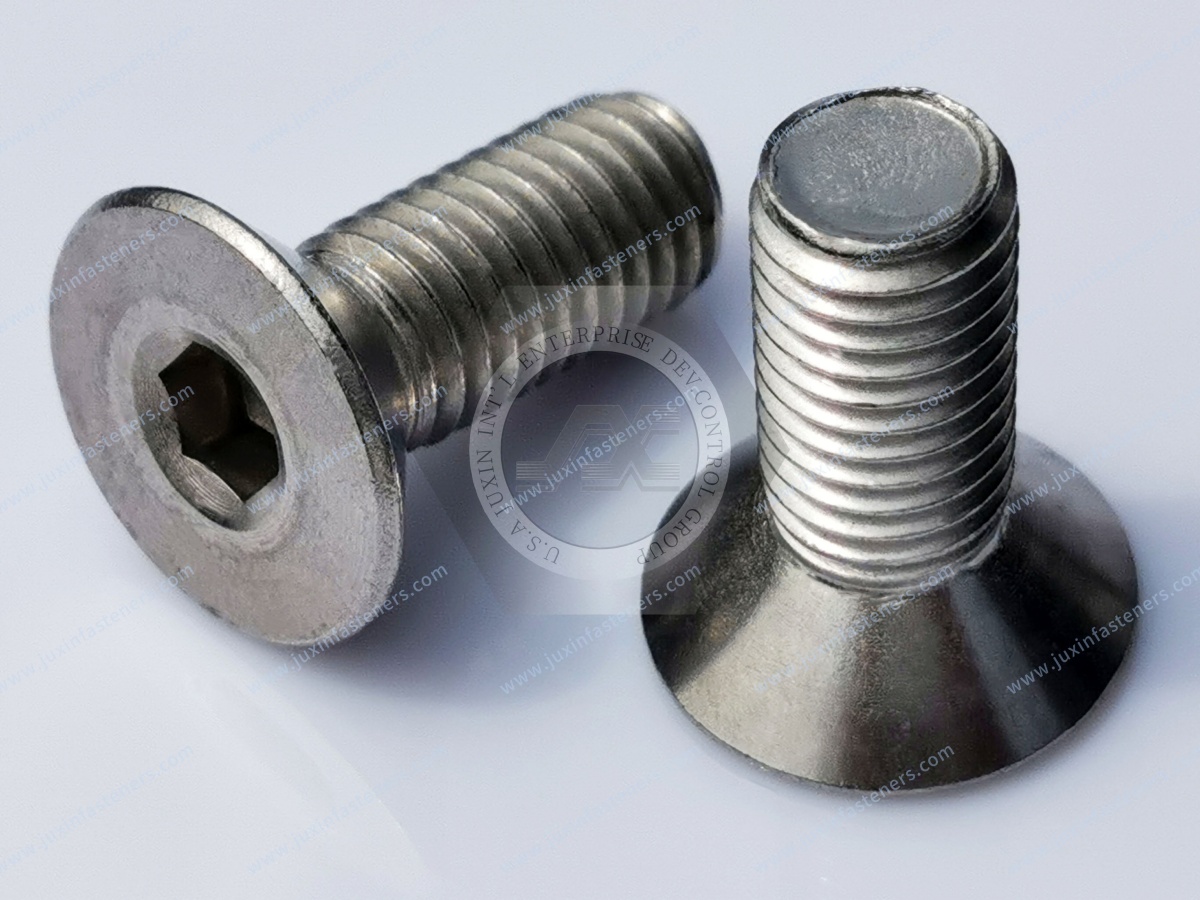
A metric hex socket flat head screw is a threaded fastener with an internal hexagonal drive and a countersunk head.
The screw is designed to seat in a compatible countersink so that its top surface can be flush with, or appropriately positioned relative to, the surrounding component.
Main Features
Metric external thread
Internal hexagonal socket drive
Countersunk flat head
Stainless steel material
Defined head and thread dimensions
Flush-mount capability when correctly installed
Common Commercial Names
Metric hex socket flat head screw
Metric socket countersunk head screw
Stainless steel Allen flat head screw
18-8 stainless steel countersunk screw
A2 stainless steel socket countersunk screw
Important Terminology Note
In North American fastener terminology, flat head screw commonly refers to a countersunk screw.
It should not be confused with a screw having a flat bearing surface beneath a cylindrical or pan-shaped head.
90° vs. 100° Countersunk Flat Head Screws
One of the most important technical distinctions concerns the head angle.
90° Metric Countersunk Screws
Common metric hex socket countersunk head screws specified to ISO 10642 use a 90-degree countersunk head configuration.
100° Countersunk Screws
A 100-degree head configuration is a different design and must be specified separately.
It should not automatically be treated as interchangeable with a 90-degree metric screw.
Why the Angle Matters
A mismatch between the screw head angle and mating countersink can cause:
Uneven bearing contact
Incorrect head seating
Protrusion above the surface
Localized stress
Inconsistent tightening behavior
Surface damage
Engineering Recommendation
Always identify the required countersunk head angle on the drawing or through the applicable product standard.
Critical Rule
Do not assume that all metric flat head socket screws have a 100-degree countersunk head.
ISO 10642 and DIN 7991: What OEM Buyers Should Know
ISO 10642 is a relevant international dimensional standard for hexagon socket countersunk head screws.
DIN 7991 is a widely recognized legacy designation associated with hexagon socket countersunk head screws.
Important Procurement Distinction
Commercial suppliers may reference DIN 7991 and ISO 10642 together.
However, buyers should not assume that every legacy DIN-designated product and every ISO-designated product are dimensionally identical.
The applicable standard edition, dimensions and mechanical requirements should be verified.
Engineering Recommendation
For drawing-based procurement, specify the approved standard and revision or provide a complete dimensional drawing.
18-8 Stainless Steel Material: What Does It Mean?
18-8 is a broad commercial designation commonly associated with chromium-nickel austenitic stainless steels.
It is frequently used in the market for fasteners made from materials related to 304 stainless steel.
However, 18-8 is not a complete substitute for a specific material specification.
Material Selection Considerations
Required chemical composition
Mechanical-property class
Corrosion environment
Surface condition
Manufacturing process
Customer specification
304 Stainless Steel
304 may be suitable for general industrial applications where its corrosion resistance and mechanical properties satisfy the design requirements.
A2 Stainless Steel
A2 is a stainless steel material group used in relevant ISO fastener specifications.
The required mechanical-property class should be identified separately.
316 Stainless Steel
316 may be considered for selected environments requiring improved resistance to certain localized corrosion mechanisms compared with 304.
Important Limitation
304, 316, 18-8, A2 and A4 are not universally interchangeable material specifications.
A proposed substitution must satisfy the approved chemical, mechanical and application requirements.
Why Use a Hex Socket Drive?
The internal hexagonal drive allows torque to be applied through a mating hex key or driver bit.
Potential Advantages
Compact drive access
Compatibility with appropriate hand tools
Compatibility with selected powered assembly tools
Recessed drive geometry
Flush exterior head design
Important Limitation
A hex socket drive does not automatically provide greater torque capacity than every other drive system.
Actual drive performance depends on:
Socket size
Socket depth
Head geometry
Tool fit
Material strength
Manufacturing quality
Installation conditions
Engineering Insight
Countersunk flat head screws often have less available head volume than certain cylindrical-head screws.
The reduced head geometry may influence drive strength and allowable tightening conditions.
Countersink Design for Metric Flat Head Screws
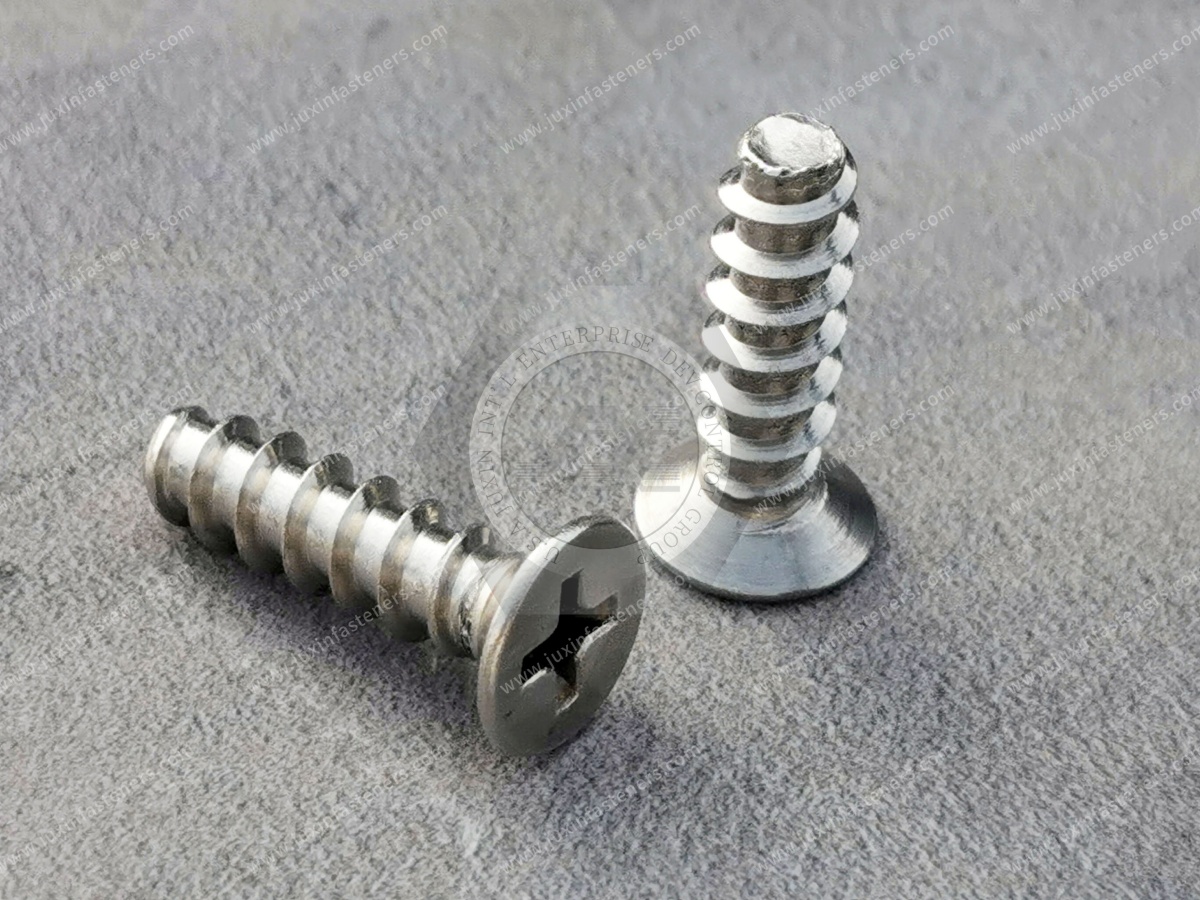
A countersunk screw requires a properly designed mating feature.
Important Dimensions
Countersink angle
Countersink major diameter
Countersink depth
Clearance-hole diameter
Screw head diameter
Head height
Surface position after installation
Why Countersink Depth Matters
An insufficiently deep countersink may leave the screw head protruding.
An excessively deep countersink may reduce the remaining material thickness and alter the bearing conditions.
Why Countersink Diameter Matters
An incorrectly sized countersink may produce poor seating or an undesirable contact pattern.
Engineering Recommendation
Define the mating countersink using the actual screw standard or approved drawing.
Do not rely on nominal thread diameter alone.
Flush Mounting Is a System-Level Requirement
A screw may be manufactured correctly yet fail to sit flush because the mating component is incorrectly machined.
Potential Causes of Protruding Screw Heads
Incorrect countersink angle
Insufficient countersink depth
Incorrect head dimensions
Burrs
Coating buildup
Surface distortion
Poor installation alignment
Practical Inspection Recommendation
Evaluate the assembled screw-head position relative to the functional surface.
A screw's dimensional compliance alone does not guarantee a flush finished assembly.
Thin-Sheet and Thin-Panel Design Limitations
Thin panels require special attention when using countersunk screws.
Creating a countersink removes material from the component.
Potential Risks
Reduced remaining thickness
Localized deformation
Insufficient bearing support
Distortion during tightening
Enlarged or damaged countersink
Reduced joint durability
Engineering Recommendation
For thin sheet metal or lightweight panels, evaluate whether the material can support the countersunk head at the required tightening condition.
Possible Design Alternatives
Depending on the application:
A different screw head style
A formed countersink
A reinforced mounting area
A suitable threaded insert
A different fastening architecture
Important Limitation
A countersunk flat head screw should not automatically be selected simply because the assembly requires a smooth surface.
The available material thickness and bearing conditions must support the design.
Countersunk Screws in Aluminum Components
Aluminum panels and housings are common in industrial equipment.
When using stainless steel countersunk screws with aluminum, evaluate both mechanical and corrosion compatibility.
Mechanical Considerations
Aluminum bearing strength
Countersink geometry
Surface deformation
Thread engagement
Installation torque
Corrosion Considerations
Stainless steel and aluminum may experience galvanic corrosion under suitable electrolyte exposure.
Potential Design Measures
Depending on the application:
Suitable coatings
Electrical isolation where permitted
Sealing
Moisture management
Compatible joint materials
Important Limitation
A corrosion-resistant stainless steel screw does not automatically protect the surrounding aluminum component.
Thread Engagement and Mating Component Design
Metric hex socket flat head screws may engage:
A tapped metal component
A threaded insert
A compatible nut
Another approved threaded feature
Engineering Considerations
Thread designation
Engagement length
Mating material
Thread tolerance
Applied load
Installation method
Important Distinction
A screw suitable for a steel tapped hole may require different engagement conditions in aluminum or another softer material.
Engineering Recommendation
Evaluate the complete threaded joint rather than selecting screw length solely from the visible component thickness.
Metric Coarse and Fine Threads
Metric socket countersunk screws may be specified with different thread pitches where supported by the relevant product specification or approved drawing.
Metric Coarse Threads
Commonly used in many general-purpose industrial applications.
Metric Fine Threads
May be specified for particular design requirements.
Important Compatibility Rule
Metric coarse and fine threads are not interchangeable simply because they share the same nominal diameter.
Likewise, metric threads are not directly interchangeable with UNC, UNF, BSW or BSF threads.
Approximate inch conversions are dimensional references only.
Head Strength and Mechanical Property Considerations
The countersunk head geometry can affect the fastener's mechanical behavior.
Potential Design Concerns
Head-to-shank transition
Reduced head section
Drive recess geometry
Bearing stresses
Tensile loading
Installation torque
Important Engineering Distinction
The mechanical-property requirements for a particular countersunk screw must be confirmed from the applicable specification.
Do not assume that a countersunk screw has the same head-load capability as a different screw-head style made from the same material.
Stainless Steel Does Not Automatically Mean High Strength
Austenitic stainless steel fasteners may offer useful corrosion resistance and mechanical properties.
However, their strength depends on the specific material, manufacturing condition and applicable property class.
Engineering Recommendation
For highly loaded or safety-related joints, verify the actual fastener specification and required qualification.

Installation Torque and Stainless Steel Galling
Stainless steel threaded fasteners may experience galling under certain installation conditions.
Galling involves adhesive surface damage during relative sliding and may lead to thread seizure.
Potential Contributing Factors
Material pairing
Thread surface condition
High contact pressure
Installation speed
Misalignment
Inappropriate lubrication
Installation Torque Considerations
Applied torque is influenced by:
Thread friction
Bearing-surface friction
Surface finish
Lubrication
Screw geometry
Mating material
Important Limitation
There is no universally correct tightening torque for every metric 18-8 countersunk screw.
Engineering Recommendation
Establish tightening requirements using the actual screw, mating component, surface condition and joint design.
Hex Socket Stripping and Drive Damage
An internal hexagonal socket may be damaged during installation or removal.
Potential Causes
Incorrect tool size
Worn driver bit
Incomplete tool engagement
Excessive torque
Misalignment
Damaged socket geometry
Production Manager's Perspective
Repeated socket damage can increase:
Assembly rework
Scrap
Tool replacement
Cycle time
Production interruptions
Practical Manufacturing Recommendation
Use the correct driver size and establish appropriate tool-engagement and tightening controls.
Surface Finishing and Passivation
Stainless steel screws may be supplied with different surface conditions depending on the approved specification.
Passivation
Passivation is a chemical treatment intended to remove certain surface contaminants and support the corrosion-resistant passive condition of stainless steel.
Important Distinction
Passivation does not create a thick protective coating comparable to conventional electroplating.
Black Surface Treatments
Black finishes may be considered for appearance or application-specific requirements.
However, black oxide or other dark surface treatments should not be assumed to provide the same corrosion performance as untreated or passivated stainless steel.
Engineering Recommendation
Specify surface treatment, appearance and corrosion requirements separately.
Industrial Machinery and Automation Applications
Metric stainless steel hex socket flat head screws may be considered for selected machinery assemblies.
Potential Applications
Equipment covers
Machine guards
Automation panels
Fixture plates
Instrument brackets
Service-access components
Engineering Priorities
Flush surface requirements
Mechanical loading
Countersink geometry
Tool access
Maintenance
Production Priorities
Repeatable countersink machining
Correct screw identification
Consistent tightening
Reduced socket damage
Efficient assembly
Important Limitation
Safety-related machine guards and critical mechanical connections require application-specific design and approval.
Electrical Enclosures and Control Equipment
Potential applications include:
Control cabinet panels
Instrument housings
Telecommunications equipment
Electrical equipment covers
Nonstructural mounting components
Engineering Priorities
Flush head clearance
Corrosion exposure
Electrical safety
Panel thickness
Service access
Important Electrical Limitation
Stainless steel is electrically conductive.
The fastening arrangement must not compromise electrical isolation, grounding or required clearances.
Automotive and EV Auxiliary Equipment
Selected vehicle components may use metric countersunk screws where approved.
Potential Applications
Nonstructural interior panels
Auxiliary equipment housings
Selected electronic module covers
Service-access components
Engineering Priorities
Vibration
Corrosion exposure
Assembly consistency
Customer-specific requirements
Important Safety Limitation
Structural battery retention, high-voltage electrical connections, braking, steering and suspension systems require separately qualified fastening designs.
A general-purpose 18-8 stainless steel countersunk screw should not be substituted without approval.
Medical and Laboratory Equipment Housings
Selected equipment housings may use stainless steel countersunk screws for cleanable and flush exterior surfaces.
Potential Applications
Instrument covers
Laboratory equipment panels
Non-patient-contact housings
Service-access components
Engineering Priorities
Cleaning compatibility
Surface finish
Corrosion resistance
Maintenance access
Important Limitation
A stainless steel grade alone does not establish medical-device, sterilization or hygienic-design compliance.
Architectural and Outdoor Equipment
Potential applications include:
Architectural accessories
Outdoor equipment panels
Instrument housings
Nonstructural mounting components
Engineering Priorities
Corrosion environment
Countersink geometry
Mating material
Mechanical loading
Long-term service
Important Structural Limitation
Curtain wall retention, primary building connections and other safety-critical structural applications require appropriate engineering qualification.
OEM Design for Manufacturing and Assembly
A countersunk screw design should be evaluated for production feasibility.
Countersink Manufacturing
The machining or forming process must produce the required angle, diameter and depth.
Burr Control
Burrs may interfere with proper screw-head seating.
Tool Access
The assembly must provide sufficient clearance for the intended hex driver.
Screw Feeding
Automated or semi-automated assembly may require evaluation of screw handling and presentation.
Torque Control
The tightening process should be validated for the actual joint.
Inspection
Critical dimensions and flushness requirements should be measurable.
Production Manager's Perspective
A design that requires repeated manual adjustment to achieve flush seating may increase labor cost and assembly variation.
Practical Engineering Recommendation
Validate the screw, countersink and installation process together before releasing the assembly for recurring production.
Custom Metric Stainless Steel Flat Head Screws
Some OEM designs require dimensions or configurations that differ from standard catalog screws.
Potential customization requirements include:
Special screw length
Nonstandard head diameter
Custom head height
Specific countersunk angle
Special socket dimensions
Nonstandard thread pitch
Defined stainless steel material
Surface treatment
Critical dimensional tolerances
Engineering Review
Custom projects should consider:
Functional requirements
Mating countersink
Thread engagement
Mechanical properties
Manufacturing feasibility
Inspection requirements
Commercial Review
Sample quantities, MOQ, tooling requirements and delivery schedules should be confirmed during quotation.
Important Limitation
Custom manufacturing does not automatically establish compliance with a specific industry or safety-critical application.
Quality Inspection for Metric Countersunk Screws
OEM inspection requirements should reflect the approved drawing and product specification.
Potential Inspection Characteristics
Thread dimensions
Screw length
Head diameter
Head height
Countersunk angle
Hex socket geometry
Material requirements
Surface condition
Appearance
Functional Evaluation
Where required, representative assembly testing may evaluate:
Screw seating
Driver engagement
Installation behavior
Thread compatibility
Finished head position
Important Distinction
Inspection requirements should be defined for the project rather than assuming that every screw requires the same tests.
Supplier Qualification for OEM Stainless Steel Flat Head Screws
Procurement and supplier development teams should evaluate the actual product specification and production requirements.
Product Definition
Confirm the approved standard or drawing.
Material
Specify the required stainless steel grade and mechanical properties.
Head Geometry
Verify the countersunk angle and dimensional requirements.
Thread Compatibility
Confirm the thread system, diameter, pitch and tolerance.
Surface Requirements
Define the approved finish and appearance.
Inspection
Identify critical dimensions and functional requirements.
Change Control
Changes to head geometry, material, coating or manufacturing process should be reviewed against customer approval requirements.
Commercial Evaluation
Review:
Sample quantity
MOQ
Production volume
Packaging
Delivery schedule
Supply continuity
Total assembly cost
Supplier Development Insight
A replacement screw may have the same nominal thread size and length but still fail to fit the existing countersink.
Head geometry must therefore be included in supplier substitution reviews.
Preparing a Metric 18-8 Hex Socket Flat Head Screw RFQ
A complete RFQ should identify the actual engineering and commercial requirements.
Product Specification
Approved drawing or standard
Nominal thread diameter
Thread pitch
Screw length
Head diameter
Head height
Countersunk angle
Hex socket dimensions
Material and Surface
Stainless steel grade
Mechanical-property requirements
Surface treatment
Appearance requirements
Joint Information
Mating component material
Countersink geometry
Panel thickness
Thread engagement
Mechanical loading
Installation method
Quality Requirements
Dimensional inspection
Material documentation
Functional acceptance criteria
Sample approval requirements
Commercial Requirements
Sample quantity
Annual demand
Production quantity
Packaging
Target delivery schedule
Practical Procurement Recommendation
For replacement projects, provide the existing screw drawing and the mating countersink dimensions.
This helps identify head-angle and seating differences before approving an alternative supplier.
Frequently Asked Questions
What is a metric 18-8 stainless steel hex socket flat head screw?
It is a metric-threaded stainless steel countersunk screw with an internal hexagonal drive, commonly specified for flush-mount assemblies.
Are metric countersunk screws 90° or 100°?
Common ISO 10642 metric hex socket countersunk screws use a 90-degree head. A 100-degree configuration requires separate specification.
Are DIN 7991 and ISO 10642 screws identical?
Not automatically. The applicable standard editions and product dimensions should be verified.
Is 18-8 stainless steel the same as 304?
18-8 is a broad commercial designation commonly associated with 304-type stainless steel, but exact material compliance must be confirmed.
Are stainless steel flat head screws suitable for thin sheet metal?
Only where the sheet thickness, countersink geometry and bearing requirements support the design.
Can stainless steel countersunk screws be used in aluminum?
Potentially, but mechanical bearing conditions and galvanic corrosion must be evaluated.
Can 18-8 stainless steel screws replace high-strength alloy steel screws?
Not automatically. Mechanical properties, joint loading and approved design requirements must be reviewed.
Can metric screws replace UNC or UNF screws?
No. These thread systems are not directly interchangeable.
What should OEM buyers provide for a custom countersunk screw quotation?
The approved drawing, head angle, thread specification, material, surface treatment, mating component requirements, inspection criteria and purchasing quantities.
Juxin Fasteners: Metric Stainless Steel Hex Socket Flat Head Screws
Juxin Fasteners supplies industrial stainless steel fastening components and welcomes drawing-based inquiries for metric hex socket flat head screws.
Relevant product categories include:
Metric 18-8 stainless steel hex socket flat head screws
Metric 304 stainless steel countersunk screws
Metric 316 stainless steel countersunk screws
Stainless steel machine screws
Stainless steel socket screws
Custom stainless steel threaded components
Specific dimensions, materials, mechanical properties, finishes, samples, MOQ, inspection requirements and delivery schedules are subject to technical and commercial confirmation.
Request a Metric Stainless Steel Countersunk Screw RFQ
Are you sourcing metric 18-8 stainless steel hex socket flat head screws for machinery panels, electrical enclosures, precision equipment or custom OEM assemblies?
Do you need to qualify a replacement supplier, evaluate a 90-degree versus 100-degree countersunk configuration or develop a drawing-based stainless steel screw?
Juxin Fasteners welcomes inquiries from mechanical engineers, structural engineers, design engineers, manufacturing engineers, production managers,
purchasing specialists, procurement managers, supplier development teams and supply chain managers.
For technical review and quotation, please provide:
Approved screw drawing or standard + metric thread designation + screw length + head diameter + head height + countersunk angle
+ hex socket dimensions + stainless steel grade + mechanical-property requirements + surface finish + mating countersink geometry
+ panel thickness + thread engagement + installation requirements + inspection criteria + sample quantity + annual demand
+ production quantity + packaging requirements + target delivery schedule.
For replacement projects, include the existing approved screw specification and any proposed changes.
Company: Juxin Fasteners
Website: https://www.juxinfasteners.com/
Email: info@juxinfasteners.com
Send your metric stainless steel hex socket flat head screw drawings and OEM RFQ to Juxin Fasteners for technical review and quotation.
Contact Us
Tel.:
+86 020 8621 0320
+86 020 3121 6067
E-mail:
Technical Support:
Navigation
SEND INQUIREY



